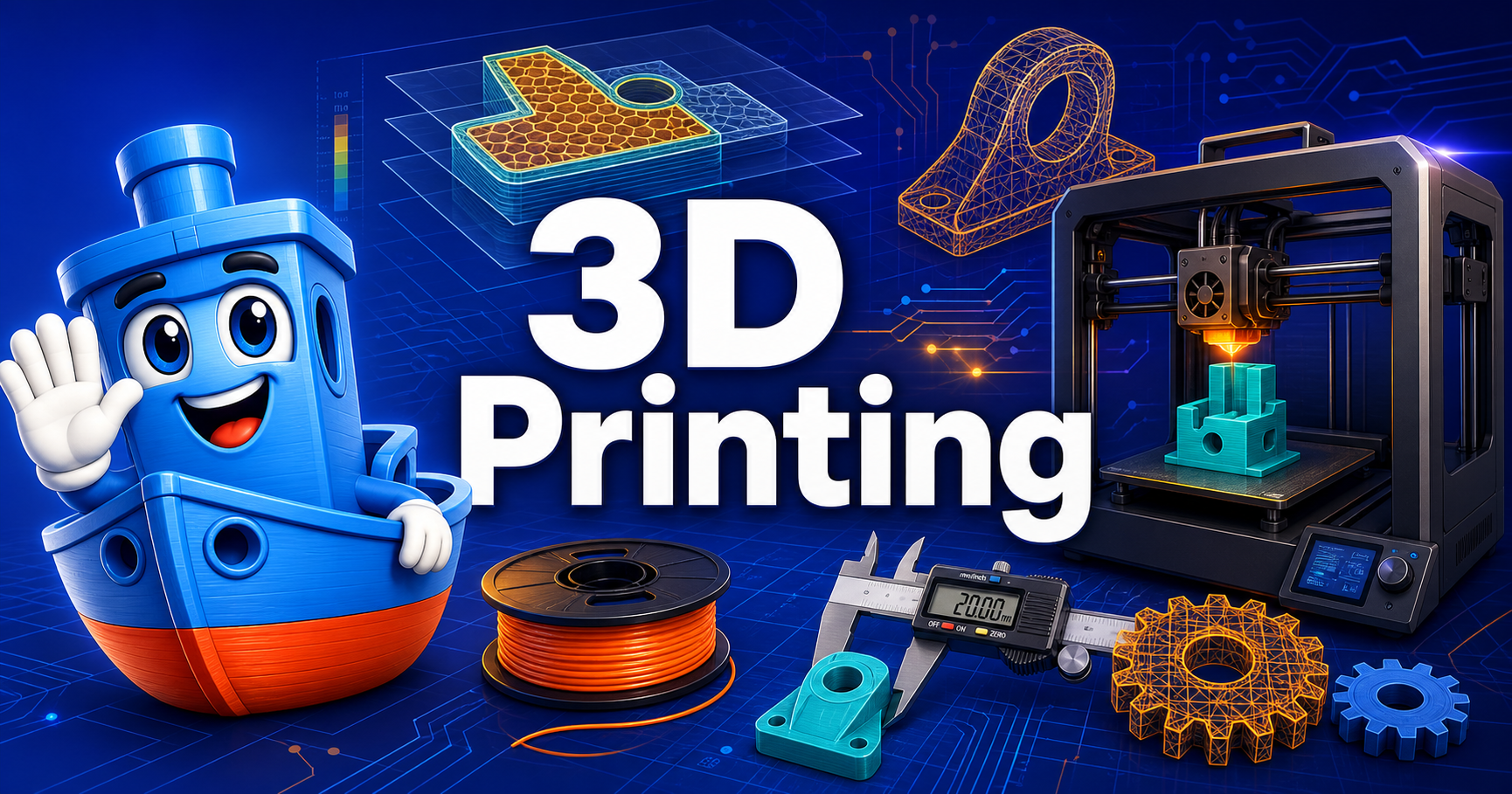
Introduction to 3D Printing
Welcome to Introduction to 3D Printing, an interactive intelligent textbook for high-school students in grades 9–12. Whether you're in a CTE pathway, a STEM elective, or a pre-engineering program, this book gives you the skills, vocabulary, and hands-on practice to design, print, and evaluate 3D-printed parts — and to earn college credit for doing it.
What You'll Learn
This course covers everything from the history of additive manufacturing to the design principles that professionals use every day:
- Seven ISO/ASTM 52900 process families — from material extrusion (FDM) to powder bed fusion and beyond
- Parametric CAD — create functional 3D models in Onshape, Fusion 360, or FreeCAD
- Slicing and print settings — dial in layer height, infill, supports, and temperature
- FDM and resin printer operation — bed leveling, calibration, washing, curing, and safety
- Materials science — PLA, PETG, ABS, TPU, nylon, and photopolymer resins compared side by side
- Design for Additive Manufacturing (DfAM) — minimize supports, maximize strength, and control tolerances
- Troubleshooting — diagnose warping, stringing, layer separation, and other common failures
- Careers and articulation — connect this course to community-college credit and industry certifications
Who This Book Is For
This textbook is designed for high-school students in grades 9–12 enrolled in CTE, engineering, or STEM pathways. No prior CAD or manufacturing experience is required — just Algebra I and basic computer skills. The material aligns with PLTW engineering pedagogy, ASTM/ISO 52900 additive manufacturing standards, and America Makes workforce competencies, making it eligible for dual credit or articulation at many community colleges.
How to Use This Book
Use the navigation sidebar on the left to move through the book. Each chapter includes:
- Explanatory prose written for grade-10–12 readers
- Interactive MicroSims for exploring slicer settings, material properties, and more
- Diagrams and infographics with hoverable details
- Quizzes to check your understanding before moving on
- References to primary sources and further reading
Key sections:
- Chapters — the main educational content, 16 chapters in sequence
- MicroSims — hands-on interactive simulations for every major concept
- Learning Graph — see how concepts connect and depend on each other
- Glossary — definitions for every technical term, in plain language
- FAQ — answers to the questions students ask most often
Getting Started
Begin with Chapter 1: Foundations and History of Additive Manufacturing to build the context you'll need for everything that follows. Your guide throughout the book is Benchy — an anthropomorphic 3DBenchy tugboat who has been printed badly more times than he'd like to admit, and learned something from every one of them.
Let's make something great.