Cybersecurity
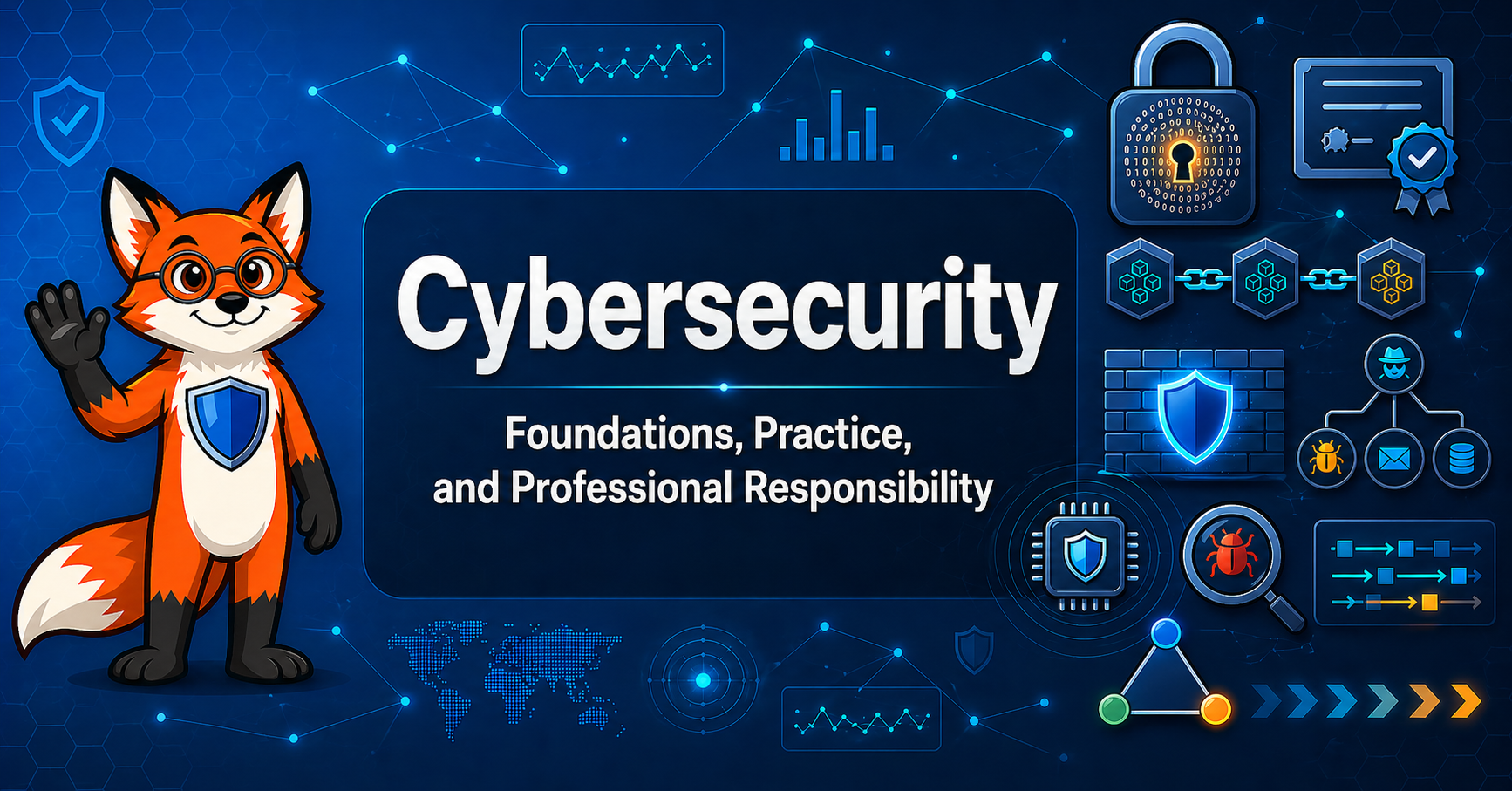
Welcome. This is an interactive intelligent textbook for undergraduate students of cybersecurity, computer science, and information systems — and for the instructors, curriculum designers, and working practitioners who support them. It is aligned to the ABET Computing Accreditation Commission Cybersecurity Program Criteria and the eight knowledge areas of the CSEC2017 Joint Task Force curriculum.
The book's central habit is simple enough for a student to remember and important enough to last a career: Trust, but verify. Every protocol, every control, and every assumption deserves the question, "How would an adversary abuse this, and what is the blast radius if they do?"
What You'll Find Here
- 16 chapters of structured reading covering security foundations, cryptography, software and component security, network and system defense, human and organizational security, societal context, operations, and emerging topics
- Interactive MicroSims — browser-based simulations that let students manipulate cryptographic operations, explore protocols, and discover principles through experimentation rather than memorization
- A friendly red-fox mascot named Sentinel who models adversarial-but-principled thinking at chapter openings, key insights, common footguns, and difficulty spikes
- A complete learning graph of 390 concepts across 12 taxonomy categories, an ISO 11179-compliant glossary, and annotated references throughout
Who This Book Is For
- Students (undergraduate, primarily sophomores–seniors). Read the chapters in concise, engineering-grounded language with worked examples and interactive simulations.
- Instructors. Use the textbook as a primary or supplementary text in an ABET-accredited cybersecurity, CS, or IS program, with the learning graph as a tool for prerequisite mapping and curriculum review.
- Practitioners and continuing-education students. Use the chapters as a structured refresher across the eight CSEC2017 knowledge areas — cryptography, software, component, connection, system, human, organizational, and societal security.
Get Started
- About This Book — purpose, audience, design, and the team behind it
- Course Description — formal overview, ABET alignment, and learning outcomes
- Chapter 1: Security Foundations — start reading
- Learning Graph — explore the 390 concepts and how they connect
Standards Alignment
This curriculum is anchored in the ABET Computing Accreditation Commission Cybersecurity Program Criteria and the CSEC2017 Joint Task Force curriculum, covering all eight knowledge areas: Data, Software, Component, Connection, System, Human, Organizational, and Societal Security. Learning outcomes are organized using the revised 2001 Bloom's Taxonomy and contribute directly to all six ABET Student Outcomes for computing programs, including the cybersecurity-specific outcome on applying security principles under adversarial conditions.
License
This work is released under the Creative Commons Attribution-NonCommercial-ShareAlike 4.0 International License (CC BY-NC-SA 4.0). You are free to share and adapt the material for non-commercial purposes as long as you give appropriate credit and share your adaptations under the same license.