Signal Processing MicroSims
Interactive Micro Simulations to help students learn signal processing fundamentals. Every MicroSim runs in your browser, uses p5.js 2.x, and has a lesson plan with activities and assessment questions.
Signal Processing MicroSims
-
2-D Convolution and Image Filtering
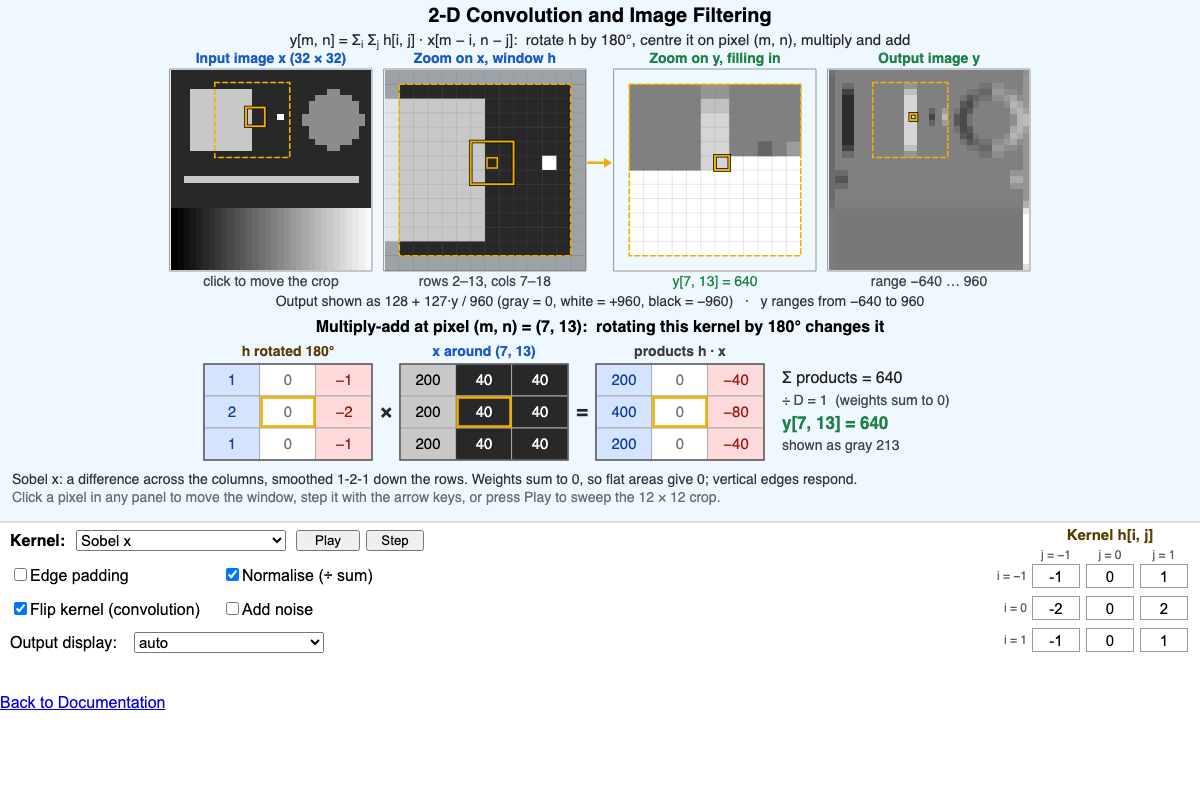
Slide a 3×3 or 5×5 kernel over a small grayscale image and see every multiply-add: blur, sharpen, Sobel and Laplacian kernels, padding, flipping and noise.
-
A Convolutional Layer Is a Learned FIR Filter
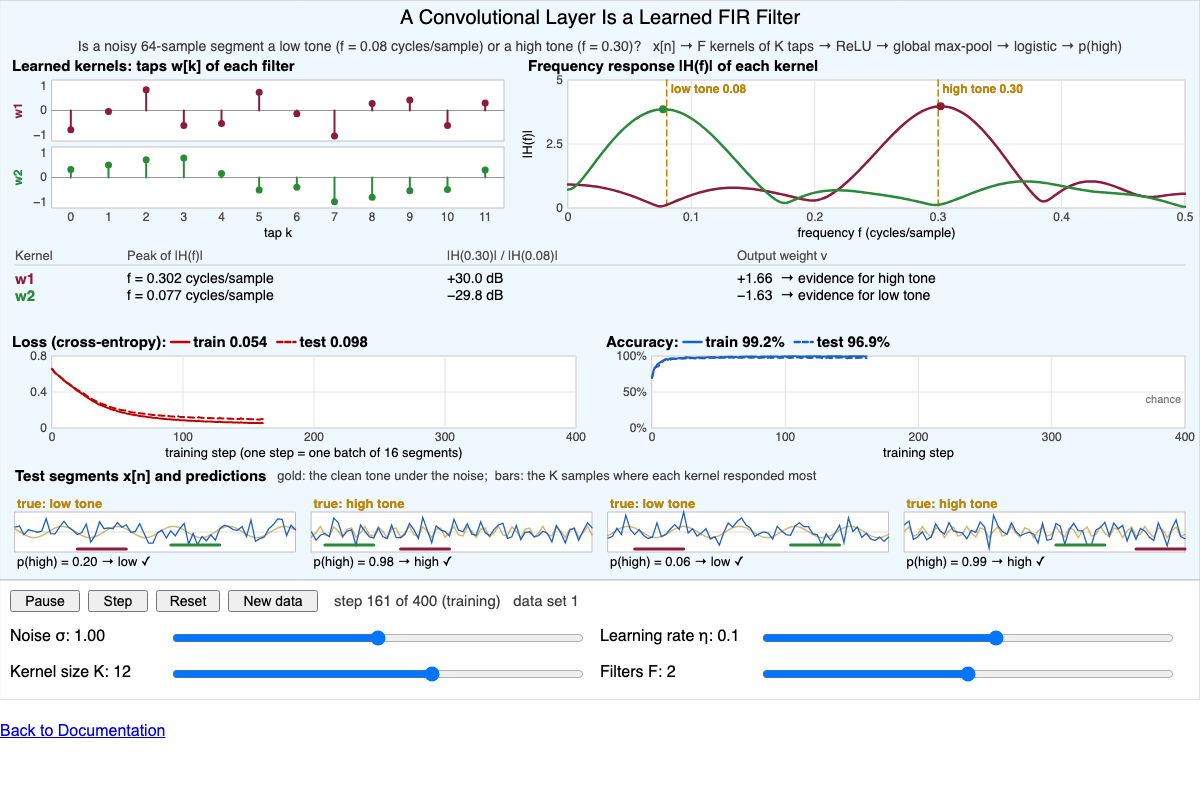
Train a tiny 1-D convolutional network in the browser and watch its kernels become band-pass FIR filters tuned to the tones it must tell apart.
-
Adaptive Algorithm Comparison Tool
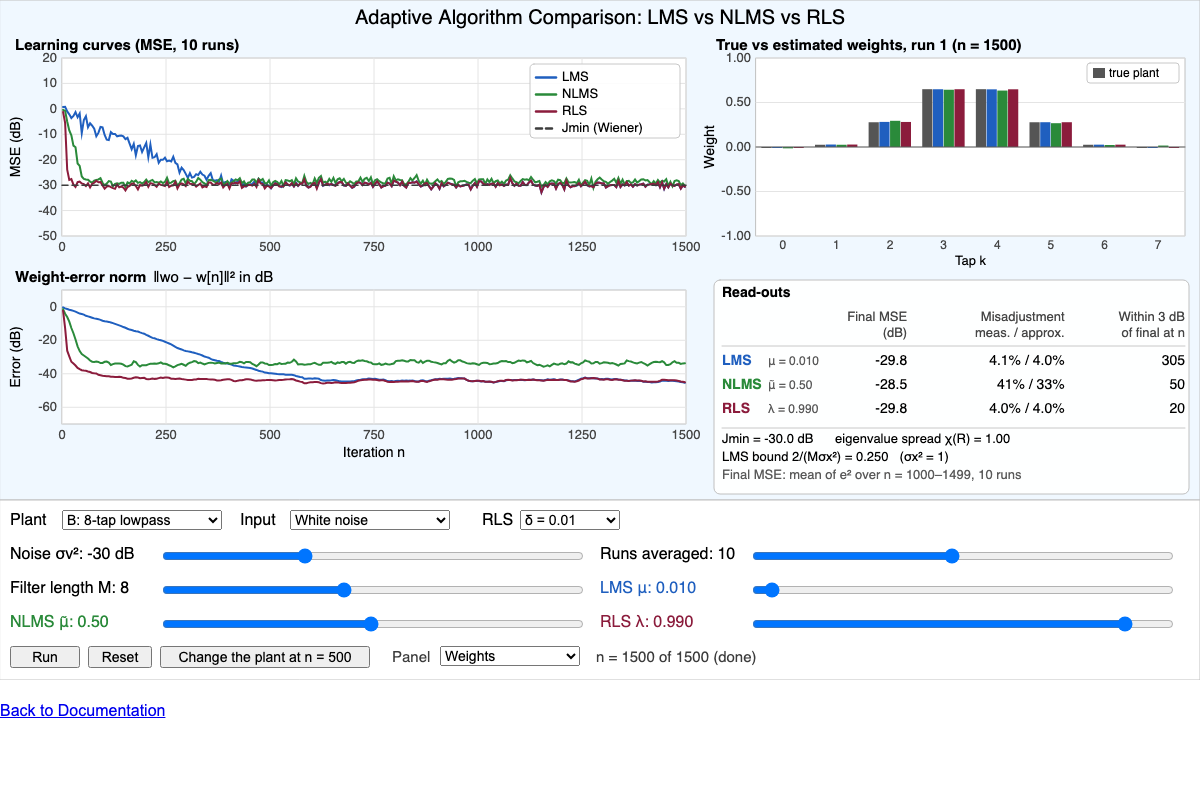
LMS, NLMS and RLS identify the same unknown FIR plant from the same noisy data. Compare convergence speed, steady-state error, stability and tracking.
-
Adaptive Noise and Echo Cancellation
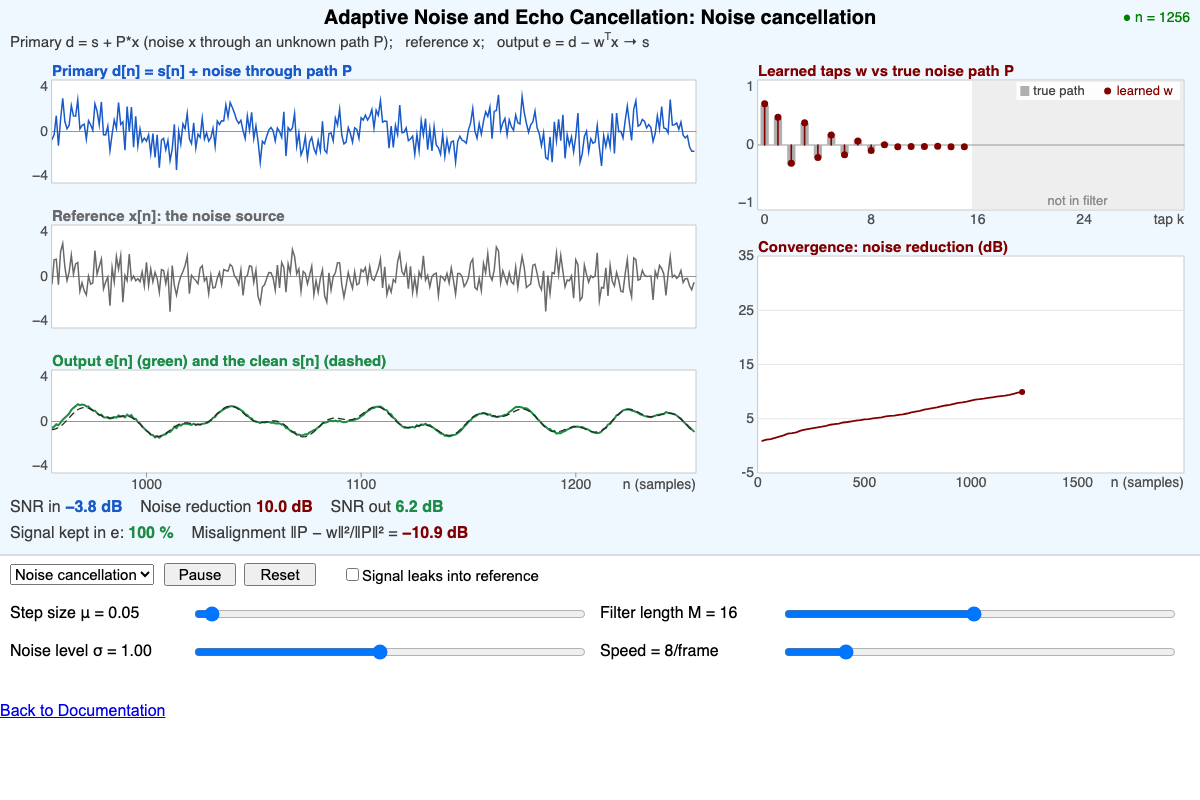
One NLMS adaptive filter, three jobs - noise cancellation with a reference input, acoustic echo cancellation with double-talk, and channel equalization.
-

Compare amplitude modulation (AM) and frequency modulation (FM) of a sine carrier by a sine message, in time and as a line spectrum with its bandwidth.
-

A sine-wave generator with its live FFT - the waveform in the time domain on top and its magnitude spectrum below, with frequency and amplitude sliders.
-
Bass and Treble Amplifier Controls

Frequency response of an amplifier's bass and treble controls, drawn as gain in dB against log frequency, with two sliders and a mouse probe that reads the gain.
-
Bilinear Transform and Frequency Warping
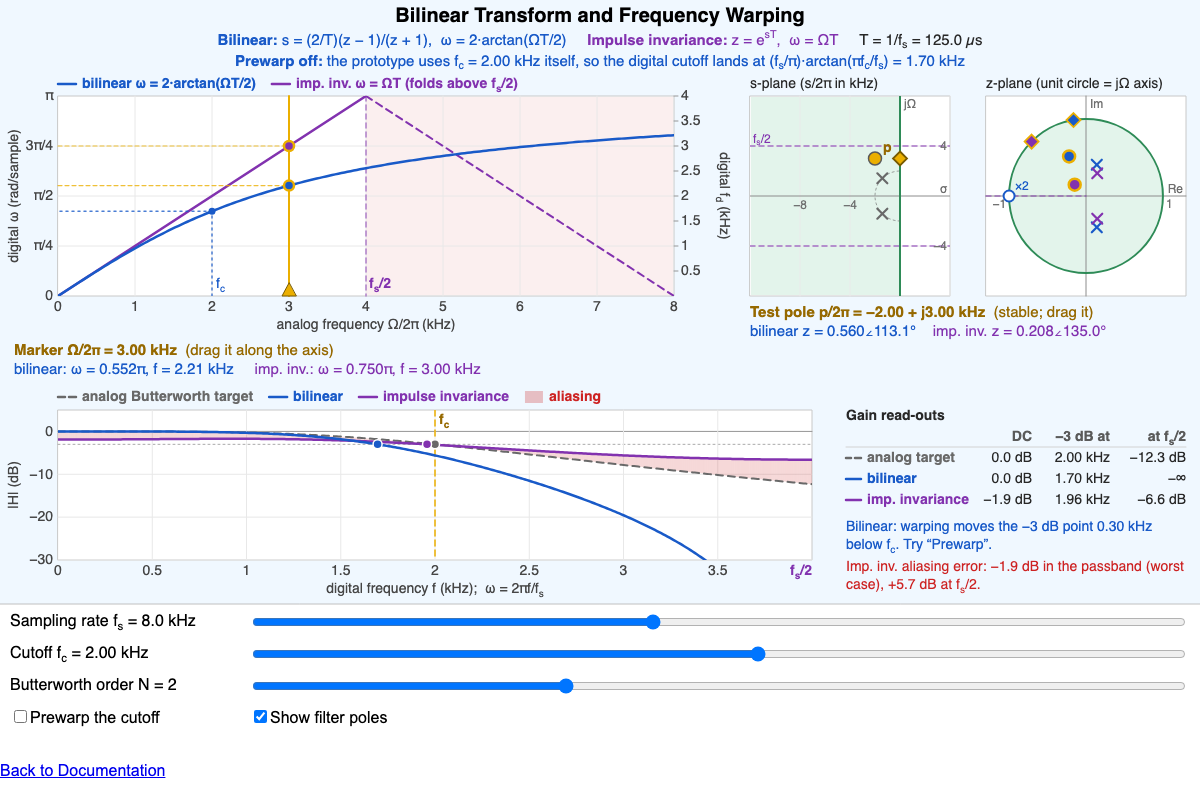
Compare the bilinear transform and impulse invariance - frequency warping, prewarping, aliasing near Nyquist and how s-plane poles map into the z-plane.
-
Citation Graph for FFT on Microcontrollers

Explore a 15-paper citation graph of FFT research on microcontrollers. Filter by research area and citation count, then compare three layouts.
-

Interactive visualization of complex numbers in the complex plane, showing both rectangular (a + bi) and polar (r angle theta) forms with geometric representations.
-
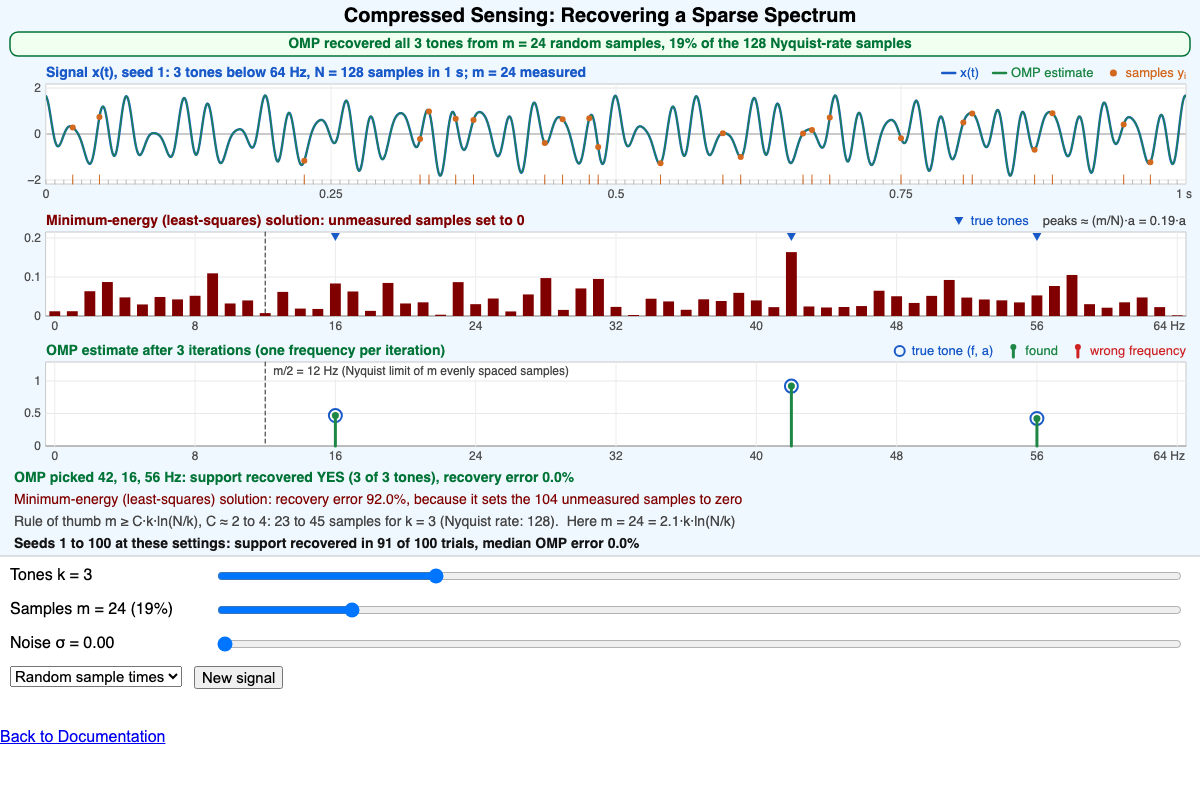
Recover a sparse spectrum of k tones from m random time samples with orthogonal matching pursuit, and compare it with the minimum-energy solution and uniform sampling.
-

A blue square slides across a red triangle while a purple gauge shows the area of overlap, the introductory picture of convolution.
-
Convolution Theorem and Circular Convolution
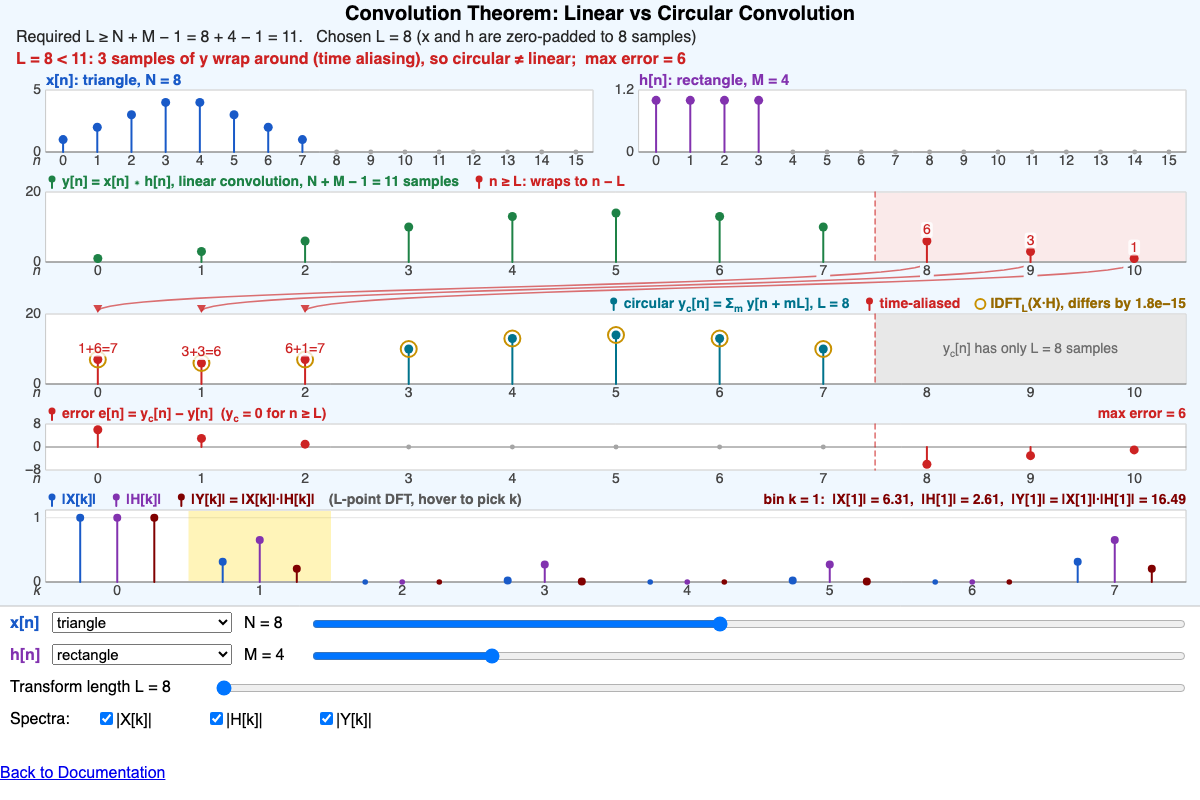
Compare linear convolution with L-point circular convolution computed as IDFT(DFT(x)·DFT(h)), and watch the tail wrap around when L < N + M − 1.
-
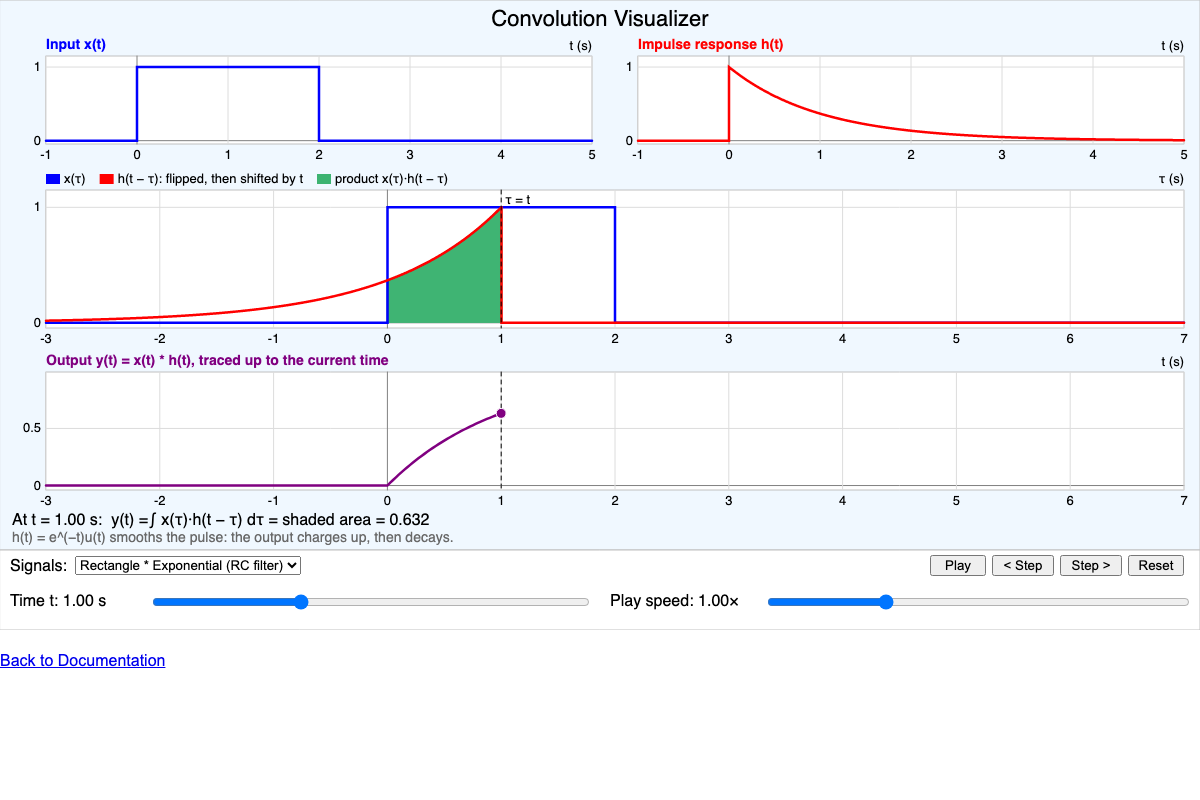
Step through the flip-and-slide picture of convolution. The impulse response is time-reversed, shifted, multiplied by the input, and the area under the product builds the output y(t).
-
Correlation and Matched Filtering
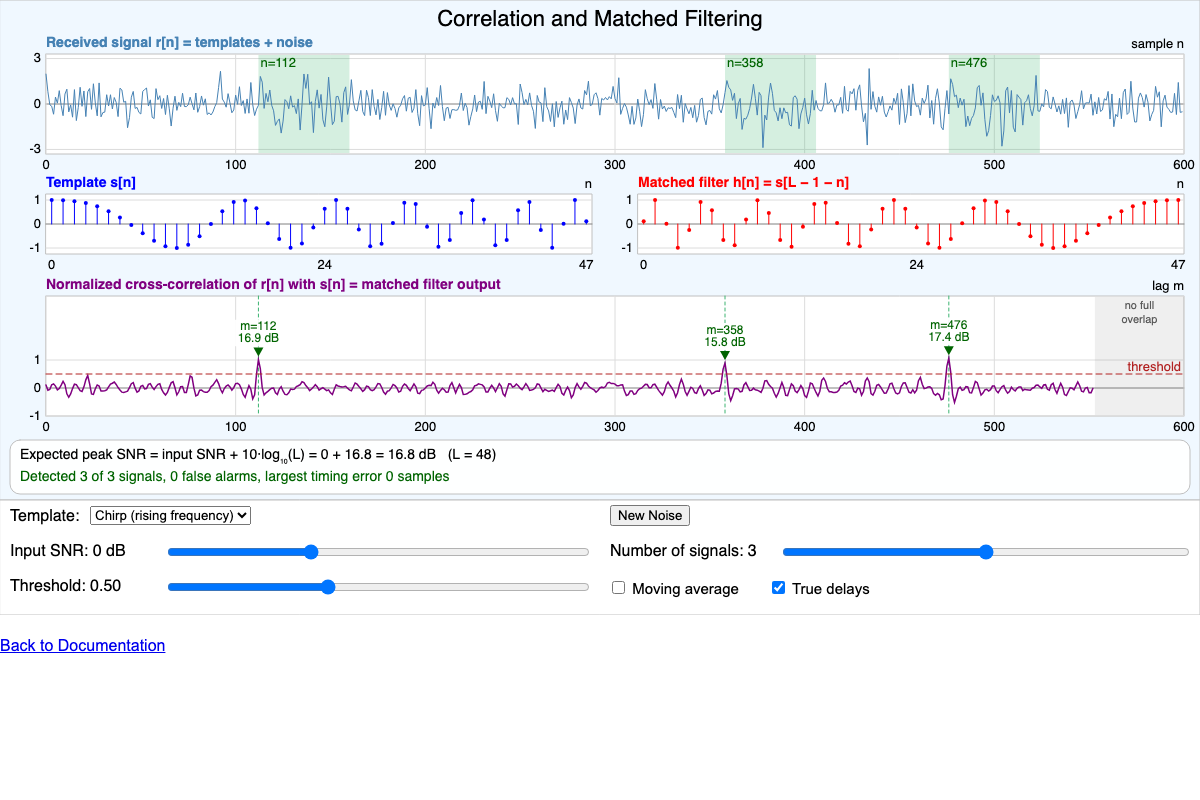
Find copies of a known template hidden in noise by cross-correlating the received signal with the template, and compare the matched filter with a simple moving average.
-
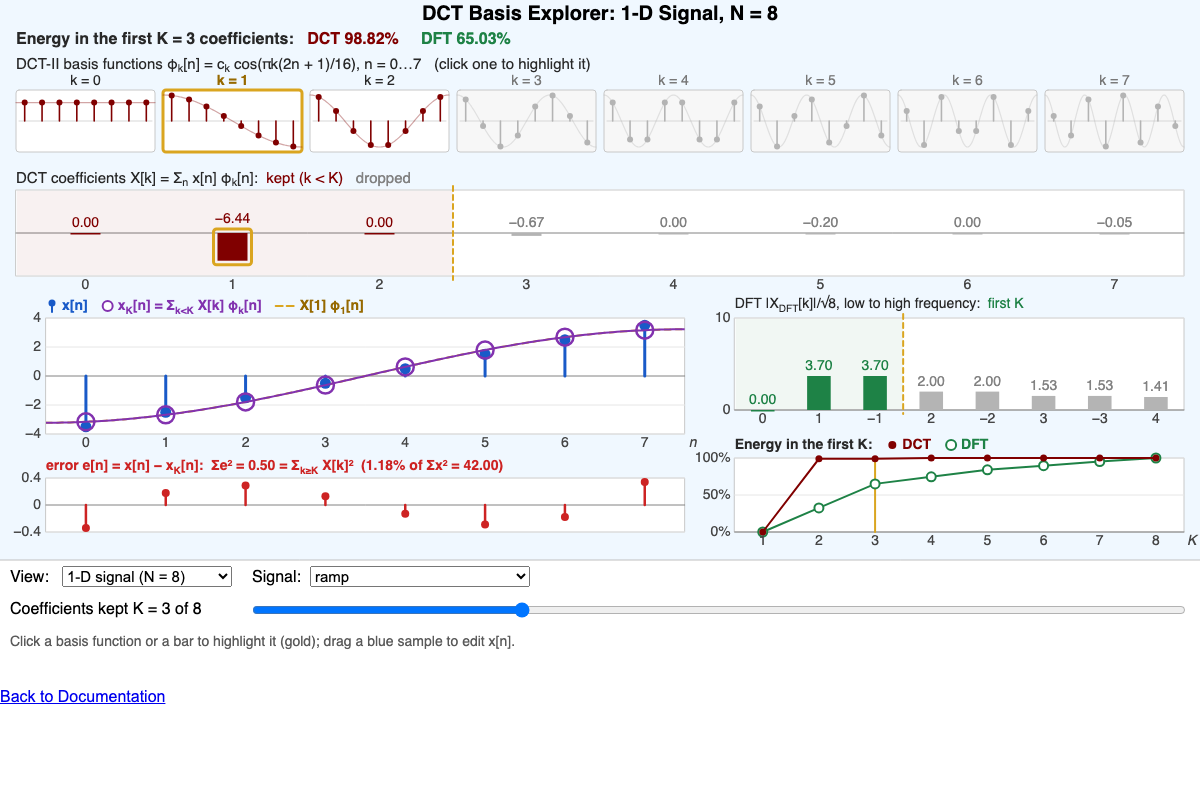
Explore the 8-point DCT-II basis functions and the 64 basis images of the 8x8 DCT, and see why energy compaction makes the DCT the core of JPEG.
-
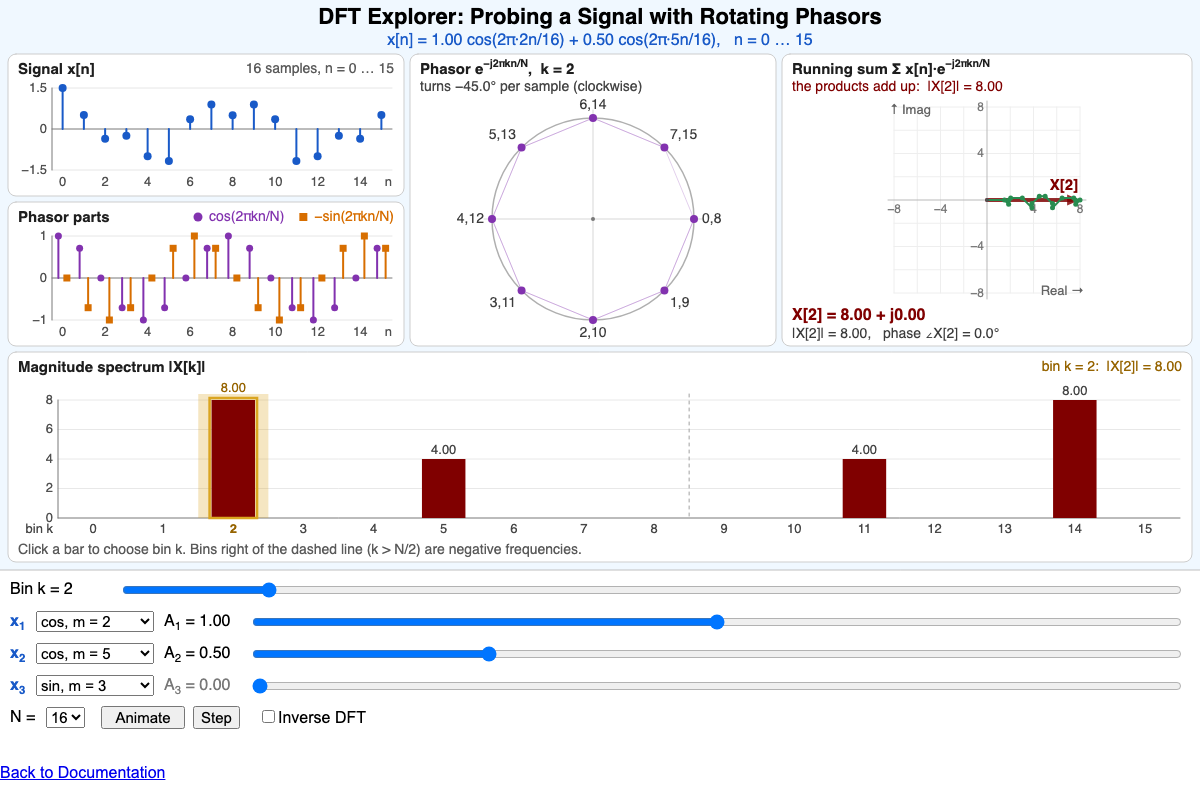
Build each DFT value X[k] by multiplying x[n] by a rotating phasor and adding the products head to tail, then rebuild x[n] from the bins you keep.
-

Watch the point e^(iθ) travel around the unit circle while its real and imaginary parts trace the cosine and sine waves, with live numeric read-outs.
-
Even and Odd Signal Decomposition
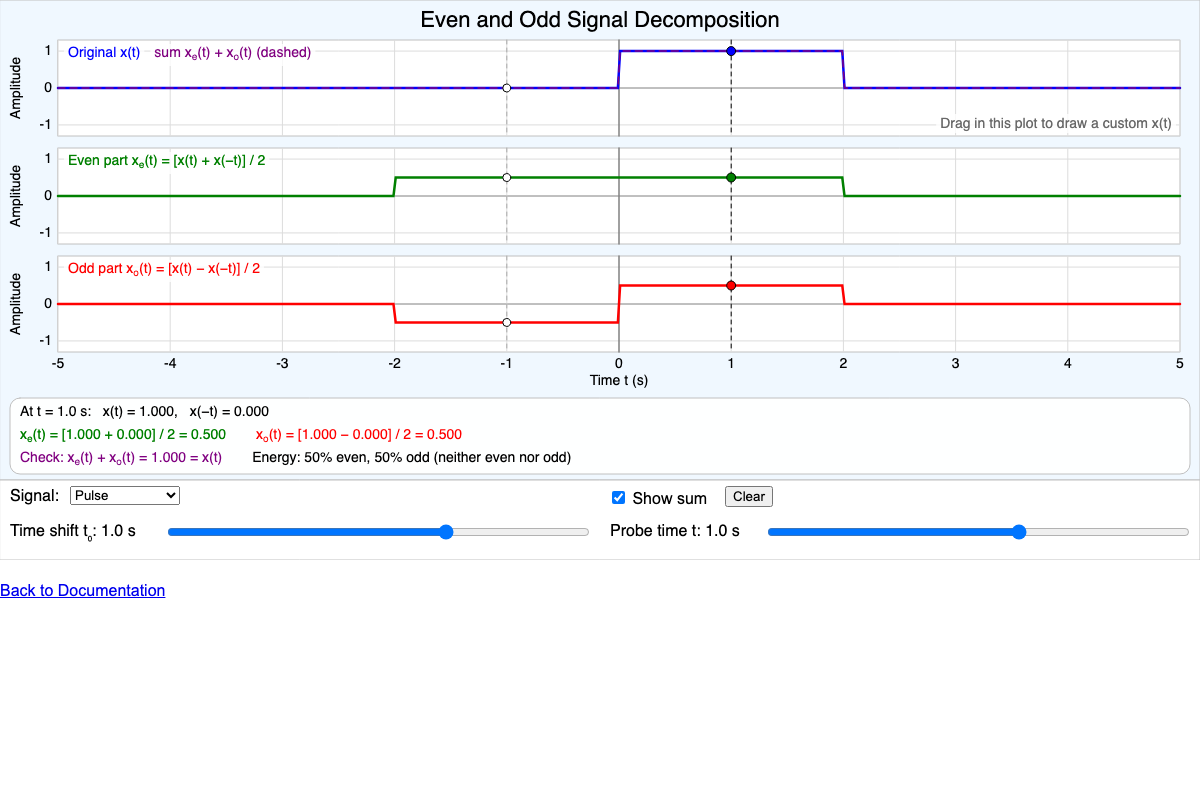
Decompose a preset or hand-drawn signal x(t) into its even part and odd part, read the worked calculation at a probe time, and verify that the two parts sum back to x(t).
-

Step through the input reordering of a radix-2 FFT, splitting every group into even and odd samples until they sit in bit-reversed order.
-
FFT Live Audio from Microphone

A live spectrum analyzer for your microphone with adjustable smoothness and FFT size, showing bin width, window length and the strongest peak.
-

A music player with a track list that shows the waveform and the FFT frequency spectrum of the song you are listening to.
-

A sine wave analysed with FFT sizes from 512 to 8192 bins. Larger FFTs give narrower bins and peaks but need a longer analysis window.
-
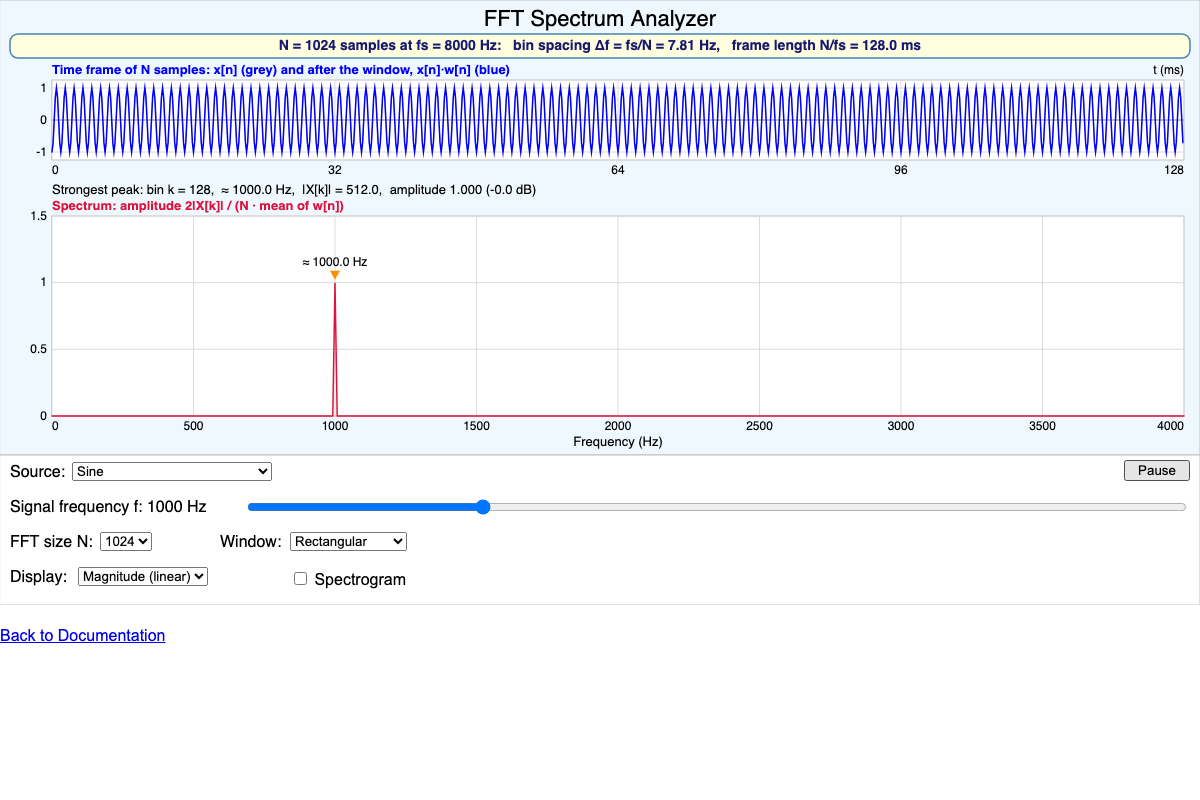
Analyze test signals or the microphone with a radix-2 FFT, choosing FFT size, window and a magnitude, dB or phase display, with peak markers and a spectrogram.
-

Compare the harmonic spectra of sine, square, triangle and sawtooth waves - which harmonics each shape contains and how fast they decay.
-
FFT with Multiple Frequency Components

Three sine-wave oscillators are added together - the combined waveform in the time domain and its FFT spectrum with one labelled peak per component.
-
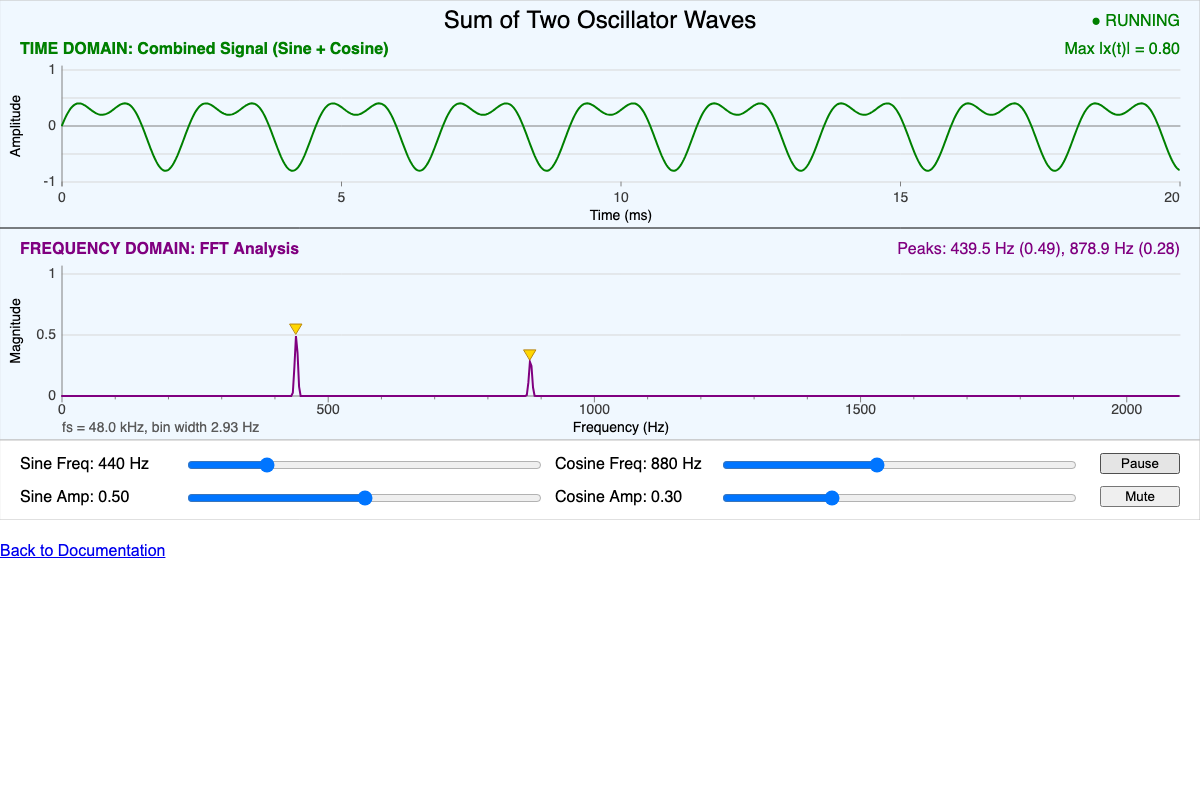
A sine and a cosine oscillator are added and played; see their sum in the time domain and one FFT peak per oscillator in the magnitude spectrum.
-
Filter Bank and Polyphase Explorer
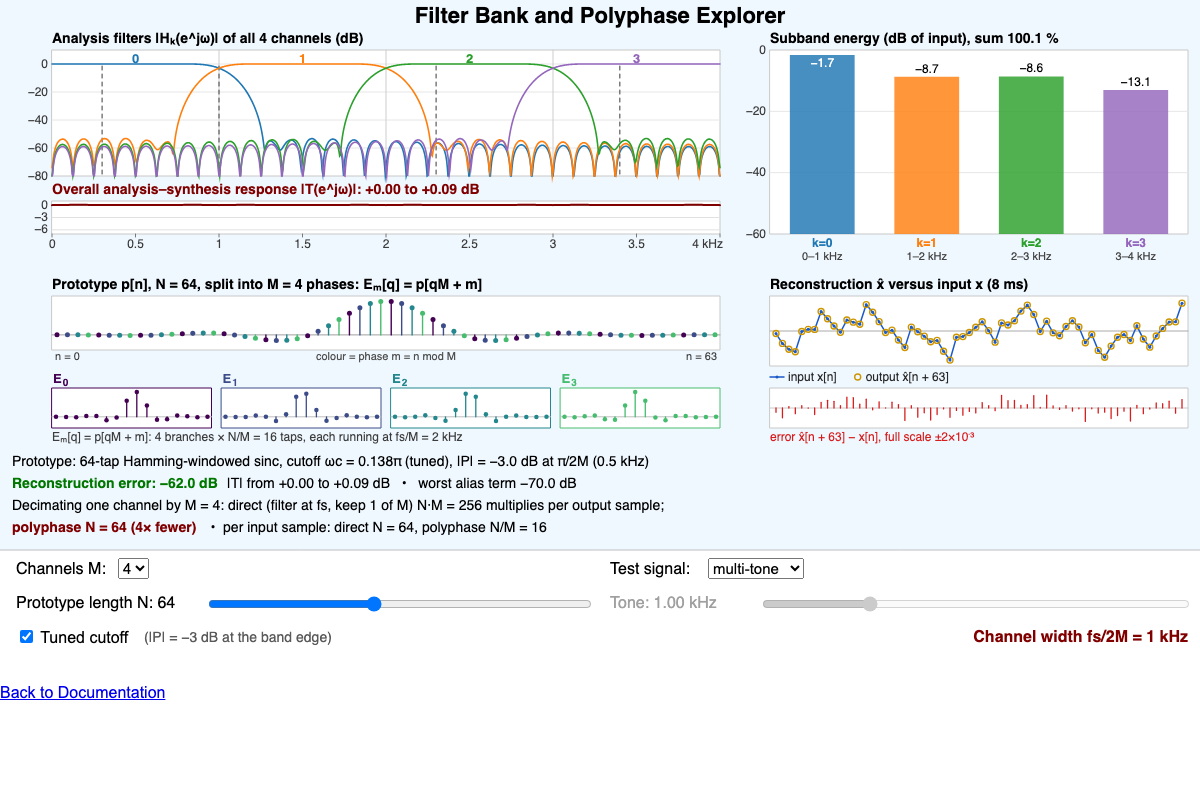
Split a signal into M subbands with a cosine-modulated filter bank, measure the reconstruction error, and see why polyphase decimation is M times cheaper.
-
FIR Filter Design Comparison Tool
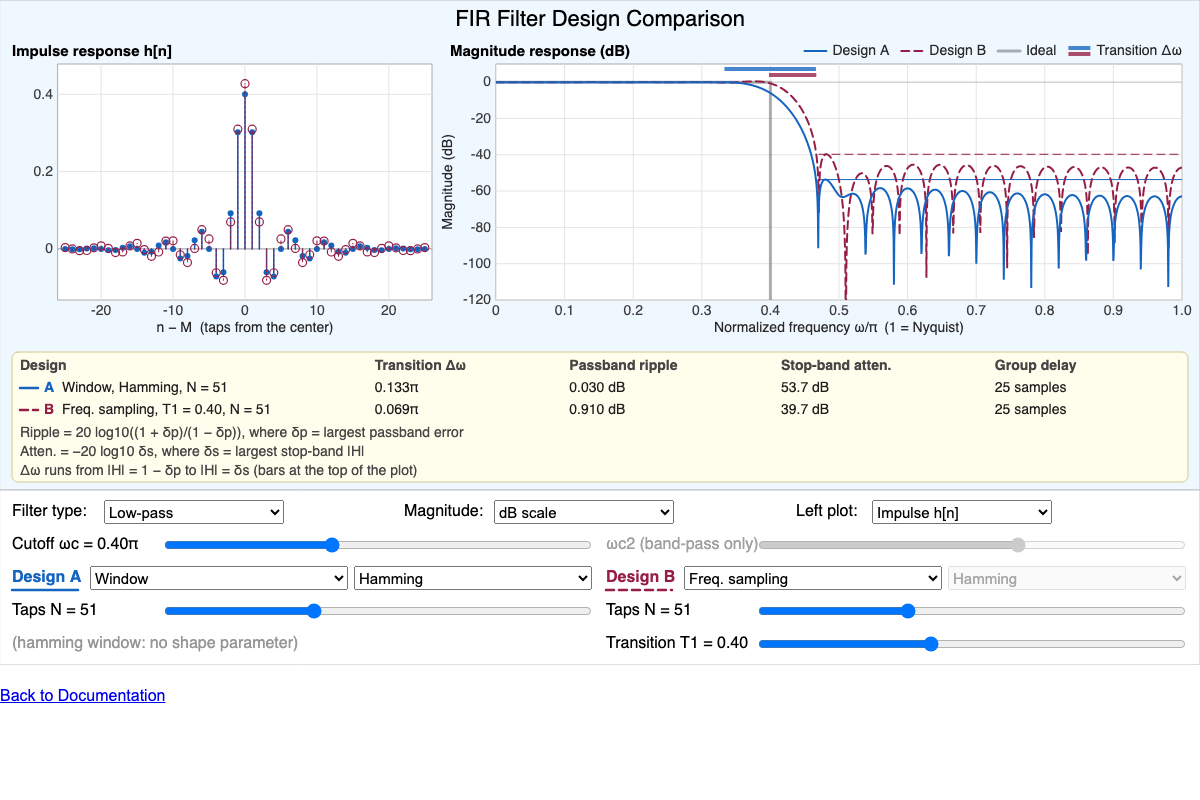
Compare two linear-phase FIR designs (window method, frequency sampling or Parks-McClellan) for the same specification, with measured ripple, attenuation and transition width.
-
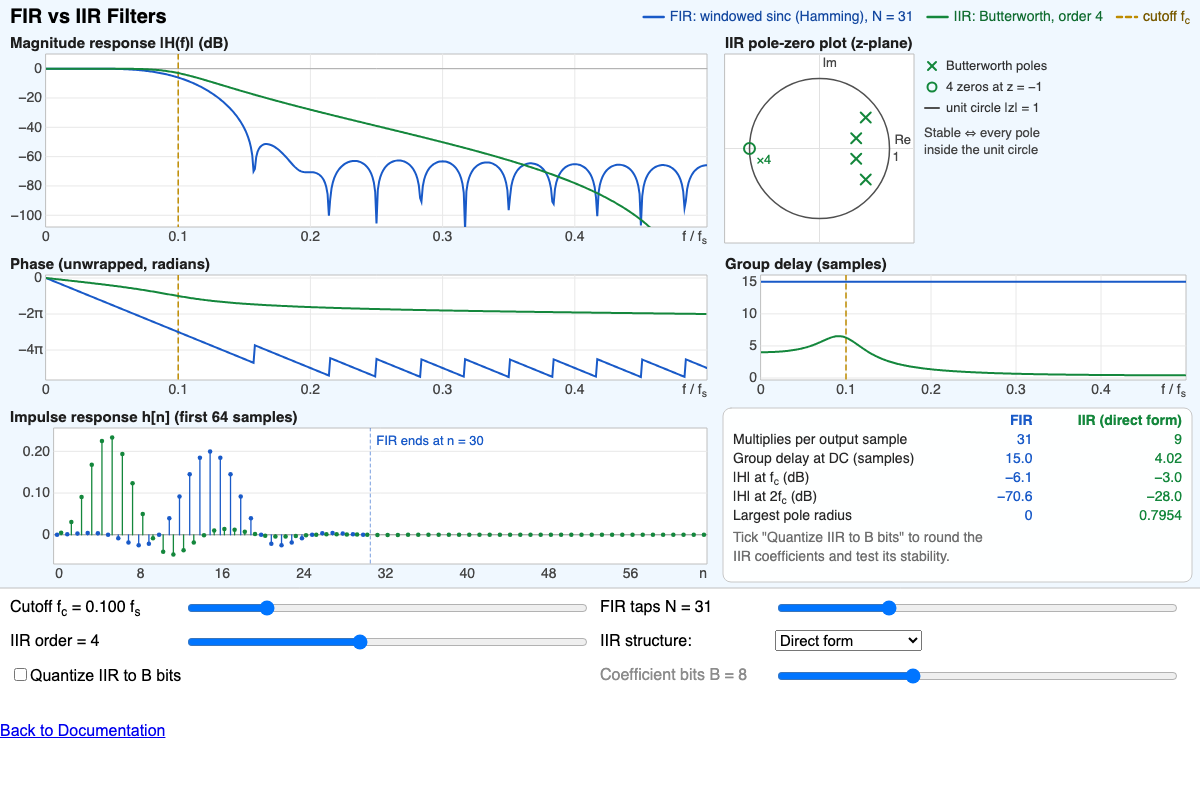
Compare an FIR windowed-sinc and an IIR Butterworth low-pass with the same cutoff - response, phase, delay, cost and stability under coefficient rounding.
-
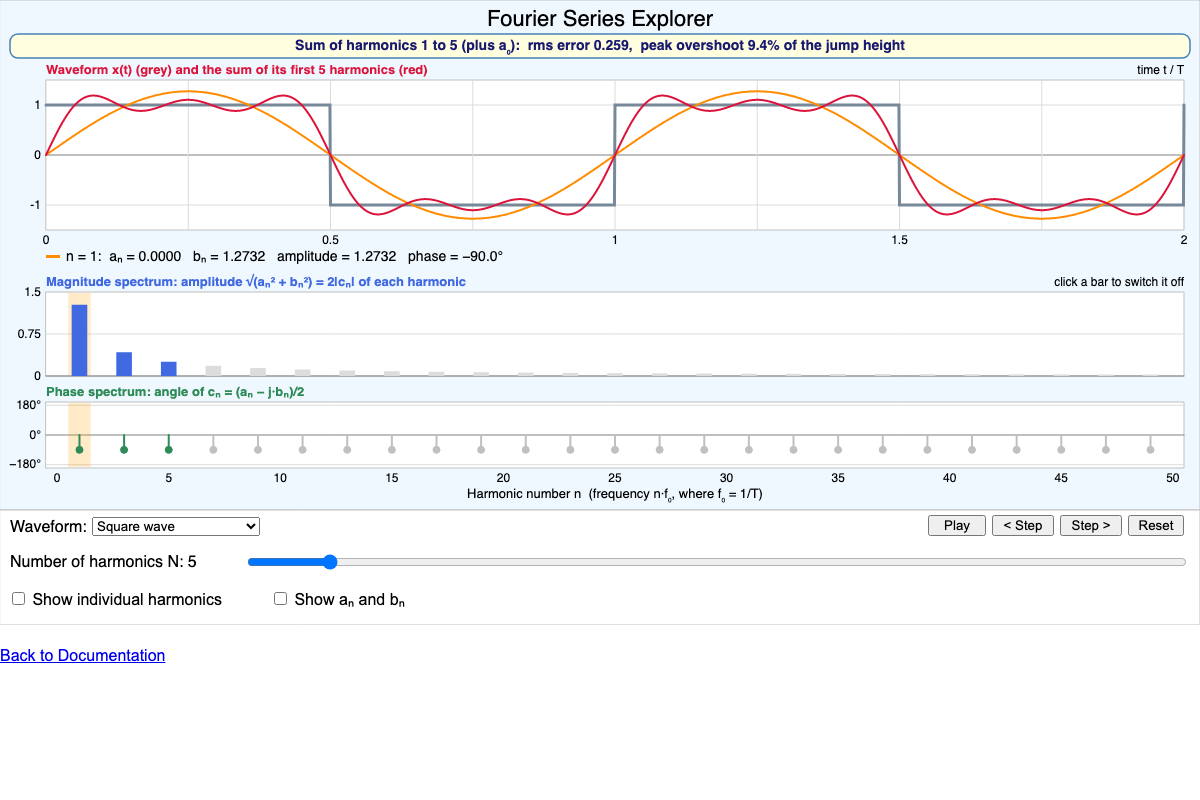
Build square, triangle, sawtooth, pulse and hand-drawn waveforms from their first N harmonics; read each harmonic's amplitude, phase and the Gibbs overshoot.
-
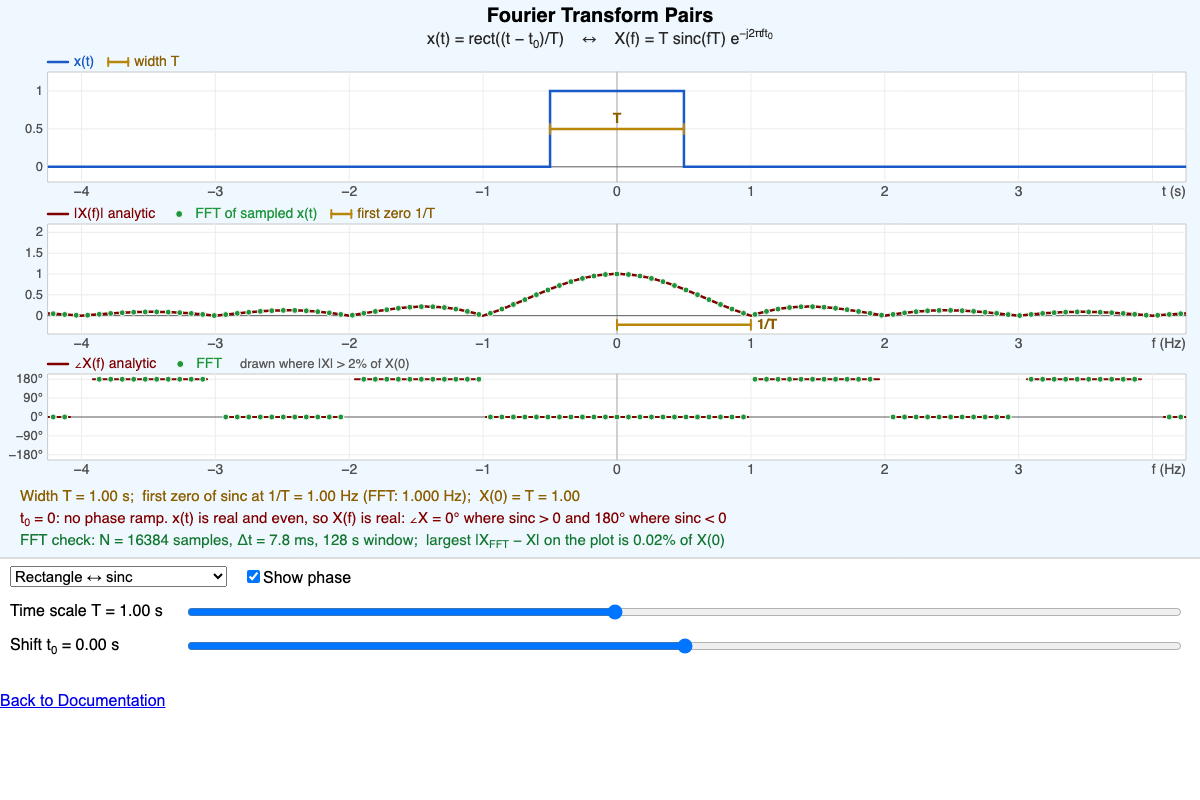
Explore five classic Fourier transform pairs and the time-scaling and time-shift properties, with each analytic X(f) checked against an FFT estimate.
-

A winding machine wraps a sine wave around a spinning circle; the center of mass of the wound curve reveals the signal frequency, as the Fourier transform does.
-
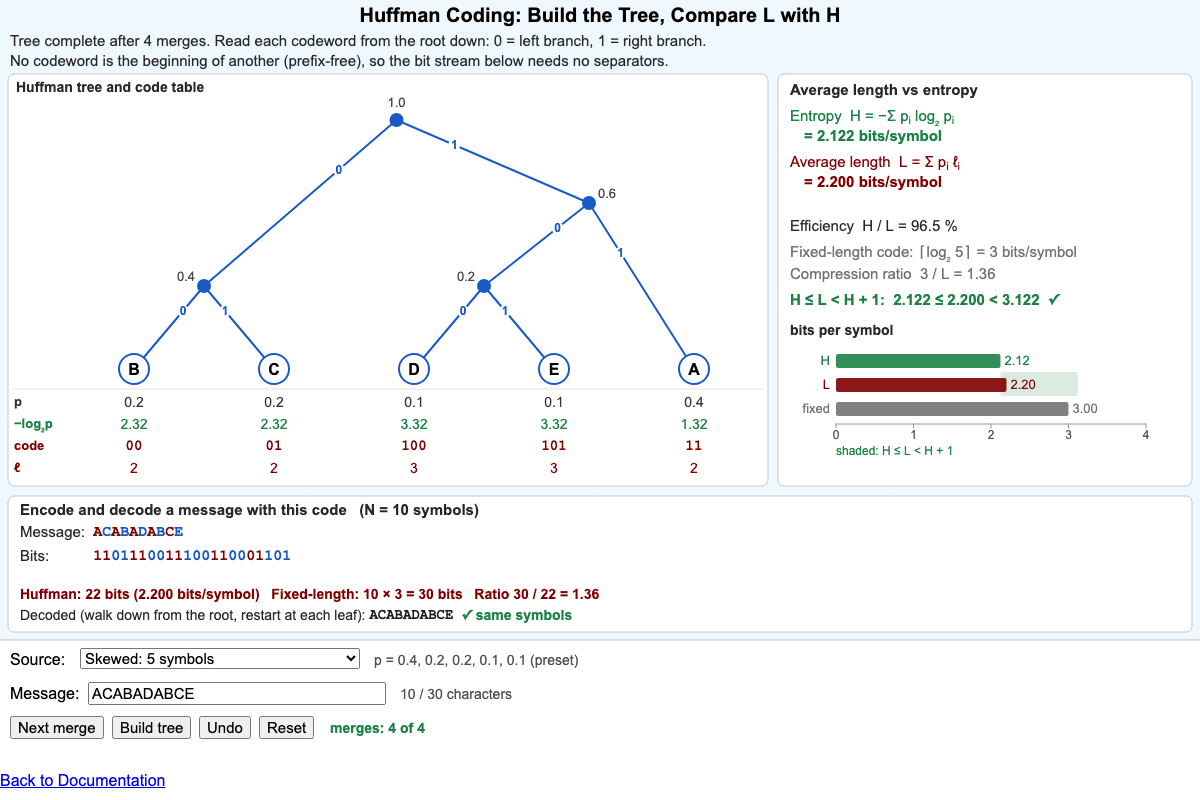
Build a Huffman tree one merge at a time, read off the prefix-free code, and compare the average code length L with the entropy H and a fixed-length code.
-
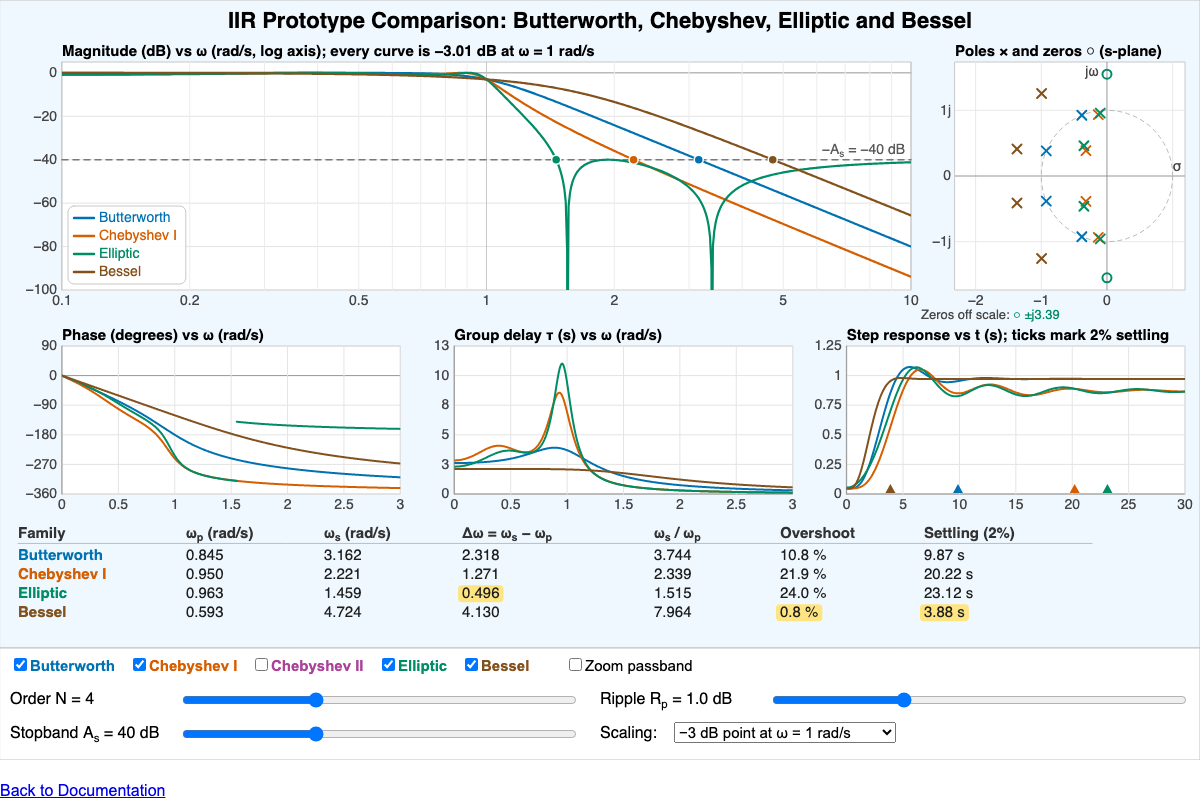
Compare Butterworth, Chebyshev I and II, elliptic and Bessel low-pass prototypes at the same order - magnitude, phase, group delay, step response and poles.
-
Impulse and Frequency Response Analyzer
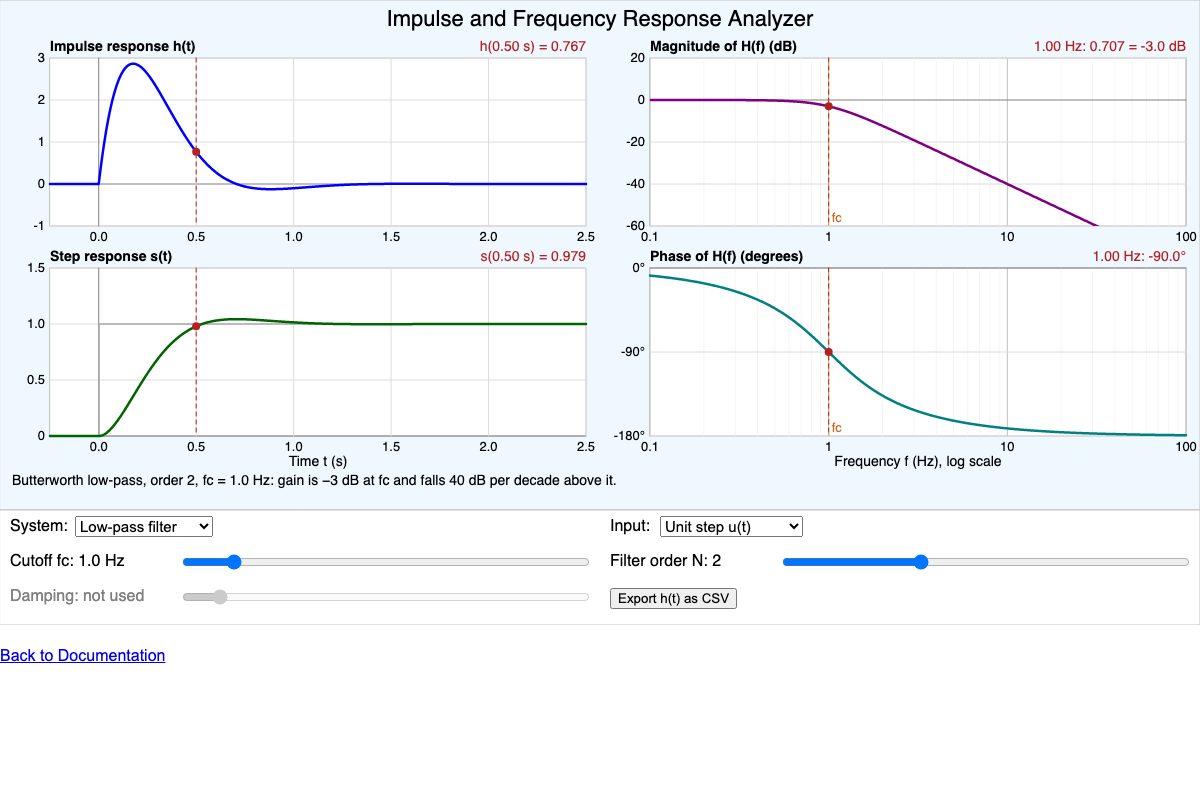
See the impulse response, step response, magnitude response and phase response of five LTI systems side by side, with linked cursors and sliders for cutoff frequency, filter order and damping ratio.
-
Interactive Filter Design and Analysis Tool
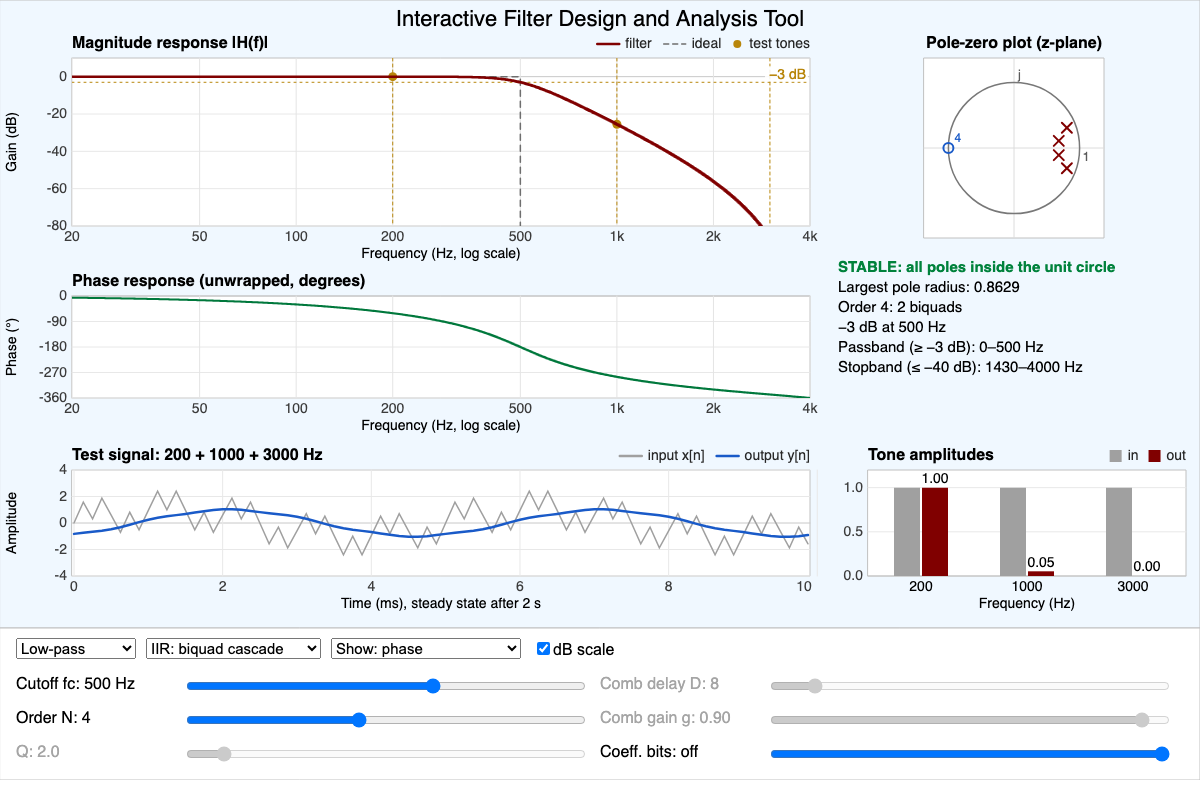
Design low-pass, high-pass, band-pass, band-stop, notch, comb and all-pass filters as IIR or FIR and see their responses, poles, stability and effect on three tones.
-
Interactive Pole-Zero Analysis Tool
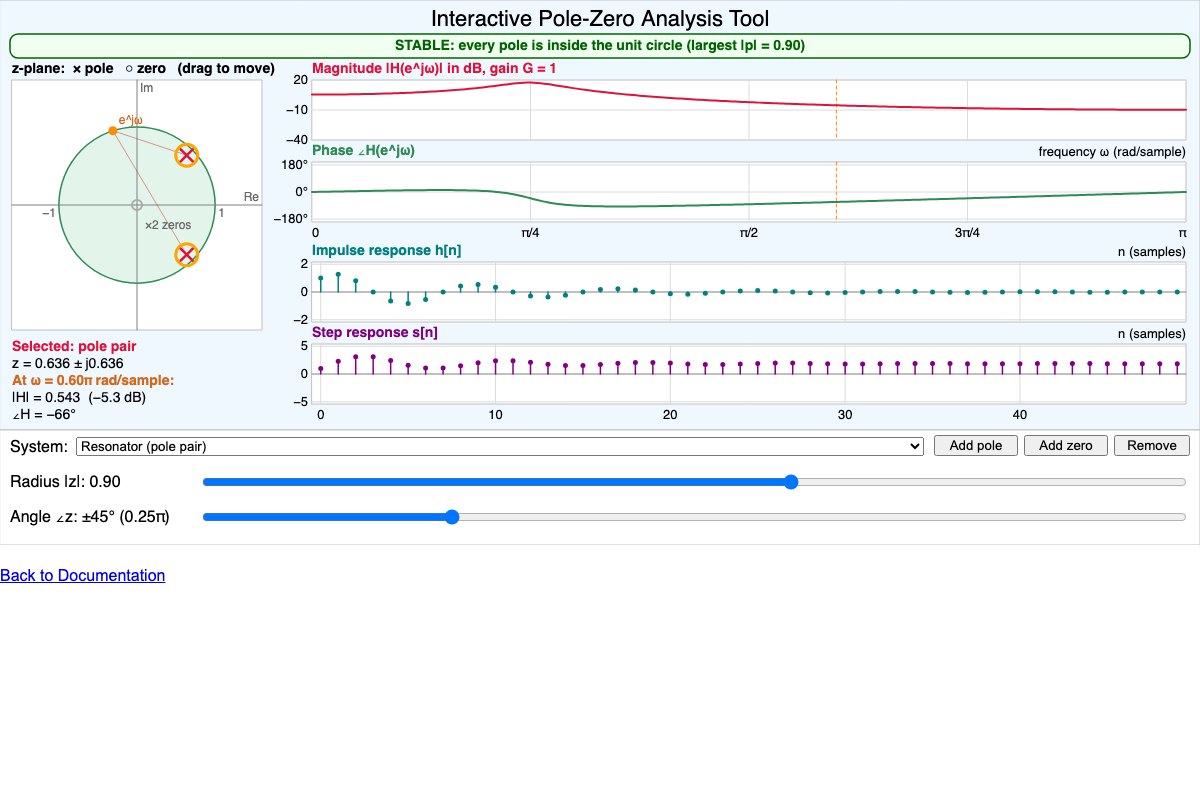
Place poles and zeros on the z-plane and watch the magnitude response, phase response, impulse response, step response and stability verdict of the discrete-time system update.
-
Interactive Spectrogram Parameter Explorer
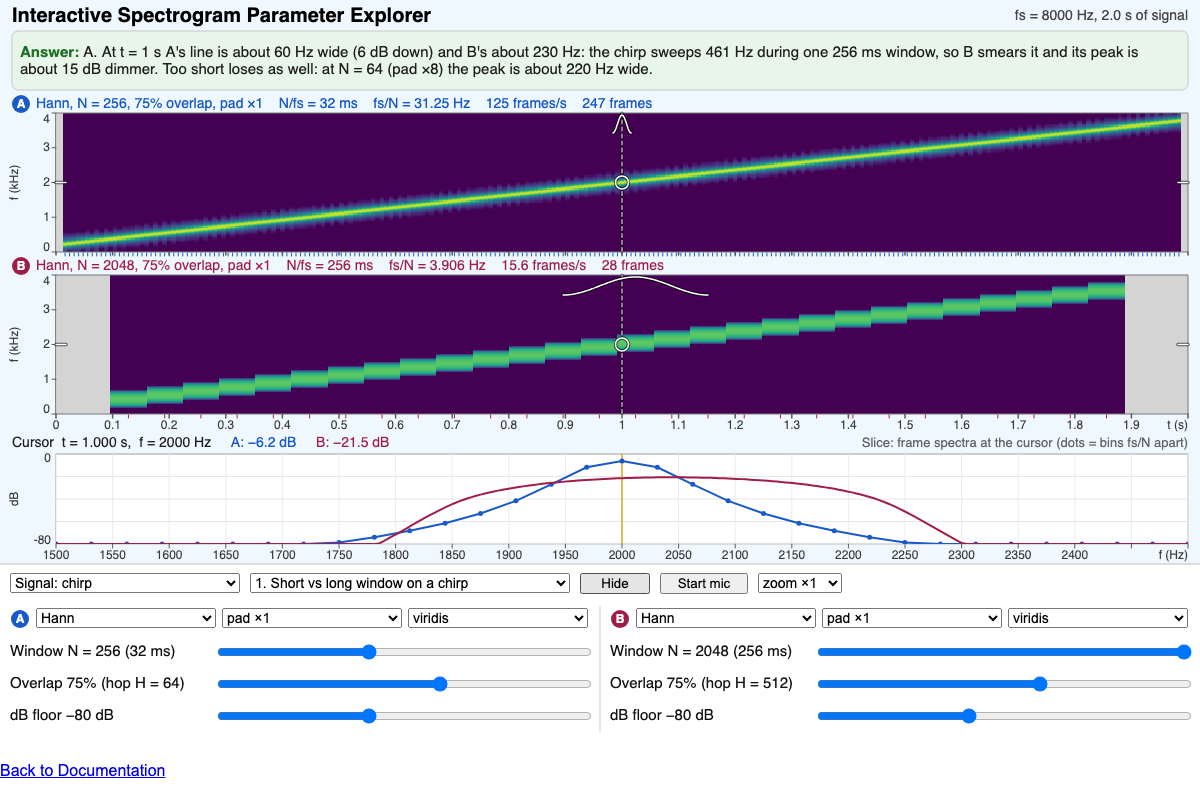
Compare two spectrograms of one signal or your microphone, each with its own window length, overlap, window, zero padding, dB floor and color map.
-
Interactive STFT Spectrogram Analyzer
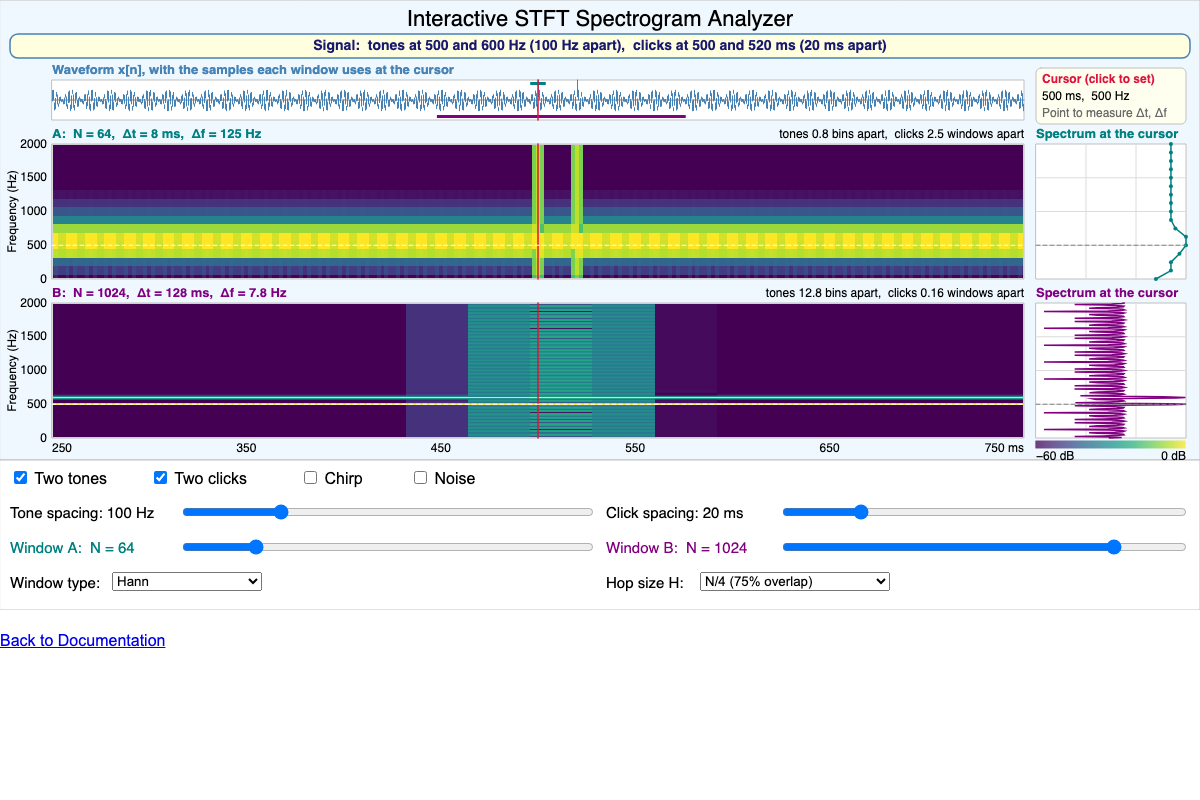
Compare short- and long-window STFT spectrograms of one test signal and use cursors to see what each window can and cannot separate in time and frequency.
-
Microphone Frequency Visualization with FFT

A real-time spectrum analyzer for your microphone. An FFT turns live sound into colored frequency bars with a decibel scale and a peak-frequency read-out.
-
Multirate Sample Rate Converter
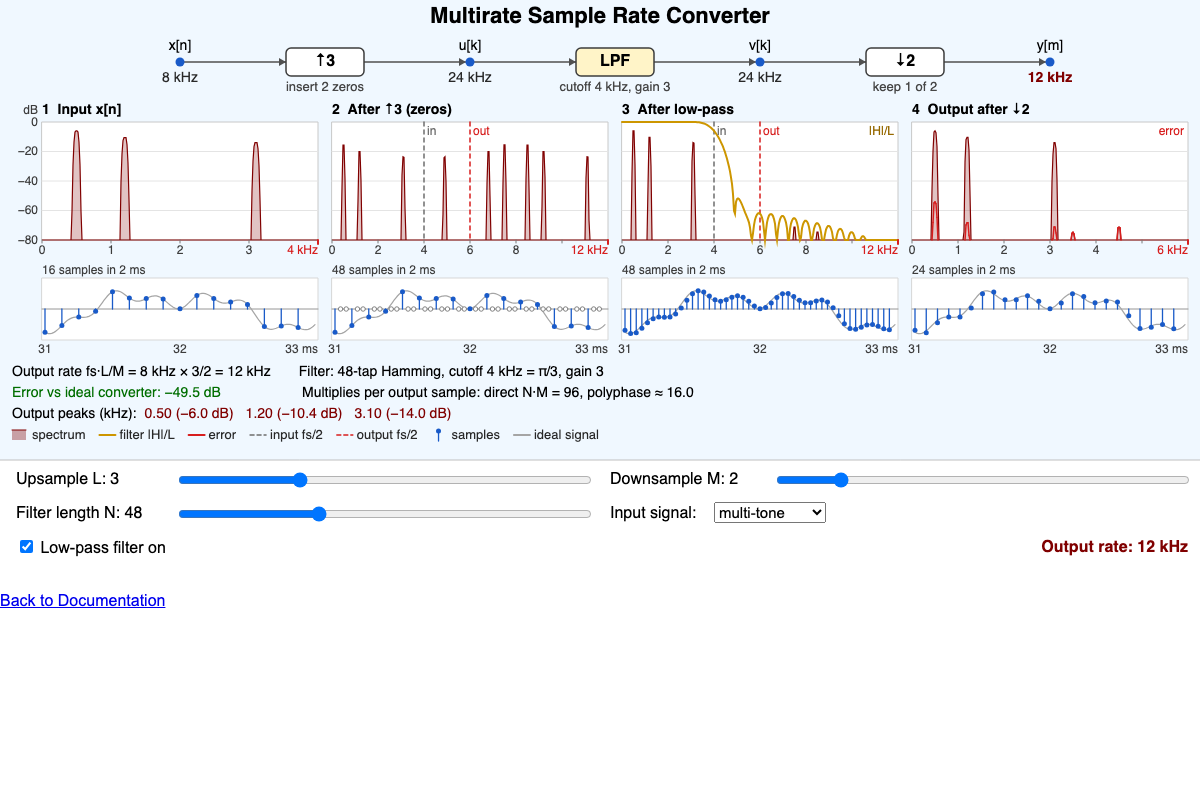
Change a signal's sample rate by L/M and watch zero insertion create images, downsampling fold aliases, and the low-pass filter remove both.
-

Drag the coefficients of w = (Az + B)/(Cz + D), draw in the z-plane and watch lines and circles map, including the bilinear transform used for IIR filters.
-
Noise Analysis and Reduction Tool
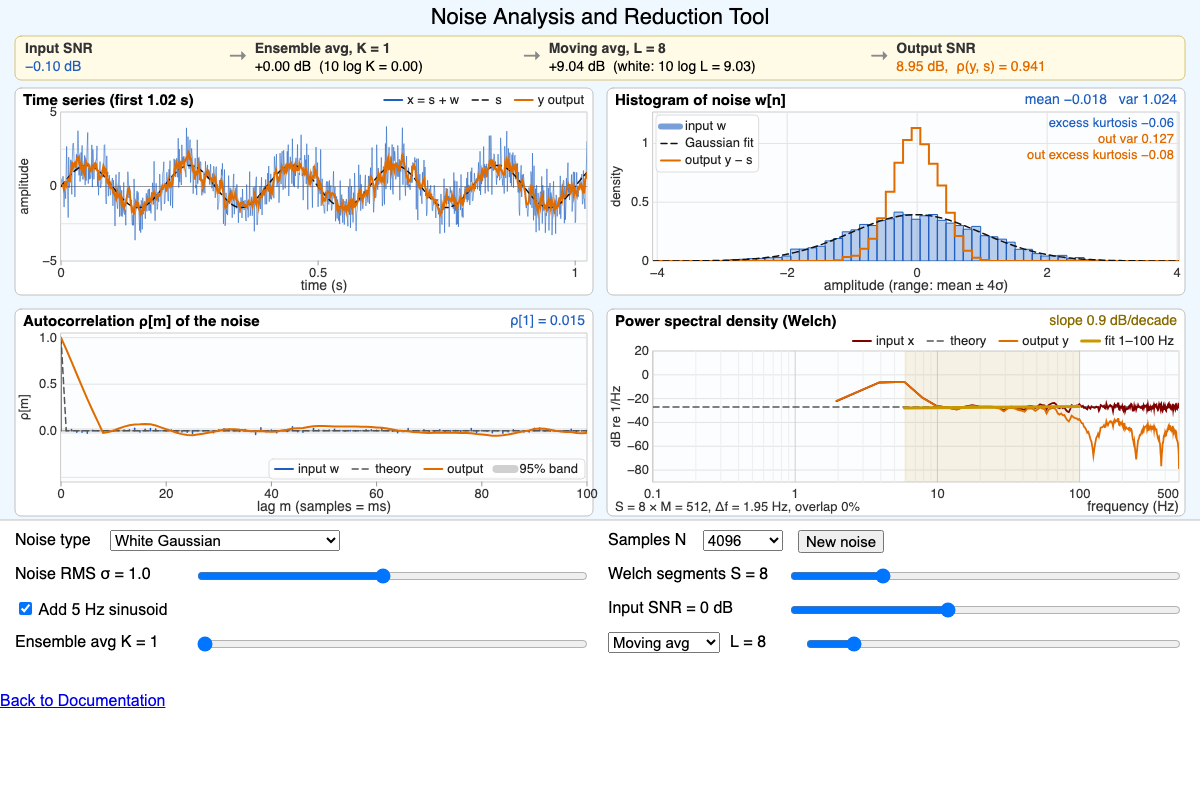
Generate white, pink, brown, band-limited and impulsive noise, measure its histogram, autocorrelation and Welch PSD, and see SNR improve with averaging and filtering.
-

Sample a 5 Hz sine wave at 1 to 50 Hz and compare ideal sinc and straight-line reconstructions to see the Nyquist rate and aliasing at work.
-
Phase Spectrum - What the Magnitude Hides
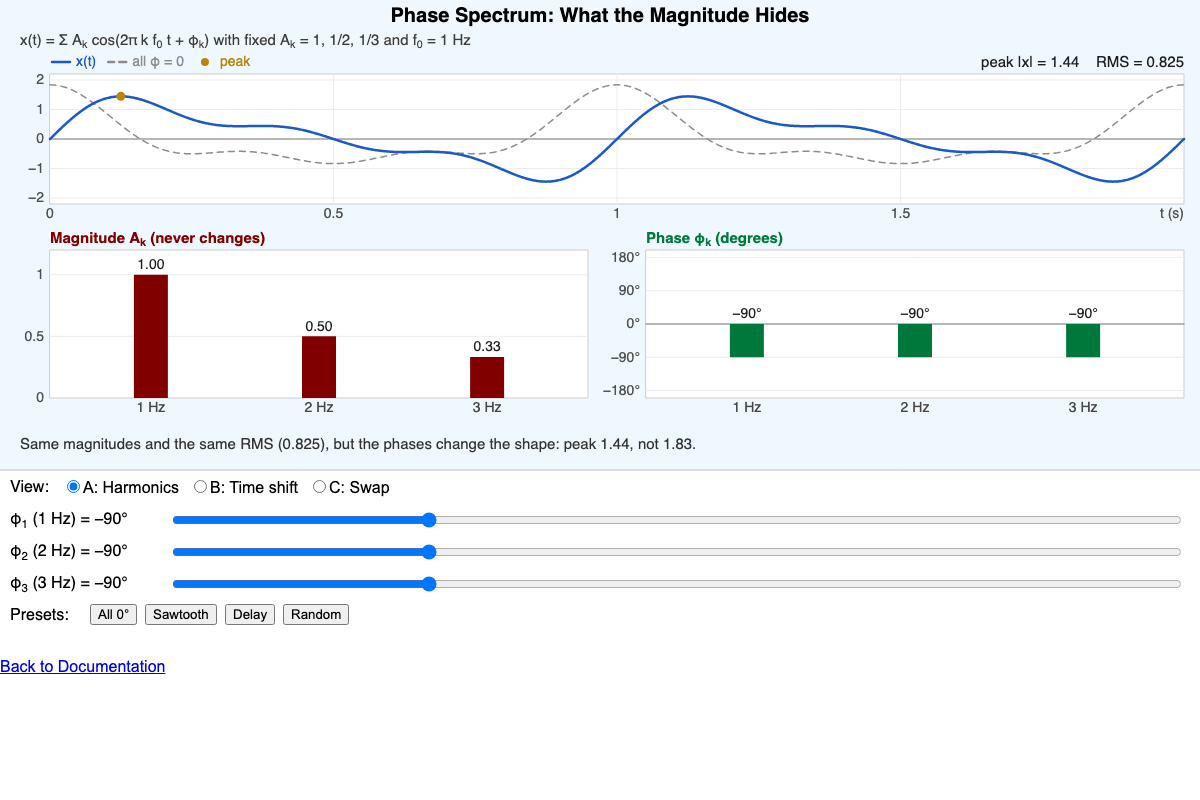
Same magnitude spectrum, different phases, different waveforms. Explore harmonic phases, the linear phase of a time shift, and the magnitude/phase swap experiment.
-
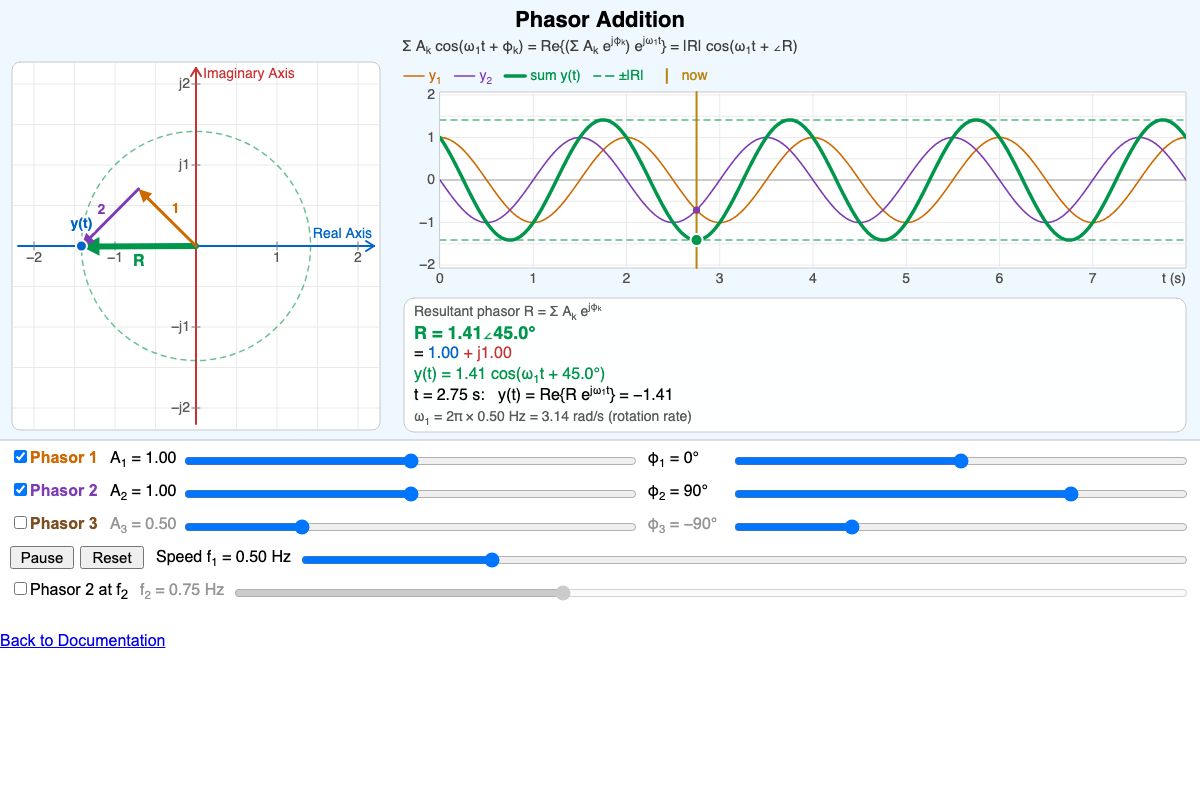
Add up to three sinusoids by adding their rotating phasors head to tail, read the resultant amplitude and phase, and see beats when one frequency differs.
-
Power Spectral Density and the Wiener-Khinchin Theorem
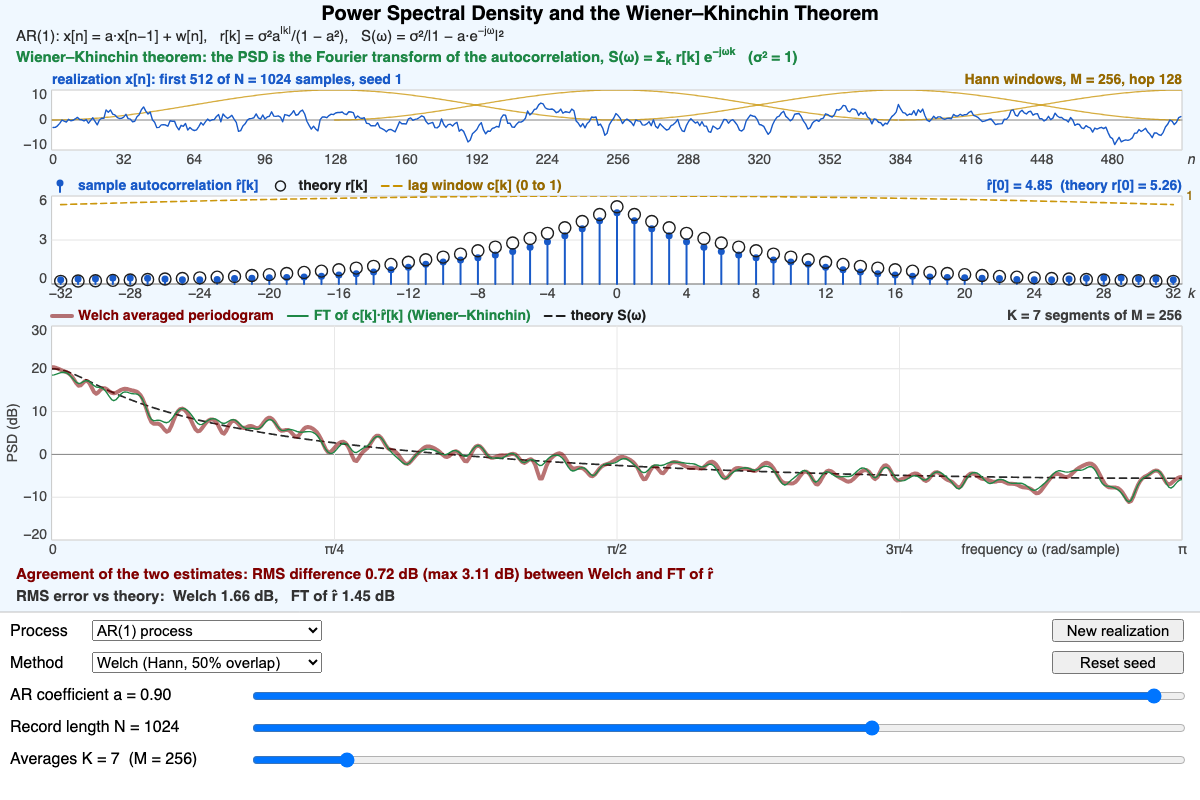
Estimate a PSD two ways, by averaged periodograms and by the Fourier transform of the sample autocorrelation, and compare both with the exact S(ω).
-
Probability Distribution Explorer
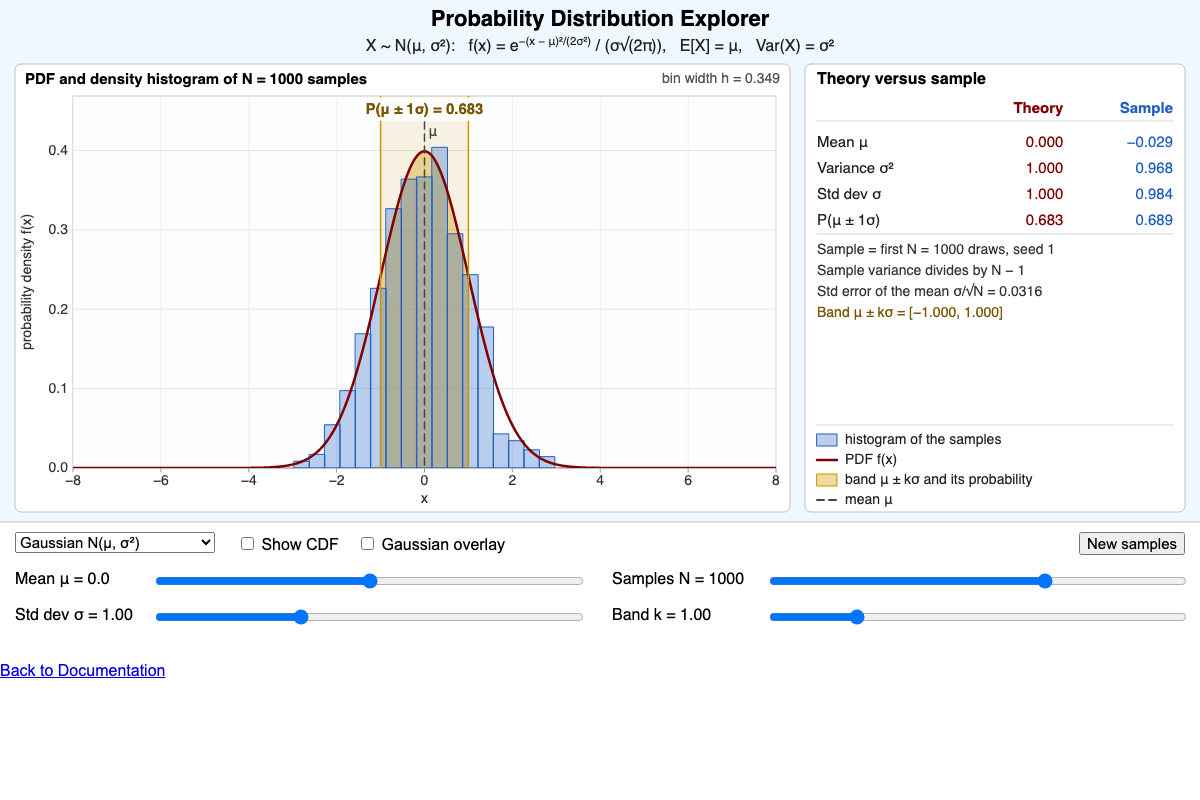
Sample uniform, Gaussian, exponential, binomial and Poisson distributions, compare sample and true mean and variance, and watch the central limit theorem.
-
Quantization and Noise Shaping
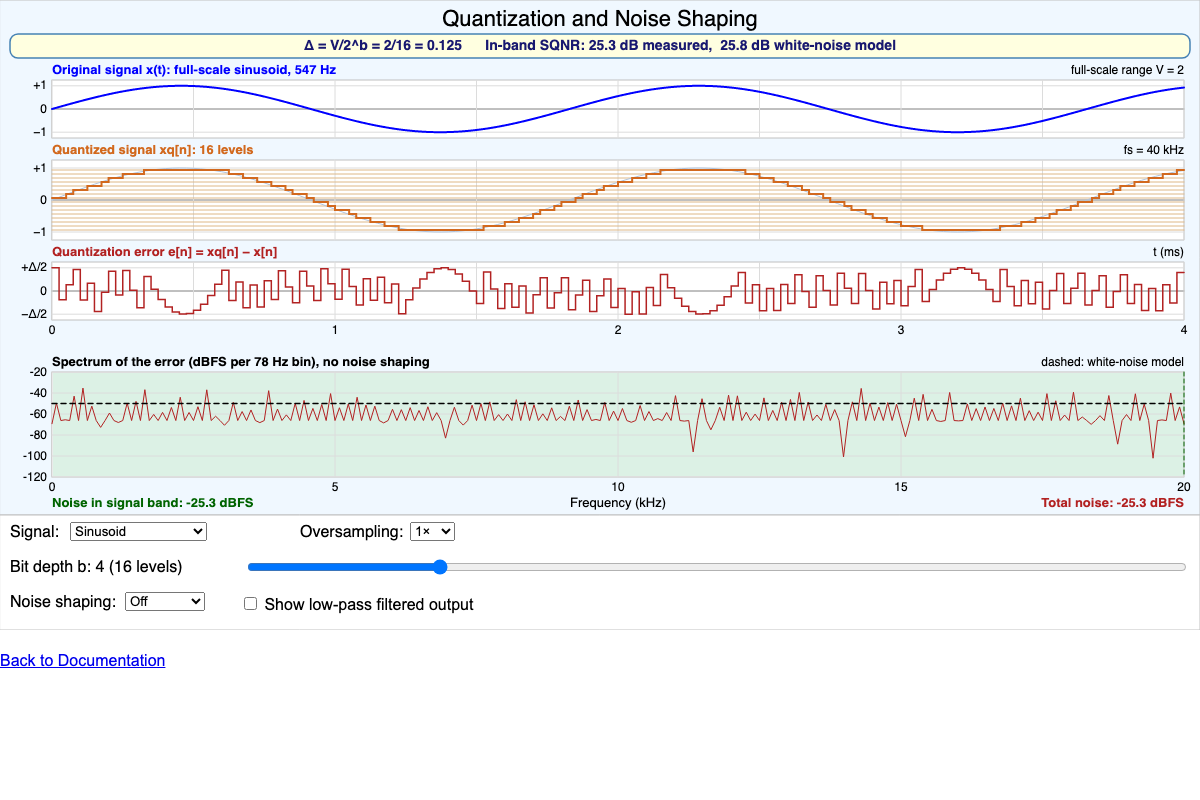
Quantize a full-scale waveform with 1 to 16 bits, see the quantization error and its spectrum, and measure how oversampling and noise shaping raise the SQNR in the signal band.
-

Set R and C of an RC low-pass filter and watch its Bode plot, with the corner frequency fc = 1/(2πRC), the -3 dB and -45° points, and the -20 dB/decade roll-off.
-
Real-Time Processing Simulator
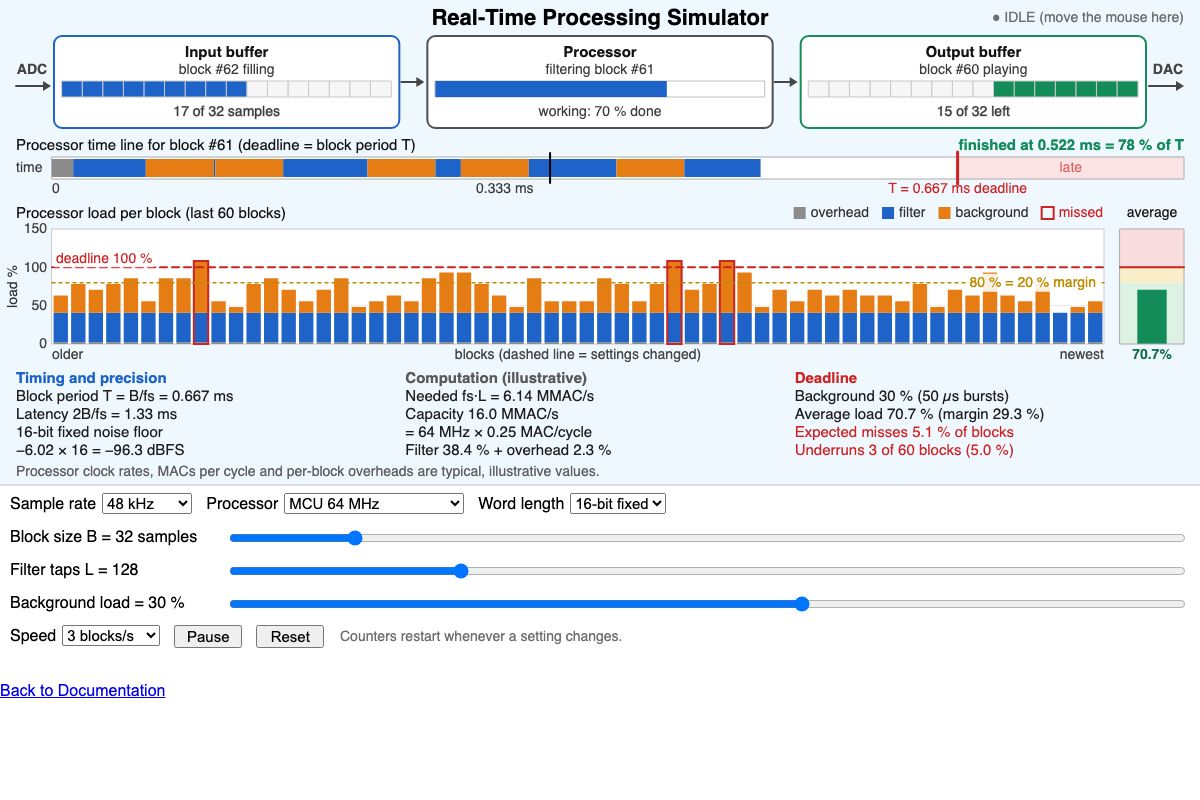
Explore block size, latency, processor load and deadlines in a double-buffered real-time FIR filter running on an MCU, Cortex-M4, DSP or FPGA.
-
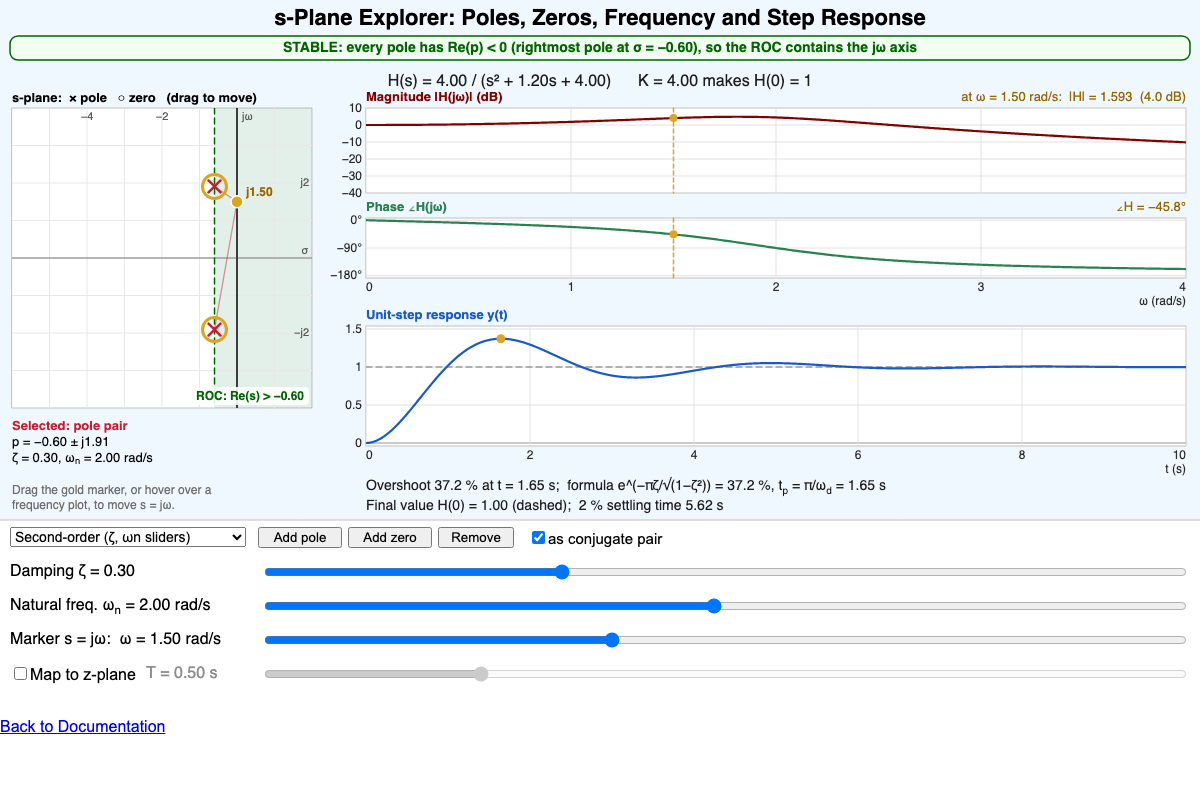
Drag poles and zeros in the s-plane and watch the frequency response along the jω axis, the step response, the ROC, stability, and the z = e^(sT) map.
-
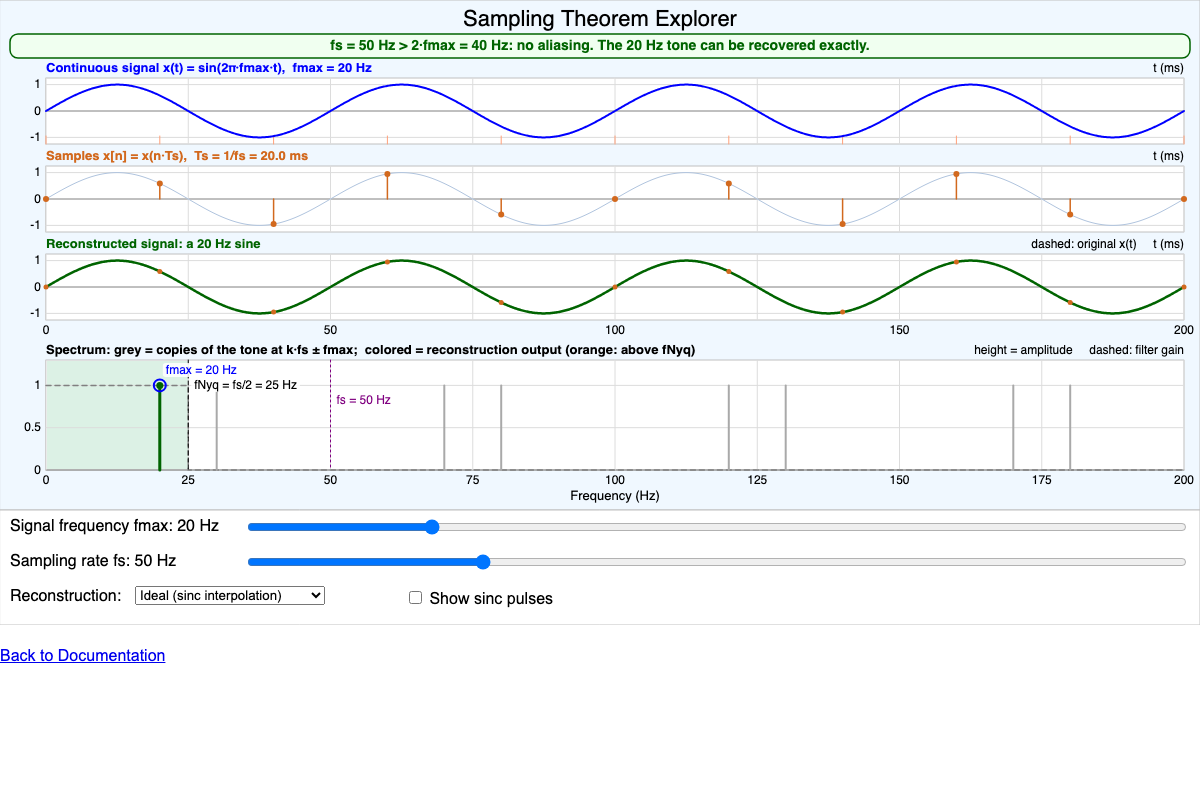
Sample a sine wave at an adjustable rate, rebuild it from its samples, and see why a tone above the Nyquist frequency folds to a lower alias frequency.
-
Signal Operations - Shift, Scale and Reverse
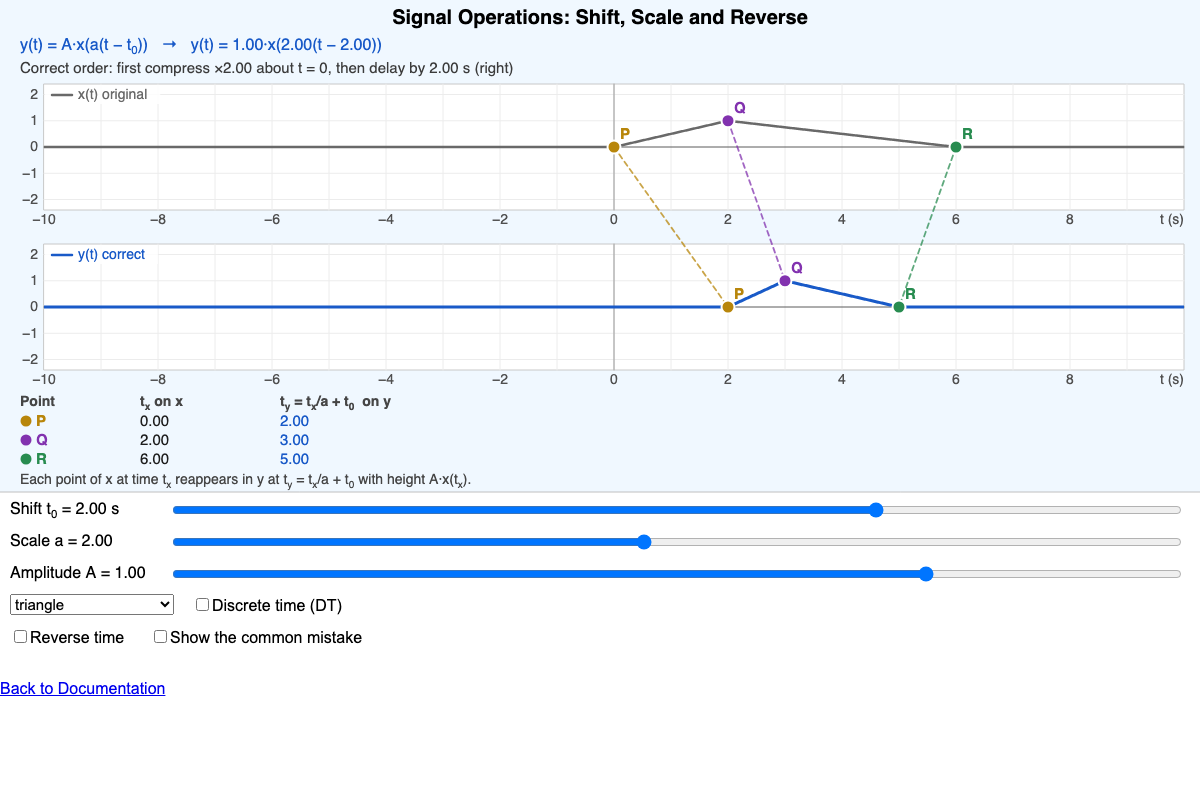
Transform elementary signals by time shifting, time scaling and time reversal, and track which points of x(t) map to which points of y(t).
-

Pan and zoom a timeline of 50 milestones in the history of electronic signal processing, from the telegraph in 1837 to cloud-based processing in 2022.
-
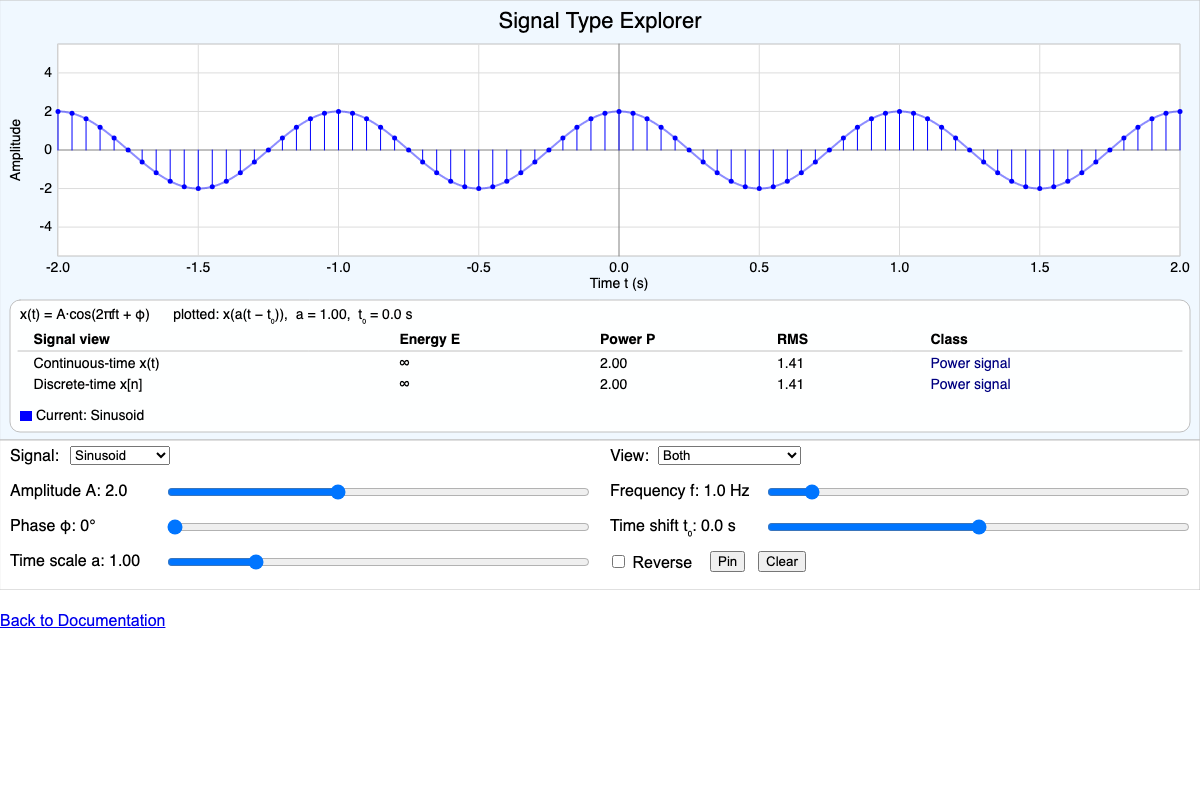
Compare continuous-time and discrete-time views of four basic signals and see how amplitude, frequency, phase, shift and scale affect energy, power and RMS.
-

Plot y(t) = A sin(2πt/T + φ) and use three sliders to see how amplitude, period and phase change a sine wave, with frequency and time-shift read-outs.
-

Play a music clip through a convolution reverb, set the decay time and the dry/wet mix, and watch the reverb tail fade after the source stops.
-
Spectral Leakage and Windowing
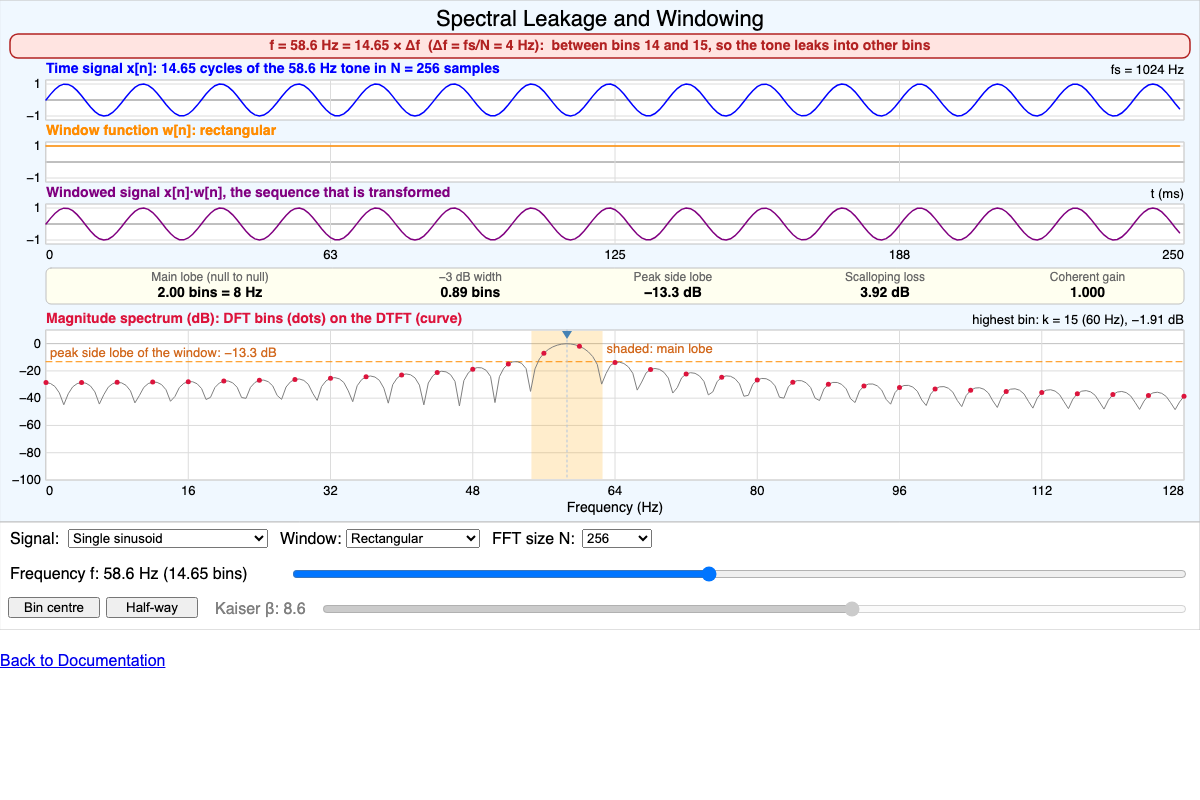
Move a tone between DFT bin centres to see spectral leakage, then compare how rectangular, Hamming, Hanning, Blackman and Kaiser windows trade main-lobe width against side-lobe level.
-

A scrollable timeline of ten landmark synthesizers, from the 1920 Theremin to the 1987 Roland D-50, in three color-coded categories.
-
System Interconnections - Series, Parallel, Feedback
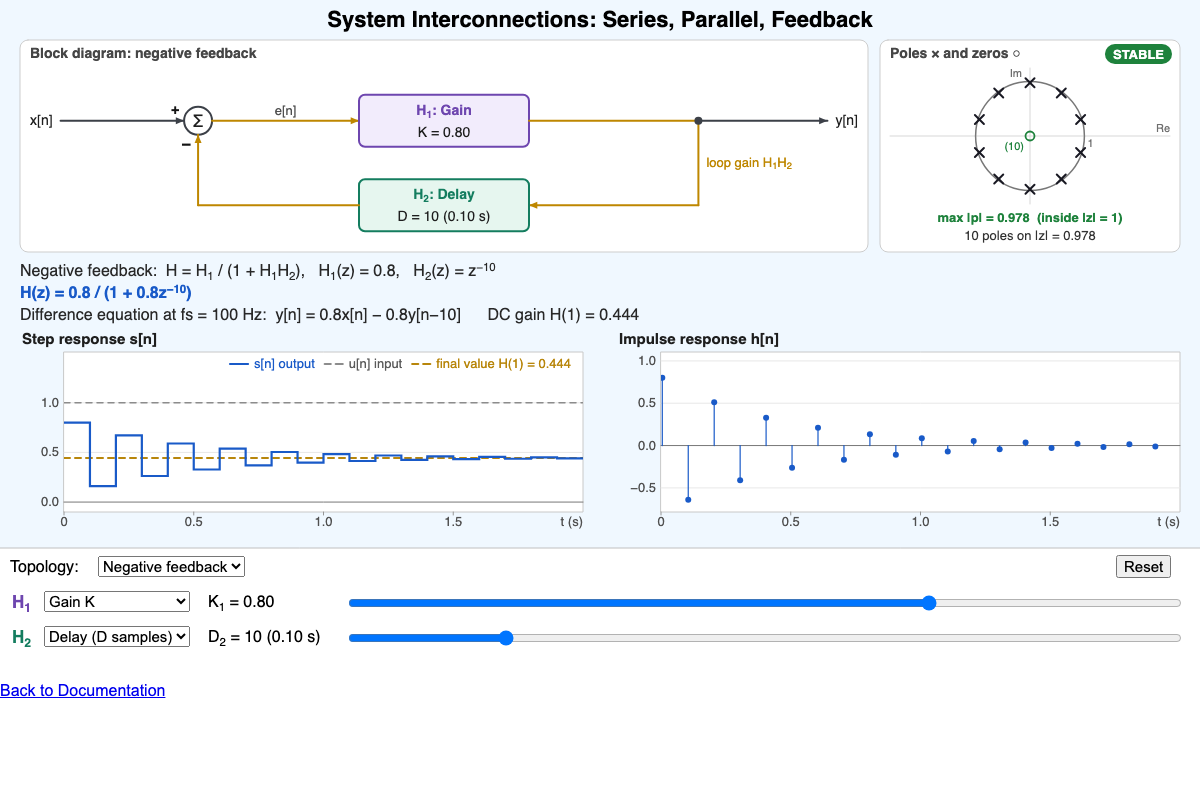
Connect gain, low-pass and delay blocks in series, parallel, negative feedback or feedforward and see the overall H(z), its poles, stability and responses.
-
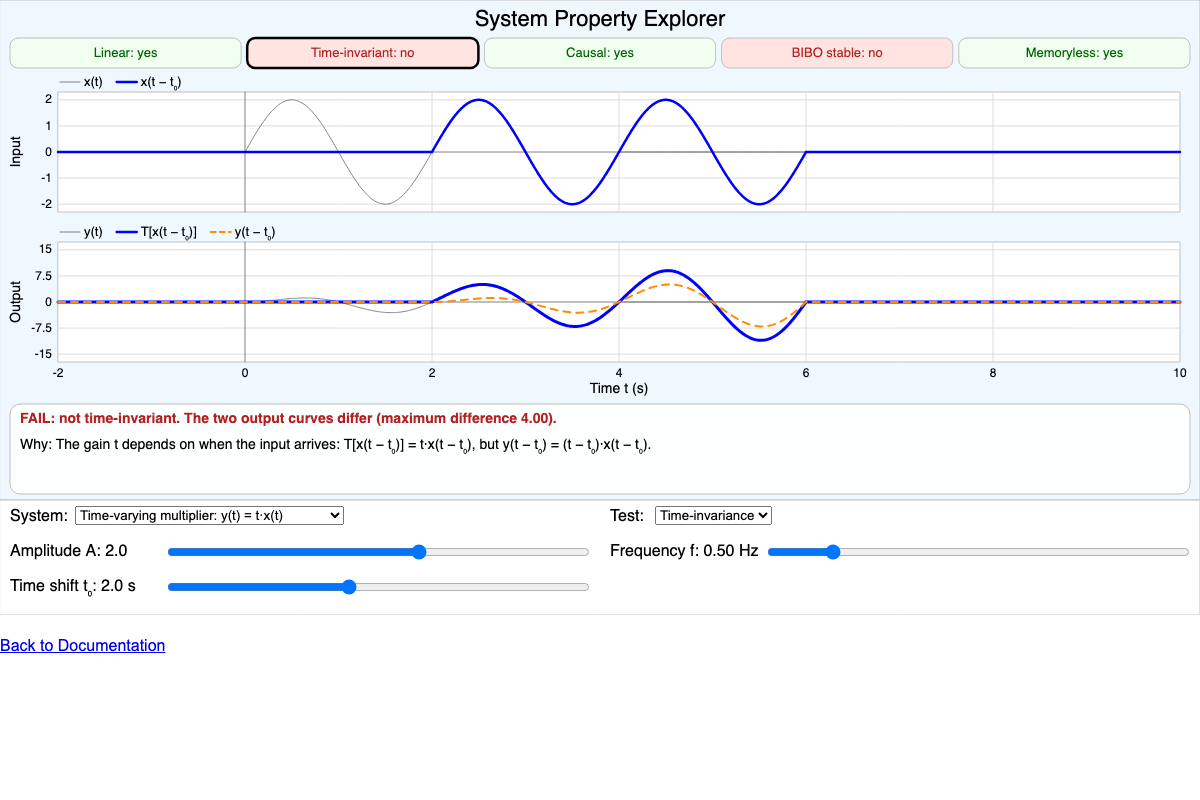
Run linearity, time-invariance, causality and BIBO stability tests on eight example systems and see which properties each system has, and why.
-
Time-Frequency Analysis Explorer
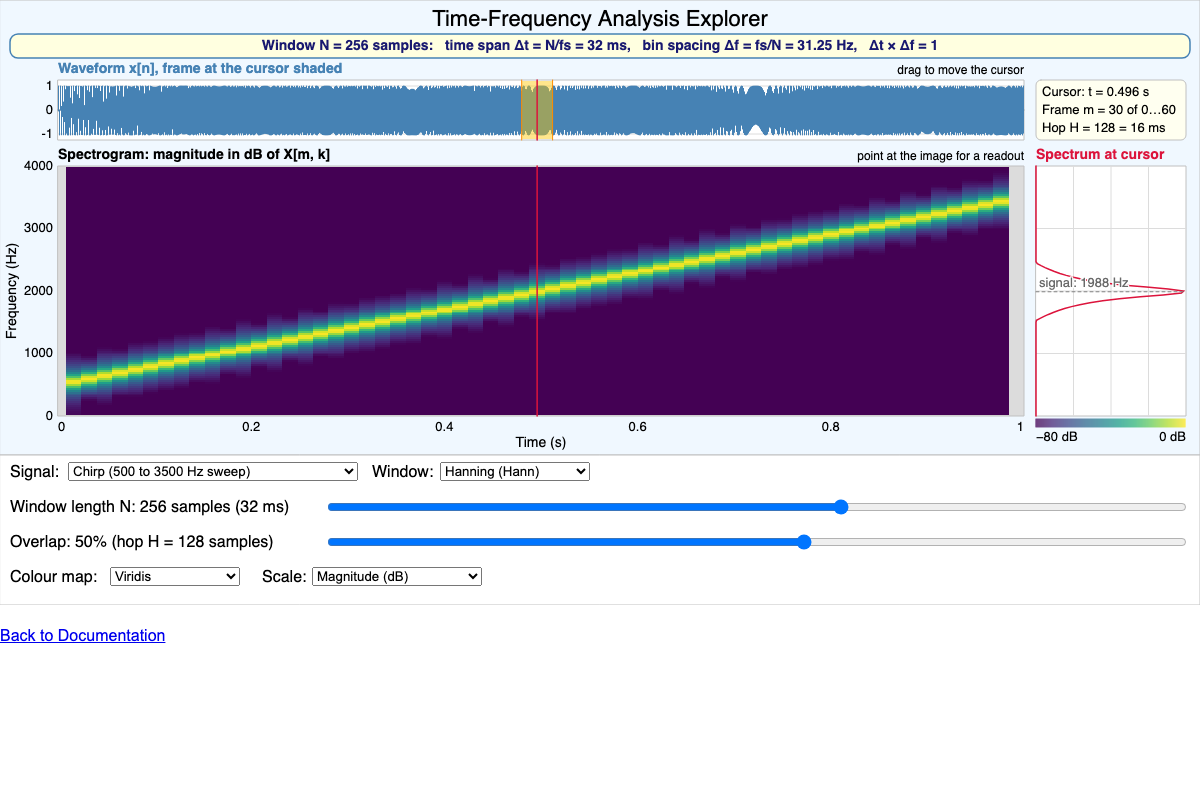
Compute spectrograms of a chirp, an FSK signal and a note sequence, and vary the STFT window length, overlap and type to see the time-frequency trade-off.
-

A sine-wave tone generator with a live FFT spectrum - hear the tone, set its frequency and amplitude, and watch its single spectral peak move.
-
Wavelet Explorer - CWT Scalogram and Haar DWT
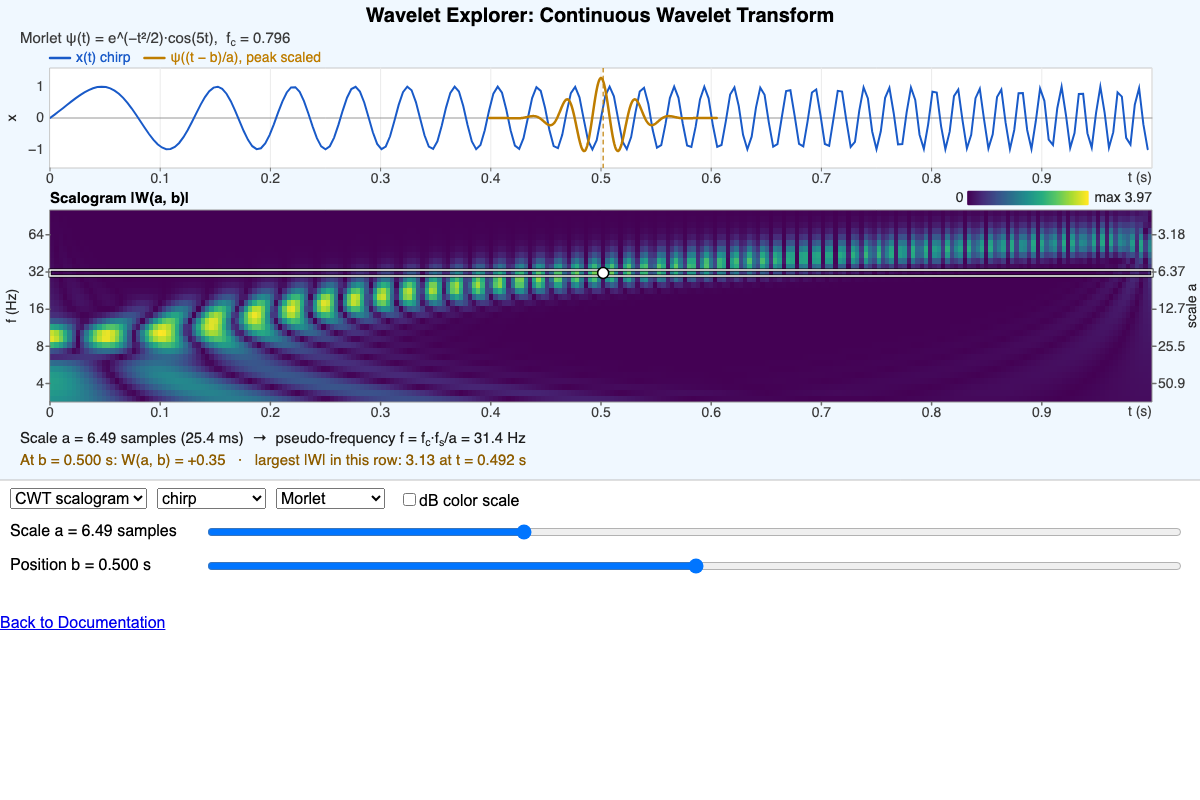
Compare a continuous wavelet transform scalogram (Morlet, Mexican hat, Haar) with a multilevel Haar DWT, and denoise a signal by hard thresholding.
About This Book
MicroSims that explain how this intelligent textbook is designed and built.
-

Interactive stepped pyramid of the six levels of Bloom's taxonomy, Remember to Create. Hover over or tap a level to read its description.
-

Interactive workflow diagram showing how a course description becomes a learning graph that feeds book-level outputs and chapter-level content.
-
Five Levels of Intelligent Textbooks

Hover over, tap or press 1 to 5 on a stair-step diagram to compare the five levels of intelligent textbooks, from static (Level 1) to autonomous AI (Level 5).
-

Explore the 200-concept learning graph of this course. Filter concepts by taxonomy category, search by name and read live node, edge and orphan counts.
-
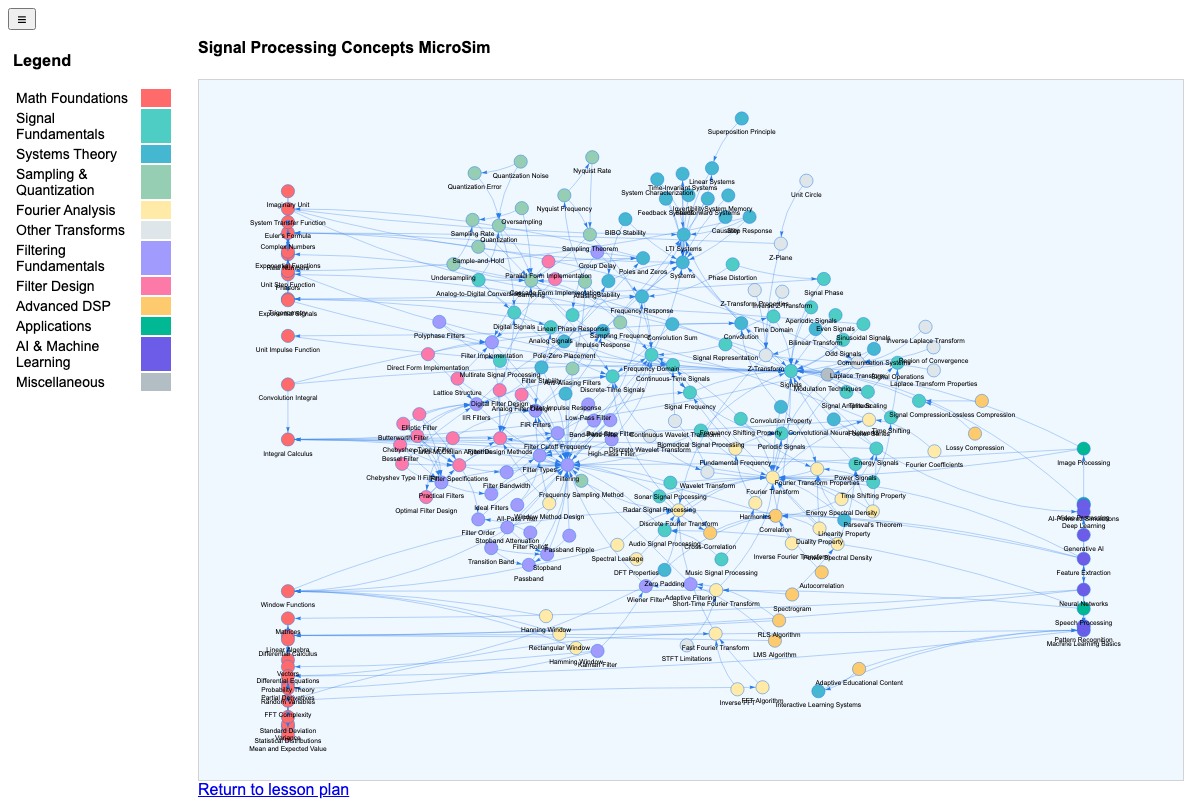
Superseded first version of the learning graph viewer, with Math Foundations nodes pinned left and Applications and AI nodes pinned right.
-

A word cloud of 51 key signal processing terms, sized by relative weight, that previews the vocabulary students meet in this book.
-

A timeline of 23 AI milestones from 1956 to 2025 with a slider that bends the time axis so you can see how milestones cluster in recent years.