List of Electrical Circuit Symbols
The following alphabetical reference shows 100 common electrical and electronic circuit symbols.
555 timer
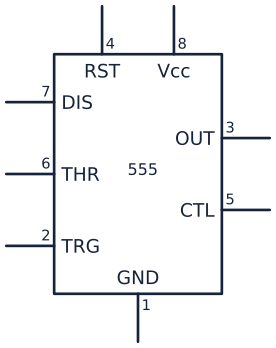
A 555 timer is used to generate delays, pulses, and oscillating signals.
AC current source

An AC current source supplies a current that periodically reverses direction.
AC voltage source

An AC voltage source supplies a voltage that periodically reverses polarity.
Ammeter

An ammeter is connected in series to measure electric current.
Analog meter

An analog meter uses a moving pointer to display an electrical measurement.
AND gate

An AND gate produces a high output only when all of its inputs are high.
Antenna

An antenna transmits or receives electromagnetic radio-frequency signals.
Audio jack

An audio jack provides a detachable connection for analog audio signals.
Battery

A battery supplies DC electrical energy from two or more cells.
Battery cell

A battery cell represents a single electrochemical source of DC voltage.
Bipolar transistor (NPN)

An NPN bipolar transistor is used for current-controlled switching and amplification.
Bipolar transistor (PNP)

A PNP bipolar transistor is used for high-side switching and current-controlled amplification.
Bridge rectifier
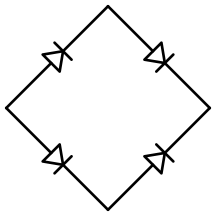
A bridge rectifier converts both halves of an AC waveform into pulsating DC.
Buffer gate
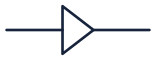
A buffer gate strengthens or isolates a digital signal without inverting it.
Bus connection

A bus connection shows a group of related conductors joining a circuit bus.
Capacitor

A capacitor stores electric charge and is used for filtering, timing, coupling, and energy storage.
Chassis ground

Chassis ground marks a connection to a device's conductive frame or enclosure.
Circuit breaker

A circuit breaker automatically opens a circuit during an overload and can be reset.
Coaxial connector

A coaxial connector joins a shielded cable while preserving its center conductor and outer shield.
Controlled current source

A controlled current source produces current determined by another circuit voltage or current.
Controlled voltage source

A controlled voltage source produces voltage determined by another circuit voltage or current.
Crystal

A crystal provides a highly stable resonant frequency for oscillators and clocks.
Current source

A current source supplies a specified current largely independent of its load voltage.
D flip-flop
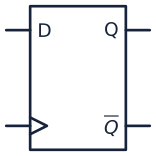
A D flip-flop stores one bit by capturing its data input on a clock transition.
DC voltage source

A DC voltage source maintains a fixed-polarity potential difference.
DIAC
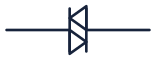
A DIAC conducts in either direction after its breakover voltage is reached and commonly triggers TRIACs.
Diode

A diode conducts primarily in one direction and is used for rectification and protection.
DIP switch

A DIP switch provides a compact bank of manual configuration switches.
DPDT switch

A double-pole double-throw switch changes two separate circuits between two paths.
DPST switch

A double-pole single-throw switch opens or closes two separate circuits together.
Earth ground

Earth ground marks a conductive connection to the physical earth for safety or reference.
Female connector

A female connector or jack accepts a mating plug to make a removable connection.
Fuse

A fuse melts and permanently opens a circuit when excessive current flows.
Galvanometer

A galvanometer detects or measures small electric currents with a sensitive moving coil.
Header connector

A header connector provides an organized row or grid of removable signal and power connections.
IGBT (N-channel)

An N-channel IGBT provides gate-controlled switching for high-voltage or high-current loads.
IGBT (P-channel)

A P-channel IGBT represents a complementary insulated-gate bipolar power switch.
Inductor

An inductor stores energy in a magnetic field and is used in filters and power converters.
Integrated circuit
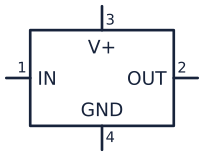
An integrated-circuit symbol represents a packaged electronic function with multiple pins.
Inverter (NOT gate)

A NOT gate produces the opposite logical state from its input.
JFET (N-channel)

An N-channel JFET controls current through an N-type channel with a reverse-biased gate.
JFET (P-channel)

A P-channel JFET controls current through a P-type channel with a reverse-biased gate.
Junction

A junction dot marks conductors that are electrically connected at the same node.
Lamp

A lamp converts electrical energy into light and may also serve as an indicator or load.
LED

A light-emitting diode produces light when forward biased and is used for indication or illumination.
Microphone

A microphone converts sound into an electrical signal.
Motor

A motor converts electrical energy into rotational mechanical motion.
Multiplexer
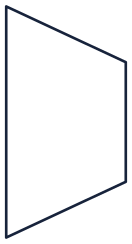
A multiplexer selects one of several inputs and connects it to a single output.
NAND gate

A NAND gate produces a low output only when all of its inputs are high.
Neon lamp

A neon lamp glows when its gas ionizes and is commonly used as a high-voltage indicator.
NMOS transistor

An NMOS transistor is a voltage-controlled device widely used for low-side switching and digital logic.
No connection

A no-connection mark identifies a pin or wire end that is intentionally left unconnected.
NOR gate

A NOR gate produces a high output only when all of its inputs are low.
Operational amplifier
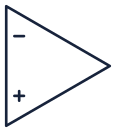
An operational amplifier amplifies the voltage difference between its two inputs.
Optocoupler
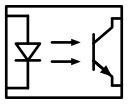
An optocoupler transfers a signal with light to provide electrical isolation.
Oscilloscope

An oscilloscope displays how an electrical signal changes over time.
Outlet
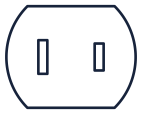
An outlet represents a mains receptacle that supplies power to a connected load.
Photodiode

A photodiode converts incident light into current and is used as a light sensor.
Photoresistor

A photoresistor changes resistance with light level and is used for simple light sensing.
Phototransistor (NPN)

An NPN phototransistor uses light to control collector current for sensitive optical detection.
Phototransistor (PNP)

A PNP phototransistor uses light to control a complementary transistor current path.
Plug

A plug is the male half of a removable electrical connector.
PMOS transistor

A PMOS transistor is a voltage-controlled device commonly used for high-side switching and CMOS logic.
Potentiometer

A potentiometer is an adjustable three-terminal resistor used as a voltage divider.
Pulse source

A pulse source produces timed voltage transitions for testing switching and digital circuits.
Push button (normally closed)

A normally closed push button opens its contacts only while it is pressed.
Push button (normally open)

A normally open push button closes its contacts only while it is pressed.
Reed switch

A reed switch changes state in response to a nearby magnetic field.
Relay
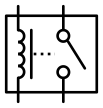
A relay uses an energized coil to operate electrically isolated switch contacts.
Resistor

A resistor limits current, divides voltage, and sets operating conditions in a circuit.
Rotary switch

A rotary switch selects one of several circuit connections by turning a shaft.
Sawtooth source

A sawtooth source generates a ramp waveform with a rapid return for timing and sweep circuits.
Schmitt trigger
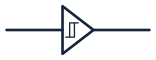
A Schmitt trigger adds hysteresis so a noisy or slowly changing input becomes a clean digital signal.
Schottky diode

A Schottky diode provides fast switching and a low forward-voltage drop.
SCR

A silicon-controlled rectifier latches on after a gate trigger and controls high-power current.
Seven-segment display
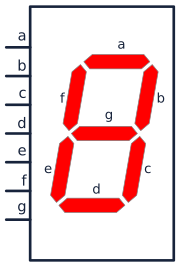
A seven-segment display combines illuminated bars to show decimal digits.
Signal ground

Signal ground marks the common reference node used by low-level circuit signals.
Solar cell
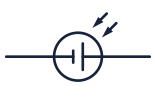
A solar cell converts light energy directly into electrical energy.
Spark gap

A spark gap conducts across an air gap when the voltage exceeds its breakdown level.
SPDT switch

A single-pole double-throw switch connects one common terminal to either of two paths.
Speaker

A speaker converts an electrical audio signal into sound.
SPST switch

A single-pole single-throw switch simply opens or closes one circuit path.
Square-wave source

A square-wave source alternates sharply between two levels for clocks and switching tests.
Terminal

A terminal marks a designated point for connecting a wire, lead, or external circuit.
Thermistor

A thermistor changes resistance with temperature and is used for sensing or current limiting.
Transformer

A transformer transfers AC energy between windings for voltage conversion or isolation.
Tri-state buffer

A tri-state buffer can drive high, drive low, or disconnect its output electrically.
TRIAC

A TRIAC controls AC power by conducting in either direction after a gate trigger.
Tunnel diode

A tunnel diode uses negative differential resistance for very fast switching and oscillation.
Vacuum tube diode

A vacuum tube diode permits electron flow from a heated cathode to an anode for rectification.
Varactor diode

A varactor diode acts as a voltage-controlled capacitor in tuning and RF circuits.
Variable capacitor

A variable capacitor adjusts capacitance for tuning resonant and filter circuits.
Variable resistor
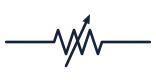
A variable resistor provides an adjustable resistance for calibration or control.
VDD supply

VDD marks the positive supply rail in MOS and digital circuits.
Voltmeter

A voltmeter is connected in parallel to measure potential difference.
VSS supply

VSS marks the lower or negative supply rail in MOS and digital circuits.
Wheatstone bridge
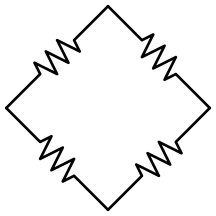
A Wheatstone bridge compares resistances and is used for precise sensing and measurement.
XNOR gate

An XNOR gate produces a high output when its inputs have the same logical state.
XOR gate

An XOR gate produces a high output when its inputs have different logical states.
Zener diode

A Zener diode maintains a nearly constant reverse voltage for regulation and protection.