List of MicroSims for Circuits 1
Interactive Micro Simulations to help students learn electronic circuits fundamentals.
-
Interactive circuit simulation with horizontal and vertical switches controlling animated current flow.
-
Interactive simulation showing electron flow through a wire circuit with adjustable speed and spacing.
-
Interactive audio signal chain from microphone to speaker with adjustable preamp gain, tone controls, and volume. Color-coded meters show bass, mid, and treble levels with clipping indicators.
-
Reference demonstration of the background grid layout used in MicroSims, showing the plot region and controls region.
-
Explore how the Q factor controls bandwidth and frequency selectivity by observing the bandpass frequency response curve, -3dB points, and passband shading.
-
Interactive simulation demonstrating battery symbols in horizontal and vertical orientations.
-
Simple animated DC circuit showing current flow when a switch is closed.
-
Interactive simulation showing capacitor symbols with different values in horizontal and vertical orientations.
-
Animate charge flow and observe voltage, current, and energy graphs during RC circuit charging and discharging.
-
Compare series and parallel capacitor combinations side-by-side with real-time equivalent capacitance calculation.
-
Interactive test demonstration of the p5.js circuit component drawing library, showing all available symbols.
-
Interactive 2D visualization of electrical circuits based on content similarity using D3.js force-directed layout.
-
Interactive flashcard trainer for learning circuit schematic symbols with flip animation and quiz mode.
-
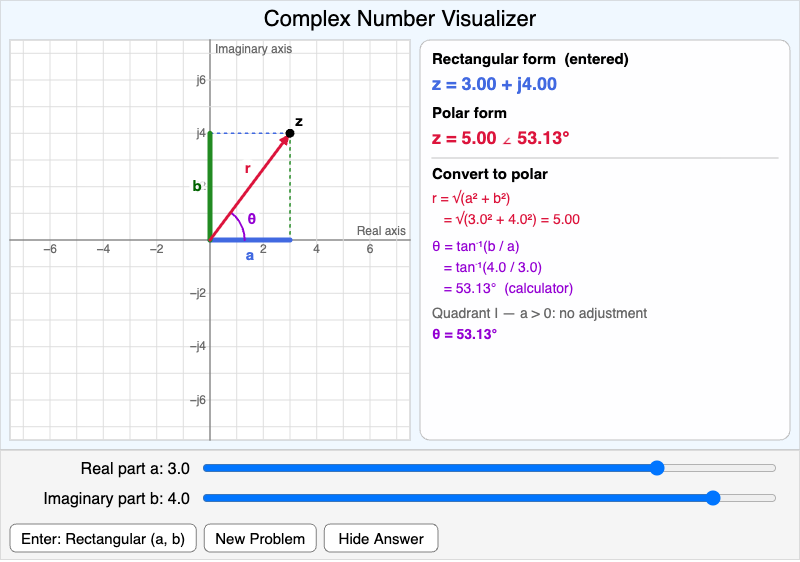
Plot a complex number on the complex plane and follow the worked conversion between rectangular form a + jb and polar form, with a quiz mode for practice.
-
Animated current meter showing how current is measured in a simple circuit.
-
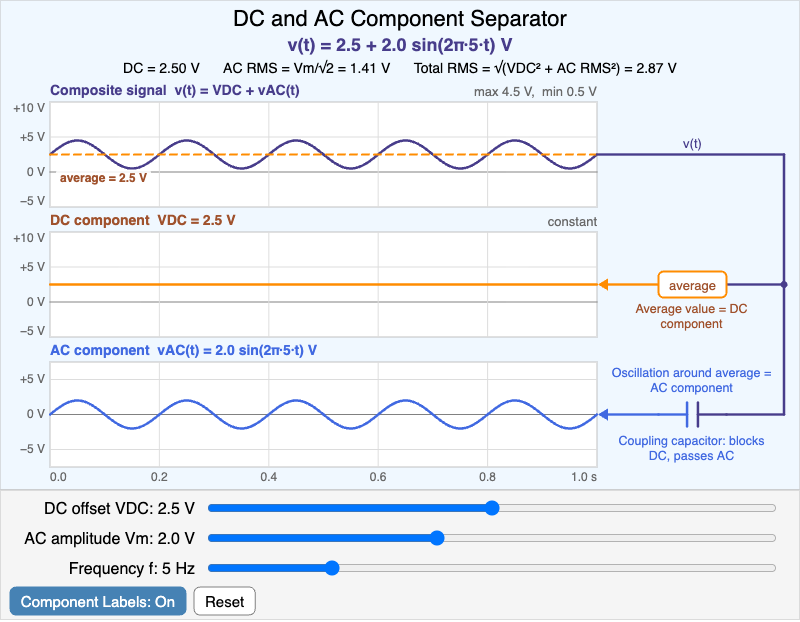
Split a composite signal into its constant DC component and its oscillating AC component on three stacked plots that share one voltage scale.
-
Interactive dB calculator converting between linear ratios and decibels, with a vertical audio SPL reference scale.
-
Demonstration of diode schematic symbol drawing in a circuit context.
-
Euler's Formula on the Unit Circle
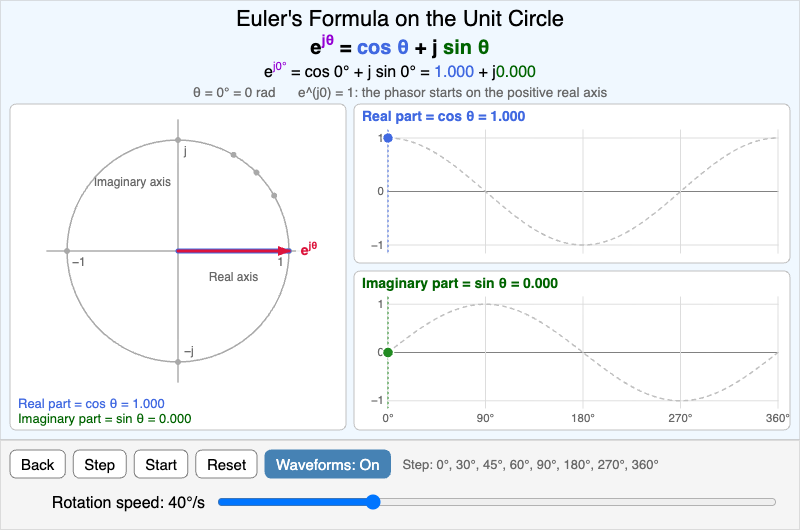
Step or rotate a unit phasor around the complex plane and watch its real and imaginary projections trace the cosine and sine waveforms.
-
Interactive MicroSim examining the tangent-line property, constant-ratio property, and derivative relationship of the exponential response.
-
Interactive Bode plot for RC low-pass and high-pass filters. Adjust R and C with sliders to see the cutoff frequency and magnitude response update in real time.
-
Compare RC and RL implementations of low-pass and high-pass first-order filters with adjustable cutoff frequency and resistance.
-
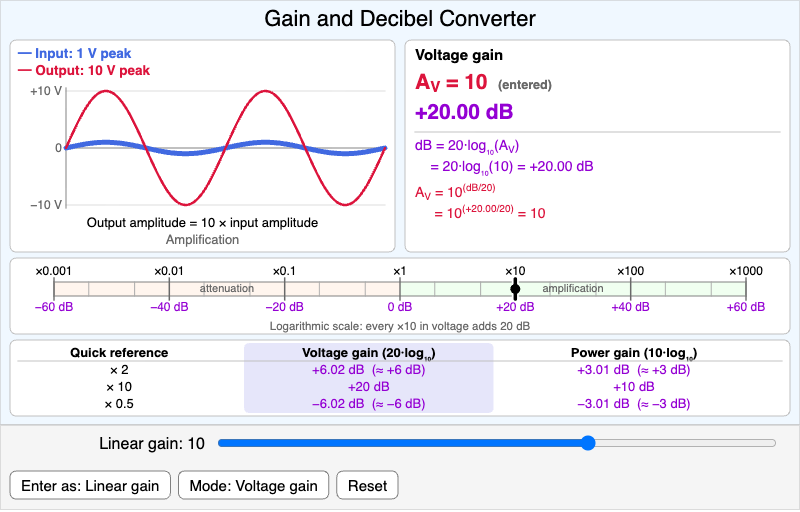
Convert between linear gain and decibels for voltage and power gains, with input and output signals and a logarithmic scale.
-
Interactive reference guide for identifying and distinguishing between different ground symbols used in circuit schematics.
-
Interactive chart comparing the linear I-V characteristic of a resistor with the nonlinear exponential characteristic of a diode.
-
Visualize the relationship between resistance, reactance, and impedance magnitude using an interactive right-triangle diagram with real-time calculations.
-
Interactive simulation showing inductor symbols with different values in horizontal and vertical orientations.
-
Step-through MicroSim for finding V(0-), V(0+), V(∞), and τ in RC and RL switching circuits.
-
Interactive MicroSim teaching KVL, KCL, mesh current method, and node voltage method using a live two-mesh circuit with adjustable components.
-
Interactive visualization of the Circuits 1 course learning graph showing concept dependencies.
-
Open learning graph viewer for exploring concept relationships and dependencies across the course.
-
Interactive circuit simulation with a switch-controlled light bulb showing animated current flow.
-
Visualize magnetic field coupling between two inductors with animated field lines, coupling coefficient, and induced voltage.
-
Interactive calculator for the natural frequency of an LC circuit, showing the inverse square root relationship on a log-log plot.
-
Interactive Ohm's Law triangle — click any section to solve for voltage, current, or resistance, with instant power calculation.
-
Interactive comparison of inverting amplifier, non-inverting amplifier, and voltage follower with real-time gain and waveform display.
-
Step through how negative feedback creates the two golden rules — virtual short and zero input current — in an inverting amplifier.
-
Interactive oscilloscope simulator with graticule, triggered waveform display, V/div, T/div, trigger controls, and automatic measurements.
-
Interactive visualization of how plate area, separation, and dielectric material affect capacitance.
-
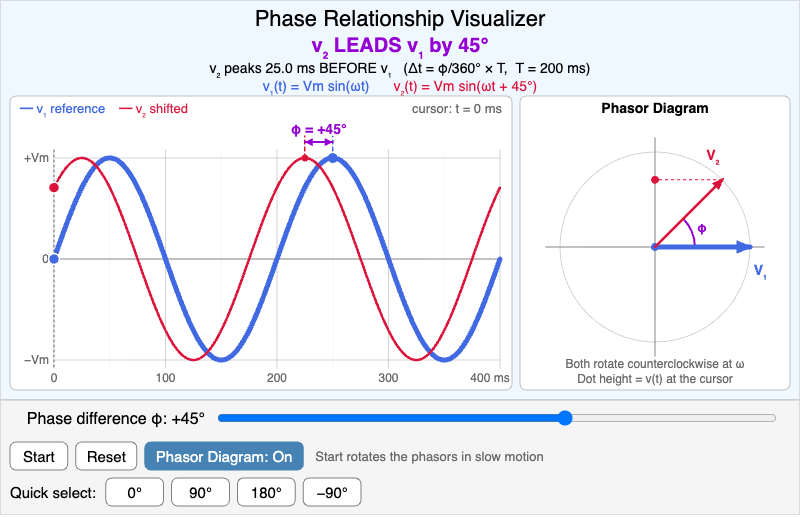
Compare two sinusoids of the same frequency on a waveform plot and a phasor diagram to see which one leads and which one lags.
-
Add two sinusoidal signals graphically using phasor head-to-tail construction and verify the result against time-domain waveforms.
-
Solve a series RLC circuit step-by-step in the phasor domain, computing impedances, current, and component voltages with a live phasor diagram.
-
Animate a rotating phasor on the complex plane and observe how its real-axis projection generates a time-domain sinusoid.
-
Interactive power triangle for learning power, voltage, current, and resistance relationships using P=VI and Ohm's Law.
-
Interactive simulation of an RC charging circuit with animated electron flow and real-time voltage and current graphs.
-
Interactive MicroSim exploring four practical RC/RL timing circuits — camera flash, 555 timer, relay protection, and audio coupling.
-
Explore how inductive and capacitive reactance vary with frequency on a log-log plot, and identify the resonant crossover point where XL equals XC.
-
Compare ideal vs real capacitor impedance across frequency, with ESR and ESL parasitics and self-resonant frequency marker.
-
Interactive simulation showing resistor symbols with different values in horizontal and vertical orientations.
-
Compare impedance and current behavior of series and parallel RLC circuits as frequency sweeps through resonance, highlighting their opposite responses.
-
Interactive simulation of an RL circuit showing inductor energizing and de-energizing with animated current flow and real-time graphs.
-
Interactive simulation of a series RLC circuit showing overdamped, critically damped, and underdamped step responses with real-time Vc and IL graphs.
-
Side-by-side AC and DC circuits demonstrating that Vrms delivers the same average power as an equivalent DC voltage.
-
Design second-order RLC filters by adjusting center frequency and Q factor across Low-Pass, High-Pass, and Band-Pass configurations.
-
Interactive sinusoidal waveform with labeled amplitude, period, frequency, phase, and optional reference signal overlay.
-
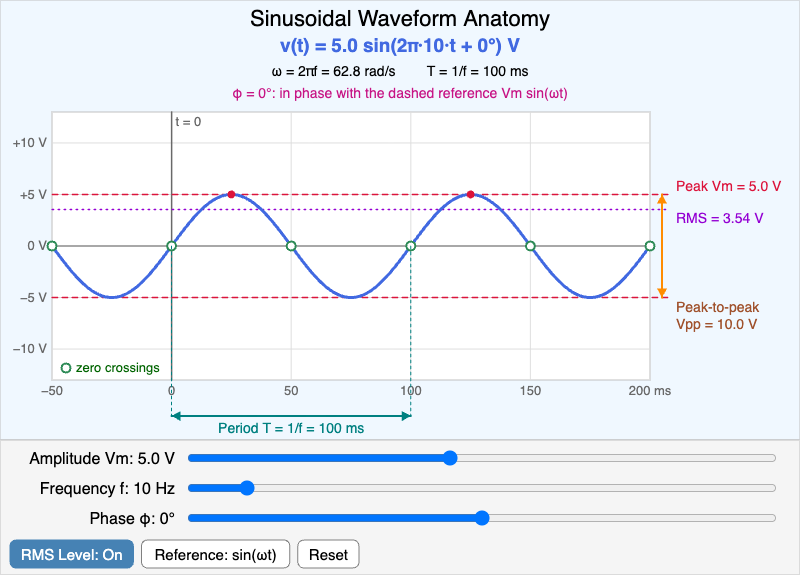
Label the peak, peak-to-peak, RMS level, period, zero crossings and phase shift of a sinusoid while sliders change amplitude, frequency and phase.
-
Interactive simulation demonstrating on/off switch symbols in horizontal and vertical orientations.
-
A 5-stage interactive MicroSim demonstrating how any linear circuit can be replaced by a Thévenin equivalent voltage source in series with resistance.
-
Interactive dual-mode calculator for designing voltage divider circuits to produce specific output voltages.
-
Interactive simulation comparing water flow in pipes to electric current in wires, demonstrating voltage-pressure and current-flow rate analogies.
-
Basic wire visualization demonstration for circuit simulations.