Appendix B — Joseph Campbell and the Patterns That Shape All Stories
Overview
Every story you have ever loved — a novel, a film, a myth, a fairy tale — is built from pieces you have encountered before. The orphan who discovers a hidden gift. The ordinary world shattered by a sudden call to adventure. The mentor who appears just when all seems lost. The dark cave the hero must enter alone. The triumphant return home, changed beyond recognition. These patterns are not clichés. They are something far older and far more interesting: they are the grammar of the human imagination, recurring across thousands of years and every culture on earth, as reliably as the grammar of language.
One man spent his entire life mapping that grammar. His name was Joseph Campbell, and what he found changed the way the twentieth century told stories — and the way many of its greatest storytellers understood their craft.
This appendix tells Campbell's story: where he came from, what he discovered, how he described the patterns he found, and why his work still matters to every reader, writer, and student of literature. It ends with a case for why you, as a student of English Language Arts, should care deeply about the same patterns Campbell devoted his life to studying — because recognizing those patterns is one of the most powerful tools a storyteller and critical reader can possess.
What's the Story Here?
 Pip has a question for you before we begin: have you ever finished a movie or a book and felt, somehow, that you had experienced it before — even though you were certain you had never seen or read it? That feeling is not déjà vu. It is pattern recognition. Your brain, shaped by thousands of years of story, is responding to a structure it already knows. Joseph Campbell spent his life figuring out why.
A Young Man's Restless Education
Joseph Campbell was born on March 26, 1904, in White Plains, New York, the son of an Irish-American wholesale hosiery merchant and his wife. By the time he was seven years old, his father had taken him to see Buffalo Bill's Wild West show at Madison Square Garden, and something shifted permanently inside the boy. He was transfixed — not by the cowboys, but by the Native Americans. Their regalia, their ceremony, their mythology. He began reading everything he could find about their traditions and stories, haunting the American Museum of Natural History in New York, where the museum's Hall of Northwest Coast Indians became something like a second home. Here was a child who recognized, even then, that these stories were pointing at something profound — something that the polite categories of school could not quite hold.
He excelled at Dartmouth College, where he began as a biology student, and then transferred to Columbia University to study English and comparative literature. He was a gifted student, intellectually restless, and an accomplished athlete — he ran a record-setting sprint that made national news. But the world he was most interested in sprinting through was not the quarter-mile track. It was the world of ideas.
At Columbia, Campbell studied medieval literature and fell under the spell of the Arthurian legends — the story cycles surrounding King Arthur, the Holy Grail, Lancelot, and Guinevere. These stories, he noticed, had a peculiar quality: they were obviously Christian in their surface imagery, yet beneath that surface they carried echoes of something much older and stranger, something that felt Celtic and pagan and mythological in a way that the Church had never fully extinguished. A character might be presented as a Christian knight, but their behavior followed patterns that belonged to an older story grammar — a grammar of magical forests, shape-shifting, trials and initiations, and encounters with the supernatural.
Campbell graduated from Columbia with his bachelor's degree in 1925 and earned his master's degree there in 1927, writing his thesis on Arthurian legend. Then Columbia sent him to Europe on a fellowship, and the course of his intellectual life changed completely.
The World Opens Up: A Global Turn
In Paris in the late 1920s, Campbell did what brilliant young Americans on European fellowships have always done: he haunted bookshops and libraries, attended lectures, and fell in love with ideas that were not yet available in the United States. He studied Old French and Provençal at the Sorbonne, continuing his medieval work. But Paris was also the capital of a new wave of anthropology and comparative mythology, and Campbell began reading widely beyond his medieval specialty. He encountered the work of Leo Frobenius, the German ethnologist who had studied African mythology and argued for deep structural parallels between mythological systems on different continents. He read deeply in Sigmund Freud's new psychoanalytic theory, which claimed that the images and symbols of dreams — the labyrinth, the dragon, the wise old man — recurred universally because they arose from the shared architecture of the human psyche. Most influentially of all, he encountered the work of Carl Gustav Jung.
Jung, a Swiss psychiatrist and psychologist who had broken from Freud, proposed that beneath the individual unconscious lay a deeper layer he called the collective unconscious — a shared psychic inheritance, common to all human beings, populated by universal figures he called archetypes. The Great Mother. The Shadow. The Trickster. The Hero. The Wise Old Man. These were not learned images, Jung argued; they were structural features of the human mind itself, as universal as the capacity for language. Campbell read Jung with growing excitement. Here was a theoretical framework that could explain what he had been noticing in medieval literature: that the same figures kept appearing, wearing different cultural costumes but playing the same psychological roles, across texts that had never had contact with one another.
Then he went to Germany, studied Sanskrit, and began reading Indian mythology. And everything he had believed about the centrality of the Western tradition — the assumption, common among literary scholars of his era, that the great mythological inheritance of humanity ran from ancient Greece through Rome through medieval Europe through the Renaissance — began to dissolve. Indian mythology was older, vaster, and in many ways more psychologically sophisticated than anything in the Western canon. And it used the same archetypes. The same patterns. The same narrative grammar.
Campbell returned to Columbia to work on his doctorate, but he found he could no longer fit his thinking into the narrow compartments the academy required. Academic departments in the 1920s and 1930s studied their traditions in silos: classicists studied Greek and Roman texts, medievalists studied medieval European texts, Orientalists studied Indian and East Asian texts, and anthropologists studied "primitive" cultures. Nobody was asking the cross-cultural question that had seized Campbell's imagination: why do all these traditions, developed in isolation from one another, tell the same stories?
The Great Depression began in 1929, and Columbia's fellowship funding dried up. Campbell, without money for further graduate study and without a dissertation that the department quite knew how to evaluate, withdrew from the doctoral program. He spent the next five years at a small cabin in Woodstock, New York, reading with systematic ferocity. He read Greek mythology, Indian mythology, Buddhist scripture, Sumerian and Babylonian texts, African folklore, Native American stories, and the latest anthropological fieldwork from the South Pacific. He read James Joyce's Ulysses and Finnegans Wake with obsessive attention, convinced that Joyce had rediscovered, through sheer literary genius, the same mythological grammar Campbell was mapping. He read Thomas Mann's great novels, which consciously drew on mythological archetypes to give modern psychological dramas a resonant depth. He was, in a literal sense, teaching himself — but teaching himself more rigorously, and more broadly, than any graduate program of his era could have accommodated.
In 1934, he joined the faculty of Sarah Lawrence College, a small liberal arts college in Bronxville, New York, where he would teach for thirty-eight years. And he began to write.
The Power of Asking Cross-Cultural Questions
 Notice what Campbell did that most scholars of his era did not: he refused to study just one tradition. He asked comparative questions — not "what does this mean in its own context?" but "why does this same pattern appear in cultures that have never met?" That is a different kind of question, and it requires a different kind of courage. The academic world of his time considered it undisciplined. Campbell considered it essential. When you study literature, ask both kinds of questions.
The Hero with a Thousand Faces: The Book That Changed Everything
In 1949, Campbell published The Hero with a Thousand Faces, and the study of mythology was never quite the same. The book's central argument was bold to the point of audacity: beneath the enormous surface variety of the world's myths, heroes' tales across every culture follow a single structural pattern, which Campbell called the monomyth — a term he borrowed from James Joyce's Finnegans Wake.
The book synthesized material from Greek mythology (Odysseus, Theseus, Prometheus), Hindu mythology (Krishna, the Buddha's enlightenment story), Aztec mythology, Norse mythology, Navajo and Pueblo ceremonial narratives, the stories of the Old and New Testament, African trickster tales, Australian Aboriginal dreamtime stories, and dozens of other traditions. Campbell's prose was not the dry, footnote-heavy style of academic scholarship; it was vivid, urgent, and written with the conviction of a man who believed he had discovered something important about what human beings are.
He described the hero's journey in seventeen stages, organized into three phases: Departure, Initiation, and Return.
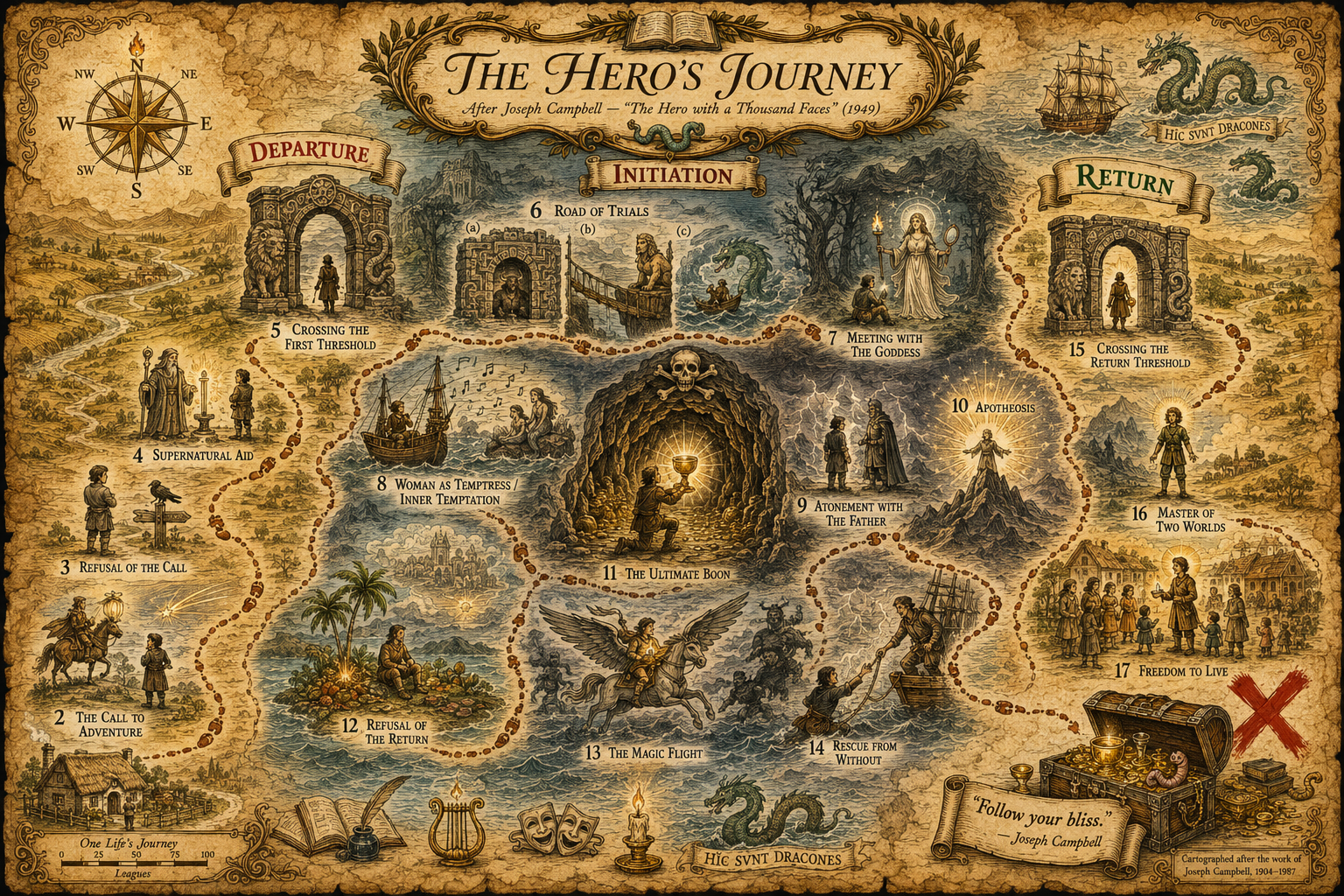
The pattern, in its essentials, goes like this:
A hero — often ordinary, often young, often unaware of their own potential — lives in a familiar world that suddenly becomes inadequate. Something calls them to adventure. They resist the call, are frightened of what it demands. A supernatural helper appears — a mentor, a guide, a magical talisman. The hero crosses a threshold from the ordinary world into a special world governed by different rules, where they face tests and trials. At the deepest point of the journey, the hero confronts the supreme ordeal — a death or death-equivalent, a descent into the innermost cave — and is transformed. They seize what Campbell called the boon or reward: a treasure, a knowledge, a power. Then they must find a way back. The return is often as difficult as the departure. And when the hero finally returns to the ordinary world, they bring back something that can heal, renew, or enrich the community they came from.
The following table shows how this pattern maps across six very different narrative traditions, spanning thousands of years and every inhabited continent. The surface details change; the grammar does not.
| Stage | Greek — Odyssey | Hindu — Ramayana | West African — Sundiata | Norse — Prose Edda (Odin) | Modern — Star Wars | Modern — Harry Potter |
|---|---|---|---|---|---|---|
| Ordinary World | Ithaca, king returned from war | Ayodhya, beloved prince | Mali, crippled king's son | Asgard, king of gods | Tatooine, moisture farm | Cupboard under the stairs |
| Call to Adventure | Athena commands the return journey | Sita abducted by Ravana | Exile and soothsayer's prophecy | Quest for wisdom; hanging on Yggdrasil | Leia's holographic message | Letter from Hogwarts |
| Refusal / Obstacle | Calypso's island; winds of Aeolus | Duty vs. grief, exile orders | Physical disability, mockery of nobles | Odin sacrifices himself willingly — no refusal | Uncle won't release Luke; family dies | Dursleys' suppression |
| Supernatural Helper | Athena, Circe, Tiresias | Hanuman, Jatayu, monkey army | Griot Balla Fasséké, divine buffalo | Mimir's well, Valkyries | Obi-Wan Kenobi, the Force | Dumbledore, Hagrid |
| Threshold Crossing | Departure from Calypso | Crossing the sea to Lanka | Exile into the wilderness | Hanging nine nights on Yggdrasil | Leaving Tatooine for Alderaan | Crossing onto Platform 9¾ |
| Tests and Allies | Sirens, Cyclops, Scylla | Battle preparations, alliances | Forging armies, testing character | Acquiring the runes | Mos Eisley, the Death Star | Hogwarts years, Quidditch, dark arts |
| Supreme Ordeal | Descent into the underworld (Hades) | Battle with Ravana | Battle of Kirina | Death and resurrection via Yggdrasil | Trench run, destroying the Death Star | Facing Voldemort in the Mirror Chamber |
| Seizing the Boon | The route home reclaimed | Sita rescued; dharmic order restored | Kingdom of Mali founded | The runes: language, wisdom, magic | Death Star destroyed; princess freed | Sorcerer's Stone protected; truth of parents revealed |
| Return | Voyage home, suitors slain | Coronation, return to Ayodhya | Return to Mali as true king | Return to Asgard with transformed wisdom | Medal ceremony; heroes honored | Return to Hogwarts for next year |
| Gift to Community | Ithaca restored; order reestablished | Righteous kingship modeled | Malian empire established | Runes given to humanity for knowledge | The galaxy's freedom | The wizarding world protected |
Campbell traced this pattern across cultures not because he thought mythmakers had borrowed from one another (though sometimes they had), but because he believed the pattern arose from the structure of the human psyche itself. Several stages deserve special attention because they carry the greatest psychological and narrative weight across all mythological systems.
The Refusal of the Call is one of the most psychologically honest stages in the whole pattern. The hero, confronted with the demand to change and grow, says no. Moses argues with God that he cannot lead Israel because he is a poor speaker. The Buddha-to-be, Siddhartha, lingers in the palace despite the signs of suffering outside its walls. Frodo in Tolkien's The Lord of the Rings tells Gandalf repeatedly that he is a hobbit of the Shire and wants no part of adventures. Hamlet knows he must act and cannot. This refusal is not weakness; it is psychological realism. To leave the ordinary world — to truly depart, not just geographically but psychologically, to let go of the identity you have built — is terrifying. The myths that include the refusal are, Campbell argued, the most honest about what transformation actually costs.
The Atonement with the Father is one of the most complex and symbolically dense stages. In many hero tales, the supreme ordeal is not a battle with an external monster but a confrontation with the father figure — the authority, the power, the system of judgment that has governed the hero's life. This confrontation may be literal (as in Star Wars, where Luke literally faces Darth Vader, who is both villain and father) or figurative (as in Hamlet, where the dead father's command is both the call to adventure and the source of the hero's psychological paralysis). What the stage requires is not the defeat of the father but a transformation of the relationship: the hero must come to see the father not as an absolute authority but as a flawed human being — and in doing so, must claim their own authority. It is, psychologically, the stage of mature individuation: the moment when a person stops defining themselves in relation to the parent (as either obedient child or rebel) and claims a self that is genuinely their own.
The Road of Trials — the sequence of tests, obstacles, and encounters in the special world — is where character is revealed and built. Campbell observed that in the great hero tales, the trials are rarely random; they test exactly what the hero needs to develop in order to accomplish the supreme ordeal. Odysseus must learn to resist the enchantments of Circe, the song of the Sirens, and the comfort of Calypso's island — all tests of his attachment to ease and pleasure over the hard purpose of homecoming. Luke Skywalker must learn to trust the Force — to let go of rational control and act from something deeper. Arjuna in the Bhagavad Gita must learn, on the eve of battle, to act from duty rather than personal feeling. In each case, the trials are a curriculum: they teach exactly what the supreme ordeal will demand.
The Magic Flight and the Rescue from Without are stages that appear in many hero tales and that modern storytelling often omits or compresses. After seizing the boon, the hero frequently cannot get back alone; they need help from outside, a grace that was not earned but is freely given. Campbell saw this as mythologically significant: the hero's journey is not finally about individual achievement but about the relationship between the individual and the community. The boon is not won by the hero alone; it is given, in some sense, as a gift that flows through the hero toward the people who need it.
The hero's journey, in his reading, was a map of psychological maturation — the journey every individual must undertake to move from childhood dependence through the trials of transformation to adult wholeness. Myth, on this account, was not primitive science, not mere entertainment, and not historical record. It was a technology of psychological development, encoded in story form so that it could be transmitted across generations.
The Four Functions of Myth
If The Hero with a Thousand Faces mapped the structure of the monomyth, Campbell's four-volume masterwork The Masks of God (published between 1959 and 1968) went deeper, asking a more fundamental question: what is mythology for? What work does it do in a culture? Why do human beings make myths at all?
Campbell's answer identified four distinct functions that myth serves in every culture where it appears. These functions are not separate; in a living mythology, they work together, reinforcing one another. But distinguishing them helps us see how deeply myth is woven into the fabric of human life — and how much contemporary storytelling, even when it looks purely secular, still performs the same functions.
The Mystical Function: Opening to Wonder
The first and most fundamental function of myth is what Campbell called the mystical function: to awaken in the individual a sense of awe, gratitude, and wonder at the sheer mystery of being alive. Before myth explains anything, before it teaches anything, it opens a door in the mind — a door into the uncanny, the inexplicable, the sacred.
In virtually every culture's mythological tradition, there are stories that exist not to explain natural phenomena or to enforce social rules but simply to induce a particular quality of attention: the recognition that existence is astonishing, that the universe is larger and stranger than ordinary perception suggests, and that human life participates in something vast and ultimately mysterious.
The Zen Buddhist koan — the paradoxical question that short-circuits rational thinking and forces a direct encounter with consciousness itself — is a highly distilled form of this function. But the same function operates in the opening chapters of the book of Genesis, where the cosmos emerges from void and darkness; in the Lakota Sioux creation story, where a spider woman weaves the world into being from the four directions; in the Greek myth of Chaos giving birth to Eros and the first gods; and in the Māori creation narrative of the world separating from the primordial embrace of Ranginui the sky father and Papatūānuku the earth mother.
The mystical function appears in literature wherever writing creates what the poet Keats called "negative capability" — the capacity to remain in uncertainty and mystery without irritably reaching for fact or reason. When a reader finishes a great novel or a powerful poem and feels, not a resolved explanation, but an enlarged and humbled sense of life's complexity, the mystical function of storytelling has done its work. It is why great literature about grief does not explain grief away; why great literature about love does not reduce love to a manageable description; why great literature about death does not pretend to know what lies beyond it.
The Cosmological Function: Mapping the Universe
The second function of myth is cosmological: to offer an image of the universe that makes sense of the human being's place within it. Every culture, before and after science, has needed a story about where the cosmos came from, how it is structured, why it operates the way it does, and where humanity fits within it.
In the ancient Mesopotamian Enuma Elish, the universe was created from the body of the slain chaos-dragon Tiamat: sky from one half of her body, earth from the other, mountains from her skull. This was not naive materialism; it was a cosmological story that told the Babylonian listener something important about the nature of order (it must be won from chaos), about the nature of the sacred (the world is made of something divine), and about the relationship between human civilization and the larger forces that surround it.
In Hindu cosmology, the universe is not a fixed creation but a cyclical process — endlessly creating and dissolving, with the god Vishnu sleeping in the cosmic ocean between cycles, dreaming the next world into existence. Time is not linear but cyclical, measured in units so vast (yugas, kalpas) that human history is a brief flicker in an immeasurable process. The cosmological message is profoundly different from the biblical one: not that the world was made for humanity, but that humanity is a momentary event in a process of incomprehensible duration.
The cosmological function in modern storytelling often operates through science fiction and speculative fiction, which asks the same questions myth has always asked — what is the nature of time? Is the universe purposive or indifferent? What is the relationship between mind and matter? — and answers them with the best tools of the present moment. When a student reads The Left Hand of Darkness by Ursula K. Le Guin, or Slaughterhouse-Five by Kurt Vonnegut, or Dune by Frank Herbert, they are engaging cosmological storytelling: stories that offer an image of the universe and ask the reader to consider where humanity belongs within it.
The Sociological Function: Holding Society Together
The third function is sociological: myth validates and maintains the moral order of the society in which it operates. It tells people what the rules are, who holds authority, what is sacred and what is profane, what the correct roles are for men and women and elders and children, and what happens to those who transgress.
This function is the most culturally variable of the four, because what counts as the correct social order differs dramatically from one culture to another. The caste mythology of ancient India — which told a story of how the four social classes (varnas) were created from different parts of the divine being Purusha, with Brahmins from the mouth, warriors from the arms, merchants from the thighs, and servants from the feet — was a mythological validation of a deeply hierarchical social order. The revolutionary mythology of the United States — with its founding stories of liberty, equality, self-determination, and the right to overthrow unjust authority — validates a very different social order.
Campbell was careful to distinguish between the living mythological function and the dead one. A mythology performs its sociological function effectively when it is genuinely believed and lived — when it connects people to something larger than their individual interests and makes the social order feel, not merely enforced, but meaningful and sacred. When a mythology is no longer believed — when people comply with its social demands outwardly but feel no inner resonance with its symbols — it becomes what Campbell called a "dead mythology," maintained by institutional power but no longer nourishing the human soul.
He saw evidence of this dying in twentieth-century Western culture, and it troubled him. He believed that one reason modern people were experiencing such widespread anxiety, meaninglessness, and social fragmentation was that the traditional mythologies that had once provided a shared cosmological and sociological framework — primarily Christian mythology in the West — had been eroded by scientific materialism without being replaced by new living mythologies adequate to the modern world.
Myths Can Outlive Their Origins
The sociological function explains something puzzling in literature: why do stories that were originally told to validate a specific, long-gone social order still speak to us? Because the deepest myths are not just about social rules — they carry the other three functions beneath the social surface. When the surface social mythology fades, the mystical, cosmological, and pedagogical layers can still resonate. That is why we read Greek myths without believing in Zeus, and why Hamlet still speaks even though Elizabethan court culture is centuries gone.
The Pedagogical Function: Guiding the Stages of Life
The fourth function is pedagogical (from the Greek paidagōgos, a guide or teacher): myth guides the individual through the stages of life, providing symbolic frameworks — often enacted in ceremony and ritual — that help a person navigate the major transitions from birth to death.
Every culture has rites of passage: ceremonies that mark the transition from one life stage to another. Initiation ceremonies that transform children into adults. Marriage ceremonies. Funeral rites. In traditional cultures, these ceremonies were embedded in living mythological systems and were psychologically powerful precisely because they drew on the accumulated symbolic vocabulary of the culture to help the individual understand what was happening to them and what it meant.
The adolescent initiation ceremony in many African cultures, for instance, involves a ritual symbolic death and rebirth: the initiate is removed from the community, subjected to trials, and then welcomed back as an adult — as if they had died as a child and been born again as a man or woman. This is not merely theatrical. Anthropologists who have studied these ceremonies document that participants experience them as genuinely transformative — that the psychological shift enacted symbolically becomes psychologically real. The ceremony does the work of helping the adolescent let go of childhood identity and claim adult identity.
Campbell saw in the hero's journey a mythological template for this same process, scaled to any life transition, not just adolescence. Every major transition in life — leaving home, falling in love, confronting death, losing an identity that once felt central — has the structure of a hero's journey: a departure from the familiar, a crossing into difficulty and uncertainty, an encounter with something that transforms, and a return as a changed person. Myth, on this account, is not just entertainment or explanation. It is a psychological survival kit, written in story form, for the transformations that every human life inevitably faces.
The Evolution of Myth: From Campfire to Civilization
One of Campbell's most fascinating arguments concerned not just the structure of myth but its evolution — the way mythological systems change as the societies that carry them change.
In his four-volume The Masks of God, Campbell traced what he saw as four broad phases in the history of world mythology, each corresponding to a fundamental shift in the human relationship to the natural and social world.
The earliest mythological phase he called primitive mythology: the stories told by hunter-gatherer cultures around the world, characterized by a profound identification with the animal world and the natural landscape. In these mythologies, the distinction between human and animal is permeable — animals are teachers, ancestors, and spiritual beings; the shaman (the culture's specialist in crossing between ordinary and supernatural reality) often takes animal form on spirit journeys. The world is experienced as animate and communicative: every mountain, river, and animal is potentially a person, potentially in relationship with the human community. The great cave paintings at Lascaux and Altamira — images of bison, horses, and ibex rendered with breathtaking skill by Paleolithic artists — Campbell read as evidence of this mythological phase, as records of the sacred relationship between human hunters and the animals on whom their lives depended.
The second phase he called agricultural mythology, emerging roughly ten thousand years ago with the shift from hunting and gathering to farming. When human communities learned to plant seeds and harvest grain, the natural cycle of death and renewal became the central mythological metaphor. The earth itself became feminine and sacred — the Great Mother, the goddess of fertility, who receives the seed (and the dead) into her body and brings forth new life. The gods and goddesses of this phase are typically organized around the cycle of the agricultural year: birth, death, and resurrection. The Egyptian myth of Osiris — torn apart, scattered, mourned by Isis, reassembled, and resurrected — is a classic example. So is the Greek myth of Persephone, whose annual descent into the underworld and return explains the cycle of the seasons. So is the Sumerian myth of Inanna's descent. And, Campbell argued with characteristic boldness, so is the story of Jesus — whose death and resurrection follows the same mythological grammar as these much older agricultural dying-and-rising god myths.
The third phase, mythologies of the civilized world, emerged with the rise of urban civilization in Mesopotamia, Egypt, India, China, and Mesoamerica. These were hierarchical societies governed by kings who were understood to be living gods or divine representatives. The mythology of these cultures reflected their social organization: at the top, sky gods — sun gods, storm gods, warrior gods — mirroring the power of the military aristocracy. The old earth goddess mythologies were absorbed, diminished, or reinterpreted. The universe came to be understood as a cosmic kingdom, governed by divine law, with the earthly king as its terrestrial representative. This is the mythological world of the Epic of Gilgamesh, the Iliad, the Mahabharata, the Hebrew Bible, and the Roman epics — worlds of heroic warriors, divine kings, cosmic battles, and the establishment of civilized order against the forces of chaos.
The fourth phase — the one Campbell found most difficult and most urgent — was the emergence of what he called occidental mythology and what we might more broadly call the mythology of modernity: a world in which the old mythological frameworks have been shattered by science and individualism, leaving the modern person without a living myth adequate to the complexity of their situation. Campbell saw this not as progress but as a crisis — not because he wanted to return to pre-modern beliefs, but because he believed that the functions myth had always served (mystical, cosmological, sociological, pedagogical) were still urgently needed and had not been replaced. The individual in the modern world had to undertake the hero's journey essentially alone, without the community rituals and shared symbols that had once supported it.
Recognizing Mythological Phases in Literature
 When you study a myth or a story with mythological dimensions, ask: which phase does this mythology come from? Is it a hunter's world where animals have spiritual significance (primitive phase)? A farming world obsessed with fertility, death, and renewal (agricultural phase)? A kingdom-world with warrior gods and divine kings (civilized phase)? Placing a story in its mythological phase immediately tells you a great deal about its values, its conflicts, and the kind of hero it can imagine.
The Power of Myth: Campbell and George Lucas
Joseph Campbell spent most of his career writing books that were admired in academic circles and slowly gained a wider audience, but he was not a household name. That changed in two stages: first, slowly, through his influence on the filmmakers and storytellers who had read his work in the 1960s and 1970s; and then suddenly, in 1988, when a six-hour television conversation with journalist Bill Moyers — filmed at George Lucas's Skywalker Ranch and aired on PBS as The Power of Myth — made Campbell one of the most widely known thinkers in America.
The connection to George Lucas was the pivot point.
Lucas has spoken and written about his debt to Campbell at length. In the early 1970s, while developing what would become Star Wars, Lucas was struggling with a fundamental problem: he wanted to make a mythological epic — not a realistic science fiction film about technology and politics, but something that operated at the level of myth, that would speak to the same deep emotional and psychological needs that Homer and the Arthurian legends had addressed. He had read The Hero with a Thousand Faces and recognized it as a structural key.
"It was really The Hero with a Thousand Faces that was the breakthrough," Lucas told an interviewer years later. He described how Campbell's identification of the monomyth gave him both a structural template and a vocabulary for understanding why certain storytelling moves worked and others did not. When he looked at his early drafts of Star Wars against Campbell's framework, he could see where the story was working mythologically and where it was not. He revised accordingly.
The parallels between Star Wars: A New Hope (1977) and Campbell's monomyth are so precise that they are now routinely taught in screenwriting courses as a demonstration of the framework. Luke Skywalker lives in the ordinary world of Tatooine, a moisture farmer's son with no apparent destiny. He receives a call to adventure through a message from a mysterious princess, carried by a droid. He initially refuses the call — he has responsibilities, his uncle needs him. Then the catastrophe that destroys his ordinary world (his family killed, his home burned) forces the crossing. He meets his mentor, Obi-Wan Kenobi — the wise old man, the supernatural helper, the possessor of the special knowledge he will need. He crosses the threshold into a special world (the Mos Eisley cantina, then the galaxy at large). He endures tests and trials. He descends into the innermost cave (the Death Star, literally a death machine). He faces his supreme ordeal. He seizes his boon (the plans, the rescue of the princess, the destruction of the Death Star). He returns in triumph.
Campbell later described Star Wars as "the first popular myth of the new era." He was deeply moved by what Lucas had accomplished — not because Lucas had simply applied his framework like a recipe, but because Lucas had understood the framework at a deep enough level to fill it with genuine mythological energy. The film did not feel like a homework exercise in the monomyth; it felt like a myth, because Lucas had also done the work of creating specific, emotionally resonant characters, a richly imagined world, and images of genuine visual power. The framework was the skeleton; the genius was in the flesh.
When The Power of Myth aired on PBS in 1988, the year after Campbell's death at age 83, millions of Americans encountered his ideas for the first time in a form that was immediate, conversational, and clearly passionate. Campbell was a magnificent teacher — learned without being pedantic, serious without being solemn, and possessed of a speaking style that made listeners feel that the ideas he was discussing were not merely interesting but urgent, that understanding mythology was not an academic luxury but a practical necessity for navigating life.
The book that accompanied the series sold millions of copies. It introduced generations of readers to Campbell's central insights: that myths are not childish superstitions but the distilled wisdom of humanity's encounter with the great questions of existence; that the hero's journey is not just a narrative pattern but a map of the psychological process of transformation; and that the modern world's loss of living mythology was not a triumph to be celebrated but a wound to be understood and, if possible, healed.
The Monomyth in Modern Cinema and Literature
Campbell's influence on storytelling since Star Wars has been immeasurable, if also sometimes oversimplified. In 1992, writer Christopher Vogler published The Writer's Journey, a practical guide for Hollywood screenwriters that condensed Campbell's monomyth into twelve stages and showed how they applied to contemporary film. Vogler's guide was so widely read and so influential that it reshaped the internal culture of Hollywood story development; producers began asking whether scripts followed the hero's journey, and the framework became a standard part of screenwriting education.
The results are visible in the most successful films of the past forty years. Consider the following:
The Lion King (1994) follows Simba — an ordinary cub, a prince, who witnesses his father's murder and is driven into exile. The call back to his kingdom comes from his father's ghost. His mentor figure is the spirit of Mufasa, combined with the comic-but-wise guidance of Timon and Pumbaa. His supreme ordeal is the confrontation with Scar and the reclaiming of his identity. His return transforms the Pride Lands from wasteland to renewed paradise. Campbell could have written the outline himself.
The Matrix (1999) is so explicitly a Campbell narrative that it uses explicitly religious and mythological imagery to mark each stage. Neo is the "Chosen One" who doesn't believe in his own destiny — the refusal of the call made literal. Morpheus is the supernatural helper who offers the crossing of the threshold (the red pill). The ship Nebuchadnezzar and the city of Zion exist as the special world. Neo's death and resurrection at the film's climax is the supreme ordeal resolved through genuine transformation.
Harry Potter and the Sorcerer's Stone follows Campbell's pattern with the precision of a demonstration model: the orphan boy in the ordinary world of the Dursleys; the call to Hogwarts; the crossing of the threshold at Platform 9¾; the mentor in Dumbledore; the tests, allies, and enemies of Hogwarts itself; the descent into the chambers beneath the school; the supreme ordeal with Voldemort; the return to the end-of-year feast.
Black Panther (2018) works the monomyth through the lens of African mythological imagery and political resonance, using the hero's journey to explore questions of identity, heritage, responsibility, and the meaning of power in ways that carry genuine mythological weight. T'Challa's journey to the ancestral plane — where he meets his dead father and receives counsel — is a precise enactment of Campbell's "atonement with the father" and the encounter with the supernatural helpers.
Moana (2016) is notable for the way it uses Campbell's framework to tell a story about a young woman's discovery of her own identity and her people's heritage — a hero's journey in which the boon is not a weapon or a kingdom but a truth about who she is. The film also consciously engages with Campbell's cosmological function, setting the hero's journey within a created world of Polynesian mythology that has its own coherent theology and cosmology.
The prevalence of the monomyth in successful contemporary storytelling is not an accident, and it is not merely the result of screenwriters following Vogler's guide like a recipe. It reflects something Campbell identified correctly: that the hero's journey engages audiences at a level deeper than plot or character — at the level of psychological recognition. When we watch a hero cross a threshold into danger, something in us feels the weight of every threshold we have crossed. When we watch a hero face their supreme ordeal, something in us rehearses our own encounters with what we cannot avoid. When we watch the return, something in us celebrates not just the character's triumph but the possibility of transformation itself.
Why Pattern-Recognition is a Literary Superpower
Joseph Campbell is not merely a historical figure worth knowing about. He is an argument — an argument that the ability to recognize deep patterns in stories is one of the most powerful intellectual tools a reader, writer, and human being can develop.
Here is the core of that argument.
Stories are not just entertainment. They are, as Campbell showed, the primary technology by which human cultures transmit accumulated wisdom across generations. The stories that have survived — that appear in every culture, that endure across millennia, that continue to be told in new forms in each new era — have survived because they carry something that human beings need. They carry maps of the psychological landscape. They carry the pattern of growth, trial, and transformation. They carry images of what is worth fighting for and what must be surrendered. They carry the grammar of meaning.
A reader who can recognize these patterns — who watches The Matrix and thinks "this is a hero's journey; this is the call to adventure; this is the supreme ordeal; Campbell would say the red pill is the threshold crossing" — is doing something more than showing off their education. They are training a form of pattern recognition that will serve them in every act of reading and writing they ever undertake. They are building a mental library of narrative structures, character archetypes, and thematic patterns that will allow them to decode new stories more quickly, to analyze existing stories more deeply, and to make better choices when they construct their own stories.
Consider what this skill looks like in practice.
A reader with Campbell in their mental toolkit can pick up an unfamiliar mythology — a Yoruba trickster story, a Finnish Kalevala cycle, a Cherokee creation narrative, a medieval Japanese tale — and immediately begin to recognize the familiar grammar beneath the unfamiliar cultural surface. They can ask: what is the call to adventure here? Who is the threshold guardian? What does the boon represent? And in answering those questions, they can move from the surface of an unfamiliar text to its depths far more quickly than a reader without the framework.
A writer with Campbell in their mental toolkit can diagnose their own stories with precision. Why does this scene feel inert? Perhaps because the hero has not yet genuinely refused the call — they are going through the motions of adventure without the psychological weight of a real departure. Why does the climax feel empty? Perhaps because the supreme ordeal asks nothing of the hero that they have not already demonstrated; there is no genuine transformation, only technical triumph. Why does the ending feel unsatisfying? Perhaps because the hero has seized the boon but not completed the return — the story ends in the special world rather than bringing the treasure back to the community that needs it.
These are not tricks. They are diagnostic tools, developed from the observation of thousands of stories across thousands of years of human experience. They are the distilled wisdom of all the storytellers who came before, encoded in structural principles that a student can learn, practice, and apply.
And there is a further dimension to Campbell's legacy that is worth naming explicitly. Campbell was arguing, at the deepest level, not just for the importance of story but for the importance of the individual's engagement with their own life as a story — as a hero's journey that is genuinely theirs to undertake. In The Power of Myth, Moyers asked Campbell what advice he would give to young people. Campbell's answer has become perhaps his most quoted statement: Follow your bliss.
The phrase sounds simple, even trite, stripped of its context. But Campbell meant something precise and demanding by it. He was not saying "do whatever makes you happy." He was saying: follow the thing that calls you, even when it is difficult, even when the call takes you away from the safe ordinary world, even when everyone around you tells you to stay. The hero's journey is not a metaphor for a comfortable life. It is a map of the life that has meaning — the life that undertakes its ordeals, faces its supreme challenges, and comes back transformed.
Every great story you read is an invitation to recognize that pattern — and to recognize it not just on the page, but in your own life.
Campbell's Own Hero's Journey
It is worth noticing that Campbell's own life followed the pattern he described. His ordinary world was the narrowly defined academic career. His call to adventure was the restless, cross-cultural curiosity that could not be satisfied within its boundaries. His threshold crossing was the five years in Woodstock, reading without a map, without a salary, without institutional validation. His supreme ordeal was the long labor of synthesizing an enormous body of knowledge into a coherent argument. His boon was The Hero with a Thousand Faces. And his return — via The Power of Myth — brought that boon to an audience of millions who needed it. Recognizing this is not just biographical trivia. It is a demonstration that Campbell's framework, when truly understood, is not just a theory about stories. It is a theory about life.
A Compelling Case for the Pattern-Seeker
We can now make the argument plainly.
The English Language Arts skills you are developing in this course — close reading, analysis of character and theme, attention to structure and form, the ability to construct and evaluate arguments, the craft of writing with clarity and power — are all, at their deepest level, forms of pattern recognition. Close reading is the recognition of patterns at the level of the sentence. Thematic analysis is the recognition of patterns at the level of the whole text. Comparative literature is the recognition of patterns across texts. And what Campbell called mythology — the deep structure of human storytelling — is the recognition of patterns across all texts, across all cultures, across all of recorded human experience.
The reader who understands the hero's journey does not merely understand Star Wars or The Matrix or Moana better. They understand The Odyssey better — and they understand why Odysseus's journey home is not just a geographic adventure but a psychological one. They understand Hamlet better — and they can see why Hamlet's refusal of the call is not mere cowardice but the central psychological drama of the play, the place where Campbell's framework identifies exactly what is at stake. They understand Their Eyes Were Watching God better — and they can trace how Janie Crawford's journey from Eatonville to the horizon and back enacts a hero's journey in which the boon is not a sword or a grail but a voice, a self, a story worth telling.
They understand their own lives better.
That is the ultimate promise of Campbell's work, and the ultimate promise of literary education at its best: that the patterns you learn to recognize in stories are the same patterns that structure human experience, and that the more fluent you become in reading those patterns, the more clearly you will see the stories you are living.
Literature is not just a record of the past. It is not just training for the SAT or the AP exam. It is, as Campbell understood, the primary archive of human wisdom — the place where every generation has encoded what it learned about the journey of being alive, so that the next generation would not have to learn it entirely from scratch. The student who reads widely and attentively, who recognizes patterns across texts and cultures, who understands why certain stories recur and what they are really saying — that student is not just building a skill set. They are inheriting a tradition.
And traditions, as Campbell spent his life demonstrating, are worth understanding from the inside.
Applying Campbell: A Framework for Your Own Reading and Writing
Campbell's framework is most useful not as a checklist but as a set of questions you can bring to any story — one you are reading, one you are writing, or one you are living.
When reading or analyzing a story, ask:
- Who is the hero, and what is their ordinary world? What is inadequate or incomplete about it?
- What is the call to adventure? Is it refused, and if so, why?
- Who plays the role of the supernatural helper or mentor? What kind of knowledge or power do they provide?
- What is the threshold — the point of no return — and what does crossing it cost the hero?
- What are the trials and tests along the road, and what do they reveal about the hero's character?
- What is the supreme ordeal — the moment of maximum danger, the closest thing to death in the story? What does the hero learn there?
- What is the boon? Is it a physical treasure, a knowledge, a relationship, an identity?
- Does the hero complete the return? Do they bring the boon back to the community that needs it?
When writing your own stories, ask:
- Have I given my hero a genuine departure — a real cost to leaving the ordinary world?
- Is my mentor figure specific and earned, or is it a generic helpful stranger?
- Does my supreme ordeal actually require something of the hero, or does it just require skill?
- Does the hero return changed — not just victorious, but genuinely transformed by what they encountered?
When looking at your own experience, ask:
- What is my ordinary world right now? What is calling me beyond it?
- Where have I refused a call that I later regretted? Where have I crossed a threshold that changed me?
- Who has served as a mentor figure in my life — someone who appeared with the right knowledge at the right time?
- What is the boon I am working toward, and what community could it serve?
These are not questions with easy answers. They are questions worth sitting with — the same questions that every story worth reading has always been asking.
Every Story Is a Map
 Pip wants to leave you with this: Joseph Campbell read tens of thousands of stories from hundreds of cultures, and what he found at the center of all of them was a single, enduring human truth — that the journey toward meaning requires a departure, a trial, and a return; that the self must be risked before it can be renewed; that the treasure worth having is always on the other side of the thing we are most afraid of. Every story you read is a rehearsal for that journey. Every story you write is a map you are making for someone who will need it. Keep reading. Keep writing. The patterns are waiting to be found — and so, reader, is the story that is uniquely yours to tell.
Further Reading
- Campbell, Joseph. The Hero with a Thousand Faces. Pantheon Books, 1949. (Third edition: New World Library, 2008.) — The foundational text; the source of the monomyth argument.
- Campbell, Joseph, and Bill Moyers. The Power of Myth. Doubleday, 1988. — The companion book to the PBS series; the most accessible introduction to Campbell's ideas.
- Campbell, Joseph. The Masks of God. 4 vols. Viking Press, 1959–1968. — The comprehensive cross-cultural survey; the deepest account of the four functions of myth.
- Vogler, Christopher. The Writer's Journey: Mythic Structure for Writers. Michael Wiese Productions, 1992. (Third edition: 2007.) — The screenwriter's practical guide to the monomyth; how Hollywood absorbed Campbell.
- Jung, Carl Gustav. The Archetypes and the Collective Unconscious. Princeton University Press, 1959. — The theoretical foundation; Campbell drew heavily on Jung's concept of archetypes.
- Frazer, James George. The Golden Bough: A Study in Magic and Religion. Macmillan, 1890. — The great Victorian comparative mythology, a direct influence on Campbell.
- Le Guin, Ursula K. The Language of the Night: Essays on Fantasy and Science Fiction. Putnam, 1979. — A master storyteller applies Jungian and mythological thinking to her own craft.
- Budd, Michael, and Clay Steinman, eds. "Star Wars" and History. Wiley-Blackwell, 2012. — Scholarly essays on Lucas, Campbell, and the mythological dimensions of Star Wars.
- Segal, Robert A. Joseph Campbell: An Introduction. Garland, 1987. — A balanced academic introduction and critical assessment of Campbell's methods and conclusions.
- Larsen, Stephen, and Robin Larsen. A Fire in the Mind: The Life of Joseph Campbell. Doubleday, 1991. — The definitive biography; essential for readers who want the full story.