Learning Record Store
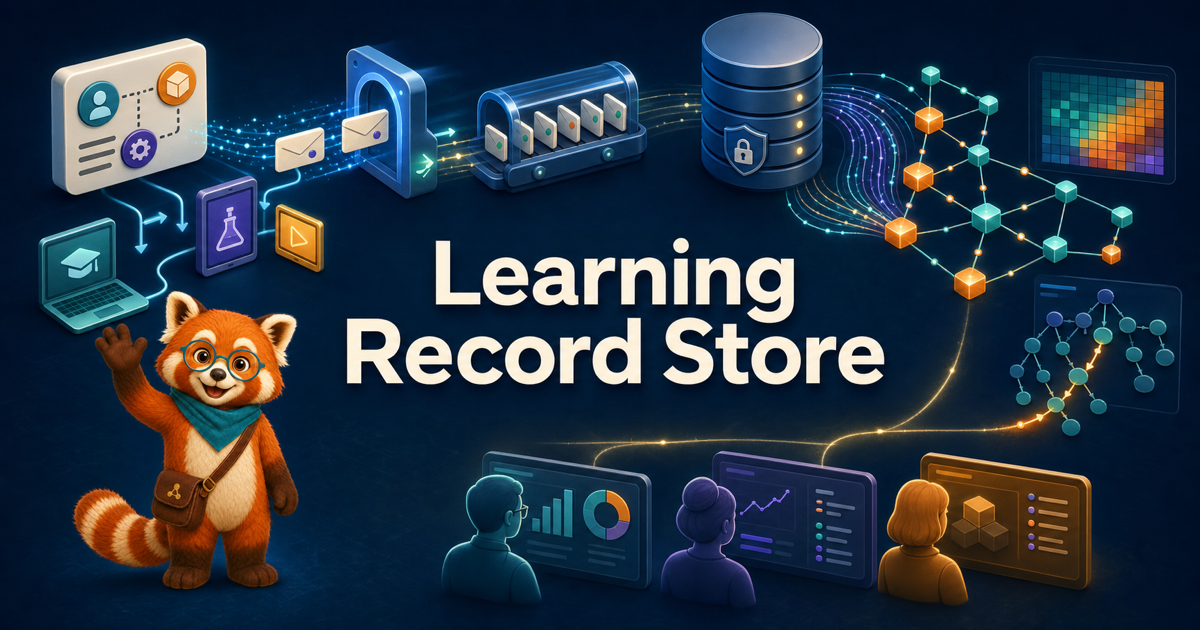
A learning experience becomes useful evidence only when its record can be trusted, moved between systems, and interpreted in context. This intelligent textbook follows that evidence from a learner's interaction, through a standards-based Learning Record Store (LRS), to the reports that help educators make better decisions.
You will begin with the plain-language story behind xAPI and interoperability, then examine the architecture of the LRS being built in this repository. Finally, you will use the same underlying record through the eyes of a district administrator, a classroom teacher, and an intelligent-textbook author.
Let's follow the record.
 Start with one learning event. Follow where it goes, what evidence it preserves,
and which decisions it can support.
Start with one learning event. Follow where it goes, what evidence it preserves,
and which decisions it can support.
Choose Your Path
Understand the standards
Learn why education moved beyond LMS-bound records, how an xAPI statement expresses "someone did something with a learning object," and how IEEE standards make those records portable across tools and institutions.
Begin with Chapter 1: From LMSs to xAPI
Examine the architecture
Trace a statement through accept-first ingestion, a durable event queue, the event store, and a compression pipeline that produces queryable summary vertices without placing every raw event in the graph.
Explore Chapter 5: The Five Architectural Planes
Use the evidence
See how one standards-based statement log supports district adoption and compliance, teacher mastery and prerequisite analysis, and author experiments on content effectiveness.
Meet the Three Personas in Chapter 24
Follow One Record End to End
- Experience: A learner reads a page, answers a question, or explores a MicroSim.
- Statement: The learning tool describes that event as a conformant xAPI record.
- Ingestion: The LRS accepts the record quickly and preserves it in the event stream and event store.
- Compression: Processing converts repeated evidence into bounded summary vertices such as concept mastery and page engagement.
- Decision: A role-specific report turns the summaries into a question an administrator, teacher, or author can act on.
Explore the Textbook
- Chapters — the complete 32-chapter path from foundations and standards through architecture, operations, and persona workflows.
- Interactive Learning Graph — explore the concepts and prerequisite connections that organize the book.
- LRS Data Model Explorer — inspect tenancy, content, experiment, and compressed-summary structures from the specification.
- MicroSims — learn by manipulating interactive models and observing the xAPI records they emit.
- Glossary — look up the standards, architecture, analytics, and privacy vocabulary used throughout the course.
- Specifications — read the authoritative LRS specification and follow its links to the design and producer contract.
- Live Graph Demo — explore example Neo4j queries over the seeded demonstration graph.
Who This Book Is For
The book is written first for the people who operate or use an LRS day to day:
- district administrators managing rollout, access, and compliance;
- classroom teachers interpreting mastery and prerequisite evidence; and
- intelligent-textbook authors measuring how content supports learning.
It also serves software engineers, learning-technology architects, standards and compliance specialists, and upper-level students in computer science, instructional design, or educational technology. Part 1 assumes only general computer literacy; the architecture chapters introduce the required xAPI vocabulary from first principles before moving into system detail.
Getting Started
Start with Chapter 1: From Learning Management Systems to the Experience API, or read the course description for the full scope, prerequisites, and learning outcomes.
One event at a time.