H-Bridge Circuits
Welcome to the H-Bridge Lab
 To make a motor spin in two directions, you need a clever circuit called an
H-bridge. Understanding H-bridges will help you understand every motor driver
chip you ever use. Let's build something amazing!
To make a motor spin in two directions, you need a clever circuit called an
H-bridge. Understanding H-bridges will help you understand every motor driver
chip you ever use. Let's build something amazing!
What Is an H-Bridge?
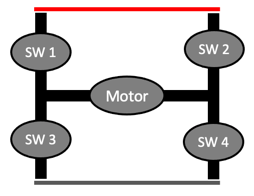
An H-bridge is a circuit made of four switches arranged around a motor. The arrangement looks like the letter "H", with the motor forming the crossbar.
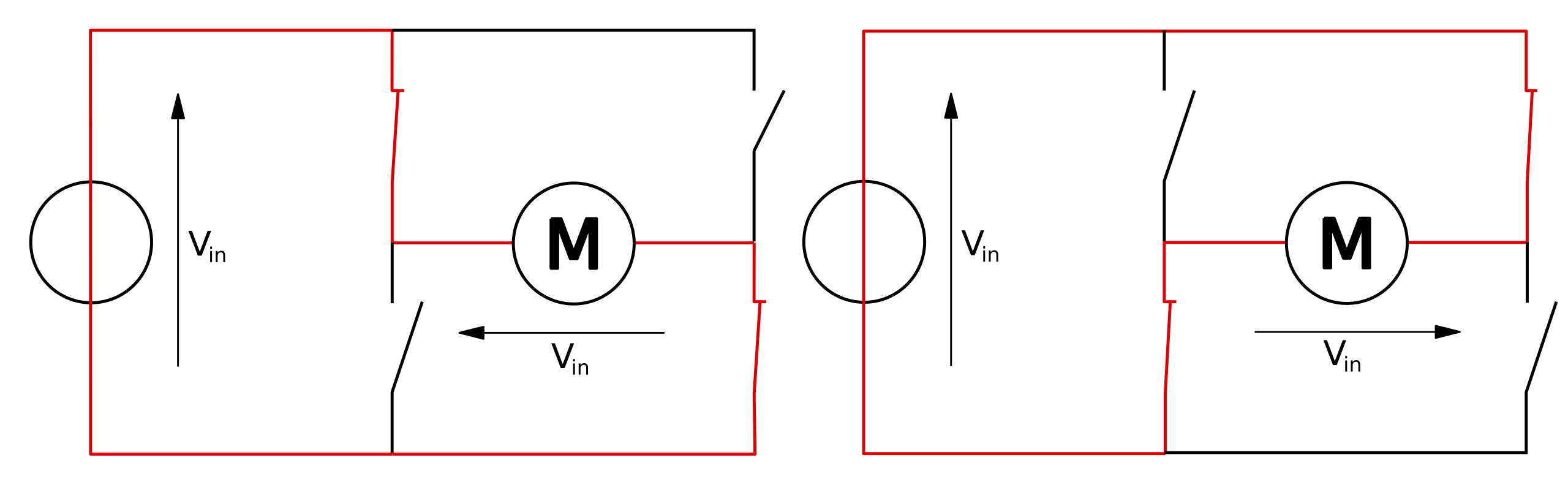
By opening and closing different pairs of switches, you can send current through the motor in either direction — which makes the motor spin forward or backward.
H-Bridge Circuit Operation
Think about what happens when you connect a battery directly to a motor:
- Positive terminal → motor → negative terminal → motor spins clockwise
- Flip the wires → motor spins counter-clockwise
An H-bridge does the same thing electronically, without you having to unplug and re-plug wires.
The four switches are numbered 1, 2, 3, and 4 around the H:
| Switch pair | Motor direction |
|---|---|
| 1 and 4 CLOSED, 2 and 3 OPEN | Forward (clockwise) |
| 2 and 3 CLOSED, 1 and 4 OPEN | Backward (counter-clockwise) |
| All OPEN | Motor coasts to a stop |
| 1 and 2 CLOSED (same side) | Short circuit — never do this! |
Watch Out!
 Never close switches on the same side of the H at the same time (for example,
1 and 2, or 3 and 4). This creates a short circuit — a direct path from
power to ground with no motor in between. It can destroy the switches or
blow a fuse instantly.
Never close switches on the same side of the H at the same time (for example,
1 and 2, or 3 and 4). This creates a short circuit — a direct path from
power to ground with no motor in between. It can destroy the switches or
blow a fuse instantly.
Speed Control with PWM
You can control motor speed by switching the motor on and off very rapidly using Pulse-Width Modulation (PWM). Apply a PWM signal to one of the active switches instead of holding it fully on.
- PWM duty cycle 100% → full speed
- PWM duty cycle 50% → half speed
- PWM duty cycle 0% → stopped
The motor averages out the rapid switching and spins at a speed between stopped and full.
Key Idea
 An H-bridge is really just four fast electronic switches — usually transistors
or MOSFETs. Chips like the L293D and DRV8833 put a complete H-bridge
inside a single package so you do not have to wire the individual switches yourself.
An H-bridge is really just four fast electronic switches — usually transistors
or MOSFETs. Chips like the L293D and DRV8833 put a complete H-bridge
inside a single package so you do not have to wire the individual switches yourself.
Building an H-Bridge from Transistors
You can build a simple H-bridge with four NPN transistors (like 2N2222A) and four diodes (like 1N4148). However, this gets complex quickly and the transistors can be damaged if switched incorrectly.
For most projects, use a dedicated H-bridge chip instead:
| Chip | Motor channels | Max voltage | Max current | Cost |
|---|---|---|---|---|
| L293D | 2 | 36 V | 600 mA | ~$0.50 |
| L298N | 2 | 46 V | 2 A | ~$1 |
| DRV8833 | 2 | 10.8 V | 1.2 A | ~$1 |
| TB6612FNG | 2 | 13.5 V | 1.2 A | ~$1.50 |
The L293D and DRV8833 are covered in the next labs.
Great Work!
 You now understand how H-bridge circuits work — the idea behind every motor
driver you will ever use. Head to the next lab to put an L293D H-bridge chip
to work in a real circuit!
You now understand how H-bridge circuits work — the idea behind every motor
driver you will ever use. Head to the next lab to put an L293D H-bridge chip
to work in a real circuit!