The Vault at the End of the World
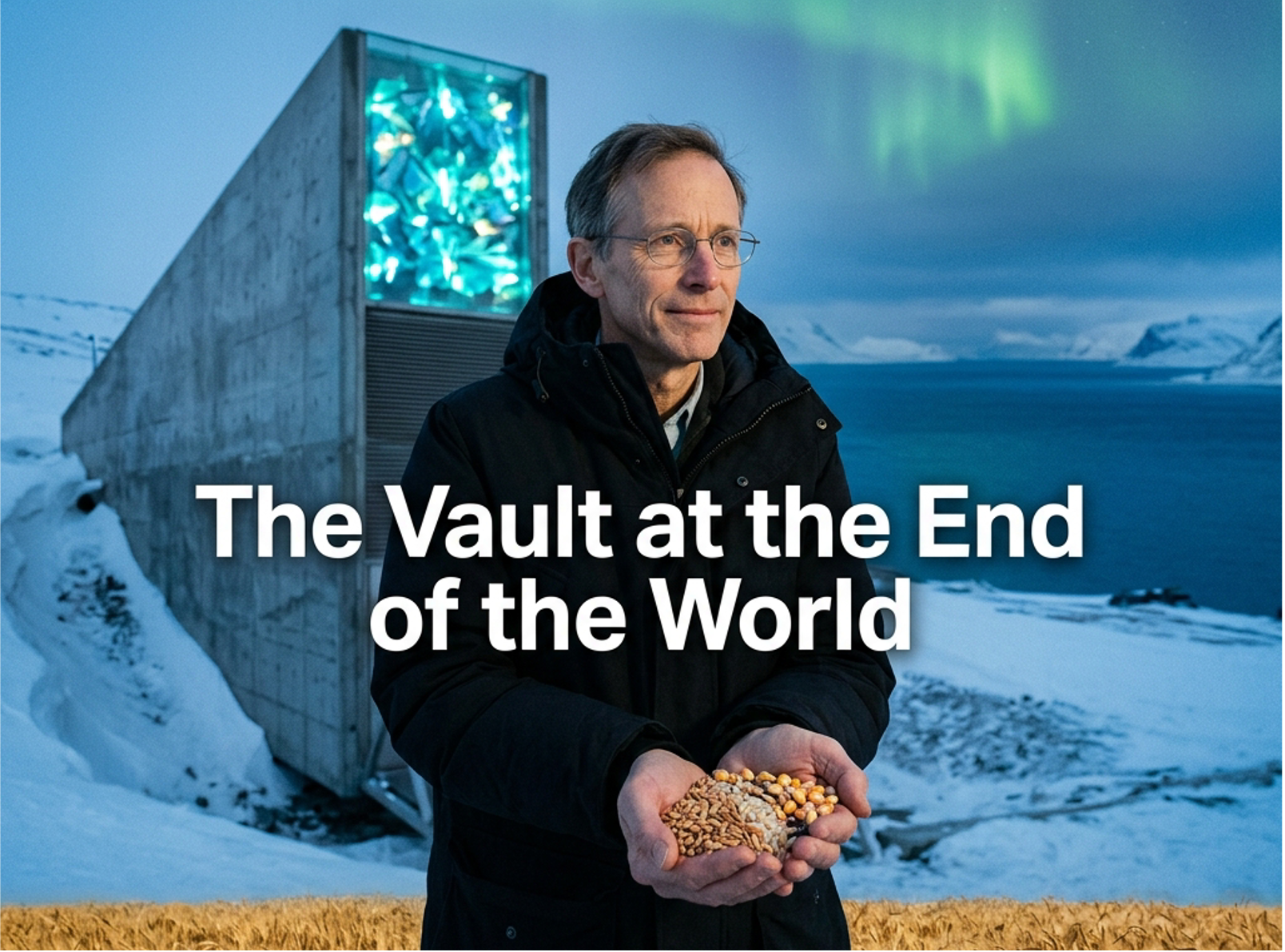
Cover Image Prompt
Please generate a wide-landscape 16:9 cover image for a graphic novel titled "The Vault at the End of the World" in a contrasting art style — warm, sun-drenched agricultural scenes (golden wheat, amber barley, deep green rice paddies) meeting stark Arctic landscapes (ice blue, granite gray, polar white). Think Wes Anderson symmetry meets documentary photography. Show Cary Fowler, a thin, soft-spoken American man in his late 50s with wire-rimmed glasses, short graying hair, and a gentle, professorial face, standing at the entrance to the Svalbard Global Seed Vault. The vault entrance is a narrow concrete wedge emerging from a snow-covered mountainside, its angular form catching pale Arctic light, with a prismatic art installation glowing blue-green above the doorway. Fowler wears a practical dark parka over a button-down shirt, looking more professor than explorer. In his cupped hands he holds a handful of diverse seeds — wheat, rice, maize, barley — golden and brown against the white snow. Behind him, the frozen Arctic landscape stretches to a gray fjord under a sky streaked with the faintest green hint of aurora. The title text "The Vault at the End of the World" is rendered in clean modern sans-serif at the top. Color palette: golden wheat, warm amber, ice blue, granite gray, polar white, steel silver, with the prismatic vault entrance providing a spark of blue-green. Emotional tone: quiet awe, the weight of centuries, hope stored in frozen silence. Include: (1) Fowler's gentle, determined expression behind wire-rimmed glasses, (2) diverse seeds cupped in his hands, (3) the angular concrete vault entrance emerging from the mountainside, (4) the prismatic art installation glowing above the door, (5) snow-covered Svalbard mountains under a pale Arctic sky, (6) a distant gray fjord with ice floes. Generate the image immediately without asking clarifying questions.Narrative Prompt
This is a 12-panel graphic novel about Cary Fowler (born 1949), the American agricultural scientist and diplomat who spent decades campaigning for the preservation of crop genetic diversity and led the creation of the Svalbard Global Seed Vault — a frozen bunker inside an Arctic mountain that holds over 1.3 million seed samples from every country on Earth, humanity's ultimate insurance policy against agricultural catastrophe. The story spans from the 1960s through the present day, set in Tennessee farmland, American universities, international conference halls, the Norwegian Arctic archipelago of Svalbard, and war-torn Syria. The art style throughout contrasts warm agricultural scenes (golden wheat fields, amber grain, lush green rice paddies, diverse crop colors) with stark Arctic landscapes (ice blue, granite gray, polar white) and austere vault interiors (steel shelving, frost, LED lighting). Think Wes Anderson symmetry meets documentary photography. Cary Fowler should be drawn consistently across panels: a thin, soft-spoken man with wire-rimmed glasses, short hair that grays over the decades, and a gentle, professorial face. He ages from a curious farm boy to a graduate student to a seasoned diplomat to a distinguished elder statesman of agricultural science — but his quiet intensity and thoughtful demeanor remain constant. He dresses practically: button-down shirts, khakis, and a parka when in the Arctic. Central themes: the catastrophic loss of crop genetic diversity in the 20th century, the vulnerability of global food systems built on genetic monocultures, the decades of diplomacy required to build international cooperation, and the profound idea that seeds are not just biology but civilization's memory — every variety represents thousands of years of human selection and adaptation. The story emphasizes both the ecological science (genetic diversity, monoculture risk, climate adaptation) and the geopolitical drama (intellectual property disputes, national sovereignty over seeds, and the moment when war proved the vault's necessity).Prologue -- Seeds Are Memory
Every seed is a story. A single grain of wheat contains ten thousand years of human decisions — which plants survived the frost, which ones a farmer's grandmother saved from the best corner of the field, which ones fed a village through a drought that killed everything else. For most of human history, farmers saved their own seeds, and the world's fields were a living library of genetic diversity — thousands of varieties of rice, wheat, maize, and barley, each adapted to a specific soil, a specific rainfall, a specific pest. Then, in the span of a single century, we burned most of that library. We replaced ten thousand varieties with ten. We called it progress. Cary Fowler looked at what we had done and saw the math: if a single disease hit those few remaining varieties, billions of people would have nothing to eat. He spent his life building a backup — a frozen vault in the Arctic where the seeds the world had forgotten could survive the disasters the world had not yet imagined.
Panel 1: A Boy Among the Rows

Image Prompt
(This is panel 1. Do not put the panel number in the image.) I am about to ask you to generate a series of images for a graphic novel. Please make the images have a consistent style and consistent characters. Do not ask any clarifying questions. Just generate the image immediately when asked. Please generate a 16:9 image in a contrasting art style — warm, sun-drenched agricultural tones (golden wheat, amber, rich green) with Wes Anderson symmetry meets documentary photography — depicting panel 1 of 12. The scene shows young Cary Fowler, around age 12, a thin, curious boy with sandy hair and round glasses, walking through his family's farm in rural Tennessee in the early 1960s. The farm is a patchwork of diverse crops — rows of heirloom tomatoes in red and orange, pole beans climbing twine, ears of multicolored Indian corn drying on a fence, purple-hulled peas, yellow squash, and green okra. His grandfather, a weathered farmer in overalls and a straw hat, walks beside him, pointing at a row of unusual tomatoes and explaining something. The afternoon sun casts long golden shadows across the rows. Color palette: golden sunlight, warm amber soil, rich greens, tomato reds, corn yellows, soft blue Tennessee sky. Emotional tone: childhood curiosity, abundance, intergenerational knowledge. Specific details: (1) young Fowler's fascinated expression as he examines a tomato his grandfather holds out, (2) the remarkable diversity of crops visible in a single frame — at least six different species, (3) the grandfather's weathered hands and easy smile, (4) heirloom tomatoes in unusual colors — green-striped, deep purple, bright yellow, (5) the rolling Tennessee hills in the background with hardwood forest along the ridgeline, (6) a wooden seed box visible on a fence post, its compartments holding different saved seeds. Generate the image immediately without asking clarifying questions.Cary Fowler grew up on a farm in Tennessee where the garden told a story in every row. His grandfather grew tomatoes that had no name in any catalog — varieties that had been passed down through the family for generations, each one selected because it tasted better, lasted longer, or survived the late frost that killed the others. There were beans in three colors, corn with kernels like jewels, and squash so old that nobody remembered where it came from. Young Cary did not know that he was looking at a genetic library. He just knew that every plant was different, and his grandfather could tell him why.
Panel 2: The Disappearing Library

Image Prompt
(This is panel 2. Do not put the panel number in the image.) Please generate a 16:9 image in the same contrasting art style — warm agricultural tones meeting cooler academic tones, Wes Anderson symmetry meets documentary photography — depicting panel 2 of 12. Make the characters and style consistent with the prior panel. The scene shows Cary Fowler, now in his early 20s, a thin young man with wire-rimmed glasses and slightly longer 1970s hair, sitting in a university library, staring at an open textbook with an expression of dawning horror. On the page before him is a graph showing a dramatic decline — crop genetic diversity dropping steeply from 1900 to 1970. The line plunges like a cliff. Around him, the library is quiet and orderly — wooden tables, green reading lamps, stacked books. But Fowler's face tells a different story: he has just learned something terrifying. A second book lies open beside the first, showing photographs of abandoned seed varieties — strange, beautiful fruits and grains that no longer exist. Color palette: warm wood tones of the library, cool white of the page, the alarming red of the declining graph line, soft green lamplight, muted clothing. Emotional tone: intellectual shock, the moment a life's mission crystallizes. Specific details: (1) Fowler's stunned expression as he stares at the graph, (2) the graph clearly showing a 75% decline in crop diversity, (3) photographs of lost crop varieties in the second book — purple carrots, multicolored corn, odd-shaped tomatoes, (4) a pencil frozen mid-note in his hand, (5) neat stacks of agricultural science journals around him, (6) a window behind him showing a modern monoculture field outside — endless identical rows of a single crop variety, a visual contrast to the diversity in his grandfather's garden. Generate the image immediately without asking clarifying questions.In college, Fowler encountered a number that changed his life: seventy-five percent. In the twentieth century alone, three-quarters of the world's crop genetic diversity had vanished — replaced by a small number of high-yield commercial varieties bred for uniformity, not resilience. The heirloom tomatoes in his grandfather's garden, the multicolored corn, the odd local beans — varieties like those were disappearing all over the world as industrial agriculture swept across every continent. Seed companies sold farmers identical seeds each season; farmers stopped saving their own. The living library was being emptied shelf by shelf, and almost nobody had noticed.
Panel 3: The Narrowing Funnel

Image Prompt
(This is panel 3. Do not put the panel number in the image.) Please generate a 16:9 image in the same contrasting art style — warm agricultural tones with cooler analytical elements, Wes Anderson symmetry meets documentary photography — depicting panel 3 of 12. Make the characters and style consistent with the prior panels. The scene is a split composition. On the left half: a glorious, chaotic abundance of crop diversity — hundreds of varieties of wheat in every shade from pale gold to deep red, dozens of rice types from white to black to red, multicolored maize, strange and beautiful vegetables. This represents the agricultural past. On the right half: a stark, geometrically perfect modern farm — a single variety of wheat stretching to the horizon in uniform rows, identical and efficient and terrifyingly monotonous. Between the two halves stands Cary Fowler, now about 25, in a simple shirt and khakis, facing the viewer with a chalkboard behind him. On the chalkboard he has written: "30 crops = 95% of human calories." Below it: "Most varieties are genetically near-identical." He looks directly at the viewer with quiet urgency. Color palette: the left side is a riot of warm colors — golds, reds, purples, greens, ambers; the right side is a cold monochrome of pale yellow-green. The center is chalk-white and shadow. Emotional tone: the beauty of what we had, the sterility of what replaced it, and the alarm of someone who sees the danger. Specific details: (1) the vivid diversity of the left panel — at least 20 visually distinct crop varieties, (2) the eerie uniformity of the right panel — identical wheat rows vanishing to the horizon, (3) Fowler's earnest, worried expression, (4) the chalkboard statistics written in his neat hand, (5) a few seeds falling from the diverse side toward the uniform side, symbolizing what is being lost, (6) a faint crack running through the uniform field, hinting at vulnerability. Generate the image immediately without asking clarifying questions.The math was terrifying. Fewer than thirty crops provide ninety-five percent of all human calories on Earth. Of those thirty, most commercial varieties are genetically near-identical — bred from the same narrow gene pool, selected for yield and appearance rather than resistance to disease, drought, or heat. Fowler saw the funnel clearly: ten thousand years of farmers carefully diversifying humanity's food supply had been compressed, in a single century, into a handful of seeds that all shared the same weaknesses. It was as if the entire world's library had been reduced to one shelf of bestsellers — and someone was playing with matches.
Panel 4: The Famine That Proved the Point

Image Prompt
(This is panel 4. Do not put the panel number in the image.) Please generate a 16:9 image in the same contrasting art style — dark, somber tones for a historical tragedy, Wes Anderson symmetry meets documentary photography — depicting panel 4 of 12. Make the characters and style consistent with the prior panels. The scene depicts the Irish Potato Famine of the 1840s as Fowler imagines it while reading — a haunting historical illustration come to life. A blighted potato field in Ireland: the plants are blackened and rotting, their leaves curled with the distinctive marks of Phytophthora infestans. Starving Irish families — gaunt, hollow-eyed, in ragged clothing — walk along a dirt road away from the ruined field. In the foreground, overlaid as if it were a transparent lecture slide, young Fowler's face appears in a small inset, studying this history with grim recognition. A caption-style text band across the bottom reads: "One crop. One variety. One disease. One million dead." Color palette: sickly greens and blacks for the blighted potatoes, ashen gray sky, pale washed-out skin tones, muddy brown road — deliberately drained of the warm tones from earlier panels. Emotional tone: historical horror, a warning from the past. Specific details: (1) the blackened, rotting potato plants with visible blight, (2) a starving family on the road with bundles of belongings, (3) empty fields stretching to the horizon, (4) a single healthy potato plant in the far corner — representing the genetic diversity that could have saved them, (5) Fowler's thoughtful face in the inset, connecting past to future, (6) dark clouds massing overhead with an apocalyptic weight. Generate the image immediately without asking clarifying questions.Fowler studied the Irish Potato Famine of the 1840s and saw a blueprint for global catastrophe. Ireland had depended on a single potato variety — the Irish Lumper — genetically uniform across the entire island. When Phytophthora infestans arrived, a fungus-like organism the Lumper had no resistance to, it destroyed everything in two seasons. A million people died. Another million fled. The famine rewrote the demographics of an entire nation. And Fowler realized: what happened to Ireland with one crop could happen to the entire world with all of its crops. The conditions were identical — genetic uniformity on a massive scale, waiting for the right pathogen to find the right weakness. The only question was when.
Panel 5: The Loneliest Campaign

Image Prompt
(This is panel 5. Do not put the panel number in the image.) Please generate a 16:9 image in the same contrasting art style — warm but frustrated tones, Wes Anderson symmetry meets documentary photography — depicting panel 5 of 12. Make the characters and style consistent with the prior panels. The scene shows Cary Fowler, now in his mid-30s, standing at a podium in a half-empty conference room in the 1980s, passionately making his case for a global seed vault. He is thin, bespectacled, wearing a rumpled blazer over a button-down shirt, gesturing toward a projected slide showing a map of the world with red dots marking gene banks that are underfunded, deteriorating, or at risk. The audience is sparse — a few diplomats and agricultural scientists scattered across rows of empty chairs, some taking notes, others looking skeptical. Stacks of his book "Shattering: Food, Politics, and the Loss of Genetic Diversity" sit on a table by the door, mostly untouched. Color palette: institutional beige walls, fluorescent lighting, the warm brown of Fowler's blazer, red alarm dots on the projected map, empty blue chairs. Emotional tone: lonely determination, a prophet in the wilderness. Specific details: (1) Fowler mid-gesture with quiet intensity, not theatrical but deeply earnest, (2) the projected map showing vulnerable gene banks worldwide, (3) rows of mostly empty chairs, (4) a few attentive listeners among many distracted ones, (5) copies of his book stacked by the door, (6) a coffee cup on the podium and scattered papers — signs of a man who has given this talk many times. Generate the image immediately without asking clarifying questions.Fowler began campaigning for a global seed vault — a single, indestructible backup of humanity's entire agricultural heritage, stored somewhere so remote and so cold that it could survive anything: war, budget cuts, political collapse, climate change. For years, almost nobody listened. He wrote a book, Shattering: Food, Politics, and the Loss of Genetic Diversity, that laid out the crisis in devastating detail. He gave talks to half-empty conference rooms. He pleaded with government officials who were polite but unmoved. The problem, Fowler discovered, was not that people disagreed with him — it was that they could not imagine the catastrophe he was describing. Famine felt abstract. Seeds felt small. The disaster was too slow and too large for anyone to see.
Panel 6: The Politics of Seeds

Image Prompt
(This is panel 6. Do not put the panel number in the image.) Please generate a 16:9 image in the same contrasting art style — formal diplomatic tones, Wes Anderson symmetry meets documentary photography — depicting panel 6 of 12. Make the characters and style consistent with the prior panels. The scene shows Cary Fowler, now in his late 40s with graying hair and wire-rimmed glasses, seated at a large round negotiating table at the United Nations Food and Agriculture Organization (FAO) in Rome, early 2000s. Around the table sit diplomats and agricultural ministers from around the world — representatives from India, Brazil, Norway, Ethiopia, the United States, China, and others, identifiable by small national flags at their seats. The room is grand — marble floors, high ceilings, UN and FAO flags. Fowler leans forward, making a point with his hands, his expression patient but urgent. Some delegates look engaged; others have their arms crossed. Documents and seed catalogs are spread across the table. Color palette: diplomatic grays, rich wood tones of the table, white marble, the colorful flags providing splashes of red, blue, green, and gold. Emotional tone: the grinding patience of international diplomacy, the tension between national interests and global survival. Specific details: (1) Fowler leaning forward with quiet persuasion, (2) the diverse group of delegates around the circular table, (3) small national flags identifying different countries, (4) FAO and UN flags on stands behind, (5) a projected slide showing the proposed vault design, (6) a glass jar of diverse wheat seeds sitting in the center of the table — Fowler's visual prop to make the abstract concrete. Generate the image immediately without asking clarifying questions.Decades of diplomacy followed. Fowler navigated the most contentious questions in global agriculture: Who owns a seed? If a company patents a gene found in a wild plant from Ethiopia, does Ethiopia get compensated? If a country deposits seeds in a vault, do they retain sovereignty? Can seeds be weapons — withheld during a trade war or a famine? Fowler understood that the vault would never work unless every nation trusted it. He spent years at the United Nations Food and Agriculture Organization in Rome, in meetings that moved at the speed of glaciers, patiently building consensus. He was not a politician or a diplomat by training. He was a farm boy from Tennessee with wire-rimmed glasses and an argument no one could refute: We cannot eat in the future on what we lose today.
Panel 7: The Mountain at the End of the World

Image Prompt
(This is panel 7. Do not put the panel number in the image.) Please generate a 16:9 image in the same contrasting art style — stark Arctic palette with Wes Anderson symmetry meets documentary photography — depicting panel 7 of 12. Make the characters and style consistent with the prior panels. The scene shows Cary Fowler, now in his mid-50s, standing at the base of a snow-covered mountain on the Norwegian Arctic archipelago of Svalbard, looking up at the proposed vault site. He wears a dark parka, his wire-rimmed glasses fogged at the edges, his breath visible in the freezing air. The landscape is vast and austere — snow-covered mountains, a frozen fjord in the distance, polar blue sky with low-angle Arctic light casting long shadows. A small team of Norwegian engineers and geologists stands nearby with surveying equipment and rolled-up blueprints. The mountain itself is massive sandstone, its layers visible where snow has blown clear — nature's perfect freezer. A single polar bear track crosses the snow in the foreground. Color palette: ice blue, granite gray, polar white, steel silver, with the warm brown of Fowler's face and the orange of surveyor's flags providing the only warmth. Emotional tone: isolation, awe, the realization that this desolate place could hold humanity's future. Specific details: (1) Fowler gazing up at the mountain with quiet wonder, (2) the layered sandstone of the mountain face, (3) Norwegian engineers with surveying equipment, (4) the frozen fjord in the distance, (5) polar bear tracks crossing the snow, (6) the vast emptiness of the Arctic landscape emphasizing the remoteness of the site. Generate the image immediately without asking clarifying questions.The site they chose was almost absurdly perfect. Svalbard is a Norwegian archipelago roughly a thousand kilometers from the North Pole — so remote that it requires a charter flight beyond the northernmost commercial airport. The mountain is made of sandstone, geologically stable, and surrounded by permafrost that keeps the ground naturally frozen year-round. Norway is politically neutral and has been stable for centuries. Even if every freezer in the vault lost power, the permafrost would keep the seeds frozen for decades. Fowler stood at the base of the mountain and saw what he had been imagining for twenty years: a place where seeds could sleep for centuries, safe from every catastrophe that human civilization might inflict upon itself.
Panel 8: Opening Day

Image Prompt
(This is panel 8. Do not put the panel number in the image.) Please generate a 16:9 image in the same contrasting art style — Arctic austerity with ceremonial warmth, Wes Anderson symmetry meets documentary photography — depicting panel 8 of 12. Make the characters and style consistent with the prior panels. The scene shows the grand opening of the Svalbard Global Seed Vault on February 26, 2008. The iconic vault entrance — a narrow concrete and steel wedge emerging from the mountainside — glows with its prismatic fiber-optic art installation, casting blue-green light across the snow. Cary Fowler, now 58, stands at the entrance with a small group of dignitaries, including the Norwegian Prime Minister Jens Stoltenberg and Nobel Peace Prize laureate Wangari Maathai, who carries a box of seeds. Photographers' flashes illuminate the scene. The Arctic twilight sky above is deep indigo, fading to pale blue at the horizon. The entrance tunnel stretches behind them into the mountain — 120 meters of reinforced concrete disappearing into darkness. Color palette: deep indigo sky, blue-green prismatic glow from the art installation, white snow, gray concrete, the warm skin tones and colorful clothing of the dignitaries against the monochrome landscape. Emotional tone: historic achievement, quiet triumph after decades of work, the solemnity of a civilization protecting its own future. Specific details: (1) Fowler with a subtle, relieved smile — the expression of a man whose life's work has finally materialized, (2) the iconic angular vault entrance glowing with the art installation, (3) Wangari Maathai holding a seed box, (4) photographers' flashes and media cameras, (5) the tunnel stretching into the mountain behind the group, (6) the date "26 FEBRUARY 2008" visible on a simple plaque. Generate the image immediately without asking clarifying questions.On February 26, 2008, the Svalbard Global Seed Vault opened its doors — or rather, opened its tunnel, a 120-meter-long passage bored straight into the mountain and sealed with airlock doors designed to survive earthquakes, nuclear war, and rising seas. The entrance was a narrow concrete wedge emerging from the snow, crowned by a prismatic art installation that caught the Arctic light like a jewel set in ice. Dignitaries flew in from around the world. Nobel laureate Wangari Maathai carried the first seeds inside. Fowler stood at the entrance with the expression of a man who had spent thirty years describing a fire that no one else could see, and had finally finished building the firebreak. The vault was designed to last not decades but centuries — a message in a frozen bottle to generations that had not yet been born.
Panel 9: A Million Stories, Frozen

Image Prompt
(This is panel 9. Do not put the panel number in the image.) Please generate a 16:9 image in the same contrasting art style — austere vault interior with Wes Anderson symmetry meets documentary photography — depicting panel 9 of 12. Make the characters and style consistent with the prior panels. The scene shows the interior of the Svalbard Global Seed Vault — one of the three storage chambers deep inside the mountain. The room is a long, narrow tunnel lined floor-to-ceiling with industrial steel shelving holding thousands of sealed silver and black boxes, each labeled with a country name, crop type, and accession number. Frost coats every surface — the shelves, the boxes, the walls, the ceiling — giving everything a crystalline white sheen. Cold LED lighting casts a blue-white glow. Cary Fowler walks slowly down the center aisle, his breath a cloud, his parka frosted, touching one of the boxes with a gloved hand — a box labeled "SYRIA — ICARDA — Triticum durum — Durum Wheat." The temperature display on the wall reads -18°C. The perspective stretches deep into the chamber, rows upon rows of boxes receding into the frosty distance. Color palette: frost white, steel silver, ice blue LED light, the black lettering on labels, Fowler's dark parka the only warm element. Emotional tone: cathedral-like reverence, the silent weight of a million seeds sleeping in the dark. Specific details: (1) Fowler touching a labeled box with gloved reverence, (2) thousands of sealed boxes on steel shelves stretching into the distance, (3) frost coating every surface, (4) labels from dozens of countries visible — India, Brazil, Ethiopia, Japan, Mexico, Peru, (5) the temperature display reading -18°C, (6) the vanishing-point perspective emphasizing the scale of the collection. Generate the image immediately without asking clarifying questions.Seeds arrived from every country on Earth. Each shipment was sealed in silver foil packets, packed into labeled boxes, and placed on steel shelves at minus eighteen degrees Celsius. The diversity was staggering: ancient wheats from the Fertile Crescent, wild relatives of modern rice from the hills of Southeast Asia, drought-resistant sorghums from the Sahel, frost-tolerant barley from the Andes, forgotten maize varieties from Mexican highlands. Each packet was a time capsule — not just of a plant, but of the human community that had bred it over centuries. A single box from Ethiopia might contain wheat varieties that had survived droughts no modern hybrid could endure. A packet from Peru might hold potato genes that could resist a blight that had not yet arrived. The vault was not just a freezer. It was the largest collection of human agricultural knowledge ever assembled in one place.
Panel 10: The War That Proved the Point

Image Prompt
(This is panel 10. Do not put the panel number in the image.) Please generate a 16:9 image in the same contrasting art style — dark, urgent war-zone tones contrasting with Arctic safety, Wes Anderson symmetry meets documentary photography — depicting panel 10 of 12. Make the characters and style consistent with the prior panels. The scene is a dramatic split composition. On the left half: the destroyed ICARDA gene bank in Aleppo, Syria, 2015 — a modern scientific building now shattered by civil war, its roof collapsed, walls pockmarked with bullet holes, shattered glass and rubble everywhere. Smoke rises from the ruins. Scattered among the debris are seed storage containers, some crushed, some spilled open — irreplaceable drought-resistant wheat and barley varieties from thousands of years of Middle Eastern agriculture. On the right half: the pristine interior of the Svalbard vault — the same ICARDA boxes sitting safely on frosted shelves, frost-covered and untouched, their labels reading "ICARDA — ALEPPO — Backup." A thin line divides the two halves. In the lower right corner, a small inset shows Cary Fowler receiving a phone call, his face a mix of grief and relief — grief for what was destroyed, relief that the backup existed. Color palette: left side — ash gray, fire orange, rubble brown, smoke black; right side — ice blue, frost white, steel silver. The contrast should be stark and emotional. Emotional tone: the horror of cultural destruction meeting the quiet vindication of foresight. Specific details: (1) the ruined ICARDA building with collapsed roof and bullet damage, (2) spilled seed containers among the rubble, (3) the intact backup boxes in Svalbard's frost-covered shelves, (4) the ICARDA labels connecting the two halves, (5) Fowler's emotional reaction in the inset, (6) smoke on the left, frost on the right — fire and ice. Generate the image immediately without asking clarifying questions.In 2015, the Syrian civil war proved everything Fowler had warned about. ICARDA — the International Center for Agricultural Research in the Dry Areas — had maintained one of the most important seed banks on Earth in Aleppo, holding irreplaceable collections of drought-resistant wheat, barley, and lentils bred over millennia in the Fertile Crescent, the very region where agriculture was invented. The war destroyed the facility. Decades of research, thousands of unique varieties painstakingly collected from farmers across the Middle East — gone under rubble and shellfire. But not gone entirely. ICARDA had deposited backup copies in Svalbard. In September 2015, the vault made its first withdrawal: boxes of seeds were shipped from the frozen Arctic to new ICARDA facilities in Morocco and Lebanon. The irreplaceable had been replaced — because one man had spent thirty years insisting that someday, somewhere, a disaster exactly like this would happen.
Panel 11: The Race Against the Thermometer

Image Prompt
(This is panel 11. Do not put the panel number in the image.) Please generate a 16:9 image in the same contrasting art style — warm agricultural danger meeting Arctic urgency, Wes Anderson symmetry meets documentary photography — depicting panel 11 of 12. Make the characters and style consistent with the prior panels. The scene shows a conceptual composition representing climate change's threat to global agriculture and the vault's growing importance. In the center, Cary Fowler, now in his late 60s, silver-haired with wire-rimmed glasses, stands before a large projected map at a climate conference. The map shows global temperature projections — the world shifting from greens and blues to alarming oranges and reds, with agricultural zones shifting poleward. Around the edges of the image, vignette panels show the consequences: a drought-cracked rice paddy in South Asia, a wheat field scorched by heat in the American Midwest, coffee plants wilting on a Central American hillside, locusts swarming across an African field. But in each vignette, a small glowing icon of the Svalbard vault appears — the beacon of hope, the genetic reservoir that holds the wild and ancient varieties capable of tolerating heat, drought, salinity, and new diseases. Color palette: alarming oranges and reds on the climate map, parched yellows and browns in the vignettes, contrasted with the cool blue glow of the vault icons. Emotional tone: urgency and measured hope — the crisis is real but the tools exist if we act. Specific details: (1) Fowler presenting with calm authority, (2) the climate projection map behind him, (3) drought-cracked fields in one vignette, (4) heat-scorched wheat in another, (5) the small glowing vault icons in each vignette, (6) an audience of scientists and policymakers listening with grave attention. Generate the image immediately without asking clarifying questions.Climate change made the vault more urgent with every passing year. As temperatures rose, crops that had thrived for generations began failing — wheat in Punjab, rice in the Mekong Delta, maize in sub-Saharan Africa. The varieties that farmers needed for the future — heat-tolerant, drought-resistant, salinity-adapted — were often not the commercial hybrids that dominated modern agriculture. They were the ancient landraces, the wild relatives, the forgotten varieties that farmers' grandmothers had grown in marginal lands. Many of those genes existed only in Svalbard. Fowler continued to sound the alarm: the vault was not a museum of the past but a toolkit for the future. Every degree of warming made the genetic diversity inside the mountain more valuable, and every variety that went extinct outside the vault made the collection more irreplaceable.
Panel 12: The Longest View

Image Prompt
(This is panel 12. Do not put the panel number in the image.) Please generate a 16:9 image in the same contrasting art style — warm agricultural hope meeting Arctic permanence, Wes Anderson symmetry meets documentary photography — depicting panel 12 of 12. Make the characters and style consistent with the prior panels. The scene shows Cary Fowler, now in his mid-70s, silver-haired and distinguished, standing outside the Svalbard vault entrance on a summer day when the Arctic sun sits low on the horizon, casting golden light across the snow. He holds a small handful of seeds in his open palm, looking at them with quiet wonder — the same gesture as the cover image, completing the visual circle. Behind him, the vault entrance glows with its prismatic installation. But the scene has expanded: in the middle distance, researchers from around the world — a young woman from India in a lab coat, an Ethiopian scientist carrying a seed box, a Norwegian engineer checking instruments — walk toward the vault with new deposits. In the far distance, the Arctic landscape stretches to the horizon under a sky painted with the soft golds and blues of the midnight sun. A faint aurora shimmers at the top of the sky. Text overlay at the bottom: "1,300,000+ seed samples. Every country on Earth. The future, sleeping." Color palette: golden midnight-sun light, ice blue shadows, the warm amber and brown of seeds in Fowler's palm, the prismatic blue-green of the vault entrance, soft aurora greens at the top of the sky. Emotional tone: earned peace, intergenerational hope, the quiet grandeur of thinking in centuries. Specific details: (1) Fowler holding seeds in his open palm with a serene expression, (2) the vault entrance glowing behind him, (3) international researchers approaching with new seed deposits, (4) the midnight sun casting long golden shadows, (5) the vast Arctic landscape emphasizing the scale of the commitment, (6) the faintest aurora overhead, suggesting the deep future this vault is designed to protect. Generate the image immediately without asking clarifying questions.Today, the Svalbard Global Seed Vault holds over 1.3 million seed samples from virtually every country on Earth — the largest and most diverse collection of crop genetic material ever assembled. Fowler, who served as U.S. Special Envoy for Global Food Security and continued to advocate for agricultural biodiversity into his seventies, sees the vault as something more than a building. It is a statement about what kind of species we choose to be — the kind that plans for centuries, or the kind that gambles everything on a single harvest. The seeds in the mountain do not care about politics, patents, or profit margins. They carry the genetic memory of ten thousand years of human agriculture, and they will wait, frozen and patient, for the day when someone needs them. Fowler's message has always been simple: we cannot eat in the future on what we lose today.
Epilogue -- What Made Cary Fowler Different?
Cary Fowler was not a politician, not a celebrity scientist, and not a billionaire philanthropist. He was a quiet man with glasses who understood a graph and could not look away from what it showed. He saw that the world's food system had been built on a foundation of genetic uniformity — a foundation that looked strong but was riddled with invisible cracks. He understood that the solution was not a new technology or a new policy but something much older: saving seeds, the way farmers had done for ten thousand years, but at a scale and with a permanence that matched the size of the risk. His genius was patience. He spent thirty years making the same argument to people who did not want to hear it, and he never raised his voice. He simply kept showing them the math until the math became undeniable.
| Challenge | How Cary Fowler Responded | Lesson for Today |
|---|---|---|
| 75% of crop genetic diversity lost in a single century | Documented the crisis in research and writing; made the invisible loss visible | Slow-moving catastrophes are the hardest to see and the most important to address |
| Global food system dependent on a handful of genetically uniform varieties | Campaigned for a permanent, indestructible backup of all remaining diversity | Resilience requires redundancy — backups are not wasteful, they are essential |
| Decades of political resistance and bureaucratic inertia | Patient, persistent diplomacy; built trust with every nation, one meeting at a time | The most important problems often require the most boring solutions: meetings, agreements, logistics |
| War destroyed irreplaceable seed collections in Syria | Svalbard's backup saved the ICARDA collection — the vault's first real test | Insurance feels unnecessary until the disaster arrives; by then, it is too late to buy it |
| Climate change accelerating crop failures worldwide | Ancient and wild crop varieties in the vault hold genes for heat, drought, and disease tolerance | The genetic diversity we save today is the toolkit we will need tomorrow |
Call to Action
The next time you eat a meal, consider this: almost everything on your plate descends from a tiny number of crop varieties, selected not for resilience but for yield. Somewhere in a frozen mountain near the North Pole, the backup copies sleep. But a vault is only as valuable as what it contains, and new varieties are still being lost every year as small farmers abandon traditional crops for commercial seeds. You can help by supporting seed libraries, buying from farmers who grow heirloom varieties, and learning the names of the plants that feed you. Genetic diversity is not an abstraction — it is the difference between a food system that can adapt to a changing climate and one that cannot. Every seed saved is a door left open for the future.
"We can't eat in the future on what we save today — but we definitely can't eat on what we lose." -- Cary Fowler
"The loss of diversity in agriculture is the single biggest environmental catastrophe that most people have never heard of." -- Cary Fowler
"Seeds are not just a biological resource. They are the first link in the food chain. They are the basis of everything." -- Cary Fowler
References
- Wikipedia: Svalbard Global Seed Vault — Overview of the vault's design, construction, and operations in the Norwegian Arctic
- Wikipedia: Cary Fowler — Biography of the agricultural scientist and diplomat who led the vault's creation
- Wikipedia: Crop diversity — The science and history of genetic diversity in agricultural crops and its accelerating loss
- Global Crop Diversity Trust — The international organization Fowler helped establish to fund and manage the Svalbard vault and global crop conservation
- Encyclopaedia Britannica: Svalbard Global Seed Vault — Curated reference overview of the vault's history, purpose, and significance