The Coral Whisperer
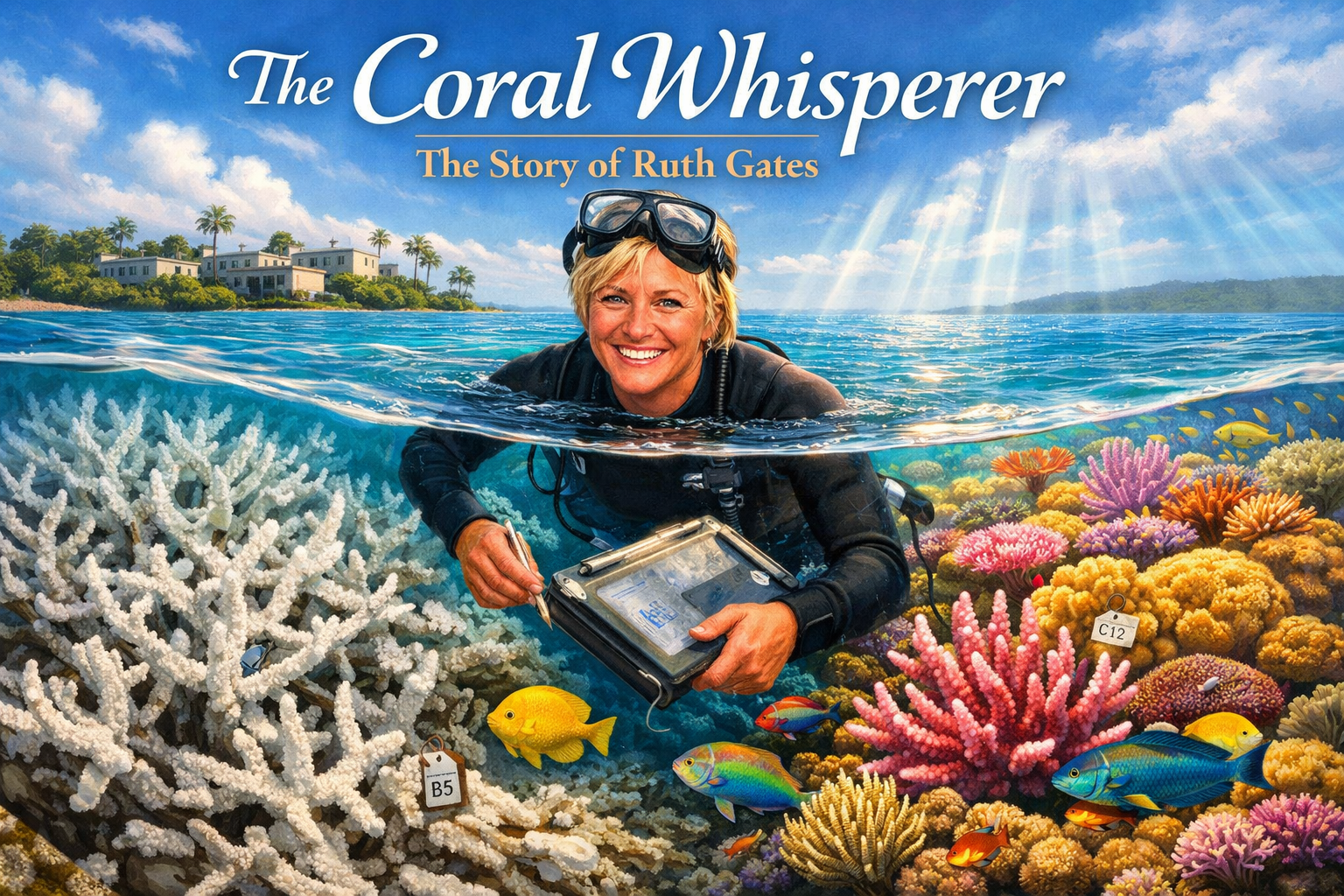
Cover Image Prompt
Please generate a wide-landscape 16:9 cover image for a graphic novel titled "The Coral Whisperer" in a tropical marine art style blending underwater National Geographic photography with scientific illustration. Show Ruth Gates, an athletic woman in her early 50s with short blonde hair, a bright radiant smile, and sun-weathered skin, floating in crystal-clear turquoise water above a coral reef. She wears a black wetsuit with a dive mask pushed up on her forehead and holds a clipboard in a waterproof housing. Below her, the reef is split dramatically: the left half is a bleached graveyard of bone-white coral skeletons; the right half bursts with vivid living color — branching pink Acropora, golden Porites mounds, purple sea fans, darting parrotfish, and swaying anemones. The title text "The Coral Whisperer" is rendered in a flowing serif typeface at the top, with "The Story of Ruth Gates" as a subtitle. Color palette: vivid coral pinks, turquoise water, deep ocean blues, bleached whites on the left contrasting with luminous living reef on the right. Emotional tone: hope against grief, beauty fighting extinction. Include: (1) Gates's characteristic bright smile and short blonde hair, (2) the stark split between dead white coral and vibrant living reef, (3) tiny research tags visible on some corals, (4) sunlight streaming down through the water in shafts, (5) the silhouette of Coconut Island's research buildings visible above the waterline in the background, (6) a small yellow tang fish swimming near Gates's hand. Generate the image immediately without asking clarifying questions.Narrative Prompt
This is a 12-panel graphic novel about Ruth Gates (1962-2018), the British-born coral biologist who pioneered "assisted evolution" — breeding heat-tolerant corals to survive climate change — at the Hawai'i Institute of Marine Biology. The story spans from the English coast in the 1970s to the reefs of Hawai'i in 2018, moving between rocky tide pools, tropical laboratories, underwater reef scenes, and scientific conferences. The art style throughout is tropical marine illustration — vivid coral pinks, turquoise waters, deep ocean blues, bleached whites for dead coral contrasting sharply with luminous living color. Think underwater National Geographic photography meets scientific illustration, luminous and dramatic. Ruth Gates should be drawn consistently across panels: an athletic woman with short blonde hair, a bright infectious smile, sun-tanned skin, often in dive gear or a colorful Hawaiian shirt, radiating energy and optimism even in difficult moments. Central ecology theme: when the world says a system is doomed, a scientist asks whether intervention can build resilience. The story emphasizes the tension between grief over dying reefs and the radical hope of assisted evolution, and the moral question of whether "playing God" is worse than doing nothing.Prologue -- The Reefs Are Dying. What If They Don't Have To?
By the early 2000s, coral reef scientists had become the pallbearers of the ocean. Every expedition returned with the same report: reefs bleaching white, crumbling to rubble, losing species faster than anyone could catalog them. The scientific literature read like a series of eulogies. Most researchers documented the death and warned about the loss. Ruth Gates read the same papers, dove the same dying reefs, and felt the same grief. But she asked a question almost no one else was asking: What if we stop writing obituaries and start breeding survivors?
It was a radical idea -- arrogant, some said. You cannot outbreed a planetary crisis. You cannot engineer your way out of a problem caused by engineering. But Gates argued that the reefs could not wait for the world to fix its carbon emissions. They were dying now. And in the wreckage, she noticed something the obituary writers had missed: a few corals, here and there, were still alive. They had survived temperatures that killed their neighbors. That, she realized, was not a tragedy. It was a starting point.
Panel 1: The Tide Pool Girl

Image Prompt
(This is panel 1. Do not put the panel number in the image.) I am about to ask you to generate a series of images for a graphic novel. Please make the images have a consistent style and consistent characters. Do not ask any clarifying questions. Just generate the image immediately when asked. Please generate a 16:9 image in tropical marine illustration style depicting panel 1 of 12. The scene shows a young Ruth Gates, about 10 years old, with short blonde hair and bright curious eyes, crouching at the edge of a tide pool on the rocky English coast near Kent, circa 1972. She is peering into the pool with her face inches from the water, utterly transfixed. In the pool: bright red anemones, purple sea urchins, tiny crabs, limpets clinging to the rocks, and translucent shrimp darting through green seaweed. The sky above is overcast English gray, but the tide pool is a pocket of alien color. Her school shoes are soaked and she does not care. Color palette: stormy grays and slate blues for the English sky and rocks, contrasting with the jewel-bright reds, purples, greens, and oranges of the tide pool life. Emotional tone: childhood wonder, discovery of a hidden world. Include: (1) young Ruth's expression of total fascination, (2) her wet school shoes and rolled-up trouser cuffs, (3) the vivid colors of anemones and urchins in the rock pool, (4) gray English coastal cliffs in the background, (5) a small notebook sticking out of her jacket pocket, (6) waves crashing gently on the rocks behind her. Generate the image immediately without asking clarifying questions.The English coast was cold, gray, and battered by wind. But the tide pools were another planet. Young Ruth Gates discovered them the way children discover everything important -- by accident, with wet shoes, on a day when she was supposed to be somewhere else. She crouched at the edge and stared into water so clear she could count the legs on a hermit crab. Anemones waved their crimson tentacles. Tiny fish shot between rocks like living sparks. She stayed until the tide came back in and her mother called her name three times. Something had taken root: the understanding that just below the surface of the ordinary world, there was a universe of staggering, alien beauty.
Panel 2: First Dive on a Tropical Reef

Image Prompt
(This is panel 2. Do not put the panel number in the image.) Please generate a 16:9 image in tropical marine illustration style depicting panel 2 of 12. Make the characters and style consistent with the prior panel. The scene shows Ruth Gates in her early 20s during her marine biology studies, experiencing her first scuba dive on a tropical coral reef, circa 1984. She floats weightless above a pristine reef in warm turquoise water, her eyes wide behind her dive mask, arms slightly outstretched in awe. The reef below is an explosion of color: branching staghorn corals in lavender and pink, massive brain corals in golden brown, bright blue sea fans waving in the current, a school of yellow butterflyfish, a green sea turtle gliding past. Sunlight pierces the water in luminous shafts. Gates wears a simple black wetsuit and has short blonde hair floating in the water. Color palette: vivid turquoise, coral pinks, lavender, golden yellows, deep blues, brilliant sunlight greens. Emotional tone: overwhelming awe, a life-changing moment. Include: (1) Gates's wide-eyed expression of wonder behind her mask, (2) the sheer diversity of coral forms -- branching, massive, plate, encrusting, (3) a cloud of tropical fish in multiple species, (4) a sea turtle in the middle distance, (5) shafts of sunlight creating a cathedral effect, (6) tiny bubbles rising from her regulator. Generate the image immediately without asking clarifying questions.Nothing in the English Channel had prepared her for this. The first time Ruth Gates descended onto a tropical reef, she wept into her dive mask. The colors were impossible -- pinks and purples and greens she had never seen in nature, branching and folding and pulsing with life. A parrotfish the size of her arm crunched coral like popcorn. A sea turtle drifted past as if she were furniture. She surfaced after forty minutes and could not speak for several more. She would later tell students that the reef was the most complex structure she had ever seen built by living things. "It makes a city look simple," she said. "And it builds itself."
Panel 3: Coconut Island

Image Prompt
(This is panel 3. Do not put the panel number in the image.) Please generate a 16:9 image in tropical marine illustration style depicting panel 3 of 12. Make the characters and style consistent with the prior panel. The scene shows Ruth Gates arriving at the Hawai'i Institute of Marine Biology on Coconut Island (Moku o Lo'e) in Kane'ohe Bay, O'ahu, circa 1990s. She steps off a small research boat onto a wooden dock, carrying dive gear over one shoulder and a laptop bag over the other, grinning broadly. Behind her, the small tropical island is lush with palm trees and low white research buildings. The bay water is calm and turquoise. In the foreground, outdoor seawater tables hold rows of coral fragments in experimental tanks. Color palette: tropical greens, turquoise bay water, white buildings against blue sky, warm wood tones of the dock, golden sunlight. Emotional tone: arrival, new beginning, excitement. Include: (1) Gates's characteristic bright smile and short blonde hair, (2) a colorful Hawaiian shirt visible under her open life jacket, (3) the distinctive low white buildings of the marine lab, (4) palm trees and tropical vegetation, (5) outdoor seawater flow-through tanks with coral fragments visible, (6) the Ko'olau mountain range green and dramatic in the background. Generate the image immediately without asking clarifying questions.Coconut Island sits in Kane'ohe Bay on the windward side of O'ahu, a five-minute boat ride from shore and a world away from everything else. The Hawai'i Institute of Marine Biology had been studying corals there for decades, surrounded by some of the most accessible reef systems in the Pacific. When Gates arrived, she felt the way she had felt at the tide pools as a child -- that she had stumbled onto something extraordinary. The island's outdoor seawater tanks let researchers keep living corals under controlled conditions, running experiments that would be impossible in the open ocean. It was a laboratory built at the edge of the reef itself. She would spend the rest of her life here.
Panel 4: The Bleaching

Image Prompt
(This is panel 4. Do not put the panel number in the image.) Please generate a 16:9 image in tropical marine illustration style depicting panel 4 of 12. Make the characters and style consistent with the prior panel. The scene shows Ruth Gates diving over a mass bleaching event on a Hawai'i reef, circa 2014-2015. She floats above an underwater landscape that looks like a bone yard -- vast fields of stark white coral skeletons stretching into the murky blue distance. A few patches of brown algae are already growing over the dead coral. The water is unnaturally warm and slightly hazy. Gates hovers with her clipboard, recording the devastation, her expression behind the mask showing grief and determination. A single small coral colony in the lower right corner still shows faint color -- a survivor. Color palette: bleached bone whites, sickly pale yellows, murky blue-greens, the absence of all the vivid colors from Panel 2 -- a ghost reef. The one surviving coral is a faint but real pink. Emotional tone: grief, devastation, but with one small note of stubborn hope. Include: (1) the vast expanse of white dead coral, (2) Gates recording data on an underwater slate with visible anguish, (3) algae beginning to overgrow dead coral skeletons, (4) the eerie absence of fish -- the reef is a desert, (5) the single surviving pink coral colony, (6) murky warm water reducing visibility compared to Panel 2's clarity. Generate the image immediately without asking clarifying questions.The first time Ruth Gates surveyed a mass bleaching event, she described it as "diving over a graveyard that was a garden last week." Bleaching happens when ocean temperatures rise even slightly above normal -- the coral animals expel the symbiotic algae that give them color and energy, turning ghostly white. If the heat persists, they starve. In 1998, 2010, 2014, 2015, 2016 -- the bleaching events came faster and worse. Entire reef systems that had taken centuries to grow died in weeks. Gates documented it all, swimming over miles of bone-white rubble, recording species, noting what was lost. But she also noticed the survivors. Here and there, a single colony still held its color. In a field of death, a few corals refused to die.
Panel 5: The Radical Question

Image Prompt
(This is panel 5. Do not put the panel number in the image.) Please generate a 16:9 image in tropical marine illustration style depicting panel 5 of 12. Make the characters and style consistent with the prior panel. The scene shows Ruth Gates in her office-laboratory at the Hawai'i Institute of Marine Biology, circa 2013. She stands at a whiteboard covered with diagrams -- coral genetics flowcharts, temperature tolerance graphs, breeding crosses, and the words "ASSISTED EVOLUTION" circled in red marker. She is mid-explanation, gesturing energetically at the board, wearing a bright turquoise Hawaiian shirt, her face lit up with the intensity of someone who has just had a breakthrough idea. A few graduate students sit around a seminar table, some looking excited, some skeptical. Through the window behind her, Kane'ohe Bay and its reefs are visible. Color palette: bright lab whites, turquoise shirt matching the bay outside, red and blue whiteboard markers, warm tropical light through the windows. Emotional tone: intellectual excitement, a paradigm shift being born. Include: (1) the whiteboard diagrams showing selective breeding crosses and temperature graphs, (2) "ASSISTED EVOLUTION" circled prominently in red, (3) Gates's characteristic energy and bright smile, (4) graduate students with a range of expressions from excited to doubtful, (5) coral samples in small tanks visible on a lab bench, (6) scientific papers and a laptop open to coral genetics data. Generate the image immediately without asking clarifying questions.The question that changed everything did not come from despair. It came from a scientist noticing a pattern. If some corals survived heat that killed their neighbors, that variation was heritable. And if it was heritable, it could be selected for. Farmers had been doing this with crops for ten thousand years. Dog breeders did it every generation. Why not corals? Gates stood at her whiteboard and wrote two words in red marker: Assisted Evolution. The idea was simple and audacious: stress corals with heat in the lab, identify the survivors, breed them together, and transplant their offspring onto degraded reefs. Don't wait for natural selection to catch up with the pace of climate change. Give it a push.
Panel 6: The Laboratory of Stress

Image Prompt
(This is panel 6. Do not put the panel number in the image.) Please generate a 16:9 image in tropical marine illustration style depicting panel 6 of 12. Make the characters and style consistent with the prior panel. The scene shows the interior of Gates's experimental coral nursery at HIMB, circa 2015. Rows of shallow seawater tanks fill a greenhouse-like structure, each tank holding coral fragments on small cement plugs. Digital temperature displays on several tanks show different temperatures -- some normal (26°C), some elevated (29°C, 31°C). Gates crouches beside a tank, examining a coral fragment with a magnifying glass, her expression focused and intent. A graduate student nearby monitors a laptop displaying real-time data on coral stress responses. Some corals in the heated tanks are pale and stressed; others hold their color defiantly. Color palette: laboratory whites, seawater blues and greens, the warm glow of grow lights, digital readout greens, coral pinks and creams. Emotional tone: rigorous experimentation, careful hope. Include: (1) rows of tanks with clearly labeled temperature settings, (2) coral fragments on cement plugs -- some bleaching, some holding color, (3) Gates examining a coral with scientific intensity, (4) digital temperature monitors showing the heat stress protocol, (5) a graduate student recording data on a laptop, (6) seawater flow-through pipes and filtration equipment. Generate the image immediately without asking clarifying questions.The work was painstaking. Gates and her team collected coral fragments from reefs around Kane'ohe Bay, mounted them on small cement plugs, and placed them in outdoor seawater tanks. Then they turned up the heat. Slowly, precisely, they raised the water temperature in some tanks to simulate bleaching conditions -- one degree, two degrees above normal. Most corals bleached and died, just as they did on the reef. But some held their color. Some kept their symbiotic algae. Some, impossibly, seemed to thrive. Those survivors were the parents of the next generation. Gates bred them together and tested their offspring. Generation by generation, the heat tolerance improved. It was not a miracle. It was selection, the oldest force in biology, applied with modern precision.
Panel 7: The Pushback

Image Prompt
(This is panel 7. Do not put the panel number in the image.) Please generate a 16:9 image in tropical marine illustration style depicting panel 7 of 12. Make the characters and style consistent with the prior panel. The scene shows a scientific conference, circa 2015. Gates stands at a podium presenting her assisted evolution research to a large audience in a modern conference hall. On the projection screen behind her is a photograph of transplanted super corals on a reef. In the audience, reactions are mixed -- some scientists lean forward with interest, others sit back with arms crossed and skeptical expressions. One audience member at a microphone stand is clearly asking a challenging question. The lighting is dramatic conference-style -- bright on Gates, dim on the audience. Color palette: dark conference hall blues and blacks, the bright projection screen showing vivid coral imagery, podium spotlight on Gates in a bright Hawaiian shirt. Emotional tone: intellectual tension, courage under scrutiny. Include: (1) Gates at the podium, confident but acknowledging the challenge, (2) the projection screen showing before/after reef photos, (3) skeptical scientists with folded arms, (4) one scientist at the audience microphone mid-question, (5) a slide title reading "Assisted Evolution: A New Approach", (6) the conference logo and coral reef imagery on banners. Generate the image immediately without asking clarifying questions.The backlash was immediate and fierce. At conferences, Gates faced a wall of skepticism from fellow coral scientists. "You can't outbreed climate change," they told her. "You're breeding a few thousand corals while billions are dying." Some called it a dangerous distraction from the real solution: cutting carbon emissions. Others used harsher language. "Playing God," they said. "Genetic tinkering with ecosystems we don't fully understand." The criticism stung, not because it was personal -- Gates had thick skin -- but because she knew it contained a grain of truth. Assisted evolution was not a substitute for reducing emissions. She never said it was. It was a lifeboat, not a cure. But when a patient is bleeding out on the operating table, you do not refuse the tourniquet because it does not fix the wound.
Panel 8: The Argument

Image Prompt
(This is panel 8. Do not put the panel number in the image.) Please generate a 16:9 image in tropical marine illustration style depicting panel 8 of 12. Make the characters and style consistent with the prior panel. The scene shows Ruth Gates in an intense but respectful conversation with a fellow scientist on a beach at sunset in Hawai'i, circa 2016. They stand near the waterline, both barefoot in the sand, Gates gesturing passionately toward the ocean while the other scientist -- an older man with gray hair and a concerned expression -- listens with his arms partly folded. Behind them, the sun sets in dramatic oranges and purples over the Pacific, and the dark shapes of a degraded reef are faintly visible in the shallow water. Color palette: dramatic sunset oranges, deep purples, silhouette blacks, warm sand golds, the dark outlines of dead reef in the shallows. Emotional tone: passionate moral debate, two people who care deeply disagreeing about the right path forward. Include: (1) Gates mid-gesture, passionate and earnest, (2) the other scientist listening with a mix of respect and doubt, (3) the degraded reef visible as dark shapes in the shallow water, (4) dramatic Hawaiian sunset filling the sky, (5) bare feet in wet sand, (6) the outline of Coconut Island in the distance. Generate the image immediately without asking clarifying questions."Doing nothing is also a choice," Gates told her critics. "And it's a choice with consequences." She understood the objection. In a perfect world, humanity would slash its carbon emissions and the reefs would recover on their own. But the reefs did not live in a perfect world. They lived in this world, where emissions were still rising, where international agreements were decades away from meaningful effect, and where every summer brought another bleaching event worse than the last. "If your house is on fire," she said, "you don't refuse the fire hose because it doesn't fix the wiring." The reefs needed time. Assisted evolution could buy them time. Not forever. But maybe long enough.
Panel 9: The Super Coral Project

Image Prompt
(This is panel 9. Do not put the panel number in the image.) Please generate a 16:9 image in tropical marine illustration style depicting panel 9 of 12. Make the characters and style consistent with the prior panel. The scene shows the Super Coral Project in full operation at HIMB, circa 2017. Gates leads a team of diverse young scientists -- men and women of different ethnicities -- working on an expanded coral nursery. Some researchers are in the water in snorkel gear, carefully attaching coral fragments to underwater frames on a degraded reef. Others work on the boat, handing down labeled coral plugs. On the boat's side, a logo reads "Super Coral Project" with a small coral icon. The water is clear, the reef below shows a mix of degraded areas and newly transplanted coral fragments glowing with color on their frames. In the background, a research vessel flies a flag. Color palette: brilliant turquoise water, vivid coral pinks and oranges on the transplant frames, boat whites, blue sky, the browns and grays of degraded reef beneath. Emotional tone: teamwork, purpose, hope translated into action. Include: (1) Gates directing the operation from the boat with her bright smile, (2) researchers in the water carefully placing coral fragments, (3) labeled coral plugs being passed from boat to divers, (4) underwater transplant frames with colorful coral fragments, (5) the contrast between degraded reef and newly planted corals, (6) the "Super Coral Project" logo on the research boat. Generate the image immediately without asking clarifying questions.In 2016, the Super Coral Project received major funding from Paul Allen's Vulcan Inc., transforming Gates's lab-bench experiment into a full-scale restoration program. The money let her expand everything: more tanks, more species, more graduate students, more reef sites. Teams of young scientists fanned out across Kane'ohe Bay, attaching heat-selected coral fragments to underwater frames on degraded reefs. It was delicate, physical work -- each fragment hand-placed, tagged, and monitored. Gates ran the operation with infectious energy, bouncing between the lab and the boat and the reef, always with that bright smile, always asking her team the same question: "What are the corals telling us today?"
Panel 10: The Survivors

Image Prompt
(This is panel 10. Do not put the panel number in the image.) Please generate a 16:9 image in tropical marine illustration style depicting panel 10 of 12. Make the characters and style consistent with the prior panel. The scene shows an underwater view of a Kane'ohe Bay reef after a bleaching event, circa 2017. The background corals are bleached white or dead and overgrown with algae. But in the foreground, a cluster of transplanted "super corals" on their research frames are vibrantly alive -- rich pinks, warm golds, and deep purples. Small fish have already begun to gather around the living corals. Gates hovers nearby in dive gear, recording observations on an underwater slate, her eyes behind the mask showing unmistakable joy. A measurement tag on the frame reads "SC-47 / Gen 3." Color palette: the stark contrast is the story -- bleached whites and dead browns in the background, vivid living pinks, golds, and purples on the transplanted super corals in the foreground, clear blue water. Emotional tone: vindication, fragile but real hope. Include: (1) the dramatic contrast between bleached background reef and living super corals, (2) Gates recording data with visible joy, (3) small fish beginning to colonize the living coral patches, (4) research tags and identification labels on the coral frames, (5) new coral growth visible at the edges of transplanted fragments, (6) a tiny cleaner shrimp on one of the living corals. Generate the image immediately without asking clarifying questions.The results came back from the reef like dispatches from a war zone -- but with unexpected good news. When the next bleaching event hit Kane'ohe Bay, the control corals bleached and many died, just as predicted. But the transplanted super corals held their color. Not all of them. Not perfectly. But at statistically significant rates, the selectively bred fragments survived conditions that killed their wild neighbors. Fish were already returning to the living patches, drawn to the only structure on the reef that still offered food and shelter. Gates stared at the data and allowed herself a careful, scientific word she rarely used: it was working.
Panel 11: The Diagnosis

Image Prompt
(This is panel 11. Do not put the panel number in the image.) Please generate a 16:9 image in tropical marine illustration style depicting panel 11 of 12. Make the characters and style consistent with the prior panel. The scene shows Ruth Gates in October 2018, sitting on a lanai (Hawaiian porch) overlooking Kane'ohe Bay at golden hour. She is thinner now, her face showing the effects of illness, but her smile is still present -- softer, more reflective. She wears a favorite Hawaiian shirt and holds a mug of tea. On the small table beside her are stacked research papers, a laptop open to coral data, and a photograph of her research team. The bay is golden in the evening light, the Ko'olau mountains purple in the distance. A plumeria tree drops blossoms nearby. Color palette: golden hour warmth -- rich ambers, soft pinks, deep purples on the mountains, turquoise bay, the greens of the plumeria. Emotional tone: peaceful determination, beauty in the face of mortality, a life fully lived. Include: (1) Gates's softer but still present smile, (2) visible signs of illness -- thinner face, a scarf or hat, (3) research papers and a laptop showing she is still working, (4) the photograph of her team, (5) Kane'ohe Bay and the Ko'olau mountains in golden light, (6) plumeria blossoms falling near her chair. Generate the image immediately without asking clarifying questions.In 2018, Ruth Gates was diagnosed with brain cancer. She was fifty-six years old. The diagnosis was advanced, and the prognosis was measured in months. She did what she had always done: she kept working. She wrote to her team about ongoing experiments. She reviewed data from the reef. She made plans for the next phase of the Super Coral Project, knowing she would not be there to see it. "The corals don't care about my schedule," she told a colleague. She died on October 25, 2018, on the island she had loved, within sight of the reef she had spent her career fighting to save. She had not saved it. But she had given it something no one else had thought to offer: a future that was not yet written.
Panel 12: The Legacy

Image Prompt
(This is panel 12. Do not put the panel number in the image.) Please generate a 16:9 image in tropical marine illustration style depicting panel 12 of 12. Make the characters and style consistent with the prior panel. The scene shows the next generation carrying Gates's work forward, circa 2024. A diverse group of young coral scientists -- Gates's former students and new researchers -- work on the reef at Kane'ohe Bay. Some are diving, transplanting corals; others are on boats analyzing data on tablets. On the shore of Coconut Island, the HIMB buildings are visible with a new sign: "Gates Coral Lab." Underwater, a thriving patch of transplanted super corals has grown significantly, now forming a small but real reef structure, with fish, sea urchins, and anemones colonizing it. Above the waterline, a bronze plaque or memorial is visible on the dock. The scene is split between above and below water, showing both the human team and the underwater results. Color palette: full tropical brilliance -- the vivid turquoise, coral pinks, ocean blues, and lush greens of a living reef and a tropical island, flooded with sunlight. Emotional tone: continuation, legacy, cautious but real hope. Include: (1) diverse young scientists continuing the work on the reef and boats, (2) the "Gates Coral Lab" sign on the HIMB building, (3) significantly grown super coral colonies forming real reef structure, (4) marine life returning -- fish, urchins, anemones colonizing the living coral, (5) the split above/below waterline composition, (6) a memorial plaque or tribute to Gates visible on the dock. Generate the image immediately without asking clarifying questions.The Hawai'i Institute of Marine Biology renamed its coral program the Gates Coral Lab. The Super Coral Project did not end when Ruth Gates died -- it accelerated. Her former students, now leading their own research programs, expanded the work to reefs in Australia, the Caribbean, and the Red Sea. A new generation of "interventionist" coral scientists built on her methods: assisted gene flow, probiotic treatments for coral microbiomes, cryopreserved coral sperm banks. None of them pretend that assisted evolution alone will save the world's reefs. But all of them carry Gates's central insight: that hope is not a feeling. It is a research program. And the reefs, battered and diminished but still alive, are not yet beyond saving -- if someone is willing to do the work.
Epilogue -- Why Ruth Gates Matters
Ruth Gates did not discover a new reef or name a new species. She did something harder: she changed the question. While an entire field was asking "How fast are the reefs dying?", she asked "How can we help them survive?" That shift -- from documentation to intervention, from elegy to engineering -- was as much a moral argument as a scientific one. She did not deny the grief. She had seen more dead coral than almost anyone alive. But she refused to let grief be the final word.
| Challenge | How Ruth Gates Responded | Lesson for Today |
|---|---|---|
| Mass coral bleaching events killing reefs worldwide | Asked why some corals survived; began breeding survivors | Look for resilience in the wreckage, not just damage |
| Scientific criticism: "You can't outbreed climate change" | Argued assisted evolution buys time while emissions are reduced | Partial solutions are not failures -- they are bridges |
| Accusations of "playing God" with reef ecosystems | Pointed out that doing nothing is also a choice with consequences | Inaction is a decision, and it has a cost |
| A fatal diagnosis at the height of her work | Kept working, planned for succession, trained the next generation | Build systems that outlast you |
Call to Action
The next time someone tells you a problem is too big to solve, ask Ruth Gates's question: What if we change the question? The reefs are still dying. The ocean is still warming. But in labs and nurseries from Hawai'i to Australia, scientists are breeding corals that can take the heat. They are not waiting for the world to fix itself. They are building lifeboats, one coral fragment at a time. You do not have to be a marine biologist to think this way. Every system -- ecological, social, technological -- has survivors hiding in the wreckage. Find them. Study them. Build on what works.
"We have an opportunity, and in many ways an obligation, to be proactive rather than reactive in the face of climate change. The corals can't wait." -- Ruth Gates
"I'm not willing to sit back and watch reefs die. I'm just not. I'm a scientist, and I'm going to use every tool I have." -- Ruth Gates
"Hope is a discipline. It requires us to act." -- Ruth Gates
References
- Wikipedia: Ruth Gates -- Biography of the British-American coral biologist and pioneer of assisted evolution for reef restoration
- Wikipedia: Coral bleaching -- The process by which corals expel symbiotic algae under thermal stress, leading to reef death
- Wikipedia: Coral reef -- Overview of coral reef ecosystems, biodiversity, and threats
- Hawai'i Institute of Marine Biology -- The research institute on Coconut Island where Gates conducted her coral resilience research
- Encyclopaedia Britannica: Coral reef -- Reference overview of coral reef structure, ecology, and conservation challenges