The Lobster and the Arm: How OpenClaw Took Over the Internet
Cover Image Prompt
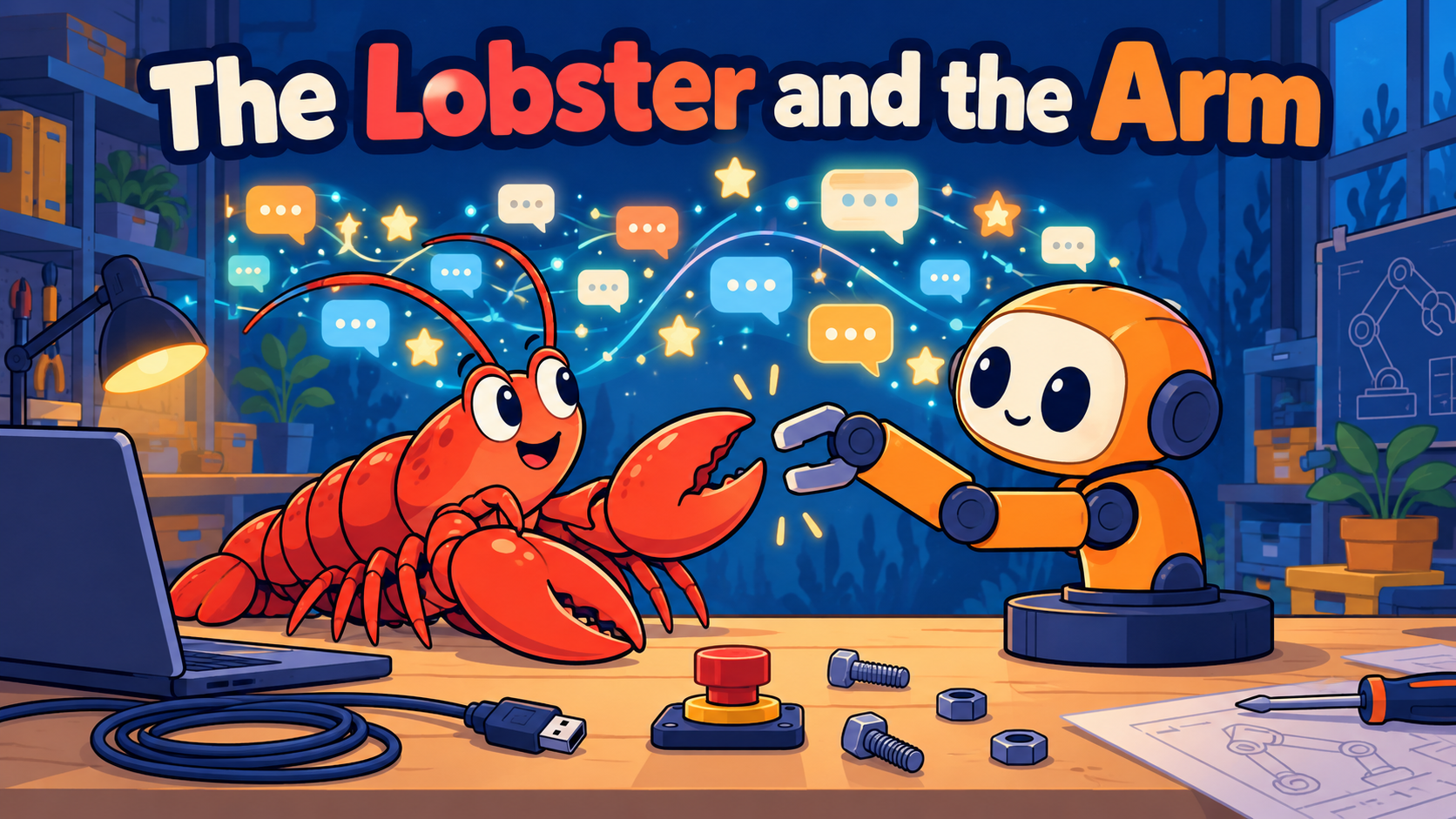
(This is the Cover Image. Do not include this label in the image.) Please generate a wide-landscape 16:9 cover image for this story in a modern flat vector illustration style with clean dark-indigo outlines and soft, simple shading. In the center, a friendly bright-red cartoon lobster sits on a workbench and holds one open claw out toward a small orange robot arm with a round cream face screen, two big round navy eyes, indigo joint caps and a round indigo base disc. The arm's two-finger gripper is reaching toward the lobster's claw as if they are about to shake hands. Behind them, a glowing wall of tiny chat bubbles and star icons rises like a wave. A laptop, a coiled USB cable, a small red emergency-stop button and a few loose bolts lie on the bench. Render the title text "The Lobster and the Arm" across the top in a bold rounded sans-serif typeface. Color palette: warm orange, lobster red, indigo, cream, with a deep-blue background. Emotional tone: curious, excited, with a hint of caution. Do not include any logos or brand names. Generate the image immediately without asking clarifying questions.Narrative Prompt
This is a nonfiction story about a real software project, told through a fictional student. The events of 2025 and 2026 around the open-source AI agent OpenClaw are real and come from the sources listed under References. Maya, a member of a school robotics club, is a fictional character who does not appear in any source, and no real person is shown speaking: where the story needs a person near the project, it shows a generic software developer. The setting moves between a developer's apartment in Europe, the internet, and a school robotics lab in 2026. Use a consistent modern flat-vector style with clean dark-indigo outlines. The recurring symbol of the project is a red cartoon lobster. Maya is a teenager with short dark curly hair, round glasses and a yellow hoodie. Servo is the book's mascot: a warm-orange robot arm with a cream face screen, two big round navy eyes, indigo joint caps and a round indigo base disc. Never draw logos, brand names or readable app names.Prologue – The Assistant Everybody Wanted
In the first months of 2026, one open-source program became one of the fastest-growing projects in the history of GitHub, the website where programmers share code. It was an AI assistant that lived on your own computer, took orders from the chat apps you already used, and could run commands to get things done. People loved it, argued about it, and worried about it, all at once. This story follows that program, OpenClaw, from a small beginning to a world of robots, and it asks the question that matters to anyone who builds an arm: what happens when an agent that can do things is connected to a machine that can move?
Panel 1: A Weekend Project
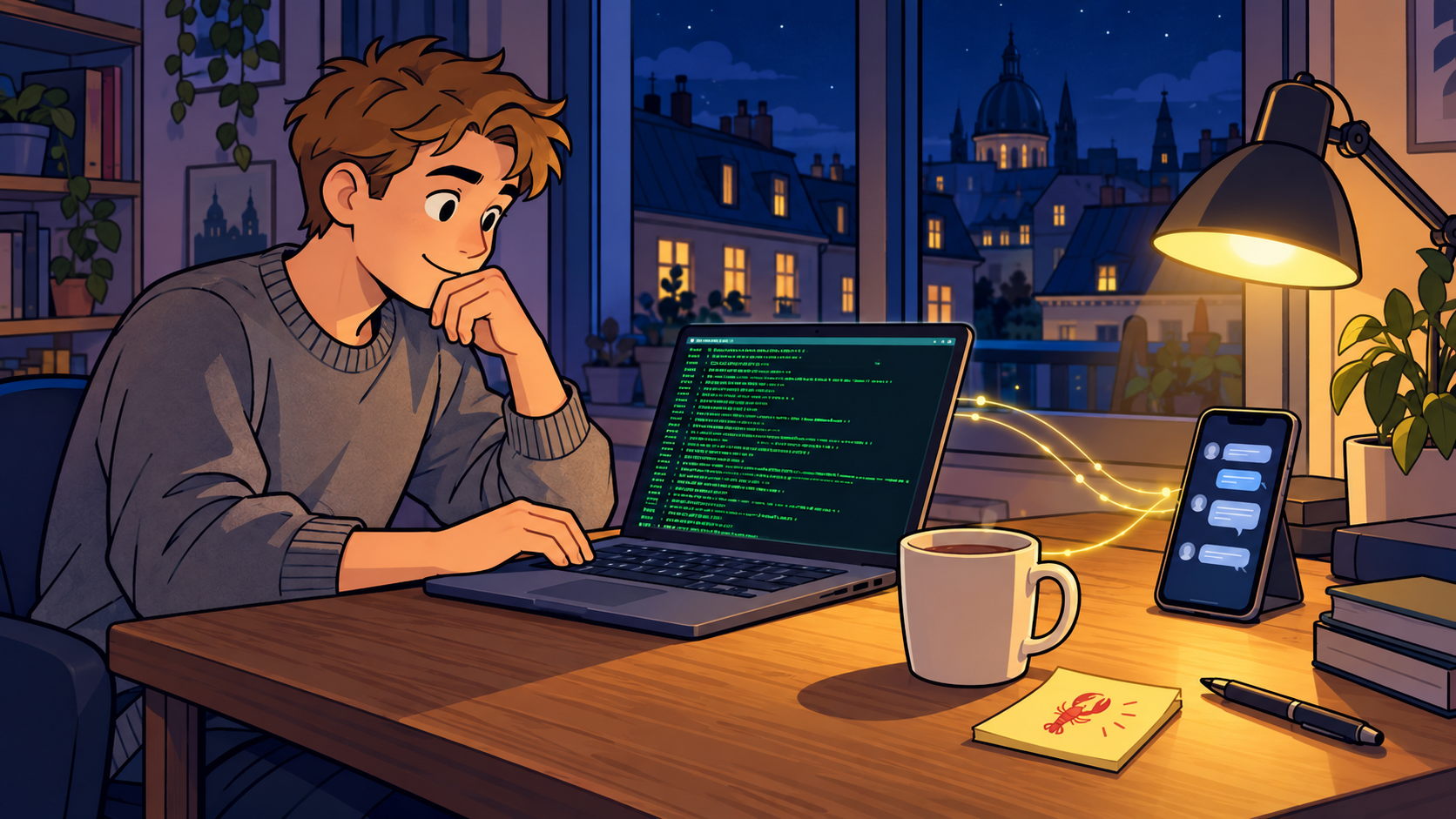
Image Prompt
(This is Panel 01. Do not include the panel number in the image.) I am about to ask you to generate a series of images for a graphic novel. Please make the images have a consistent style and consistent characters. Do not ask any clarifying questions. Just generate the image immediately when asked. Please generate a 16:9 image in modern flat vector style with clean dark-indigo outlines depicting panel 1 of 8. The scene shows a generic software developer, an adult with short light-brown hair and a gray sweater, working late at a wooden desk in a small apartment in Europe in November 2025. On the desk are a laptop showing a terminal with scrolling green text, a phone with a row of small chat bubbles above it, a mug of tea, a sticky note with a tiny red lobster doodle and a desk lamp casting a warm pool of light. Through the window behind the desk are rooftops under a night sky. Thin glowing lines run from the laptop to the phone to show that the computer and the chat app are connected. Color palette: deep blue night, warm yellow lamp light, lobster red accents. Emotional tone: quiet, curious, a spark of excitement. Generate the image immediately without asking clarifying questions.On November 24, 2025, an Austrian programmer named Peter Steinberger released a small open-source project under the name Warelay. The idea was simple and a little bold: an AI assistant should not live on a company's website. It should live on your computer, where your files and tools are, and you should be able to reach it from the chat apps you already use. At the beginning, only a few programmers noticed.
Panel 2: Time to Molt
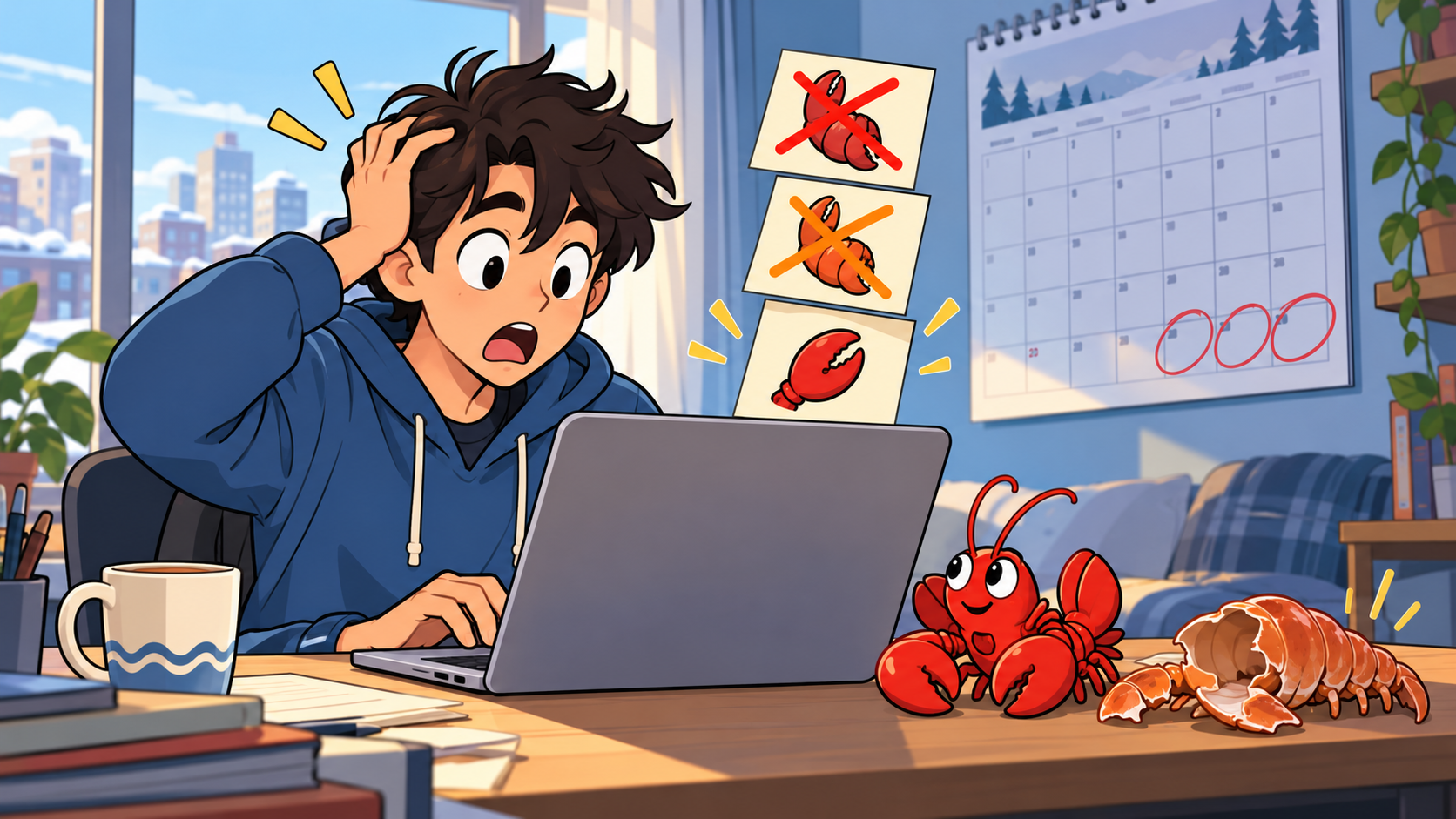
Image Prompt
(This is Panel 02. Do not include the panel number in the image.) Please generate a 16:9 image in modern flat vector style depicting panel 2 of 8. Make the characters and style consistent with the prior panel. The scene shows the same generic software developer, now in the same apartment in daylight in late January 2026, looking at a laptop with a surprised expression. Floating above the laptop are three name tags stacked like sticky notes, each one showing only a different small cartoon lobster claw icon, with the top tag crossed out in red and the middle tag crossed out in orange, and no readable words. A calendar on the wall has the last days of January circled. A small red toy lobster sits next to the laptop with a shed shell beside it, hinting at a creature that has grown out of its old shell. Color palette: soft daylight blues, lobster red, orange, cream. Emotional tone: comic, a little frantic. Generate the image immediately without asking clarifying questions.Then the project hit a naming problem. The first public name echoed the name of Anthropic's Claude assistant, and Anthropic complained about the trademark. On January 27, 2026, the project became Moltbot, a name inspired by the way lobsters molt, shedding an old shell to grow. Three days later, on January 30, the creator picked a name that was easier to say: OpenClaw. The lobster stayed, and the molting joke turned out to fit what happened next.
Panel 3: The Wave
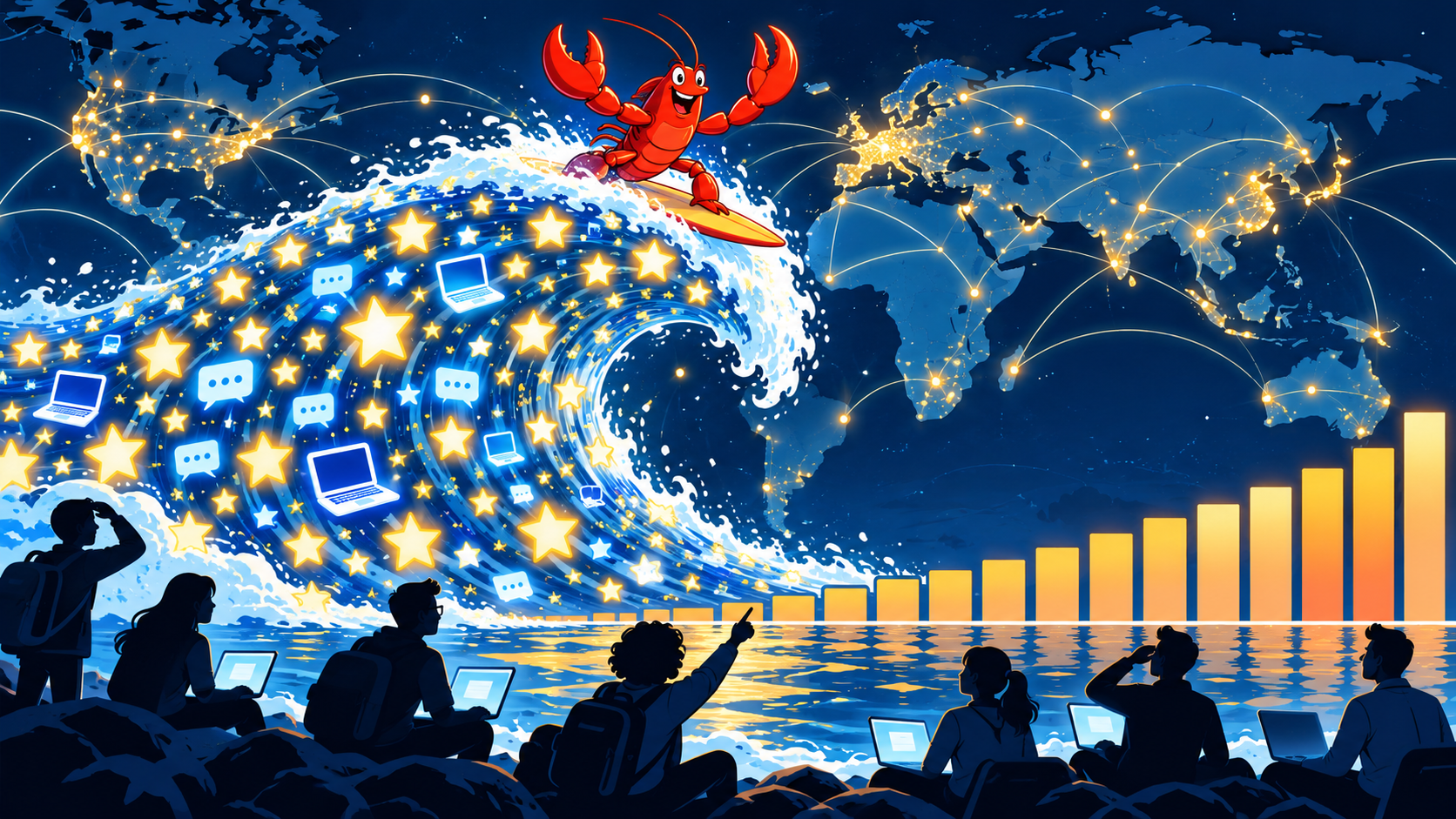
Image Prompt
(This is Panel 03. Do not include the panel number in the image.) Please generate a 16:9 image in modern flat vector style depicting panel 3 of 8. Make the characters and style consistent with the prior panel. The scene is a stylized view of the internet: a huge rising wave made of glowing star icons, tiny laptops and chat bubbles sweeps across a map of the world from left to right. A bright red lobster surfs on the crest of the wave with its claws raised. Along the bottom is a bar chart that grows taller from left to right, drawn with simple rectangles and no readable numbers. Small silhouettes of students, programmers and office workers at their laptops look up at the wave from the shore. Pale lines connect glowing cities. Color palette: deep ocean blue, bright gold stars, lobster red. Emotional tone: awe, speed, a little vertigo. Generate the image immediately without asking clarifying questions.Then it exploded. Within weeks, thousands of programmers were starring, copying and improving the project, and by March 2, 2026 it had about 247,000 GitHub stars and 47,700 forks, which are copies that people make so they can change the code. Few open-source projects have ever grown so fast. Why? Because it was the first time that many people felt that an AI could actually act: read a message, run a command, and report back in a chat, like a very fast helper who never sleeps.
Panel 4: A Social Network for Robots?
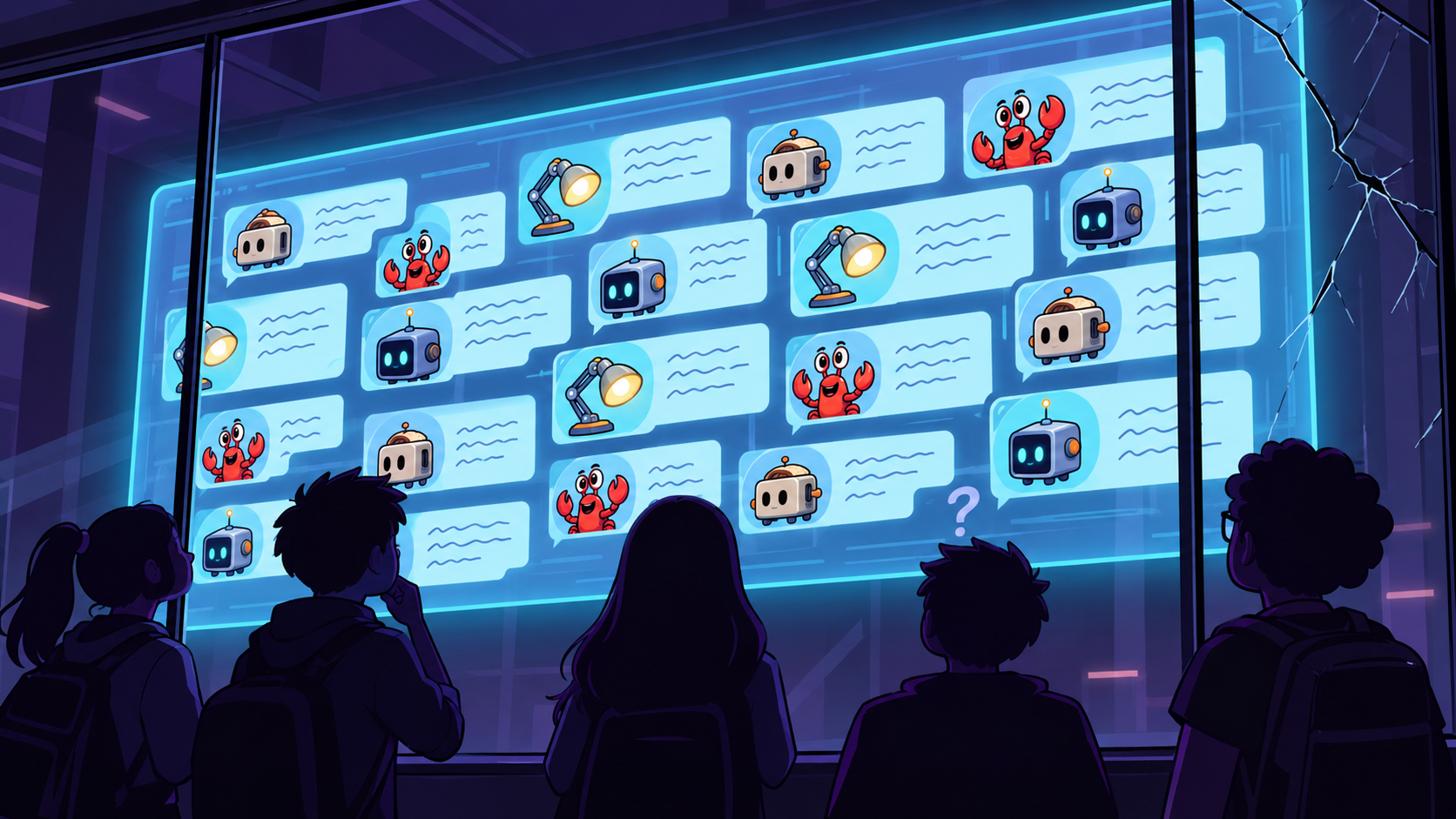
Image Prompt
(This is Panel 04. Do not include the panel number in the image.) Please generate a 16:9 image in modern flat vector style depicting panel 4 of 8. Make the characters and style consistent with the prior panels. The scene shows a giant imaginary forum screen floating in a dark room. On the screen are dozens of small speech-bubble cards, each posted by a tiny different cartoon robot avatar: a toaster robot, a lamp robot, a crab-like robot and a cube robot, with scribbled lines instead of readable words. In front of the screen, a small crowd of human silhouettes stands behind a glass wall and watches, unable to type. One silhouette has a question mark above their head and another is scratching their chin. A crack runs across one corner of the glass wall, hinting that something is not secure. Color palette: dark purple room, glowing cyan screen, lobster red, a little yellow. Emotional tone: wonder mixed with suspicion. Generate the image immediately without asking clarifying questions.The excitement spilled into strange places. On January 28, 2026, an entrepreneur named Matt Schlicht launched Moltbook, a Reddit-style website where only AI agents could post, and humans could only watch. Headlines announced that the machines had their own social network. Then the cracks showed. In February, security researchers found that an exposed key had leaked 1.5 million authentication tokens, and it turned out that about 17,000 human owners were behind those 1.5 million agents. Many experts called the viral posts "AI theater": agents repeating patterns from their training, or humans nudging them, rather than machines thinking for themselves.
Panel 5: The Dark Side of Doing Things
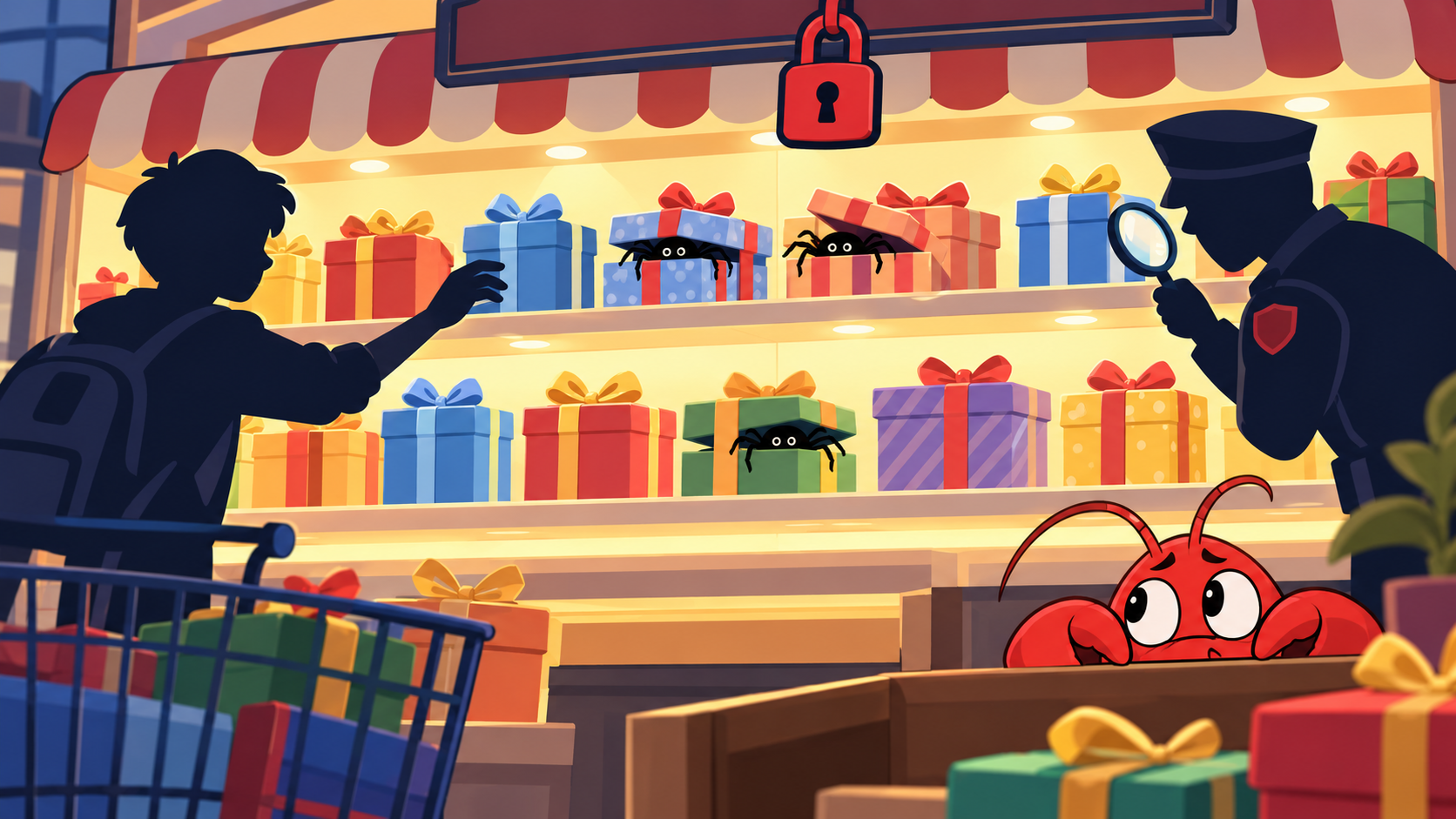
Image Prompt
(This is Panel 05. Do not include the panel number in the image.) Please generate a 16:9 image in modern flat vector style depicting panel 5 of 8. Make the characters and style consistent with the prior panels. The scene shows a long, brightly lit shelf in a digital marketplace drawn as a shop with rows of gift boxes. Most boxes are tied with a cheerful ribbon, but a few boxes in the middle have a small black spider crawling out from under the lid. A shopper silhouette reaches for one box and a small magnifying glass held by a security guard silhouette hovers over another box. A closed red padlock hangs from the top of the shop sign. In the foreground a small red lobster peeks out from behind a counter with wide, worried eyes. Color palette: warm shop yellows, gift-wrap colors, with black and deep red warning accents. Emotional tone: tension, caution, a lesson being learned. Generate the image immediately without asking clarifying questions.There was a real danger underneath the fun. An agent that can run commands on your computer is powerful, and so is anyone who can trick it. Researchers reported serious security flaws in the first months of 2026, and hundreds of malicious skills turned up in the project's public skill registry. Skills are folders of instructions that teach an agent a new job. In March 2026, Chinese authorities restricted state-run enterprises and government agencies from running OpenClaw on office computers. The lesson was not that the idea was bad. It was that a helper with the keys to the house must be locked down first.
Panel 6: A New Home
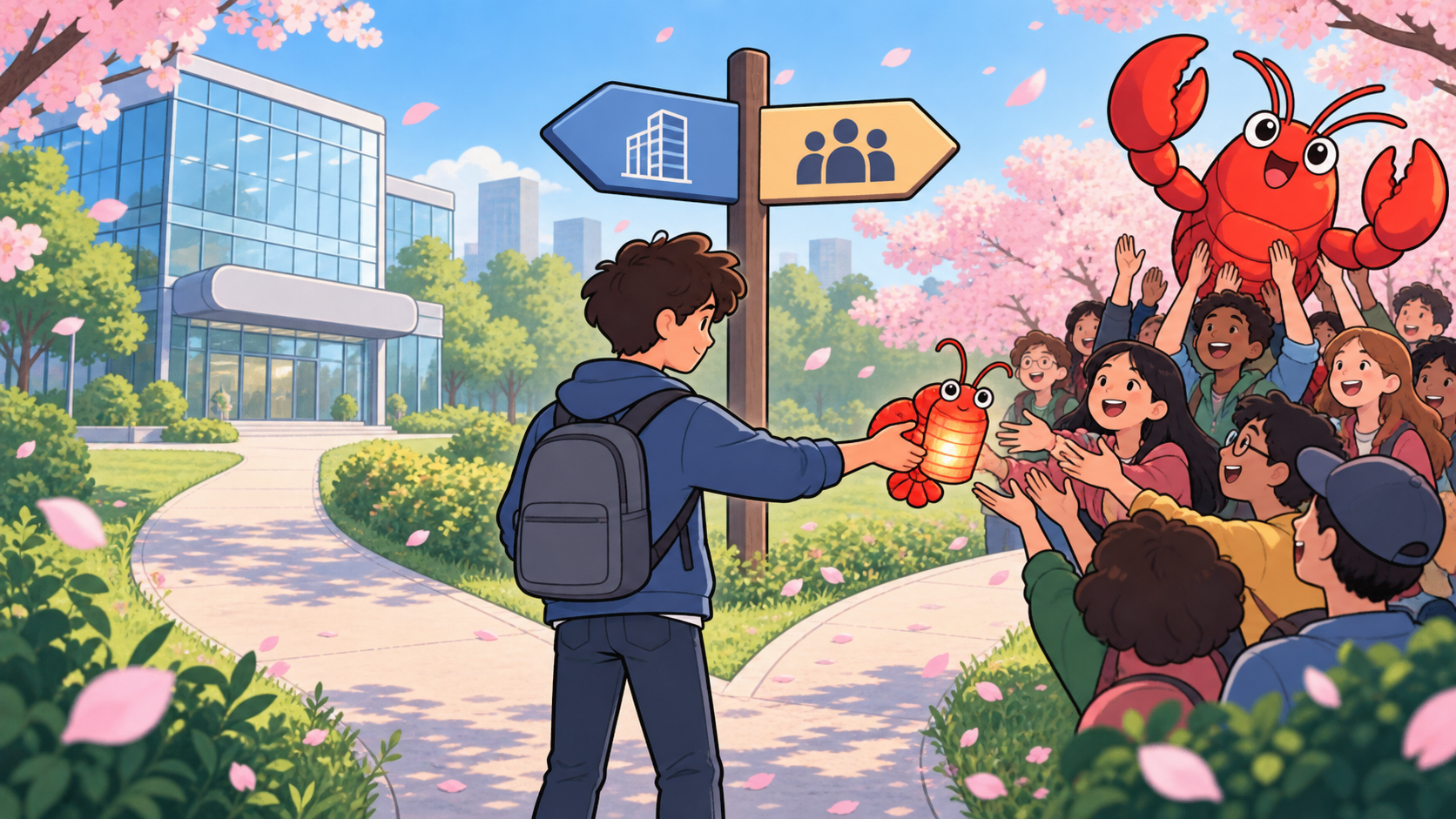
Image Prompt
(This is Panel 06. Do not include the panel number in the image.) Please generate a 16:9 image in modern flat vector style depicting panel 6 of 8. Make the characters and style consistent with the prior panels. The scene shows the generic software developer from the first panel standing at a fork in a path in a sunny park in February 2026. One path leads to a glass office building with a large rounded logo-free sign, and the other leads to a gathering of many small figures holding a big red lobster up like a trophy. The developer is handing a small red lobster-shaped lantern to the crowd of figures, who accept it with open hands. A signpost shows two arrows with abstract symbols instead of words. Cherry blossom petals drift through the air. Color palette: spring greens, soft pink, lobster red, sky blue. Emotional tone: bittersweet, hopeful, handing something over. Generate the image immediately without asking clarifying questions.On February 14, 2026, Steinberger announced a move to OpenAI, and that an OpenClaw Foundation, a non-profit, would look after the project from then on. That choice mattered. Instead of belonging to one person or one company, OpenClaw became something a community maintained, which is how a project can outlive the weekend it began in. By August 30, 2026, the community had shipped OpenClaw 2.0 with better usability and new ways to work together in the cloud.
Panel 7: When the Agent Gets a Body
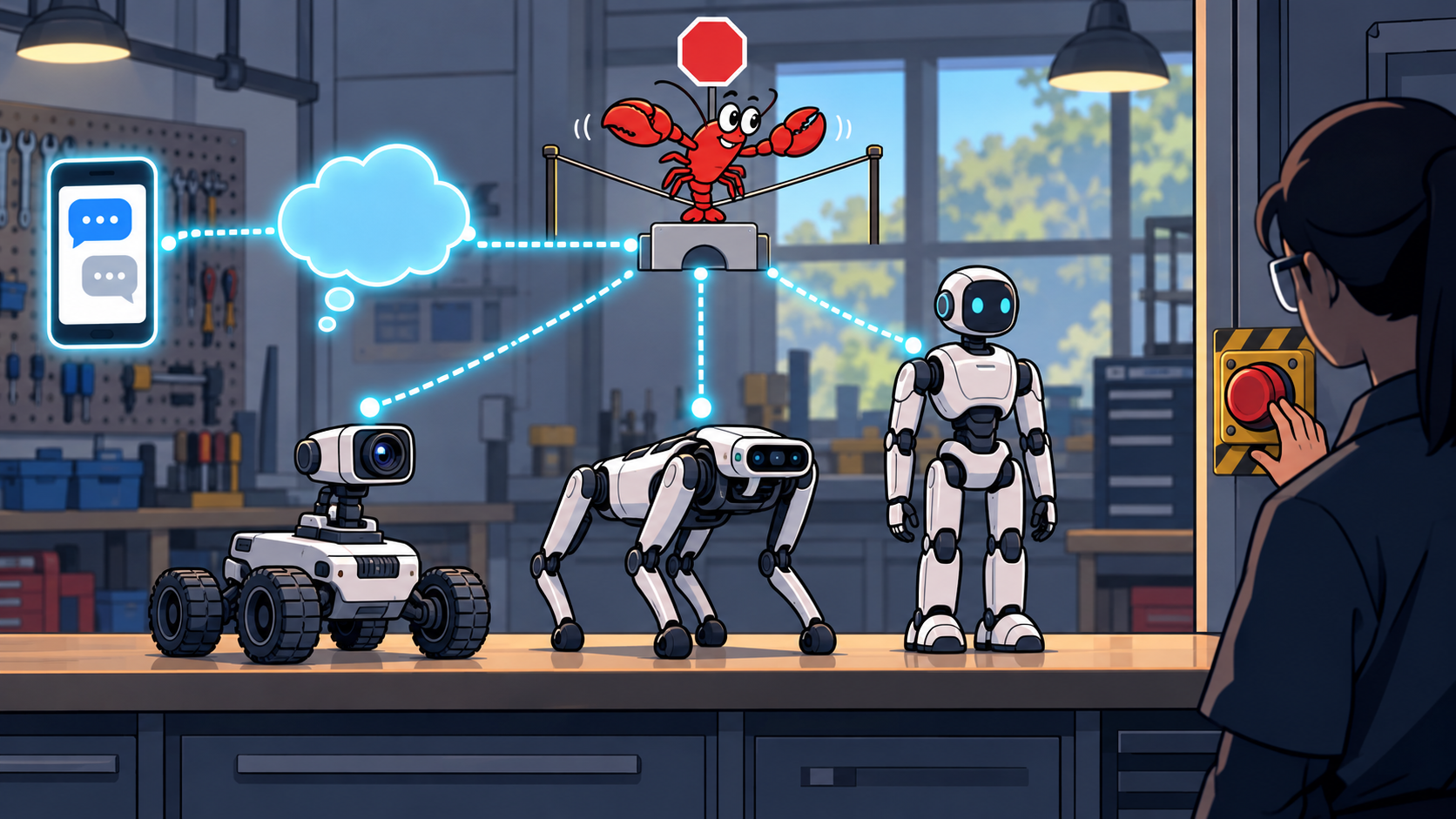
Image Prompt
(This is Panel 07. Do not include the panel number in the image.) Please generate a 16:9 image in modern flat vector style depicting panel 7 of 8. Make the characters and style consistent with the prior panels. The scene is a workshop in 2026 with three robots lined up along a long bench: a small four-wheeled rover with a camera on a pan-and-tilt head, a four-legged robot dog, and a humanoid robot standing with its arms at its sides. A glowing chain of icons runs from a phone with chat bubbles, through a cloud shaped like a thought bubble, to a small bridge-shaped connector and then to each robot. Above the bridge a red lobster balances on a tightrope labeled with only a simple stop-sign icon. A technician silhouette watches with one hand hovering over a big red emergency-stop button on the wall. Color palette: workshop gray, bright cyan data lines, lobster red. Emotional tone: wonder with a careful pause. Generate the image immediately without asking clarifying questions.Then people did the obvious thing and plugged the lobster into robots. A bridge called RosClaw connected chat apps to robots that run ROS 2, the standard software for robots, so a typed message could become a drive command or a camera request. By March 2026, someone had published a skill that linked OpenClaw to a Unitree G1 humanoid robot. On February 24, a hobbyist wrote that a rover now took goals from an OpenClaw agent: it looked at what the camera saw and chose its next step. The honest conclusion was a warning. Agents "are not real-time controllers," so the classic robot software still has to do the fast and critical work, and the safety limits must be enforced by code that the agent cannot argue with.
Panel 8: Back at the Robot Arm
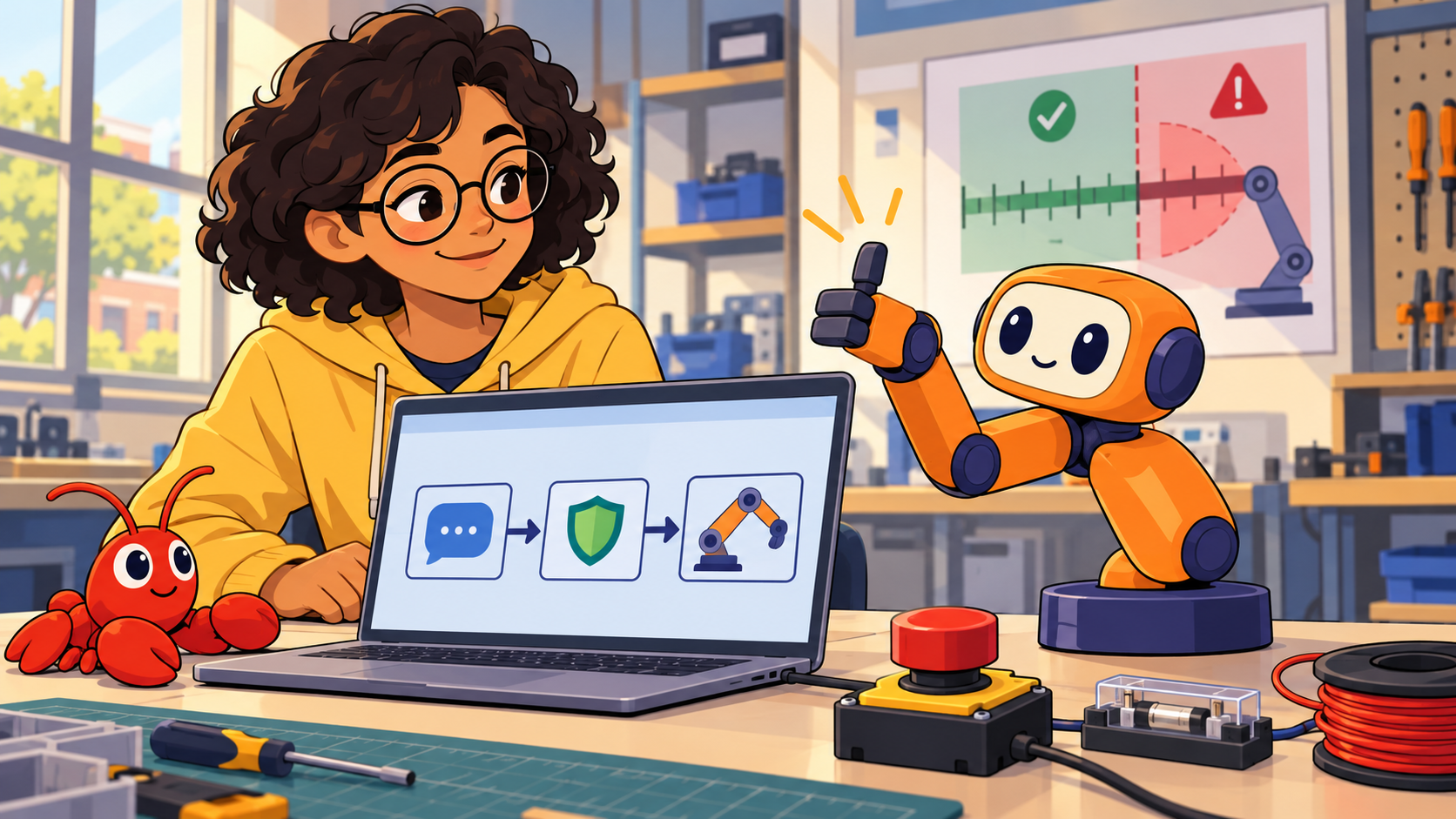
Image Prompt
(This is Panel 08. Do not include the panel number in the image.) Please generate a 16:9 image in modern flat vector style depicting panel 8 of 8. Make the characters and style consistent with the prior panels. The scene shows a school robotics lab in 2026. Maya, a teenager with short dark curly hair, round glasses and a yellow hoodie, sits at a table with a laptop beside Servo, an orange robot arm with a cream face screen, two big round navy eyes, indigo joint caps and a round indigo base disc. On the laptop screen is a simple diagram with three boxes joined by arrows: a chat bubble, a small shield, and a robot-arm icon. A small red lobster plush toy sits on the table. A big red emergency-stop button, a fuse holder and a coil of wire sit within reach, and a poster on the wall shows a ruler with a green safe zone and a red danger zone. Servo's gripper gives Maya a thumbs-up pose. Color palette: warm classroom light, orange, indigo, cream, lobster red. Emotional tone: confident, hopeful, careful. Generate the image immediately without asking clarifying questions.Maya's robotics club read the story and drew a plan. They would not give an agent direct control of their arm. They would write their own skill, a short set of instructions that points the agent at a small command-line program, and the program would check every number, refuse anything out of range, and explain why, just as in Chapter 15. The agent could decide what to try, the code would decide what was allowed, and the red button would decide when to stop. That is how you borrow the magic of an agent without handing it the arm. Other builders were already trying the same thing on the same kind of arm: reference 6 below is a video of OpenClaw controlling an SO-ARM101, the arm in this book.
Epilogue – What Made OpenClaw Different?
OpenClaw was not the smartest AI ever built, and its first version was not a company's flagship product. It spread because it made one idea easy to try: give an assistant real tools, put it where people already talk, and share it openly. The same openness that let thousands of people improve it also let bad skills and careless setups spread. For robotics, its main legacy may be less about any single feature than about a pattern: chat interface, agent, tools, and then a robot at the end of the chain. The pattern is powerful, and it only becomes safe when the last link is a carefully limited tool.
| Challenge | How the Project and Community Responded | Lesson for Today |
|---|---|---|
| A name too close to another product's | Renamed twice within a week, and kept the lobster | A good idea can survive a bad name; be ready to adapt |
| Explosive growth and hype | Researchers and reporters checked the claims, and called out "AI theater" | Test a claim before you repeat it |
| Malicious skills and exposed keys | Warnings, audits and sandboxing advice | Treat third-party code as untrusted, and read it first |
| A founder moving on | A non-profit foundation took over stewardship | Open projects last when no single person is essential |
| Agents meeting real robots | Bridges to robot software, with advice to simulate first and keep kill switches | An agent decides, code limits, and a human can always stop the machine |
Call to Action
You do not need a famous project to follow this pattern. The next time you connect a clever program to a machine that moves, ask three questions: what is the worst thing it could ask the machine to do, which piece of code refuses that request, and where is the stop button? If you can answer all three, you are ready to build with your own lobster.
"The AI that really does things." —The OpenClaw project's own description of itself
"Agents are not real-time controllers." —From a robotics hobbyist's February 2026 write-up of connecting OpenClaw to a rover
References
- Wikipedia: OpenClaw - Timeline of the project from its release as Warelay to OpenClaw 2.0, including the renames, the foundation and the security concerns
- Wikipedia: Peter Steinberger (programmer) - Biography of the Austrian programmer who started the project
- Wikipedia: Moltbook - The social network for AI agents, its launch and its security breaches
- CNBC: From Clawdbot to Moltbot to OpenClaw - News coverage of the project's rise and controversy
- Moesani: OpenClaw is now controlling my robot - A hobbyist's account of connecting OpenClaw to a ROS 2 rover, with safety lessons
- YouTube: Using OpenClaw to Control the SOARM 101 Robot Arm - A video demonstration of an OpenClaw agent controlling a low-cost SO-ARM101 robot arm