MicroSims
MicroSims are small, interactive educational simulations — each one focused on
a single concept. They live under docs/sims/<sim-name>/ and are embedded
into chapters via iframes.
New MicroSims can be created with the microsim-generator skill, which routes
to the appropriate library (p5.js, Chart.js, vis-network, Mermaid, Leaflet,
Plotly, Venn.js).
Catalog
-
Hobby PWM Servo vs. Serial Bus Servo
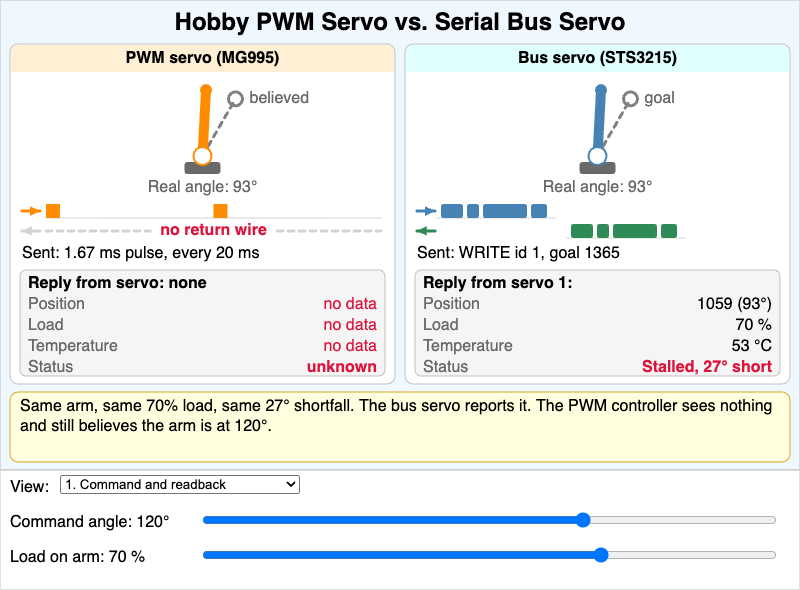
Why an MG995 hobby servo cannot replace the STS3215 bus servos in an SO-ARM100/101: command and readback, leader/follower, and wiring. Used in Appendix A.
-
Explore and then take a quiz on the seven named parts of a six-axis robot arm: base, shoulder, upper arm, elbow, forearm, wrist, and end effector. Used in Chapter 2.
-
Seven reachability problems for a flat two-link arm, then an explore mode where link lengths and the elbow limit reshape the shaded workspace ring. Used in Chapter 2.
-
Predict where a follower arm's joint ends up when it copies a leader: the copy rule, the follower's joint limits, and calibration error. Used in Chapter 2.
-
Change the supply voltage and load resistance, watch animated current dots speed up and slow down, then solve five target-current and target-power challenges. Used in Chapter 3.
-
Pick a wire gauge, length and load current and see the voltage lost in the wires, then choose the thinnest safe wire for five loads. Used in Chapter 3.
-
Predict whether the arm runs, the fuse blows, or the E-stop stops it, and watch the current dots stop or flow. Used in Chapter 3.
-
Predict what a motor driver's input reads with and without a shared ground wire, and watch the signal current loop appear and vanish. Used in Chapter 3.
-
Set the four switches of an H-bridge and predict whether the motor runs forward, reverses, coasts, brakes or short-circuits, with animated current dots. Used in Chapter 5.