Challenge Cards Bring Focus
Cover Image Prompt
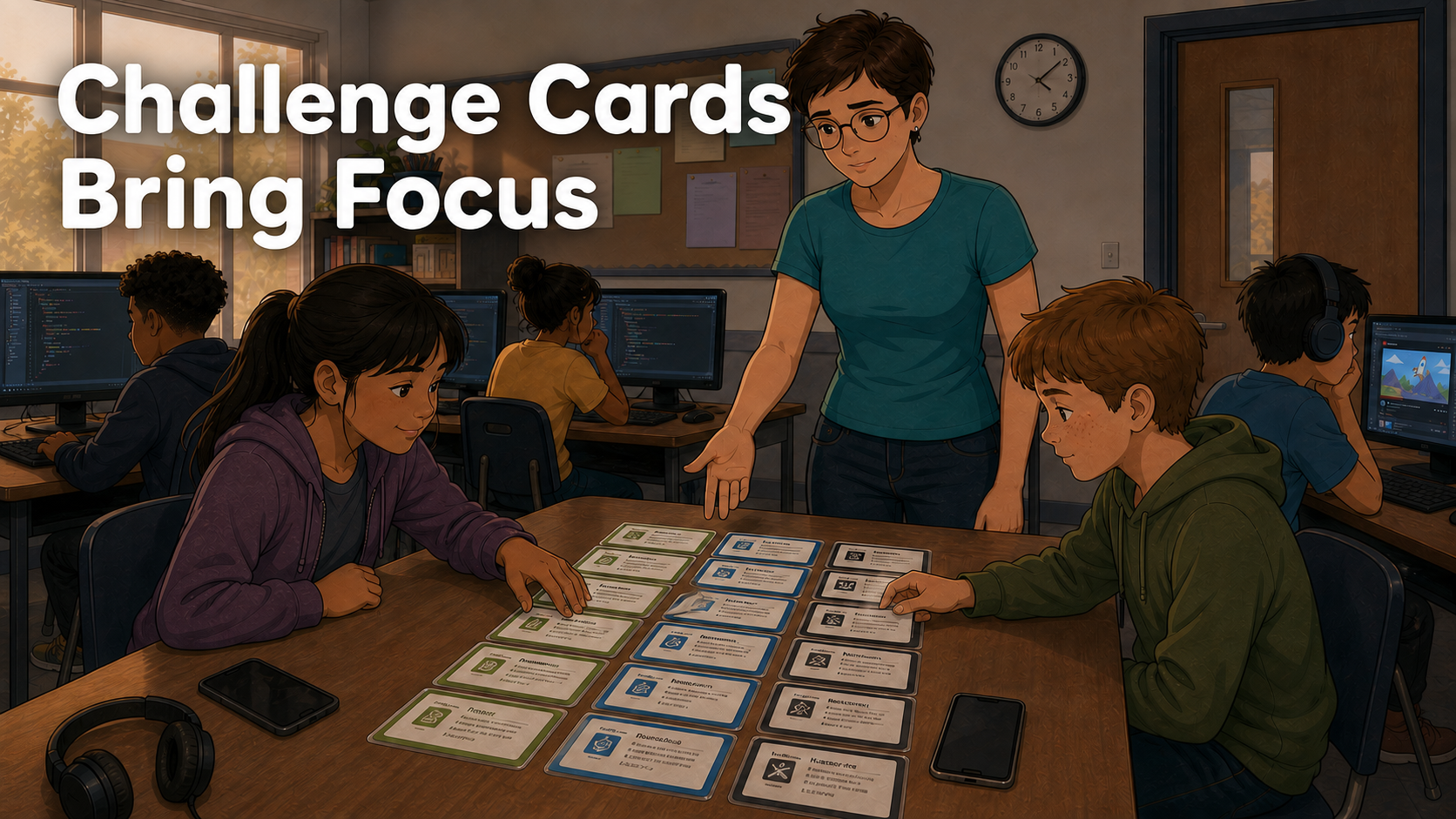
(This is the Cover Image. Do not include this label in the image.) Please generate a wide-landscape 16:9 cover image in a warm, contemporary educational-graphic-novel style — clean linework, soft cel-shading, grounded realistic proportions. Scene: a coding-club center table displaying three neat rows of laminated cards with colored borders — green, blue, and black — fanned out invitingly. A woman in her 30s (Sally), wearing glasses and a plain t-shirt, stands behind the table gesturing toward the cards while two students (a boy around 10, a girl around 13) lean in, reaching for cards with interested expressions, their phones visibly set aside on the table. Title text "Challenge Cards Bring Focus" rendered in a bold, rounded, friendly sans-serif typeface. Color palette: crisp green, blue, and near-black card borders against a neutral classroom background, warm overhead lighting. Emotional tone: order emerging from distraction, quiet confidence. Generate the image immediately without asking clarifying questions.Narrative Prompt
This is a fictional composite story, not a depiction of a specific real club or a real named individual. "Sally" represents a pattern seen across many coding clubs: a volunteer who solves a chronic distraction problem by borrowing and adapting a tiered challenge-card system from other clubs. Setting: a present-day, community-based after-school coding club in the United States, serving students roughly ages 9-14. Art style: warm, contemporary educational-graphic-novel illustration, clean linework, soft cel-shading, consistent character design and color palette across all panels — Sally should be immediately recognizable from panel to panel (same glasses, same short haircut, same t-shirt style).Prologue – The Room That Couldn't Settle
Sally had volunteered at her coding club for two terms, and she'd watched the same thing happen almost every week: students arrived, sat at the computers, and within minutes some of them had drifted somewhere else entirely — a video, a group chat, anywhere but the project in front of them. They weren't bad kids. They just didn't have anything pulling them back.
Panel 1: Everyone Somewhere Else
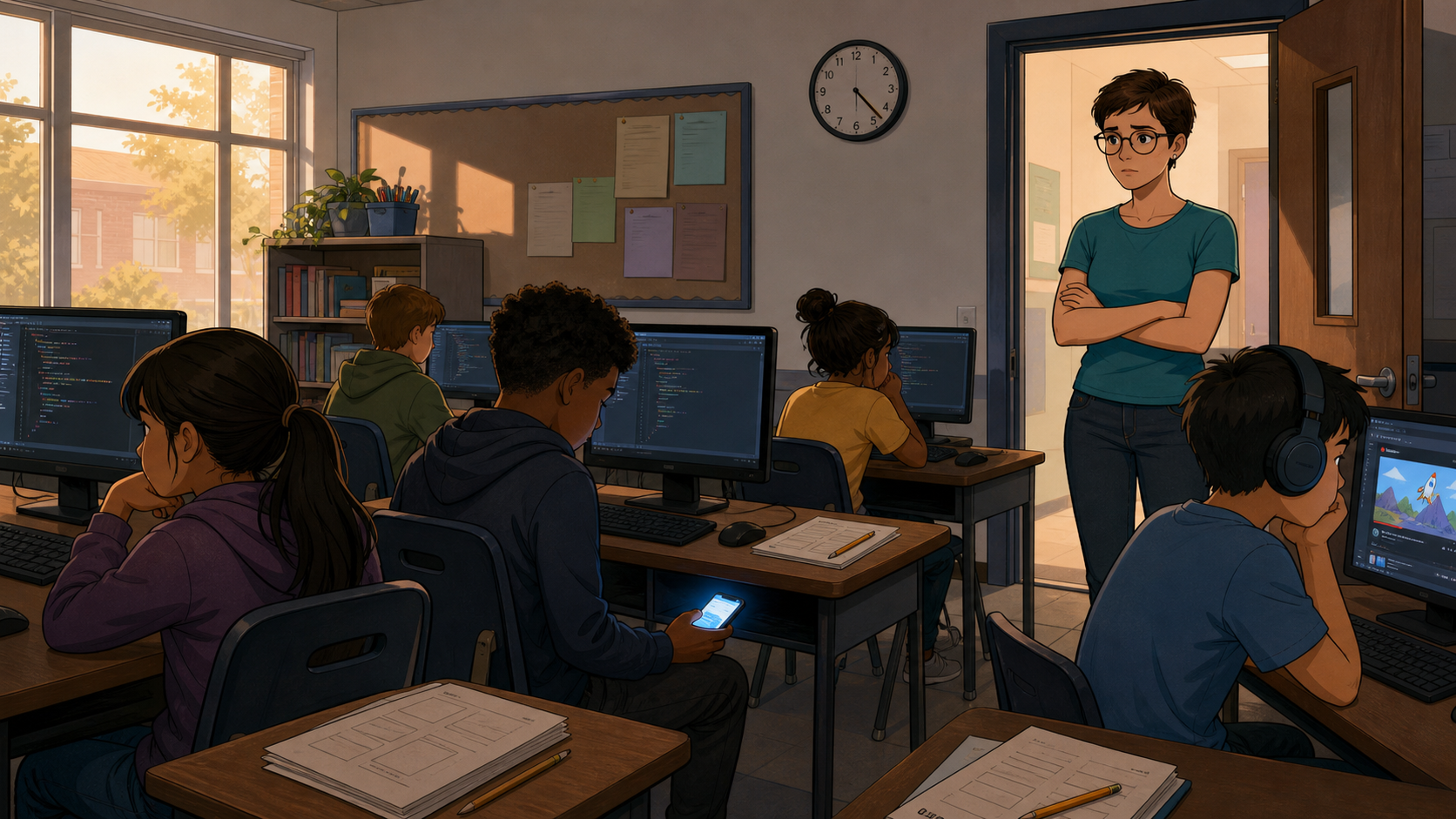
Image Prompt
(This is Panel 01. Do not include the panel number in the image.) I am about to ask you to generate a series of images for a graphic novel. Please make the images have a consistent style and consistent characters. Do not ask any clarifying questions. Just generate the image immediately when asked. Please generate a 16:9 image in a warm, contemporary educational-graphic-novel style depicting panel 1 of 7. The scene should show a coding-club classroom with several students at computer stations, two of them clearly disengaged — one scrolling a phone under the desk, another watching a video with headphones on, screens showing unfinished code editors behind them. Sally, a woman in her 30s with glasses and short hair, stands in the doorway surveying the room with a concerned, thoughtful expression. Setting: present-day USA after-school classroom, late afternoon light through windows. Color palette: muted classroom neutrals, the glow of phone screens standing out as a small distracting light source. Emotional tone: quiet concern, drift, low energy. Six visual details: a phone screen glowing under a desk, headphones on a distracted student, an unfinished code editor on a monitor, a wall clock, scattered unopened worksheets, Sally's crossed arms in the doorway. Generate the image immediately without asking clarifying questions.Every week Sally watched students come in, sit down at the computers, and start working — for a little while. Then the smallest thing would pull them away: a notification, a video, a friend two seats over. They weren't focused on coding, weren't building their problem-solving skills, and Sally didn't yet know how to change that.
Panel 2: Asking Around
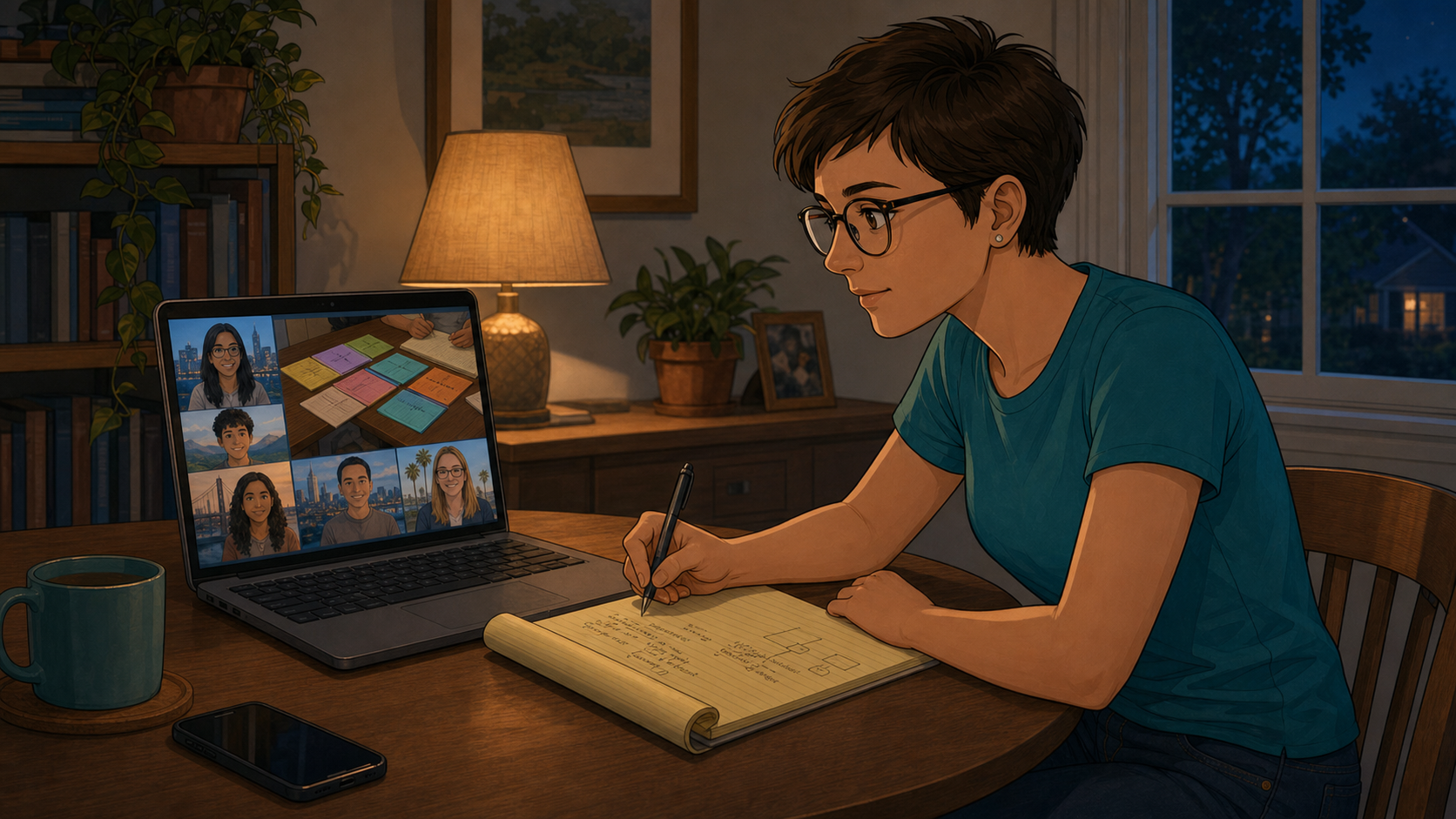
Image Prompt
(This is Panel 02. Do not include the panel number in the image.) Please generate a 16:9 image in the same style depicting panel 2 of 7. Make Sally consistent with the prior panel. The scene should show Sally at home in the evening on a video call, laptop open showing a grid of other coding-club volunteers from different cities, one of their shared screens displaying a photo of a table with colorful cards laid out. Sally leans forward, taking notes on a legal pad. Setting: present-day USA home office or kitchen table, evening, warm lamp light. Color palette: warm indoor lamp tones with a cool blue laptop-screen glow. Emotional tone: curiosity, active investigation. Six visual details: laptop video call grid, a shared screen showing colorful cards, a legal pad with handwritten notes, a pen mid-write, a mug on the table, evening light through a window. Generate the image immediately without asking clarifying questions.Sally started asking other club leaders what they did about distraction, and one answer kept coming up: a set of "challenge cards" — laminated, color-coded cards laid out where every student could see them the moment they walked in. She'd never seen anything like it at her own club.
Panel 3: Green, Blue, and Black
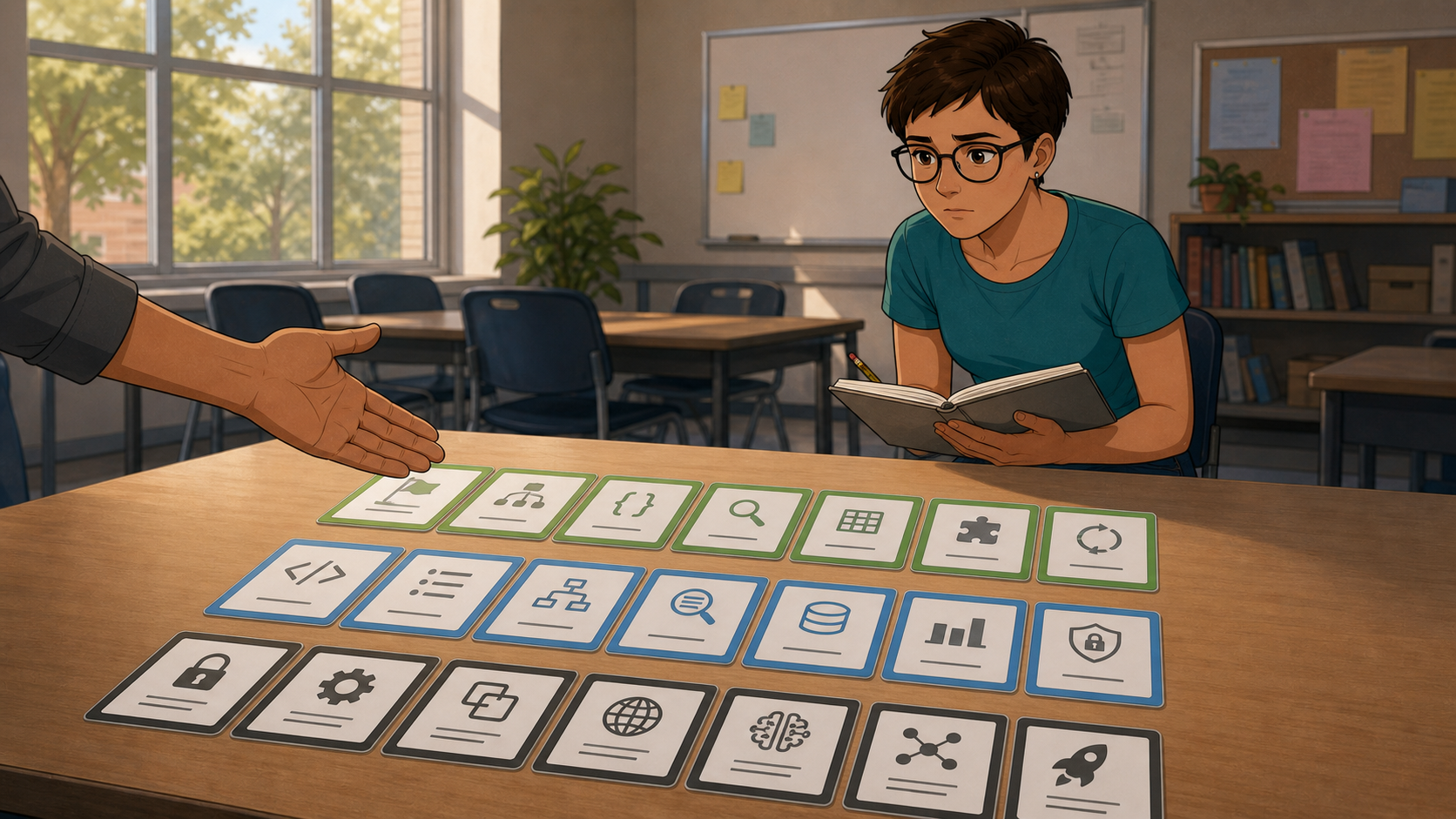
Image Prompt
(This is Panel 03. Do not include the panel number in the image.) Please generate a 16:9 image in the same style depicting panel 3 of 7. Make Sally consistent with prior panels. The scene should show a close-up of a real example table at a different club, three tidy rows of laminated cards with green, blue, and black borders respectively, each card showing a small icon and short title, a hand (not Sally's) gesturing to explain the tiers. Sally stands just behind, observing closely with a notebook in hand. Setting: a different, present-day USA coding-club room, daytime. Color palette: crisp green, blue, and black card borders against a plain table surface. Emotional tone: discovery, clarity. Six visual details: green-bordered cards, blue- bordered cards, black-bordered cards, small icons on each card, a hand gesturing to explain the tiers, Sally's notebook open and ready. Generate the image immediately without asking clarifying questions.At the club she visited, every card had a colored border that meant something: green cards were quick, easy warm-ups; blue cards took real focus; black cards were the hardest, often requiring a team. Students didn't need an adult to tell them where to start — the color told them.
Panel 4: Building Her Own Deck
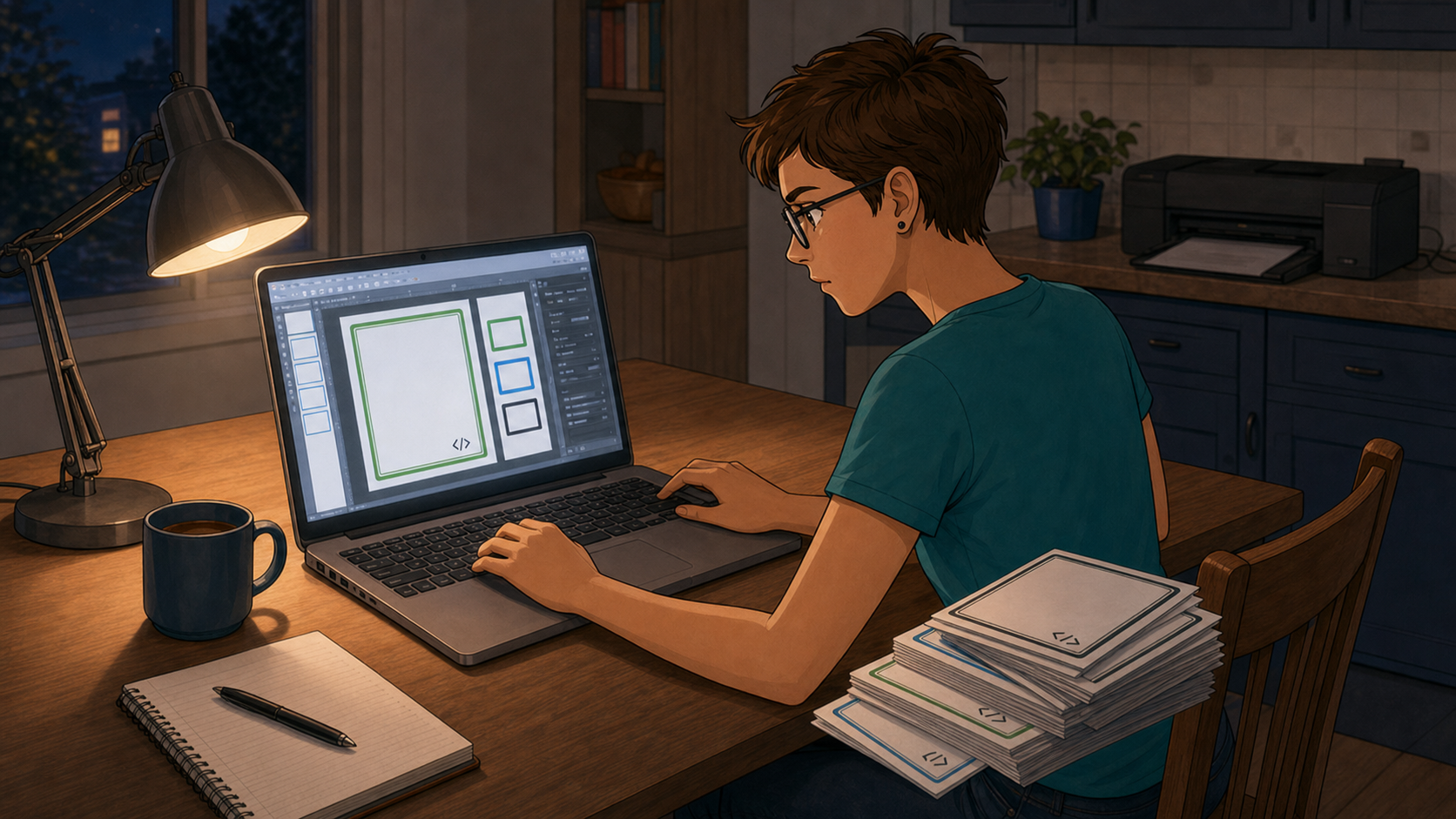
Image Prompt
(This is Panel 04. Do not include the panel number in the image.) Please generate a 16:9 image in the same style depicting panel 4 of 7. Make Sally consistent with prior panels. The scene should show Sally at her kitchen table late at night, laptop open to a slide- design program, a stack of freshly printed cards nearby not yet laminated, colored border swatches visible on screen. Setting: present-day USA home, nighttime. Color palette: warm lamp light, cool laptop glow, colorful printed cards as the visual focal point. Emotional tone: focused, determined, a small creative project taking shape. Six visual details: laptop showing card-design software, a stack of printed but unlaminated cards, colored border swatches on screen, a mug of coffee, a desk lamp, a printer in the background. Generate the image immediately without asking clarifying questions.Sally didn't wait for anyone's permission — she opened a slide program that same week and designed a dozen cards of her own: green for warm-ups, blue for focus work, black for team challenges. It took a few late nights, but by the weekend she had a full deck ready to print.
Panel 5: The Table Everyone Notices
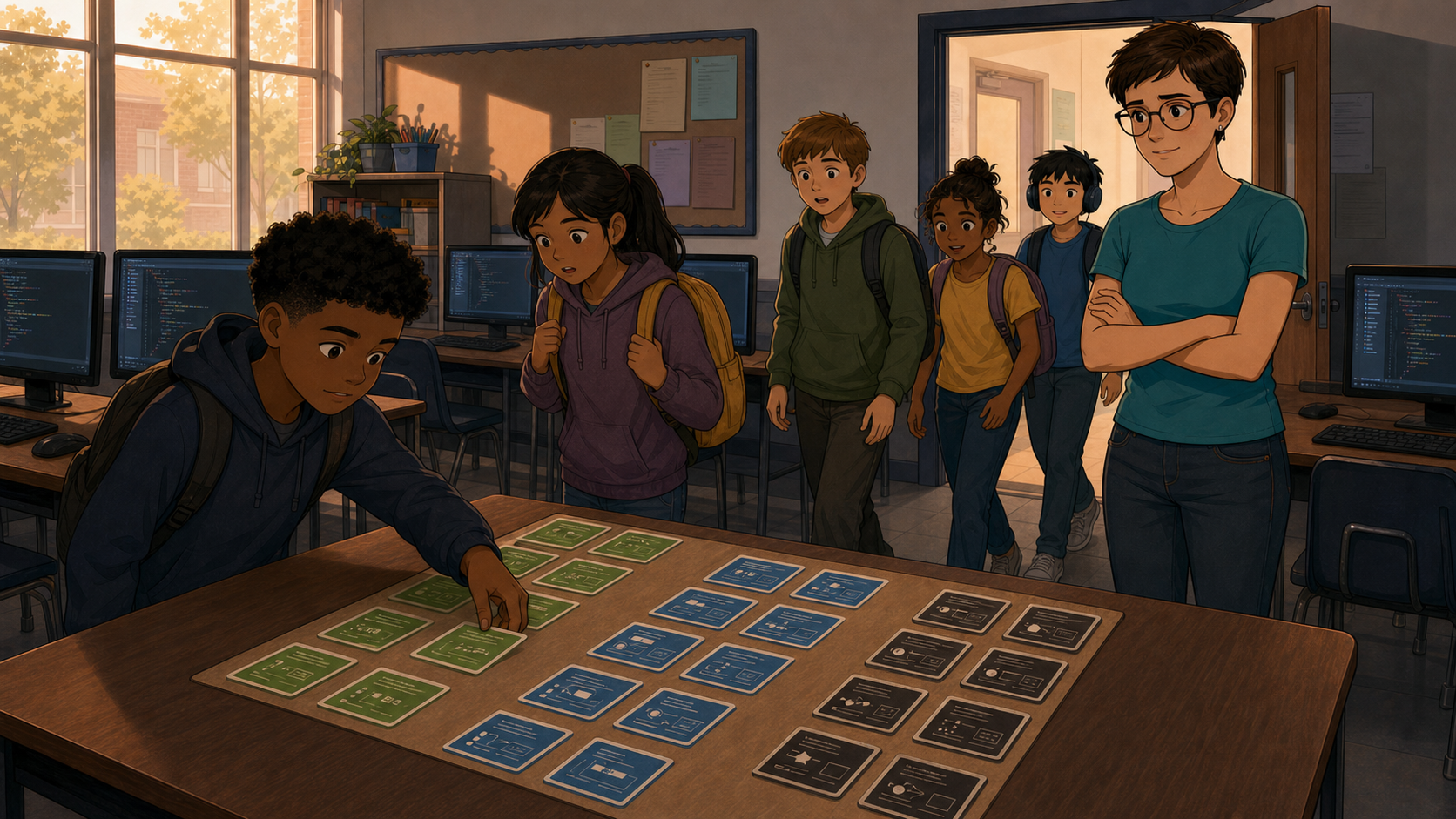
Image Prompt
(This is Panel 05. Do not include the panel number in the image.) Please generate a 16:9 image in the same style depicting panel 5 of 7. Make Sally and the classroom consistent with prior panels. The scene should show the same classroom from panel 1, now with a freshly displayed center table of Sally's own green, blue, and black cards, several students walking in and immediately noticing the table, one already reaching for a green card with curiosity. Sally stands nearby, watching with a hopeful expression. Setting: same present-day USA classroom, same time of day as panel 1. Color palette: the new colorful cards standing out against the same muted classroom as panel 1. Emotional tone: cautious hope, first signs of change. Six visual details: the new card table, a student reaching for a green card, curious expressions, Sally watching from a few steps away, the same computer stations from panel 1 now in the background, natural light through windows. Generate the image immediately without asking clarifying questions.The next session, Sally set the deck out on the center table before anyone arrived. She didn't announce it or explain the rules — she just watched. Within minutes, the first curious student picked up a green card, and within an hour half the room had chosen one too.
Panel 6: Phones Down, Debate Up
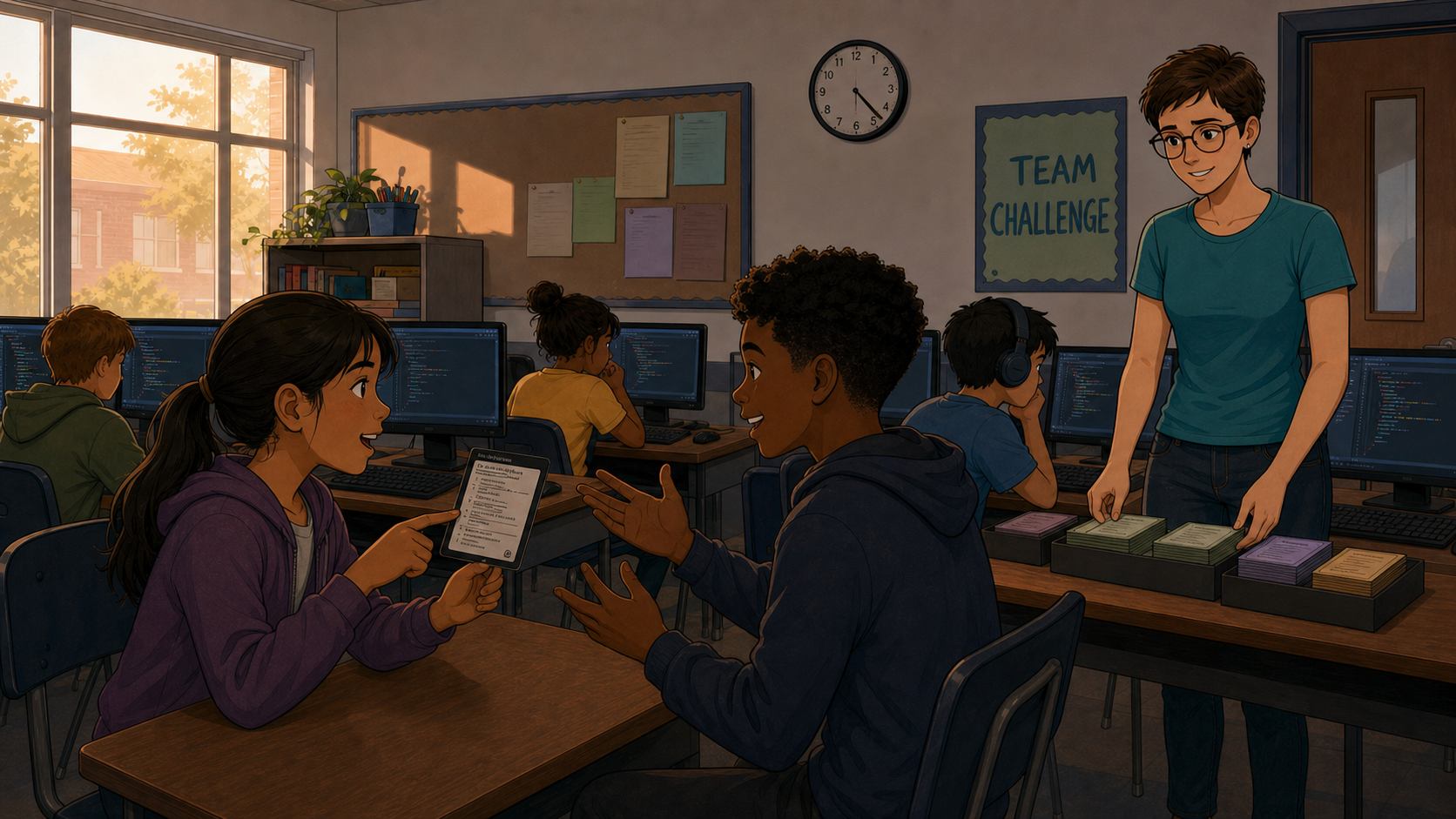
Image Prompt
(This is Panel 06. Do not include the panel number in the image.) Please generate a 16:9 image in the same style depicting panel 6 of 7. Make Sally consistent with prior panels. The scene should show several weeks later: the same classroom, now animated, two students mid-conversation gesturing at a black-bordered card between them, clearly debating an idea, phones nowhere visible on any desk, other students working intently at their stations in the background. Sally stands near the card table restocking it, smiling as she watches the debate. Setting: same present-day USA classroom, same layout, weeks later. Color palette: warm, lively classroom tones, phones notably absent from the scene. Emotional tone: energetic engagement, collaborative focus. Six visual details: two students debating over a black card, animated hand gestures, no phones visible anywhere, other students focused at their stations, Sally restocking the card table, a poster referencing "team challenge" on the wall. Generate the image immediately without asking clarifying questions.Weeks later, Sally realized she hadn't seen a single phone out in an hour. Instead she heard students arguing happily over whether they'd "done the turtle card" yet, comparing notes on the hardest black cards, and pitching each other ideas for cards that didn't exist yet.
Panel 7: A Deck That Keeps Growing
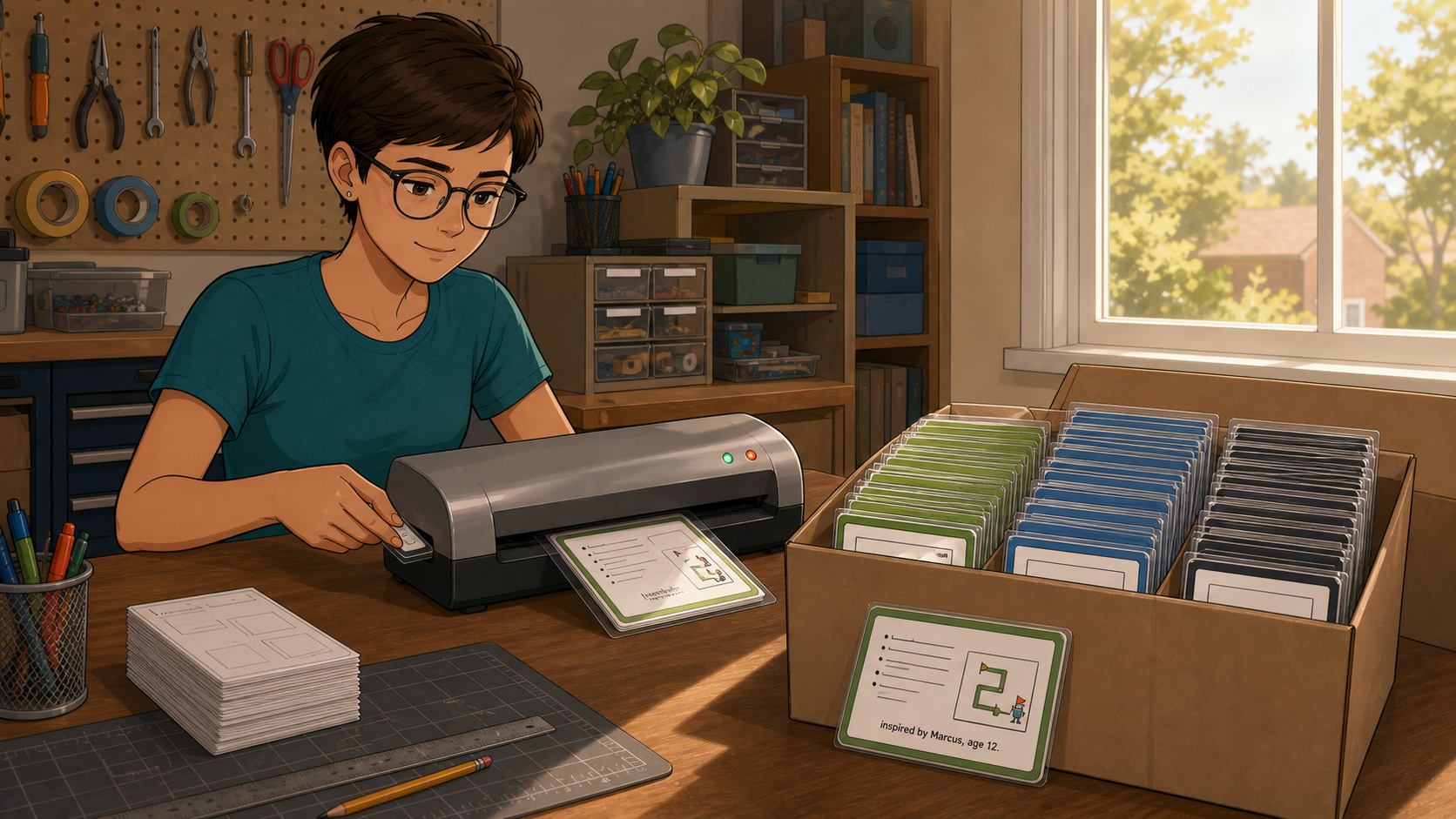
Image Prompt
(This is Panel 07. Do not include the panel number in the image.) Please generate a 16:9 image in the same style depicting panel 7 of 7. Make Sally consistent with prior panels. The scene should show Sally at a home workbench with a small laminating machine, feeding a new card through it, a large organized box of finished laminated cards open beside her showing dozens of green, blue, and black cards, one card visibly printed with a small credit line and a student's name. Setting: present-day USA home workshop corner, daytime. Color palette: bright, satisfied, full-color card box as the visual anchor. Emotional tone: pride, accomplishment, a small project turned into a lasting system. Six visual details: a laminating machine mid-feed, a large box of finished cards, a card with a visible student-credit line, neatly organized card dividers by color, a stack of blank card templates ready for more, warm daylight through a window. Generate the image immediately without asking clarifying questions.By the end of the year Sally had her own laminator and a card library deep enough to fill a shoebox, including a few cards students had pitched themselves — one proudly printed with the line "inspired by Marcus, age 12." The room that used to drift toward its phones now argued about which black card to try next.
Epilogue – Structure Isn't the Opposite of Freedom
Sally hadn't solved distraction by cracking down on phones — she'd solved it by giving students something more interesting to reach for first. The card system didn't just fill time; it gave every student, regardless of skill level, an obvious next step the moment they walked in the door.
| Challenge | How Sally Responded | Lesson for Today |
|---|---|---|
| Students drifted to phones and videos with no clear starting point | Displayed a visible, tiered set of challenge cards on the center table | A room without an obvious first move invites distraction — give students something to reach for the moment they arrive |
| Sally didn't know what a working solution looked like | Asked other club leaders what they'd already tried | You don't have to invent a fix from scratch — borrowing and adapting a proven idea from another club is faster and safer |
| A one-size-fits-all activity didn't match students' different skill levels | Color-coded cards into green, blue, and black tiers | Visible difficulty tiers let students self-select an appropriate challenge without an adult gatekeeping every choice |
| The deck risked going stale after the first few sessions | Kept expanding it, including cards suggested and credited to students | A challenge-card system stays alive when students see themselves as co-creators, not just users |
Call to Action
Distraction usually isn't a discipline problem — it's a design problem. Before your next session, put three tiers of quick, focused, and team-based challenges somewhere every student will see them walking in, and watch how much of the "phone problem" quietly solves itself.
"Did you do the turtle card yet?" —a student, mid-argument with a friend
"Inspired by Marcus, age 12." —credit line on a student-suggested card
References
- Wikipedia: Flashcard - Background on the tiered, self-paced card format Sally adapted
- Wikipedia: Bloom's taxonomy - The framework this book's own learning outcomes use, echoed in the green/blue/black difficulty tiers
- Wikipedia: Instructional scaffolding - The educational theory behind giving students a visible, graduated set of challenges
- Wikipedia: Differentiated instruction - How tiered materials let students of different skill levels self-select an appropriate task
- STEM Classroom Administration - The companion textbook on managing classroom technology and materials