Imagine, Create, Share, Reflect
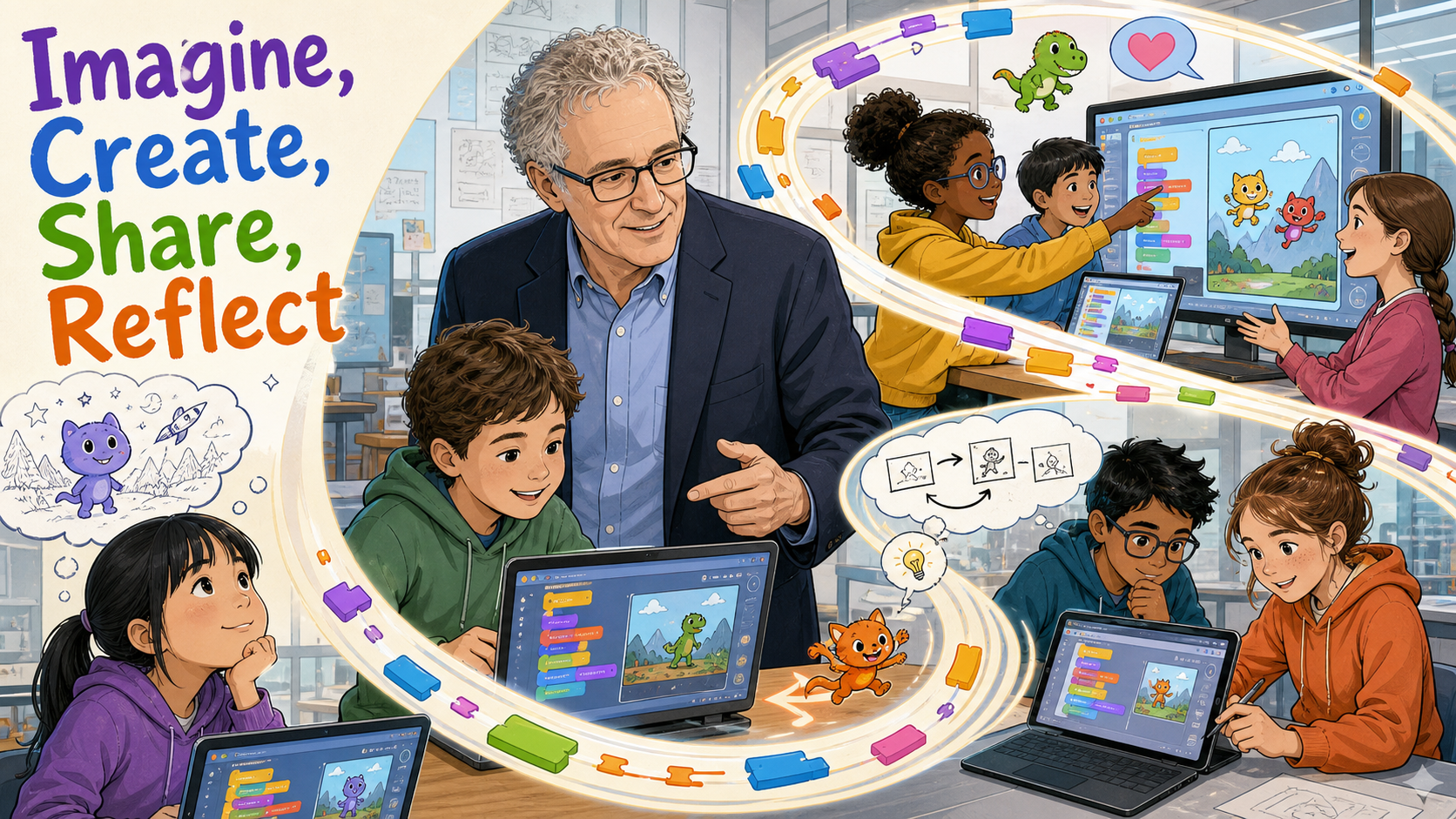
Cover Image Prompt
(This is the Cover Image. Do not include this label in the image.) Please generate a wide-landscape 16:9 cover image in a warm, contemporary educational-graphic-novel style — clean linework, soft cel-shading, grounded realistic proportions. On the left third, render the title "Imagine, Create, Share, Reflect" as bold, hand-lettered stacked text in purple, blue, green, and orange, with a small chalkboard-style doodle beneath it of a smiling purple cat character, stars, and a rocket, and a girl with dark hair resting her chin on her hand as she looks up at the words thoughtfully. In the center, an older man with curly white-gray hair, glasses, and a navy blazer over a blue button-down shirt (Mitchel Resnick) stands smiling warmly among students, gesturing with one hand. A glowing golden ribbon spirals through the whole composition, linking several small vignettes: a boy in a green hoodie at a laptop showing a block-based coding interface with an orange dinosaur character and a mountain backdrop; two students pointing at a large classroom display showing an orange cat character and a heart icon; a girl clapping with delight; a thought bubble with a sequence of sketch-to-character frames and a glowing lightbulb, watched by a boy in glasses and a girl in an orange hoodie; more students at laptops with colorful code blocks and character sprites. Color palette: warm cream and wood-tone classroom backdrop punctuated by bright primary and secondary colors from the title text, character sprites, and glowing ribbon. Emotional tone: warmth, wonder, mentorship, and creative energy. Generate the image immediately without asking clarifying questions.Narrative Prompt
This is a nonfiction story about a real, living person: Mitchel Resnick (born 1956), the LEGO Papert Professor of Learning Research at the MIT Media Lab and director of its Lifelong Kindergarten research group. The story spans the United States from the late 1970s to the present day — his physics studies, his years as a technology journalist, his doctoral work under Seymour Papert, his group's programmable-brick research, the creation and 2007 launch of Scratch, and Scratch's ongoing global reach. Art style: warm, contemporary educational-graphic-novel illustration, consistent linework and color palette across all panels. Resnick is drawn with dark curly hair in the earlier (pre-2000) panels and white-gray curly hair with glasses and a navy blazer in the later panels, reflecting his real aging across the decades — this is intentional, not an inconsistency. Creative liberties: panel 1 shows young Resnick mentoring neighborhood kids at a basketball court and an electronics workbench alongside his physics studies; these specific scenes are illustrative composites representing his early, well-documented instinct for hands-on teaching and tinkering rather than a documented single event. The title used throughout this story shortens Resnick's actual five-step "Creative Learning Spiral" — Imagine, Create, Play, Share, Reflect — to four words for the title text; the word "Play" is preserved and explained in the narrative prose even though it does not appear in the title itself. No real brand or product names appear in any image; the narrative prose names specific products (Scratch, LEGO Mindstorms) where historically accurate.Prologue – A Language Built From a Philosophy
Somewhere near you, a kid is probably making a cat dance across a screen using colorful blocks that snap together like puzzle pieces. That language is Scratch, and more than 150 million people have used it to build their first games, animations, and stories. Behind it stands one MIT researcher who spent decades arguing that the best model for learning isn't a lecture hall or a worksheet — it's a kindergarten classroom, where children imagine, build, play, share what they've made, and start imagining again. His name is Mitchel Resnick, and this is the story of how that belief became a tool now sitting on your own coding club's tables.
Panel 1: A Physicist Who Kept Wondering "What If"
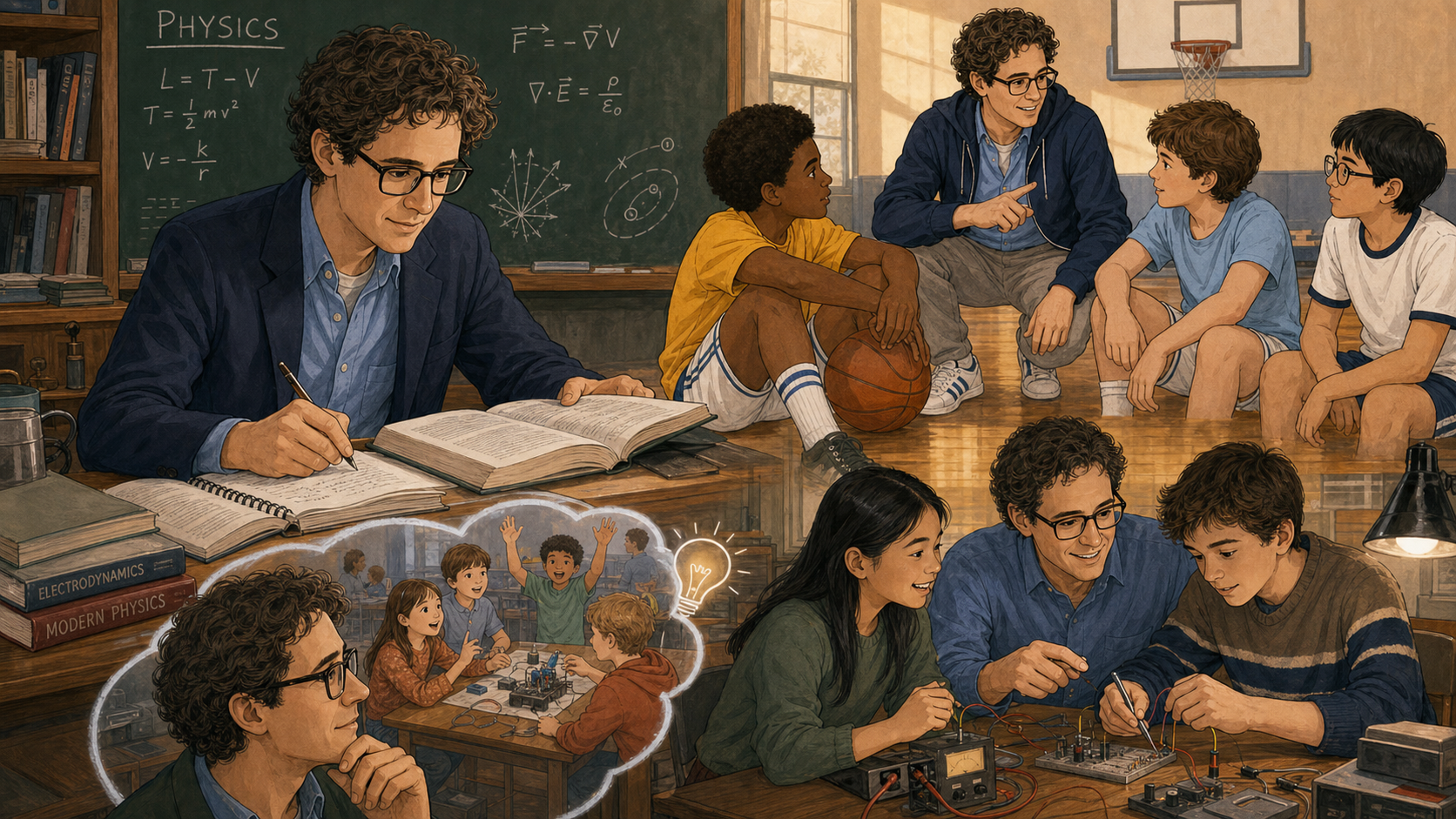
Image Prompt
(This is Panel 01. Do not include the panel number in the image.) I am about to ask you to generate a series of images for a graphic novel. Please make the images have a consistent style and consistent characters. Do not ask any clarifying questions. Just generate the image immediately when asked. Please generate a 16:9 image in a warm, contemporary educational-graphic-novel style depicting panel 1 of 9. Divide the scene into three linked vignettes around one recurring young man in his 20s with dark curly hair, glasses, and a navy blazer over a blue button-down shirt: (1) at a desk writing in a notebook in front of a chalkboard covered in physics equations and orbital diagrams, stacks of physics textbooks nearby; (2) crouched on an outdoor basketball court in a hoodie, pointing and talking animatedly to a small group of boys sitting on the gym floor, one boy hugging a basketball and watching him with admiration; (3) seated at a workbench with a girl and another young man, soldering irons and multimeters and circuit boards spread across the table, all three focused and smiling. Setting: a university physics department and a nearby neighborhood gym and workshop, United States, late 1970s. Color palette: warm sepia-tinted classroom browns and chalkboard greens, contrasted with brighter primary colors on the electronics and basketball. Emotional tone: curiosity, quiet mentorship, restless intelligence. Six visual details: chalkboard equations, a basketball tucked under a boy's arm, a stack of physics textbooks, soldering irons and wires on the workbench, a gymnasium hoop in the background, the young man's consistent glasses and blazer across all three vignettes. Generate the image immediately without asking clarifying questions.Mitchel Resnick studied physics at Princeton, filling notebooks with equations about orbits and forces. But even while he was deep in formal coursework, the pull toward something else was already there — the version of him who couldn't stop drawing curious kids into whatever he was building or explaining, whether that meant a pickup basketball game or an evening spent wiring a circuit. Long before he had a job title in education, Resnick already had the instincts of a teacher who would rather hand someone a tool than a lecture. It would take a detour through journalism before he realized that instinct could become a career.
Panel 2: The Journalist Who Wasn't Convinced
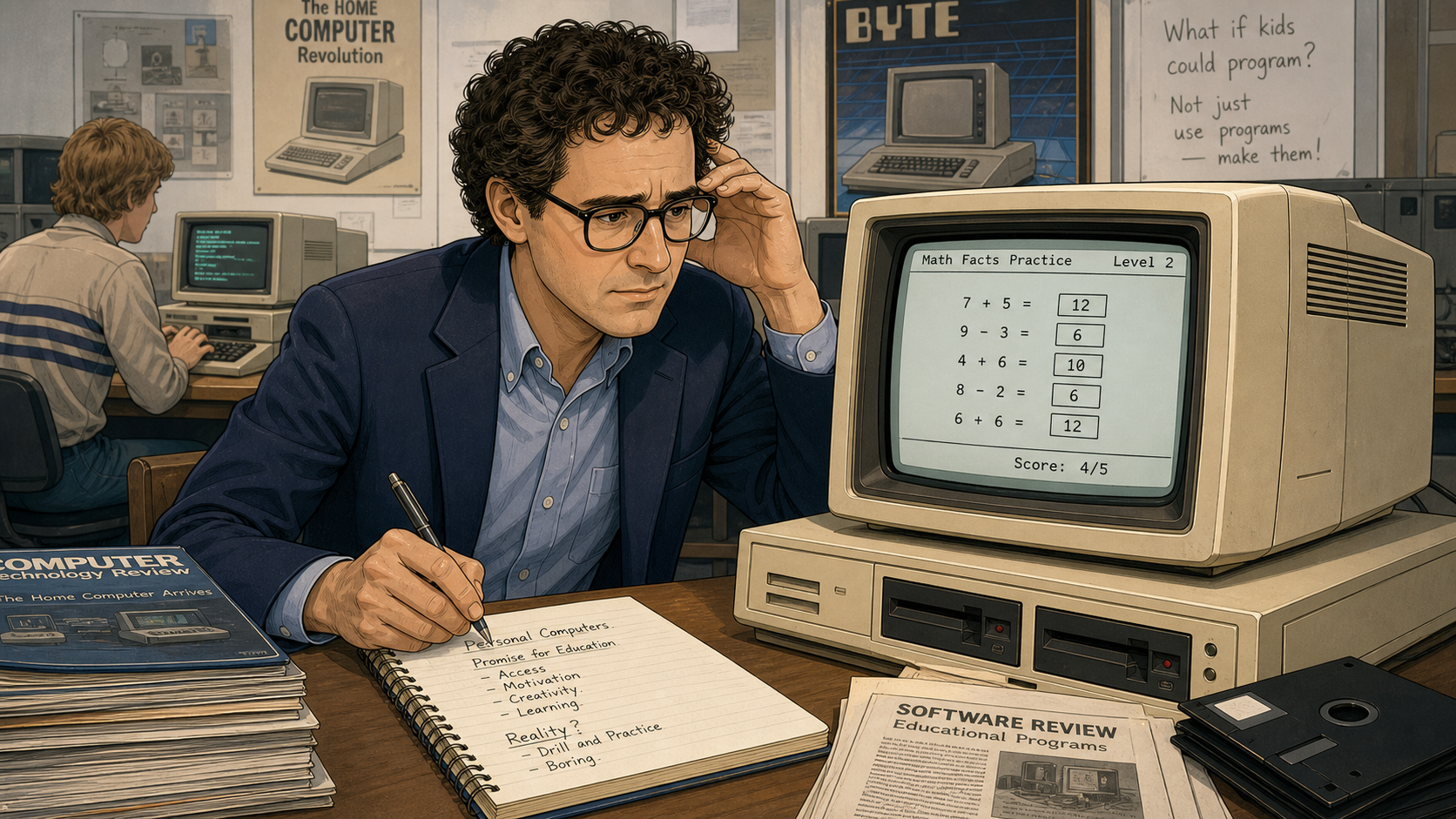
Image Prompt
(This is Panel 02. Do not include the panel number in the image.) Please generate a 16:9 image in the same style depicting panel 2 of 9. Keep the young man consistent with the prior panel — dark curly hair, glasses, navy blazer over a blue shirt. The scene should show him seated at a cluttered desk in a technology-magazine newsroom, chin resting on one hand, brow furrowed, writing notes on a legal pad that reads "Personal Computers — Promise for Education: Access, Motivation, Creativity, Learning. Reality? Drill and Practice. Boring." beside him sits a beige early-1980s desktop computer whose screen displays a simple math drill program with a score counter. On the wall behind him, a hand-lettered sign reads "What if kids could program? Not just use programs — make them!" among stacks of technology magazines and industry posters. A second young journalist works at another computer in the background. Setting: a magazine office in the United States, early 1980s, personal-computer era. Color palette: muted beige and brown office tones with the pale glow of the CRT screen as an accent. Emotional tone: skepticism, restless dissatisfaction, an idea forming. Six visual details: the beige CRT monitor with a drill-and-practice program, the handwritten legal pad notes, the hand-lettered wall question, stacks of computer magazines, floppy disks on the desk, a second journalist typing in the background. Generate the image immediately without asking clarifying questions.By the late 1970s, Resnick was working as a science and technology correspondent, covering the personal-computer boom for a national business magazine. He watched schools rush to buy the new machines, and then watched most of that promise shrink down to programs that drilled kids on math facts and graded them like a machine grading a worksheet. It wasn't that Resnick doubted computers belonged in classrooms — he doubted this particular use of them. The question he kept scribbling in the margins of his notes was simple: what if kids didn't just run the software, but built it?
Panel 3: A Professor Who Saw Learning Differently
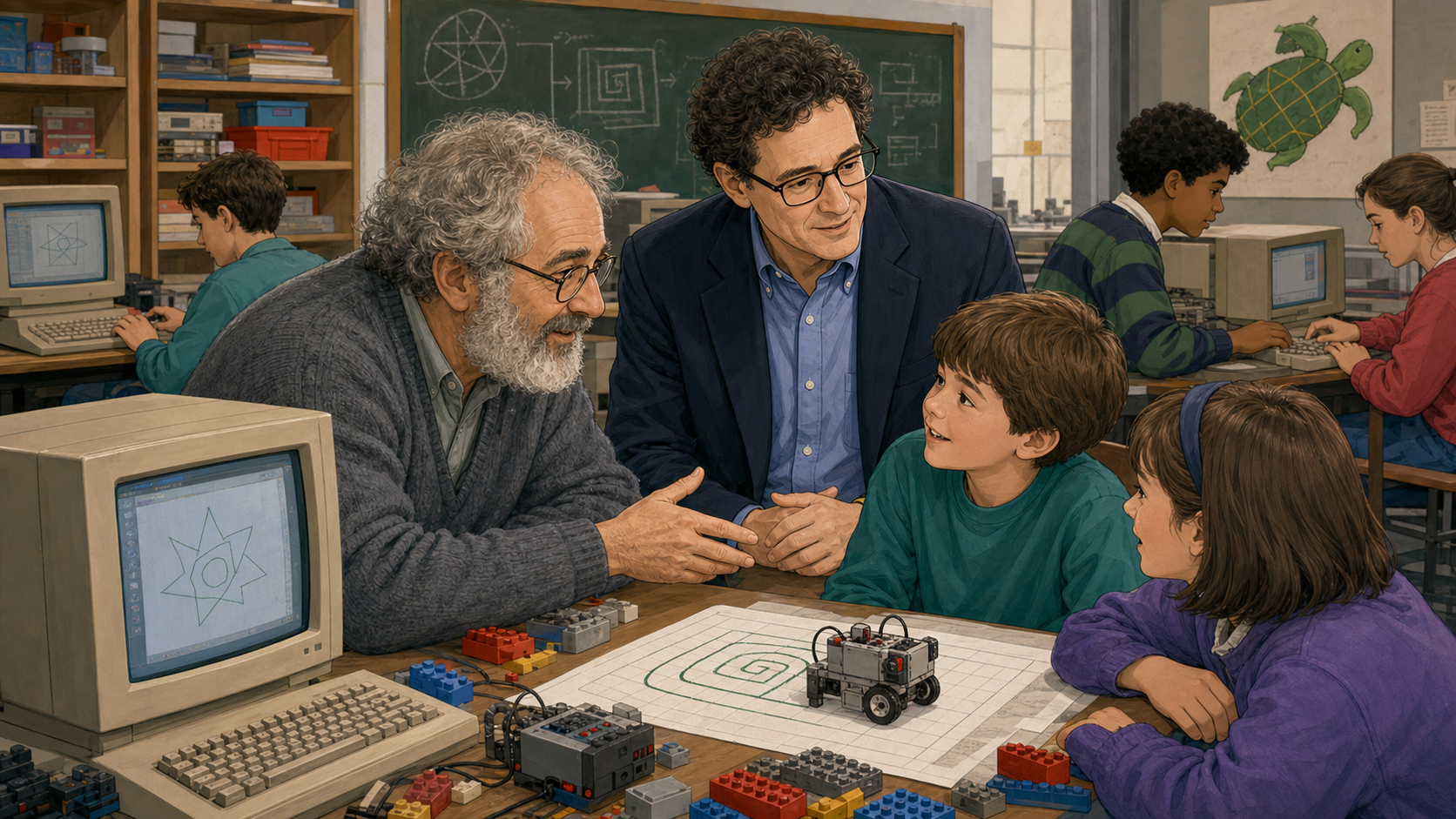
Image Prompt
(This is Panel 03. Do not include the panel number in the image.) Please generate a 16:9 image in the same style depicting panel 3 of 9. Show two men at a classroom table: an older man in his 50s with gray curly hair, a full gray beard, glasses, and a gray cardigan (Seymour Papert), and the same young man from prior panels, now with a few more years on him, dark curly hair, glasses, navy blazer (Resnick), both leaning in and talking with a boy and a girl seated at the table. On the table sits a small wheeled robot built from colorful construction pieces, motors, and wires, rolling along a hand-drawn spiral path on graph paper. Behind them, a chalkboard shows a geometric spiral and simple flowchart-style diagrams, and a wall poster shows a friendly cartoon turtle inside a hexagon shape. In the background, other students work at boxy beige computer terminals displaying simple geometric line-drawings. Setting: an MIT research classroom, United States, early-to-mid 1980s. Color palette: warm wood tones, chalkboard green, with bright primary-colored construction pieces and wiring as accents. Emotional tone: mentorship, discovery, intellectual excitement passing from one generation to the next. Six visual details: the small wheeled robot on the spiral path, the turtle poster, chalkboard geometric diagrams, beige computer terminals with line-drawings, the older mentor's gray cardigan, the students' rapt attention. Generate the image immediately without asking clarifying questions.In 1982, at a conference on the emerging personal-computer market, Resnick heard MIT professor Seymour Papert describe an entirely different vision: computers as material for children to build with, not programs that built children into passive users. Papert's own language, Logo, let kids steer an on-screen "turtle" by writing simple commands — and the ideas behind it, that people learn best by constructing things they care about, hit Resnick like the missing piece of an argument he'd been having with himself for years. He left journalism, enrolled at MIT, and became Papert's doctoral student, earning his PhD in 1992 under Papert and fellow computer scientist Hal Abelson.
Panel 4: Turning Bricks Into a Building Block for Ideas
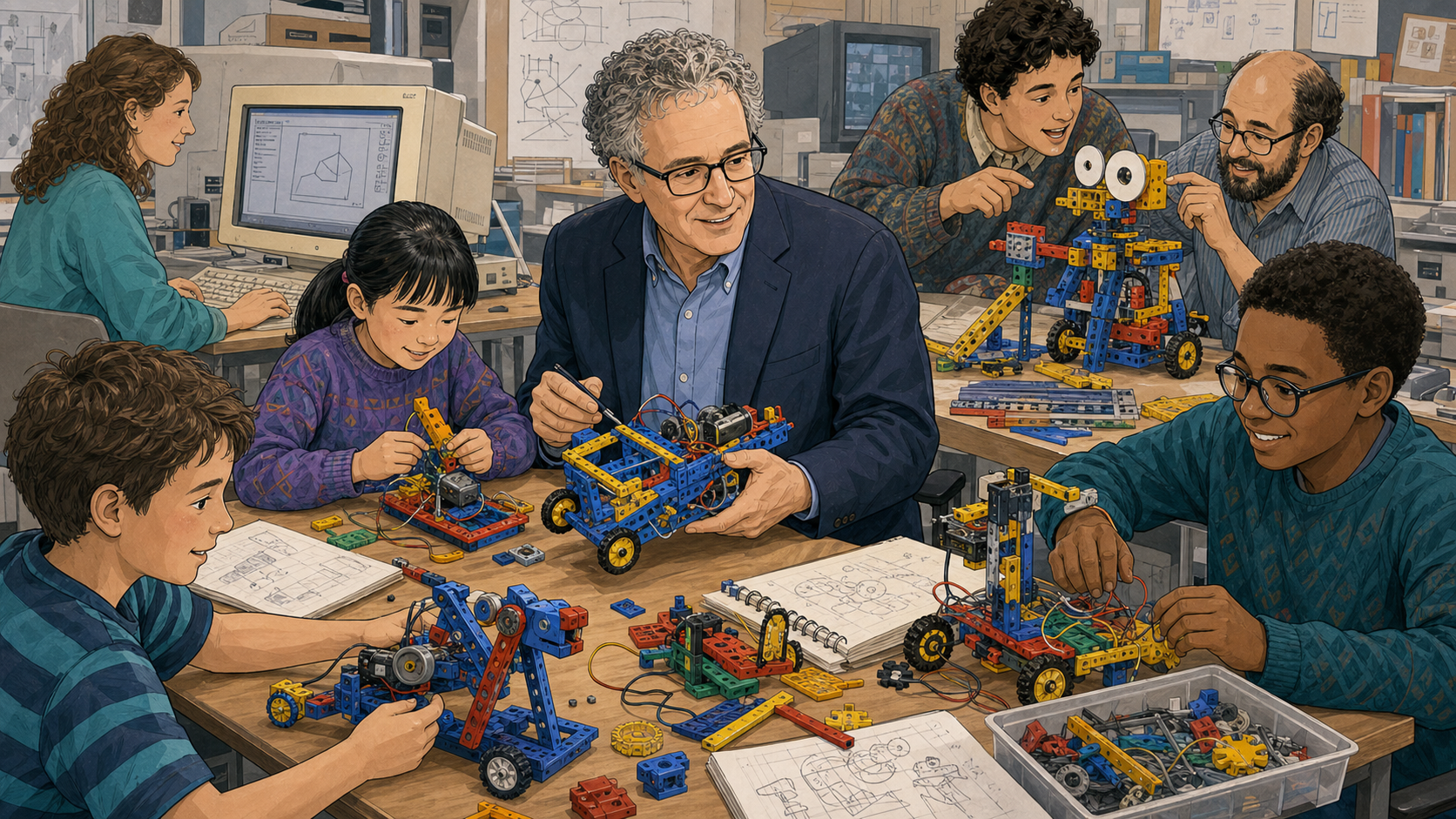
Image Prompt
(This is Panel 04. Do not include the panel number in the image.) Please generate a 16:9 image in the same style depicting panel 4 of 9. Show the same man, now with gray-streaked curly hair, glasses, navy blazer over a blue shirt, seated at a workshop table crowded with children building small robots out of colorful interlocking construction pieces, gears, wheels, and small motors wired to controller boxes. A girl and a boy work with him directly at the center of the table, while at the far end a bearded engineer in his 40s helps two more students attach large plastic eyes to a walking robot. A young woman researcher works at a nearby computer displaying simple geometric shapes. Blueprints and hand-drawn robot sketches are scattered across the table and pinned to the wall behind them. Setting: an MIT Media Lab workshop, United States, early-to-mid 1990s. Color palette: warm wood-tones with bright primary-colored construction pieces (red, yellow, blue) as focal accents. Emotional tone: hands-on collaboration, delighted discovery, engineering playfulness. Six visual details: interlocking construction pieces and gears, wired controller boxes, a robot with large plastic eyes, hand-drawn robot blueprints pinned to the wall, a computer screen with geometric shapes, motors and loose wheels scattered on the table. Generate the image immediately without asking clarifying questions.Back at MIT, Resnick's research group asked a bigger question: could Papert's building-block philosophy live inside an actual building block? Working with Papert and engineers at the LEGO company, the team built the "programmable brick" — a plastic block containing a tiny computer that kids could wire to motors and sensors and control with their own code. Kids didn't just assemble a robot from instructions; they programmed how it behaved. In 1998, that research became a commercial product, LEGO Mindstorms, and thousands of classrooms suddenly had access to robotics that responded to code a ten-year-old had written.
Panel 5: Designing a Language Any Kid Could Speak
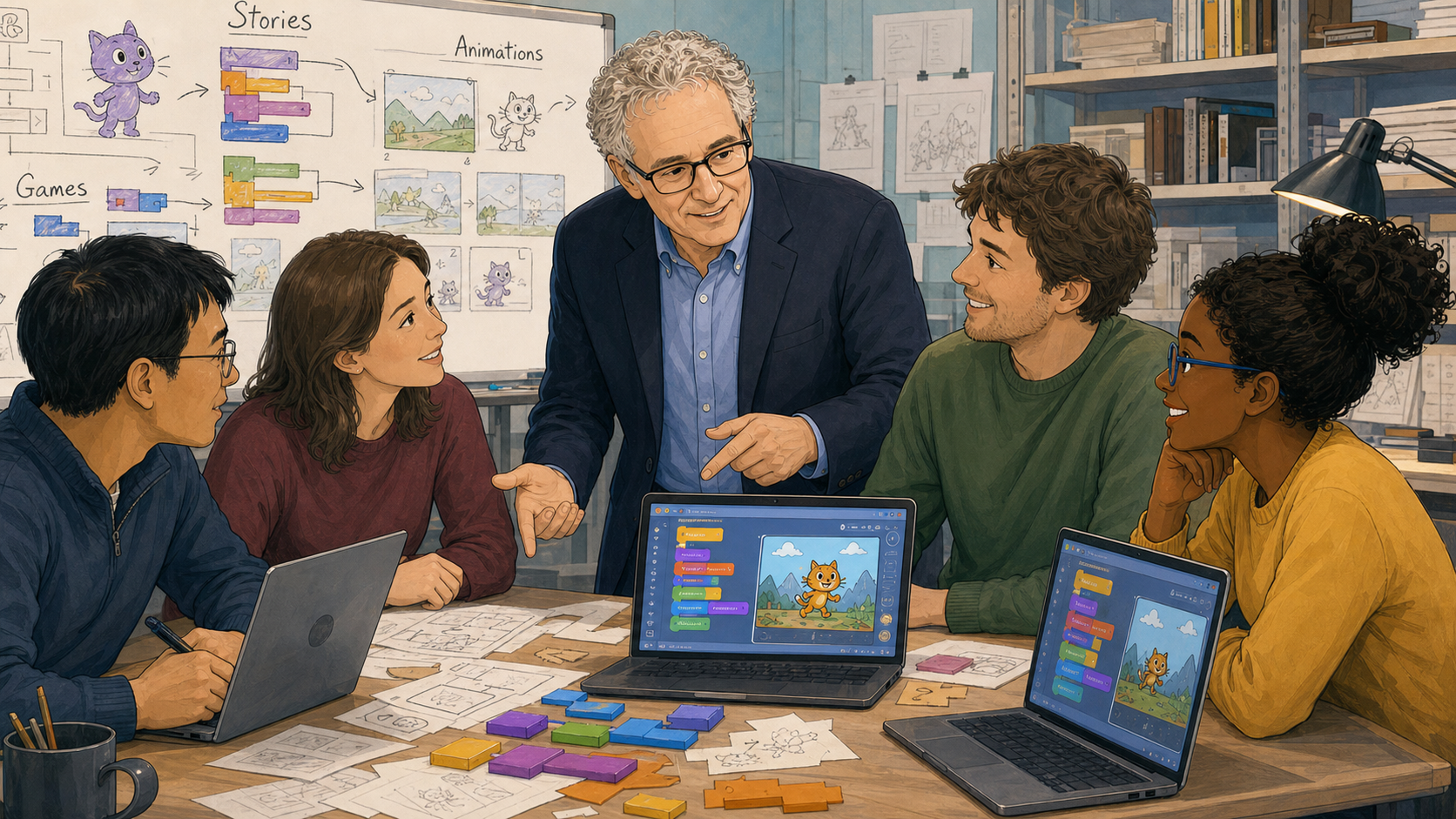
Image Prompt
(This is Panel 05. Do not include the panel number in the image.) Please generate a 16:9 image in the same style depicting panel 5 of 9. Show a man in his mid-40s with curly gray hair and glasses, wearing a navy blazer over a blue shirt (Resnick), standing and gesturing warmly toward four younger researchers seated around a table cluttered with laptops and sketches. A whiteboard behind them is divided into three labeled columns — "Stories," "Animations," "Games" — each showing rough sketches of colorful interlocking command blocks leading to simple character drawings (a cat, a mountain landscape). Two laptop screens on the table show an early block-based coding interface with an orange cat character standing in a grassy, mountainous scene. Loose colorful paper cutouts shaped like puzzle-piece blocks are scattered on the table. Setting: an MIT Media Lab design studio, United States, early 2000s. Color palette: cool studio grays and blues warmed by the bright primary and secondary colors of the whiteboard sketches and block cutouts. Emotional tone: collaborative excitement, creative problem-solving. Six visual details: the three-column whiteboard diagram, paper block-shaped cutouts, laptops showing the cat character and mountain scene, sketch drawings of the cat in different poses, a coffee mug on the table, bookshelves in the background. Generate the image immediately without asking clarifying questions.By the early 2000s, Resnick led the Lifelong Kindergarten research group, and its biggest challenge was reaching kids who would never sit through a robotics workshop. The team wanted a programming language that felt like snapping together LEGO bricks instead of memorizing syntax — one where a wrong move couldn't produce a cryptic error, only a chance to try again. They sketched command blocks shaped like puzzle pieces that only fit together in ways that made sense, and built in support for stories, animations, and games from day one, so kids with wildly different interests could all find a reason to start.
Panel 6: The First Time Kids Saw It Come Alive
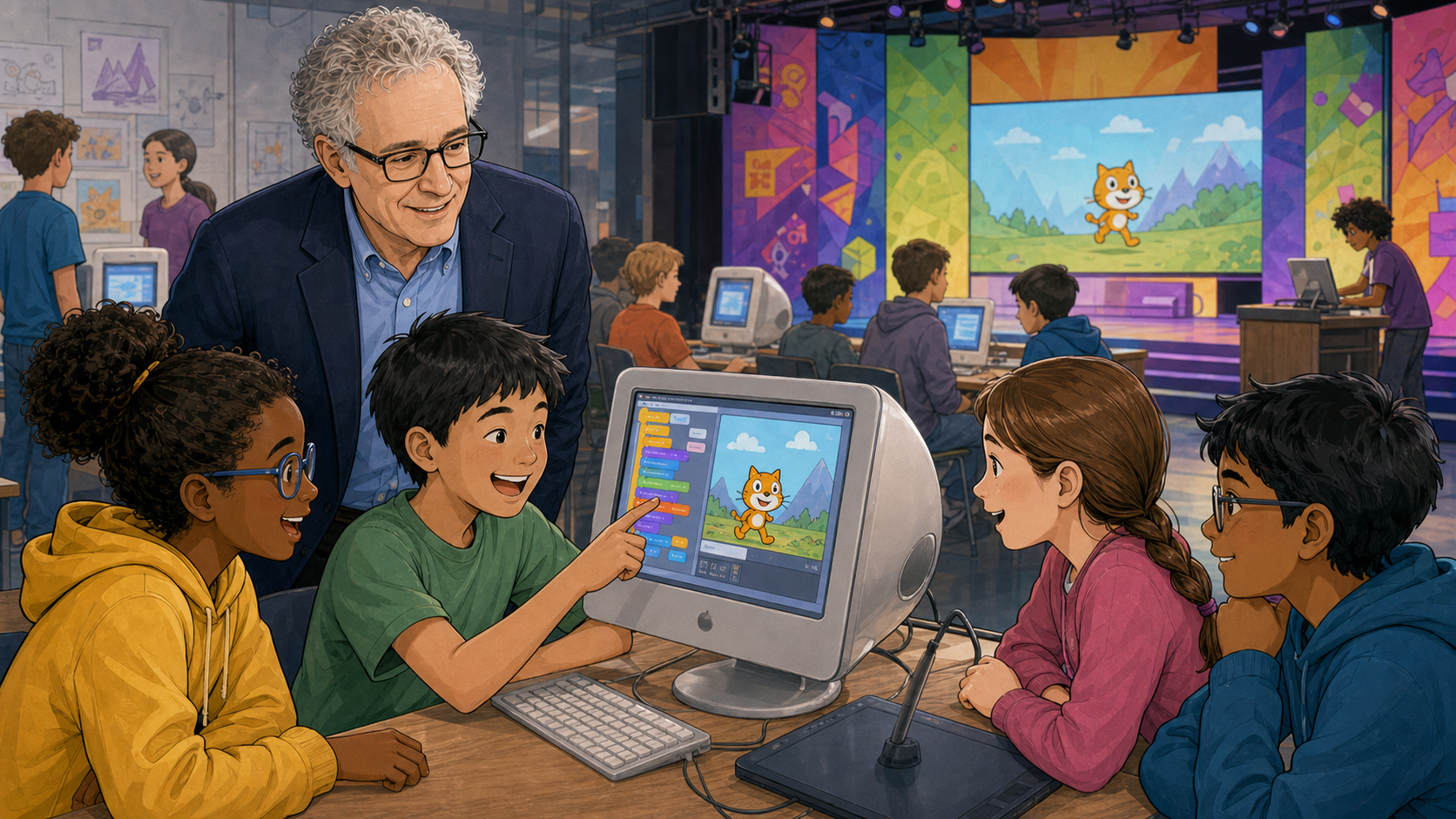
Image Prompt
(This is Panel 06. Do not include the panel number in the image.) Please generate a 16:9 image in the same style depicting panel 6 of 9. Show the man with curly gray hair, glasses, and navy blazer (Resnick) standing behind a boy seated at a bulbous early-2000s all-in-one computer, the boy pointing excitedly at the screen where a block-based coding interface displays an orange cat character in a grassy, mountainous scene. A girl and another boy lean in from the right, delighted. Behind them, a large classroom display screen shows the same orange cat character enlarged, and several more children work at similar computers at other tables. Colorful geometric banners and stage lighting suggest a launch or showcase event. Setting: a computer lab or community showcase space, United States, mid-2000s. Color palette: bright, celebratory blues, purples, oranges, and greens from the event banners and screen glow. Emotional tone: excitement, first discovery, communal celebration. Six visual details: the bulbous all-in-one computer, the enlarged cat character on the big screen, colorful geometric event banners, other children at computers in the background, stage-style lighting, the boy's pointing hand. Generate the image immediately without asking clarifying questions.Scratch launched publicly in 2007, and Resnick got to watch the moment he had spent two decades working toward: a kid who had never written a line of code, snapping blocks together, and watching a character move because of a decision that kid had made. There was no drill-and-practice scorecard, no single correct answer to reach — just a cat on a mountainside doing exactly what its young programmer told it to do. Word spread through classrooms and after-school computer clubhouses fast, because the tool didn't need to be explained; it needed to be touched.
Panel 7: A World Where Every Project Gets an Audience
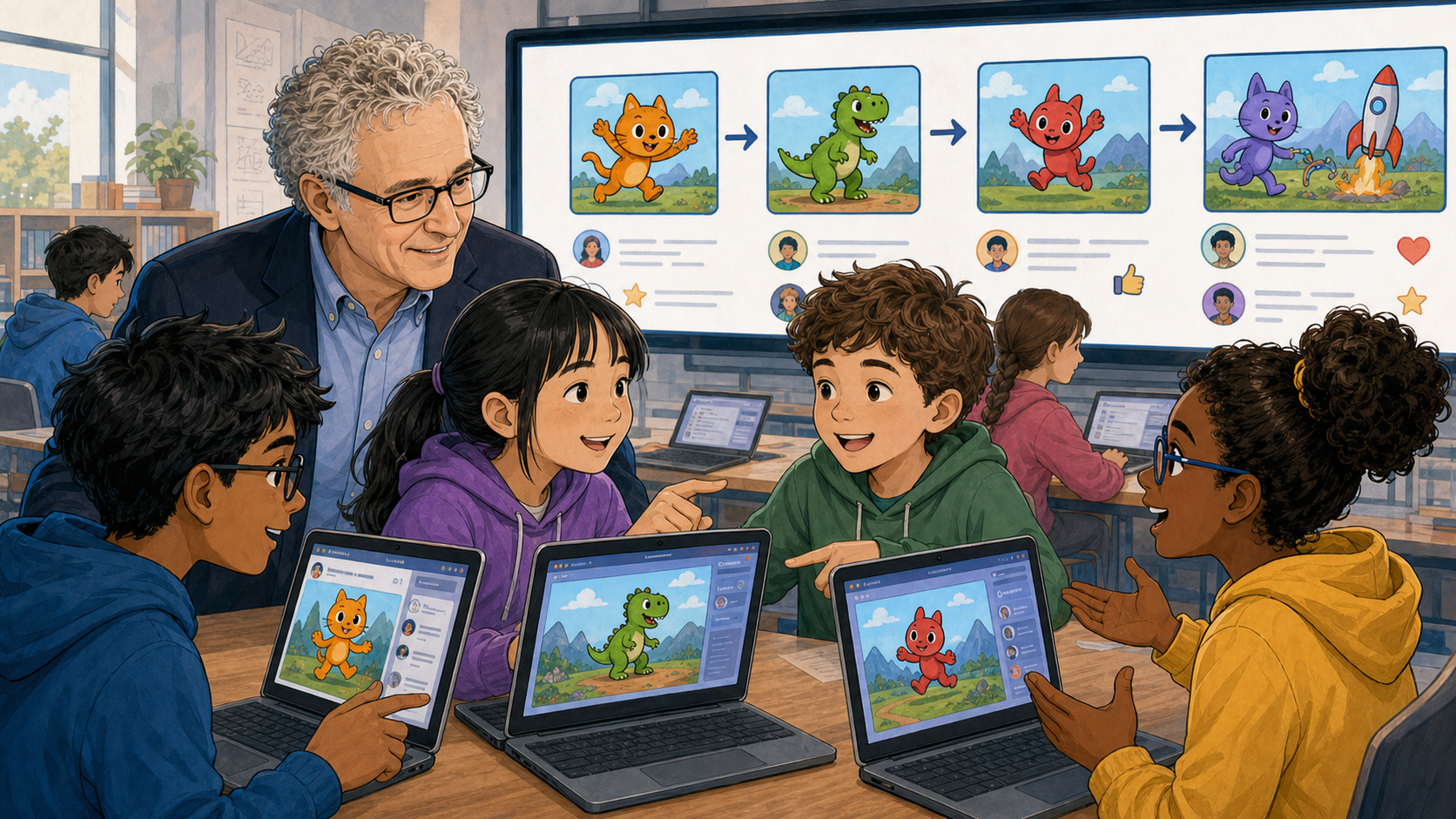
Image Prompt
(This is Panel 07. Do not include the panel number in the image.) Please generate a 16:9 image in the same style depicting panel 7 of 9. Show the man with curly gray hair, glasses, and navy blazer (Resnick) standing behind four children gathered around a large classroom display screen. The screen shows a row of four shared project thumbnails — an orange cat, a green dinosaur, a red creature, and a purple cat beside a rocket launch — each with a small user avatar, comment lines, and icons for a star, a thumbs-up, and a heart beneath it. Two children in the foreground hold open laptops showing the same thumbnails on their own screens, comparing notes. Setting: a modern classroom with laptops on the desks, United States, present day. Color palette: bright, cheerful character colors (orange, green, red, purple) against a clean white display background. Emotional tone: pride, community, the joy of being seen and appreciated by peers. Six visual details: the four project thumbnails, comment and like icons beneath each, laptops showing matching thumbnails, a heart icon, a star icon, the children's animated pointing and talking. Generate the image immediately without asking clarifying questions.The most radical decision on the team wasn't a feature of the programming language — it was building an online community around it from the very start. Every Scratch project could be shared, and every shared project could be viewed, commented on, and remixed by any other member, whether they lived down the hall or across an ocean. A ten-year-old's dinosaur animation could get a comment from a kid in another country who had turned it into something new. Sharing wasn't an add-on feature; it was, in Resnick's words, one full turn of the process he wanted every young creator to experience.
Panel 8: The Spiral, Spinning in Real Time
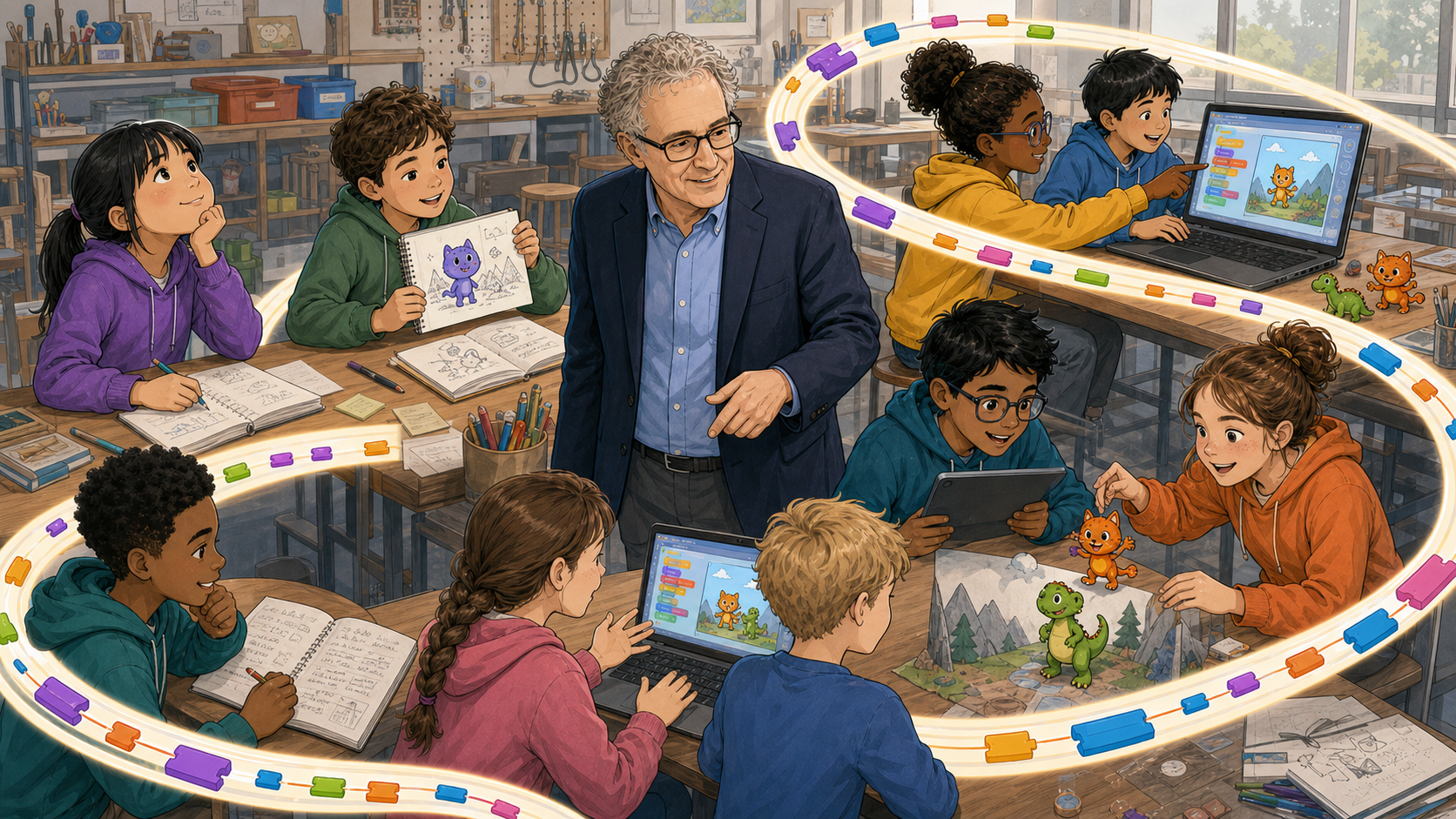
Image Prompt
(This is Panel 08. Do not include the panel number in the image.) Please generate a 16:9 image in the same style depicting panel 8 of 9. Show the man with curly gray hair, glasses, and navy blazer (Resnick) standing at the center of a workshop room, gesturing toward a wide table of children engaged in different stages of a project: on the left, two children sketch character drawings of a purple cat in open notebooks; at the laptop in front of Resnick, two children type code blocks while a screen shows an orange cat and green dinosaur character; on the right, two more children hold up a paper diorama with a small cardboard dinosaur figure while a third child reaches out to touch it, delighted. A glowing golden ribbon spiral loops through the whole scene, connecting the sketching, coding, and sharing groups into one visual loop. Setting: a contemporary classroom workshop, United States, present day. Color palette: warm wood-tones with the golden ribbon and bright character colors as the visual accents. Emotional tone: joyful momentum, an idea moving continuously from thought to object to audience. Six visual details: open sketchbooks with character drawings, laptops with the cat and dinosaur characters, a paper diorama with a small figure, the glowing golden ribbon spiral, a pencil cup and sticky notes on the table, children at multiple stages of the same creative process. Generate the image immediately without asking clarifying questions.Resnick came to describe this whole process as a spiral: imagine an idea, create something from it, play with what you've made, share it with other people, reflect on what worked and what didn't — and land right back at imagine, this time with a better idea than before. It isn't a one-time assignment with a grade at the end; it's a loop kids can spin through again and again in a single afternoon. Watching a table of students sketch, code, and hand projects to each other all at once, you can see the spiral running in real time, powered by nothing more than curiosity and an audience.
Panel 9: Millions of Kids, One Idea
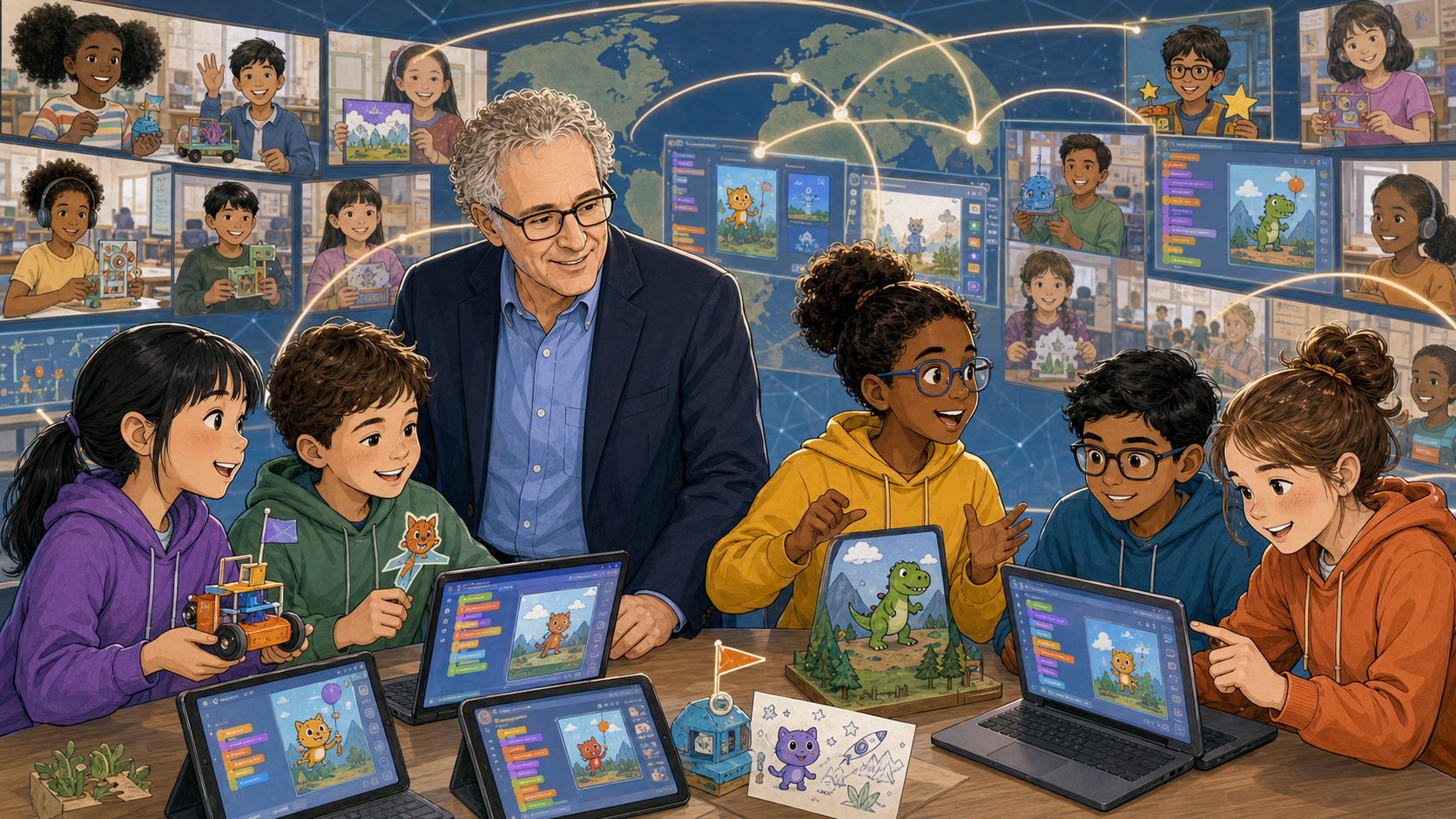
Image Prompt
(This is Panel 09. Do not include the panel number in the image.) Please generate a 16:9 image in the same style depicting panel 9 of 9. Show the man with curly gray hair, glasses, and navy blazer (Resnick) standing among a diverse group of five children at a table full of laptops and tablets displaying the orange cat and green dinosaur characters, one child holding a small handmade robot. Behind them, a glowing world map stretches across the background wall, with thin lines of light connecting it to a grid of small screens showing children of many different backgrounds in classrooms around the globe, each holding up or working on their own character-based project. Setting: a modern classroom opening onto a symbolic global network visualization, present day. Color palette: deep blue map background with warm golden connection lines and the bright character colors of each small screen. Emotional tone: legacy, global reach, quiet pride in an idea that outgrew its origin. Six visual details: the glowing world map, golden connection lines linking distant screens, the small handmade robot, laptops and tablets on the table, the grid of diverse children's screens, the character sprites repeated across multiple screens. Generate the image immediately without asking clarifying questions.Today, more than 150 million people have created a Scratch account, and the language has been translated into more than 70 languages, reaching kids in almost every country on Earth. Most of them will never meet Mitchel Resnick, and most won't know his name — but every time one of them snaps two blocks together and watches something happen because of it, they're standing inside an idea he spent his whole career building. That idea is probably sitting on a table in your own coding club right now, waiting for the next kid to imagine something with it.
Epilogue – What Made Resnick's Approach Different?
Resnick didn't set out to build a piece of software. He set out to change what "using a computer" meant for a kid — from following instructions to giving them. Every decision that followed, from the programmable brick to Scratch's sharing community, was in service of one belief: that creativity, not correctness, is what real learning should train.
| Challenge | How Resnick Responded | Lesson for Today |
|---|---|---|
| Early educational software mostly drilled kids with flashcard-style questions instead of letting them build anything | He left journalism to study under Seymour Papert and helped design tools where kids programmed rather than were programmed at | The best learning tools hand control to the learner, not just information |
| Programming languages for kids were often too rigid for beginners to start creating quickly, or too simple to grow with them | His team designed Scratch around "low floors, high ceilings, and wide walls," so any child could start immediately and keep growing | Good tools should be easy to start, hard to outgrow, and open to many kinds of projects |
| A tool used alone, on one computer, in one classroom, only ever reaches the kids sitting in front of it | Scratch launched as an online community from day one, so every project could be shared, remixed, and commented on by kids worldwide | Sharing turns a solitary skill into a global creative conversation |
| Even great tools can leave kids stuck after one pass at an idea, with nowhere to take it next | Resnick frames learning as a spiral — imagine, create, play, share, reflect, and imagine again — so every finished project seeds the next one | Reflection isn't the end of a project; it's the beginning of the next one |
Call to Action
The next time your coding club opens Scratch, you're not just running a piece of software — you're stepping into a philosophy that took one researcher three decades to build. Let your members imagine before they click "start," share what they make even when it's unfinished, and circle back to imagine again. That spiral is the whole point.
"Instead of making kindergarten like the rest of school, we need to make the rest of school (indeed, the rest of life) more like kindergarten." —Mitchel Resnick
"Computers will not live up to their potential until we start to think of them less like televisions and more like paintbrushes." —Mitchel Resnick, "Computer as Paintbrush" (2006)
"We believe the best way to cultivate creativity is to support people working on projects based on their passions, in collaboration with peers and in a playful spirit." —Mitchel Resnick, Lifelong Kindergarten (2017)
References
- Wikipedia: Mitchel Resnick - Biography of the MIT Media Lab researcher who led the creation of Scratch
- Wikipedia: Scratch (programming language) - History and design of the block-based language Resnick's team built
- Wikipedia: Seymour Papert - Biography of Resnick's doctoral advisor and the constructionist-learning pioneer behind Logo
- MIT Media Lab: Mitchel Resnick - Person Overview - Official MIT Media Lab biography, current research, and awards
- GBH: Mitchel Resnick - Boston public-media profile covering his journalism background, LEGO Mindstorms work, and the Computer Clubhouse network