Turtles All the Way Down
Cover Image Prompt
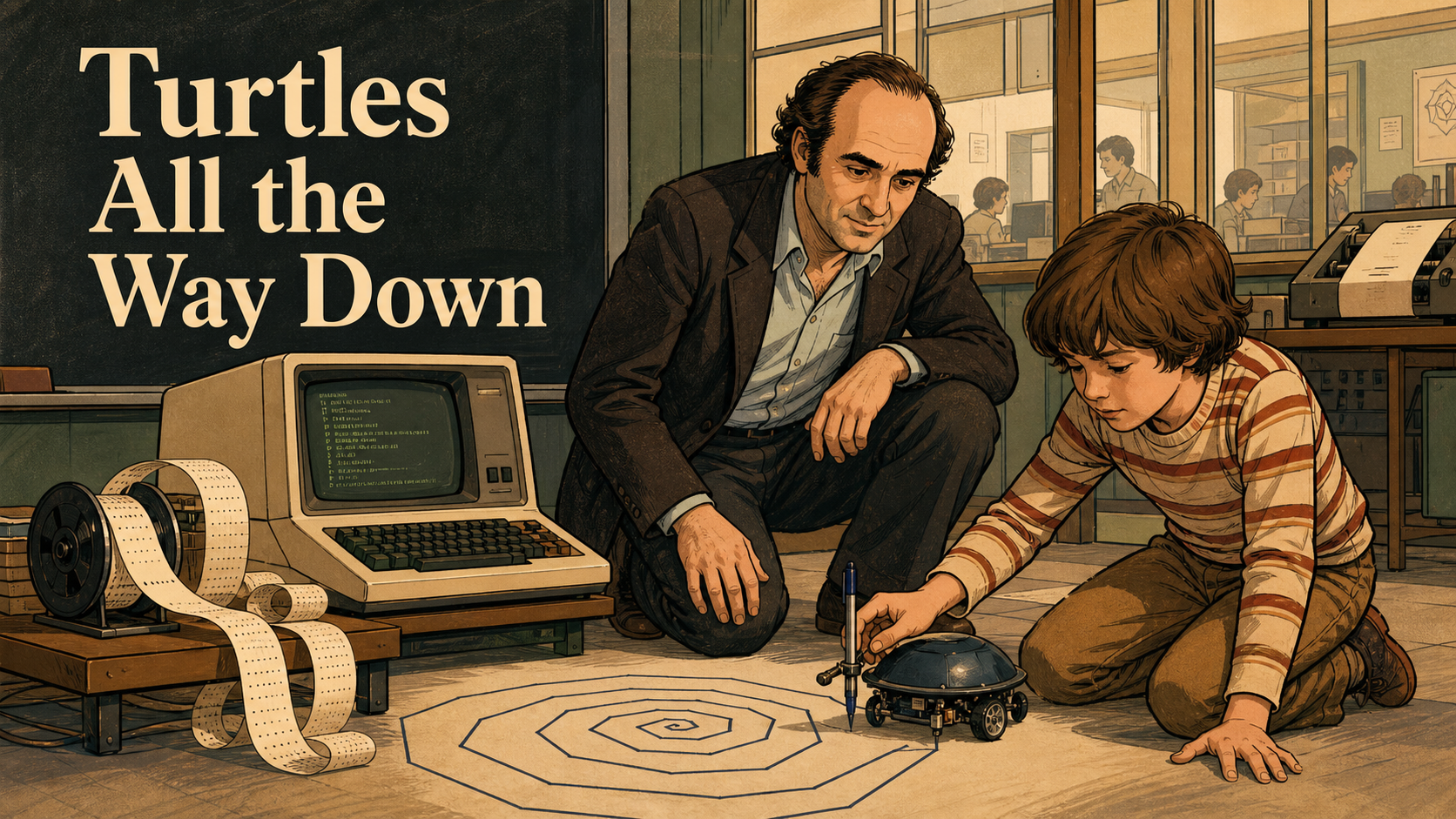
(This is the Cover Image. Do not include this label in the image.) Please generate a wide-landscape 16:9 cover image in a warm, sepia-toned educational graphic-novel illustration style with detailed pen-and-ink linework and muted earth-tone digital coloring. Scene: an MIT lab in the early 1970s. A man in his early forties with curly dark brown hair, in a dark brown suit jacket over an open-collar light blue shirt, crouches beside a boy of about ten in a red-and-cream striped sweater, both watching intently as a small dome-shelled, wheeled robot traces a spiral path on a large sheet of paper on the floor. Behind them, an early computer terminal with a green-on-black screen sits on a wooden stand, coiled punched paper tape spilling onto the floor beside it. A chalkboard on the left carries the hand-lettered title "Turtles All the Way Down" in a warm cream serif typeface. Through a glass partition behind the pair, other researchers work at desks and a printer in a busy lab, with a cityscape visible farther back. Color palette: warm sepia browns, tans, and olive greens, with the cream title text and a pale blue-green terminal glow as accents. Emotional tone: quiet concentration, discovery, mentorship. Six visual details: the spiral drawn in dark ink on butcher paper, the small pen mounted under the robot's shell, the coiled punch tape, the man's rolled-up shirt sleeve, the boy's focused pointing hand, the busy lab visible through the glass behind them. Generate the image immediately without asking clarifying questions.Narrative Prompt
This is a biographical story about a real historical figure, Seymour Papert (1928-2016), mathematician and educator, born in Pretoria, South Africa, who later worked in Geneva, Switzerland and at MIT in Cambridge, Massachusetts, USA. The story spans roughly the 1930s to the present day. Central themes: children learn best by building, testing, and debugging their own constructions rather than being told the right answer ("constructionism"); the computer as a material for children to think with, not a machine that drills them. Art style: warm, sepia-toned educational graphic-novel illustration, detailed pen-and-ink linework, muted earth-tone palette (browns, tans, olive) with selective pale blue/turquoise accents for screens, consistent across all panels. Character-consistency note: Papert is drawn with curly dark brown hair through his middle years, receding and turning gray/white by the 1990s, generally in a dark jacket over an open-collar light shirt; his build and jacket style stay consistent within each era. Creative liberties: Panel 8's notebook cover reading "Turtles All the Way Down / Seymour Papert" is an artistic stand-in for the real book he was drafting at that desk, *Mindstorms: Children, Computers, and Powerful Ideas* (1980) - it is not the actual title of his book. Panel 12 depicts a present-day coding club with an elder mentor whose likeness echoes Papert's; this is a symbolic legacy device representing his enduring influence, not a claim that Papert (who died in 2016) was literally present. Likenesses of Piaget, Minsky, and Papert's LOGO collaborators are dramatized approximations for a general audience, not verified portraiture. Several panels compress years of collaborative work into one representative scene for pacing.Prologue – The Boy Who Loved Gears
Before he was two years old, Seymour Papert was obsessed with the differential gear in his family's car — long before he had the words to explain why. That early, wordless fascination with how spinning parts turn together became the seed of an idea that would reshape how the world teaches children: that people build understanding the same way they build machines, piece by piece, with their own hands. Decades later, working first with the century's most famous child psychologist and then with a room full of MIT engineers, Papert turned that instinct into a programming language, a robot, and a philosophy of learning called constructionism. Every coding club that hands a kid a laptop and steps back — instead of lecturing — is quietly living out an idea Papert spent sixty years arguing for.
Panel 1: The Gears of Pretoria
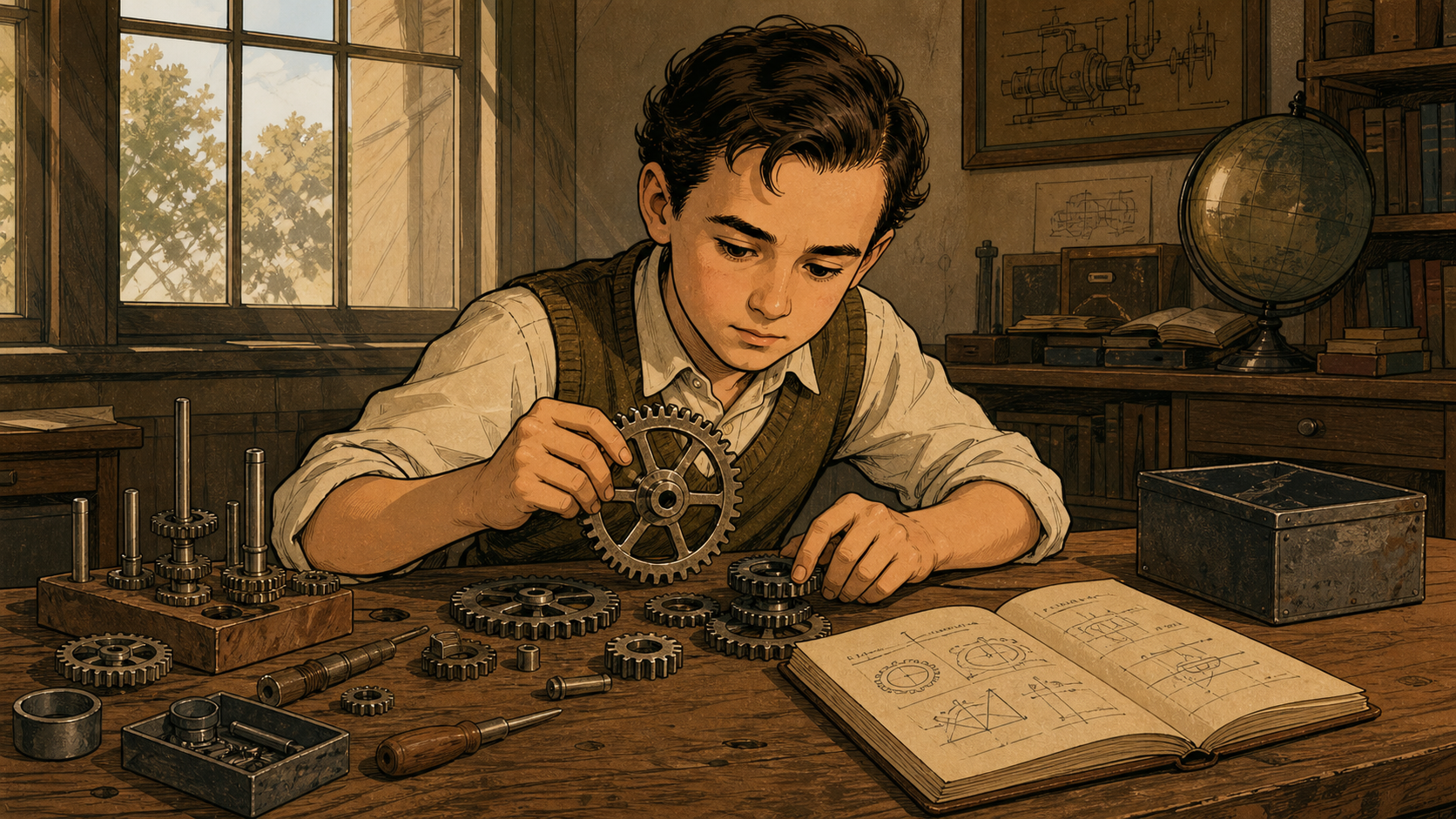
Image Prompt
(This is Panel 01. Do not include the panel number in the image.) I am about to ask you to generate a series of images for a graphic novel. Please make the images have a consistent style and consistent characters. Do not ask any clarifying questions. Just generate the image immediately when asked. Please generate a 16:9 image in a warm, sepia-toned educational graphic-novel style depicting panel 1 of 12. The scene should show a boy of about ten, with neat dark brown hair, wearing a buttoned vest over a white shirt with rolled sleeves, seated at a wooden desk in a 1930s South African study, carefully fitting together a large metal gear with his hands while smaller gears, shafts, and a metal toolbox sit scattered across the desk. An open notebook beside him shows hand-drawn mechanical diagrams and geometric sketches. A globe, stacked books, and a framed technical drawing sit on shelves behind him, with warm daylight coming through a window. Color palette: warm browns, tans, and muted olive greens. Emotional tone: quiet, absorbed concentration and curiosity. Six visual details: the large gear held in his hands, smaller gears and shafts scattered on the desk, the open notebook with mechanical sketches, a globe on the shelf, a framed technical diagram on the wall, sunlight through the window. Generate the image immediately without asking clarifying questions.In the 1930s, in Pretoria, South Africa, a boy named Seymour Papert spent hours at a desk covered in salvaged gears, sprockets, and spare machine parts, fitting them together and watching how one wheel's turn became another's. He later wrote plainly about that fascination: "I fell in love with the gears." Long before he had any theory of learning, gears simply made sense to his hands and eyes in a way no lecture ever had. That private, hands-on obsession became the model he would spend his career building for other children — understanding is something you construct, not something poured into you.
Panel 2: A Mathematician's Mind
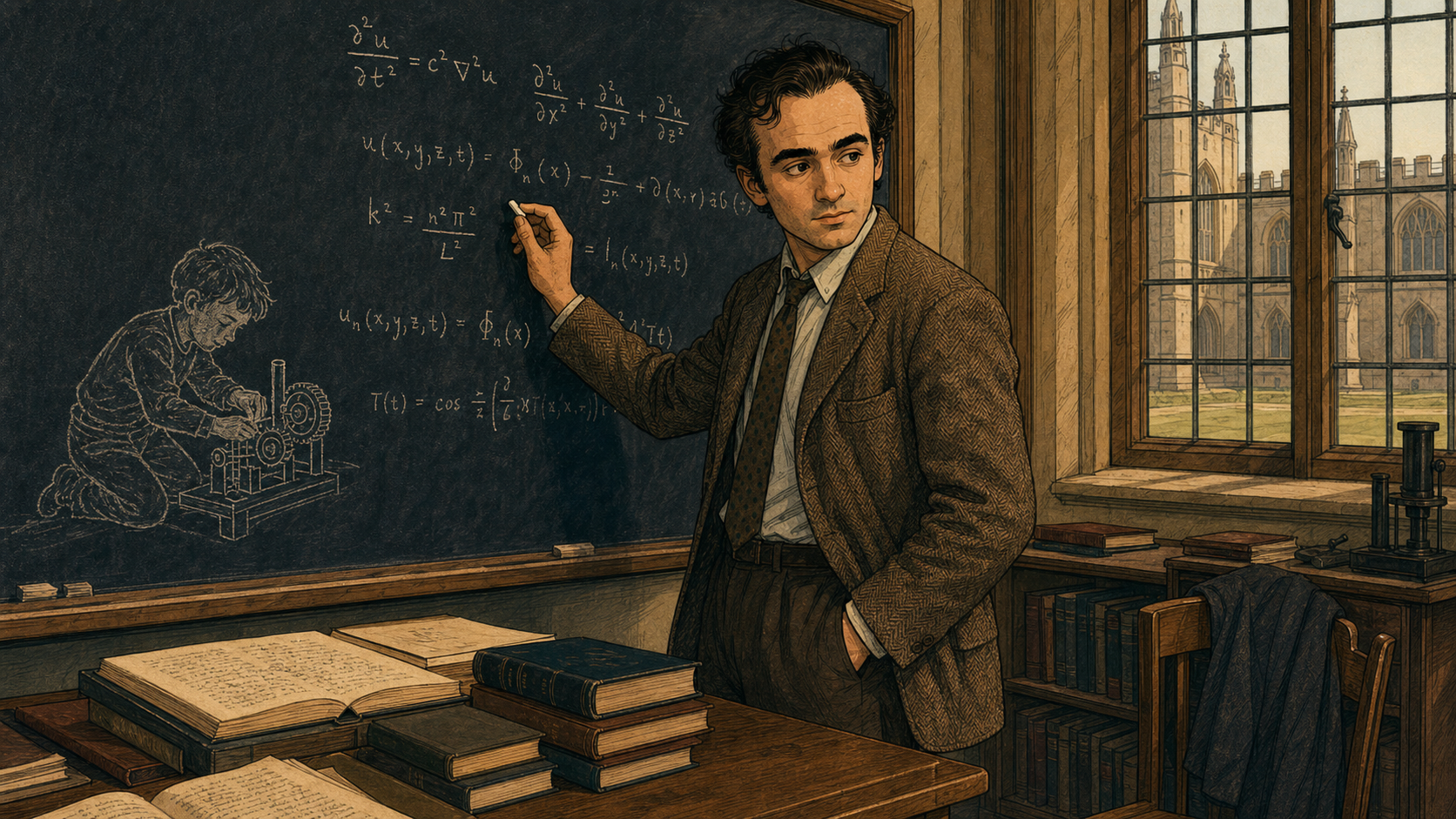
Image Prompt
(This is Panel 02. Do not include the panel number in the image.) Please generate a 16:9 image in the same style depicting panel 2 of 12. Make the young-adult version of the boy from panel 1 consistent with his likely adult appearance: a man in his late twenties with dark curly hair, wearing a herringbone jacket, tie, and light shirt, standing at a large chalkboard covered in handwritten equations, mid-stride writing another line with chalk. To the left of the equations, rendered as a faint pale chalk sketch rather than solid color, is a ghostly image of the same boy from panel 1 kneeling over his gears — a visual echo of memory. Stacks of open books and bound journals sit on a desk in the foreground. Through a large leaded-glass window behind him, Gothic university buildings and a lawn are visible in daylight. Color palette: warm browns and tans, with the chalk equations and ghostly boy in pale cream against the dark chalkboard. Emotional tone: focused intellectual absorption, a quiet thread connecting past and present. Six visual details: the handwritten equations, the pale ghost-sketch of the boy with gears, the chalk in his hand, stacked open books on the desk, his jacket and tie, the Gothic buildings through the window. Generate the image immediately without asking clarifying questions.By the time Papert reached the University of Cambridge in England to complete a second doctorate in mathematics, gears had given way to equations on the chalkboard. Colleagues remembered a mind that moved fluidly between abstract proof and concrete tinkering, as if the two were never really separate — the same instinct that had once fitted gear to gear was now fitting theorem to theorem. That conviction, that abstract ideas grow out of concrete experience, would soon carry him to Geneva, Switzerland, and into a collaboration that changed the course of his career.
Panel 3: Learning From Piaget
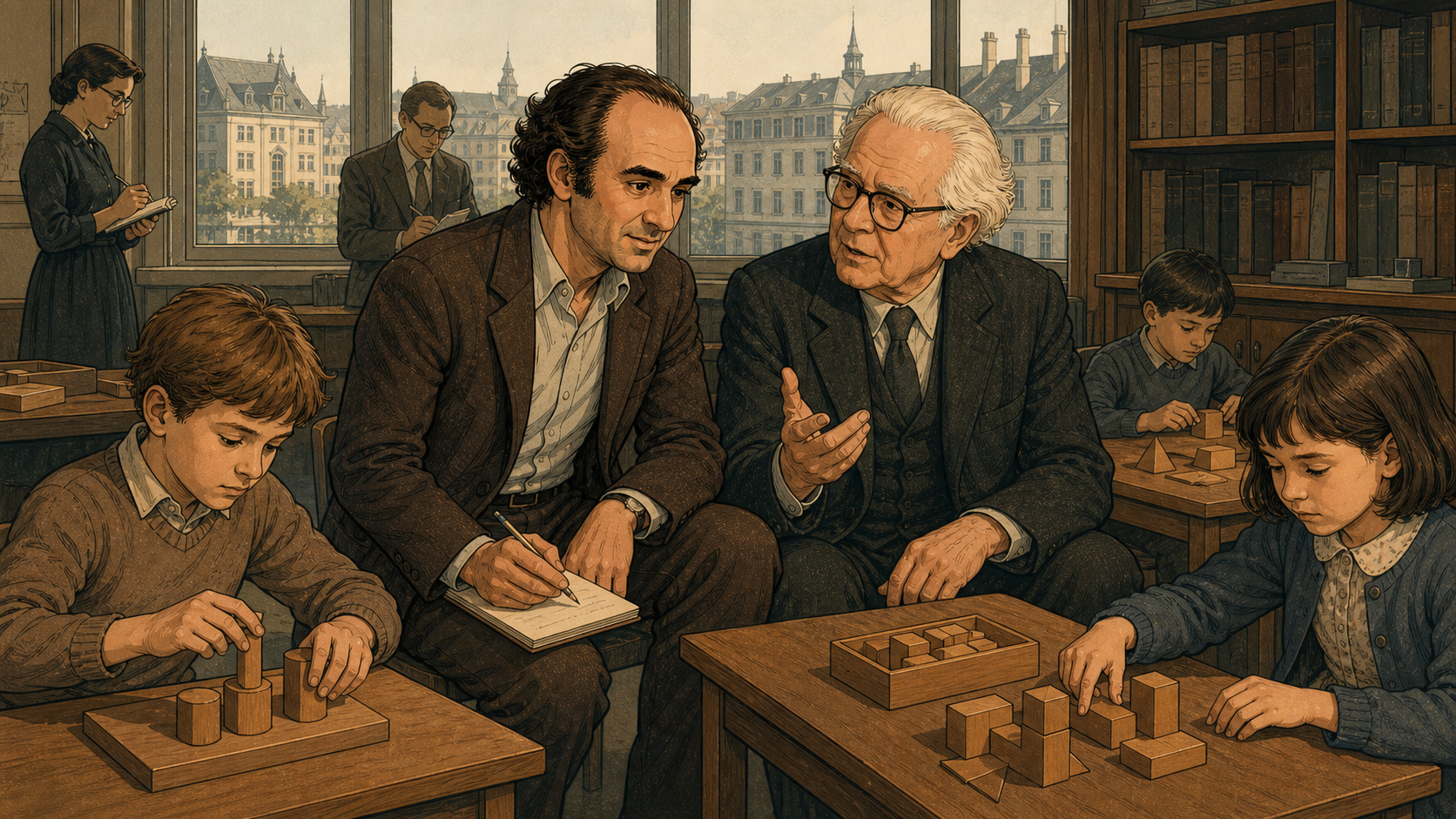
Image Prompt
(This is Panel 03. Do not include the panel number in the image.) Please generate a 16:9 image in the same style depicting panel 3 of 12. Make the man from panel 2 consistent, now in his early thirties, curly dark hair, brown jacket, seated beside an elderly man with white hair, round wire-frame glasses, and a dark three-piece suit, mid-conversation and gesturing as he speaks. Around them, in a research room with tall windows overlooking a European city, several children sit at low tables building structures out of wooden blocks and geometric shapes, while two researchers in the background take notes on clipboards. Bookshelves line the back wall. Setting: a child-development research center in Geneva, Switzerland, late 1950s. Color palette: warm browns and muted blue-grays, with soft daylight through the windows. Emotional tone: intellectual exchange, mutual respect, attentive observation. Six visual details: the elderly man's expressive gesturing hand, the children's wooden building blocks, a researcher taking notes in the background, tall windows with a city view, the bookshelves, the young man's notebook and pencil. Generate the image immediately without asking clarifying questions.In 1958, Papert joined the Swiss psychologist Jean Piaget's research center in Geneva, where children building towers of wooden blocks were studied as seriously as any laboratory experiment. For five years he absorbed Piaget's central insight: that children are not empty vessels waiting to be filled, but active builders who construct their own understanding of the world through their own actions on it. Piaget was reportedly so impressed that he said no one understood his ideas as well as Papert did. But Papert left Geneva troubled by one gap in the theory — it explained brilliantly how children learn on their own, yet said almost nothing about how a teacher, a tool, or a machine might help that process along.
Panel 4: Founding the AI Lab
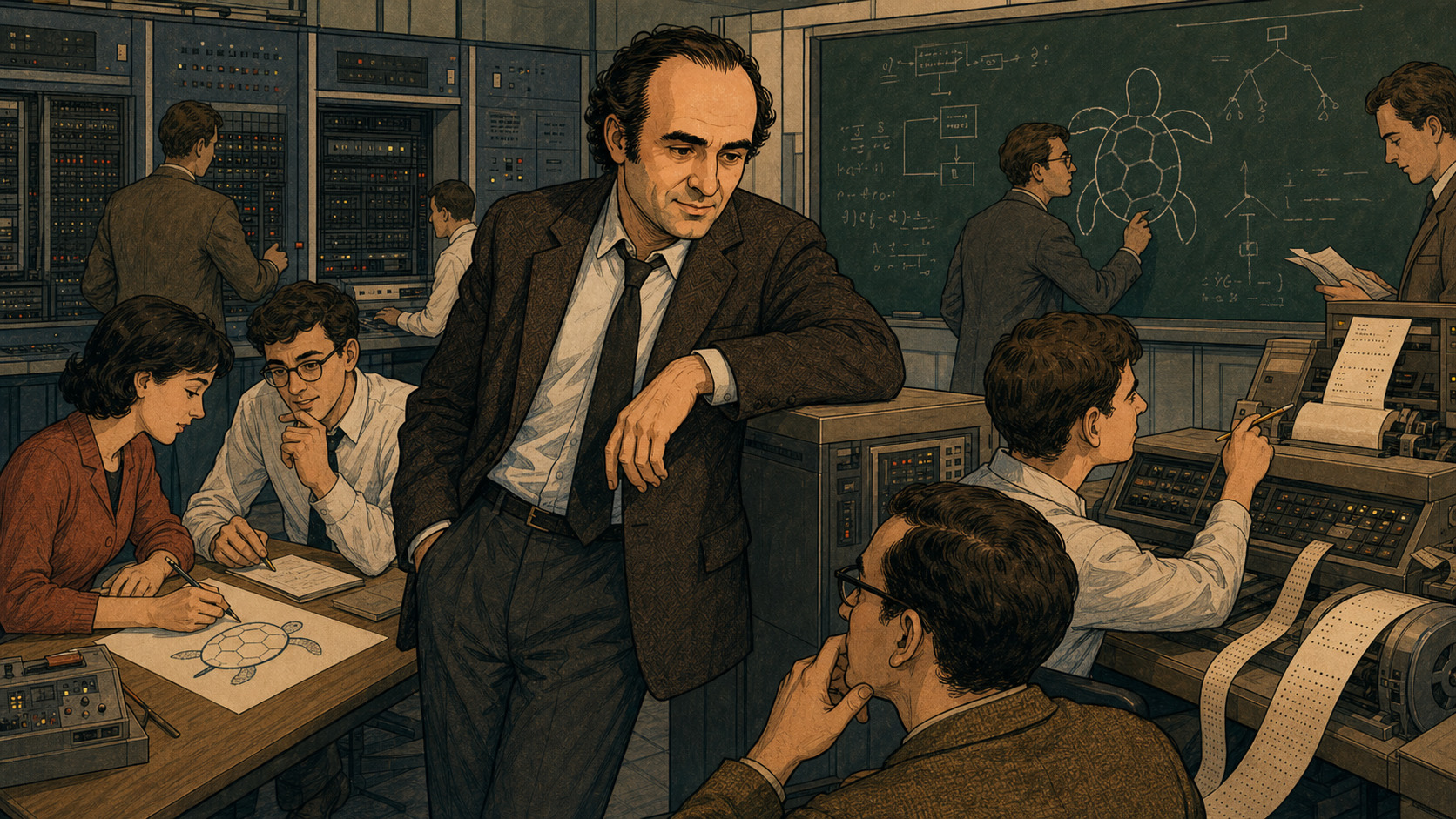
Image Prompt
(This is Panel 04. Do not include the panel number in the image.) Please generate a 16:9 image in the same style depicting panel 4 of 12. Make the man consistent with prior panels, now in his early forties, curly dark hair, dark suit jacket, standing with one arm resting on a large computer cabinet in a busy research lab, surrounded by young researchers: one man and one woman writing notes at a desk with a hand -drawn turtle sketch, a researcher drawing a turtle diagram and flowchart on a large chalkboard, and two others working at a punch-tape teleprinter station. Wall-mounted equipment racks with blinking indicator lights line the back wall. Setting: an MIT computer research laboratory, early 1970s. Color palette: warm browns and tans with cool gray-blue machine accents. Emotional tone: purposeful energy, shared intellectual excitement. Six visual details: the turtle diagram and flowchart on the chalkboard, the hand-drawn turtle sketch on the desk, the punch-tape teleprinter, the equipment racks with indicator lights, the standing man's contemplative expression, researchers actively writing and typing. Generate the image immediately without asking clarifying questions.In 1963, Papert crossed the Atlantic to MIT, where mathematician and AI researcher Marvin Minsky was building one of the first laboratories dedicated to machine intelligence. The two co-authored a landmark book on perceptrons together, and in 1970 became co-directors of the newly formed MIT Artificial Intelligence Laboratory — a room full of room-sized computers, punch tape, and researchers convinced that thinking itself could be studied like an engineering problem. But Papert's question was never quite the same as his colleagues': he was less interested in making machines think like people, and more interested in what happens when children get their hands on a machine that thinks. On the chalkboard behind him, a small drawn turtle was already starting to share space with the equations.
Panel 5: Inventing LOGO
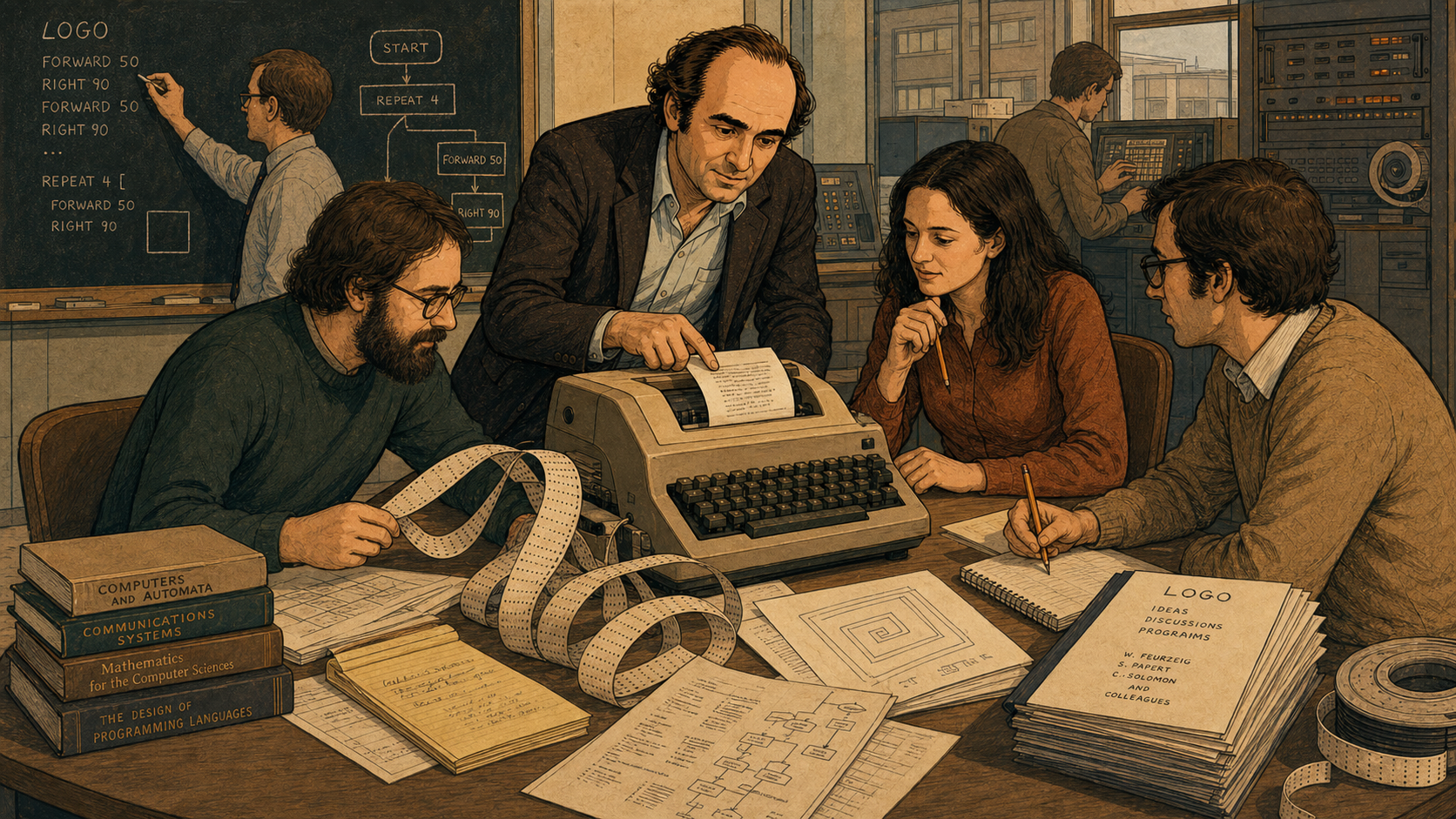
Image Prompt
(This is Panel 05. Do not include the panel number in the image.) Please generate a 16:9 image in the same style depicting panel 5 of 12. Make the man consistent with prior panels, curly dark hair, dark jacket, leaning over a teletype machine and pointing at a printed line of text, surrounded by three colleagues: a bearded man in a dark green sweater holding a length of punched paper tape, a woman with long dark hair in a rust-colored blouse resting her chin thoughtfully on her hand, and another man in a tan sweater writing in a notebook. A chalkboard behind them reads "LOGO," a short list of simple movement commands, and a flowchart. Stacked reference books and a notebook labeled with the team's names sit on the cluttered table amid loose punch tape. Setting: a research office at a computing company, late 1960s. Color palette: warm browns and tans with the chalkboard's pale cream lettering as an accent. Emotional tone: collaborative discovery, focused teamwork. Six visual details: the printed teletype output, the coiled punch tape, the chalkboard command list and flowchart, the stacked reference books, the notebook with the team's names, the woman's thoughtful pose. Generate the image immediately without asking clarifying questions.Working alongside Wally Feurzeig and Cynthia Solomon at the research firm Bolt Beranek and Newman, Papert helped design a programming language built entirely around a child's-eye view of the world: type FORWARD 50 and something moves forward fifty steps; type RIGHT 90 and it turns a quarter circle. They called it LOGO, and its first commands were embarrassingly simple on purpose. The team's real invention wasn't the syntax — it was giving every command a body a child could act out by walking it themselves, so geometry stopped being a page of proofs and became something felt in your own arms and legs. Within a few years, those same commands would be steering not just text on a screen, but an actual robot across a classroom floor.
Panel 6: Turtles in the Classroom
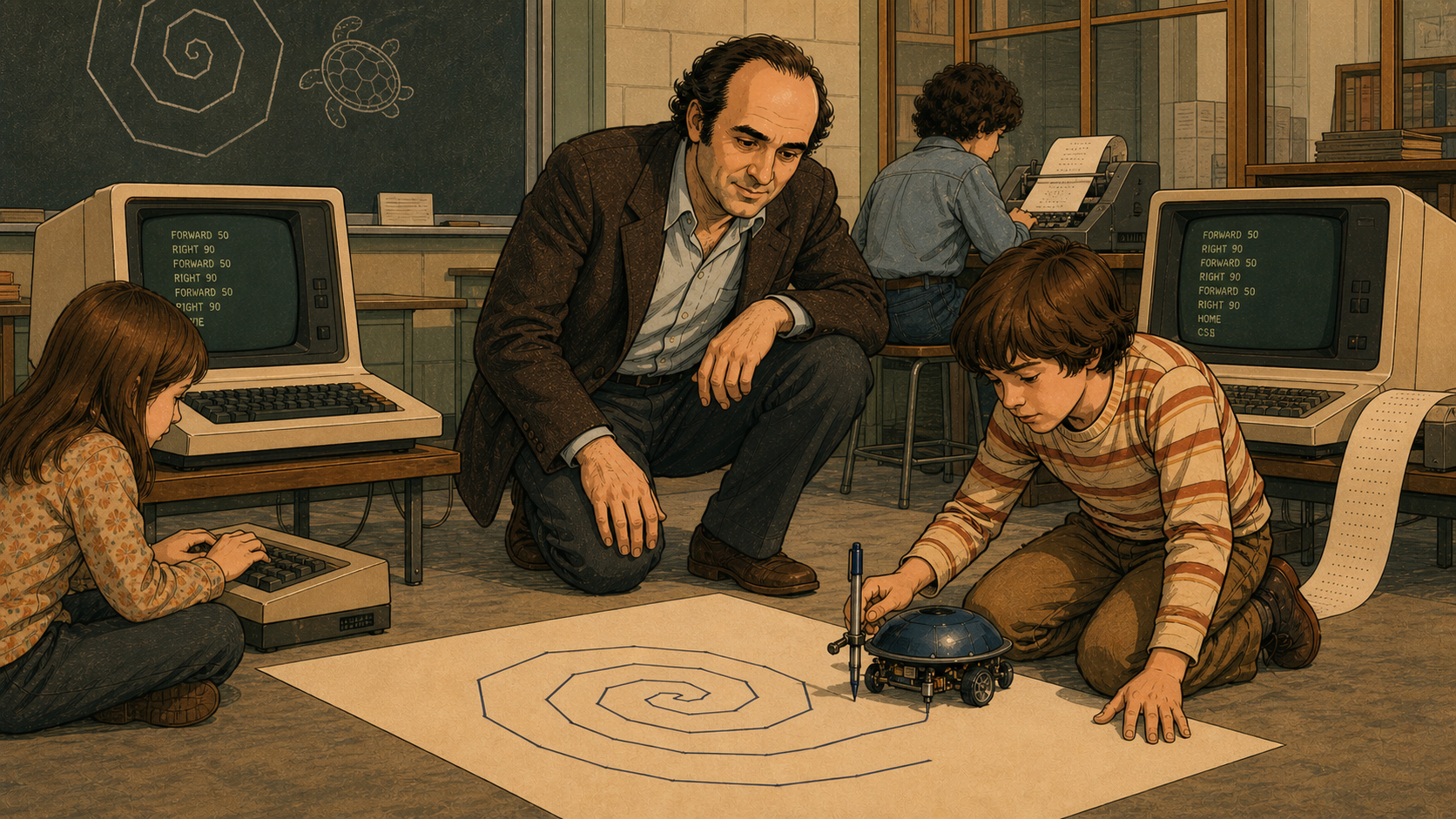
Image Prompt
(This is Panel 06. Do not include the panel number in the image.) Please generate a 16:9 image in the same style depicting panel 6 of 12. Make the man consistent with prior panels, kneeling on a classroom floor beside a boy in a striped sweater who is guiding a small dome-shelled wheeled robot along a spiral drawn in ink on a large sheet of paper. To the left, a girl sits cross-legged typing on a boxy terminal keyboard displaying simple movement commands, with a chalkboard behind showing a hand-drawn spiral and turtle sketch. Another child works at a second terminal in the background, its screen also showing a list of movement commands. Setting: an American school classroom, mid-1970s. Color palette: warm browns and tans with a pale green terminal glow as an accent. Emotional tone: playful concentration, hands-on discovery. Six visual details: the spiral drawn on paper, the small wheeled turtle robot with its pen, the girl's terminal showing command text, the chalkboard sketch, coiled punch tape beside one terminal, the kneeling man's encouraging posture. Generate the image immediately without asking clarifying questions.By the mid-1970s, LOGO had grown a body: a small dome-shelled robot nicknamed the "turtle," wired to carry a pen and trace whatever path its program described. In classrooms, kids who had never enjoyed math knelt on the floor beside their turtles, typing FORWARD and RIGHT commands and watching spirals bloom across butcher paper. Papert crouched beside them not as a teacher checking answers, but as a fellow investigator, curious what the turtle would do next. For a child who could already walk in a square, programming a turtle to draw one wasn't abstract at all — it was just describing, out loud, something their own body already knew how to do.
Panel 7: The Bug Is Not a Failure
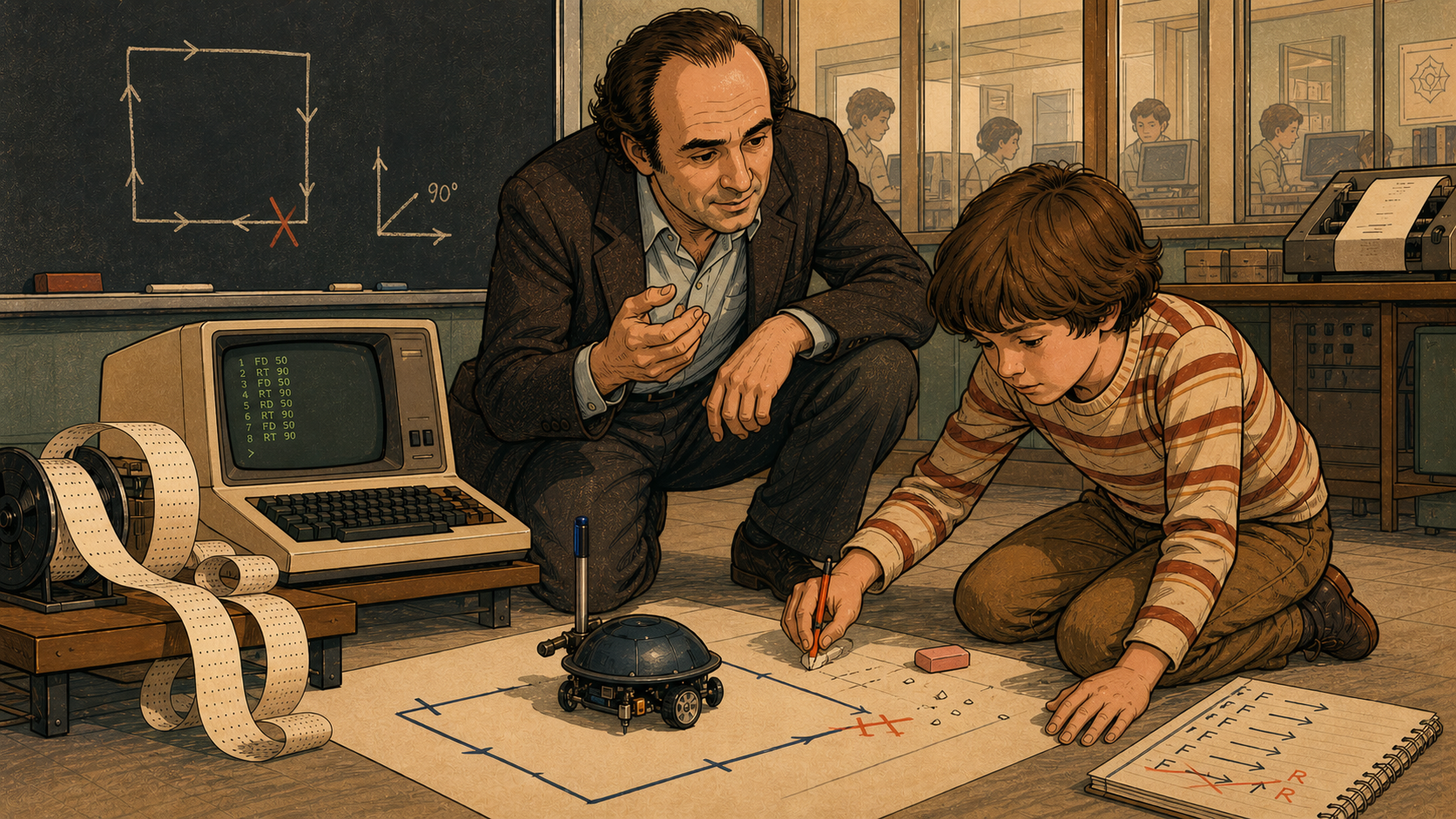
Image Prompt
(This is Panel 07. Do not include the panel number in the image.) Please generate a 16:9 image in the same style depicting panel 7 of 12. Make the man consistent with prior panels, kneeling beside a boy in a striped sweater who is pointing with a pencil at a broken, incomplete square path drawn on paper, with a small red X marking the gap where the path went wrong, and a spiral-bound notebook beside him showing crossed-out movement commands. A computer terminal to the left displays a short numbered list of movement commands. A chalkboard behind shows a hand-drawn square with directional arrows and a 90-degree angle diagram, with one arrow marked by a red X. Setting: the same school classroom, mid-1970s. Color palette: warm browns and tans with the red X and pale green terminal glow as sparing accents. Emotional tone: patient curiosity, a puzzle being worked out rather than corrected. Six visual details: the broken square path, the red X mark, the notebook with crossed-out commands, the terminal's command list, the chalkboard angle diagram, the boy's own pointing hand tracing the error. Generate the image immediately without asking clarifying questions.When a student's turtle veered off course and left a broken, lopsided square instead of a clean one, Papert didn't reach for the pencil to fix it himself. He asked the boy what the turtle had actually done, command by command, until the error revealed itself in the gap between the intended path and the real one. In Papert's classroom vocabulary there was no such thing as a wrong answer, only a "bug" — information the program handed back to you, waiting to be understood rather than punished. That single reframing, borrowed from computer programming and pointed at learning itself, is arguably his most quietly radical idea: mistakes are data, not verdicts.
Panel 8: Writing Mindstorms
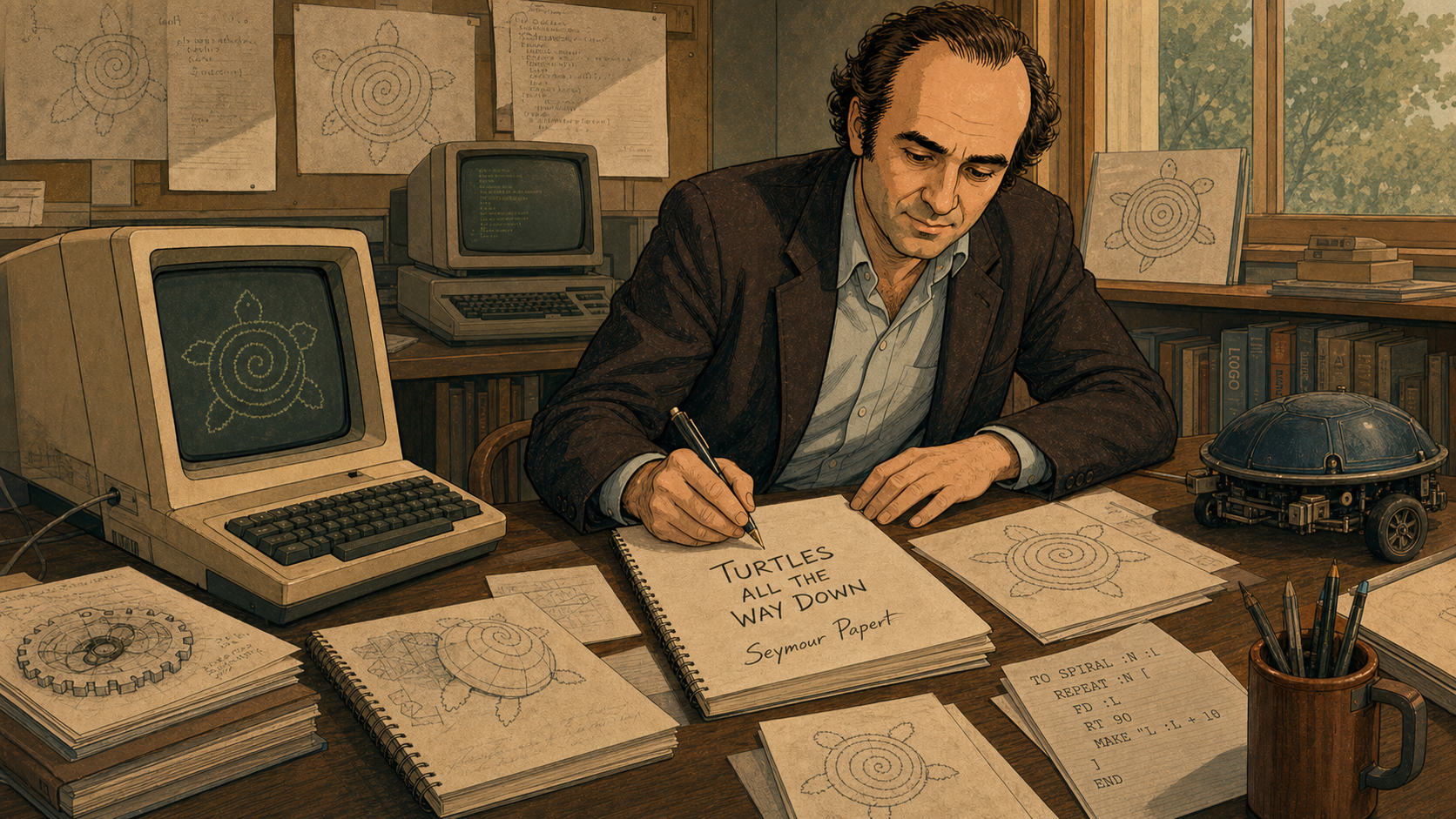
Image Prompt
(This is Panel 08. Do not include the panel number in the image.) Please generate a 16:9 image in the same style depicting panel 8 of 12. Make the man consistent with prior panels, seated at a cluttered desk, writing by hand in a spiral notebook, with two computer terminals beside him — one displaying a spiral turtle-graphics pattern — and a small dome-shelled robot resting at the edge of the desk. Sheets of paper covered in spiral turtle drawings and hand-lettered notes are pinned to the wall and propped against the window behind him, along with bookshelves holding reference volumes. A mug of pencils and loose sheets with simple programming code sit near his writing hand. Setting: a home or campus study, late 1970s, daylight through the window. Color palette: warm browns and tans, with the pale terminal glow as an accent. Emotional tone: focused, satisfied absorption in a long project nearing completion. Six visual details: the spiral notebook he is writing in, the pinned turtle drawings on the wall, the small robot on the desk, the terminal showing a spiral pattern, the mug of pencils, the sheet of simple code beside his hand. Generate the image immediately without asking clarifying questions.Through the late 1970s, Papert filled notebook after notebook — turtle spirals pinned to the wall around him, a physical turtle robot resting within arm's reach — working out how to explain a decade of classroom experiments to people who had never seen a child program a computer. The book taking shape at that desk would become Mindstorms: Children, Computers, and Powerful Ideas, published in 1980, the work that finally gave his classroom philosophy a name: constructionism, the idea that people build knowledge most effectively when they are actively engaged in constructing things in the world. He put his ambition plainly on its pages: "the child programs the computer, and, in doing so, both acquires a sense of mastery over a piece of the most modern and powerful technology and establishes an intimate contact with some of the deepest ideas from science, from mathematics, and from the art of intellectual model building."
Panel 9: Turtle Fever
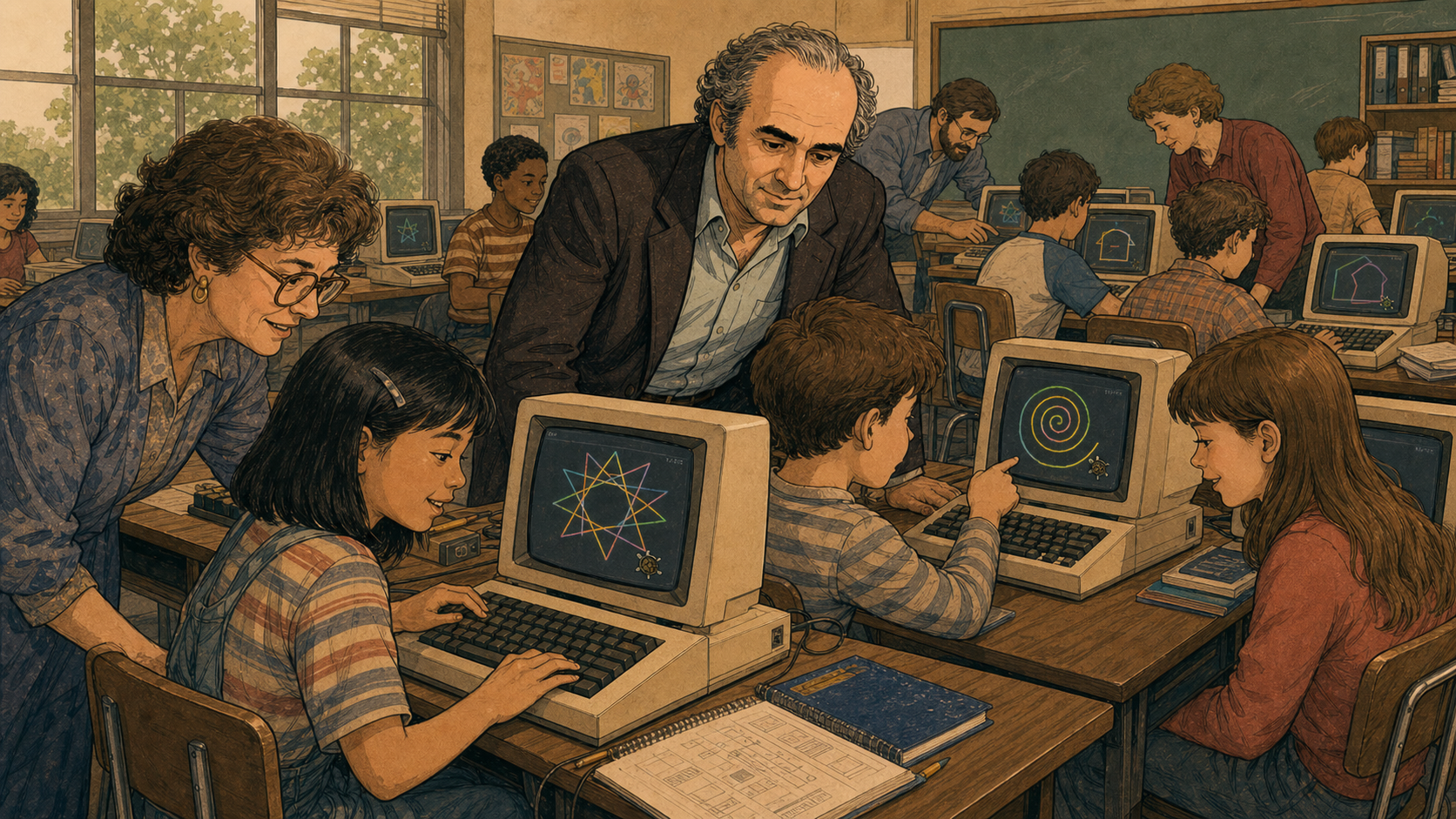
Image Prompt
(This is Panel 09. Do not include the panel number in the image.) Please generate a 16:9 image in the same style depicting panel 9 of 12. Make the man consistent with prior panels, now balding with gray-white curly hair at the temples, leaning over two children at adjacent computer terminals — one screen showing a colorful star pattern drawn in overlapping lines, the other showing a colorful spiral with a small turtle icon. A teacher with curly brown hair leans in beside a girl at a third terminal. Several more children work at terminals in the background of a busy classroom with large windows and children's artwork on the walls. Setting: an American school computer lab, mid-1980s. Color palette: warm browns and tans with bright multicolor screen graphics as vivid accents. Emotional tone: widespread enthusiasm, a classroom alive with independent exploration. Six visual details: the colorful star pattern on screen, the spiral with turtle icon, the teacher assisting a student, children's artwork on the wall, multiple terminals in use, notebooks open beside the keyboards. Generate the image immediately without asking clarifying questions.Mindstorms landed at the exact moment personal computers were arriving in American classrooms, and LOGO software spread through schools by the thousands of copies. Papert crisscrossed the country visiting classrooms where kids programmed spirals, stars, and polygons on screen instead of on the floor, delighted to see teachers stepping back and letting students direct their own turtles. Not every school grasped the philosophy behind the software — some reduced LOGO to just another drill program — but wherever a teacher truly let a class explore, Papert saw exactly the kind of self-directed, hands-on learning he had argued for since Geneva. The turtle, once a single robot in one MIT lab, was now a shared icon in classrooms most of its inventors would never visit.
Panel 10: Bricks, Wires, and Code
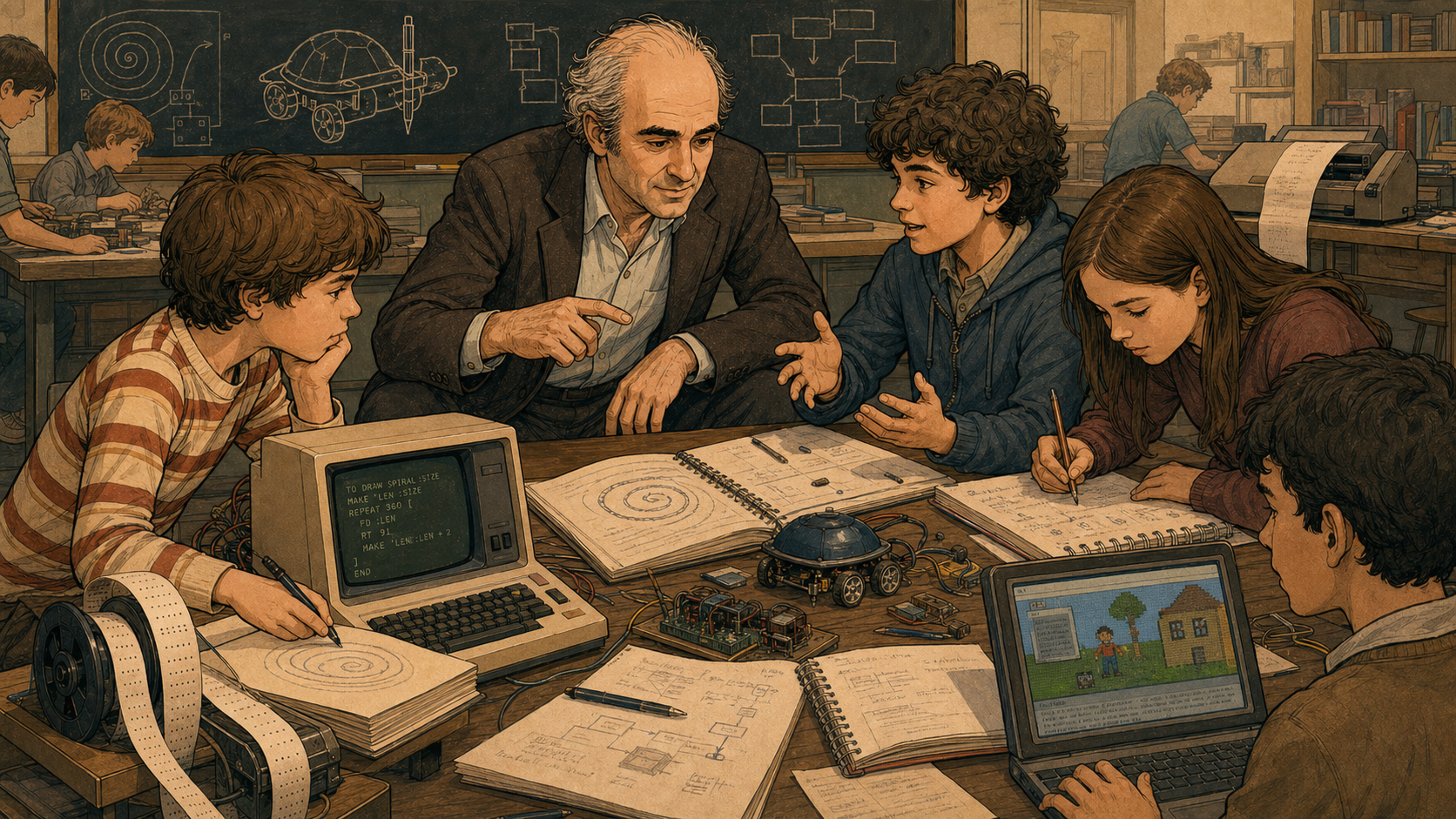
Image Prompt
(This is Panel 10. Do not include the panel number in the image.) Please generate a 16:9 image in the same style depicting panel 10 of 12. Make the man consistent with prior panels, now with fuller white-gray hair, seated among a group of teenagers gathered around a table covered in spiral-bound notebooks, a small wheeled robot wired to a circuit board, and loose electronic components, with one boy's laptop screen showing a simple on-screen scene with a character, a tree, and a house. A computer terminal to the left displays a short block of programming code describing a spiral. A chalkboard behind them shows a turtle-shaped toy car sketch and a flowchart diagram. Setting: an MIT research workshop, 1990s. Color palette: warm browns and tans with soft screen-glow accents. Emotional tone: collaborative, hands-on engineering enthusiasm. Six visual details: the wired robot on circuit board, the loose electronic components, the terminal's spiral code, the laptop's on-screen scene, the chalkboard turtle-car sketch, the coiled punch tape nearby. Generate the image immediately without asking clarifying questions.At the MIT Media Lab in the 1990s, Papert and colleagues extended turtle geometry from drawings into physical machines, wiring small programmable bricks with motors and sensors that students could command directly. Teenagers who had grown up on LOGO code now built small robots that reacted to light and touch, watching their own written instructions turn into movement they could push, adjust, and rebuild. That research became the direct ancestor of a commercial robotics kit released in 1998 and deliberately named after Papert's book — a rare case of an educational philosophy naming a toy instead of the other way around. The debugging lesson from decades earlier still applied: a robot that rolled the wrong way was not a failure, just the next problem to solve.
Panel 11: A Laptop for Every Child
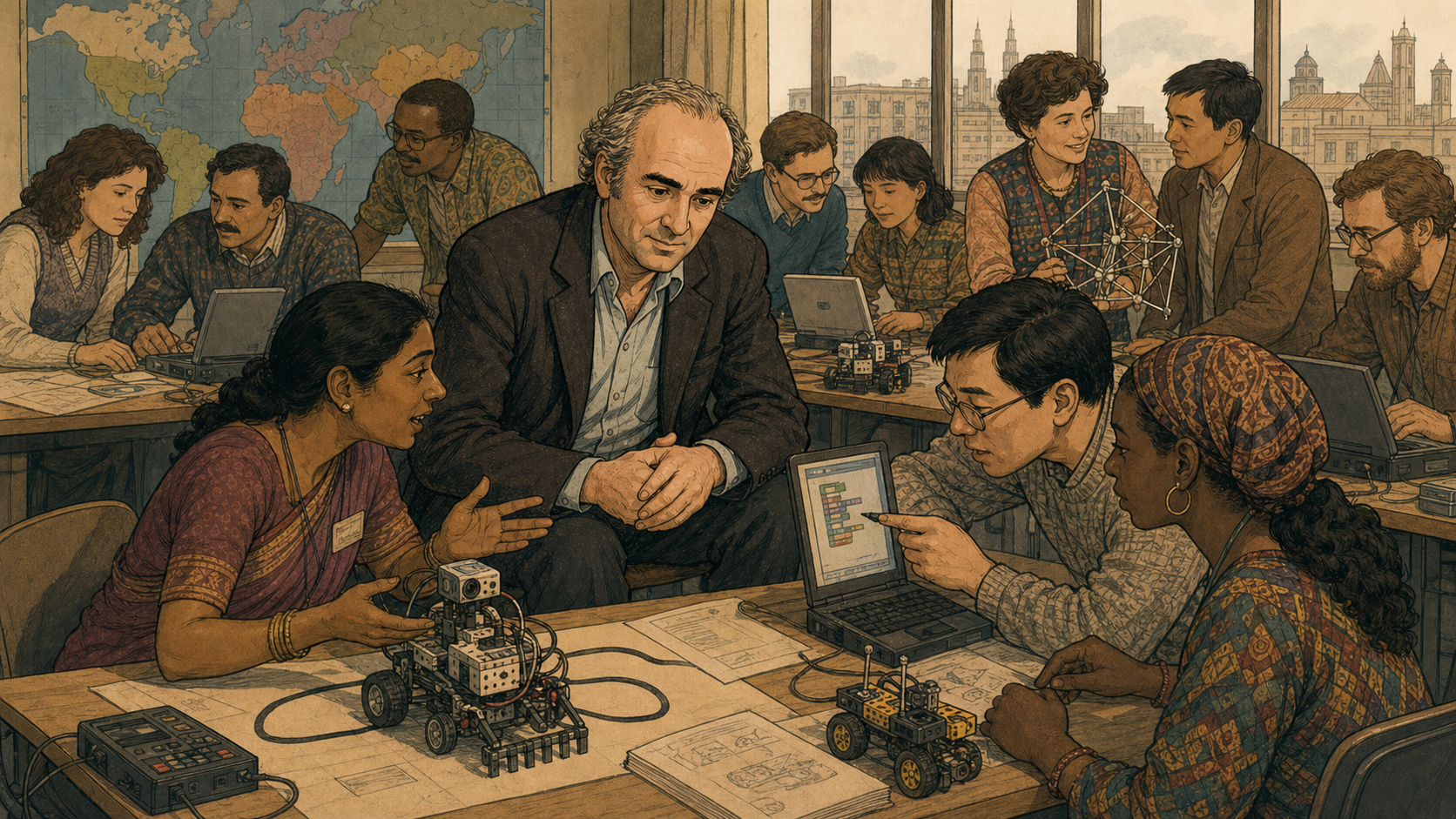
Image Prompt
(This is Panel 11. Do not include the panel number in the image.) Please generate a 16:9 image in the same style depicting panel 11 of 12. Make the man consistent with prior panels, now elderly with white curly hair, seated at the center of a diverse group of adults from different parts of the world gathered around a table, gesturing as he speaks with a woman in a patterned sari beside him who is examining a small rugged laptop with an antenna, while across the table two more colleagues examine a second small laptop and a wire-frame model structure. A large world map hangs on the wall behind them, and a city skyline is visible through tall windows. Setting: an international workshop room, mid-2000s. Color palette: warm browns and tans with the map's muted colors and small laptop screens as accents. Emotional tone: shared global purpose, warm collaborative energy. Six visual details: the world map on the wall, the small rugged laptop with antenna, the second laptop showing simple on-screen shapes, the wire-frame model structure, the sari-clad woman's engaged expression, the city skyline through the windows. Generate the image immediately without asking clarifying questions.In his seventies, Papert turned to a problem that had nagged him for years: constructionist learning meant little to children who had never touched a computer at all. Working with Nicholas Negroponte and Alan Kay, he helped shape One Laptop per Child, a nonprofit founded in 2005 to design a rugged, low-cost laptop — eventually reaching millions of children across more than forty countries — built to run programming environments in the spirit of LOGO. For Papert, the project was really his oldest argument at a global scale: that every child, not just the well-funded ones, deserves the chance to build ideas rather than simply receive them. In December 2006, while in Hanoi for a mathematics education conference tied to this same work, Papert was struck by a motorbike and suffered a severe brain injury that would slow him for the rest of his life.
Panel 12: The Idea Outlives the Man
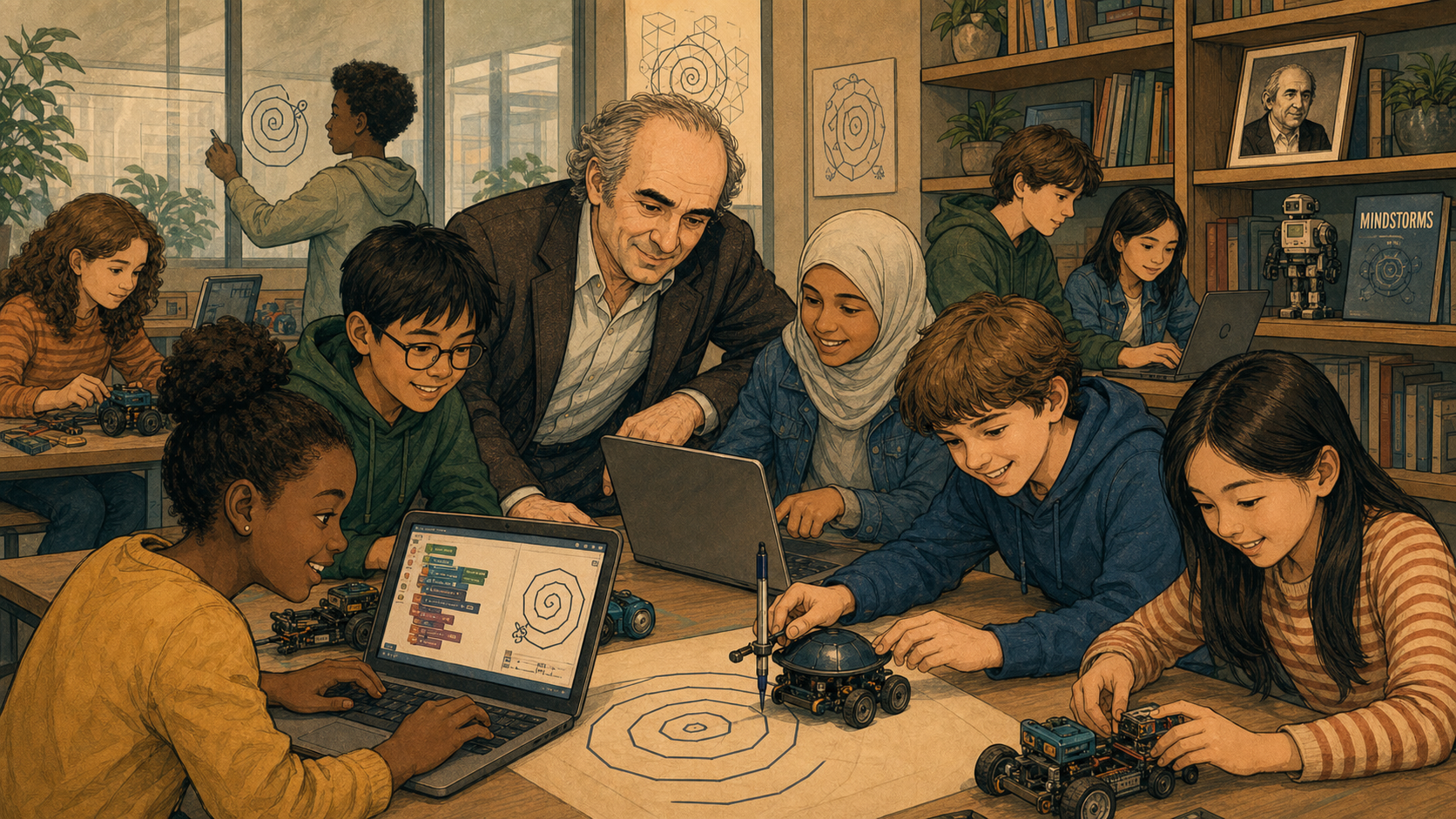
Image Prompt
(This is Panel 12. Do not include the panel number in the image.) Please generate a 16:9 image in the same style depicting panel 12 of 12. Make the elder man consistent with panel 11's likeness, leaning in warmly among a diverse group of teenagers at a table covered in laptops showing colorful block-based code and spiral turtle graphics, small wheeled robots, and a dome-shelled turtle robot tracing a spiral on paper. In the background, one teen draws a spiral and turtle shape on a glass wall, another works at a laptop near a bookshelf holding a framed portrait of an older curly-haired man and a book with a small robot figure beside it. Potted plants and large windows suggest a bright, modern maker space. Setting: a present-day coding club. Color palette: warm browns and tans with soft laptop-screen glow as accents, slightly brighter and more contemporary than earlier panels. Emotional tone: joyful collaboration, a legacy carried forward. Six visual details: the block-based code on a laptop screen, the spiral turtle graphic on another screen, the dome-shelled robot tracing paper, the framed portrait on the shelf, the book with the small robot figure, the teen drawing a spiral on the glass wall. Generate the image immediately without asking clarifying questions.Papert never fully recovered from the accident in Hanoi, and he died in Blue Hill, Maine, in 2016, at the age of eighty-eight. But walk into almost any coding club today — kids clustered around laptops running block-based code, a small wheeled robot tracing a spiral across a table, a mentor who asks "what do you think went wrong?" instead of just fixing it — and you are standing inside his idea, whether or not anyone in the room has ever heard his name. His portrait and his book sit on a shelf in clubs that carry his philosophy forward without a manual, because the philosophy was never really about the turtle. It was about handing the controls to the kid and trusting them to build something real.
Epilogue – What Made Papert Different?
Papert didn't invent a teaching trick; he inverted an entire relationship. Where most educational technology tried to make the computer teach the child, Papert insisted the child should teach the computer — and, in doing so, teach themselves something no worksheet could reach. From a boy alone with a box of gears to a scientist rebuilding education on three continents, his sixty-year argument never really changed: give a learner something real to build, let them find their own mistakes, and stand back.
| Challenge | How Papert Responded | Lesson for Today |
|---|---|---|
| Schools treated computers as devices that "taught" children through drills | He flipped the relationship: the child would program the computer, not the other way around | Give learners the controls, not just the content |
| Piaget's theory explained how children construct understanding in their own minds, but offered no bridge to the classroom | Papert extended it into constructionism: learning sticks best when the "construction" is a tangible, shareable object | Design projects that end in something a learner can point to and say "I made that" |
| A wrong turtle command produced a visibly broken drawing, not a red mark on a test | He treated the broken drawing as useful information, not failure, and let the child work out the fix | Treat every bug as a clue, not a verdict on the learner |
| Bringing computers to well-funded schools left millions of children out entirely | In his seventies he helped launch One Laptop per Child to put low-cost, LOGO-capable machines in children's hands worldwide | Access is not a footnote to good teaching — it is part of the design problem |
Call to Action
The next time a kid in your club hits a bug, resist the urge to just fix it for them. Ask what the code actually did, hand back the controls, and let them find the gap between what they meant and what happened — Papert built an entire philosophy of learning on exactly that pause.
"I fell in love with the gears." —Seymour Papert, "The Gears of My Childhood," foreword to Mindstorms (1980)
"In my vision, the child programs the computer and, in doing so, both acquires a sense of mastery over a piece of the most modern and powerful technology and establishes an intimate contact with some of the deepest ideas from science, from mathematics, and from the art of intellectual model building." —Seymour Papert, Mindstorms: Children, Computers, and Powerful Ideas (1980)
"You can't think about thinking without thinking about thinking about something." —Seymour Papert
References
- Wikipedia: Seymour Papert - Biography of the mathematician and educator who co-created LOGO and constructionism
- Wikipedia: Logo (programming language) - The educational programming language and turtle graphics Papert co-created at BBN
- Wikipedia: Constructionism (learning theory) - Papert's learning theory that people build knowledge best by constructing real things
- MIT Media Lab: In Memory of Seymour Papert - MIT Media Lab's memorial tribute covering his career and influence
- Encyclopaedia Britannica: Seymour Papert - Overview of Papert's life, LOGO, and educational philosophy