The Garage Where Everyone Was Welcome
Cover Image Prompt
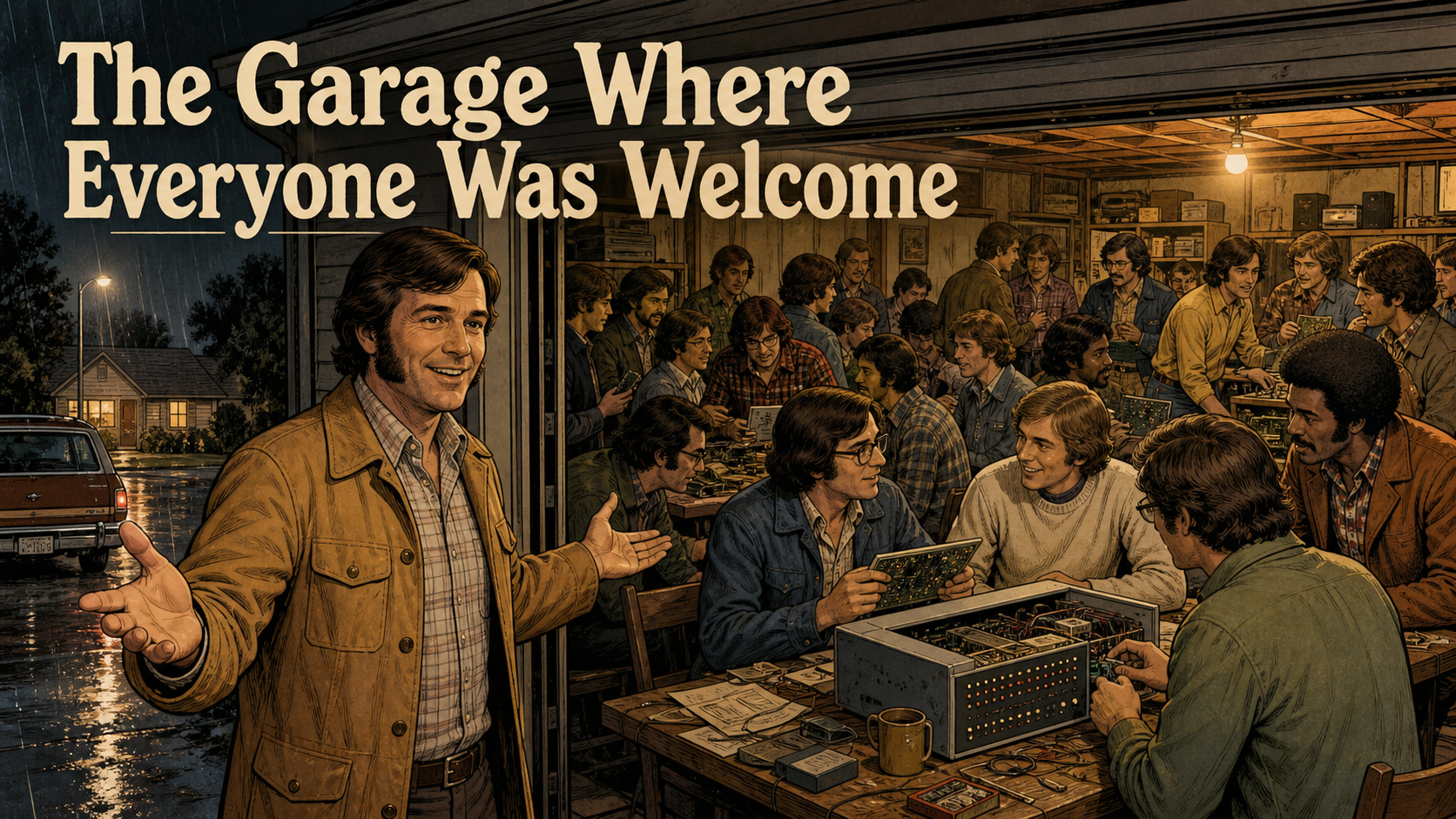
(This is the Cover Image. Do not include this label in the image.) Please generate a wide-landscape 16:9 cover image in a warm, detailed 1970s-realist graphic-novel style with fine linework and cinematic lighting. Scene: a rainy night in March 1975 in Menlo Park, California. A two-car garage door stands open, spilling warm amber light onto a wet driveway. In the foreground, a smiling man in his thirties (Gordon French — wavy brown hair, tan corduroy jacket over a plaid shirt) stands with both arms open in welcome, addressing the viewer as if greeting new arrivals. Behind him, roughly thirty hobbyists of mixed ages and backgrounds — flannel shirts, denim jackets, sweaters — crowd around homemade workbenches. On the nearest table sits a metal-cased computer with a front panel of toggle switches and small glowing lights, alongside circuit boards, hand-drawn schematics, and a coffee mug. A wood-paneled station wagon is parked on the glistening street under a streetlamp; a modest ranch house glows softly in the background. Rain falls in visible sheets against the dark sky. Bold cream-colored vintage serif title text reads "The Garage Where Everyone Was Welcome" in the upper left. Color palette: deep indigo and charcoal for the rainy exterior, contrasted with warm amber and gold for the crowded interior. Emotional tone: quiet excitement, generosity, the feeling of something historic beginning without anyone quite knowing it yet. Generate the image immediately without asking clarifying questions.Narrative Prompt
This is a dramatized retelling of a real historical event: the founding of the Homebrew Computer Club in Gordon French's garage in Menlo Park, California, on March 5, 1975, and its growth through the club's move to the Stanford Linear Accelerator Center (SLAC) auditorium and its eventual close in December 1986. Era: mid-1970s to mid-1980s Silicon Valley, United States. Art style: warm, detailed 1970s-realist graphic novel illustration with fine linework and period-accurate clothing, technology, and typography, consistent across all panels. Character consistency note: the recurring man in the tan corduroy jacket represents Gordon French across panels 1, 2, 5, and 8; he should keep the same hair, build, and jacket throughout. Creative liberties: the dozens of hobbyists filling each panel are artistic composites standing in for the real, undocumented individuals who attended — they are not claimed as likenesses of specific named members except where the narrative text identifies someone by name. The recruitment flyer shown in Panel 1 ("Build Your Own Microcomputer... Everyone Welcome") is a stylized recreation capturing the spirit of Fred Moore's real 1975 invitation; Moore's actual, verifiable flyer wording is quoted directly in the Panel 1 narrative text and in the Quotes section below, not copied into the image. Panel 6's young hobbyist holding up a circuit board is a representative depiction of the well-documented practice of Steve Wozniak bringing his hand-wired boards to Homebrew meetings; the illustration is not asserted to be a verified likeness. Note on ages: Wozniak (born 1950) was 24 and already a Hewlett-Packard engineer when he joined Homebrew in 1975, and Steve Jobs (born 1955) was 20 — both young adults, not teenagers, contrary to some popular retellings.Prologue – A Club With No Boss
No one owned the Homebrew Computer Club. It had no headquarters, no paid staff, no application form, and no entrance fee — just a mailing list, a rotating cast of volunteers, and a standing invitation for anyone curious enough to show up. Between 1975 and 1986, the loose band of hobbyists who gathered under that name helped launch more than twenty companies, including Apple Computer, and quietly rewrote the rules for who was allowed to build a computer. Every free, all-welcome coding club that meets today in a school library or community center is, in a very real sense, still standing in that garage.
Panel 1: Everyone Welcome
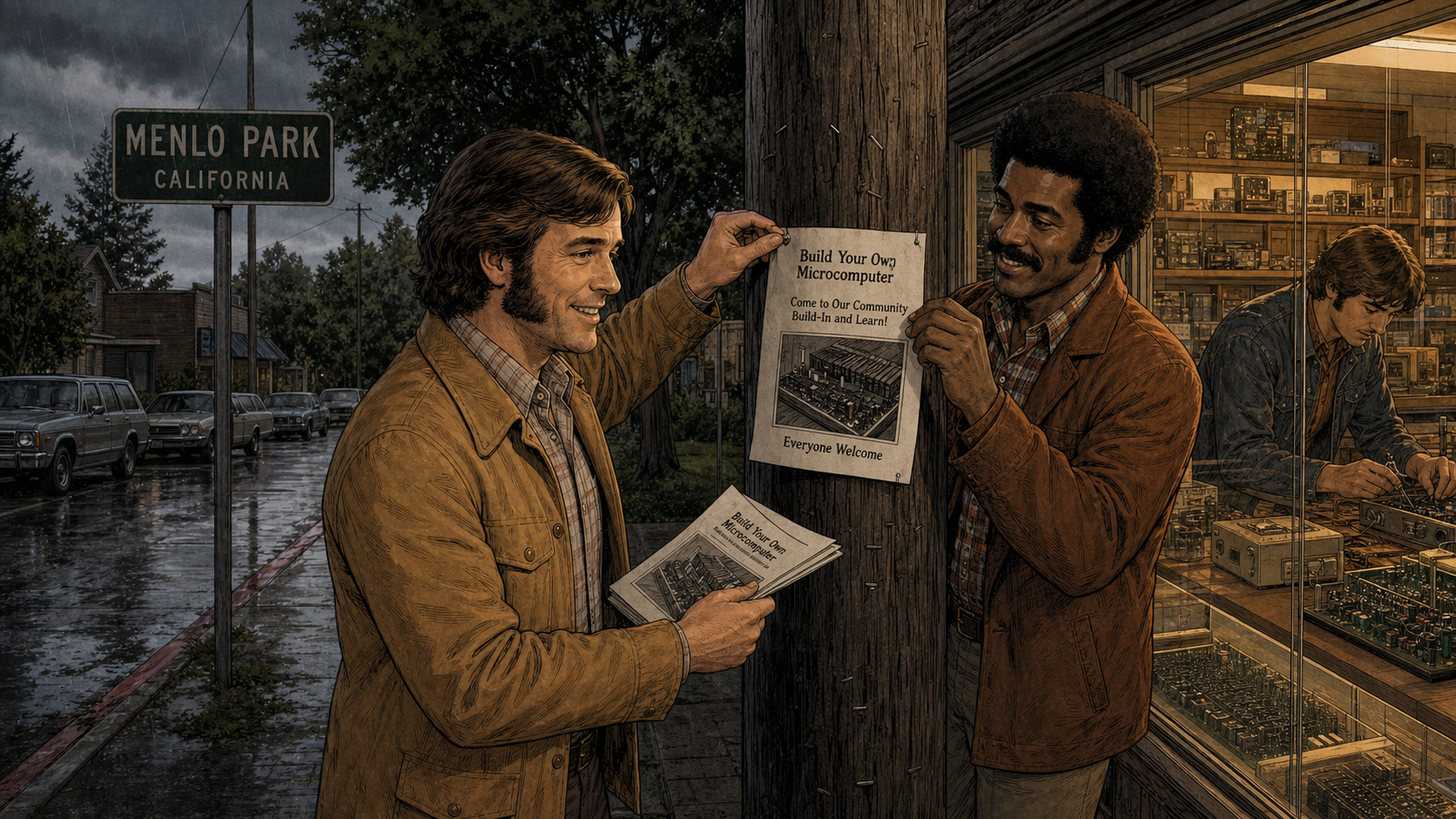
Image Prompt
(This is Panel 01. Do not include the panel number in the image.) I am about to ask you to generate a series of images for a graphic novel. Please make the images have a consistent style and consistent characters. Do not ask any clarifying questions. Just generate the image immediately when asked. Please generate a 16:9 image in a warm 1970s-realist graphic-novel style depicting panel 1 of 8. The scene shows a rainy evening street in Menlo Park, California, with a green "MENLO PARK / CALIFORNIA" road sign visible in the background. Two men stand at a wooden telephone pole outside a lit electronics-surplus shop window: on the left, a smiling man in his thirties with wavy brown hair and a tan corduroy jacket (Gordon French) holds a stack of flyers; on the right, a man with a full afro and a brown corduroy jacket pins a flyer to the pole that reads "Build Your Own Microcomputer / Come to Our Community Build-In and Learn! / Everyone Welcome" above a small line drawing of a circuit board. Through the shop window behind them, a third young man works alone at a workbench cluttered with surplus radio parts. Setting: Menlo Park, California, early 1975, evening rain. Color palette: wet-street blues and grays outside, warm amber light spilling from the shop window. Emotional tone: hopeful, communal, inviting. Six visual details: the "Menlo Park, California" road sign, rain streaking the pavement, parked cars with visible taillights, the hand-lettered flyer text, a hammer or thumbtack mid-motion, shelves of radio equipment visible through the shop glass. Generate the image immediately without asking clarifying questions.Fred Moore and Gordon French did not have money to advertise, so they made do with a stack of hand-typed flyers and a fistful of thumbtacks. Moore's real invitation, copied about a hundred times and nailed to poles and shop windows around Menlo Park, asked a simple question that any hobbyist tinkering alone in a garage would recognize instantly: "Are you building your own computer? Terminal? TV typewriter? I/O device?" It did not ask what school anyone attended, what company they worked for, or how much they already knew — only whether they were curious.
Panel 2: Thirty Strangers in a Garage
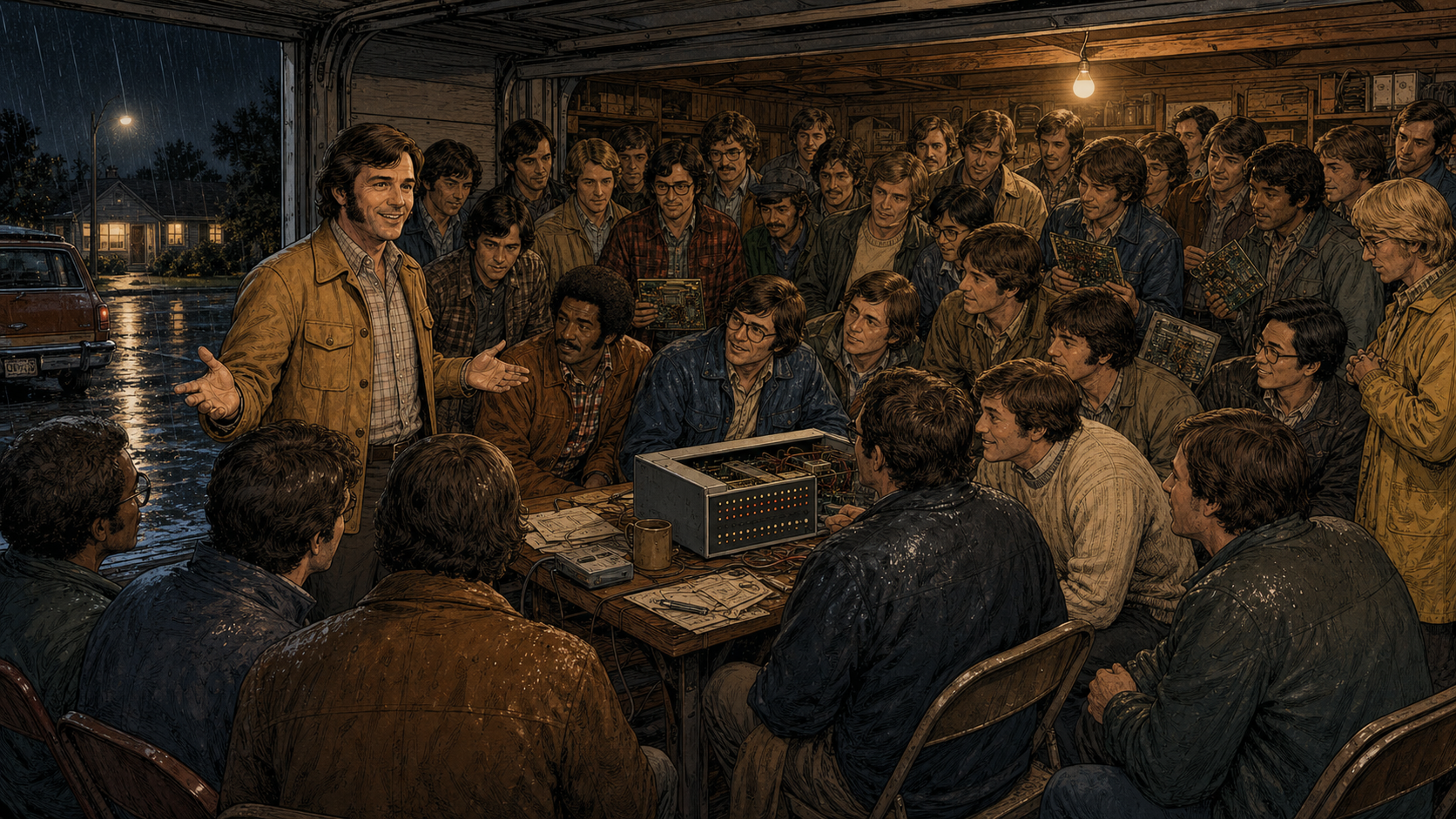
Image Prompt
(This is Panel 02. Do not include the panel number in the image.) Please generate a 16:9 image in the same style depicting panel 2 of 8. Keep Gordon French consistent with panel 1. The scene shows the open garage door of a modest ranch house on a rainy night, warm bulb light spilling out onto the driveway where a wood-paneled station wagon is parked. Gordon French stands just inside the doorway with both arms open, welcoming a packed crowd of roughly thirty hobbyists of mixed ages already gathered around a long workbench. On the table sits a metal-cased computer with a front panel of toggle switches and small lit indicator lights, surrounded by tools, notebooks, and a coffee mug. Garage shelving behind the crowd is stacked with ham-radio gear and equipment boxes. Setting: Menlo Park, California, the night of March 5, 1975. Color palette: cool rainy blue-black outside, warm amber and gold light inside. Emotional tone: anticipation, warmth, a history-making ordinariness. Six visual details: the switch-and-light front panel of the computer, the rain visible through the open door, the parked station wagon, crowded folding chairs, hand-drawn notes on the table, shelves of vintage electronics. Generate the image immediately without asking clarifying questions.On the night of March 5, 1975, about thirty strangers filed into Gordon French's garage because a shipment of a new build-it-yourself kit computer, the MITS Altair 8800, had just reached the Bay Area for review by the People's Computer Company. Nobody in that garage was paid to be there, and nobody had to prove they belonged. Engineers stood shoulder to shoulder with students and retirees, all staring at the same blinking front panel, all equally new to the idea that a computer could sit on a kitchen table instead of filling a corporate basement. By the end of the night they had a name for themselves — the Homebrew Computer Club — and a habit of meeting every two weeks that would outlast the decade.
Panel 3: No Gatekeepers
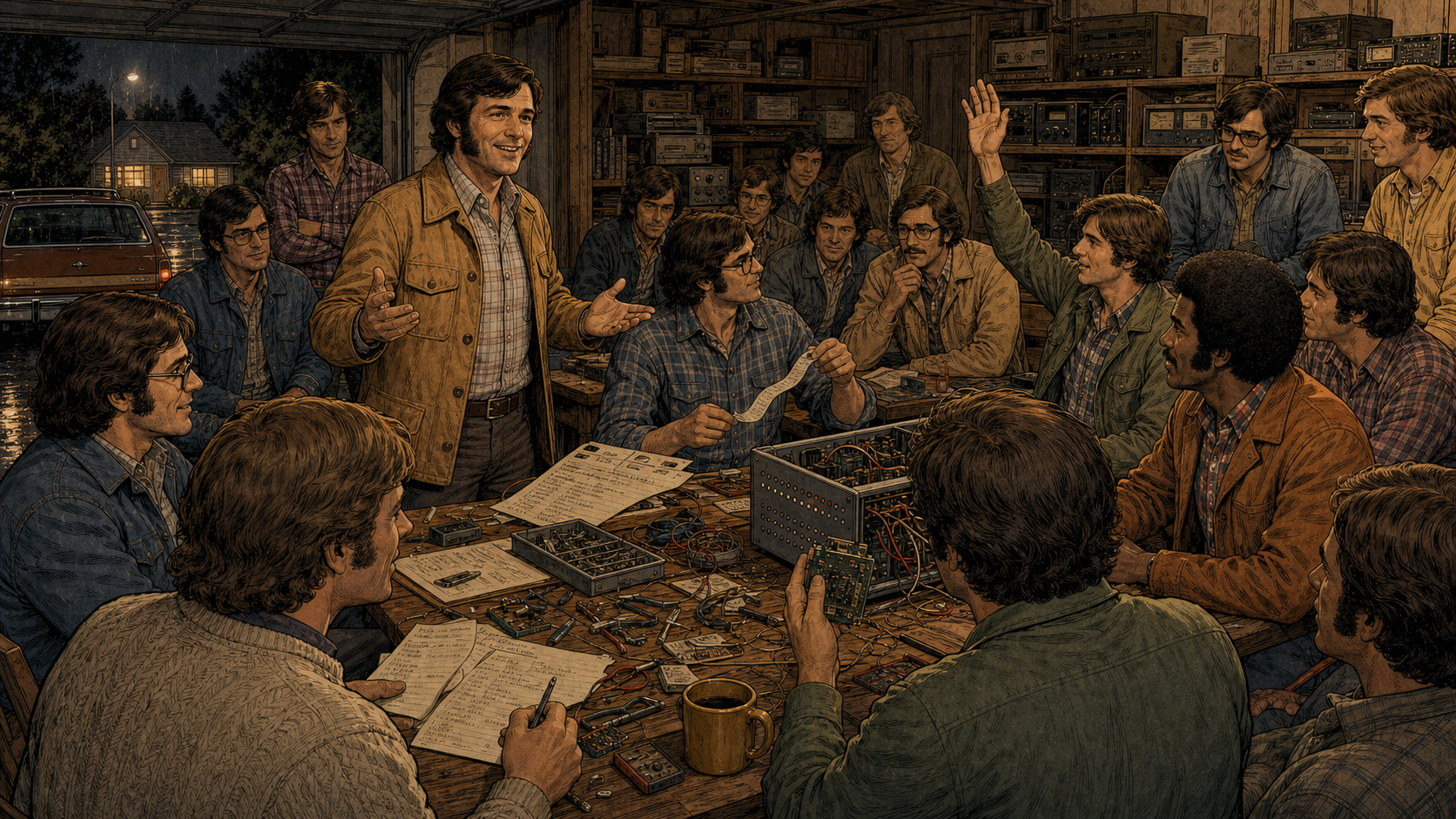
Image Prompt
(This is Panel 03. Do not include the panel number in the image.) Please generate a 16:9 image in the same style depicting panel 3 of 8. Keep Gordon French and the setting consistent with panel 2. The scene shows the same crowded garage, now even fuller, with Gordon French mid-sentence, hands gesturing as he explains something to the group. In the middle of the crowd, one man in a green jacket raises his hand eagerly with a question, while another nearby holds up a thin strip of printed paper tape for others to see. The workbench in front of them is covered with tools, a coffee mug, hand-drawn notes, and an open computer chassis with visible wiring. Setting: same Menlo Park garage, same rainy night, packed even tighter than before. Color palette: same warm amber interior against the dark rainy exterior glimpsed through the doorway. Emotional tone: eager participation, informality, nobody waiting to be called on. Six visual details: the raised hand, the strip of paper tape, the open chassis with wiring, scattered hand tools, a spiral notebook full of notes, the crowd pressing in close around the table. Generate the image immediately without asking clarifying questions.There was no professor at the front of the room and no syllabus taped to the wall. Questions flew the moment someone had one, and answers came from whoever in the crowd happened to know — sometimes a Stanford-trained engineer, sometimes a teenager who had only read about transistors in a library book. That first meeting ran long because nobody wanted to leave, and by the time French finally sent everyone home, the group had already agreed to meet again in two weeks.
Panel 4: Splitting Into Study Groups
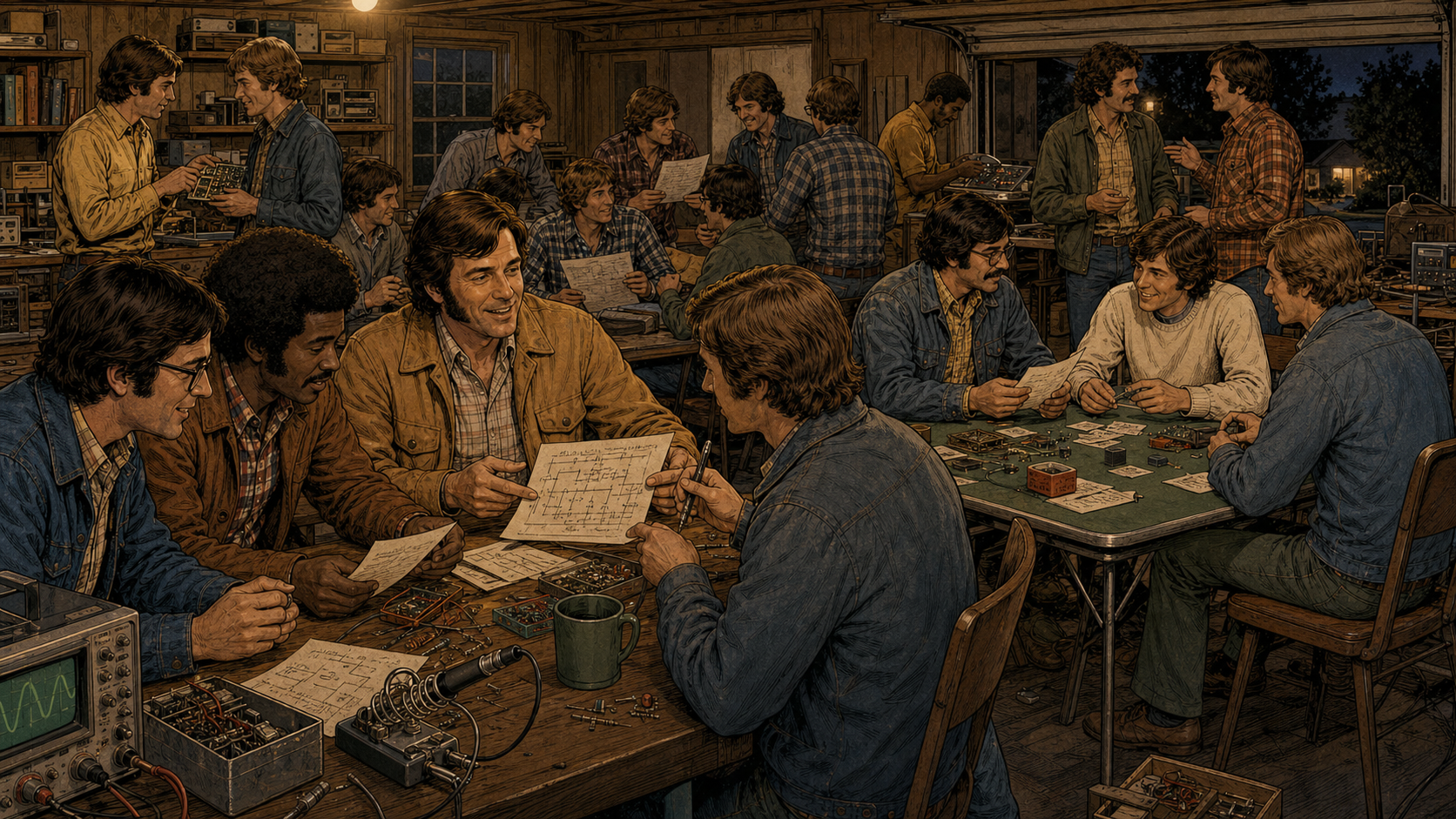
Image Prompt
(This is Panel 04. Do not include the panel number in the image.) Please generate a 16:9 image in the same style depicting panel 4 of 8. Keep the characters and garage setting consistent with prior panels. The scene shows the same garage, now organized into two informal clusters at separate tables. In the foreground, a small group huddles over a hand-drawn schematic spread across the table, next to an oscilloscope showing a glowing waveform and a soldering iron resting in its stand. Slightly behind them at a card table, another cluster of members trades small circuit boards and parts, one holding a green circuit board up to the light. Shelves of ham-radio equipment and books line the walls; the open garage door shows the rainy street outside. Setting: same Menlo Park garage, later the same evening. Color palette: warm lamp light with the cool blue glow of the oscilloscope screen as an accent. Emotional tone: focused collaboration, self-organized learning. Six visual details: the oscilloscope waveform, the soldering iron, the hand-drawn schematic, the card table of traded parts, a stack of reference books, the rainy street through the doorway. Generate the image immediately without asking clarifying questions.Within an hour, the single crowd had split itself into smaller clusters without anyone assigning the groups. One table traced a schematic line by line under the blue glow of a borrowed oscilloscope; another swapped spare parts and finished boards like kids trading baseball cards. This was the club's real invention — not any single piece of hardware, but a working model of how strangers with different skill levels could teach each other for free, simply by standing close enough to watch.
Panel 5: Outgrowing the Garage
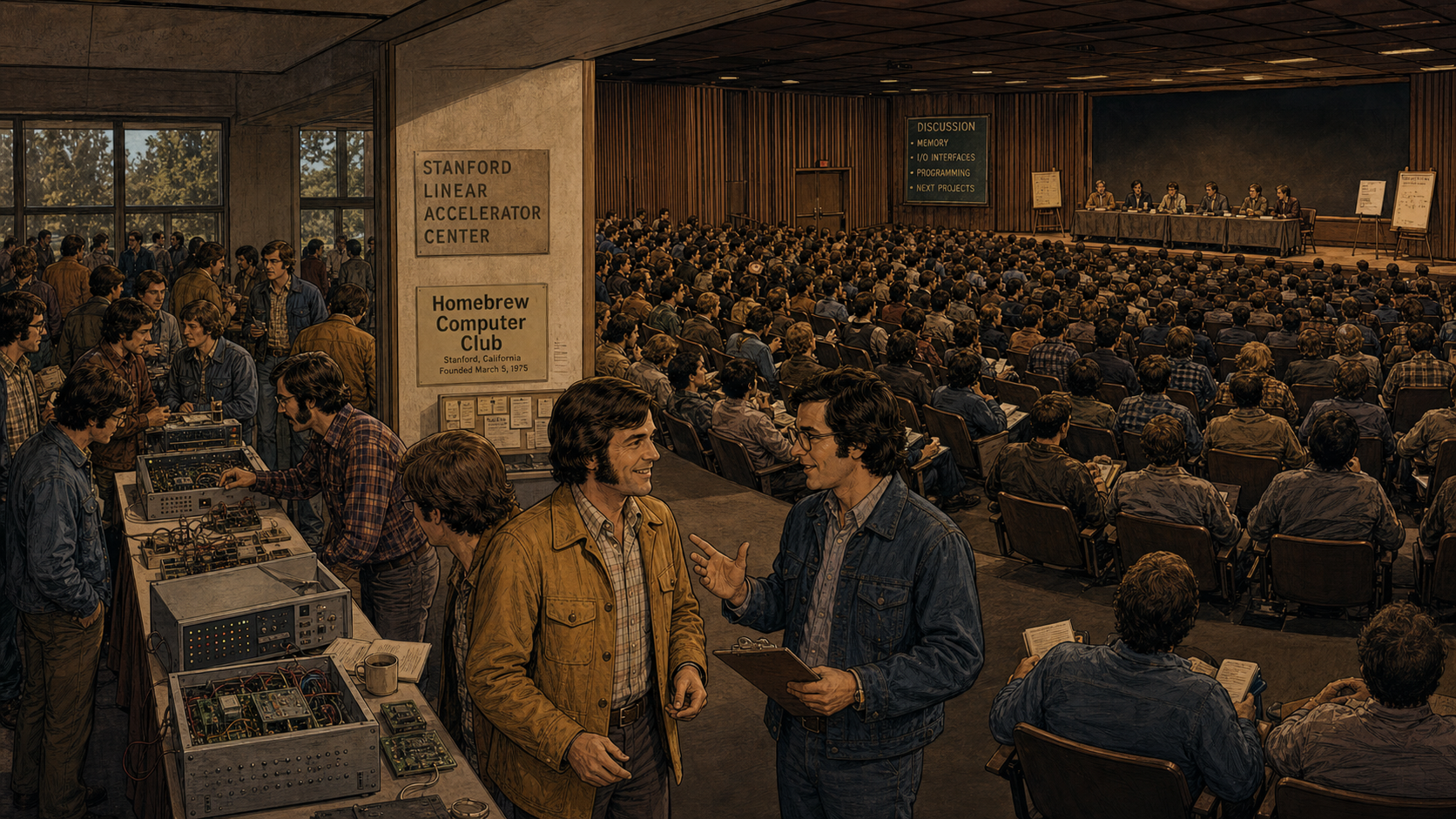
Image Prompt
(This is Panel 05. Do not include the panel number in the image.) Please generate a 16:9 image in the same style depicting panel 5 of 8. Keep Gordon French consistent with prior panels. The scene shows a large modern auditorium lobby with a wall sign reading "STANFORD LINEAR ACCELERATOR CENTER" above a smaller plaque reading "Homebrew Computer Club / Stanford, California / Founded March 5, 1975." Through an open doorway, hundreds of attendees fill rows of auditorium seats facing a stage where a panel of members sits at a long table beneath a sign reading "DISCUSSION: Memory, I/O Interfaces, Programming, Next Projects." In the foreground lobby, Gordon French, now with faint touches of gray, talks with a member holding a clipboard, near a table of homemade equipment. Setting: Stanford Linear Accelerator Center, Menlo Park, California, the club's later, larger meetings. Color palette: institutional warm wood tones and daylight through tall windows, contrasted with the club's homemade electronics on display. Emotional tone: pride at how far the club has grown, still informal despite the size. Six visual details: the SLAC wall sign, the founding plaque with the date, the crowded auditorium seating, the discussion topics sign on stage, the clipboard, the display table of homemade gear. Generate the image immediately without asking clarifying questions.A single garage could hold thirty people, not the hundreds who wanted in. The club moved first to a nearby school and then to the Stanford Linear Accelerator Center's own auditorium, where semi-monthly meetings routinely drew hundreds of members and the mailing list grew past fifteen hundred names within two years. The venue changed, but the rule stayed the same: anyone who showed up even once counted as a member, no dues required.
Panel 6: A Board Worth Sharing
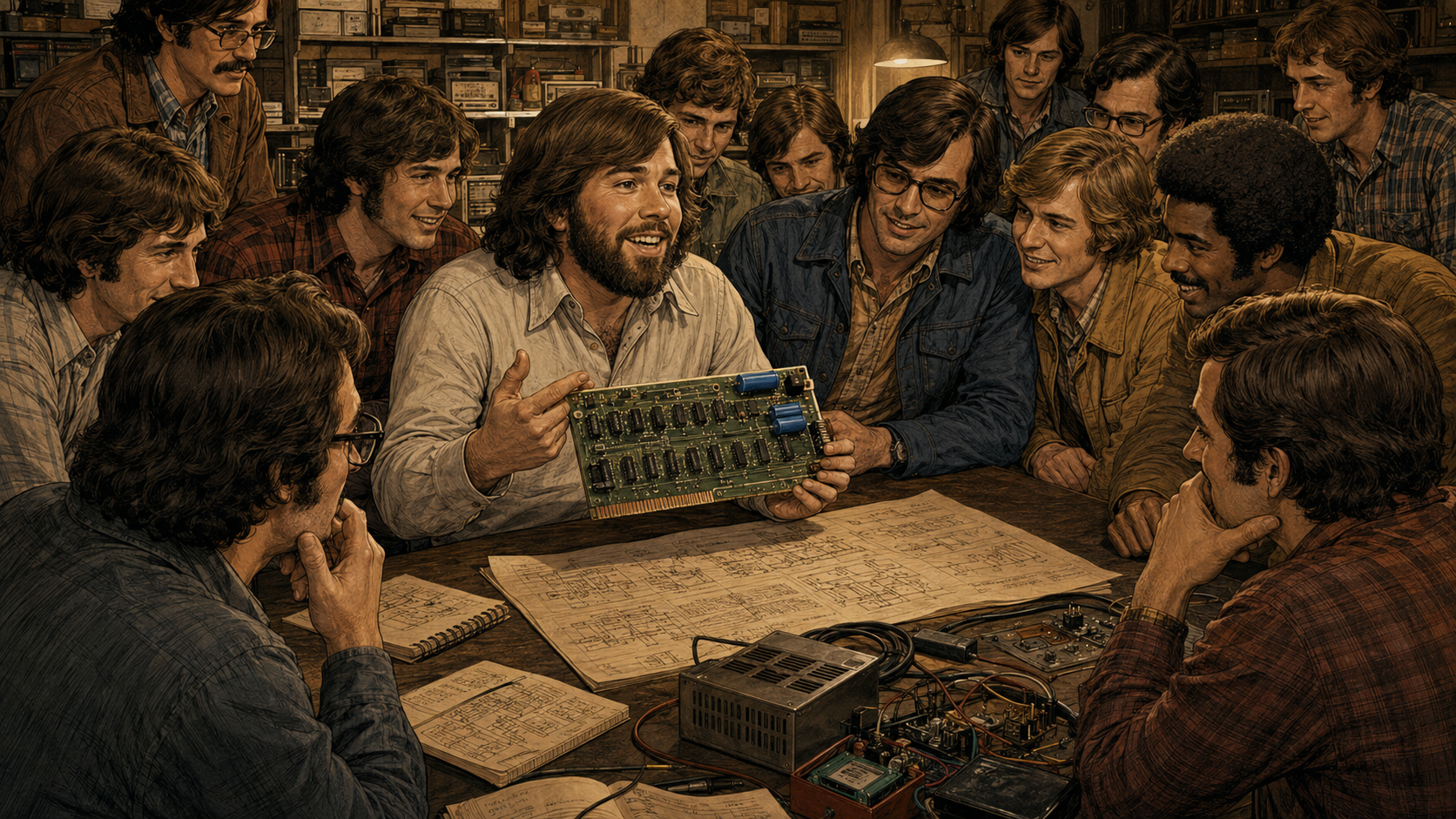
Image Prompt
(This is Panel 06. Do not include the panel number in the image.) Please generate a 16:9 image in the same style depicting panel 6 of 8. Keep the club members' clothing and the overall visual style consistent with prior panels. The scene shows a close, warmly lit gathering: a young engineer in his mid-twenties holds up a green circuit board dense with chips and two blue capacitors, explaining it with visible enthusiasm to roughly a dozen fellow club members packed elbow to elbow around a table covered in hand-drawn schematics, a power supply, and scattered tools. Every face in the semicircle is turned toward the board, several leaning in for a closer look. Shelves of radios and electronics fill the background under a single hanging lamp. Setting: a Homebrew Computer Club meeting, mid-1970s. Color palette: warm amber lamplight, the green circuit board as the visual focal point. Emotional tone: shared excitement over a genuinely new idea. Six visual details: the populated circuit board, the two visible capacitors, the semicircle of leaning-in faces, the hand-drawn schematics on the table, the power supply with visible cables, the single overhead lamp. Generate the image immediately without asking clarifying questions.Among the regulars who kept coming back was a young Hewlett-Packard engineer named Steve Wozniak, only twenty-four years old and still too shy to speak up during meetings. Instead he communicated the way the club understood best: by building something and holding it up. Night after night he carried in his latest hand-wired board, and it was at Homebrew, showing that work to a circle of fellow hobbyists rather than to any investor, that the machine which became the Apple I first took shape. "If there was no Homebrew Computer Club," Wozniak would say years later, "there would probably be no Apple Computer."
Panel 7: No Pay, Just Passion
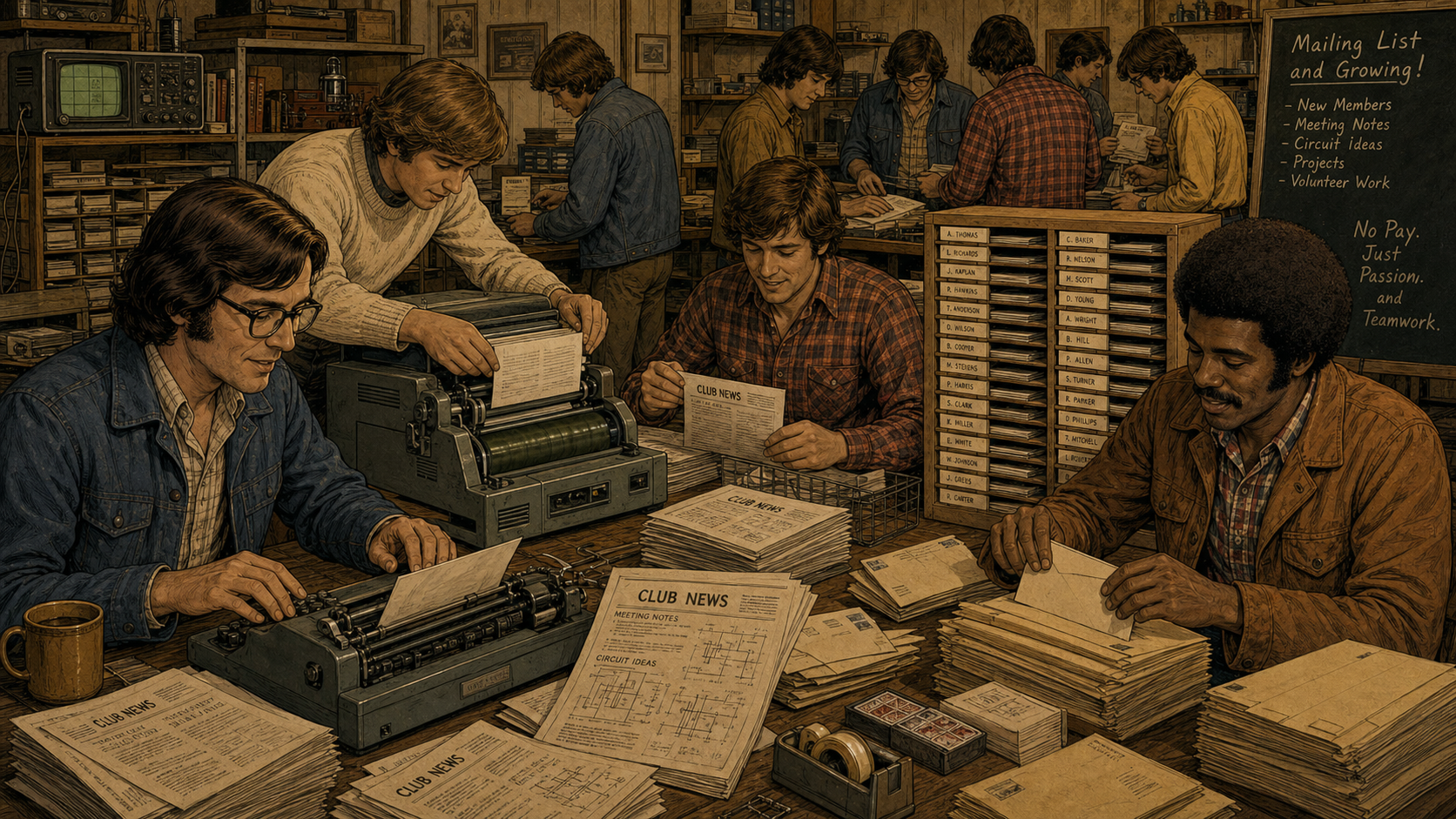
Image Prompt
(This is Panel 07. Do not include the panel number in the image.) Please generate a 16:9 image in the same style depicting panel 7 of 8. Keep the club members consistent with prior panels. The scene shows a cluttered workroom table where volunteers produce a newsletter titled "CLUB NEWS." One member types a stencil on a manual typewriter; another feeds pages through a hand-cranked mimeograph duplicator; a third sorts finished newsletter sheets into stacks; a fourth, seated at right, files envelopes into a wooden card-catalog wall of cubbies labeled with members' surnames. A chalkboard on the right reads "Mailing List and Growing! – New Members – Meeting Notes – Circuit Ideas – Projects – Volunteer Work" followed by "No Pay. Just Passion. and Teamwork." An oscilloscope and shelves of parts bins line the left wall. Setting: a Homebrew Computer Club workroom, mid-1970s. Color palette: sepia-warm paper and wood tones lit by a single overhead bulb. Emotional tone: quiet, dedicated, unglamorous labor done gladly. Six visual details: the mimeograph duplicator, the typewriter with a stencil loaded, the stacked "Club News" sheets, the labeled card-catalog wall, the chalkboard text, the coffee mug on the table. Generate the image immediately without asking clarifying questions.Somebody still had to write down what got discussed, and that job fell to volunteers too. The club's newsletter, typed on stencils and run off on a hand-cranked mimeograph, carried meeting notes and circuit ideas to members who could not make it in person, growing to twenty-one issues before it stopped in 1977. Founding member Fred Moore had one rule for anyone who took something useful from the club: "bring back more than you take." The newsletter, stuffed envelope by envelope by people who were never paid a cent, was that rule in action.
Panel 8: The Garage That Never Really Closed
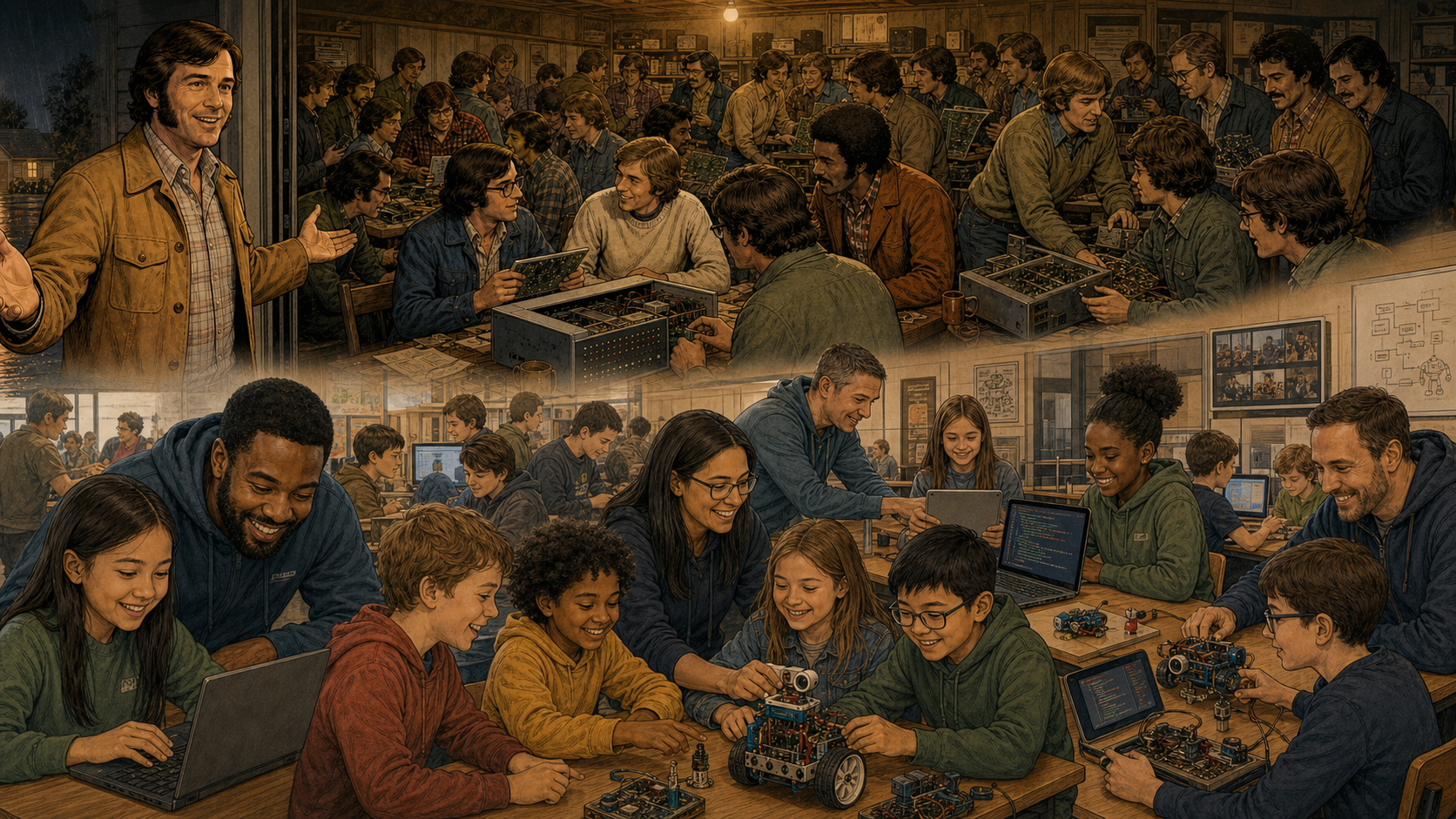
Image Prompt
(This is Panel 08. Do not include the panel number in the image.) Please generate a 16:9 image in the same style depicting panel 8 of 8, composed as a split diptych. The top half recreates the historic Homebrew Computer Club: Gordon French welcoming a crowd on the left, and on the right a packed workbench scene of members examining an open computer chassis together, matching the visual style, clothing, and lighting of earlier panels exactly. The bottom half, in the same warm illustrative style but modern lighting and setting, shows a sunlit classroom or makerspace where a diverse group of children of different genders and ethnicities work alongside adult mentors at tables, building small robots and writing code on laptops, mirroring the same collaborative, shoulder-to-shoulder posture as the scene above them. Setting: top half, Menlo Park, California, 1975; bottom half, a present-day coding club classroom. Color palette: warm amber-sepia tones on top transitioning to brighter, cooler daylight tones below, visually linking the two eras. Emotional tone: continuity, legacy, an unbroken thread of volunteer teaching. Six visual details: French's welcoming gesture echoed by a mentor's gesture below, matching huddled-around-a-table poses in both halves, a laptop screen showing code in the bottom half, a small wheeled robot on a table below, shelf clutter above mirrored by shelf/poster clutter below, the same warm color of light bridging both scenes. Generate the image immediately without asking clarifying questions.The Homebrew Computer Club held its last meeting in December 1986, more than a decade after that first rainy night, but the model it proved never went away. Every coding club that opens its doors to beginners and experts alike, charges no admission, and trusts members to teach each other is running the same experiment Gordon French and Fred Moore started with a stack of flyers and a two-car garage — and it is still producing the same result.
Epilogue – What Made Homebrew Different?
Homebrew never had a curriculum, a budget, or a single person in charge, and that turned out to be exactly its advantage. Because nobody owned the club, nobody could be excluded from it; because nobody was paid, everyone who stayed was there for the same reason — genuine curiosity. That same combination of open doors and volunteer energy is what every coding club in this book is built to recreate, at a much smaller and more manageable scale than an auditorium full of future industry founders.
| Challenge | How Homebrew Responded | Lesson for Today |
|---|---|---|
| No budget, no venue, no institutional backing | Met in a member's garage, then borrowed space from a school and a research lab | A coding club needs a room and a regular time far more than it needs money |
| Members ranged from total beginners to working engineers | Let anyone teach and anyone ask, with no formal instructor role | Peer teaching works across wildly different skill levels when nobody is gatekeeping |
| Interest exploded faster than any one meeting could hold | Split naturally into smaller groups and eventually moved to a bigger auditorium | Growth is a good problem — plan to split into smaller groups rather than turning people away |
| Keeping hundreds of scattered members informed for free | Volunteers wrote, printed, and mailed their own newsletter | A club's documentation and communication are as valuable as its projects, and they can be run entirely by volunteers |
Call to Action
You do not need a corporate sponsor, a fancy lab, or a famous founder to start something that matters — Homebrew started with a folding table and a shared willingness to explain things twice. Open your club's doors the way Gordon French opened his garage door: to anyone curious enough to walk in, regardless of what they already know.
"Are you building your own computer? Terminal? TV typewriter? I/O device?" —Fred Moore, in his original 1975 invitation to the first meeting
"The Homebrew Computer Club was the highlight of my life. I was too shy to ever talk in the club meeting, but the way that I could communicate sometimes was by doing good designs." —Steve Wozniak
"Bring back more than you take." —Fred Moore, describing the club's expected ethic of reciprocity
References
- Wikipedia: Homebrew Computer Club - Full history of the club's founding, meetings, membership, and influence on Silicon Valley
- Wikipedia: Altair 8800 - The build-it-yourself kit computer whose arrival prompted the club's first meeting
- Wikipedia: Steve Wozniak - Biography of the club's most famous alumnus and co-founder of Apple Computer
- Computer History Museum: The Homebrew Computer Club - Museum exhibit history of the club's origins, growth, and role in launching the personal computer industry
- Encyclopaedia Britannica: Steve Wozniak - Curated biographical overview of Wozniak's work at Hewlett-Packard, Homebrew, and Apple