The Clubhouse With No Locked Doors
Cover Image Prompt
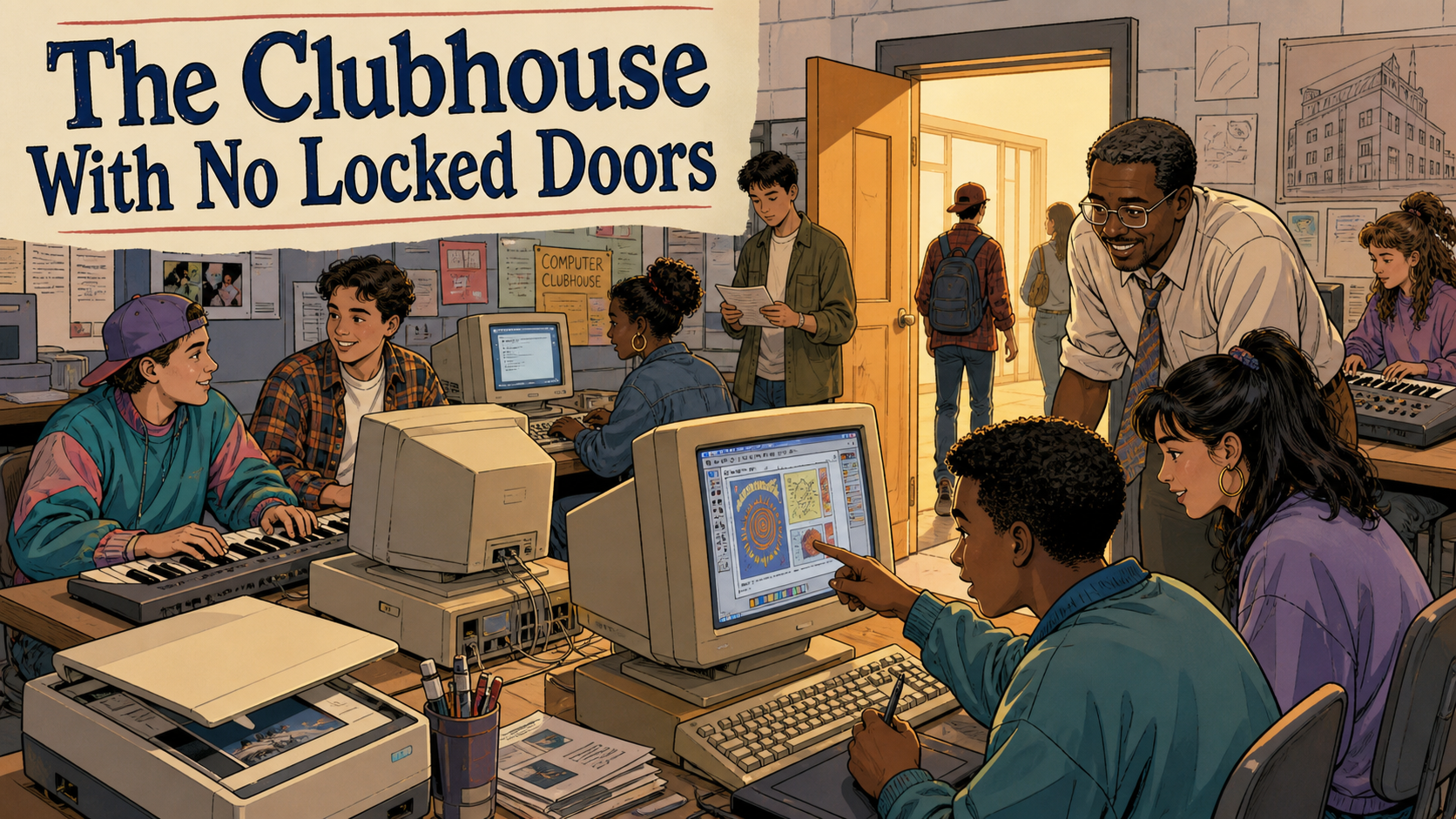
(This is the Cover Image. Do not include this label in the image.) Please generate a wide-landscape 16:9 cover image in a warm, nostalgic early-1990s educational-graphic-novel style — clean linework, soft cel-shading, muted period color grading. Scene: a bustling after-school computer clubhouse room, several teenagers of different ethnic backgrounds seated at boxy beige early-1990s computers and electronic keyboards, one boy pointing excitedly at a colorful graphics program on his monitor, a smiling Black adult male mentor in a shirt and tie leaning in to help two teens at a computer, a bulletin board reading "COMPUTER CLUBHOUSE" behind them, an open door in the background with more young people walking in freely, taped-up drawings and building blueprints covering the walls. Title text "The Clubhouse With No Locked Doors" rendered in a bold, hand-torn-paper banner in a friendly vintage newspaper typeface. Color palette: warm amber lamplight, dusty teal and mauve 1990s clothing tones, beige computer plastics. Emotional tone: welcome, energy, creative freedom. Generate the image immediately without asking clarifying questions.Narrative Prompt
This is a real historical founding story: the Computer Clubhouse, opened in 1993 in Boston as a partnership between the MIT Media Lab (led by Mitchel Resnick and Natalie Rusk) and the Computer Museum in Boston, with Stina Cooke of the Computer Museum as a co-founder. Setting: Boston, Massachusetts, 1993, at the Computer Museum on Museum Wharf, serving teens from underserved neighborhoods including Roxbury, Dorchester, and South Boston. Central themes: replacing locked, curriculum-driven computer labs with an open, mentor-supported, youth-driven-projects model; trusting teenagers with real professional tools instead of simplified drills; the idea later called "technological fluency." Creative liberties taken: the specific teen characters (the girl in the purple jacket, the boy in the ball cap, the boy in the plaid shirt, and others) are a composite representing the roughly 1,000 real young people who joined in the Clubhouse's first two years — they are not depictions of any single named individual. Dialogue on signage and screens is illustrative, not transcribed from a specific historical document. Art style: warm, nostalgic early-1990s educational-graphic-novel illustration, clean linework, soft cel-shading, boxy beige-plastic computer hardware accurate to 1993, consistent character designs and color palette across all panels so the same teens and mentors are recognizable panel to panel.Prologue – A City Full of Locked Doors
In 1993, most computer labs in American cities worked the same way: a teacher stood at the front, a locked cabinet held the good equipment, and every student worked through the same worksheet at the same pace. For teenagers in Boston neighborhoods like Roxbury and Dorchester, the newest tools of the digital age were usually the ones they were told to stay away from. Two researchers at the MIT Media Lab thought that backwards — and a museum a few blocks away was willing to help them prove it.
Panel 1: What Do You Need to Create?
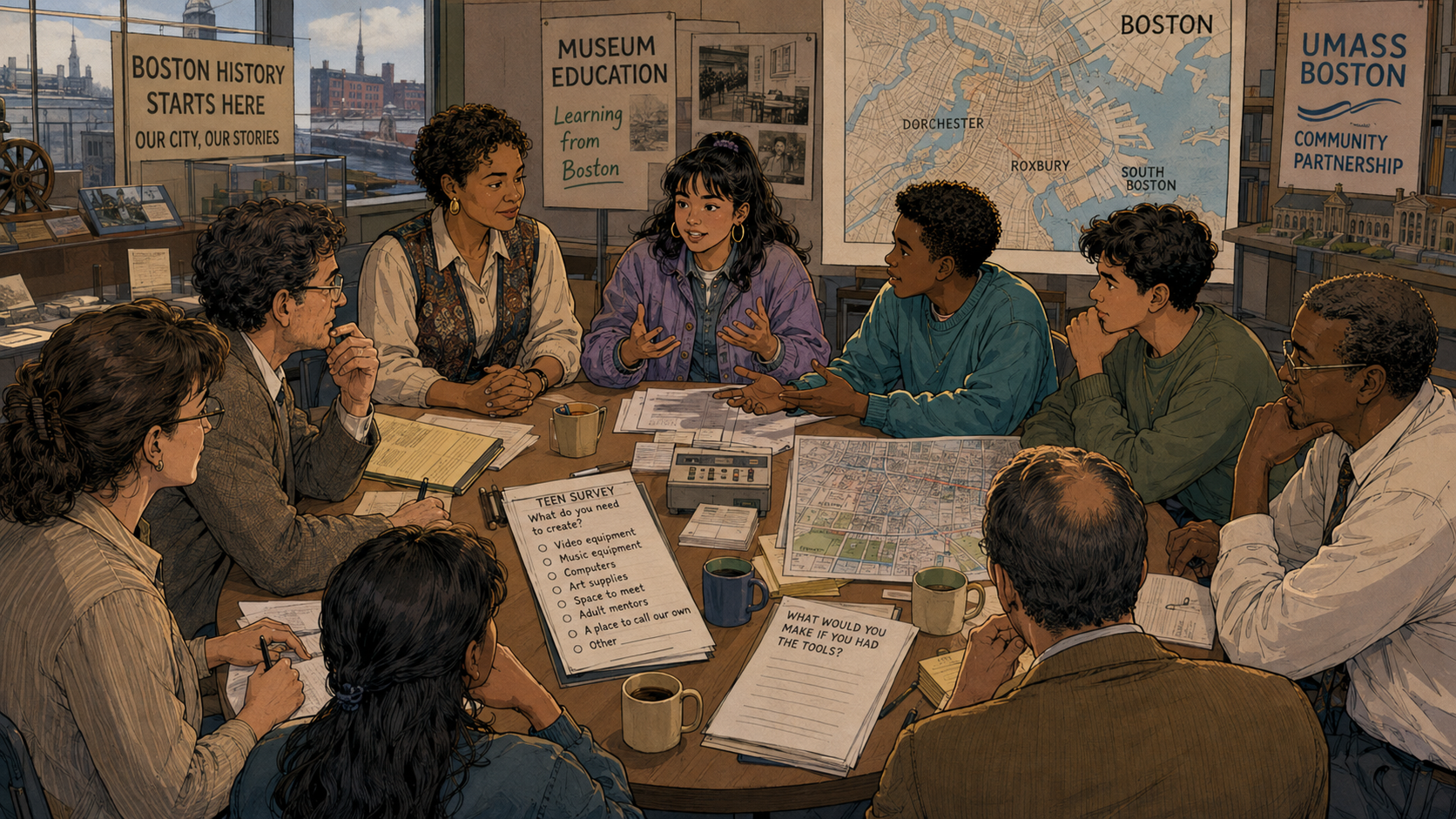
Image Prompt
(This is Panel 01. Do not include the panel number in the image.) I am about to ask you to generate a series of images for a graphic novel. Please make the images have a consistent style and consistent characters. Do not ask any clarifying questions. Just generate the image immediately when asked. Please generate a 16:9 image in a warm, nostalgic early-1990s educational-graphic-novel style depicting panel 1 of 8. The scene shows a round table in a museum meeting room overlooking the Boston skyline and harbor through large windows, where two adult museum staff and MIT researchers sit alongside four neighborhood teenagers, all leaning in and talking. On the table is a handwritten "TEEN SURVEY: What do you need to create?" sheet with checkboxes for video equipment, music equipment, computers, art supplies, space to meet, adult mentors, and "a place to call our own," plus a second sheet reading "WHAT WOULD YOU MAKE IF YOU HAD THE TOOLS?" Behind them, posters read "MUSEUM EDUCATION — Learning from Boston" and a wall map of Boston labels Dorchester, Roxbury, and South Boston. Setting: The Computer Museum, Boston, 1993, daytime. Color palette: warm wood tones, museum-beige walls, harbor blues through the window. Emotional tone: collaborative, respectful listening, genuine curiosity. Six visual details: the teen-survey checklist, the labeled Boston neighborhood map, coffee mugs on the table, a "UMass Boston Community Partnership" banner, a teenage girl gesturing while she talks, an older museum staffer taking notes. Generate the image immediately without asking clarifying questions.Before anyone touched a screwdriver or a paint can, the researchers and museum staff did something unusual for adults planning a program for teenagers: they asked the teenagers what they actually wanted. Around a table overlooking Boston Harbor, kids from Dorchester and Roxbury filled out surveys about what tools they needed and what they'd build if nobody was standing over their shoulder. The answers weren't a curriculum — they were a wish list: music gear, art supplies, computers, and mentors who would treat them like builders, not students.
Panel 2: The Old Way — Locked Cabinets, Fixed Quizzes
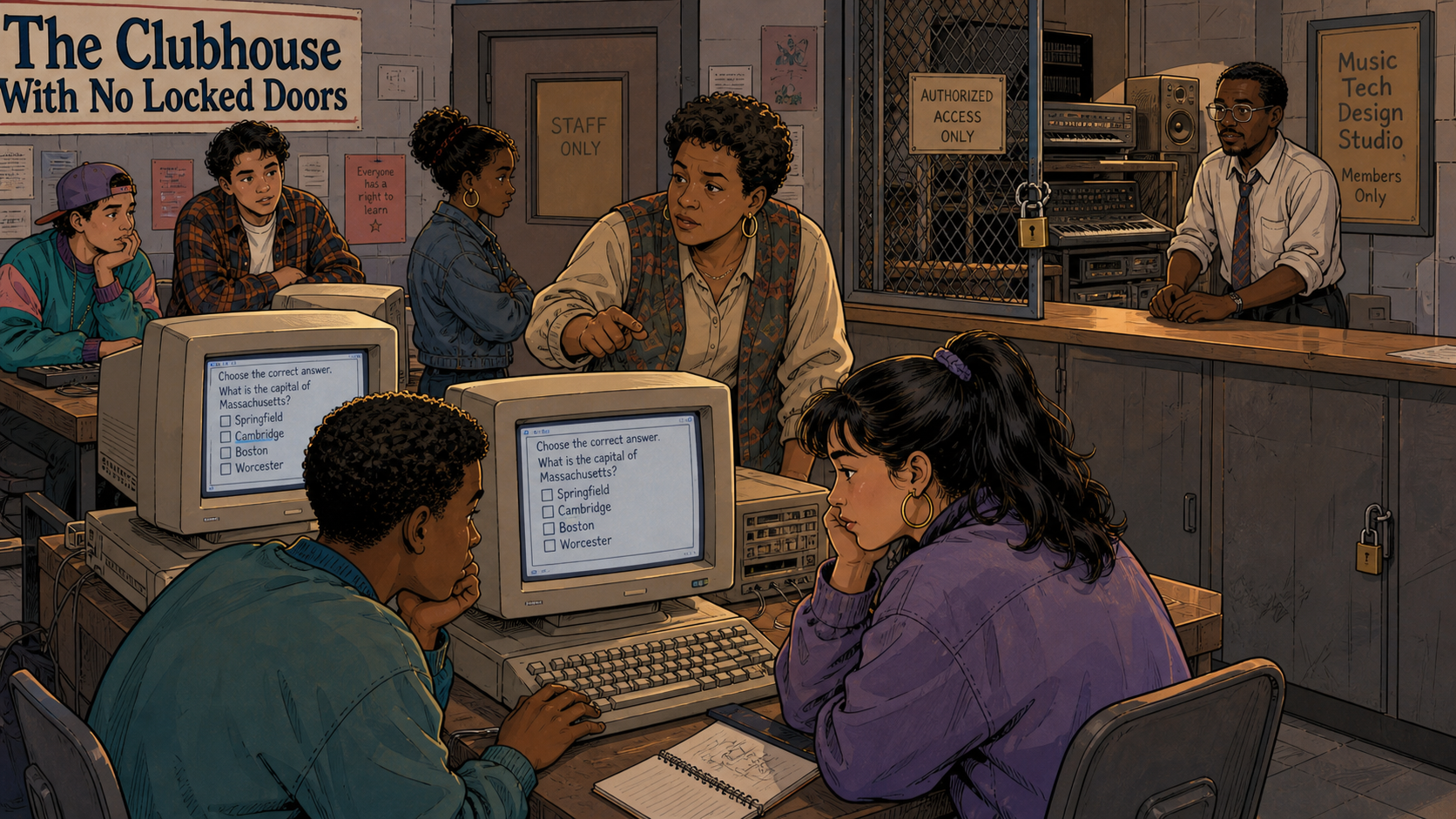
Image Prompt
(This is Panel 02. Do not include the panel number in the image.) Please generate a 16:9 image in the same style depicting panel 2 of 8. Make the setting consistent with a typical early-1990s school computer lab. The scene shows two teenagers at beige computer terminals, both looking bored, their screens displaying an identical fixed multiple-choice quiz reading "Choose the correct answer. What is the capital of Massachusetts?" with options Springfield, Cambridge, Boston, Worcester. Behind them, a locked wire equipment cage is chained shut with a padlock under a sign reading "AUTHORIZED ACCESS ONLY," and a nearby door reads "STAFF ONLY." A small hand-written note taped to the wall reads "Everyone has a right to learn." An adult staff member stands behind a counter, arms folded, guarding the locked gear rather than teaching. Setting: a conventional restricted computer lab, Boston area, early 1990s, dim fluorescent lighting. Color palette: cool gray-blue institutional tones, contrasting with the warm palette of the other panels. Emotional tone: restriction, boredom, missed potential. Six visual details: the padlocked wire cage, the "STAFF ONLY" door, the identical quiz screens, the folded-arms staffer, a "MUSIC TECH DESIGN STUDIO — Members Only" sign on the locked cabinet, two teens resting their chins on their hands in boredom. Generate the image immediately without asking clarifying questions.This was the problem the founders were trying to solve. Across the city, the good equipment — synthesizers, mixing boards, the newest computers — usually sat behind a locked cage with a sign that read "Authorized Access Only," while the machines students were allowed to touch ran the same fixed multiple-choice quiz for everyone. Mitchel Resnick and Natalie Rusk of the MIT Media Lab had watched this pattern for years and believed technology access built on locks and worksheets was teaching kids the opposite of what it claimed to. If teenagers were ever going to become genuine creators with technology, someone needed to hand them the keys instead of guarding them.
Panel 3: Teens Design Their Own Room
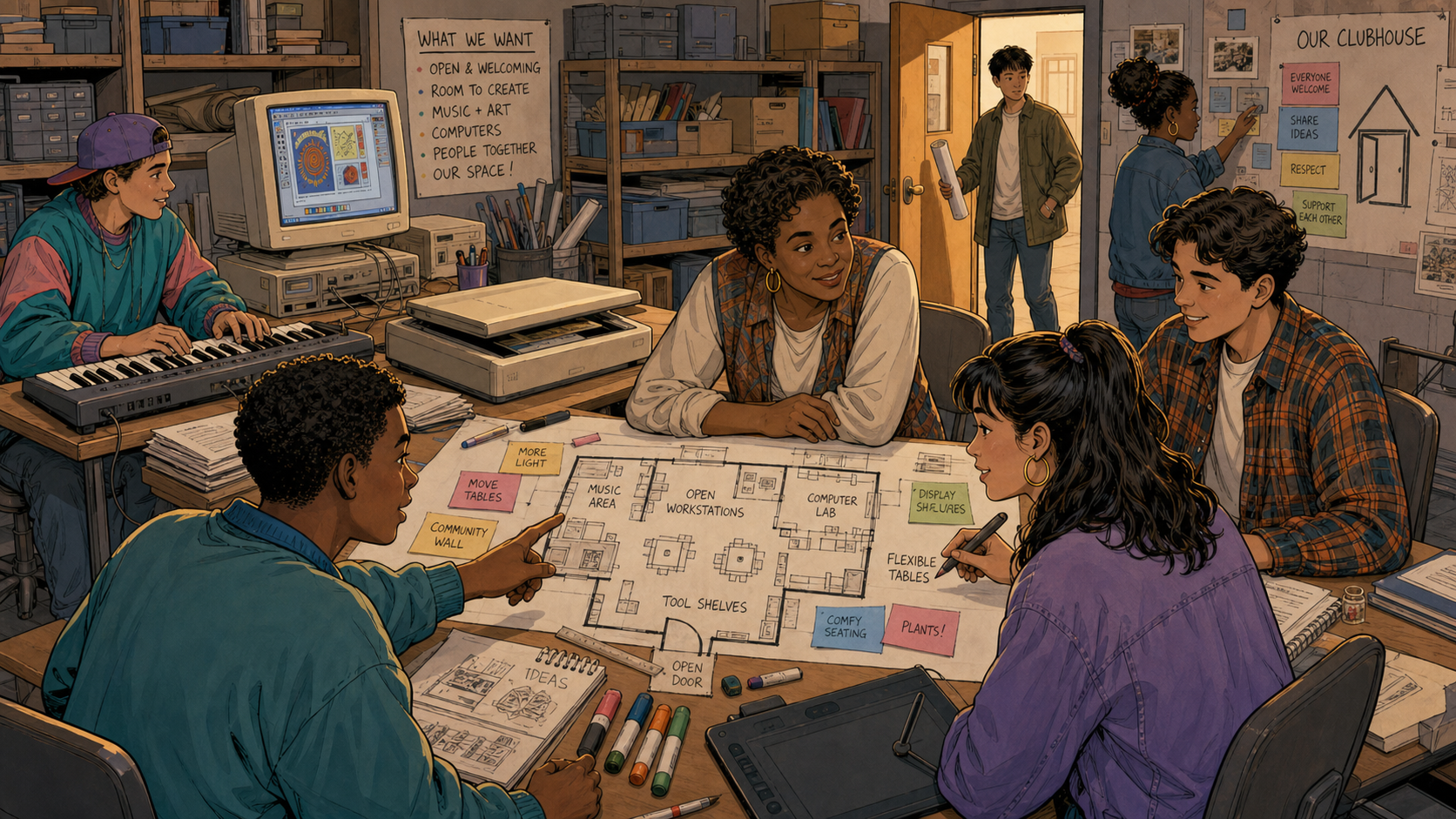
Image Prompt
(This is Panel 03. Do not include the panel number in the image.) Please generate a 16:9 image in the same style depicting panel 3 of 8. Make the teen characters consistent with panel 1. The scene shows the same group of teenagers and a mentor gathered around a large hand-drawn floor plan spread across a worktable, covered in colorful sticky notes reading "MORE LIGHT," "MOVE TABLES," "COMMUNITY WALL," "DISPLAY SHELVES," "FLEXIBLE TABLES," "COMFY SEATING," "PLANTS!," and "OPEN DOOR," labeling zones for a Music Area, Open Workstations, Computer Lab, and Tool Shelves. On the wall behind them, a large hand-lettered poster reads "OUR CLUBHOUSE" above four sticky notes: "EVERYONE WELCOME," "SHARE IDEAS," "RESPECT," "SUPPORT EACH OTHER." A boy plays a keyboard connected to a computer showing colorful generative art in the background, while two more teens enter through an open door. Setting: a storage-and-workroom space at the Computer Museum, Boston, 1993. Color palette: warm wood and cardboard-box tones with bright sticky-note accent colors. Emotional tone: ownership, pride, collaborative design. Six visual details: the sticky-note floor plan, the "OUR CLUBHOUSE" values poster, the boy at the keyboard, storage boxes and shelves of supplies, a scanner and older computer on a side table, teens entering through the open doorway. Generate the image immediately without asking clarifying questions.Instead of handing the teens a finished room, the mentors handed them markers and a blank floor plan. The same kids who had filled out the survey now argued over where the music area should go, whether the door should always stay open, and what values belonged on the wall. "Everyone welcome. Share ideas. Respect. Support each other" — the rules of the Clubhouse were written by the people who would actually have to live by them, months before a single visitor walked through the door.
Panel 4: Opening Day, 1993
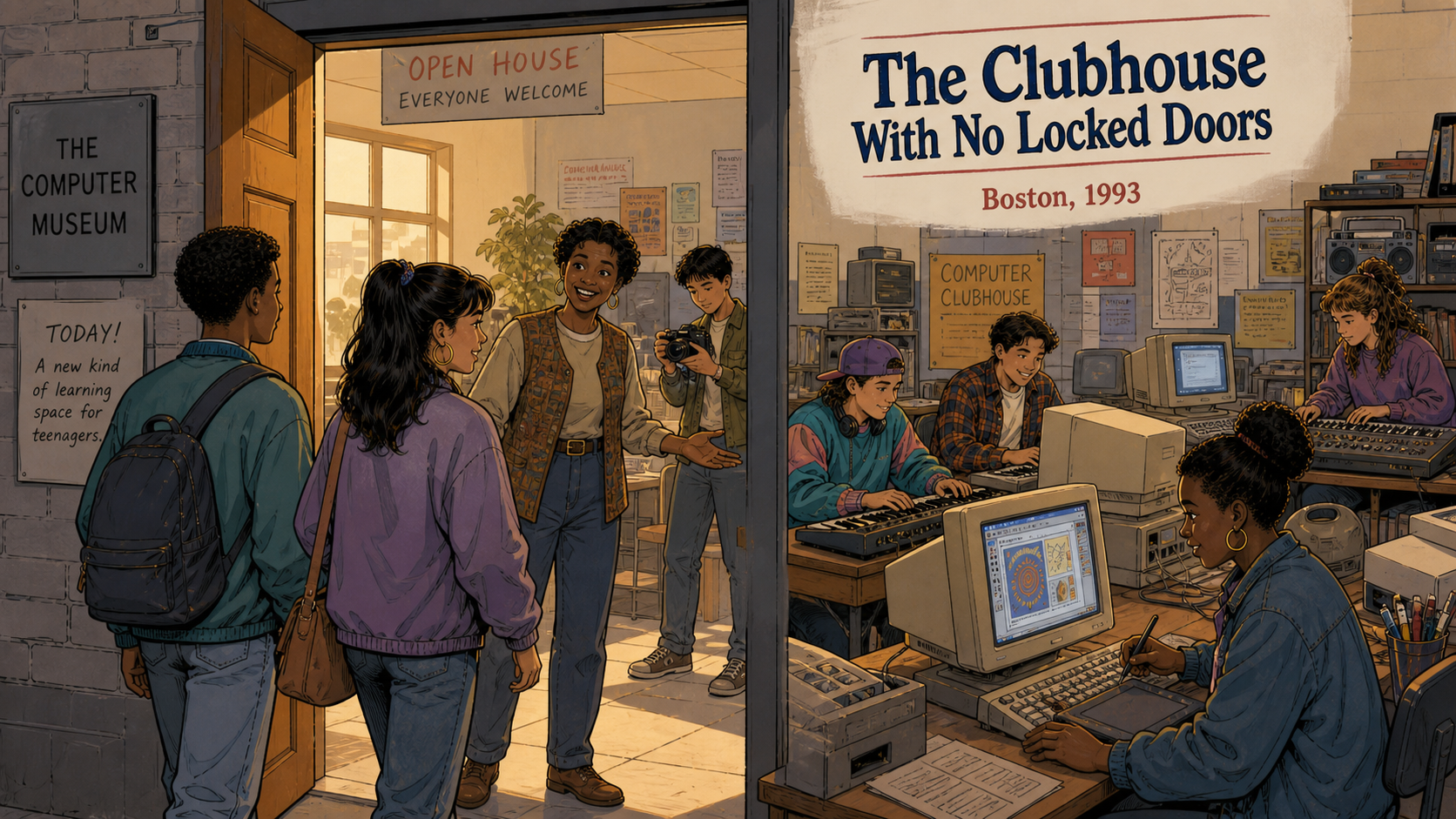
Image Prompt
(This is Panel 04. Do not include the panel number in the image.) Please generate a 16:9 image in the same style depicting panel 4 of 8. Make the teens and setting consistent with prior panels. The scene shows three teenagers with backpacks walking through a wide-open front door into a lit, welcoming room, greeted by a smiling adult woman staff member with her arms open in welcome while a young man documents the moment with a camera. A sign beside the door reads "THE COMPUTER MUSEUM" and a handwritten sign reads "TODAY! A new kind of learning space for teenagers," beneath a banner reading "OPEN HOUSE — EVERYONE WELCOME." Through the doorway, other teens are already seated at computers and a keyboard, a "COMPUTER CLUBHOUSE" sign visible on the far wall. A large title card in the image reads "The Clubhouse With No Locked Doors — Boston, 1993." Setting: The Computer Museum entrance, Boston, 1993, late-afternoon golden light spilling through the open door. Color palette: warm golden interior light against a cooler gray exterior. Emotional tone: welcome, anticipation, a threshold being crossed. Six visual details: the open unlocked door, the "OPEN HOUSE — EVERYONE WELCOME" sign, backpacks on the arriving teens, the camera capturing the moment, teens already inside at computers and a keyboard, the "COMPUTER CLUBHOUSE" wall sign. Generate the image immediately without asking clarifying questions.On opening day, there was no orientation lecture and no sign-up sheet that decided who got to use the good equipment. There was just an open door at the Computer Museum on Museum Wharf, a hand-lettered sign promising "a new kind of learning space for teenagers," and neighborhood kids walking in off the street to see for themselves. In its first two years, more than a thousand young people came through that door — 98 percent of them from underserved communities across Boston.
Panel 5: Drop In, Build What You Want
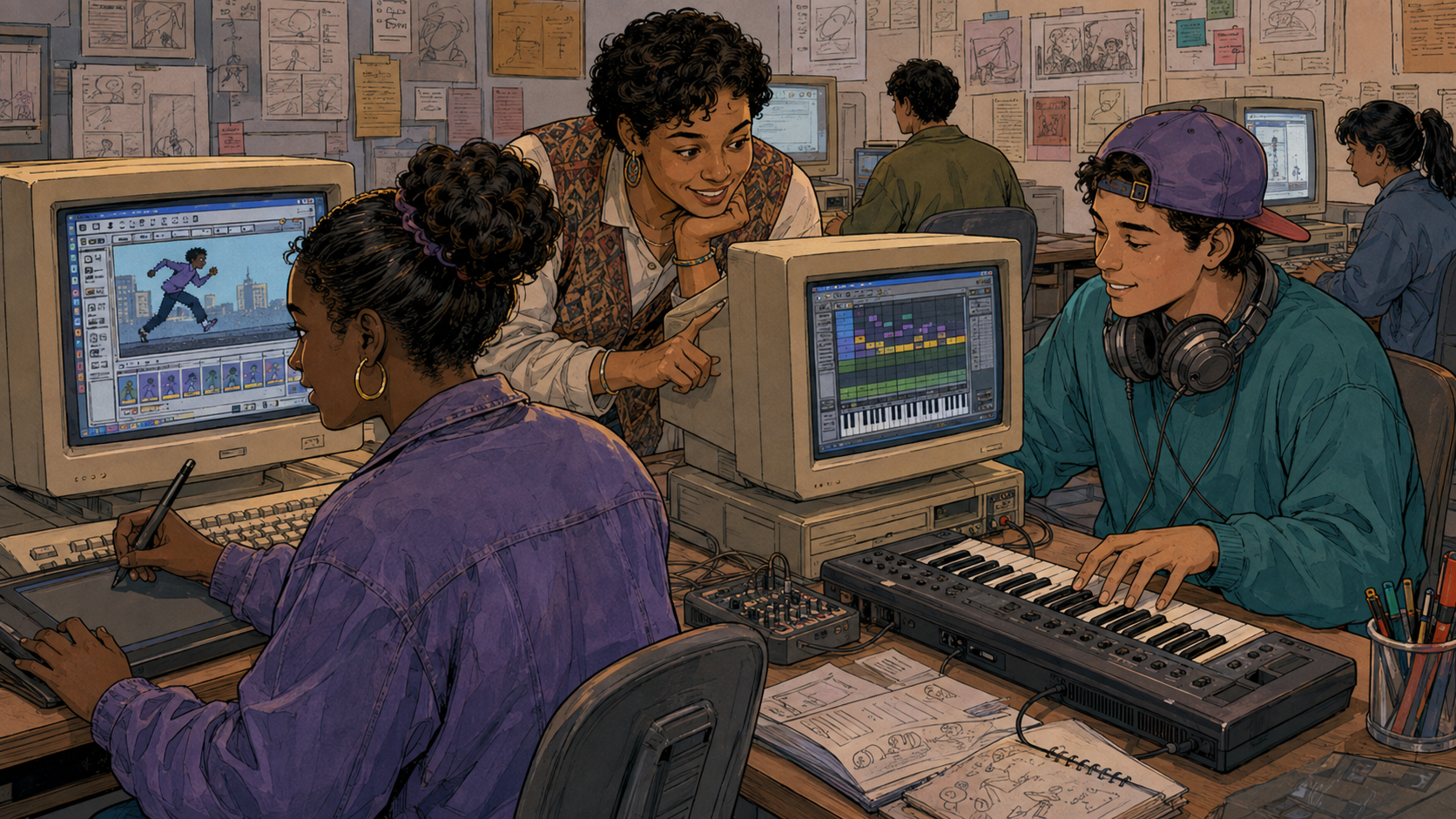
Image Prompt
(This is Panel 05. Do not include the panel number in the image.) Please generate a 16:9 image in the same style depicting panel 5 of 8. Make the mentor and teens consistent with prior panels. The scene shows a woman mentor leaning between two workstations, on the left a teenage girl using a graphics tablet to animate a running figure on her computer screen, on the right a teenage boy wearing headphones around his neck playing a MIDI keyboard connected to a computer showing a music sequencer with colored note blocks, an open sketchbook of storyboard drawings on the desk between them. The walls are covered with taped-up sketches, storyboards, and sticky notes from other members' projects. Setting: the Computer Clubhouse workroom, Boston, 1993. Color palette: warm lamp-lit interior, colorful computer-screen accents against beige hardware. Emotional tone: focused creative independence, quiet mentor support. Six visual details: the graphics tablet and animation timeline, the MIDI keyboard and music-sequencer screen, the mentor's encouraging point at the animation, the boy's headphones resting around his neck, the sketchbook full of storyboards, walls covered in other members' project drawings. Generate the image immediately without asking clarifying questions.Once the doors were open, nobody assigned the projects. One girl chose to animate a running figure against a city skyline; a few feet away, a boy layered notes into a music sequencer with headphones looped around his neck. A mentor circulated between them, answering questions only when asked, never taking over the mouse. This was the idea Resnick and Rusk later called technological fluency — not just knowing how to operate a tool, but having the confidence to use it to say something that was genuinely yours.
Panel 6: A Whole February With One Mentor
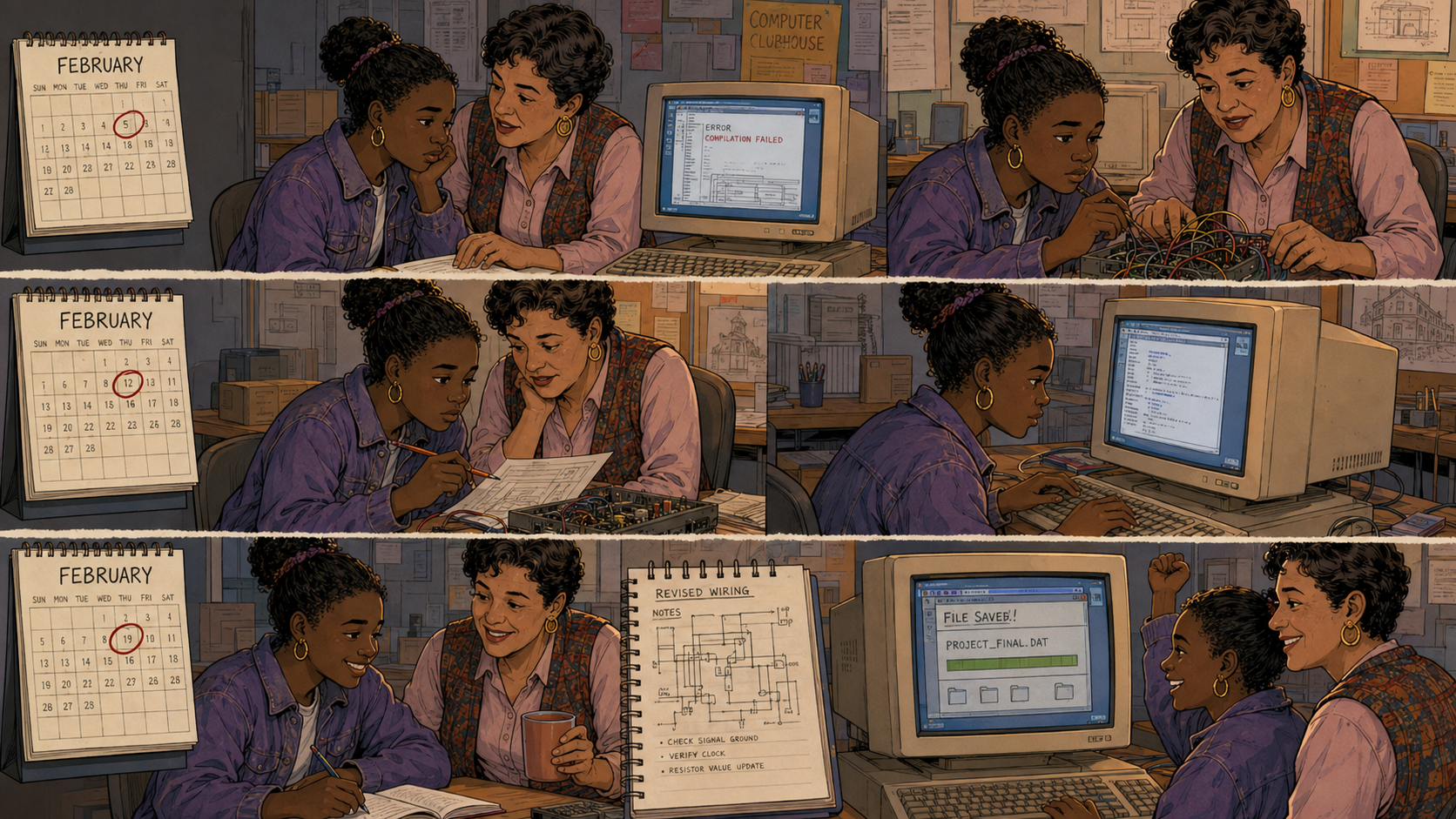
Image Prompt
(This is Panel 06. Do not include the panel number in the image.) Please generate a 16:9 image in the same style depicting panel 6 of 8, laid out as a six-panel comic-strip grid. Make the girl and mentor consistent with prior panels. Panel row 1: a wall calendar reading "FEBRUARY" with the 5th circled, beside the girl and her mentor looking at a computer screen reading "ERROR — COMPILATION FAILED"; then the two of them working together with a soldering iron and a tangle of colored wires on a circuit board. Panel row 2: the calendar now with the 12th circled, the girl and mentor reviewing handwritten notes and a partly assembled circuit board; then the girl alone typing code at the computer, focused. Panel row 3: the calendar now with the 19th circled, the girl and mentor smiling together over coffee and a notebook page titled "REVISED WIRING NOTES" with a hand-drawn circuit diagram; then a screen reading "FILE SAVED! — PROJECT_FINAL.DAT" as the girl pumps her fist and the mentor grins beside her. Setting: the Computer Clubhouse workroom, Boston, 1993, over the course of one February. Color palette: warm consistent lamp-lit tones across all six panels to show the passage of time in the same place. Emotional tone: patient persistence turning into earned triumph. Six visual details: the three calendar pages marking the passing weeks, the "COMPILATION FAILED" error screen, the soldering and wiring work, the "REVISED WIRING NOTES" notebook page, the "FILE SAVED!" screen, the girl's fist-pump celebration. Generate the image immediately without asking clarifying questions.Technological fluency didn't arrive in an afternoon. One member spent nearly the entire month of February working the same problem with the same mentor beside her — a failed compile on the 5th, a rewired circuit board on the 12th, revised notes over coffee on the 19th. Nobody rushed her to the next worksheet and nobody moved her to a different mentor to keep to a schedule. When the screen finally read "File Saved," the win belonged entirely to her, and to the adult who had shown up week after week to keep believing she'd get there.
Panel 7: A Second Clubhouse, and a Day Just for Girls
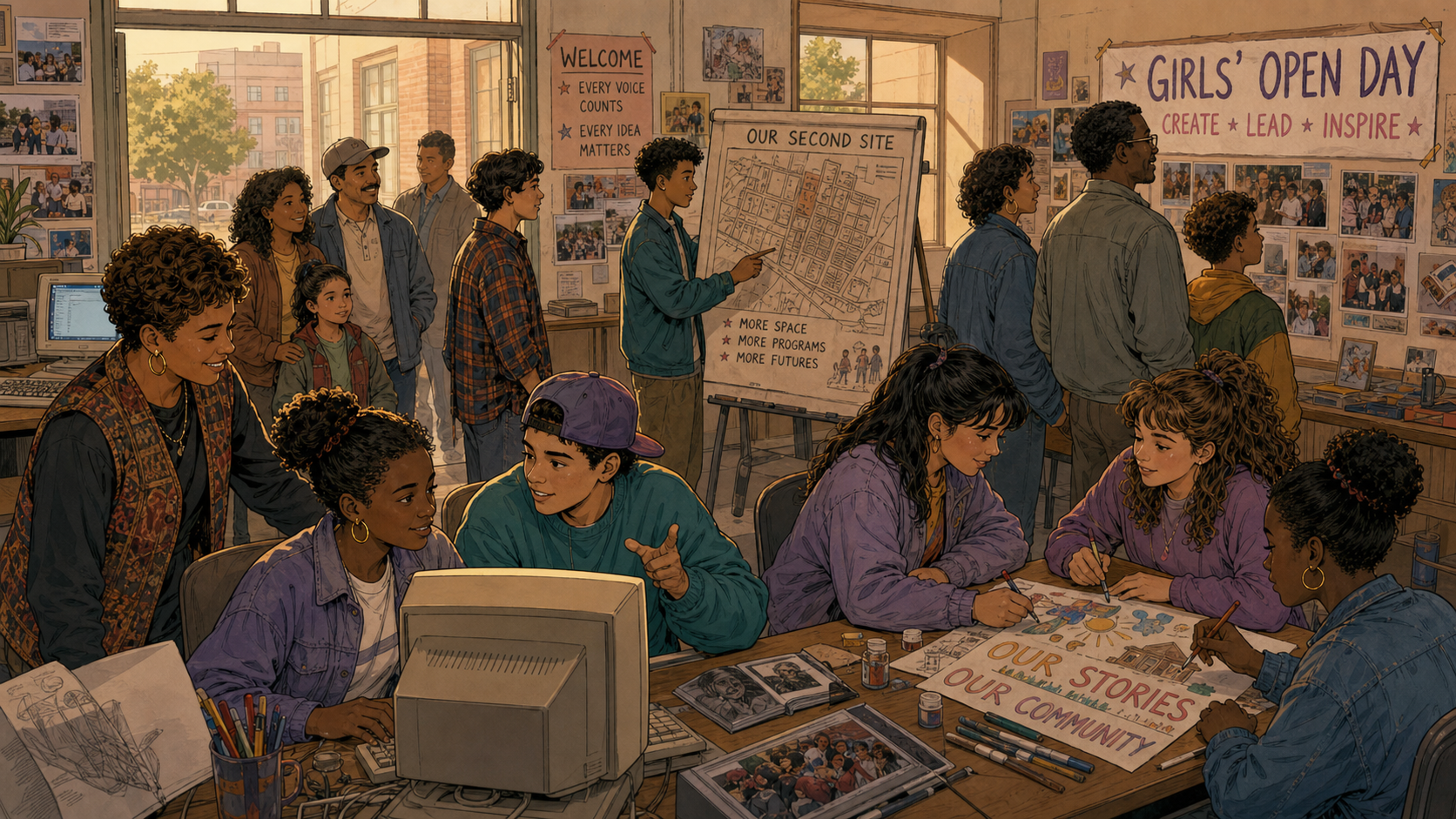
Image Prompt
(This is Panel 07. Do not include the panel number in the image.) Please generate a 16:9 image in the same style depicting panel 7 of 8. Make the teen characters consistent with prior panels, now slightly older. The scene shows a bright room where a teenage boy points at a hand-drawn neighborhood map on an easel labeled "OUR SECOND SITE" with notes reading "MORE SPACE," "MORE PROGRAMS," "MORE FUTURES," while nearby three teenage girls paint a poster reading "OUR STORIES — OUR COMMUNITY." A large banner on the wall reads "GIRLS' OPEN DAY — CREATE · LEAD · INSPIRE" and a smaller sign reads "WELCOME — EVERY VOICE COUNTS, EVERY IDEA MATTERS." A mentor and several parents and younger siblings look on, some visiting for the first time, with a city street and tree visible through open windows. Setting: a Computer Clubhouse site, Boston, mid-to-late 1990s, daytime. Color palette: bright, optimistic daylight tones. Emotional tone: pride, expansion, community celebration. Six visual details: the "OUR SECOND SITE" map easel, the "GIRLS' OPEN DAY" banner, the "OUR STORIES — OUR COMMUNITY" poster in progress, visiting parents and younger kids, framed photos of past Clubhouse members on the wall, an open window showing the neighborhood outside. Generate the image immediately without asking clarifying questions.Word spread the way it does when something actually works: through the members themselves. Within a few years the original Clubhouse needed a second site to keep up with demand, and members who once needed convincing to walk through the door were now the ones presenting the floor plan for it. A "Girls' Open Day" brought in younger sisters and neighbors who had never pictured themselves as engineers, animators, or musicians — and left with a project of their own already started.
Panel 8: One Idea, Carried Around the World
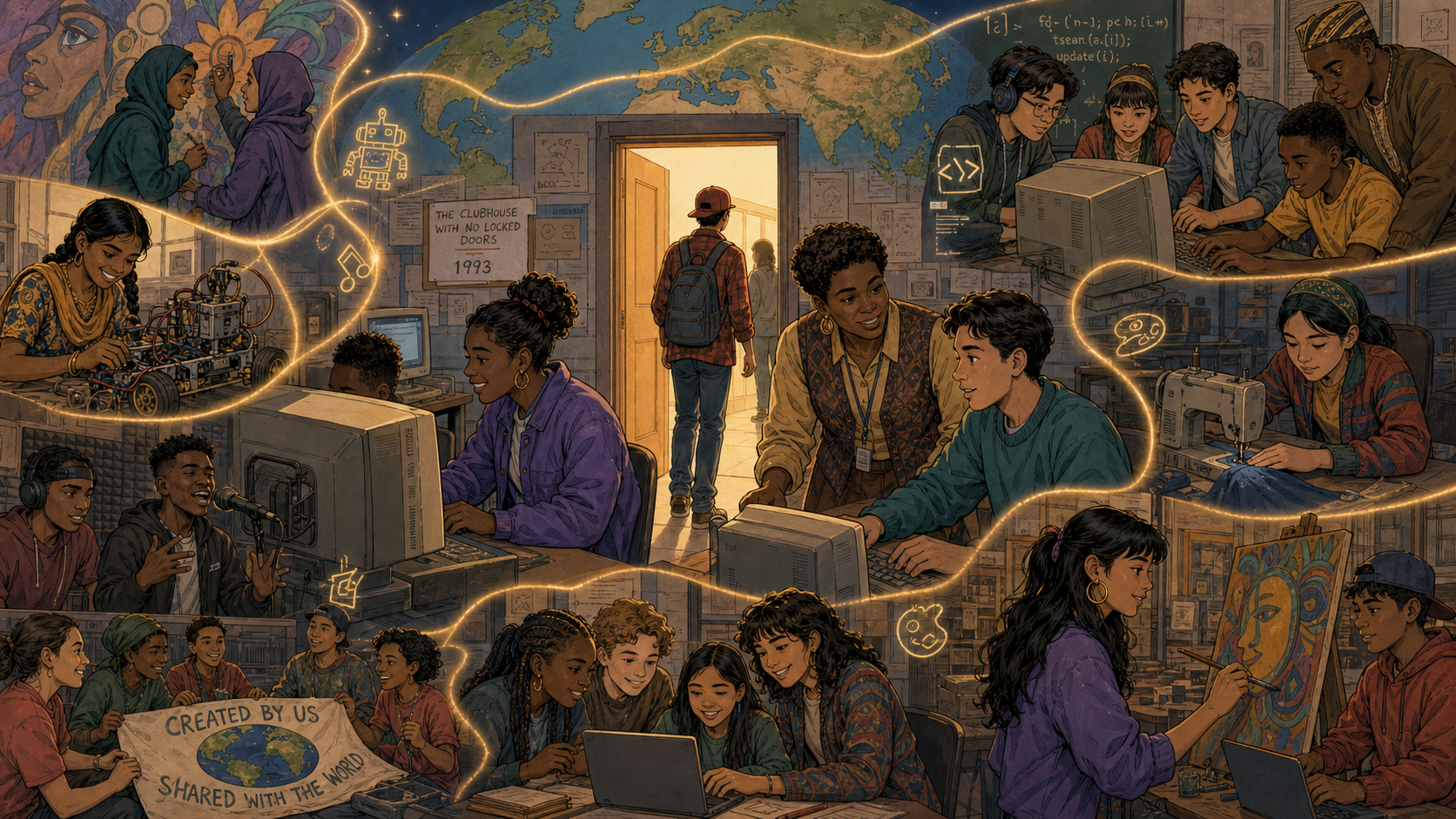
Image Prompt
(This is Panel 08. Do not include the panel number in the image.) Please generate a 16:9 image in the same style depicting panel 8 of 8, composed as a montage. At the center, a mentor and a teenage boy work together at a computer in the original 1993 Boston Clubhouse, a plaque beside them reading "THE CLUBHOUSE WITH NO LOCKED DOORS — 1993," with a new visitor walking through an open doorway in the background beneath a faint world map. A glowing golden thread winds outward from this center to smaller framed scenes around the edges: a girl in a headscarf wiring a small robot; two boys performing music into a microphone; a girl sewing an LED-lit garment on a machine; a diverse group of teens gathered around a computer covered in program code; a girl painting a large sun mural on canvas; and a group holding a hand-lettered banner reading "CREATED BY US — SHARED WITH THE WORLD" in front of a globe. Setting: a symbolic global collage radiating from the original Boston Clubhouse, present day framing on a 1990s core scene. Color palette: warm amber core light with a soft golden connecting thread against varied international scene palettes. Emotional tone: legacy, pride, worldwide belonging. Six visual details: the "THE CLUBHOUSE WITH NO LOCKED DOORS — 1993" plaque, the golden connecting thread, the robotics scene, the sewing-machine scene, the "CREATED BY US — SHARED WITH THE WORLD" banner, the world map behind the central doorway. Generate the image immediately without asking clarifying questions.What started in a thousand square feet on the ground floor of a Boston museum did not stay in Boston. The model — open hours, real tools, no fixed lesson plan, mentors who listened more than they lectured — became the Computer Clubhouse Network, eventually growing into what is known today as The Clubhouse Network: more than 150 Clubhouses across roughly nineteen countries, on nearly every continent, all tracing back to that one unlocked door.
Epilogue – What Made This Clubhouse Different?
The Computer Clubhouse didn't succeed because it had better computers than the locked lab down the street — for years, its donated hardware was often older. It succeeded because it changed who got to decide what happened next: not a curriculum, not a locked cabinet, but the teenager sitting at the keyboard. That single shift, repeated in city after city and country after country, is still the clearest description of what the Clubhouse model actually is.
| Challenge | How the Founders Responded | Lesson for Today |
|---|---|---|
| Underserved teens had little access to real design and technology tools | The Computer Museum and MIT Media Lab opened a free, drop-in space stocked with real equipment | A club earns trust by handing over real tools, not simplified toys |
| Traditional computer labs used fixed curricula and locked cabinets | The Clubhouse let members choose their own projects on an open schedule | Ownership of the project, not compliance with a lesson plan, is what builds lasting engagement |
| One-time access does not build deep skill | Adult mentors stayed with members across weeks and months of the same project | Consistency of relationship matters more than any single lesson |
| A single site could not reach everyone who needed it | Members themselves helped design and advocate for new sites and outreach days | Youth who feel ownership become the strongest recruiters and advocates for growth |
Call to Action
The next time your club is tempted to lock away the good equipment "until they're ready," remember the 1,000 teenagers who walked through an unlocked door in Boston in 1993 and proved they were ready the whole time. Hand over the real tools, find them a mentor who will stick around, and then get out of the way.
"There's no one breathing down your neck here." —a Computer Clubhouse member, describing the program in its early years
"Technological fluency means much more than the ability to use technological tools... True fluency involves the ability to express, explore, and realize ideas." —Mitchel Resnick and Natalie Rusk, MIT Media Lab
References
- Wikipedia: The Clubhouse Network - Biography of the organization founded in 1993 as the Computer Clubhouse by Mitchel Resnick and Natalie Rusk of the MIT Media Lab and Stina Cooke of the Computer Museum
- Wikipedia: MIT Media Lab - The MIT research lab whose researchers co-founded and continue to collaborate with the Clubhouse network
- Wikipedia: The Computer Museum, Boston - The Boston museum that hosted the first Computer Clubhouse on its ground floor starting in 1993
- The Clubhouse Network - official site - The present-day international nonprofit network descended from the original 1993 Computer Clubhouse
- MIT Media Lab: The Computer Clubhouse - Technological Fluency in the Inner City - The founders' own account of the Clubhouse's origins, philosophy, and early results