The Waiting List
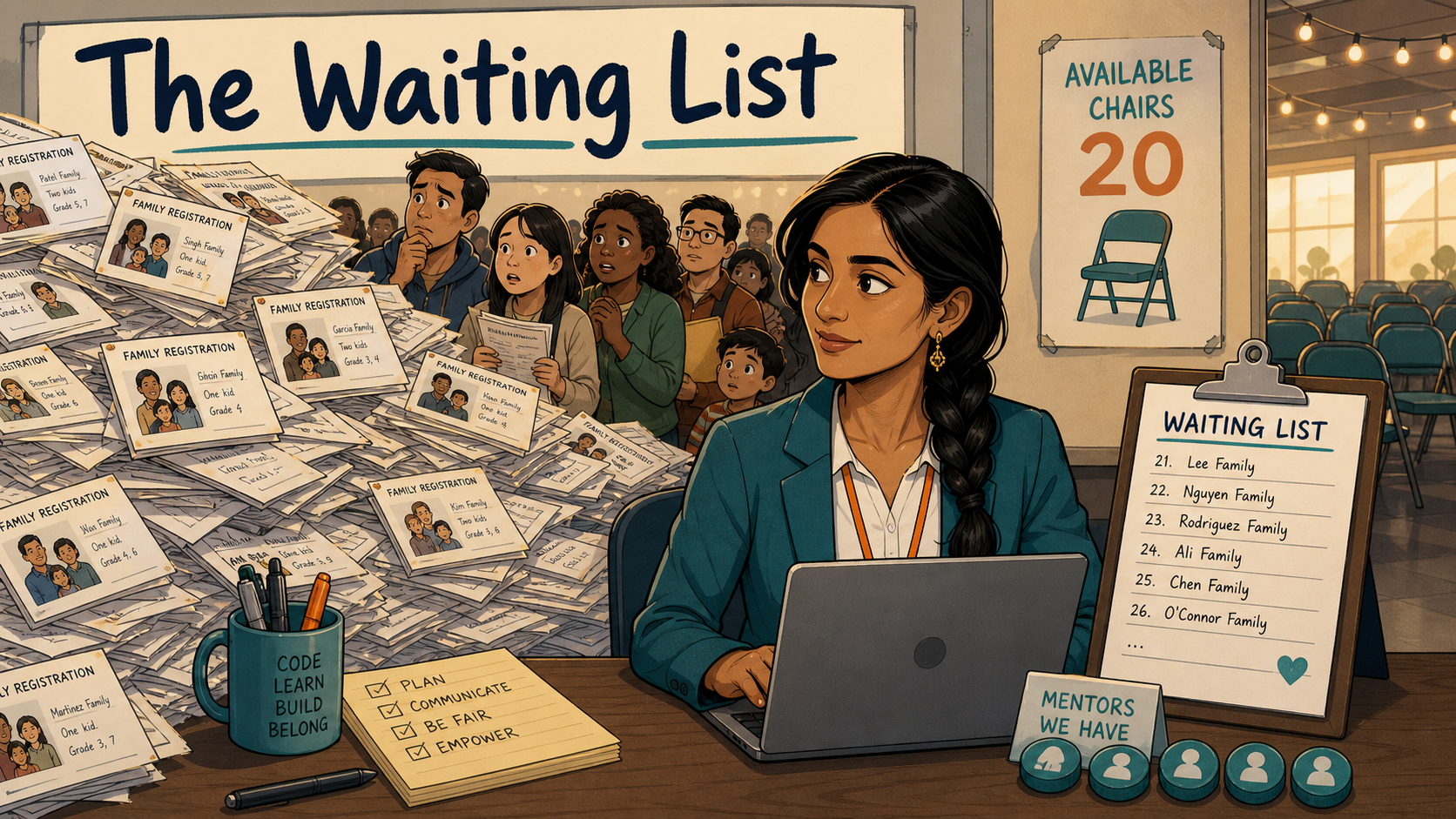
Narrative Prompt
This is a fictional composite story, not a depiction of a specific real club or a real named individual. "Priya" (registration coordinator, braided hair, teal blazer, orange lanyard) represents a pattern seen across many first-time club registrations: enthusiasm outpaces capacity by an order of magnitude, and the fix isn't turning families away but gating growth by confirmed mentor count. Setting: a present-day community coding-club registration opening in the United States. Art style: warm, contemporary educational- graphic-novel illustration, clean linework, soft cel-shading, consistent character design and color palette across all panels — Priya should be immediately recognizable from panel to panel.Prologue – Twenty Chairs, One Morning
Priya had planned the club's first-term registration carefully: a simple online form, twenty available seats, a clean list ready to fill. She had built a waiting-list page just in case — never expecting she would need it within the hour.
Panel 1: A System Built in Advance

Priya sat at her desk on launch morning with coffee in hand, watching a tidy grid of twenty chair icons fill her laptop screen under "First-Term Online Registration." Beside it sat a notepad headed "Waiting List" — empty for now, built in advance just in case more families applied than there were seats. She had no idea how soon she'd need it.
Panel 2: Three Hundred Families, One Morning

By mid-morning, "Family Registration" cards were piling up faster than Priya could read them, email notifications stacking on top of each other across her screen. She circled a number on her notepad in disbelief: 300 families had applied for a room with twenty chairs in it. The sign on the wall behind her still read "20."
Panel 3: Seventeen Filled, Three Left, a Line Out the Door
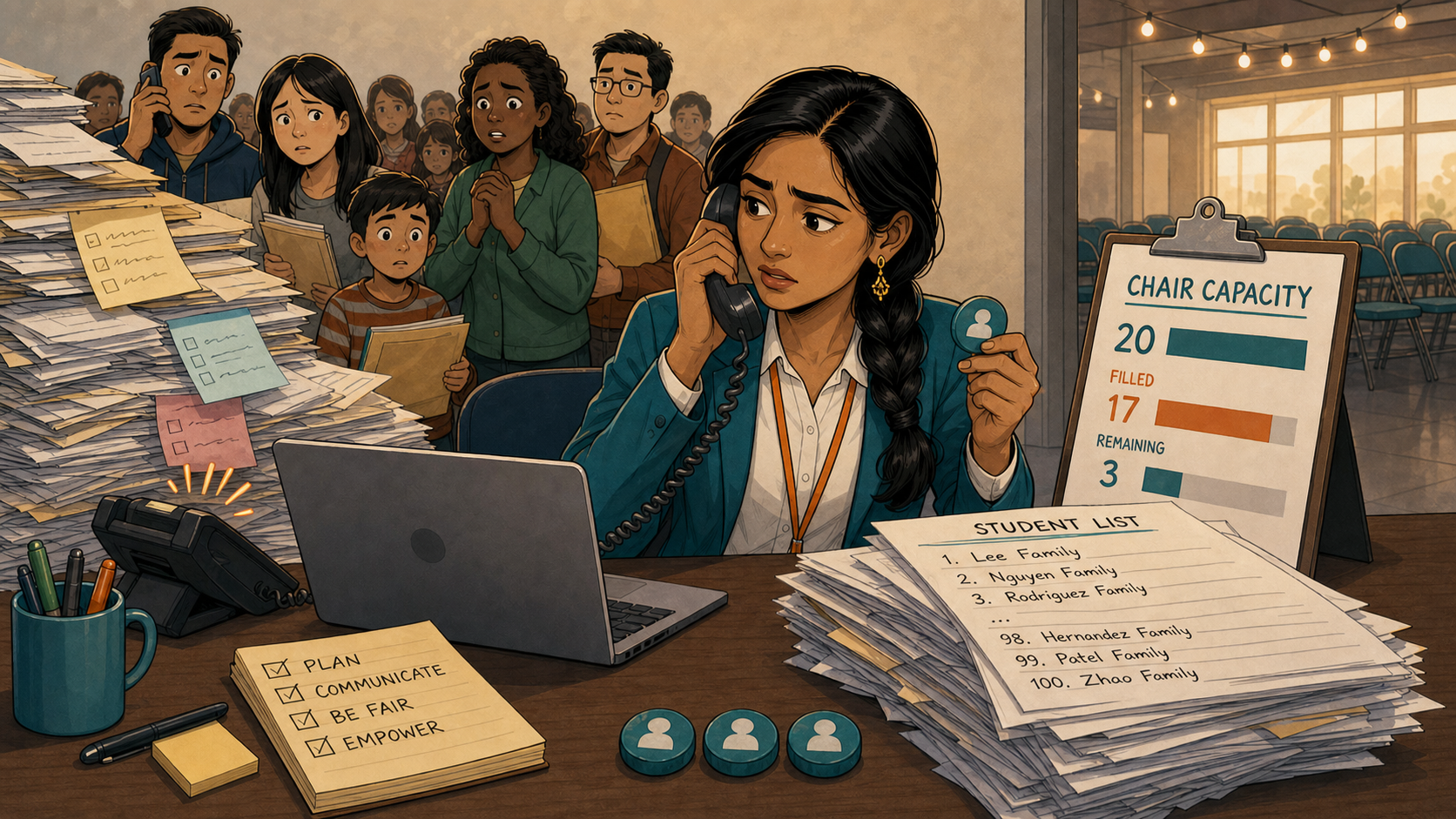
By afternoon, families were lining up in person, phones were ringing, and a printed capacity board told the whole story at a glance: twenty seats, seventeen filled, three remaining — with a stack of a hundred registration forms still waiting to be read. Priya held the phone to her ear with one hand and a token seat marker in the other, trying to be fair to everyone at once and failing.
Panel 4: Mentors Unlock Seats, Not the Other Way Around

That evening, Priya redesigned the whole system around one idea: seats wouldn't open because a family clicked fastest — they'd open because a mentor was confirmed. Her new screen showed it plainly: each confirmed mentor unlocked exactly three student seats, no more, with everyone else moving to a clearly numbered waiting list instead of a black hole.
Panel 5: Confirmations Instead of Chaos
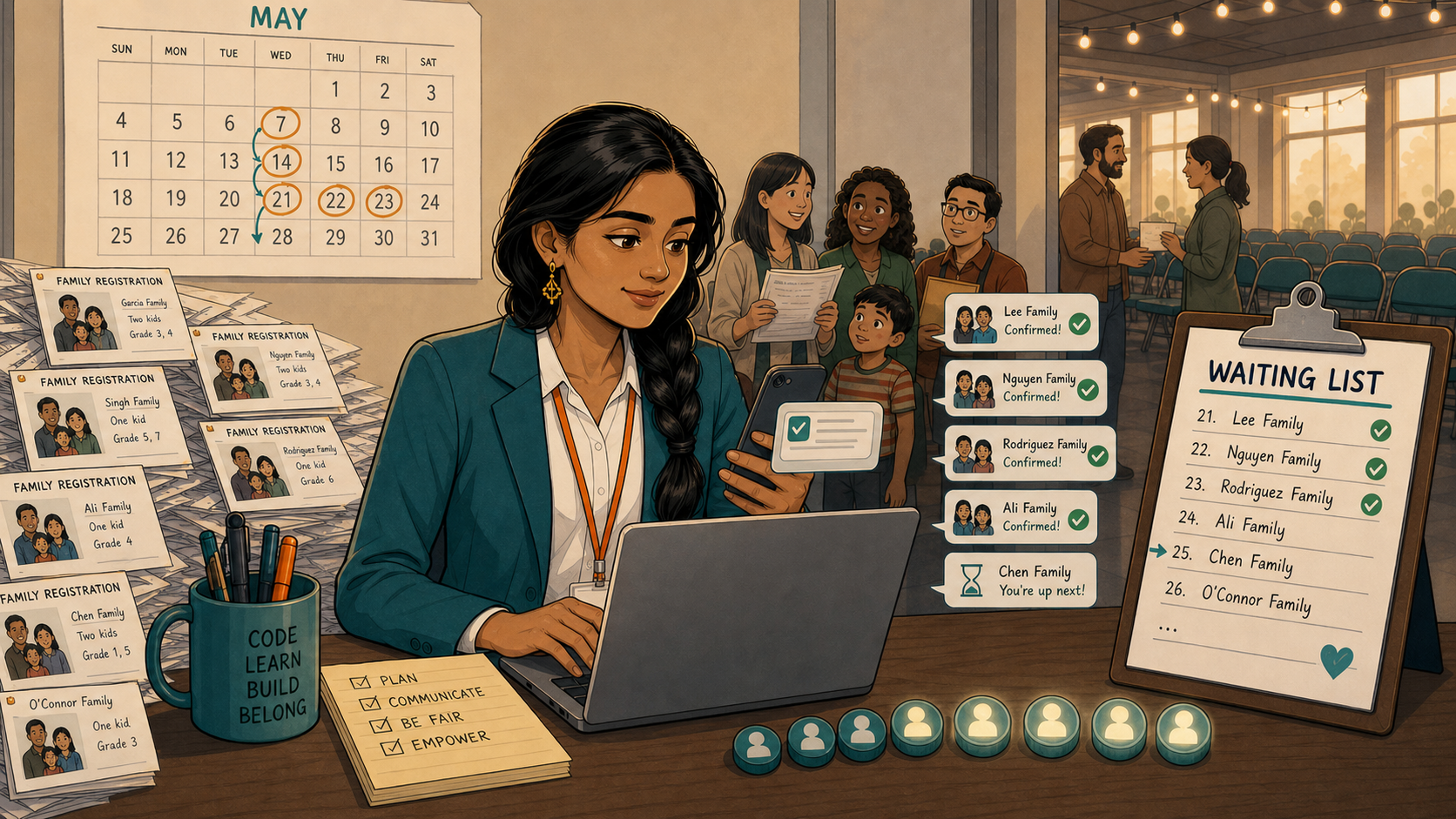
Over the following weeks, as new mentors confirmed, Priya sent out confirmations in calm, scheduled waves instead of one first-come scramble: "Lee Family confirmed," "Nguyen Family confirmed," "Rodriguez Family confirmed," each one checked off a numbered list a family could actually see themselves moving up. Nobody was left wondering if they'd been forgotten.
Panel 6: A Room That Finally Matches Its Seats
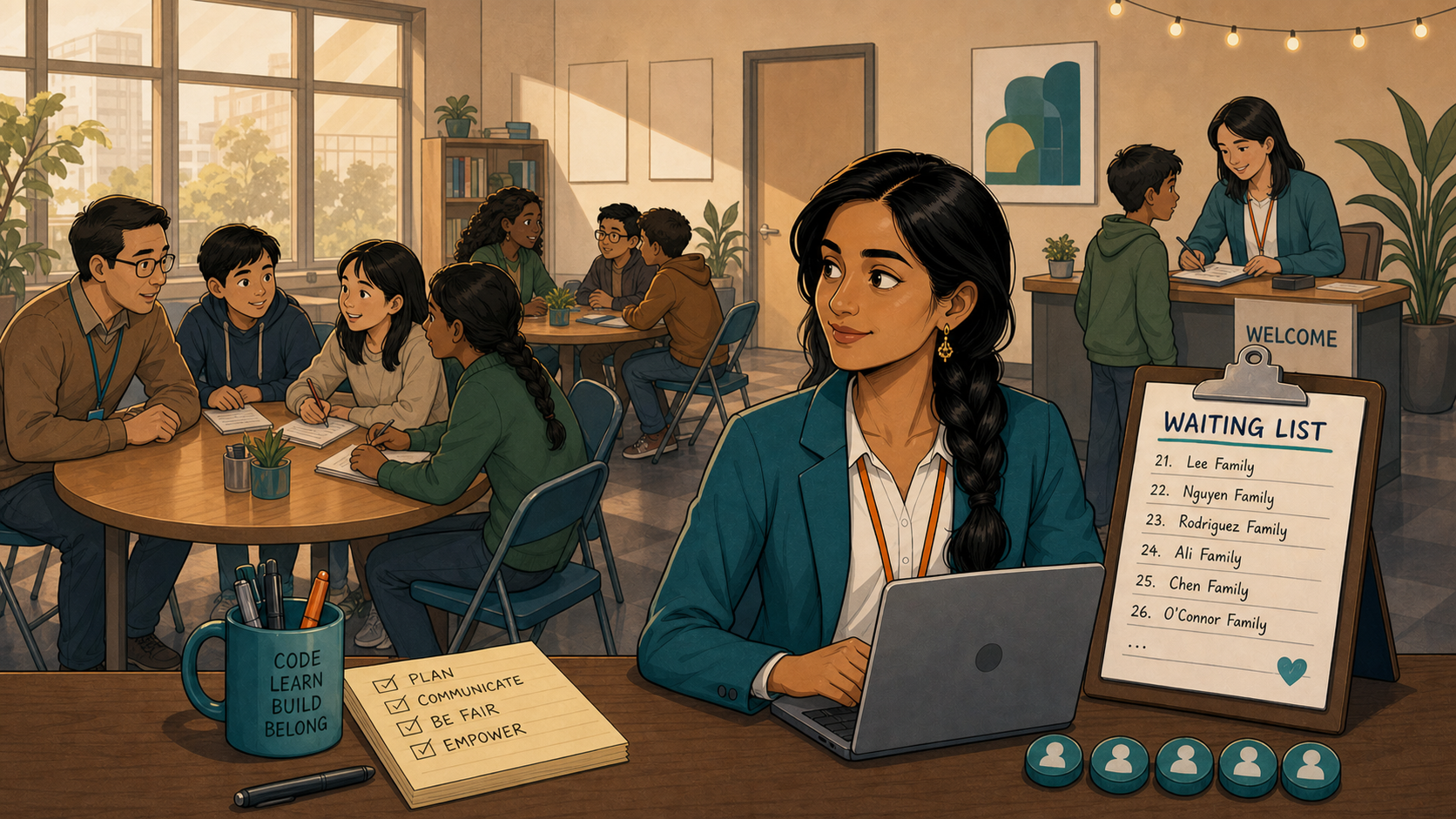
By the time the term actually started, the room matched the plan instead of the panic: small groups working comfortably with a mentor nearby, a proper welcome desk for new families, and a waiting list on the wall that families could check instead of wondering. Priya sat back at her laptop, calm for the first time since launch morning.
Epilogue – Fair Isn't the Same as First
Priya's first instinct on launch day was to feel like she'd failed — 300 families for 20 seats felt like proof the system was broken. It wasn't. The demand was a sign of success; the chaos was just a sign that capacity needed to be tied to something real. Once seats were gated by confirmed mentors instead of by who clicked fastest, the same overwhelming demand became a fair, visible waiting list instead of a source of daily panic.
| Challenge | How Priya Responded | Lesson for Today |
|---|---|---|
| 300 families applied for 20 seats within hours of registration opening | Built and staffed a phone line and capacity board to manage the immediate overflow honestly | A surge in demand is a signal to communicate capacity clearly, not to quietly overpromise seats that don't exist |
| First-come-first-served registration couldn't scale fairly with so few mentors | Redesigned registration so each confirmed mentor unlocked a fixed number of student seats | Gating enrollment by mentor capacity, not click speed, keeps growth fair and sustainable at the same time |
| Families on a waiting list had no visibility into their status | Sent staggered, numbered confirmations families could track over several weeks | A waiting list only feels fair when people can actually see their place in it |
Call to Action
Before your next registration opens, decide in advance what unlocks a seat — a mentor, not a click. A big waiting list isn't a crisis; an invisible one is. Build the visible version before you need it, the way Priya wishes she had.
"Three hundred families for twenty seats felt like a failure. It wasn't — it was proof the demand was real." —Priya, after launch day
"Each confirmed mentor unlocks three student seats." —the rule that replaced first-come, first-served
References
- Wikipedia: Eventbrite - The event registration platform many clubs use to manage sign-ups and capacity
- Wikipedia: Queueing theory - The mathematics behind fair, orderly waiting lists under limited capacity
- Wikipedia: Overbooking - What happens when signups are allowed to exceed real capacity without a gating rule
- Wikipedia: First-come, first-served - The default allocation rule Priya's mentor-gated system replaced
- STEM Classroom Administration - The companion textbook on managing classroom capacity and technology