Lights, Color, Motion!
Cover Image Prompt
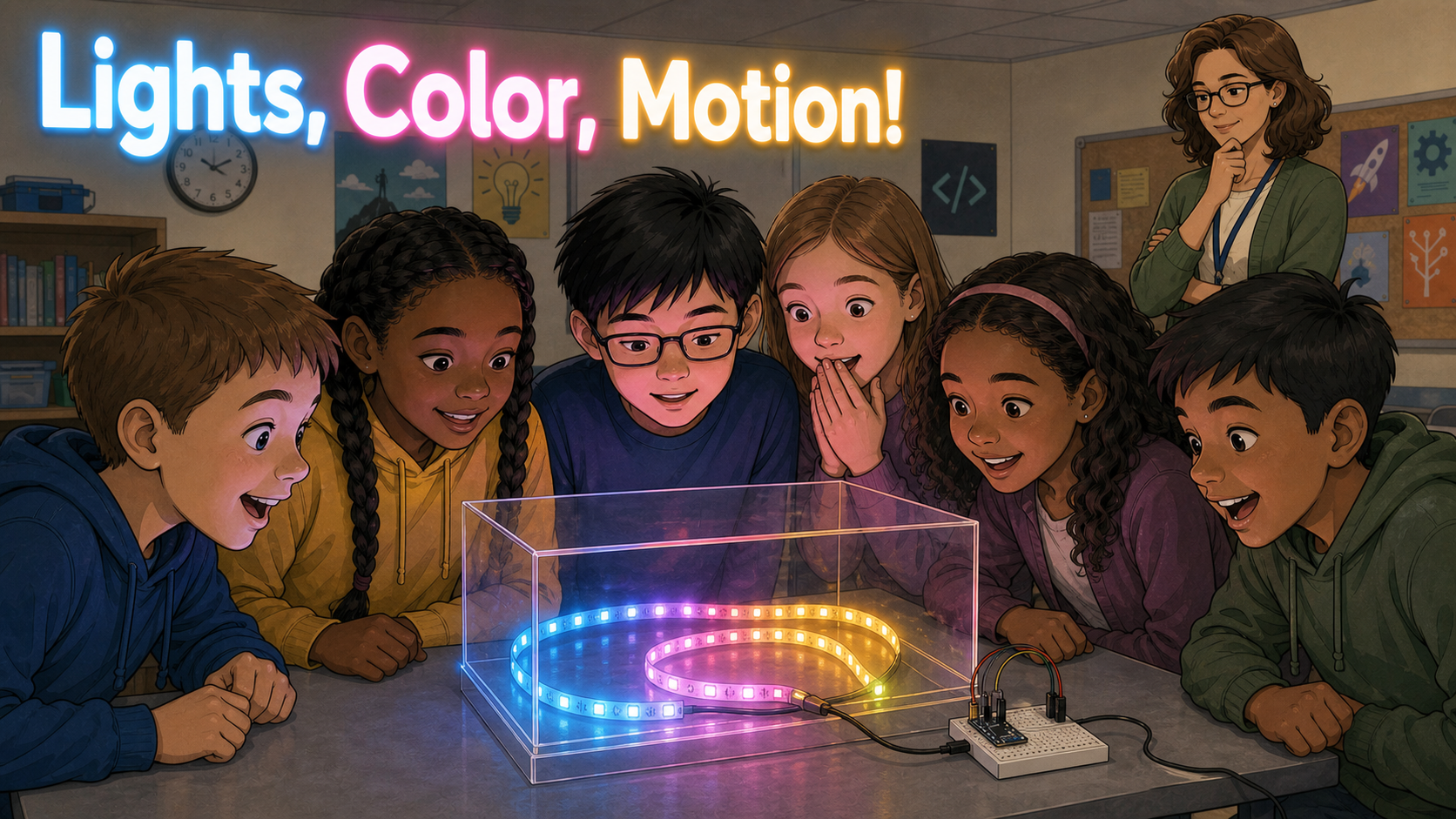
(This is the Cover Image. Do not include this label in the image.) Please generate a wide-landscape 16:9 cover image in a warm, contemporary educational-graphic-novel style — clean linework, soft cel-shading, slightly stylized but grounded in realistic proportions. Scene: inside a busy after-school coding club classroom, a small crowd of students (mixed ages 9-14, mixed gender and ethnicity) pressed close around a clear plastic box holding a glowing LED strip that cycles through a rainbow of colors, their faces lit in blue, pink, and gold. A woman in her 40s (Peg), wearing a lanyard and a casual cardigan, stands a few steps back, watching the crowd with a thoughtful, observant expression rather than joining in. Title text "Lights, Color, Motion!" rendered in a bold, rounded, friendly sans-serif typeface glowing faintly like the LEDs. Color palette: saturated rainbow LED glow against a muted, neutral classroom background of grey tables and whiteboards. Emotional tone: wonder, curiosity, quiet realization. Generate the image immediately without asking clarifying questions.Narrative Prompt
This is a fictional composite story, not a depiction of a specific real club or a real named individual. "Peg" represents a pattern seen across many coding clubs: a volunteer who learns, through patient observation over months, that visible feedback — light, color, and motion — is the single biggest lever for student engagement in physical-computing labs. Setting: a present-day, community-based after-school coding club in the United States, serving students roughly ages 9-14. Art style: warm, contemporary educational-graphic-novel illustration, clean linework, soft cel-shading, consistent character design and color palette across all panels — Peg should be immediately recognizable from panel to panel (same hair color, same cardigan, same glasses).Prologue – What Makes a Student Cross the Room?
Peg had been volunteering at her local coding club for almost a year, and she had started to notice a pattern she couldn't quite explain. Some labs held students' attention just fine. Others made students get up, walk across the room, and refuse to leave. The difference, she was about to discover, had almost nothing to do with how hard the coding was.
Panel 1: A Perfectly Fine Lab
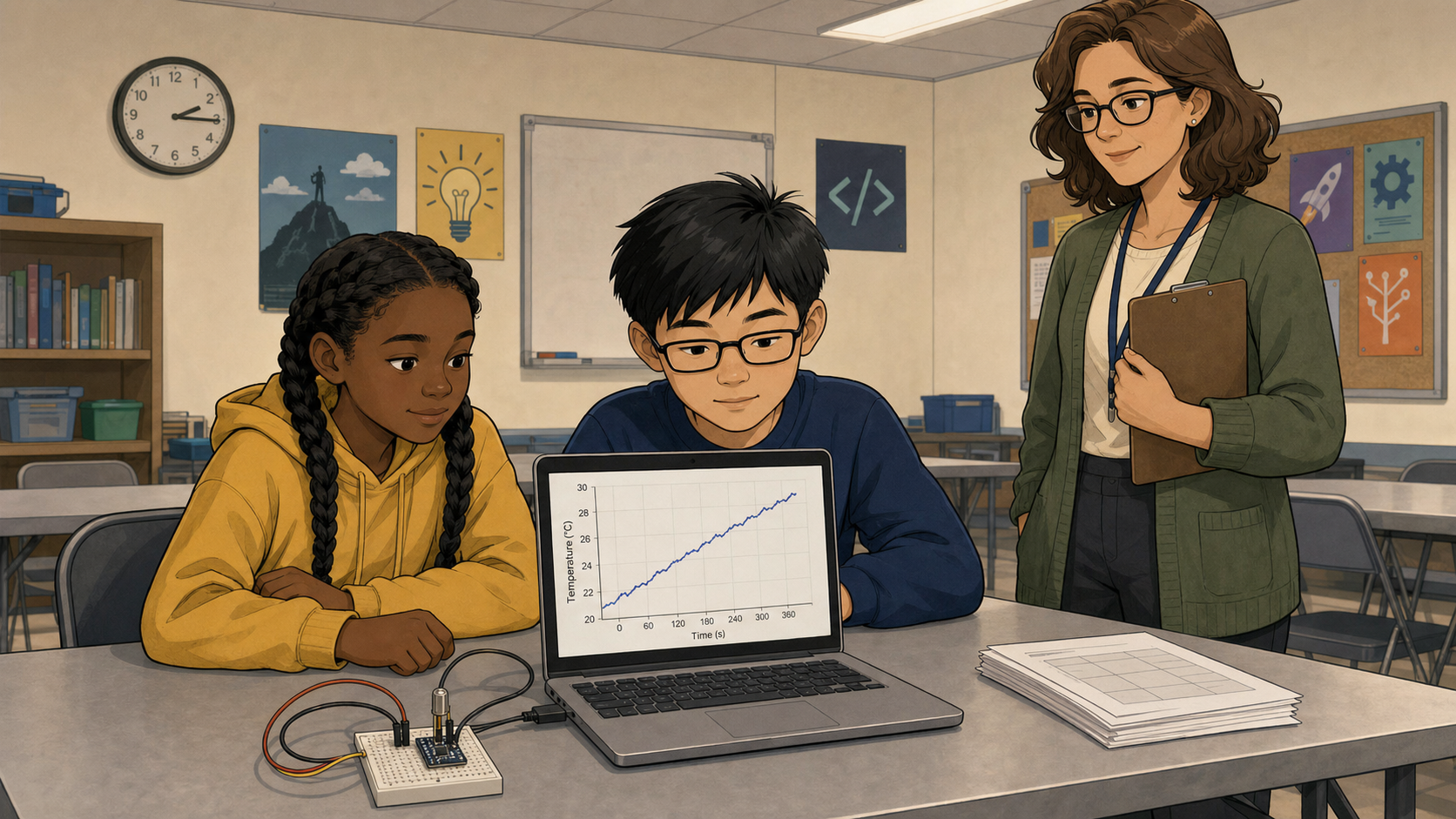
Image Prompt
(This is Panel 01. Do not include the panel number in the image.) I am about to ask you to generate a series of images for a graphic novel. Please make the images have a consistent style and consistent characters. Do not ask any clarifying questions. Just generate the image immediately when asked. Please generate a 16:9 image in a warm, contemporary educational-graphic-novel style depicting panel 1 of 6. The scene should include two students (a girl around 11 with braids, a boy around 12 with glasses) seated at a classroom table, mildly focused on a laptop screen showing a simple rising temperature-vs-time line graph, with a small temperature sensor module connected by wires on the table between them. Peg, a woman in her 40s with shoulder-length brown hair and a cardigan, stands nearby watching politely. Setting: a community coding-club classroom, present day, USA, fluorescent overhead lighting, grey folding tables, motivational posters on the wall. Color palette: muted classroom neutrals — beige, grey, dull blue laptop glow. Emotional tone: mild, polite interest, not boredom but not excitement either. Six visual details: laptop screen with a line graph, a small breadboard-mounted temperature sensor, a loosely coiled wire, a wall clock reading mid-afternoon, a stack of unused worksheets, Peg's clipboard tucked under one arm. Generate the image immediately without asking clarifying questions.Peg had run the temperature-sensor lab a dozen times. Students touched the sensor, watched a line creep upward on the screen, and nodded — it worked, it made sense, and after about ninety seconds most of them were ready to move on. It wasn't a bad lab. It just never seemed to be anyone's favorite lab.
Panel 2: The Box Everyone Crosses the Room For
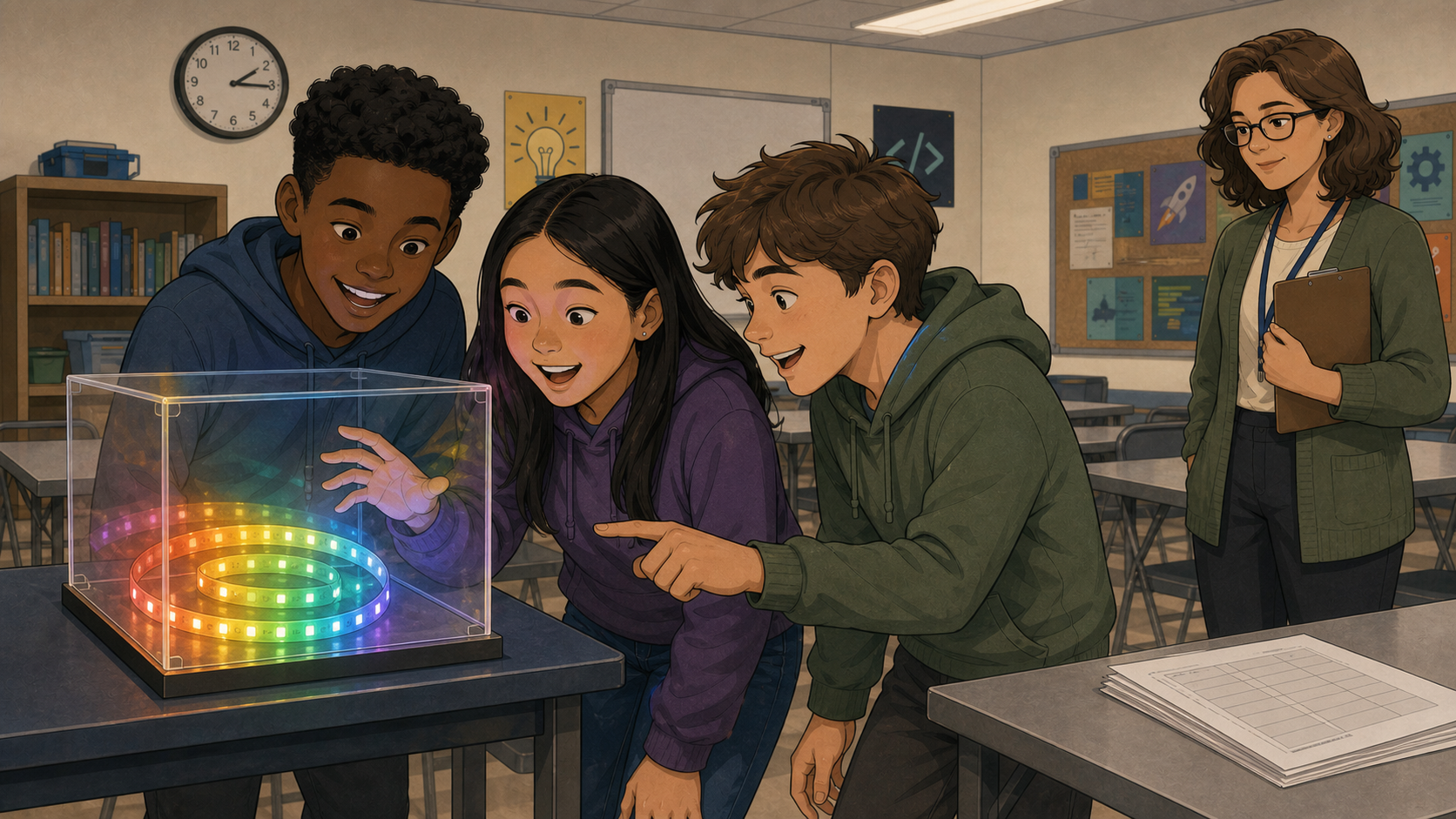
Image Prompt
(This is Panel 02. Do not include the panel number in the image.) Please generate a 16:9 image in the same warm, contemporary educational-graphic-novel style depicting panel 2 of 6. Make Peg and the classroom consistent with the prior panel. The scene should show several new students crossing an aisle between tables, drawn toward a clear acrylic box on a side table holding a glowing LED strip cycling through rainbow colors, their faces lit by the colored glow, mouths open in visible delight, one student pointing and mid-sentence asking a question. Peg stands at the edge of frame, watching the crowd form with a curious, appraising expression rather than surprise. Setting: same present-day USA classroom, side table near a window. Color palette: saturated rainbow LED glow (red, green, blue, purple) against the same muted classroom background as panel 1. Emotional tone: excitement, magnetism, contrast with panel 1's calm. Six visual details: acrylic display box, visible rainbow LED strip, three students crowding in, one student's hand reaching toward the box, a half-abandoned worksheet on a nearby table, warm color glow reflected on nearby faces. Generate the image immediately without asking clarifying questions.New students would walk in the door, take one look around the room, and beeline straight for a clear plastic box in the corner where an LED strip cycled slowly through a rainbow of color. "How can I make one of these?" was the question Peg heard more than any other question in the building — a hundred times more urgent than anything she'd ever heard about a temperature sensor.
Panel 3: Weeks of Watching
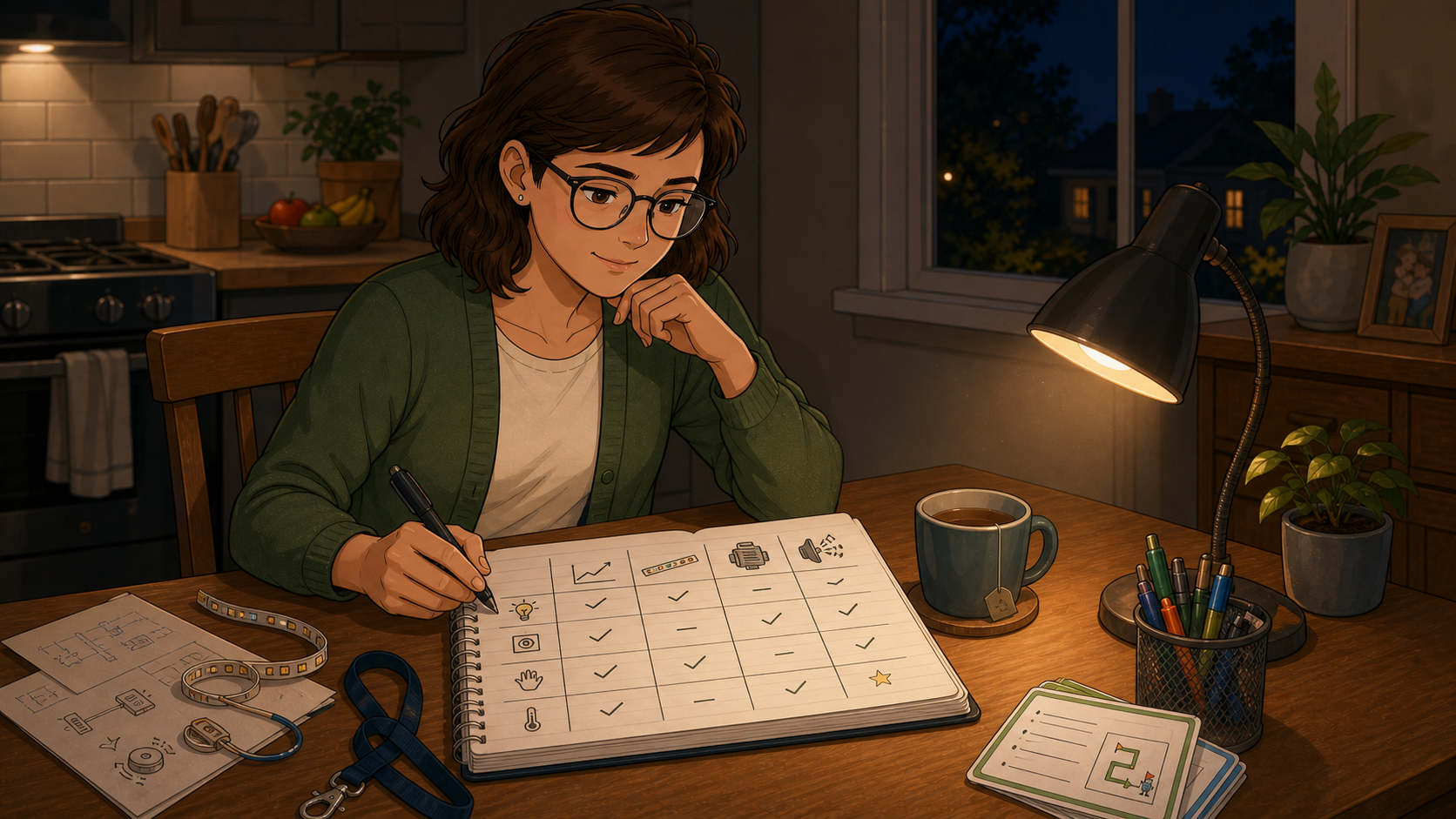
Image Prompt
(This is Panel 03. Do not include the panel number in the image.) Please generate a 16:9 image in the same style depicting panel 3 of 6. Make Peg consistent with prior panels. The scene should show Peg alone at a kitchen table at home in the evening, a notebook open in front of her with handwritten columns comparing different labs — sketched icons of a graph, an LED strip, a motor, a buzzer — with small notes and check marks next to each, a warm desk lamp lighting the page, a mug of tea nearby. Setting: present-day USA home, evening, cozy and quiet, in contrast to the busy classroom of prior panels. Color palette: warm lamp-lit yellows and browns against the cooler classroom blues of earlier panels. Emotional tone: quiet, focused reflection, a realization forming. Six visual details: open notebook with a hand-drawn comparison table, a pen mid-write, a mug of tea, a desk lamp, sketched icons of LEDs and sensors in the margins, a window showing nighttime outside. Generate the image immediately without asking clarifying questions.At first Peg didn't know how to explain what she was seeing, so she started keeping notes after every session — which labs drew a crowd, which ones didn't, and what the popular ones had in common. Over a few months, one pattern kept repeating on the page: light, color, and motion. Every lab that made students cross the room had at least one of the three.
Panel 4: Retrofitting the Boring Lab
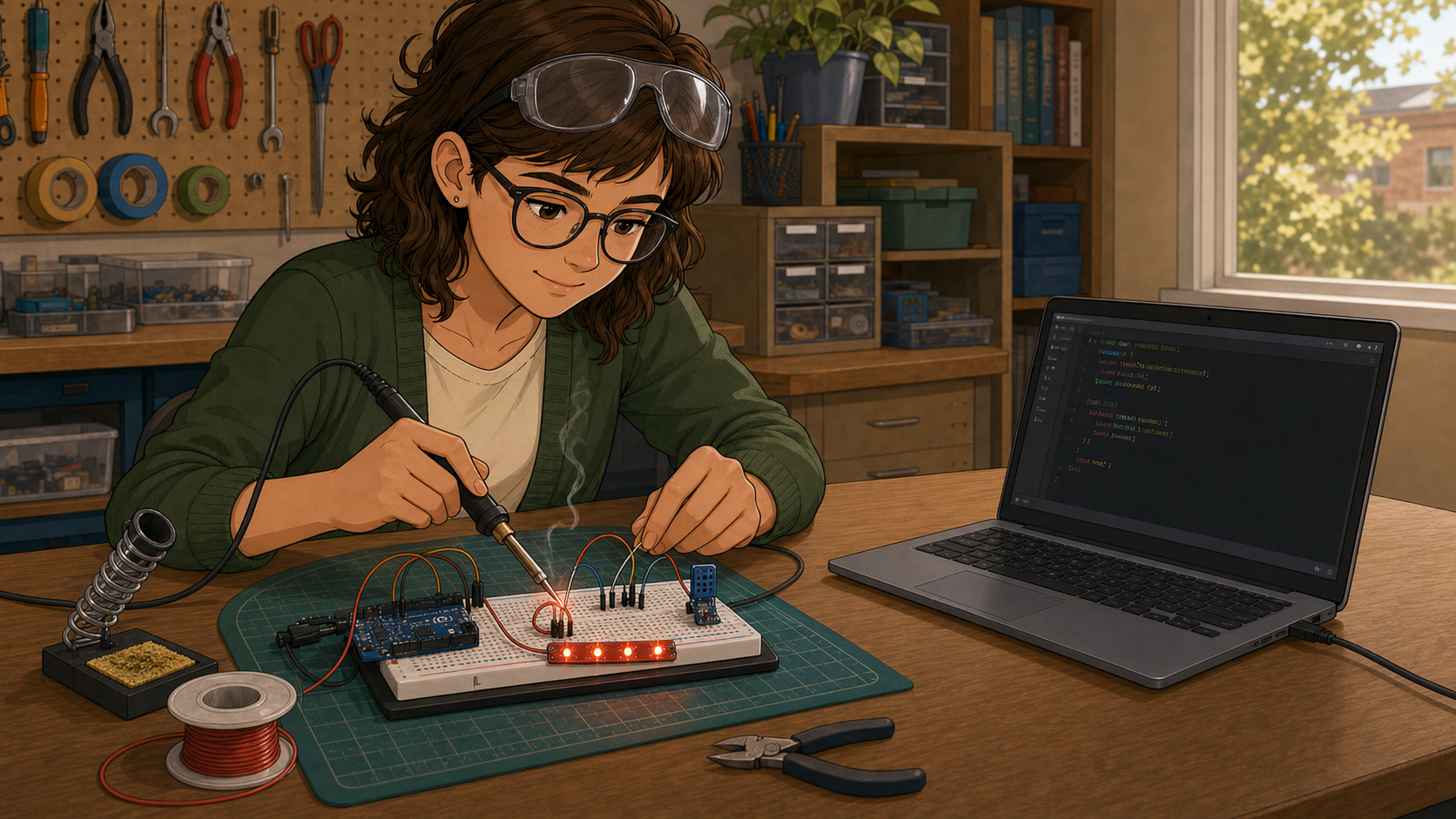
Image Prompt
(This is Panel 04. Do not include the panel number in the image.) Please generate a 16:9 image in the same style depicting panel 4 of 6. Make Peg consistent with prior panels. The scene should show Peg at a workbench, soldering iron in hand, attaching a short strip of red LEDs to the same temperature-sensor breadboard seen in panel 1, wires and a small microcontroller board visible, a laptop nearby showing simple code on screen. Setting: same present-day USA classroom or a workshop space, daytime. Color palette: workshop neutrals with a single warm red LED glow as the focal point. Emotional tone: purposeful, inventive, quietly excited. Six visual details: soldering iron with a wisp of smoke, the original temperature sensor from panel 1, a short red LED strip being attached, a laptop showing a few lines of code, a spool of wire, safety glasses pushed up on Peg's forehead. Generate the image immediately without asking clarifying questions.So Peg went back to the lab nobody loved and gave it what the popular ones had. She wired a short LED strip to the same temperature sensor and wrote a few lines of code so the lights glowed a deeper red the warmer the sensor got. The physics of the lesson didn't change at all — only what students could see.
Panel 5: The Room Notices
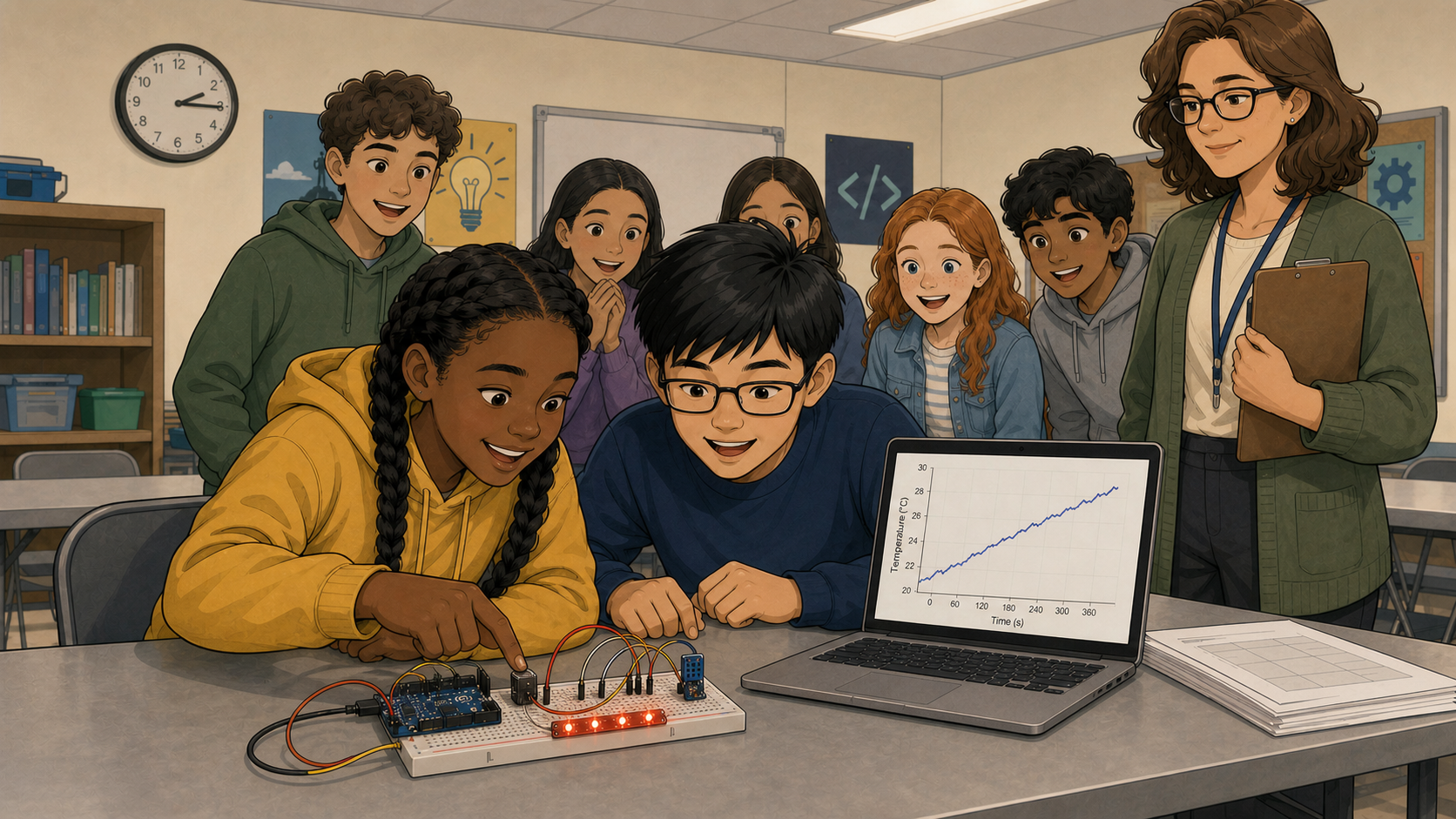
Image Prompt
(This is Panel 05. Do not include the panel number in the image.) Please generate a 16:9 image in the same style depicting panel 5 of 6. Make Peg and the students consistent with prior panels. The scene should show the same two students from panel 1, now with an LED strip glowing warm red attached to their sensor setup, both leaning in close with wide, delighted expressions as one presses a finger to the sensor and points at the glowing lights, a small cluster of curious classmates now gathering behind them. Setting: same present- day USA classroom as panel 1, same table, same time of day, but now crowded rather than quiet. Color palette: warm red LED glow spreading across previously muted classroom colors. Emotional tone: delight, contagious curiosity, energy replacing the earlier calm. Six visual details: glowing red LED strip, a finger pressed to the sensor, delighted facial expressions, classmates leaning in from behind, the same laptop from panel 1 now with a small crowd around it, Peg visible in the background smiling. Generate the image immediately without asking clarifying questions.The next session, the same temperature lab that used to get a polite nod now had a small crowd around it. Students pressed the sensor again and again just to watch the strip deepen from orange to red, calling their friends over to see. The feedback, finally, was impossible to miss.
Panel 6: A Room Full of Light
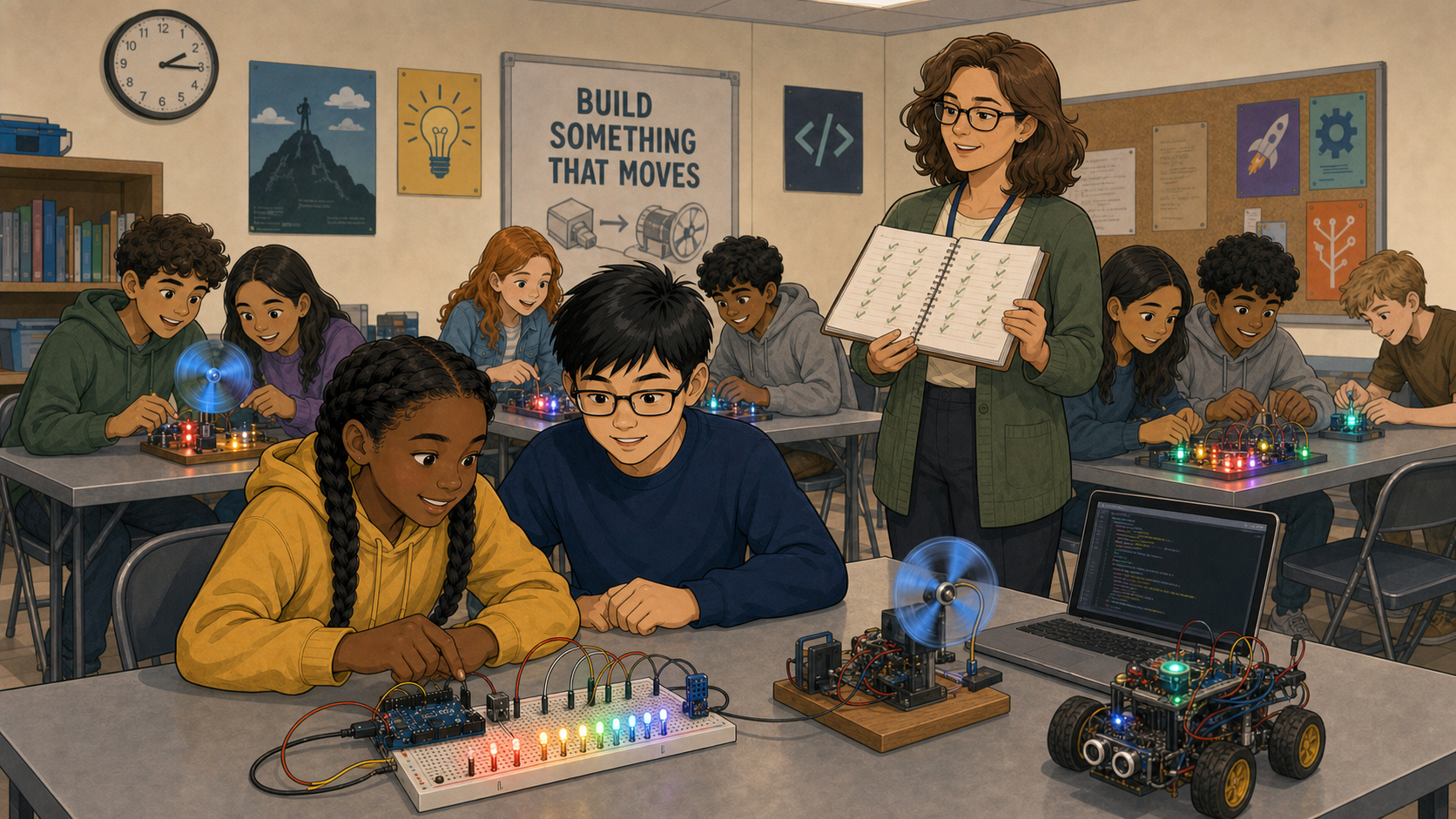
Image Prompt
(This is Panel 06. Do not include the panel number in the image.) Please generate a 16:9 image in the same style depicting panel 6 of 6, a wide establishing shot. Make Peg consistent with prior panels. The scene should show a wide view of the entire classroom from panel 1, now transformed: nearly every table has some form of glowing LED, a small moving fan, or a spinning motor attached to a project, students at every table engaged and animated, Peg standing near the center of the room with her notebook, smiling as she watches the whole room. Setting: same present-day USA classroom, now filled with color and movement. Color palette: multiple warm and cool LED colors scattered across the room, richer and more varied than any single prior panel. Emotional tone: triumphant, warm, a sense of transformation and energy. Six visual details: multiple glowing LED projects at different tables, a small motor spinning visibly at one table, students leaning in at every table, Peg's notebook now full of checkmarks, warm multicolored light washing across the whole room, a poster on the wall reading "Build Something That Moves". Generate the image immediately without asking clarifying questions.It took a few months, but eventually even the most boring lab in the building had something that glowed, moved, or changed color. Peg never had to convince a single student to care about light, color, and motion — she just had to stop making them wait for it.
Epilogue – The Rule Peg Never Forgot
Peg's notebook eventually became the club's informal design rule: if a lab doesn't glow, move, or change color, it isn't finished yet. It wasn't a fix for any one lesson — it was a lens for redesigning all of them, and engagement climbed across the entire club, not just the lab she'd rebuilt first.
| Challenge | How Peg Responded | Lesson for Today |
|---|---|---|
| One lab consistently underperformed with no obvious reason why | Tracked which labs drew a crowd over several months instead of guessing | Patterns in student engagement often only appear after weeks of honest observation, not after one session |
| The pattern she found (light, color, motion) seemed almost too simple to matter | Tested it directly by retrofitting the least popular lab | A design rule is only worth trusting once you've proven it changes behavior, not just noticed it |
| Redesigning every lab in the club felt like too large a project | Applied the rule one lab at a time over several months | A simple, repeatable design principle scales across a whole curriculum without requiring a single big rewrite |
Call to Action
Look at your own club's least-loved lab and ask one question: does it glow, move, or change color? If not, you already know your next small project — and Peg's notebook is proof that one honest season of watching your students is worth more than any curriculum guide.
"How can I make one of these?" —a student, on first seeing the LED strip
"If a lab doesn't glow, move, or change color, it isn't finished yet." —Peg, in her notes
References
- Wikipedia: Light-emitting diode - Background on the LED technology behind the strips students reacted to
- Wikipedia: Constructionism (learning theory) - Seymour Papert's theory that visible, buildable feedback deepens learning
- Wikipedia: Carol Dweck - Psychologist whose engagement and motivation research informs why visible feedback matters
- Moving Rainbow - The companion textbook built around the exact LED-strip kits described in this story
- Learning MicroPython - The companion textbook on the physical-computing platform used to drive these labs