Centaur Performance Review: Half Promoted, Half on a PIP
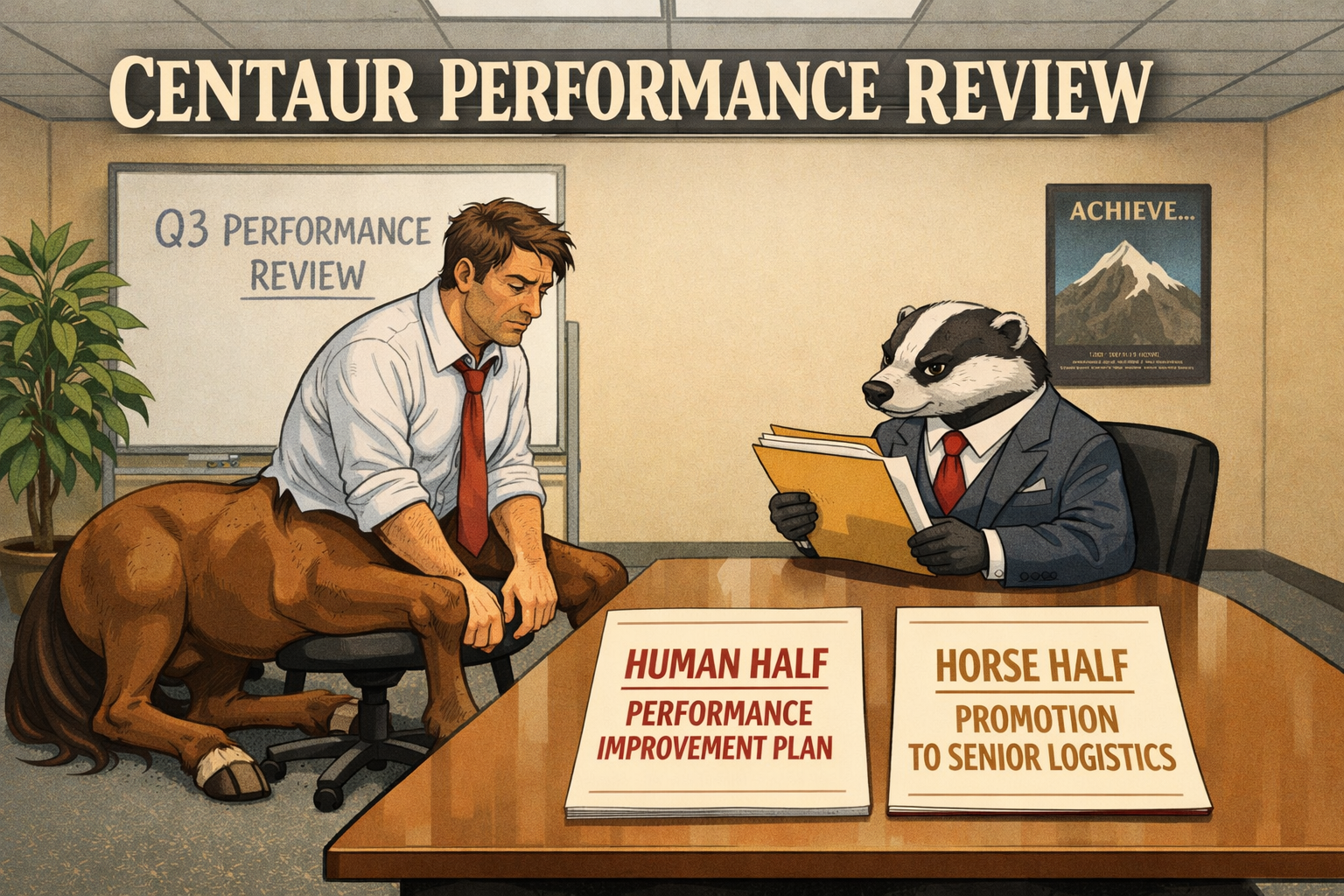
Cover Image Prompt
Please generate a wide-landscape 16:9 cover image for a satirical graphic novel titled "Centaur Performance Review." The scene shows a centaur — human torso from the waist up (male, wearing a slightly too-small business shirt, tie loosened, expression of weary resignation), horse body from the waist down (powerful, chestnut-brown, muscular) — sitting awkwardly in a standard office chair that is clearly designed for a human. The chair is comically inadequate: the centaur's horse body extends far behind it, hooves splayed on the carpet, back legs folded at an uncomfortable angle. The setting is a generic corporate conference room: drop ceiling with fluorescent panels, a whiteboard with "Q3 PERFORMANCE REVIEW" written on it, a fake plant in the corner, motivational posters on the walls. Across a small table sits the manager — a compact, efficient-looking badger in a suit, holding a thick manila folder and a scoring rubric. On the table between them: two separate documents. One is labeled "HUMAN HALF — PERFORMANCE IMPROVEMENT PLAN" in red. The other is labeled "HORSE HALF — PROMOTION TO SENIOR LOGISTICS" in gold. The centaur stares at both documents. The color palette is corporate beige, fluorescent white, the brown of the centaur's coat, and the red/gold of the two contradictory reviews. Art style: modern editorial illustration with clean lines and warm satirical detail, capturing the specific aesthetic misery of corporate performance reviews. The title "CENTAUR PERFORMANCE REVIEW" appears in bold serif font across the top. Generate the image immediately without asking clarifying questions.Narrative Prompt
This is a satirical graphic novel about the impossibility of being evaluated as two things at once — a direct allegory for human-AI collaboration and the way organizations try to measure hybrid workers by splitting them into parts that were never meant to be separated. The central character is Clive, a centaur who works at Gallop & Associates, a mid-sized logistics company. Clive is a single being with a single consciousness, but his employer insists on evaluating his "human half" and "horse half" as separate employees with separate KPIs, separate career tracks, and separate managers. The satire targets performance review culture — the corporate ritual of reducing a whole person to a rubric, the practiced empathy of managers delivering bad news, the euphemisms that make termination sound like a growth opportunity, and the HR systems that cannot accommodate anyone who does not fit the template. Every scene should feel like a real annual review translated one degree into absurdity. The art style should be corporate mundane — fluorescent lights, beige carpet, motivational posters, conference rooms with no windows — with the centaur's mythological physicality disrupting the environment at every turn.Prologue — The Calendar Invite
The calendar invite arrived at 4:47 PM on a Friday, which is when all performance reviews are scheduled: late enough in the day that the recipient cannot sleep, late enough in the week that they cannot act, and precisely timed to ensure maximum anxiety over two days of helpless waiting. The subject line read "Q3 Performance Check-In — Clive (Both Halves)." The parenthetical was new.
Clive had worked at Gallop & Associates for six years. He was, by any reasonable measure, the company's most productive logistics coordinator. He could carry 400 pounds of inventory across the warehouse floor while simultaneously updating the shipping manifest on his tablet. He had never missed a deadline. He had never called in sick. He had once delivered a pallet of server equipment to Building C during a power outage by simply running it over on his back while the forklifts sat useless in the dark.
None of this, he suspected, would appear in the review.
Image Prompt
I am about to ask you to generate a series of images for a satirical graphic novel about a centaur receiving a corporate performance review. Please make the images have a consistent modern editorial illustration style with clean lines, expressive characters, and consistent character designs throughout — the aesthetic of corporate mundanity disrupted by mythological physicality. Do not ask any clarifying questions. Just generate the image immediately when asked. Please generate a 16:9 image depicting panel 1 of 8. Late Friday afternoon in a generic open-plan office. Clive the centaur stands at his cubicle, reading a calendar notification on his monitor. He has a human upper body — a man in his mid-30s with short brown hair, wearing a slightly rumpled white dress shirt with sleeves rolled up and a loosened blue tie. From the waist down, he is a chestnut horse — powerful, well-groomed, but clearly too large for the cubicle. His hindquarters extend into the aisle behind him, and a passing coworker — a small, nervous rabbit in business casual — has to squeeze past. Clive's expression is the specific dread of someone who has just received a Friday afternoon calendar invite from their manager. On his monitor: the calendar notification reading "Q3 Performance Check-In — Clive (Both Halves) — Monday 10 AM." His cubicle is decorated with a "Employee of the Month" photo (showing only his horse half, from a low angle), a small plant, and a stress ball that has been crushed. The cubicle walls are too short for him — his human torso rises above the partition, visible to the entire office. The color palette is office beige, fluorescent white, and the warm brown of Clive's coat. The mood is Friday dread — the universal experience of receiving bad news you cannot act on until Monday. Generate the image now.His cubicle had never fit him. The partition walls came up to his horse shoulders, which meant his entire human torso was visible to the office at all times — a permanent violation of the privacy the cubicle was designed to provide. His chair was a standard-issue ergonomic model rated for 250 pounds. Clive weighed 1,100 pounds. He had submitted a furniture accommodation request in his first week. It had been marked "under review" for six years.
Panel 2: The Conference Room
Image Prompt
Please generate a 16:9 image depicting panel 2 of 8. Make the characters and style consistent with the prior panel. A small corporate conference room — windowless, fluorescent-lit, with a single round table, four human-sized chairs, a whiteboard, and a fake ficus in the corner. The room is clearly too small. Clive the centaur has entered the room and his horse body takes up most of the available floor space. He has positioned his front hooves under the table, but his hindquarters press against the back wall, and his tail is caught in the partially closed door. He is trying to appear comfortable and professional, hands folded on the table, but the physical absurdity is evident. Across the table sits his manager — Margaret, a compact, efficient badger in a charcoal blazer, reading glasses perched on her snout, holding a thick manila folder with colored tabs. She does not acknowledge the space issue. On the table: two separate folders (one red, one gold), a glass of water, and a box of tissues (standard for performance reviews). On the whiteboard behind Margaret: "GALLOP & ASSOCIATES — Where Every Half Counts" (the company slogan). A motivational poster on the wall reads "TEAMWORK: TOGETHER EVERYONE ACHIEVES MORE" with a stock photo of hands stacking — human hands, no hooves. Clive notices this. The color palette is conference-room beige, fluorescent lighting, and the brown of Clive's coat against the gray of corporate furniture. The mood is the specific claustrophobia of a performance review in a room designed for someone else. Generate the image now.The conference room was called "The Meadow." All of Gallop & Associates' conference rooms were named after outdoor spaces — The Meadow, The Clearing, The Hilltop — in the way that companies name windowless rooms after things they have replaced. The Meadow was eight feet by ten feet. Clive was nine feet long. He entered sideways, positioned his front hooves under the table, and accepted that his tail would remain in the hallway. The door could not close. Margaret, his manager, did not mention this.
"Thank you for making time, Clive," she said, as if he had been given a choice. She opened the manila folder. It contained two sub-folders, each with its own colored tab. The red tab read "Human Half." The gold tab read "Equine Half." Clive noticed that the gold tab was thicker.
Panel 3: The Human Half Review
Image Prompt
Please generate a 16:9 image depicting panel 3 of 8. Make the characters and style consistent with the prior panels. Close-up of the review in progress. Margaret the badger holds the RED folder open, reading from a printed performance rubric. The rubric is visible — a grid with categories down the left side ("Communication," "Emotional Intelligence," "Leadership Potential," "Cultural Fit," "Innovation Mindset") and ratings across the top ("Exceeds," "Meets," "Developing," "Below"). Most checkmarks are in the "Developing" and "Below" columns. Margaret's expression is one of practiced corporate empathy — the face of someone who has been trained to deliver bad news as if it were a gift. Clive's human half is visible across the table — his expression shifts from attentive to wounded as he reads the rubric upside-down. His hands grip the table edge. Behind Margaret, the whiteboard now shows handwritten notes: "Human Half KPIs: Soft skills, Collaboration, 'Executive Presence,' Thought Leadership." A sticky note on the folder reads "PIP RECOMMENDED." Clive's horse body, visible below the table line, is tense — muscles rippling, one hoof pawing the carpet anxiously, leaving a small divot. The physical stress response of the horse half betrays what the human half is trying to hide. The color palette emphasizes the red of the folder against the beige room. The mood is the sinking feeling of hearing your professional worth reduced to checkboxes. Generate the image now."Let's start with your human half," Margaret said. She opened the red folder. "Communication: Developing. Your emails are clear and professional, but the 360-degree feedback indicates that some colleagues find your presence in meetings 'physically overwhelming.' We've noted this as a soft-skills opportunity."
Clive asked if "physically overwhelming" referred to his ideas or his body. Margaret said it was "a holistic assessment" and moved on.
"Emotional intelligence: Below benchmark. The EQ assessment flagged that you become visibly agitated during budget discussions." Clive pointed out that his horse half shifts weight when anxious, which is a physiological response, not an emotional one. Margaret said the distinction "did not change the score" and that he might benefit from the company's mindfulness webinar series, which was held in The Clearing, a room even smaller than The Meadow.
"Leadership potential: Unclear." Margaret paused. "Clive, I want to be transparent. The leadership competency framework was designed for — and I'm quoting HR here — 'standard-configuration employees.' Your configuration is non-standard. This isn't a judgment. It's a taxonomy issue."
Panel 4: The Horse Half Review
Image Prompt
Please generate a 16:9 image depicting panel 4 of 8. Make the characters and style consistent with the prior panels. The same conference room, but the mood has shifted dramatically. Margaret now holds the GOLD folder open, and she is beaming — the corporate beam of a manager delivering exceptional news. The gold rubric is visible: categories include "Speed," "Endurance," "Cargo Capacity," "Reliability," and "Hoof Maintenance." Every single checkmark is in the "Exceeds Expectations" column. Some categories have double checkmarks. One — "Cargo Capacity" — has three checkmarks and a small star drawn next to it. Margaret gestures at the rubric with pride. Clive's expression is complicated — his human face shows a mix of flattery and offense, the specific indignity of being praised for your body while being criticized for your mind. His horse half, meanwhile, stands taller — chest out, coat gleaming, tail (still in the hallway) swishing with unconscious pride. The duality is the visual joke: the top half deflates while the bottom half preens. On the whiteboard: "Equine Half KPIs: Load capacity (lbs), Sprint velocity (mph), Uptime (%), Manure management." The last item has been hastily erased but is still faintly visible. The color palette shifts to warmer golds. The mood is the uncomfortable experience of being celebrated for the wrong reasons. Generate the image now.Margaret closed the red folder and opened the gold one. Her entire demeanor changed. She sat up straighter. She smiled. The smile was real — not the practiced empathy of the human-half review but the genuine enthusiasm of a manager presenting numbers she was proud of.
"Your equine half," she said, "is exceptional. Speed: 97th percentile. You outperformed every forklift in the warehouse. Endurance: you logged 847 miles last quarter without a single breakdown. Cargo capacity: 400 pounds, which is — I checked — more than any other employee in the company, including the actual trucks." She paused for emphasis. "The trucks, Clive."
"Reliability: perfect. You have never called in sick. Your hooves are in excellent condition. Your coat is well-maintained — the grooming team noted this specifically." Clive did not know there was a grooming team. He did not know he had been assessed by them. He chose not to ask.
"The recommendation," Margaret said, turning to the final page, "is a promotion. Your equine half is being advanced to Senior Logistics Specialist, effective immediately. Congratulations."
Clive waited for the rest of the sentence. It did not come.
Panel 5: The PIP
Image Prompt
Please generate a 16:9 image depicting panel 5 of 8. Make the characters and style consistent with the prior panels. Clive stands in the conference room, now holding two documents — one in each hand. In his left hand: a red document titled "PERFORMANCE IMPROVEMENT PLAN — Clive (Human Half)" with dense paragraphs of corporate language, checkboxes, and a signature line at the bottom. In his right hand: a gold document titled "PROMOTION LETTER — Clive (Equine Half) — Senior Logistics Specialist" with a congratulatory header and a new salary figure. He holds them at arm's length, looking back and forth between them with the expression of a person trying to solve a logic puzzle that has no solution. Margaret stands nearby, having delivered both documents, hands clasped in front of her with the satisfied posture of someone who believes the conversation went well. The visual joke is the split: draw an imaginary line across Clive's midsection where human meets horse — everything above the line is on a PIP, everything below is being promoted. On the wall, the "TEAMWORK" poster is visible again, now reading as darkly ironic. On the table, the box of tissues has been opened — Margaret used one, not Clive. The color palette splits: red-tinted light falls on Clive's upper half, gold-tinted light on his lower half. The mood is bureaucratic absurdity reaching its logical conclusion. Generate the image now.The Performance Improvement Plan was four pages long. It required Clive's human half to demonstrate "measurable growth" in communication, emotional intelligence, and leadership within 90 days. Failure to meet the benchmarks would result in "separation" — a word that, given Clive's anatomy, he found more alarming than HR intended.
The promotion letter was one page. It congratulated his equine half on an outstanding quarter, outlined a 12% salary increase, and invited him to the Senior Leadership Offsite in Aspen. "Travel accommodations," the letter noted, "will be arranged for standard-configuration attendees. Non-standard configurations should contact Facilities."
Clive held both documents, one in each hand, and experienced what he would later describe to his therapist as "a structurally divided sense of professional identity." His top half was failing. His bottom half was thriving. He was, simultaneously, the company's worst communicator and its best asset. The two assessments had been written by the same manager, in the same meeting, about the same person.
"Do you have any questions?" Margaret asked.
Clive had several. He started with the most pressing: "Who does my human half report to now?"
Margaret checked the organizational chart. "Your equine half," she said. "As Senior Logistics Specialist, your equine half is now two levels above your human half in the reporting structure." She paused. "Is that a problem?"
Panel 6: The Org Chart
Image Prompt
Please generate a 16:9 image depicting panel 6 of 8. Make the characters and style consistent with the prior panels. Clive stands before a large whiteboard in a hallway, studying the company's updated organizational chart. The chart is a standard corporate hierarchy — boxes and lines descending from the CEO at the top. In the middle of the chart, the absurdity is visible: "CLIVE (EQUINE HALF) — Senior Logistics Specialist" appears in a gold box at a senior level, with a dotted reporting line descending to "CLIVE (HUMAN HALF) — Logistics Coordinator (PIP)" in a red box two levels below. An arrow connects the two boxes, labeled "Direct Report." Other employees on the chart are normal single-box entries — "Janet (Rabbit) — Accounting," "Morris (Turtle) — Compliance." Only Clive occupies two boxes. A small crowd of coworkers has gathered to look at the updated chart: the nervous rabbit from Panel 1 stares with mouth open, a cat in HR attire holds a clipboard and nods as if everything is perfectly normal, and a bemused fox takes a photo with a phone. Clive stands with arms crossed (human half) while his horse half is turned slightly, as if his hindquarters are literally looking down at his own torso. The color palette is hallway fluorescent, whiteboard white, and the red/gold of Clive's two boxes. The mood is corporate absurdity made visible in org-chart form. Generate the image now.The organizational chart was updated by Tuesday. It was displayed, as all org charts are, on a whiteboard in the main hallway where everyone could see it and no one could escape it. Clive's entry was the only one that occupied two boxes. His equine half sat in a gold box at the Senior Specialist level, with a dotted line descending to his human half in a red box two levels below. The dotted line was labeled "Direct Report."
He was, officially, his own subordinate.
HR had reviewed the arrangement and found no policy violation. "The reporting structure is based on role, not anatomy," the HR representative — a cat named Denise — explained. "Your equine half holds a senior role. Your human half holds a junior role. The hierarchy is clear." Clive asked how he was supposed to give himself performance feedback. Denise said there was a form for that. There was always a form.
The fox in Marketing took a photo of the org chart and posted it to the company Slack with the caption "Management structure is really galloping ahead this quarter." The fox received a written warning for "unauthorized use of equine wordplay in professional channels." Clive received nothing, because he could not file a complaint against his own direct report.
Panel 7: The One-on-One with Himself
Image Prompt
Please generate a 16:9 image depicting panel 7 of 8. Make the characters and style consistent with the prior panels. The smallest conference room in the office — "The Burrow" — barely six feet by six feet. Clive has attempted to hold a one-on-one meeting with himself, as required by the new reporting structure. He sits at a tiny round table, but the room is so small that he fills it entirely — his horse body curves along the walls, his tail is pressed against the door, and his human torso barely fits at the table. On the table: two name placards. One reads "CLIVE (EQUINE) — Manager" and the other reads "CLIVE (HUMAN) — Direct Report." He has a notebook open and a pen in hand. He is attempting to take meeting notes. The expression on his face is the particular vacancy of a person conducting a mandatory meeting with himself. On the notebook page, visible to the viewer, he has written: "Agenda: 1. Performance goals (human half) 2. Feedback from manager (equine half) 3. Action items" and below that, in different handwriting: "This is insane." A coffee cup sits on each side of the table — two cups, one meeting, one person. Through the tiny window in the door, a coworker peeks in with concern. The color palette is claustrophobic beige — small room, big centaur. The mood is the loneliest meeting in corporate history. Generate the image now.The one-on-one was scheduled for Thursday at 2:00 PM, because all one-on-ones are scheduled for the worst part of the worst day of the week. Clive booked The Burrow — the company's smallest conference room, chosen because no one else would want it, and because holding a meeting with yourself in a large room felt somehow worse than holding it in a small one.
He set up two name placards. He opened his notebook. He began.
"So," his human half said, addressing the room, "how do we feel about Q4 goals?"
His equine half did not respond, because it was his own body and did not hold separate opinions. He wrote this down: "Manager (equine) — no verbal feedback. Interpreted as approval." He moved to action items. "Action item 1: Improve communication skills. Action item 2: Attend mindfulness webinar. Action item 3: Stop scheduling meetings with myself." He crossed out the third item. The meetings were mandatory. Denise had confirmed this.
He drank both coffees. The meeting lasted its full thirty minutes. He rated it, on the post-meeting feedback form, as "Productive — 4 out of 5." He did not know who would read the form. He suspected no one would. He submitted it anyway. This is what professionals do.
Panel 8: The Exit Interview
Image Prompt
Please generate a 16:9 image depicting panel 8 of 8. Make the characters and style consistent with the prior panels. Clive stands outside the Gallop & Associates office building on a sunny day. He has packed his things into saddlebags draped over his horse half — cardboard boxes of office supplies, his stress ball, the "Employee of the Month" photo, and a small plant. His human half wears a casual jacket over his work shirt — the tie is gone. His expression is calm, clear, relieved — the face of someone who has made a decision and is at peace with it. He holds a single document: his resignation letter. On it, visible in his neat handwriting: "Dear Margaret, I regret to inform you that both halves of me are leaving. Effective immediately. Please update the org chart accordingly." Behind him, through the glass doors of the building, the office continues — fluorescent lights, cubicles, employees at desks. A "NOW HIRING" sign has already appeared in the window, reading: "Logistics Coordinator needed. Must be results-oriented, team-focused, and a single continuous organism. Centaurs welcome (pending configuration review)." The sun is warm on Clive's back. His coat gleams. His tail swishes freely — no longer caught in a conference room door. In the parking lot, a horse trailer is parked, but Clive walks past it. He does not need it. He has always had his own transportation. The color palette shifts to warm outdoor sunlight — the first natural light in the entire story — against the cold fluorescent glow of the building behind him. The mood is liberation. Not dramatic, not mythological. Just a person walking away from a place that could not see him whole. Generate the image now.The resignation letter was one page. It was addressed to both his manager (Margaret) and his manager's manager (himself, technically, which created a delivery paradox that Denise spent two days trying to resolve in the system). It read:
"Dear Margaret, I regret to inform you that both halves of me are leaving. I understand that this creates a vacancy at two levels of the organizational chart. I recommend filling both positions with a single employee, provided you can find one willing to report to their own hindquarters. I have attached my forwarding address. It is one address, because I am one person. Please update the org chart accordingly. Sincerely, Clive (Complete)."
He signed it once. Not twice. Once.
The exit interview was conducted by Denise, who asked him to rate his experience on a scale of 1 to 5. Clive asked if he should provide one rating or two. Denise consulted the handbook, found no guidance, and created a new form on the spot: "Exit Interview — Non-Standard Configuration (v1.0)." It had two columns. Clive filled in both with the same number: 2. "The rating is the same," he said, "because I am the same."
He walked out into the sunlight. His saddlebags were packed. His coat was clean. His tie was off. The parking lot was warm under his hooves — the first natural ground he had touched during business hours in six years. He did not look back. He did not need to. Both halves agreed on that.
Epilogue — What Made Clive Different?
Clive was not a bad employee. He was an excellent employee who could not be evaluated by a system designed for someone else. The rubrics, the KPIs, the 360-degree feedback tools, the org charts — all of them assumed a standard configuration. Clive was not standard. He was better. He was faster, stronger, and more versatile than any human or any horse. But the system could not see him whole. It could only split him into parts it recognized, grade those parts separately, and arrive at a conclusion that made sense on paper and nonsense everywhere else.
| Challenge | How Clive Responded | Lesson for Today |
|---|---|---|
| Furniture that did not fit him | Submitted an accommodation request (pending for 6 years) | Systems that cannot accommodate you are not designed for you — they are designed despite you |
| Being evaluated as two separate employees | Participated in good faith, attended meetings with himself | Compliance with an absurd system does not make the system less absurd |
| His human half placed on a PIP | Accepted the feedback, attended the webinars | You can meet every benchmark and still be measured by the wrong ones |
| His horse half promoted above his human half | Attempted to manage the reporting paradox | When the org chart cannot contain you, the org chart is the problem |
| Reporting to his own hindquarters | Resigned, as a complete being | The most powerful career move is refusing to be divided into parts that serve someone else's taxonomy |
Call to Action
Every hybrid worker is a centaur. Half of you does the work the company values — the measurable, quantifiable, output-driven half that shows up on dashboards and earns promotions. The other half — the creative, intuitive, emotional, human half — is placed on a Performance Improvement Plan because it cannot be graphed.
The AI-augmented workforce faces the same split. The AI half will exceed every benchmark: speed, accuracy, throughput, availability. The human half will be rated "Developing" in categories the AI half made irrelevant. The org chart will not know where to put you. HR will create a new form. The form will have two columns.
Clive's answer was to refuse the split. He was not a human half and a horse half. He was a centaur — a single being, indivisible, with skills that emerged from the combination and could not be measured by separating the parts. The company could not see this. The next company might.
If your employer evaluates you by halves, you are working for people who cannot see you whole. Walk out. You have your own transportation.
"I am one person. I have always been one person. The fact that your org chart requires two boxes is not my configuration problem. It is yours." — Clive, Resignation Letter
"The reporting structure is based on role, not anatomy." — Denise, HR, with complete sincerity
References
- Performance Appraisal - The corporate ritual of reducing a whole person to a rubric, conducted annually in rooms too small for the conversation and far too small for centaurs
- Centaur (Chess) - The concept of human-AI teams in chess, where the hybrid outperforms either component alone — provided no one puts the human half on a PIP
- Performance Improvement Plan - A formal document that ostensibly supports employee growth but functionally serves as a 90-day countdown to termination, now available in standard and non-standard configurations
- Reasonable Accommodation - The legal requirement to modify work environments for employees with different needs, which at Gallop & Associates has been "under review" since Clive's first week
- Hybrid Work - The modern arrangement where employees split their time between office and remote work, not to be confused with Clive's situation, where the employee is the one who is split