The Werewolf's Work-Life Balance
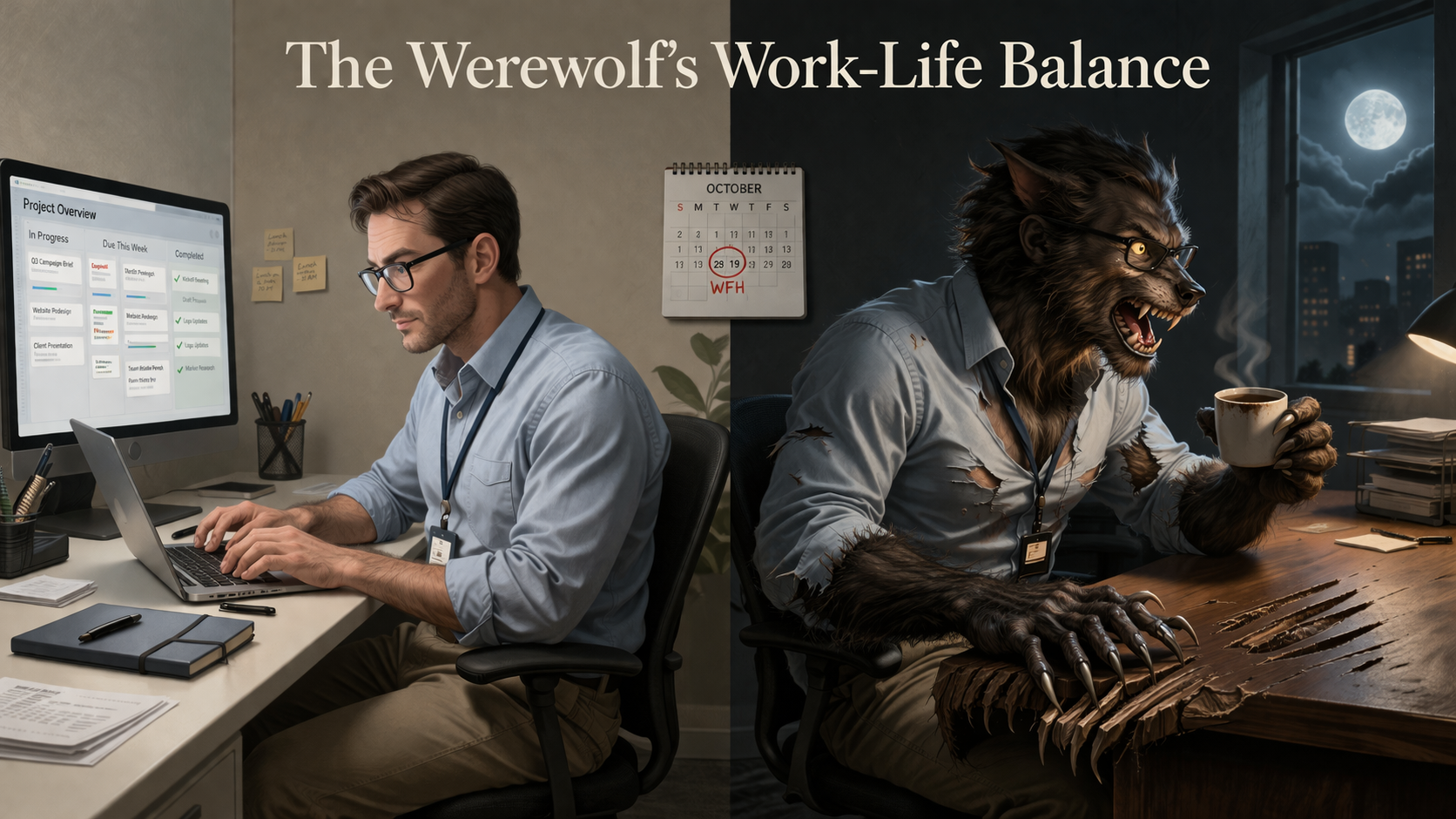
Cover Image Prompt
The title is "The Werewolf's Work-Life Balance" in light text at the top. Please generate a 16:9 cover image in modern editorial illustration style depicting a split office scene. On the left side, a werewolf in human form — a mild-looking man in his mid-thirties, button-down shirt, khaki pants, glasses, lanyard — sits at a neat desk with a laptop and a project management dashboard on screen. On the right side, the same figure mid-transformation: shirt mostly intact but strained, hands becoming claws, eyes yellow, jaw extending, still somehow gripping a coffee mug in one partially-wolf claw. The desk on the right side is dented and has claw marks along the edge. Between the two halves, a small calendar on the wall shows a full moon circled in red with the notation "WFH." The color palette is office beige and gray on the left, deeper charcoal and amber on the right, with the full moon casting a cold silver light from a window. Tone: the split professional identity, played completely straight. Generate the image immediately without asking clarifying questions.Narrative Prompt
This is a satirical graphic novel story about the impossible demands of the modern hybrid workplace — the expectation that employees perform consistently across radically different contexts, maintain a unified "personal brand" regardless of circumstance, and accommodate their own complexity within whatever policy framework HR has produced this quarter. The werewolf is not a villain. The werewolf is a dedicated project manager who happens to undergo a full physiological transformation during certain calendar events that HR has categorized as "scheduled personal needs." The allegory targets: the hybrid work policy as a document that describes a world that does not exist; the HR accommodation process as a performance of support that does not change the underlying conditions; the expectation of consistent professional identity across contexts that are not professionally identical; and the performance review as a mechanism that evaluates outputs without examining the conditions under which they were produced. Tone: Deadpan, procedural, and grimly sympathetic. The humor comes from the company's documents being entirely reasonable on their face and entirely unworkable in practice. The werewolf should never be monstrous — only professional, exhausted, and doing its best. Art style: Modern editorial illustration — clean lines, flat colors, corporate office aesthetic. The werewolf's human form is neat and slightly rumpled. The wolf form retains the business casual clothing (increasingly shredded). The office environment should look completely normal except for the structural reinforcements, the claw marks, and the occasional bite taken out of a document.Prologue — An Accommodation, Not an Excuse
The company's Hybrid Work Policy was forty-three pages long. It had been revised eleven times since the original 2020 document, which had been eight pages and had not anticipated most of the situations it was now called upon to govern. The current version included sections on home office stipends, virtual meeting etiquette, time zone equity, ergonomic self-assessment, and, beginning with revision seven, a subsection titled "Non-Standard Physiological Schedules," which had been added following a confidential consultation with the legal department and did not name anyone specifically.
Marcus Webb had been a project manager at the firm for six years. He was organized, thorough, well-liked by his team, and reliably delivered on deadline. He also underwent a complete physical transformation into a large gray wolf on the three nights surrounding the full moon, which occurred twelve to thirteen times per year and was, HR had confirmed in writing, a qualifying condition under the company's Inclusion and Accessibility Policy.
The Transformation Accommodation Plan was fourteen pages. It had a cover sheet. Marcus had signed it in November. The cubicle reinforcements had been installed in January. By February, he had eaten two quarterly reports and one visitor badge. The accommodation was working as designed.
Panel 1 Image Prompt
Style-setting panel: Please generate a 16:9 image in modern editorial illustration style — clean lines, flat colors, neutral office palette. The scene is an open-plan office: drop ceilings, fluorescent lights, ergonomic chairs, motivational posters. In the center, a reinforced cubicle stands out from the rest: its walls are thick steel-reinforced panels, the desk is bolted to the floor, and the chair is heavy-duty with no removable parts. A small laminated sign on the cubicle entrance reads "Marcus Webb — Project Manager / Transformation Accommodation Zone." Inside the cubicle, Marcus in human form — mild-mannered, glasses, business casual, a neat pile of project folders — sits at his laptop. On the cubicle wall: a large monthly calendar with moon phases marked, several phases circled in red and labeled "WFH." On the desk, a Slack status badge on a stand reads "Currently: 🐺 Lycanthropic." The tone is completely normal, unremarkably corporate. Color palette: office beige, slate gray, fluorescent white, warm amber from a desk lamp. Generate the image immediately without asking clarifying questions.Marcus had requested one modification to the accommodation plan that HR had declined: the option to list "moon phase" as a recurring calendar event visible to his team. HR had explained that this would constitute disclosure of a protected condition. Marcus noted that his team could already see the structural reinforcement on his cubicle, the moon-phase calendar on his wall, and the Slack status option that HR had itself installed. HR acknowledged this and explained that the distinction was important. Marcus added the moon phases to his Outlook calendar as "Personal Appointment" and set them to repeat. His team stopped scheduling his Tuesday reviews in October.
Panel 2 — The Moon-Phase Calendar
Panel 2 Image Prompt
Please generate a 16:9 image in the same modern editorial illustration style. Make the characters and style consistent with the prior panel. The scene shows a close-up of two overlapping calendar views: on the left, a printed moon-phase calendar with each full moon circled in red and annotated with neat handwritten labels — "WFH," "WFH," "WFH (conference — reschedule)," "WFH (Q3 close — problem)." On the right, an Outlook calendar on a laptop screen, showing the same dates blocked off as "Personal Appointment" in a neutral gray. Next to several of these blocks, small red conflict flags: "Team All-Hands," "Client Presentation — Werner Group," "Board Prep." Marcus's human hand, visible at the keyboard, is reaching to click on the "Board Prep" conflict. His expression, visible from the side, is the expression of someone calculating something they have calculated many times before. Color palette: calendar beige, Outlook blue-gray, red conflict flags, neutral office light. Tone: the specific administrative burden of a recurring personal need in a corporate calendar system. Generate the image immediately without asking clarifying questions.The moon operated on a 29.5-day cycle. The company's quarterly calendar operated on a 91-day cycle. These two cycles aligned in ways that Marcus could predict but could not prevent. The October full moon fell on the same day as the Q3 all-hands. The January full moon fell four hours before the board preparation session. The March full moon — the one that began at 11:47 PM on a Tuesday — technically permitted his attendance at the Wednesday morning client call, provided that the transformation completed within the standard six-to-eight-hour window, which it had, in most months, done. Marcus kept a spreadsheet. The spreadsheet had conditional formatting. The cells that were red outnumbered the cells that were green by a ratio that had not improved since he had started tracking it.
Panel 3 — The Zoom Call
Panel 3 Image Prompt
Please generate a 16:9 image in the same modern editorial illustration style. Make the characters and style consistent with the prior panel. The scene is a laptop screen showing a video call grid of eight participants — a mix of human professionals in home offices and conference rooms. In one tile, Marcus is visible mid-transformation: he is in human-ish form but his jaw is slightly extended, his hands are claws on the keyboard, and his shirt collar is strained. He has turned his camera to a low angle so mostly his forehead and ceiling are visible. His Zoom status reads "Marcus Webb — PM (He/Him)." In the chat sidebar, visible messages read: "Marcus can you share your screen?" and "Marcus you're on mute" and "Marcus is that a — nevermind." The other participants show a range of expressions: polite, carefully neutral, one person is looking at something just off-screen with controlled alarm. The meeting title in the top bar reads "Werner Group — Q3 Status Check-In." Tone: the professional performance of normalcy under unusual conditions. Color palette: Zoom grid gray-blue, laptop screen glow, the slight amber of a nearly-wolf, corporate home office backgrounds. Generate the image immediately without asking clarifying questions.The March call with the Werner Group had been scheduled for 9 AM. Marcus's transformation had concluded at approximately 8:53 AM, which was technically sufficient. The issue was that "concluded" was a relative term and the full reversal of certain features — specifically the jaw, the hands, and a persistent awareness of ambient sound that made sustained concentration difficult — typically required an additional forty minutes. Marcus joined the call at 9:02. He kept his camera low. He typed his contributions to the meeting. When the client asked why he was not speaking, he explained he was having audio issues, which was accurate in the sense that his current vocal configuration was not optimized for client communication. His notes from the call were thorough. Three of the letters had claw marks through them. He had retyped those sections before sending the summary.
Panel 4 — The Quarterly Report
Panel 4 Image Prompt
Please generate a 16:9 image in the same modern editorial illustration style. Make the characters and style consistent with the prior panel. The scene shows Marcus in his human form at his reinforced desk, holding up a quarterly report document. The document is mostly intact but has a large semicircular bite taken from the upper-right corner — cleanly and deliberately, in the way that removes exactly the page numbers and the header, leaving the content readable. The bite is smooth, professional, almost precise. Marcus is examining the damage with the specific expression of someone assessing whether a document is still submittable. On his desk, a stapler, a tape dispenser, and a Post-it note that reads "scan before filing — physical copy compromised." His laptop shows an email draft with the subject line: "Q4 Report — Please Use Digital Version (Physical Compromised)." Tone: the pragmatic professionalism of managing an ongoing situation. Color palette: office beige, document white, the specific amber of a chomped edge. Generate the image immediately without asking clarifying questions.The Q4 report had been finished before the February full moon. The issue was that Marcus had stored it in his desk drawer rather than the shared drive, a decision he had made to avoid the version-control conversation and had subsequently regretted for reasons he had not fully anticipated at the time of the decision. The bite was structural — it had removed the upper-right corner of pages one through seven, including the executive summary header and the table of contents page numbers, but had left the data intact. Marcus scanned the document, cropped the damaged sections, and submitted the digital version with a note explaining that the physical copy had been "compromised during storage." His manager, a practical otter named Diane, had replied: "Got it. Is the data complete?" Marcus confirmed that the data was complete. Diane marked it received. The physical copy went into the shredder, which handled it without comment.
Panel 5 — The Expense Report
Panel 5 Image Prompt
Please generate a 16:9 image in the same modern editorial illustration style. Make the characters and style consistent with the prior panel. The scene shows an expense report form on Marcus's laptop screen, partially completed. Visible line items include: "Client dinner — $84.50 (Approved)," "Conference registration — $450.00 (Pending)," "Office supplies — $23.11 (Approved)," and then, at the bottom: "Property damage (involuntary) — $340.00." In the "Description" field for the last item: "Desk lamp, one (1) ergonomic chair armrest, door handle (replacement, interior), and partial wall panel in Conference Room B. Dates: Feb 4-5. See attached Incident Report #IR-2024-019." A dropdown next to the line item shows Marcus hovering over category options: "Business Travel," "Meals & Entertainment," "Office Supplies," "Other." He has selected "Other." The tooltip on "Other" reads: "Requires VP approval for amounts over $250." Marcus's expression is that of someone who has done this before. Tone: the bureaucratic normalization of the unusual. Color palette: expense report blue-gray, laptop white, the neutral of administrative inevitability. Generate the image immediately without asking clarifying questions.The expense report policy categorized reimbursable items under eleven headers. "Property damage (involuntary)" was not among them. Marcus had initially tried "Office Supplies (Replacement)," which had been rejected by the automated system because replacement parts for a load-bearing wall panel did not qualify as supplies. He had tried "Facilities" — no employee-submitted category. He had tried "Other," which required VP approval for amounts over $250, which this was. The VP, a large iguana named Reginald who had approved three prior versions of this expense report in previous quarters, had approved it without comment and added a note to his assistant to establish a standing pre-authorization for Marcus's February and October submissions. This was efficient. Marcus appreciated it. He sent Reginald a thank-you email. Reginald replied: "Let's just set up a template." They set up a template. The template was titled "Monthly Operations — Special Conditions." It auto-populated the description. Marcus submitted it monthly. It was approved automatically. This was how institutional accommodation actually worked, as opposed to how it was described in the policy documents.
Panel 6 — The In-Office Day
Panel 6 Image Prompt
Please generate a 16:text image in the same modern editorial illustration style. Make the characters and style consistent with the prior panel. The scene is the open-plan office on a regular in-office day, not a moon day. Marcus in full human form is at his reinforced cubicle, laptop open, coffee cup in hand, talking to a colleague — a cheerful fox in a cardigan — who has rolled their chair over to chat. The conversation appears pleasant and normal. In the background, other employees walk past with laptops and coffee. Two of them glance at the steel-reinforced cubicle walls with the casual acceptance of people who have worked near something long enough to stop noticing it. On the wall behind Marcus, the moon-phase calendar is visible, as is a framed print that reads "COLLABORATION IS A TEAM SPORT." The reinforced door to the cubicle is open. A small sign on the doorframe says "Please knock — even if open." The tone is: completely normal Tuesday. Color palette: warm office beige, fluorescent white, soft blues and grays, the slight visual incongruity of reinforced steel in a beige office. Generate the image immediately without asking clarifying questions.On in-office days that did not coincide with lunar events, Marcus was, by most observable measures, an entirely ordinary project manager. He arrived at 8:40. He made coffee. He reviewed his Asana board and attended his 9 AM standup with his camera on and his audio functional. He gave feedback on deliverables, resolved two cross-team dependencies, and updated three project timelines. He had lunch with the fox from the adjacent team and discussed the Q1 roadmap. He was good at his job. He had been good at his job for six years. The reinforced cubicle was simply where he sat. His colleagues had stopped noticing it approximately two weeks after installation, which was the standard timeline for any office change, including the new printer, the different brand of coffee, and the structural modifications to a load-bearing workspace accommodation zone. Offices normalize everything. This was, Marcus had concluded, both reassuring and faintly alarming.
Panel 7 — The Slack Status
Panel 7 Image Prompt
Please generate a 16:9 image in the same modern editorial illustration style. Make the characters and style consistent with the prior panel. The scene shows a Slack interface on Marcus's laptop during a partial transformation evening — he is at his home desk (a reinforced version of his office setup, with similarly dented edges), mid-wolf, still in his work shirt which has not yet given up entirely. The Slack status dropdown is open on screen, showing available options: "🟢 Active," "🟡 Away," "🔴 Do Not Disturb," "🏠 Working Remotely," "📅 In a Meeting," "🐺 Currently Lycanthropic (estimated return: morning)." Marcus has his partially-clawed hand hovering over the "Currently Lycanthropic" option. In the main channel visible behind the dropdown, messages from teammates: "Marcus quick question on the Harmon timeline," "Marcus you around?", "@marcus ping when you're back," and, from Marcus three hours earlier, "OOO — back tomorrow — async only until 9am." His out-of-office message is visible in his profile: "Unavailable: Feb 4-5. For urgent matters contact Diane. For non-urgent matters, they are not urgent." Tone: the professional management of personal unavailability, with a status option that required a Zendesk ticket to create. Color palette: Slack purple and white, home office warm amber, the slight gray of a mid-transformation. Generate the image immediately without asking clarifying questions.The "Currently Lycanthropic" Slack status had required a support ticket. The Slack administrator — a meticulous crow named Yolanda — had escalated it to IT, who had escalated it to HR, who had confirmed it was an approved accommodation and escalated it back to IT, who had created the status option with the wolf emoji and the default duration of "until tomorrow morning," which covered the standard transformation window. Yolanda had also created a custom notification rule that auto-set Marcus's status during the three calendar days surrounding the full moon, which meant Marcus did not have to remember to set it himself, which had been a problem in the early months when he had occasionally forgotten and a colleague had walked to his home address with a casserole because they thought he was sick. The casserole had been fine. The explanation had been less fine. The custom notification rule was better for everyone.
Panel 8 — The Performance Review
Panel 8 Image Prompt
Please generate a 16:9 image in the same modern editorial illustration style. Make the characters and style consistent with the prior panel. The scene is an annual performance review meeting: a small glass-walled conference room, Marcus in human form across a table from Diane the otter — his manager, professional and warm — who has a printed review form and a laptop open. On the review form, visible sections include ratings: "Delivery: Exceeds Expectations," "Collaboration: Meets Expectations," "Communication: Meets Expectations," and at the bottom, in a "Development Areas" box, handwritten text reading: "Inconsistent personal brand across platforms. Recommend: unified professional presence strategy." Marcus is reading this last note with the expression of someone who has received feedback that is technically accurate and entirely beside the point. Diane has the expression of someone who did not write this note and is also reading it for the first time. On the wall behind them, a poster reads "YOUR BEST SELF, EVERY DAY." Color palette: conference room glass and gray, review form white, the slight warm light of a professional meeting. Tone: the performance review as a document that describes a world that does not correspond to the one being reviewed. Generate the image immediately without asking clarifying questions.The performance review rated Marcus "Exceeds Expectations" on delivery, "Meets Expectations" on collaboration and communication, and included one development area, which Diane read aloud with the careful neutrality of a person reading something they had not written and did not fully endorse: "Inconsistent personal brand across platforms." The note had been generated by the 360-degree feedback algorithm, which had compared Marcus's LinkedIn profile photo (professional headshot, business casual, slight smile) with his Slack profile (same headshot), his client-facing email signature (same), and two instances of video call footage in which he had been, in the algorithm's classification, "not visually consistent with baseline professional presentation." Marcus asked if the algorithm understood the reason for the inconsistency. Diane confirmed that the algorithm did not take reason into account. Marcus asked if the note could be removed. Diane said that development areas required a response in the system, but that he could write "See Accommodation Plan, Appendix C" in the response field. He did. The system accepted it. The review was filed. His rating did not change. He was, by the numbers, doing well. This was true and also incomplete, in the way that performance reviews reliably were.
Epilogue — Excellent Adaptability
The following year, Marcus was promoted to Senior Project Manager. His promotion memo cited his "exceptional delivery track record, cross-functional collaboration, and demonstrated adaptability under non-standard working conditions." The structural reinforcements were upgraded to accommodate the new role's requirement for a private office. The private office door was rated for higher impact loads. The moon-phase calendar was reprinted in a larger format and laminated.
At the all-hands announcing his promotion, the CEO mentioned Marcus as an example of the company's commitment to "meeting employees where they are." The slide behind the CEO showed a stock photo of a sunrise. Nobody mentioned the accommodation plan. Nobody mentioned the expense report template. Nobody mentioned Yolanda's custom Slack notification rule, or Reginald's standing pre-authorization, or Diane's careful reading of a performance note she had not written and did not endorse.
These were the actual accommodations. The policy document was forty-three pages. The accommodations were four people doing their jobs thoughtfully. Marcus sent each of them a thank-you card in December. He wrote them by hand. The handwriting was very neat, except in October, when he wrote them by claw. Those four he recopied.
| What the Policy Said | What Actually Happened | What This Looks Like Everywhere |
|---|---|---|
| "Transformation Accommodation Plan" | A reinforced cubicle and a standing expense pre-authorization | Formal accommodations describe intent; informal adjustments deliver it |
| "Non-Standard Physiological Schedule" | Moon-phase blocking on a shared calendar labeled "Personal Appointment" | Systems that cannot name a thing make the person manage it invisibly |
| "Consistent professional presence" | Four people who understood context and adjusted accordingly | Brand consistency is a metric for a world where context doesn't change |
| "3 days in-office, 2 remote, wolf as needed" | A policy that described a schedule and a reality that required a spreadsheet | Hybrid work policies govern average cases; the non-average cases govern themselves |
| Performance review: "inconsistent personal brand" | "See Accommodation Plan, Appendix C" | Evaluation systems measure outputs without modeling the conditions that produced them |
| "Meeting employees where they are" | A Slack notification rule and a laminated calendar | The CEO slide was a sunrise. The accommodation was Yolanda's admin work. |
Call to Action
The next time your company announces a new hybrid work policy, count how many pages it is. Then count how many pages the lived experience of that policy will require that are not in the document.
The difference is what your colleagues are managing without being asked about it, without being credited for it, and without the performance review algorithm knowing it exists.
Ask Yolanda how she is doing. She set up a lot of custom notification rules last quarter. She has not mentioned it.
"The accommodation plan is fourteen pages. The actual accommodation is four people being decent. I appreciate both, but I know which one I would miss." —Marcus Webb, Senior Project Manager, annual review response field
"Development area: inconsistent personal brand. I am choosing to interpret this as a compliment." —Marcus Webb, same document, two lines later
References
-
Hybrid work — Wikipedia overview of hybrid workplace models, including the policy frameworks, equity challenges, and practical implementation gaps that the werewolf's situation satirizes.
-
Workplace accommodation — The legal and organizational framework for reasonable accommodations, including the gap between what policy documents describe and what operational adjustments actually deliver.
-
Personal branding — The concept of maintaining a unified professional identity across platforms, contexts, and presentations — applied here to someone whose contexts are fundamentally incompatible.
-
Performance appraisal — The structural limitations of formal evaluation systems, including their tendency to measure observable outputs while remaining blind to the conditions that produced them.
-
Lycanthropy — Wikipedia's overview of the werewolf mythology, including the historical anxiety about the self that cannot be reconciled — a theme that translates with minimal modification to the modern hybrid work context.