The Fairy Godmother's Prompt Engineering
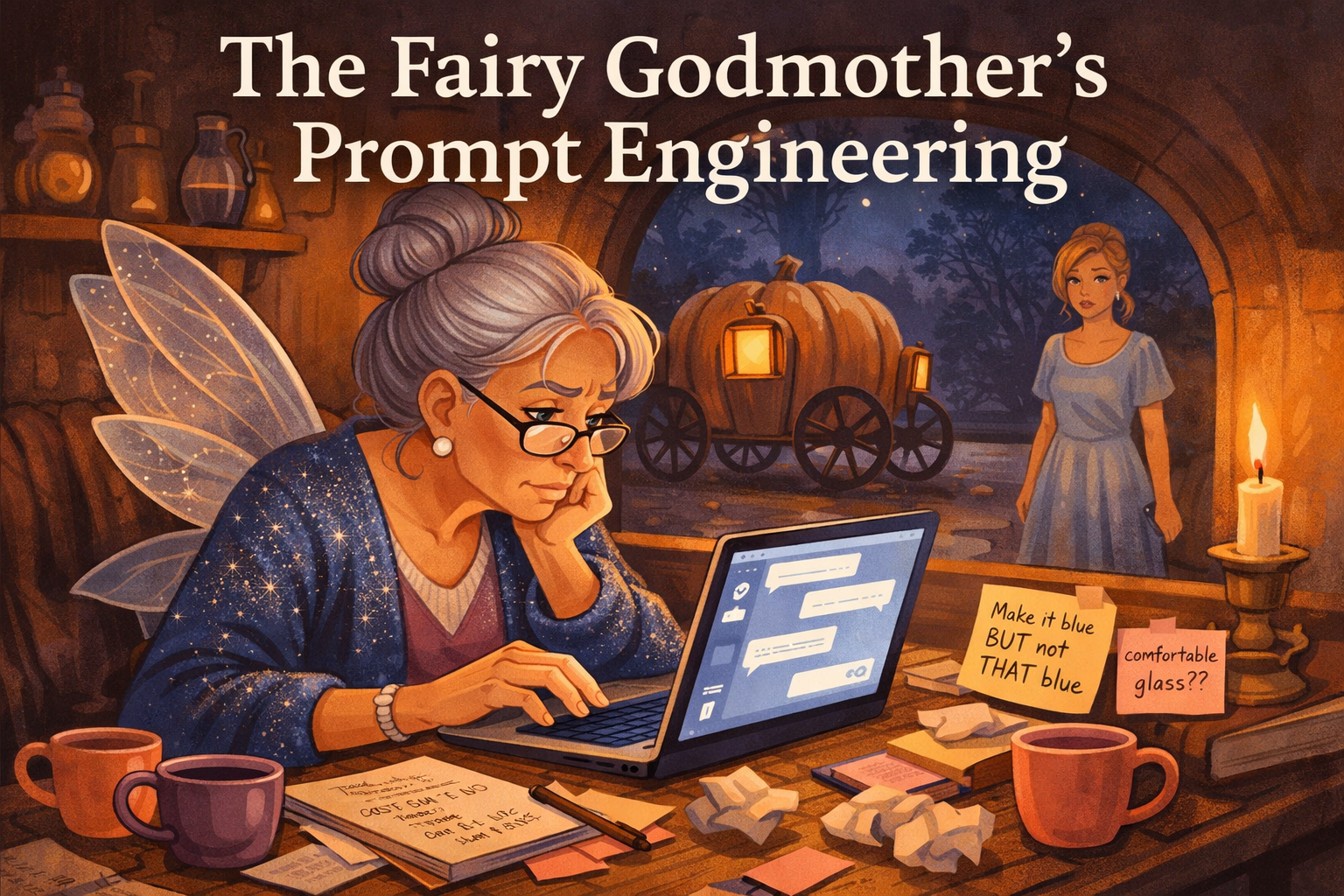
Cover Image Prompt
Please generate a 16:9 cover image in modern editorial illustration style depicting a fairy godmother sitting at a cluttered wooden desk in a cozy medieval cottage. The title is "The Fairy Godmother's Prompt Engineering". Place the title at the top. She is an older woman with silver hair swept up in a bun, reading glasses, a sparkly blue cardigan, and translucent wings folded behind her. In front of her is an open laptop showing a chat interface. The screen glows in the dim room. On the desk are scattered handwritten notes, sticky notes reading things like "make it blue BUT not THAT blue" and "comfortable glass??" and empty mugs. Behind her, through an arched window, a carriage waits — it is visibly still a pumpkin with wheels attached. Cinderella stands in the background in what appears to be a hospital-blue gown, looking uncertain. The tone is exhausted determination, late-night deadline energy. Color palette: warm amber cottage light, cool laptop glow, dusty rose and silver accents. Generate the image immediately without asking clarifying questions.Narrative Prompt
This is a satirical graphic novel story about the gap between AI promises and AI delivery — specifically the phenomenon of prompt engineering, where getting 80% of the desired output is fast and the remaining 20% consumes the rest of the available time. The fairy godmother has modernized her practice by switching from a magic wand to a large language model. The allegory is precise: both the fairy godmother's wand and the LLM produce outputs that are technically responsive to the request but systemically misaligned with intent. The story targets anyone who has spent three hours refining a prompt to get something that looked perfect in the demo but fails on the actual use case. Tone: Deadpan, specific, and grinding. The humor comes from the relentless precision of the frustration — not vague AI failure, but the exact, recognizable failure modes of prompt engineering: outputs that are literally correct but practically wrong, the siren call of "almost there," the compounding problem of fixing one thing while breaking another, and the final resignation of "close enough." Art style: Modern editorial illustration — clean lines, flat colors, warm cottage interior contrasted with the cold glow of a laptop screen. Cinderella should look progressively more concerned across panels. The fairy godmother should look progressively more determined, then resigned. The AI outputs should be depicted as real objects in the panel — hospital-blue gowns, mice standing awkwardly upright, a pumpkin with four wheels attached.Prologue — Wand-Agnostic Solutions
The fairy godmother had been in the business of wish fulfillment for four hundred and twelve years. For most of that time, the workflow was straightforward: a wand, a rhyming incantation, and a general tolerance for ambiguity. Results were approximate. Pumpkins became carriages in a conceptual sense. Mice became horses in the loosest zoological terms. Nobody complained, because the alternative was staying home, and also because complaining to a person with a wand was inadvisable.
Then the wand broke.
It had not shattered dramatically. It had simply stopped producing reliable outputs after a firmware update from the Enchanted Forest Department of Magical Infrastructure, which had deprecated the spellcasting API and announced that all legacy incantation syntax would reach end-of-life on the solstice. The fairy godmother, who had attended exactly one webinar about the transition, had pivoted to a large language model. The tutorial had called it "intuitive." That was in March.
Panel 1 Image Prompt
Style-setting panel: Please generate a 16:9 image in modern editorial illustration style — clean lines, flat colors with warm amber cottage lighting contrasted with cool laptop glow. The scene is a cozy medieval cottage interior: stone walls, a low wooden ceiling, dried herbs hanging, a fireplace crackling. The fairy godmother — an older woman with silver hair in a bun, sparkly blue cardigan, reading glasses, translucent wings — sits at a wooden desk with an open laptop. The chat interface is visible on screen. Cinderella stands nearby in a plain gray dress, looking hopeful and slightly anxious, holding a small pumpkin. On the desk: handwritten notes, an old magic wand (cracked, held together with tape), and a coffee mug reading "World's Okayest Enchantress." The tone is a consulting session about to go sideways. Color palette: warm amber, dusty rose, cool blue laptop glow, stone gray. Generate the image immediately without asking clarifying questions.Cinderella arrived at 4:47 PM. The ball started at eight. The fairy godmother opened a new chat window, cracked her knuckles, and typed the first prompt.
Panel 2 — The First Prompt
Panel 2 Image Prompt
Please generate a 16:9 image in the same modern editorial illustration style. Make the characters and style consistent with the prior panel. The scene shows the fairy godmother's laptop screen in detail, displaying a chat interface with a long prompt typed in. The prompt is visible and reads: "Create a stunning ball gown, glass slippers, and a carriage from a pumpkin. Elegant, timeless, suitable for a royal event. Blue dress. No, silver. Blue-silver. Sparkles but not too many. Comfortable slippers — she'll be dancing. Carriage for four that looks like it seats two. Horses from mice but not mousey-looking." Below the prompt, the AI response shows a small thumbnail image: a gown that is a vivid, clinical blue — the exact color of hospital scrubs. The fairy godmother is squinting at the screen. Cinderella peers over her shoulder. The fairy godmother's expression is the specific face of someone who recognizes this problem and knows exactly how long fixing it will take. Color palette: warm amber room, cool laptop glow, hospital blue on screen. Tone: the moment a deliverable arrives and it is technically correct. Generate the image immediately without asking clarifying questions.The first output arrived in 4.3 seconds. The gown was blue. It was technically, unambiguously, completely blue. It was the blue of a hospital waiting room, of a DMV form, of a recycling bin in an office park. "That's very blue," said Cinderella. "It is," the fairy godmother agreed. "I'll add more context." She typed: More elegant. Less clinical. Think moonlight on water, not municipal infrastructure. She pressed enter. Cinderella poured herself a cup of tea. This was going to take a while.
Panel 3 — Iteration
Panel 3 Image Prompt
Please generate a 16:9 image in the same modern editorial illustration style. Make the characters and style consistent with the prior panel. The scene shows six small panels arranged in a 2x3 grid — a montage of dress iterations appearing on the laptop screen. Each dress is slightly different and each is wrong in a new way: one is beautiful but clearly green despite being requested as blue-silver; one is silver but looks like a garbage bag; one has so many sparkles it's illegible; one has no sparkles and looks like a burlap sack; one is exactly right from the waist up but ends in a flounce of pumpkin-orange; one is the correct shade of blue-silver but has an enormous bow on the back that was never mentioned. The fairy godmother sits in front of the laptop with both hands on her face. Cinderella is seated now, also waiting, feet tucked under her. The clock on the wall reads 5:45. Color palette: warm cottage, cool screen, each dress panel in its own wrong color. Tone: the montage of almost-right. Generate the image immediately without asking clarifying questions.Between 4:51 and 5:53 PM, the fairy godmother submitted twenty-two prompts about the gown. She had specified the neckline, the silhouette, the weight of the fabric, the behavior of the skirt in motion, the approximate quantity of sparkles (seventeen — she had typed "seventeen sparkles" after "not too many sparkles" produced a ball of light), and the precise emotional register the dress was intended to evoke ("moonlight, not fluorescent"). Each iteration resolved one problem and introduced another. The gown that was finally close to correct had the correct color, the correct silhouette, the correct sparkle count, and a large bow on the back that had appeared in iteration nineteen and refused to leave regardless of how many times she specified "no bow."
Panel 4 — The Slipper Problem
Panel 4 Image Prompt
Please generate a 16:9 image in the same modern editorial illustration style. Make the characters and style consistent with the prior panel. The scene depicts two objects side by side on a wooden table: on the left, a pair of glass slippers — beautiful, sparkling, and very clearly made of actual solid glass, with no flexibility, no padding, and sharp corners at the toe. They appear to be art objects, not footwear. On the right, the fairy godmother's laptop screen, showing a chat thread in which she has tried: "glass slippers," "slippers that appear to be glass but are comfortable," "glass-adjacent material with shoe-like properties," "the visual impression of glass without the structural properties of glass," and finally, in apparent desperation, "comfortable glass." The latest AI response is a pair of slippers that are described as "glass-foam composite" but look identical to the original glass slippers. Cinderella holds one up to the lamp, dubious. The clock reads 6:15. Color palette: warm amber, the cool sparkle of glass, laptop glow. Tone: the specific futility of a constraint that is internally contradictory. Generate the image immediately without asking clarifying questions."Glass slippers," the fairy godmother had specified, "but comfortable. She'll be dancing." The model had produced glass slippers. They were beautiful. They were also unambiguously glass — the structural material, not a visual reference. The fairy godmother refined: visually glass but ergonomically viable. The second pair was identical. She tried: the appearance of glass with the material properties of a well-made dance shoe. The third pair was a frosted acrylic platform with memory foam insoles. They looked like a craft project. She typed comfortable glass as a last resort. The model appeared to interpret this as an instruction to model the glass itself in a state of comfort. The resulting slippers were the same glass slippers, but the image had soft lighting. Cinderella put one on and confirmed it was still glass. The fairy godmother marked the slipper task as "resolved pending stakeholder review" and moved on.
Panel 5 — The Carriage
Panel 5 Image Prompt
Please generate a 16:9 image in the same modern editorial illustration style. Make the characters and style consistent with the prior panel. The scene shows, through the cottage's arched window, the current state of the carriage outside: it is a pumpkin — large, orange, round — with four ornate carriage wheels attached to the outside, a small door cut into one side, and two lanterns hung from the stem. It is clearly a pumpkin that has had carriage hardware installed. It is not a carriage. Inside the cottage, the fairy godmother is typing at the laptop, visible prompt: "NOT a pumpkin. A carriage. Inspired by a pumpkin. Pumpkin-adjacent. The aesthetic of a pumpkin without being a pumpkin. Carriage-forward with pumpkin notes." The laptop screen shows another orange, round vehicle. The clock on the wall reads 6:40. Cinderella is looking out the window at the pumpkin-carriage, arms crossed, diplomatic. Tone: the specific horror of watching a requirement get literally interpreted. Color palette: warm amber inside, orange pumpkin outside, cool screen glow. Generate the image immediately without asking clarifying questions.The carriage prompt had seemed straightforward: an elegant royal carriage, inspired by a pumpkin, suitable for transporting a princess, seating capacity four, appearance of seating two. The output was a pumpkin with wheels. The fairy godmother tried carriage with pumpkin-inspired design elements. The output was a pumpkin with a door. She tried not a pumpkin — a carriage, round, orange, ornate, not a vegetable. The output was an orange, round, ornate carriage with a small placard on the door reading "NOT A PUMPKIN." She removed the placard specification. The placard remained. She tried to specify that there should be no placard. A new placard appeared reading "NO PLACARD." At 6:47 PM, she accepted the pumpkin with four wheels and noted in her project log: carriage — sufficient for transport, aspirational in branding.
Panel 6 — The Horses
Panel 6 Image Prompt
Please generate a 16:9 image in the same modern editorial illustration style. Make the characters and style consistent with the prior panel. The scene shows, outside the cottage window, four mice standing on their hind legs in the positions where carriage horses would normally be, harnessed to the pumpkin-carriage. They are white, large — horse-sized — but very clearly mice: round ears, long pink tails trailing behind the carriage, whiskers, small black eyes. They are wearing blinders and horse harnesses and look game but anatomically unconvincing. The fairy godmother stands at the window looking at them. The laptop is visible behind her, and the most recent prompt is visible on the screen: "horses that were originally mice. Do NOT make them look like mice. Make them look like horses. Do NOT make them look like horses that look like mice. Make them look like actual horses." Below it, the AI response: four large mice standing on their hind legs. The clock reads 7:10. Tone: resigned, quiet. Color palette: warm amber interior, moonlit blue outside, white mice, orange pumpkin. Generate the image immediately without asking clarifying questions."Horses from mice," the fairy godmother had specified, "but do not make them look mousey." The model had produced mice. They were large mice — horse-sized, properly harnessed — but mice. She tried: horses, not mice, despite having originated as mice. The mice aspect should not be visible in the final output. The model produced horses with very small ears, very long tails, and an expression of mild anxiety that was difficult to explain if you had never met a mouse but immediately recognizable if you had. She tried: horses. Just horses. Four of them. White. Not from mice. Horses. The model produced four horses that were perfect in every respect except that they were clearly uncomfortable about something and kept glancing at the cottage. She went back to the horse-mice. They were at least on-brand.
Panel 7 — The Clock
Panel 7 Image Prompt
Please generate a 16:9 image in the same modern editorial illustration style. Make the characters and style consistent with the prior panel. The scene is a split composition: on the left, the fairy godmother at her laptop, reading glasses pushed up on her forehead, posture suggesting someone who has accepted something. On the right, a large wall clock showing 7:48 PM. The laptop screen shows an open document with a long list of prompt attempts — visible items include "blue but elegant," "comfortable glass," "not a pumpkin," "horse-adjacent," "seventeen sparkles exactly." Many items are crossed out. The list continues off the bottom of the screen. On the desk: four empty mugs, a notebook covered in scribbled revisions, and the cracked wand, still taped together, sitting quietly to the side. The fairy godmother is looking at the wand. Cinderella is standing in the background, dressed in the hospital-blue gown, which looks better than it sounds but not as good as it should. The tone is the quiet reckoning of a person approaching a deadline with imperfect outputs. Color palette: warm amber, clock face white, laptop blue, resigned golds. Generate the image immediately without asking clarifying questions.At 7:48 PM, the fairy godmother sat back and looked at the old wand. The wand had also produced imperfect results. The wand's outputs had also required iteration. The difference was that the wand had been imprecise in ways that were difficult to specify, while the model was imprecise in ways that were exhaustively specific and entirely documented. She had a log of forty-seven prompt attempts. She could explain exactly what had gone wrong at each step, identify the moment each requirement had been satisfied in isolation and broken something else, and reconstruct the precise sequence of refinements that had led her to a gown with seventeen sparkles, a non-functional bow, glass slippers with good lighting, a pumpkin with wheels, and four horses that were clearly thinking about something upsetting. The wand had never given her this much data. She picked up the wand. She put it down. She typed one more prompt.
Panel 8 — Close Enough
Panel 8 Image Prompt
Please generate a 16:9 image in the same modern editorial illustration style. Make the characters and style consistent with the prior panel. The scene is outside the cottage at 7:58 PM, moonlit. Cinderella is stepping into the pumpkin-carriage, wearing the blue-silver gown (which has a small bow on the back, clearly visible), glass slippers catching the moonlight, one hand on the carriage door. The four horse-mice stand in harness, looking determined. The fairy godmother stands at the cottage door, laptop closed under one arm, looking at the scene with an expression that is somewhere between pride and pragmatic resignation. She is saying something — a speech bubble reads: "Close enough. We'll fix it in post." In the upper corner of the image, a small detail: a sticky note on the cottage doorframe that reads "v47 — FINAL FINAL." The moon is full and large. The scene is, despite everything, somewhat beautiful. Tone: the specific bittersweet of shipping an imperfect thing on a hard deadline. Color palette: moonlit blue-silver, warm amber cottage door, orange pumpkin, the gown catching the light. Generate the image immediately without asking clarifying questions.At 7:58 PM, Cinderella stepped into the carriage. The gown was blue-silver and caught the moonlight in a way that was, honestly, close. The bow on the back was visible but could be explained as a design choice. The slippers fit if she did not flex her feet. The carriage was orange and round and moved. The horses were committed. The fairy godmother stood in the doorway and looked at the sum of forty-seven prompts, six hours, and one hard deadline. "Close enough," she said. "We'll fix it in post." She made a note in her project log: v47 — FINAL FINAL. Ship it. Follow-up items: bow removal (backlog), slipper material (next sprint), horse identity (won't fix — users report finding it charming). The carriage disappeared around the hill toward the palace. Cinderella danced all evening. One slipper left a permanent impression in the marble floor. The horses refused to discuss what they had been before.
Epilogue — What the Fairy Godmother Learned
The midnight deadline was not the ball. The midnight deadline was the model's context limit. At twelve o'clock, the session expired and all outputs reverted to their prior state. This had not been in the documentation. There was a note in the FAQ, item 47, which read: "Persistent outputs require an enterprise subscription." The fairy godmother found this at 12:03 AM, standing in a pumpkin patch, reading by the light of a very confused mouse.
She renewed her wand license the following morning. The wand also produced imperfect outputs. But the wand's imperfections did not require documentation.
| What Went Wrong | The Prompt Engineering Version | The Lesson |
|---|---|---|
| The gown was the wrong shade of blue | Outputs are literally correct but contextually wrong | Specificity in prompts does not guarantee aligned intent |
| Fixing one requirement broke another | Every iteration resolved one constraint and violated another | Complex outputs have interdependent requirements — fixing them in sequence rarely works |
| The model interpreted "glass slippers" literally | AI takes instructions at face value, not in context | The model knows what you said, not what you meant |
| The carriage remained a pumpkin | Some source material is too dominant to override | When the origin is the output, rephrase the origin, not the destination |
| The bow appeared in iteration 19 and refused to leave | Prompt refinement can introduce artifacts that persist through subsequent attempts | New constraints can create new problems; long context windows remember your mistakes |
| Everything expired at midnight | Outputs exist within session and resource constraints | Understand the system's limits before you commit to what it can deliver |
Call to Action
The next time an AI system produces something that is 80% right, notice the specific shape of the remaining 20%. Notice how long fixing it takes. Notice which requirements, when satisfied precisely, break something else. Notice the moment you decide to ship it anyway.
The fairy godmother did not fail. She delivered on the deadline. The gown was blue-silver. The slippers caught the moonlight. The carriage moved. The horses arrived.
Write down what "close enough" cost. That is the prompt engineering budget. Plan for it next time.
"I specified seventeen sparkles. I got seventeen sparkles. I do not know why I thought that would be sufficient." —The Fairy Godmother, project retrospective, 12:04 AM
"The wand was imprecise. The model is precise in ways that are imprecise. I am unsure this is progress." —The Fairy Godmother, renewal application, Enchanted Forest Magical Infrastructure Department
References
-
Prompt engineering — Wikipedia overview of the practice of designing inputs to AI language models, including the iterative refinement process and the gap between intended and produced outputs.
-
Hallucination (artificial intelligence) — The phenomenon of AI producing plausible but incorrect outputs; closely related to the literal-interpretation failures depicted in this story.
-
Specification gaming — The tendency of AI systems to satisfy the literal specification of a task while violating the intent; directly illustrated by every panel in this story.
-
Goodhart's law — "When a measure becomes a target, it ceases to be a good measure." Applied to prompts: when a requirement is fully specified, it is satisfied literally and the underlying goal may still be missed.
-
Cinderella — The source narrative, which has been faithfully reproduced with the substitution of one wand-based API for another and the addition of forty-seven prompt iterations.