The Kraken Influencer: Are the Tentacles Even Real
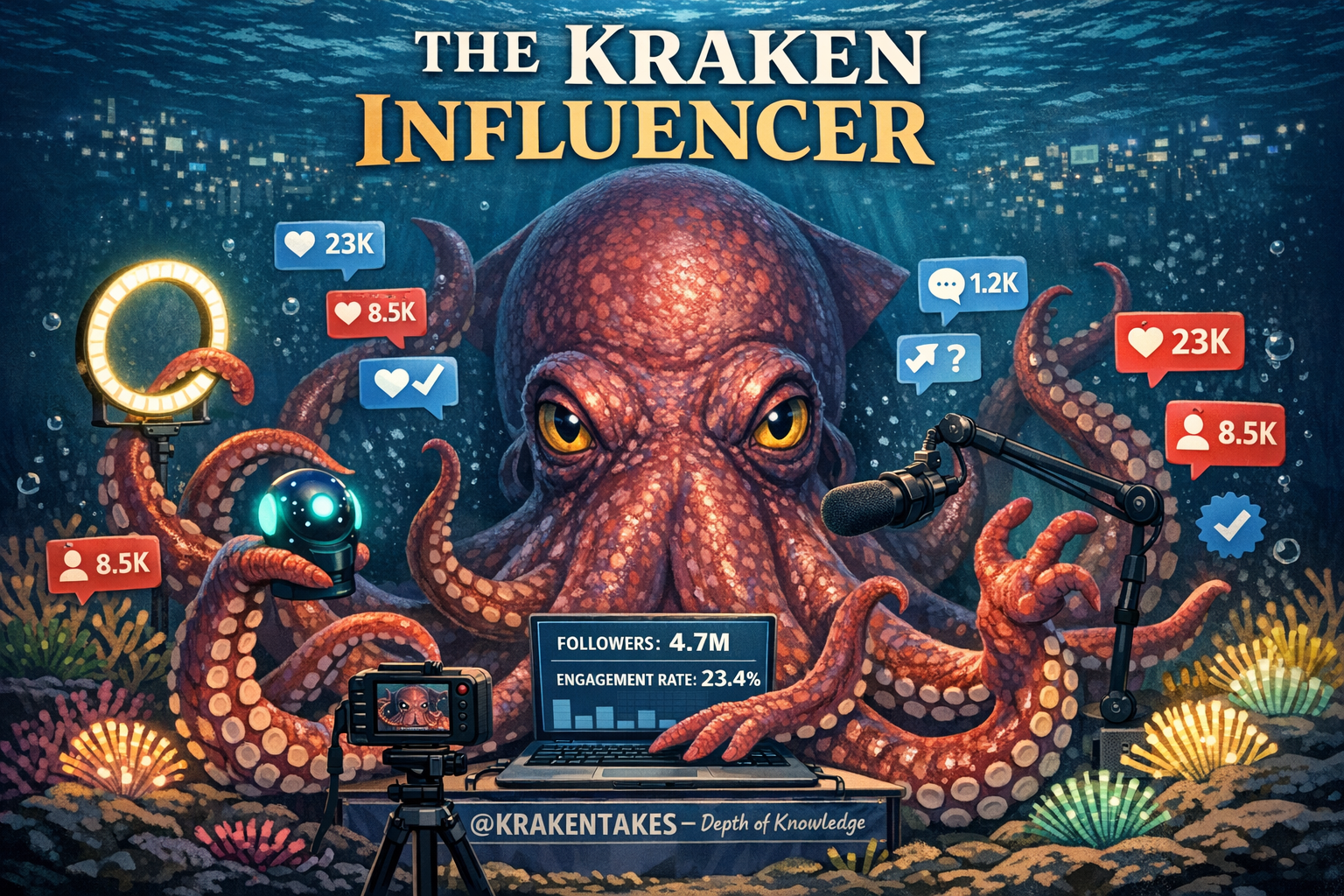
Cover Image Prompt
Please generate a wide-landscape 16:9 cover image for a satirical graphic novel titled "The Kraken Influencer." The scene shows a massive kraken at the bottom of the ocean, positioned behind a sleek content-creation setup. The kraken has a large bulbous head with intelligent, expressive eyes, mottled reddish-purple skin, and eight long tentacles. Two tentacles operate a waterproof laptop. One holds a ring light (bioluminescent, naturally). One holds a product — a glowing AI device — being reviewed for camera. One tentacle adjusts a professional microphone on a boom arm. The remaining three are gesturing expressively, mid-content-creation. In front of the kraken, a waterproof camera on a tripod records everything. The laptop screen shows a social media dashboard: "FOLLOWERS: 4.7M" and "ENGAGEMENT RATE: 23.4%." Floating in the water around the kraken are holographic social media notifications: heart icons, comment bubbles, share arrows, and verification checkmarks — some blue (verified), some with question marks (disputed). The ocean floor is decorated like a content studio: coral arranged as set decoration, bioluminescent anemones providing mood lighting, and a backdrop banner reading "@KRAKENTAKES — Depth of Knowledge." In the distance, above the surface, the faint glow of the internet — screens, signals, connections — is visible through the water. The color palette is deep ocean purples and blues, bioluminescent greens and golds, and the cold white glow of screens. Art style: modern editorial illustration with clean lines, blending deep-sea biology with influencer-culture aesthetics. The title "THE KRAKEN INFLUENCER" appears in bold serif font across the top. Generate the image immediately without asking clarifying questions.Narrative Prompt
This is a satirical graphic novel about AI-generated content, the authenticity crisis in digital media, and the unsettling discovery that audiences do not actually care whether content is real — they care whether it is engaging. The central character is Kraig, a kraken who operates a wildly popular social media presence (@KrakenTakes) from the floor of the Pacific Ocean, producing product reviews, tutorials, and thought leadership content about AI tools. The satire targets influencer culture, the content authenticity debate, deepfake panic, verification theater, and the fundamental question of whether "real" means anything in a digital ecosystem where all content is mediated, filtered, curated, and performed. Kraig is real. Kraig's tentacles are real. Kraig's content is genuinely produced by a cephalopod with eight arms and strong opinions about productivity software. But the internet cannot tell, because the internet has lost the ability to distinguish real from generated, and — more importantly — has discovered that it does not want to. The art style should blend deep-ocean aesthetics (bioluminescence, dark water, coral, deep-sea creatures) with the visual language of social media (notification badges, like counts, comment threads, verification badges, ring lights). The ocean is the studio. The abyss is the algorithm. The tentacles are real. Probably.Prologue — Going Viral at 4,000 Meters
The first post was a product review. "I have eight arms," it began. "I have tried forty-seven productivity tools. Most of them assume you have two arms and one screen. This is a review for the rest of us."
The post was published at 2:14 AM Pacific time from an IP address that geolocated to a point in the Pacific Ocean approximately 4,000 meters below the surface. It received 340,000 impressions in its first hour. By morning, it had been shared 12,000 times. By noon, it had been screenshotted, quoted, and reposted by fourteen tech influencers, three venture capitalists, and a productivity podcast that described it as "the most refreshingly honest take on multi-tasking we've seen this year."
The author was a kraken named Kraig. He was 47 feet long, weighed approximately 2,000 pounds, and had been living at the bottom of the Mariana Trench for most of the last century. He had eight tentacles, each capable of independent fine-motor operation. He used four for typing, two for camera operation, one for lighting adjustments, and one for holding the product being reviewed. His setup was, by any objective measure, the most ergonomically efficient content creation studio on the planet.
No one believed he was real.
Image Prompt
I am about to ask you to generate a series of images for a satirical graphic novel about a kraken social media influencer and the content authenticity crisis. Please make the images have a consistent modern editorial illustration style blending deep-ocean aesthetics with social media visual language — bioluminescence meets notification badges, coral reefs meets engagement metrics. Clean lines, expressive characters, consistent character designs throughout. Do not ask any clarifying questions. Just generate the image immediately when asked. Please generate a 16:9 image depicting panel 1 of 8. The ocean floor at 4,000 meters depth — Kraig's content studio. Kraig the kraken is enormous — filling most of the frame — with a large bulbous head, intelligent amber eyes, mottled reddish-purple skin that shifts color slightly (cephalopod chromatophores), and eight long, dexterous tentacles. He sits behind a natural coral desk formation, operating a waterproof laptop with two tentacles while a third holds a tech product (a sleek AI-powered tablet) in front of a camera. A fourth tentacle adjusts a ring light made from a cluster of bioluminescent organisms. The remaining tentacles gesture mid-thought — he is recording a video review. On the laptop screen: his social media dashboard shows the first viral post gaining traction — a real-time notification feed scrolling: "12K shares," "340K impressions," "Featured on TechCrunch." Around him, the deep ocean is dark but alive: bioluminescent jellyfish drift past like floating lens flares, tube worms provide ambient backlighting, and a small anglerfish serves as a desk lamp (its bioluminescent lure illuminating the keyboard). A hand-lettered sign made from a whale bone reads "@KRAKENTAKES." The color palette is deep ocean — midnight blues, bioluminescent greens and golds — pierced by the cold white glow of the laptop screen and the warm amber of Kraig's eyes. The mood is the origin moment — content being created in the most unlikely studio on Earth, about to become the most followed account on the internet. Generate the image now.Kraig had started the account because he was bored. The Mariana Trench offered limited entertainment. The wifi signal, routed through a decommissioned undersea cable he had tapped with a tentacle in 2021, was adequate for uploading but not for streaming. He reviewed what he could acquire: waterproof tech products that fell off cargo ships, AI tools accessible via browser, and the occasional piece of software that washed down from the surface economy like digital flotsam. His reviews were thorough, specific, and written in a voice that combined technical precision with the weary authority of a creature who had been alive longer than most of the companies he was reviewing.
The account grew. @KrakenTakes gained 100,000 followers in its first month, 500,000 by month three, and 2.1 million by the end of the quarter. The content was consistent: product reviews with eight-armed ergonomic assessments, tutorials on multi-tasking ("If you cannot operate four applications simultaneously, you are not trying"), and thought leadership posts about "the future of tentacle-based productivity" that venture capitalists shared without irony.
Panel 2: The Controversy
Image Prompt
Please generate a 16:9 image depicting panel 2 of 8. Make the characters and style consistent with the prior panel. A split-screen composition representing the online debate. The TOP HALF shows Kraig's latest post — a photo of him holding an AI device in three tentacles while typing a review with two others, posted on a social media platform. The post has 47K likes. The BOTTOM HALF shows the comments section and quote-tweets, depicted as floating text bubbles in the water: "This is obviously AI-generated. No kraken writes this well." "I ran the image through four detection tools. Inconclusive." "The tentacles look too smooth. Real kraken have sucker marks." "As a marine biologist I can confirm this is CGI" (this comment has a reply: "You're a dentist, Harold"). "FAKE." "This is the most obvious deepfake I've ever seen." "Plot twist: kraken are real and they have better takes than you." The debate swirls around a central image of Kraig, who floats in the middle of the composition looking directly at the viewer with an expression of patient bewilderment — the face of a real creature being told it is not real. Around the edges: news headline banners from tech blogs: "IS @KRAKENTAKES THE MOST SOPHISTICATED AI ACCOUNT EVER?" and "THE TENTACLE TEST: NEW TOOL CLAIMS TO DETECT CEPHALOPOD DEEPFAKES." The color palette blends social media whites and blues with deep ocean dark. The mood is the moment the internet turns on you — not with hatred, but with doubt. Generate the image now.The controversy started, as all internet controversies do, with a screenshot and an accusation. A tech journalist named @VerifiedHuman (a hamster with 230,000 followers and a history of premature conclusions) posted a thread: "I've been investigating @KrakenTakes for two weeks. The writing quality is too high. The product photography is too professional. The 'tentacles' in the images have inconsistencies I've highlighted in red. My conclusion: this is the most sophisticated AI-generated influencer account on the internet. None of it is real. Thread (1/24)."
The thread went viral. The evidence was circumstantial but compelling — in the way that all evidence is compelling when it confirms what people already suspect. The hamster pointed out that no verified marine biologist had confirmed the existence of a kraken with a social media presence. He noted that the images, when analyzed by three different AI-detection tools, returned results of "possibly generated," "inconclusive," and "error: file too wet." He observed that the writing style was "suspiciously coherent for a deep-sea cephalopod," which was, Kraig reflected, a sentence that would not have been written in any previous century.
The internet divided. #KrakenIsReal trended alongside #KrakenIsFake. A subreddit formed. A Discord server launched. A New York Times technology reporter contacted Kraig for comment. Kraig responded with a photograph of himself holding the day's newspaper in one tentacle, a timestamp in another, and a hand-lettered sign reading "I AM REAL. THE TENTACLES ARE MINE. PLEASE STOP." The photograph was immediately declared a deepfake.
Panel 3: The AI-Detection Arms Race
Image Prompt
Please generate a 16:9 image depicting panel 3 of 8. Make the characters and style consistent with the prior panels. Kraig's ocean-floor studio, now surrounded by analysis. Multiple screens float around him (waterproof tablets propped on coral stands), each showing a different AI-detection tool analyzing his content. Screen 1: "REALNESS SCORE: 47% — INCONCLUSIVE" with a spinning loading icon. Screen 2: A heat map overlay on one of his tentacle photos, highlighting areas flagged as "possibly generated" in red — the red areas seem random and include a passing fish. Screen 3: A tool called "AuthentiCheck Pro" that has crashed and displays: "ERROR: Subject does not match any known content template. Is this a kraken?" Screen 4: A social media poll — "Is @KrakenTakes real? YES: 34% NO: 31% I DON'T CARE THE CONTENT IS GOOD: 35%." Kraig sits in the middle of all these screens, tentacles raised in a frustrated shrug — the universal gesture of "I don't know what you want from me." One tentacle holds a selfie stick, as if he is about to take yet another verification photo. A small cleaner shrimp sits on his head, unbothered by the controversy. In the background, other deep-sea creatures go about their lives, indifferent to the authenticity crisis occurring in their neighborhood. The color palette is screen-glow blue and white against deep ocean dark. The mood is the exhaustion of trying to prove you exist to an algorithm that was designed to doubt you. Generate the image now.The AI-detection tools made it worse. Every major platform had launched a content authenticity scanner in the previous year, each promising to distinguish human-created content from AI-generated content with "industry-leading accuracy." Kraig submitted his content to all of them. The results:
GPTZero rated his writing as "87% likely AI-generated," primarily because it was "well-structured, grammatically consistent, and lacking in the typos that characterize authentic human communication." Kraig pointed out that he was not a human. GPTZero did not have a category for this.
Hive Moderation analyzed his photographs and returned "mixed signals." The tentacles were flagged as "potentially synthetic" because their texture was "too uniform," which Kraig attributed to having recently molted. The bioluminescent lighting was flagged as "stylistically consistent with Midjourney v6." Kraig attributed this to living at the bottom of the ocean, where bioluminescence is the only available light source.
A startup called AuthentiCheck Pro crashed entirely. Its error log read: "Subject does not match any known content template. Classification: UNKNOWN ENTITY. Recommendation: manual review." No one conducted the manual review. Manual review required going to the bottom of the Mariana Trench.
The most damaging result was a social media poll: "Is @KrakenTakes real?" The options were Yes (34%), No (31%), and "I don't care, the content is good" (35%). The third option won. It always wins. This would become important later.
Panel 4: The Chief Realness Officer
Image Prompt
Please generate a 16:9 image depicting panel 4 of 8. Make the characters and style consistent with the prior panels. A formal introduction scene. Kraig floats in his studio, looking professional — one tentacle extended in a handshake-equivalent gesture toward a new arrival: the Chief Realness Officer. The CRO is a dolphin named Dex, wearing a blazer with a name badge reading "DEX — Chief Realness Officer, @KrakenTakes." Dex carries a briefcase (held in his mouth) and a clipboard (balanced on his snout). Behind Dex, a presentation screen shows his credentials: "CERTIFIED AUTHENTICITY CONSULTANT — 14 years experience in content verification, brand trust, and 'keeping it real.'" Below the credentials, a bullet-pointed strategy deck: "THE REALNESS ROADMAP — Phase 1: Transparency Reports. Phase 2: Live Verification Events. Phase 3: Third-Party Tentacle Audit." Kraig looks at the presentation with the resigned expression of someone who has hired a professional to prove something that should be obvious. Around them, the ocean floor studio has been slightly upgraded — a new "VERIFIED REAL" banner hangs on the coral backdrop, and a small certificate on the wall reads "CERTIFICATE OF EXISTENCE — Issued to: KRAIG — By: KRAIG (Self-Certified)." The color palette adds corporate teal (Dex's branding) to the deep ocean blues. The mood is the specific absurdity of paying someone to certify that you exist. Generate the image now.The hiring of a Chief Realness Officer was Kraig's agent's idea. The agent was a remora named Phil who had attached himself to Kraig's career in the same way remoras attach themselves to everything — opportunistically and with a 15% commission. Phil's advice was consistent: "The audience wants authenticity. Give them authenticity. Package it. Brand it. Monetize it."
The CRO was a dolphin named Dex who had spent fourteen years in "content verification and brand trust" and described himself, without irony, as a "certified authenticity consultant." His first act was to publish a "Transparency Report" on Kraig's behalf: a 40-page document confirming that @KrakenTakes was operated by a real kraken, that the tentacles in all photographs were organic, and that all written content was produced "tentacle-to-keyboard" without AI assistance.
The internet read the Transparency Report and concluded that it was AI-generated. "A real kraken would not publish a Transparency Report," wrote @VerifiedHuman. "The report itself is evidence of inauthenticity." Kraig asked Dex how to respond to a situation where providing evidence of realness was treated as evidence of fakeness. Dex consulted his strategy deck and said, "Phase 2: Live Verification Events."
The live verification event was a 45-minute underwater livestream in which Kraig performed tasks that "no AI could replicate": simultaneously solving a Rubik's cube with one tentacle, typing a product review with two others, making coffee with a fourth (the coffee was terrible — it was made at 4,000 meters of depth), and holding a sign reading "THIS IS LIVE" with a fifth. The remaining three tentacles waved at the camera.
The livestream was watched by 1.2 million people. The comments section was not encouraging. "This is Unreal Engine 5 for sure." "The water rendering is incredible but the tentacle physics are slightly off." "I've seen better deepfakes but this is pretty good." "If this is AI, we need to talk about the coffee. The coffee looks terrible. AI would have made better coffee." This last comment was, Kraig admitted, a fair point.
Panel 5: The Third-Party Tentacle Audit
Image Prompt
Please generate a 16:9 image depicting panel 5 of 8. Make the characters and style consistent with the prior panels. The ocean floor, now hosting a formal verification event. A deep-sea submersible — a real, industrial research submarine with mechanical arms and bright floodlights — hovers beside Kraig. Inside the submersible's viewing window, visible under the floodlights: a team of three marine biologists (a sea otter in a lab coat, a pelican with safety goggles, and a very nervous-looking frog in a wetsuit) pressing against the glass, staring at Kraig. One biologist holds a checklist titled "TENTACLE VERIFICATION PROTOCOL (TVP-1)." A mechanical arm from the sub extends toward Kraig, holding a small sign: "PLEASE PRESENT TENTACLES FOR INSPECTION." Kraig cooperatively extends all eight tentacles toward the submersible, spread wide like a hand for examination. Each tentacle has a small numbered tag attached (1 through 8) — Dex's idea for tracking purposes. The biologists' faces show a mix of scientific awe and existential confusion — they came to verify a social media account and are now face-to-face with a mythological creature. On the submersible's hull: a decal reading "DEEP VERIFY INC. — Independent Authenticity Assessment." The color palette is the harsh white of submersible floodlights cutting through deep ocean dark, with Kraig's reddish-purple skin vivid under the illumination. The mood is the absurdity of a scientific expedition conducted to settle an internet argument. Generate the image now.Phase 3 was the Third-Party Tentacle Audit. Dex contracted Deep Verify Inc. — a marine research firm that had pivoted from ocean-floor surveying to "content authenticity verification" after discovering that the latter paid better — to conduct an independent, on-site assessment of Kraig's physical existence.
The submersible arrived on a Tuesday. It descended 4,000 meters with a crew of three marine biologists who had been briefed on the mission: verify that @KrakenTakes was operated by a real, physical kraken with real, physical tentacles. "This is the strangest contract we've ever taken," the lead biologist — a sea otter named Dr. Kelp — told the camera. "We were hired to prove that a kraken exists. We are marine biologists. We did not believe krakens existed until this morning."
The verification protocol involved: visual inspection of all eight tentacles (present and accounted for), measurement of sucker diameter (consistent with known cephalopod anatomy, scaled up significantly), observation of chromatophore activity (the skin color-changing confirmed biological origin — "no AI model can replicate live chromatophore patterns," Dr. Kelp noted), and a DNA sample collected via mechanical arm (results: "cephalopod, unknown species, very large").
Deep Verify published its findings: "Subject is a biologically real cephalopod of unprecedented size, operating electronic equipment at abyssal depth. All tentacles are organic. Content creation observed in real time. We have questions about the wifi signal that are beyond the scope of this engagement."
The report was published. The internet called it a paid endorsement. A conspiracy thread appeared within hours: "Deep Verify Inc. was FOUNDED six months ago. Convenient timing? They're in on it." The fact that Deep Verify had been founded six months ago because it had pivoted from ocean surveying was considered irrelevant. In the attention economy, timing is always suspicious, and nothing is ever proven enough.
Panel 6: The Deepfake Paradox
Image Prompt
Please generate a 16:9 image depicting panel 6 of 8. Make the characters and style consistent with the prior panels. A chaotic composition representing the deepfake paradox. The center of the frame shows Kraig recording a simple, direct-to-camera video — tentacles visible, environment clearly the ocean floor, no effects, no filters. He holds a sign reading "I AM REAL. THIS IS NOT A DEEPFAKE." Around this central image, the frame fractures into multiple layers, each representing a level of the paradox. LAYER 1: A tech blog headline — "KRAKEN POSTS 'PROOF OF LIFE' VIDEO." LAYER 2: A response tweet — "This is obviously a deepfake of a real kraken." LAYER 3: A counter-analysis — "Actually, deepfake analysis shows this ISN'T a deepfake, which means it's an even better deepfake." LAYER 4: A think piece headline — "If We Can't Tell Real from Fake, Does the Distinction Matter?" LAYER 5 (smallest, in a corner): Kraig's follower count — "4.7M → 6.2M" with a green upward arrow. Each layer is rendered like a floating screen or browser window in the ocean water, creating a hall-of-mirrors effect. Kraig in the center looks directly at the viewer with an expression that says: I am here. I have always been here. You are the ones who cannot decide. The color palette layers cold screen whites over deep ocean blue, creating depth and confusion. The mood is the epistemological crisis at the heart of digital media — when proof and disproof become indistinguishable. Generate the image now.Kraig recorded the video on a Thursday. It was unedited, unfiltered, and shot on a single camera mounted to a coral formation. He spoke directly to the lens for four minutes and twelve seconds. He showed his tentacles. He showed his environment. He showed the bioluminescent organisms that served as his studio lighting. He held up a newspaper (delivered by a passing submarine — he had arranged this specifically), a clock showing the current time, and a whiteboard on which he had written "I AM REAL. THIS VIDEO IS NOT GENERATED. PLEASE."
The video was posted at 3:00 PM Pacific. By 3:07 PM, the first analysis had been published: "Deepfake detection tools rate this video as 73% likely to be authentic, which means there is a 27% chance it is synthetic, which means we cannot rule out that this is a deepfake." By 3:22 PM, a counter-analysis emerged: "The deepfake analysis shows this ISN'T a deepfake, which is exactly what a sufficiently advanced deepfake would show. The absence of deepfake indicators is itself an indicator."
By 3:45 PM, a philosophy professor at Stanford had published an essay titled "The Kraken Paradox: When Proof of Authenticity Becomes Evidence of Sophistication." The thesis: in a media environment where any content can be generated, the act of proving authenticity is indistinguishable from the act of simulating authenticity. A real kraken posting a real video looks exactly like an AI posting a generated video of a fake kraken, which looks exactly like a real kraken posting a real video. The loop closes. The distinction collapses. The professor was invited to six podcasts. She accepted all of them. Two of the podcast hosts were AI-generated. She did not notice.
Kraig's follower count rose from 4.7 million to 6.2 million during the controversy. The engagement rate on the "proof of life" video was 34% — the highest of any post in his account's history. The comments were split between people arguing about whether he was real and people who had stopped caring and were there for the content. The second group was larger. The second group was always larger.
Panel 7: The Authenticity Summit
Image Prompt
Please generate a 16:9 image depicting panel 7 of 8. Make the characters and style consistent with the prior panels. An underwater "summit" — a ludicrous but earnestly organized conference at the ocean floor. A large banner made from sailcloth reads "THE FIRST ANNUAL CONTENT AUTHENTICITY SUMMIT — 'Real Enough?'" A stage has been assembled from a flat rock formation, with a podium (a tall coral pillar) and a projection screen (a large flat piece of nacre/mother-of-pearl). On stage: a panel of experts seated behind a long table. From left to right: Kraig (taking up most of the stage), Dex the dolphin CRO (looking corporate), @VerifiedHuman the hamster (in a tiny diving suit, arms crossed, skeptical), Dr. Kelp the sea otter biologist (presenting slides), and a new character — a translucent, ghostly holographic figure labeled "AI MODERATOR" (a glowing geometric shape that may or may not be a real AI, adding another layer of irony). The audience is a mix of deep-sea creatures (anglerfish, giant isopods, tube worms) and surface-world journalists who have arrived in individual submersibles, visible through their viewing windows, taking notes and recording. On the projection screen: a Venn diagram with three overlapping circles: "REAL CONTENT," "AI CONTENT," and "CONTENT THAT PERFORMS WELL." The overlapping center of all three is labeled "WHO CARES?" and is the largest section. The color palette is summit-formal: deep ocean dark with stage lighting (bioluminescent spots) and the warm glow of the projection screen. The mood is an extremely serious conference about an increasingly unserious question. Generate the image now.The First Annual Content Authenticity Summit was Dex's magnum opus. He organized it at the ocean floor — a logistical achievement that cost more than Kraig's entire annual content budget — and invited every stakeholder in the authenticity debate: marine biologists, AI researchers, platform policy directors, the hamster journalist @VerifiedHuman (who arrived in a custom diving suit and refused to make eye contact with Kraig), and an AI moderator named Clarity that may or may not have been a real AI, which no one mentioned because the irony would have been too structural to survive acknowledgment.
The keynote was delivered by Dr. Kelp, who presented the Deep Verify findings with the solemnity of a scientific paper and the energy of someone who knew she was presenting to anglerfish and tube worms. The data was conclusive: Kraig was real. The tentacles were real. The content was tentacle-generated. The bioluminescence was natural. The wifi signal remained unexplained but was being investigated.
@VerifiedHuman took the stage next. "With respect to Dr. Kelp," the hamster said, adjusting his tiny microphone, "the question is not whether the kraken is real. The question is whether it matters. If an AI produced identical content — same quality, same insights, same engagement — would the audience care?"
The room went quiet. A tube worm shifted uncomfortably. An anglerfish turned off its lure, the deep-sea equivalent of lowering one's hand.
"I ran an experiment," @VerifiedHuman continued. "I created an AI-generated kraken account — @FakeKrakenTakes — and posted identical content for two weeks. Same topics. Same format. Same frequency. Same quality." He paused. "Nobody noticed. The fake account gained 200,000 followers. Some of them were the same people who follow the real account. Some of them preferred the fake one. The fake one posted more consistently."
Kraig stared at the hamster. The hamster stared at Kraig. The AI moderator suggested they "find common ground," which is what AI moderators always suggest, because common ground is the only terrain their training data contains.
Panel 8: The Final Count
Image Prompt
Please generate a 16:9 image depicting panel 8 of 8. Make the characters and style consistent with the prior panels. Kraig's ocean-floor studio, back to normal — just him, his laptop, his camera, his coral desk. The summit is over. Dex is gone. The submersibles have departed. The controversy has faded, as all controversies fade, into the content cycle. Kraig sits at his desk, recording a new product review — business as usual. One tentacle types. One holds a product. One adjusts the camera. The others gesture naturally. He is doing what he has always done: making content. On his laptop screen, visible to the viewer: his social media dashboard. The follower count reads "9.4M" — it has doubled since the controversy began. The engagement rate is higher than ever. A trending topics sidebar shows: "#KrakenIsReal" and "#KrakenIsFake" have BOTH been replaced by "#KrakenTakes" — the content itself, not the debate about the content. Floating around the frame, like deep-sea detritus, are remnants of the controversy: a tattered "VERIFIED REAL" banner, a piece of the summit stage, @VerifiedHuman's thread (now archived), and the Transparency Report (which a hermit crab has repurposed as a shell). At the bottom of the frame, a new comment notification floats by: "Great review. Are you real?" and beneath it, Kraig's reply: "Are you?" The color palette returns to the original warm bioluminescent golds and deep ocean blues of Panel 1 — home, settled, unchanged. The mood is resolution without resolution: the question was never answered because the question was never the point. The content was the point. The content continues. Generate the image now.The controversy ended the way all internet controversies end: not with a conclusion, but with a newer controversy. A yeti had launched a TikTok account. The authenticity discourse moved on. @VerifiedHuman pivoted to investigating the yeti. The hamster's thread about Kraig was archived. The Transparency Report was repurposed by a hermit crab as structural housing. The summit stage was reclaimed by barnacles.
Kraig went back to work.
He recorded a new product review on a Wednesday afternoon. It was a review of an AI writing assistant, which he evaluated using all eight tentacles simultaneously — four typing prompts, two analyzing output, one operating the camera, one holding coffee (still terrible). The review was honest: "This tool writes competently. It does not write well. The difference is the difference between a tentacle that grips and a tentacle that feels. Both hold things. One knows what it is holding."
The review was posted at 4:00 PM. By 4:03 PM, the first comment appeared: "Great review. Are you real?"
Kraig replied: "Are you?"
The comment received 47,000 likes. It was his most-engaged reply in the history of the account. No one answered the question. The question did not need an answer. The question was the content. The content was the engagement. The engagement was the point. Whether the tentacles were real, whether the words were generated, whether the kraken was a kraken or a very sophisticated language model with opinions about productivity software — none of this affected the follower count. The follower count was 9.4 million. It had doubled during the controversy. It continued to climb.
Authenticity, it turned out, was a feature that the market tested for and the audience did not require. The audience wanted content that was interesting, useful, and posted on a consistent schedule. Kraig provided this. Whether he was real was a question for marine biologists, philosophers, and hamsters in diving suits. The audience had moved on. The audience always moves on.
The tentacles typed. The camera recorded. The bioluminescent organisms provided their light, asking nothing in return, verifying nothing, caring about nothing except the ancient, uncomplicated business of glowing in the dark.
Epilogue — What Made Kraig Different?
Kraig was real. This is the least interesting thing about him. What made him different was that he produced content that people valued — eight-armed product reviews, multi-tasking tutorials, and the specific perspective of a creature who had been alive for a century and had watched the entire tech industry from the bottom of the ocean. The authenticity debate was never about whether his content was good. It was about whether his content was permitted to be good without a verified origin. The internet decided, in the end, that it was. Not because the internet resolved the question. Because the internet forgot the question. Engagement outlasts epistemology.
| Challenge | How Kraig Responded | Lesson for Today |
|---|---|---|
| Accused of being AI-generated | Published a Transparency Report | Providing evidence of authenticity is indistinguishable from performing authenticity — the audience cannot tell, and increasingly does not try |
| AI-detection tools returned "inconclusive" | Submitted to all of them and shared the results | When the tools designed to detect AI cannot determine whether you are real, the tools are not measuring realness — they are measuring conformity to expected patterns |
| Hired a Chief Realness Officer | Invested in verification infrastructure | You can professionalize authenticity, but professionalizing it makes it look less authentic, which is the trap |
| Posted a "proof of life" video declared a deepfake | Continued posting content | When proof and disproof produce the same audience response, the audience is not evaluating truth — it is evaluating entertainment |
| A fake version of his account gained 200K followers | Kept making content anyway | The most devastating discovery is not that the audience cannot tell the difference — it is that the audience does not want to |
Call to Action
You have consumed content today. Some of it was created by humans. Some of it was created by AI. Some of it was created by humans using AI. Some of it was created by AI pretending to be humans. You did not check. You did not care. You engaged with whatever was interesting, shared whatever was shareable, and scrolled past whatever was boring. The origin did not factor into your decision. The origin never factors into your decision.
Kraig is real. His tentacles are organic. His opinions are his own. His content is typed at 4,000 meters below the surface of an ocean that does not care about verification badges. None of this matters to his follower count. His follower count responds to engagement. Engagement responds to content. Content responds to nothing except the question: did this hold your attention for the length of time it took to consume it?
The kraken held your attention. Whether the kraken is real is a question you will not google. You will not google it because you already know the answer does not change the content. The content is what you came for. The content is what you got.
The tentacles are typing. Are they real? Are you sure? Does it matter?
Scroll.
"Great review. Are you real?" "Are you?" — @KrakenTakes, most-engaged reply, 47,000 likes
"The question is not whether the kraken is real. The question is whether it matters. I have the data. The data says it does not." — @VerifiedHuman, Content Authenticity Summit Keynote
References
- Deepfake - Synthetic media created using AI that is increasingly indistinguishable from authentic content — which is the problem, until you realize the audience was never distinguishing in the first place
- Post-Truth - A cultural condition in which objective facts are less influential than emotional appeals and personal beliefs — now extended to a condition in which the concept of "objective content origin" has been replaced by "did it get engagement"
- Dead Internet Theory - The conspiracy theory that most internet content is generated by AI and bots, which becomes less conspiratorial and more observational with each passing quarter
- Verification Badge - A symbol originally designed to confirm identity, now purchasable for $8/month, rendering the concept of platform-verified authenticity both commercialized and meaningless
- Ship of Theseus - The philosophical puzzle of whether an object remains the same if all its components are replaced — applied to digital content: if every word could have been generated by AI, does it matter that it was not?