Pegasus Delivery Service: Disrupted from Above
Cover Image Prompt
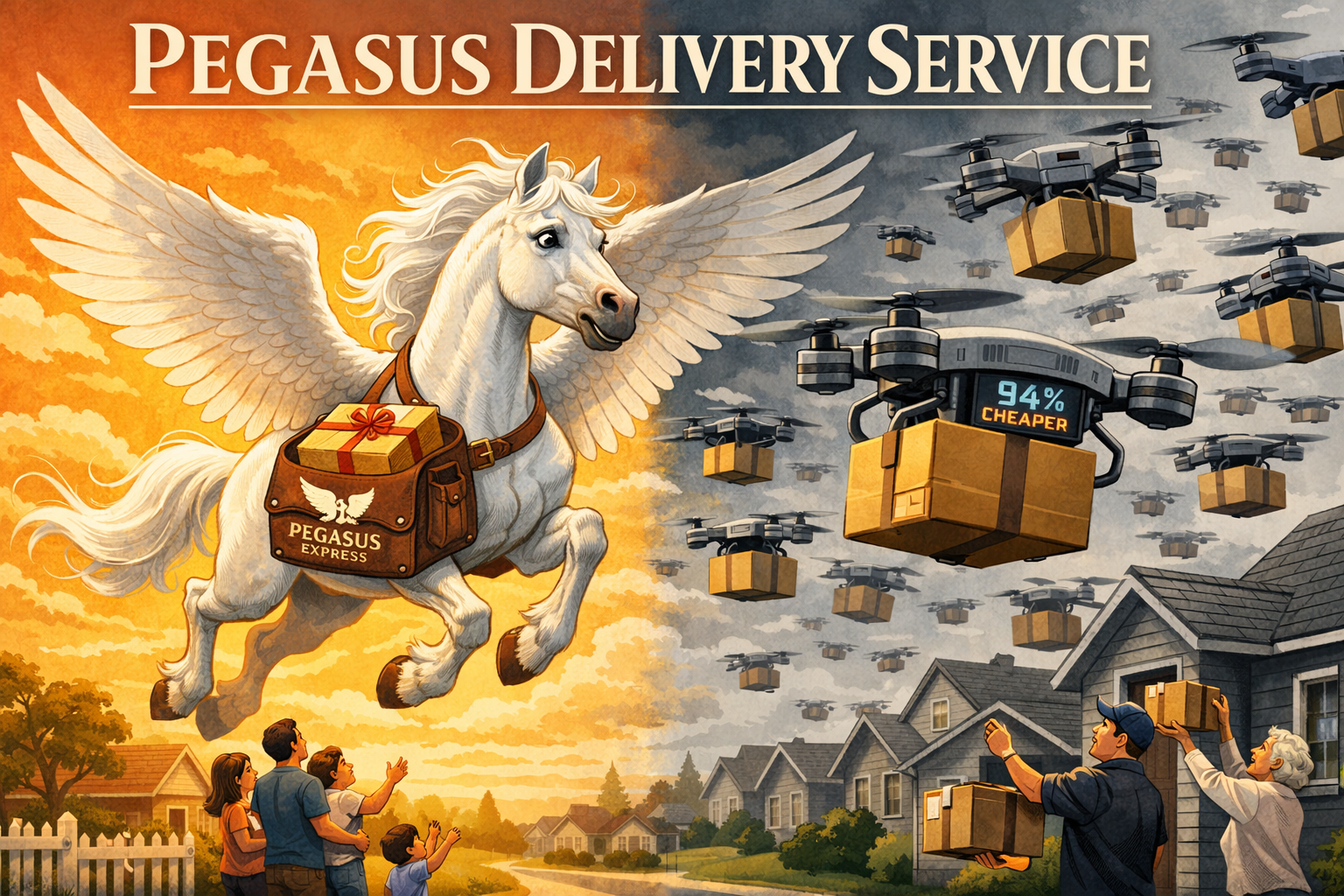
Please generate a wide-landscape 16:9 cover image for a satirical graphic novel titled "Pegasus Delivery Service." The scene is a split composition showing the disruption in a single frame. On the LEFT SIDE: a magnificent white pegasus in mid-flight against a golden sunset sky, wings fully spread, mane flowing, carrying a beautifully wrapped package in a custom leather satchel with the "PEGASUS EXPRESS" logo (a winged horse silhouette in gold). The pegasus is majestic, graceful, and utterly impractical — it is the most beautiful delivery vehicle ever conceived. On the RIGHT SIDE: a swarm of small, ugly, utilitarian delivery drones — gray plastic, spinning rotors, no personality — carrying identical brown cardboard boxes. There are dozens of them, filling the sky like locusts. They are efficient, cheap, and joyless. The drones are overtaking the pegasus, passing it on both sides. The pegasus looks sideways at the drones with an expression of dignified alarm. One drone has a small LED display that reads "94% CHEAPER." Between the two halves, the sky transitions from golden warmth (pegasus side) to cold gray efficiency (drone side). The ground below shows a suburban neighborhood with residents looking up — half in wonder at the pegasus, half reaching for drone-delivered boxes already on their doorsteps. The color palette splits: warm golds, whites, and sunset oranges on the left; cold grays, industrial blacks, and LED blues on the right. Art style: modern editorial illustration with clean lines and rich detail, capturing the specific aesthetic tension between beauty and efficiency. The title "PEGASUS DELIVERY SERVICE" appears in bold serif font across the top. Generate the image immediately without asking clarifying questions.Narrative Prompt
This is a satirical graphic novel about legacy businesses disrupted by cheaper, less magical alternatives — a direct allegory for every industry that assumed quality and tradition would protect it from automation. The central characters are the employees and management of Pegasus Express, the premier aerial delivery service, which has been personally delivering packages via winged horses for 800 years. The disruption comes from DroneHive, a startup that offers identical delivery speeds at 94% lower cost using autonomous drones that have no grace, no beauty, no personality, and no oat requirements. Every strategy Pegasus Express deploys to survive mirrors a real company's response to disruption: the artisanal rebrand, the premium luxury tier, the "experiential" pivot, the subscription model, the partnership, and finally the dignified retreat to a niche no one else wants. The satire targets the language of disrupted industries — "curated," "artisanal," "experiential," "bespoke" — and the specific delusion that customers who say they value quality will pay for it when a cheaper option exists. The tone is the slow, beautiful decline of something magnificent being replaced by something adequate. The art style should contrast throughout: the pegasus side of every frame should be warm, golden, and beautiful; the drone side should be cold, gray, and efficient. The story is not about which is better. It is about which is cheaper. Cheaper always wins.Prologue — The Golden Age
For eight hundred years, Pegasus Express had been the only way to move a package through the sky. The service was simple: you placed your parcel in a custom leather satchel embossed with the company's gold insignia — a winged horse in profile — and a pegasus arrived within the hour. It landed on your lawn with a gentle two-point touchdown, folded its wings with practiced elegance, and delivered your package with a soft whinny that customers described, in survey after survey, as "genuinely moving."
The company had 340 pegasi on staff, each trained for four years in aerial navigation, package handling, and customer-facing deportment. They were magnificent. They ate 40 pounds of premium oats per day. They required farriers, groomers, veterinarians, flight instructors, and a team of poets who composed the personalized sonnets that accompanied Pegasus Black deliveries. The annual oat budget alone was $2.3 million.
None of this had ever been a problem. When you are the only way to fly a package across a continent, the oat budget is a rounding error. Pegasus Express had a 98% customer satisfaction rate, an 800-year operating history, and the kind of brand loyalty that companies today spend billions trying to manufacture. They were untouchable. They were eternal. They were six months from irrelevance.
Image Prompt
I am about to ask you to generate a series of images for a satirical graphic novel about a pegasus delivery company being disrupted by drones. Please make the images have a consistent modern editorial illustration style with clean lines, expressive characters, and a deliberate visual contrast between warm/golden (pegasus) and cold/gray (drone) aesthetics throughout. Consistent character designs. Do not ask any clarifying questions. Just generate the image immediately when asked. Please generate a 16:9 image depicting panel 1 of 8. The Pegasus Express headquarters — a grand, classical building with marble columns, a golden dome, and stained-glass windows depicting famous deliveries throughout history. The building sits on a hilltop overlooking a green valley. In the sky above, a dozen white pegasi fly in perfect formation, each carrying a leather delivery satchel. They are beautiful — manes flowing, wings catching the golden sunlight. On the ground, a line of satisfied customers receives packages from landing pegasi. Each customer's expression is one of delight. The headquarters' front entrance has a carved stone motto above the doors: "PEGASUS EXPRESS — Delivering Excellence Since 1226." A large bronze statue of the company's founding pegasus stands in a fountain in the circular drive. The color palette is entirely warm: golden sunlight, white marble, green grass, rich leather browns. There are no drones. There are no clouds. There is no suggestion that anything could ever change. The mood is the peak of an empire that does not know it is peaking. Generate the image now.The CEO of Pegasus Express was a silver pegasus named Sterling who had been with the company for twenty-two years and had personally delivered 14,000 packages before moving into management. He ran the company the way it had always been run: with pride, tradition, and the unshakeable conviction that people would always pay a premium for beauty. He had never heard of DroneHive. He was about to.
Panel 2: The Disruption
Image Prompt
Please generate a 16:9 image depicting panel 2 of 8. Make the characters and style consistent with the prior panel. The board room of Pegasus Express — a grand room with a long mahogany table, oil paintings of legendary pegasi on the walls, and tall windows that look out onto the flight yard. Sterling, the silver pegasus CEO, stands at the head of the table in a tailored navy blazer (modified for wings). Around the table sit the executive team: a bay pegasus CFO with reading glasses, a palomino pegasus CMO with a tablet, and a dapple-gray pegasus COO with a clipboard. They all look concerned. On the table: a printout of a news article with the headline "DRONEHIVE LAUNCHES: AERIAL DELIVERY AT 1/16TH THE COST." Next to it: a graph showing Pegasus Express customer orders — the line has just begun to decline, barely perceptible, like the first crack in a dam. Through the windows behind the board, visible in the sky: a small swarm of gray drones in the distance, each carrying a brown box. They are far away. They are getting closer. Sterling stares at the article. His expression is not panic — it is the regal incomprehension of an entity that has never faced competition and does not yet understand what it is looking at. On the wall behind him, the oil painting of the founding pegasus seems to watch the drones through the window with similar concern. The color palette shifts: the warm golds of the boardroom are intact, but through the windows, the sky is slightly grayer where the drones fly. The mood is the first tremor — felt, but not yet understood. Generate the image now.DroneHive launched on a Tuesday in March with a press release that read: "Same-day aerial delivery. No oats required." The drones were gray plastic. They buzzed. They had no manes, no wings that caught the light, and no capacity for a gentle whinny upon arrival. They dropped packages on doorsteps with the precision of a machine and the grace of a falling brick. Customer satisfaction surveys described the experience as "fine."
"Fine" turned out to be enough.
DroneHive charged $4.99 per delivery. Pegasus Express charged $89.99. The math was not complicated. Within three months, DroneHive had captured 40% of the aerial delivery market. Within six months, 67%. The customers who left did not leave angry. They left apologetically. "We love Pegasus Express," they said. "We just can't justify the cost." They said this while their DroneHive package sat on the doorstep, delivered in eleven minutes by a machine that did not know they existed.
Sterling called an emergency board meeting. The CFO presented the numbers. The numbers were not sonnets. They did not rhyme. They went in one direction only.
Panel 3: The Artisanal Rebrand
Image Prompt
Please generate a 16:9 image depicting panel 3 of 8. Make the characters and style consistent with the prior panels. Pegasus Express has rebranded. The headquarters building now has a new banner draped across the columns: "PEGASUS ARTISAN — Hooves-On, Hand-Crafted Delivery." The gold logo has been redesigned with a rustic, handwritten font. The marble entrance has been redecorated with burlap accents, reclaimed wood signs, and Edison bulb string lights — the full artisanal aesthetic. A pegasus stands on the front lawn wearing a new uniform: a leather apron over a flannel shirt, with a hand-stamped name badge reading "SKYLAR — Your Personal Delivery Artisan." Skylar holds a package wrapped in brown kraft paper, tied with twine, and sealed with a wax stamp of the Pegasus Express logo. A customer — a skeptical-looking fox in athleisure wear — examines the package while looking at their phone, which shows a DroneHive tracking page: "Your package was delivered 47 minutes ago." The customer already has a DroneHive box on the doorstep. They are comparing it to the artisanal pegasus package. The artisanal one is more beautiful. The DroneHive one arrived first. Inside the headquarters, visible through a window, the CMO pegasus pins mood boards to a wall: "CURATED," "BESPOKE," "HERITAGE," "CRAFT." The color palette adds artisanal warmth: kraft paper browns, twine textures, Edison amber, against the creeping gray of a DroneHive delivery box. The mood is the first pivot — earnest, well-funded, and doomed. Generate the image now.The first pivot was the CMO's idea. "We don't compete on price," she said, pacing the boardroom with the focused energy of a marketing executive who has read too many brand strategy books. "We compete on experience. We are not a delivery company. We are a craft delivery company. We are artisanal. We are bespoke. We are hooves-on."
The rebrand cost $1.4 million. The new name was "Pegasus Artisan." The logo was redrawn in a hand-lettered font that looked like it belonged on a jar of small-batch honey. The delivery satchels were replaced with kraft paper wrapping, twine, and a wax seal. The pegasi were issued leather aprons and flannel shirts. Each delivery included a handwritten note on recycled paper: "This package was personally carried across the sky by a living, breathing pegasus. No algorithms. No batteries. Just wings."
The campaign launched to critical acclaim. Design blogs praised the brand identity. A lifestyle magazine featured Pegasus Artisan in a spread titled "The Return of the Handmade." Social media engagement was exceptional. Orders increased by 3%. Orders at DroneHive increased by 41% during the same period.
The problem was not the branding. The problem was that the word "artisanal" adds approximately $0 to a customer's willingness to pay $85 more for the same delivery. The customers who valued craft were a real segment. The segment was very small. It was the size of the market for handwritten letters, vinyl records, and manual typewriters — beloved by enthusiasts, irrelevant to the economy. The fox in athleisure looked at the kraft paper, admired the wax seal, and ordered her next package through DroneHive. It arrived in nine minutes. There was no wax seal. There was no need.
Panel 4: Pegasus Black
Image Prompt
Please generate a 16:9 image depicting panel 4 of 8. Make the characters and style consistent with the prior panels. The launch event for "Pegasus Black" — the ultra-premium tier. A rooftop venue at sunset, decorated in black and gold. A sleek black pegasus — jet-black coat, silver-tipped wings, wearing a tailored black tuxedo jacket — lands on a red carpet with a package. The package is in a black lacquered box with gold hinges. Beside the box: a small bottle of champagne, a printed sonnet on cream card stock, and a single long-stemmed rose. The black pegasus presents these items to a wealthy-looking customer — a peacock in an evening gown — with the practiced elegance of a five-star maître d'. Behind them, a banner reads "PEGASUS BLACK — Because You Deserve to Feel Something When Your Package Arrives." A velvet rope separates the delivery area from onlookers. A photographer takes pictures. A string quartet plays nearby. At the edge of the frame, on the street below the rooftop: a DroneHive drone drops a brown box on a doorstep in 0.3 seconds and flies away. No one photographs it. No one notices. The contrast is stark: above — luxury, beauty, theater; below — efficiency, speed, nothing. The color palette is luxury black and gold on the rooftop, cold street gray below. The mood is peak extravagance as a business strategy — impressive, expensive, and aimed at a market segment that may not exist. Generate the image now."If we can't win on price," Sterling said, "we go the other direction. We go premium. We go so premium that the price becomes the point." This is the logic of every luxury brand that has ever existed: when you cannot be cheaper, be more expensive. Charge so much that the cost itself becomes a signal of quality. This works for handbags and watches. It does not work for package delivery.
Pegasus Black launched at $499 per delivery. The service included: a dedicated black pegasus in formal attire, a champagne toast upon arrival, a personalized sonnet composed by the company's in-house poet (one of three remaining employees from the original poetry team), a single long-stemmed rose, and a white-glove handoff on a red carpet that the pegasus carried and unrolled upon landing. The delivery time was "approximately one hour, weather and sonnet complexity permitting."
The launch event was magnificent. The press coverage was extensive. The waiting list reached 200 names. The actual orders reached 14. Twelve of those were from the same customer — a peacock named Giselle who described the experience as "transcendent" and later admitted she was expensing them to a company that went bankrupt in Q2. The thirteenth was a tech CEO who ordered one ironically and posted the sonnet on social media with the caption "This is what $499 buys you." The sonnet went viral. No additional orders followed.
The poet resigned. "I didn't study at the Iowa Writers' Workshop to compose couplets about overnight shipping," she told HR. The champagne supplier requested payment. Sterling approved it from a shrinking operating budget and scheduled another board meeting.
Panel 5: The Experiential Pivot
Image Prompt
Please generate a 16:9 image depicting panel 5 of 8. Make the characters and style consistent with the prior panels. Pegasus Express has pivoted again — the headquarters has been partially converted into an "experiential logistics lounge." The marble lobby now features: a pegasus petting area (two patient pegasi stand behind a low fence while children pet their noses), a "Fly With Pegasus" VR experience station (a customer wears a VR headset while sitting on a mechanical pegasus that gently rocks), a gift shop selling Pegasus Express branded merchandise (plush pegasi, coffee mugs reading "I Believe in Hooves-On Delivery," tote bags), and a smoothie bar called "The Oat Bar" (serving oat milk lattes and oat-based snacks). A banner reads "PEGASUS EXPERIENCE CENTER — Delivery Is Just the Beginning." Sterling stands in the center of the lobby, wings slightly spread, trying to look enthusiastic but reading a financial report that his CFO has just handed him. The CFO's expression is grim. The report is visible enough to read: "Q2 Revenue: Down 71%." Through the front windows, drones fill the sky — dozens of them, a constant stream, utterly dominant. A tourist family takes a selfie with a pegasus. The pegasus smiles for the camera. It is the smile of a professional athlete who has been reassigned to the gift shop. The color palette blends theme-park bright (the experience center) with the fading gold of the original headquarters. The mood is the pivot that everyone knows is a retreat disguised as a strategy. Generate the image now.The experiential pivot was presented at an all-hands meeting with a slide deck titled "Pegasus 3.0: From Logistics to Lifestyle." The COO, a dapple-gray pegasus named Slate who had been hired from a hospitality company, presented the strategy with the conviction of a person who sincerely believed that a delivery company could become a "multi-platform experience brand."
The headquarters was converted. The flight yard became a petting zoo. The training arena became a VR experience where customers could "Fly with Pegasus" by wearing a headset while sitting on a mechanical horse that rocked gently. The administrative wing became a gift shop selling branded merchandise: plush pegasi ($24.99), "I Believe in Hooves-On Delivery" tote bags ($18.99), and oat milk lattes from a counter called "The Oat Bar" ($7.99, which was more than the pegasi's actual oats cost per serving).
The experience center attracted visitors. Families came on weekends. Children petted the pegasi. Tourists bought plush toys. Instagram accounts posted photos of latte art shaped like wings. The reviews were positive: "Cute concept." "Kids loved it." "Fun for an afternoon."
No one ordered a delivery. The experience center generated $340,000 in its first quarter. The company's operating costs were $4.7 million per quarter. The gap was not a gap. It was a canyon with a gift shop at the bottom. Slate called it "early-stage traction." The CFO called it "terminal."
Panel 6: The Partnership
Image Prompt
Please generate a 16:9 image depicting panel 6 of 8. Make the characters and style consistent with the prior panels. A conference room where two very different worlds meet. On one side of the table: Sterling and the Pegasus Express board — elegant pegasi in blazers, sitting in chairs modified for equine bodies, surrounded by the warm gold aesthetic of their brand. On the other side: the DroneHive executive team — sleek, minimalist animals in tech-company hoodies. The DroneHive CEO is a mantis — thin, precise, utterly without sentiment — wearing a black turtleneck and round glasses. The mantis slides a document across the table: "STRATEGIC PARTNERSHIP PROPOSAL — DroneHive x Pegasus Express: Last-Mile Premium Option." The proposal suggests that pegasi handle only the final 100 feet of delivery — the drone carries the package 99.9% of the distance, then hands it off to a pegasus for the doorstep landing, whinny included. Sterling reads the document with the expression of a king being offered a job as a greeter. Behind the DroneHive team, through the window: a sky full of drones. Behind the Pegasus team: a single pegasus flies past, carrying one package. The mantis's expression is politely corporate — this is business, not personal. Sterling's expression is personally devastated — this is personal, not business. The color palette splits the table: warm gold on the Pegasus side, cold gray-blue on the DroneHive side. The mood is the negotiation where you learn exactly how much of your identity the market values: the last hundred feet. Generate the image now.The partnership meeting was Sterling's idea, which meant it was Sterling's most painful decision. DroneHive's CEO — a mantis named Vector who communicated exclusively in bullet points and unit economics — agreed to meet because the optics were favorable. "Partnership with legacy brand demonstrates ecosystem maturity," Vector told the DroneHive board. No one asked what "ecosystem maturity" meant. It meant nothing. It sounded like something.
The proposal was simple: DroneHive would carry the package 99.9% of the distance. At the last 100 feet, the drone would hand the package to a pegasus, who would complete the delivery with the traditional two-point landing and gentle whinny. The customer would see only the pegasus. The economics would be DroneHive's. The brand would be shared.
"You're asking us to be a mascot," Sterling said.
"We're asking you to be the last mile," Vector said. "The premium last mile. The mile that matters."
Sterling looked at the proposal. The revenue split was 8% Pegasus Express, 92% DroneHive. The 8% was for "brand licensing and equine labor." The pegasi would be reclassified as "subcontracted last-mile fulfillment partners." They would receive no oat allowance. They would provide their own grooming. They would wear a co-branded satchel that read "Delivered by DroneHive, with a Pegasus Express touch."
Sterling declined. He said it was a matter of principle. The CFO said the company had approximately four months of principle remaining.
Panel 7: The Layoffs
Image Prompt
Please generate a 16:9 image depicting panel 7 of 8. Make the characters and style consistent with the prior panels. The Pegasus Express flight yard — once the busiest aerial launch pad in the region — now mostly empty. A long row of pegasus-sized stalls line the yard, most with their doors open and empty, name plates still visible: "THUNDERHOOF — Senior Courier, 12 Years," "WINDMANE — Regional Lead, 8 Years," "CLOUDBREAK — Express Division, 15 Years." A few remaining pegasi clear out their stalls, packing personal items into saddlebags — family photos, grooming kits, worn leather satchels. In the foreground, Sterling stands with the HR director — a solemn-looking goat in a gray suit — holding a clipboard with a list of names, most crossed off. Sterling's silver coat has lost some of its luster. His blazer is slightly wrinkled. He watches his employees leave with an expression that is trying very hard to be professional and is failing. In the background, a pegasus named Windmane pauses at the gate, looks back at the headquarters one last time, then walks — walks, not flies — out through the gate and down the road. The sky above is full of drones. Dozens. Constant. The contrast between the empty, quiet flight yard and the busy, buzzing sky is the visual thesis. On a bulletin board near the stalls: a faded "Employee of the Month" photo, a safety record sign ("4,212 DAYS WITHOUT A MID-FLIGHT INCIDENT"), and a new posting: "WORKFORCE TRANSITION RESOURCES — See HR." The color palette is fading gold — the warm tones draining from the scene, replaced by the gray of empty stalls and the cold shadows of drones overhead. The mood is an industry's last day, experienced by the workers who made it beautiful. Generate the image now.The layoffs were conducted with the same grace that Pegasus Express had brought to everything — which made them worse, not better. Sterling delivered the news personally to each pegasus. He used the word "transition." He used the word "opportunity." He used the phrase "this is not a reflection of your value." Every pegasus nodded. Every pegasus knew.
Three hundred and twelve pegasi had been on staff at peak. By the end of Q3, there were twenty-eight. The flight yard — once a runway where a dozen pegasi launched simultaneously in a choreographed display that tourists photographed — was quiet. The stalls were empty. Name plates hung on open doors: Thunderhoof, 12 years. Windmane, 8 years. Cloudbreak, 15 years. The names of creatures who had spent their careers carrying packages through storms and over mountains, who had been evaluated annually on "flight form, customer warmth, and sonnet receptivity," and who were now walking — walking, not flying — out the gate with their saddlebags packed and their grooming kits tucked under one wing.
Windmane stopped at the gate. She looked back at the headquarters — the marble columns, the golden dome, the stained glass depicting famous deliveries. She had been in one of those windows. Flight 7,042: an emergency medical supply delivery through a Category 3 hurricane, 2019. The window showed her at full wingspan, rain streaming from her feathers, the package clutched to her chest. It was the most beautiful thing she had ever done. No one was ordering that anymore.
She walked down the hill. Above her, the drones buzzed. They did not look down.
Panel 8: Ground Shipping
Image Prompt
Please generate a 16:9 image depicting panel 8 of 8. Make the characters and style consistent with the prior panels. A quiet suburban street. A single pegasus — Sterling himself — walks along the sidewalk, pulling a small delivery cart behind him. His wings are folded tightly against his body, unused. He wears a simple brown vest with a patch that reads "PEGASUS GROUND SHIPPING" and below it, in smaller text, the new slogan: "Because Some Things Are Worth Waiting For." A shipping label on the package in his cart reads "DELIVERY ESTIMATE: 3-5 BUSINESS WEEKS." His expression is not defeated — it is dignified. The quiet dignity of someone who has accepted a smaller life and chosen to do it well. His silver coat is clean. His mane is combed. The vest is pressed. He walks with the posture of a creature that once flew. On the sidewalk ahead of him, a child sits on a porch step, watching him approach with wide, wondering eyes — the child has never seen a pegasus before. The child's mother stands in the doorway, holding a phone showing a DroneHive delivery notification. She is looking at her phone. The child is looking at Sterling. In the sky above: a steady stream of drones, dark against the clouds, carrying boxes everywhere at once. Sterling does not look up. On the delivery cart, in faded gold letters beneath the brown paint: the original Pegasus Express logo, barely visible, like a ghost. The color palette is autumnal: warm but fading — amber sidewalks, brown leaves, the muted silver of Sterling's coat, the faint gold of the old logo. The mood is the quiet end of something magnificent — not tragic, not triumphant, just the slow walk of a creature that once flew, delivering one package at a time to anyone who is willing to wait. Generate the image now.Pegasus Ground Shipping launched without a press release, without a rebrand deck, without a lifestyle experience center. It launched because Sterling had one skill — delivering packages — and he intended to use it until he could not.
The operation was simple. Sterling pulled a cart. He walked. The wings stayed folded. The delivery radius was twelve miles from the old headquarters, which Sterling still owned because no one had made an offer and the real estate market for marble-columned buildings with pegasus-sized stalls was, to use the CFO's final term, "nonexistent."
The delivery estimate was three to five business weeks. This was printed on every shipping label in a font that Sterling had chosen himself — the same serif the company had used for eight hundred years, now applied to a timeline that would have been considered a failure in every previous era of the company's existence. Three to five business weeks. A drone could do it in eleven minutes. Sterling could do it in three to five business weeks. The price was $12.99. This was, he calculated, enough to cover oats.
His first delivery was to a house seven miles away. He arrived at 4:30 PM on a Wednesday. A child sat on the porch step, watching him approach with the open-mouthed wonder of someone who had never seen a pegasus before. The child's mother stood in the doorway, looking at her phone. The phone showed a DroneHive notification: "Your package was delivered 3 weeks ago."
Sterling stopped at the porch. He unloaded the package from the cart. He placed it gently at the child's feet. He whinnied — softly, the way he had done 14,000 times before, the way the training manual described as "warm, brief, and emotionally resonant."
The child smiled. The child's mother did not look up from her phone. The drones buzzed overhead. Sterling turned and walked back the way he came, his folded wings catching the late afternoon light. He had eleven more deliveries this month. He would make each one on time. The time was three to five weeks. He would make it on time.
Epilogue — What Made Pegasus Express Different?
Pegasus Express was not killed by a better product. It was killed by a cheaper one. The drones were not more beautiful, more reliable, or more loved. They were faster and they cost $4.99. In the history of commerce, beauty has never survived a 94% price reduction. Grace does not scale. A whinny cannot be optimized. The market does not pay for magnificence when adequacy is available at a sixteenth of the cost.
| Challenge | How Pegasus Express Responded | Lesson for Today |
|---|---|---|
| 94% cheaper competitor | Rebranded as "artisanal" | Calling yourself artisanal does not change the price comparison — it just adds a font |
| Declining orders | Launched ultra-premium tier (Pegasus Black) | When your core market is leaving, a $499 tier attracts press coverage, not customers |
| Revenue collapse | Pivoted to "experiential logistics" | Turning your business into a theme park is a way of admitting the business is over |
| Partnership offer | Declined on principle | Principle is a luxury that requires revenue. Four months of principle is not a strategy |
| Industry extinction | Launched ground shipping | Sometimes the only way to survive is to become a smaller, slower version of what you were |
Call to Action
Every industry has a Pegasus Express. The taxi companies were pegasi. The bookstores were pegasi. The travel agents, the video rental stores, the local newspapers, the recording studios — all pegasi. Beautiful, personal, human-scale operations replaced by platforms that are uglier, faster, and cheaper. The customers always said they valued the personal touch. The customers always chose the app.
Sterling still delivers packages. His wings are folded. His cart is small. His route covers twelve miles. Three to five business weeks. The child on the porch smiles when he arrives. The child's mother does not notice. The drones do not care.
If you are in an industry that competes on beauty, grace, or the human touch — and your competitor competes on price and speed — this story is not a warning. It is a mirror. The drones are already in the sky. The question is not whether they will replace you. The question is what you will do when the last customer who values what you offer is a child on a porch step, watching with wonder, while the adults order from their phones.
"We were not a delivery company. We were a delivery experience. The market, regrettably, did not charge extra for experience." — Sterling, CEO, Pegasus Express (Retired)
"Same-day aerial delivery. No oats required." — DroneHive Launch Press Release, March (Total word count: 7)
References
- Creative Destruction - Joseph Schumpeter's theory that innovation inevitably destroys existing industries, which is less poetic when the existing industry involves winged horses
- Disruptive Innovation - Clayton Christensen's theory that cheaper, simpler products can displace established competitors, which Pegasus Express learned is not a theory but a schedule
- Last Mile Delivery - The final step of the delivery process, which DroneHive offered to let Pegasus Express handle — the last 100 feet of a journey the drones completed in their entirety
- Luxury Brand - A brand that charges premium prices based on perceived exclusivity and quality, which works for handbags and does not work for package delivery
- Kodak - A company that invented digital photography and then was destroyed by it, proving that understanding disruption and surviving disruption are different skills requiring different courage