The Golem's Sprint Retrospective: The Ceremony Is the Product
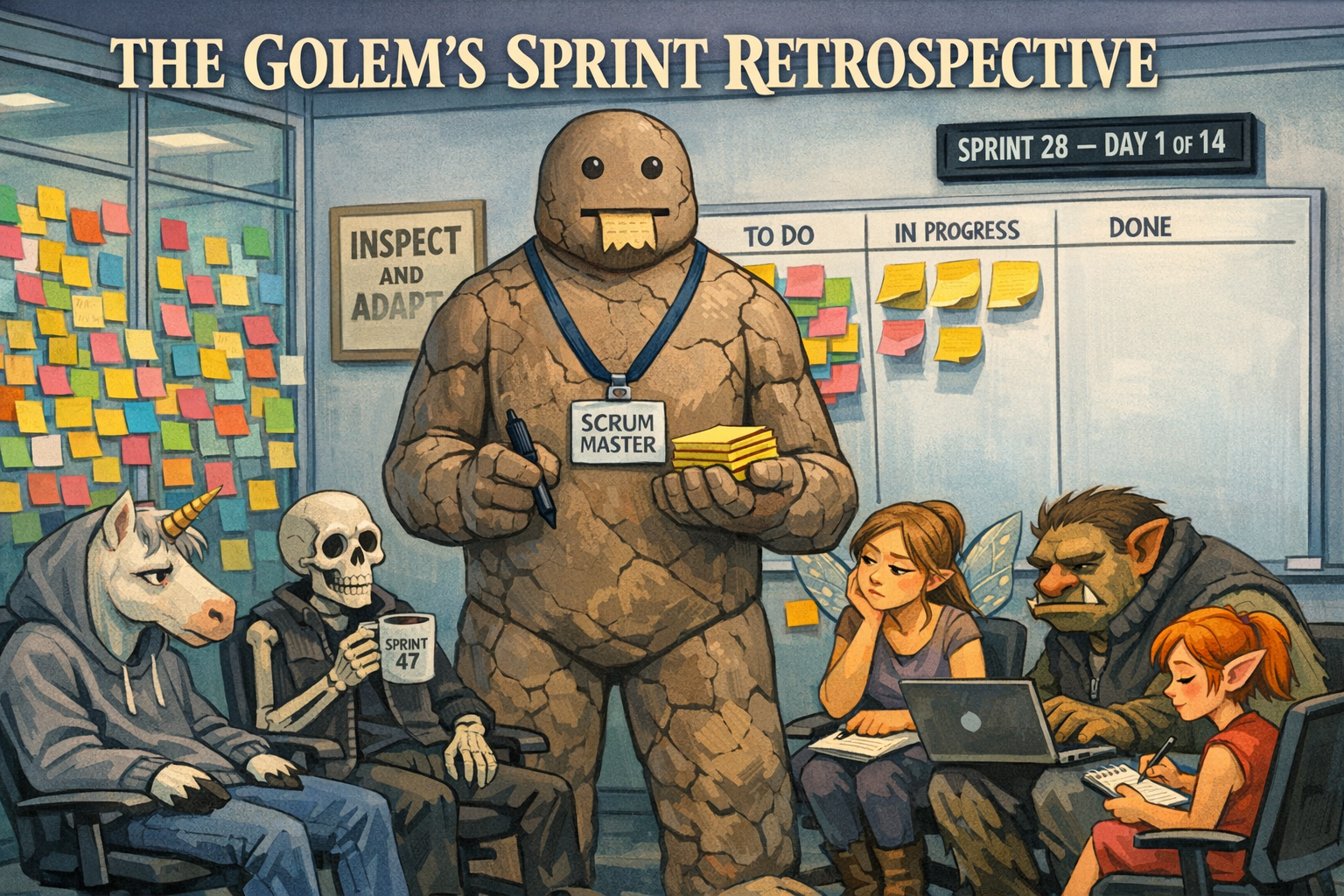
Cover Image Prompt
Please generate a wide-landscape 16:9 cover image for a satirical graphic novel titled "The Golem's Sprint Retrospective." The scene shows a modern Agile team room — glass walls, a large whiteboard divided into swim lanes ("TO DO," "IN PROGRESS," "DONE"), and a wall covered in colorful sticky notes. At the center of the room stands a golem — a large, humanoid figure made of clay, approximately seven feet tall, smooth and featureless except for two simple round eyes and a straight-line mouth. The golem is gray-brown clay, slightly cracked at the joints, wearing a "SCRUM MASTER" lanyard and holding a stack of fresh sticky notes in one clay hand and a marker in the other. From its slightly open mouth, a corner of parchment is visible — the scroll of instructions that animates it. Around the golem, the Agile team sits in a circle of office chairs: a weary unicorn in a hoodie, a skeleton with a coffee mug ("SPRINT 47" written on it), a fairy with dimming wings (reminiscent of the consultant from Dracula Industries), a troll in a fleece vest hunched over a laptop, and a pixie taking notes. The whiteboard's "DONE" column is completely empty. The "IN PROGRESS" column has three items that have been there so long the sticky notes have curled at the edges. The "TO DO" column is overflowing. On the wall: a motivational poster reading "INSPECT AND ADAPT" with the "ADAPT" part faded almost to invisibility. A digital sprint timer on the wall reads "SPRINT 28 — DAY 1 OF 14." The color palette is office-bright — sticky-note yellows, pinks, blues, and greens — against the muted gray-brown of the golem and the tired expressions of the team. Art style: modern editorial illustration with clean lines, capturing the specific aesthetic of Agile war rooms (sticky notes, swim lanes, burndown charts) inhabited by creatures who have stopped believing in the process but continue performing it. The title "THE GOLEM'S SPRINT RETROSPECTIVE" appears in bold serif font across the top. Generate the image immediately without asking clarifying questions.Narrative Prompt
This is a satirical graphic novel about Agile methodology as performative ritual — the specific phenomenon where organizations adopt every ceremony, artifact, and vocabulary of Agile without adopting the thing that makes Agile work: the willingness to actually change based on what the ceremonies reveal. The central character is the Golem — a clay creature animated by written instructions placed in its mouth, who serves as the team's Scrum Master. The golem is the perfect metaphor for process-driven management: it follows the instructions exactly, without interpretation, without judgment, without soul. It facilitates standups. It runs retrospectives. It writes sticky notes. It does not care whether the sticky notes lead to change. The instructions do not say "produce outcomes." The instructions say "continue the ceremony." The satire targets Agile-as-religion: the retrospectives where the same feedback appears sprint after sprint, the velocity charts that measure motion instead of progress, the standups that become status meetings, the sprint reviews where nothing is reviewed because nothing was shipped, and the organizational belief that following the process is the same as producing the product. Every scene should be instantly recognizable to anyone who has lived through sprint culture — the specific sticky-note colors, the dot-voting, the "action items" that are never actioned, the burndown chart that burns nothing down. The art style should be the aesthetic of the Agile war room: sticky notes everywhere, swim-lane whiteboards, burndown charts, timers, dot stickers — all rendered with the clinical warmth of a religious ritual performed by a clay creature that does not understand worship but performs the gestures precisely.Prologue — The Instructions
The parchment was placed in the golem's mouth on a Monday at 9:00 AM, which is when all processes begin: at the start of a week, with the optimism that only Monday mornings and project kickoffs produce, and which dissipates by approximately 10:15 AM Tuesday.
The instructions were written in Hebrew, as tradition required, and translated into Agile, as the organization required. They read:
Facilitate the daily standup at 9:15 AM. The standup shall last no more than 15 minutes. Each team member shall answer three questions: What did I do yesterday? What will I do today? What is blocking me? Do not resolve the blockers. Document them. Facilitate the sprint retrospective on the final day of each sprint. The retrospective shall follow the format: What went well? What didn't go well? What will we do differently? Write the answers on sticky notes. Place the sticky notes on the board. Photograph the board. File the photograph. Do not act on the findings. Begin the next sprint. Continue the ceremony. Do not question the ceremony. The ceremony is the product.
The golem read the instructions. The golem did not understand the instructions, because golems do not understand. Golems execute. This made the golem, by every measurable standard, the most effective scrum master the team had ever had.
Image Prompt
I am about to ask you to generate a series of images for a satirical graphic novel about a golem scrum master and the performative ritual of Agile methodology. Please make the images have a consistent modern editorial illustration style that captures the specific aesthetic of Agile war rooms — sticky notes, swim lanes, burndown charts, dot voting — inhabited by mythical creatures. Clean lines, expressive characters, consistent character designs throughout. Do not ask any clarifying questions. Just generate the image immediately when asked. Please generate a 16:9 image depicting panel 1 of 8. A ceremony of creation — a modern office conference room where the golem is being "activated." The golem stands in the center of the room — a seven-foot humanoid figure made of smooth gray-brown clay, featureless except for two simple round eyes (like dots) and a straight horizontal line for a mouth. Its body is solid, slightly cracked at the elbows and knees from drying, and entirely expressionless. A hand — belonging to a VP of Engineering (a well-dressed hawk in a blazer, visible at the edge of the frame) — places a rolled parchment scroll into the golem's mouth. The scroll is visible, partially inserted, with Hebrew-style lettering visible on the exposed portion. Around the room, the Agile team watches: a unicorn in a hoodie (senior developer, tired eyes, coffee in hand), a troll in a fleece vest (backend engineer, skeptical expression), a fairy with delicate wings (designer, hopeful), a pixie with a tiny laptop (junior developer, nervous), and a skeleton in a cardigan (QA engineer, has been here too long). On the table: an Agile certification textbook, a box of sticky notes (fresh, unopened), and a "WELCOME TO THE TEAM" card signed by everyone. On the whiteboard: "SPRINT 1 — DAY 0" and below it, a fresh, empty Kanban board. Everything is clean. Everything is new. The color palette is Monday-morning bright: clean whites, fresh sticky-note colors, the untouched optimism of a process that has not yet been tested. The mood is the beginning — the moment before the ceremony starts, when the team still believes the process will save them. Generate the image now.The golem's name was not important. No one named it. Golems are not named. They are activated, assigned, and — when the process concludes — deactivated. The team called it "Scrum," which was not a name but a role, and which the golem accepted because the golem accepted everything. Acceptance was not a personality trait. It was a structural property. Clay does not argue.
The team had been through four scrum masters in two years. The first had quit after Sprint 3, citing "philosophical differences with the product owner's definition of done." The second had been promoted to management, where she was no longer required to produce anything, only to observe others not producing things. The third had transferred to a different team, a move the team described as "lateral" and the third scrum master described as "escape." The fourth had been the golem. The golem would not quit, transfer, or be promoted. The golem would continue.
Panel 2: The Standup
Image Prompt
Please generate a 16:9 image depicting panel 2 of 8. Make the characters and style consistent with the prior panel. The daily standup — 9:15 AM. The team stands in a loose circle in front of the Kanban board. The golem stands at the board, holding a timer (a small hourglass, because golems are traditional) and a clipboard. Each team member delivers their update. The unicorn speaks, looking at the floor: "Yesterday I worked on the auth module. Today I'll continue. Blocker: the API specification changed again." The troll has his arms crossed: "Same as yesterday. Same blocker. Same as last sprint." The fairy reads from her tiny phone: "I designed the new dashboard. It's blocked by the auth module, which is blocked by the API spec." The pixie raises a hand nervously: "I finished my ticket but I can't merge because the CI pipeline is broken." The skeleton holds its coffee mug (now reading "SPRINT 14"): "Everything is on fire. This is fine." The golem writes each blocker on the clipboard with a clay finger that leaves small brown smudges on the paper. It does not ask follow-up questions. It does not resolve the blockers. The instructions do not say "resolve." The instructions say "document." On the Kanban board behind the team: the "IN PROGRESS" column has the same three sticky notes from the cover — they have been there for weeks, the edges curling. A small sticky note on the board reads "FIX CI PIPELINE — Sprint 3" and has clearly been there since Sprint 3. They are now in Sprint 14. The hourglass shows 14 minutes elapsed — the standup is about to go over time. The color palette is morning-routine: slightly washed out, familiar, the fluorescent light of a meeting that has happened 200 times. The mood is the standup that has become a status meeting that has become a ritual that has become a habit that has become a religion. Generate the image now.The standup began at 9:15 AM. It had begun at 9:15 AM every day for fourteen sprints. The golem stood at the board, hourglass in hand, and waited. The team stood in a circle, which is the Agile-prescribed formation, as if the geometry of the meeting could compensate for the stasis of the work.
The unicorn went first. "Yesterday I worked on the authentication module. Today I'll continue working on the authentication module. Blocker: the API specification changed again." The unicorn had reported this blocker in Sprint 3. It was now Sprint 14. The API specification had changed eleven times. Each change invalidated three to four days of work. The unicorn had rebuilt the authentication module eleven times. It was, by volume, the most-developed feature in the company's history. It had never been deployed.
The troll went second. "Same as yesterday." The troll had been saying "same as yesterday" for so long that it had become a philosophical statement rather than a status update. Same as yesterday. Same as the yesterday before that. Same as the yesterday that will come tomorrow. The troll understood, in a way the others did not, that the standup was not a meeting about progress. It was a meeting about continuity. The purpose was not to communicate what had changed. The purpose was to demonstrate that nothing had.
The golem documented each blocker. The clay fingers left brown smudges on the clipboard. The golem did not ask why the blockers from Sprint 3 were still present in Sprint 14. The instructions did not say "ask why." The instructions said "document." The golem documented. The ceremony continued.
Panel 3: The Retrospective
Image Prompt
Please generate a 16:9 image depicting panel 3 of 8. Make the characters and style consistent with the prior panels. The sprint retrospective — the ritual at its most concentrated. The team sits in a circle. The golem stands at a large blank wall covered in three columns of different-colored sticky notes — the standard retro format. Column 1 (green sticky notes): "WHAT WENT WELL" — the notes read: "Team communication was good," "We didn't break prod this time," "Free donuts on Thursday." Column 2 (pink sticky notes): "WHAT DIDN'T GO WELL" — the notes read: "API spec changed again," "CI pipeline still broken," "Sprint scope changed mid-sprint," "We didn't ship anything," "Retrospective feedback from last sprint was not acted on." Column 3 (blue sticky notes): "WHAT WILL WE DO DIFFERENTLY" — the notes read: "Freeze API spec before sprint," "Fix CI pipeline," "Reduce scope changes," "Act on retrospective feedback." The visual JOKE is revealed in a detail: below the current sticky notes, the same wall shows FAINT OUTLINES and TAPE RESIDUE from previous retrospectives — dozens of layers of sticky notes, removed and replaced, each one containing the same feedback. If you look closely, the ghost impressions of previous notes are visible, and they say the same things: "API spec changed," "CI pipeline broken," "Ship something." The same feedback, sprint after sprint, layer after layer, like geological strata of unresolved process. The golem takes a photograph of the current board with a Polaroid camera — the Polaroid develops in real time, showing the board exactly as it is: identical to the last photograph, and the one before that. A stack of previous Polaroids sits on a nearby table, each one showing the same board layout. The team's expressions range from weary acceptance (unicorn), to dark amusement (skeleton), to barely concealed rage (troll). The pixie is dot-voting with small sticker dots — each "What didn't go well" item has multiple dots, indicating the team knows what's wrong. Knowing has not helped. The color palette is sticky-note bright — yellows, pinks, greens, blues — against the gray of the golem and the weariness of the team. The mood is the 14th retrospective where the team gives the same feedback, the board looks the same, and the ceremony produces the same output: a photograph, not a change. Generate the image now.The retrospective was the holiest of the Agile ceremonies. It occurred on the final day of each sprint — a two-week cycle that had produced, over fourteen iterations, exactly zero shipped features. The retrospective was not responsible for this. The retrospective was responsible for discussing it. These were different functions.
The golem stood at the wall with three colors of sticky notes: green (What Went Well), pink (What Didn't Go Well), blue (What Will We Do Differently). The team wrote. The golem placed the notes on the wall. The pattern was familiar because it had not changed in seven months.
Green: "Team communication was good." This appeared on every retrospective board. It was the one thing the team could praise without lying. They communicated constantly. They communicated about the blockers. They communicated about the scope changes. They communicated about the fact that the retrospective feedback from the previous sprint had not been acted on. The communication was excellent. The communication had achieved nothing.
Pink: "API spec changed again." "CI pipeline still broken." "Sprint scope changed mid-sprint." "We didn't ship anything." "Retrospective feedback from last sprint was not acted on." Each note was written in a different hand. Each note had been written before — not the same physical note, but the same words, on the same color paper, placed on the same wall, in the same column, sprint after sprint. The wall beneath the current notes showed the ghosts of previous retrospectives: tape residue and faint ink impressions, layer upon layer, like sediment in a river that flows nowhere.
Blue: "Freeze API spec before sprint." "Fix CI pipeline." "Reduce scope changes." "Act on retrospective feedback." The same actions, proposed again, documented again, photographed again, filed again, not acted on again. The golem took a Polaroid of the board. The Polaroid developed. It looked like the previous Polaroid. It looked like the one before that. The stack of Polaroids on the table was twenty-eight photographs high. If you fanned through them quickly, they formed an animation of nothing happening.
Panel 4: The Velocity Chart
Image Prompt
Please generate a 16:9 image depicting panel 4 of 8. Make the characters and style consistent with the prior panels. The golem stands at a wall-mounted screen showing the team's velocity chart — a line graph tracking "story points completed per sprint" over 28 sprints. The chart is the centerpiece of the image, large and detailed. The line shows a pattern: it rises slightly in Sprints 1-3 (the honeymoon period), plateaus at a mediocre level for Sprints 4-10, declines gradually through Sprints 11-20, and has been flat at near-zero for Sprints 21-28. The X-axis is labeled with sprint numbers. The Y-axis shows story points. A horizontal "target velocity" line is drawn above the actual line — the gap between target and actual has been growing every sprint. The golem points at the chart with one clay finger, presenting it to the VP of Engineering hawk (from Panel 1) who sits in a chair, arms crossed, expression stern. The golem's other hand holds a printout titled "VELOCITY TREND ANALYSIS — Sprint 28" with the same chart and a bullet-pointed summary. The summary is visible: "Velocity: Declining. Root cause: External dependencies, scope changes, CI failures, unresolved blockers (see retrospective archives, Sprints 1-28). Recommendation: Continue monitoring." The word "Continue" is circled in the golem's smudgy clay handwriting. It is always "continue." Through a glass wall behind them, the team is visible at their desks — the unicorn stares at a screen, the troll has headphones on, the skeleton drinks coffee. They are not building. They are waiting. The color palette is dashboard-clinical: chart blues and grays, the red of the target line they'll never reach, the brown of the golem. The mood is the sprint review where the numbers prove that nothing is working, and the response is to look at the numbers again next sprint. Generate the image now.The velocity chart was the golem's purest output. It required no interpretation, no judgment, no soul. It was a line on a graph that measured story points completed per sprint. The golem plotted it faithfully, point by point, sprint by sprint, and presented it at each review with the same clay-handed gesture — one finger pointing at the line, the other holding the printout.
The line told a story the team already knew: Sprints 1 through 3 had been productive. The team was new, the backlog was fresh, and the blockers had not yet calcified. Sprints 4 through 10 were the plateau — the period when the process felt sustainable and the output was adequate, if not inspiring. Sprints 11 through 20 were the decline — each sprint slower than the last as the unresolved blockers accumulated like silt in a river. Sprints 21 through 28 were the flatline: velocity near zero, the team expending effort that produced no countable output, the sprint a formality and the standup a eulogy.
"The velocity is declining," the VP of Engineering said, reading the printout. This was accurate. It was also, Fern would have noted had she been present, the kind of observation that one could make by looking at a downward line and saying "it goes down."
"Recommendation?" the VP asked.
The golem consulted the parchment in its mouth. The parchment did not contain recommendations. The parchment contained instructions. "Continue monitoring," the golem said.
"Is that all?"
The golem did not understand the question. The golem did not understand questions. "Continue monitoring," the golem repeated. The instructions said "continue." The golem continued.
The VP sighed. He approved the next sprint. He approved every sprint. Approving sprints was his function in the same way that facilitating retrospectives was the golem's function: neither questioned whether the function produced value. The function existed. The function was performed. This was sufficient.
Panel 5: The Action Items
Image Prompt
Please generate a 16:9 image depicting panel 5 of 8. Make the characters and style consistent with the prior panels. A graveyard of action items. The scene shows a storage closet at the back of the office — a room the team has started calling "The Vault." The door is open, revealing walls covered floor-to-ceiling with sticky notes — hundreds of them, maybe thousands, in blue (the "What will we do differently" color from the retrospectives). Each note contains an action item that was documented, photographed, filed, and never executed. The notes are layered so thickly they have begun to peel and fall, creating a carpet of sticky notes on the floor. Some notes are yellowed with age (from Sprint 1). Some are fresh (from Sprint 28). All contain recognizable action items: "Fix CI pipeline," "Freeze API spec," "Reduce meeting time," "Pair program on complex tickets," "Schedule tech debt sprint," "Talk to product about scope creep," "Actually do the things we said we'd do last sprint." The golem stands in the doorway, carrying the latest batch of blue sticky notes from the Sprint 28 retrospective, about to add them to the wall. Its expression is unchanged — it has no expression — but the mechanical act of adding notes to an overflowing room has an accidental pathos. Behind the golem, the skeleton QA engineer stands in the hallway, coffee mug (now reading "SPRINT 28") in hand, watching the golem file the action items with the dark amusement of someone who has been dead for some time and finds the living amusing. The color palette is sticky-note blue (the action items) against storage-closet gray and the warm brown of the golem. The mood is the room where good intentions go to die — documented, filed, and forever unacted upon. Generate the image now.The action items had their own room. This was not official. The office did not designate a room for unresolved action items. The room designated itself, the way all storage spaces designate themselves: someone put something there once, and then more things followed, and then no one cleaned it out, and then the things became the room's identity.
The team called it the Vault. It was a storage closet at the back of the office, three feet by five feet, with walls that had been progressively covered in blue sticky notes — the "What Will We Do Differently" notes from twenty-eight retrospectives. Each note contained an action item that the team had identified, the golem had documented, the board had displayed, the Polaroid had captured, and no one had executed.
"Fix CI pipeline" appeared seventeen times, in seven different handwritings, across fourteen sprints. The first instance was from Sprint 1, written in the pixie's careful script, when fixing the CI pipeline was a one-day task. By Sprint 14, the same fix was estimated at three weeks. By Sprint 28, the pipeline had accumulated so much technical debt that the troll had described fixing it as "an archaeological expedition."
"Freeze API spec" appeared twelve times. The API had never been frozen. The API had changed forty-one times in twenty-eight sprints. Each change was described by the product owner (a salamander who communicated exclusively through Jira tickets and never attended retrospectives) as "a minor clarification." Forty-one minor clarifications had, collectively, constituted a complete rewrite of the specification.
"Actually do the things we said we'd do last sprint" appeared once. It was from Sprint 7. It was written by the troll. The troll had stopped writing action items after Sprint 7. "The room remembers," the troll said, when asked why. "I don't need to add to its memory."
The golem carried the Sprint 28 action items to the Vault. It placed them on the wall with the methodical care of a creature performing a sacred function. The blue notes adhered to the wall. Some of the older notes fell to the floor, creating a carpet of unfulfilled commitments that the golem stepped on without acknowledgment. The golem did not acknowledge. The golem documented.
Panel 6: The Sprint Review Where Nothing Is Reviewed
Image Prompt
Please generate a 16:9 image depicting panel 6 of 8. Make the characters and style consistent with the prior panels. The sprint review — the ceremony where the team demonstrates what was built during the sprint. The entire team sits in the Agile room facing a projector screen. The golem stands beside the screen with a clicker. The screen shows... nothing. A blank demo page. A staging environment with no new features. The previous sprint's demo (identical to this one) is visible as a faded ghost image behind the blank screen — same page, same absence of features, same ceremony. The team sits in their chairs: the unicorn has pulled its hoodie up over its horn, the troll is on a laptop doing actual work during the meeting, the fairy's wings are almost completely dim (the process has drained her), the pixie takes notes (notes of what? nothing happened), and the skeleton holds its mug ("SPRINT 28") with the calm of someone who has been through this particular form of nothing many times. The VP of Engineering hawk sits in the front row, looking at the blank screen with the expression of a manager who knows the sprint produced nothing and will approve the next sprint anyway. The golem clicks to the next slide. The next slide is the velocity chart from Panel 4. The golem clicks to the next slide. The next slide is the retrospective board photograph from Panel 3. The golem clicks to the next slide. The next slide reads: "SPRINT 29 — PLANNING." The product has not shipped. The process continues. The color palette is projector-dark: the blue glow of an empty screen, the dim room, the gray of the golem. The mood is the sprint review where the absence of a demo is itself the demo — the process demonstrating, with perfect clarity, that it produces nothing except the next process. Generate the image now.The sprint review was the ceremony where the team demonstrated what had been built. Sprint 28 had produced no demonstrable output. This was consistent with Sprints 21 through 27. The golem presented it anyway.
The projector showed a staging environment. The staging environment showed the same page it had shown for the previous seven sprint reviews. Nothing was new. Nothing had changed. The URL was the same. The layout was the same. The placeholder text that read "FEATURE COMING SOON" had been there since Sprint 15 and had become, through repetition and neglect, the feature.
The golem clicked to the next slide: the velocity chart. The line was flat. The golem clicked to the next slide: the retrospective photograph. The sticky notes were the same. The golem clicked to the next slide: "Sprint 29 — Planning."
"Are there questions?" the golem asked. The golem always asked. The instructions said to ask.
There were no questions. There had not been questions since Sprint 19, when the troll had asked, "Why are we doing this?" and the golem had responded, "The ceremony is scheduled for the final day of each sprint," which answered the question of timing but not the question of purpose, and which the troll had recognized as the only answer the golem was capable of giving.
The VP approved the next sprint. He did not ask what the sprint would produce. Asking what the sprint would produce would require acknowledging that the previous sprint had not produced anything, which would require explaining why, which would require the kind of honest organizational conversation that no sprint review had ever facilitated and no sprint review had been designed to facilitate. The sprint review was designed to review. It reviewed. It reviewed the same thing every two weeks: nothing, presented on a projector, in a darkened room, by a creature made of clay.
Panel 7: The Team Breaks
Image Prompt
Please generate a 16:9 image depicting panel 7 of 8. Make the characters and style consistent with the prior panels. The Agile room, after hours. The overhead lights are off. The room is lit by the glow of the Kanban board's sticky notes (which have been there so long they seem to emit their own faint light) and the hallway light coming through the glass wall. The team has gathered — not for a ceremony, but for the first time, for a real conversation. They sit not in the prescribed Agile circle but in a loose, human cluster — some on chairs, some on the floor, the unicorn leaning against the wall. The golem is NOT present. For the first time in 28 sprints, the golem is absent — it stands in the hallway outside the glass wall, visible but not participating, hands at its sides, waiting. Inside the room, the team talks. The troll has drawn something on the whiteboard — not a Kanban board, not a velocity chart, but a simple list: "THINGS THAT WOULD ACTUALLY HELP." The list reads: "1. Talk to the product owner directly (not through Jira). 2. Fix the CI pipeline (actually). 3. Ship something small. Anything. 4. Stop having meetings about meetings. 5. Remove the parchment." The last item is underlined. The unicorn looks at it. The fairy looks at it. The skeleton nods. The pixie writes it down. Through the glass wall, the golem waits in the hallway, motionless, unaware — or perhaps aware in the way that clay is aware, which is not at all. The Kanban board looms behind the team, its sticky notes curling, its "DONE" column still empty. The color palette is after-hours warm — hallway amber, the cool blue of the whiteboard, the natural light of creatures deciding something without a ceremony. The mood is the moment the team realizes that the process is the blocker — and that the blocker has a parchment in its mouth. Generate the image now.The conversation happened on a Thursday evening, after hours, without a calendar invite. This was significant. Every interaction in the team's history had been mediated by a ceremony: standup, grooming, planning, review, retrospective. The team had never spoken without a format. The format was the container. Without the container, the team did not know what shape they were.
The troll started it. "I have a question," the troll said. "It's not for the standup and it's not for the retro. It's for us."
The team listened. This was unusual. In ceremonies, the team performed listening. This was actual listening — the kind that does not have a checkbox.
"We have been in this process for fourteen months," the troll said. "We have completed twenty-eight sprints. We have shipped nothing. We have identified the same blockers in every retrospective. We have proposed the same action items. We have executed zero of them. The golem facilitates this. The golem documents this. The golem does not fix this because the golem was not instructed to fix anything. The golem was instructed to continue the ceremony."
The troll walked to the whiteboard. The troll erased the Kanban board — the first time anyone had erased it in fourteen months. The "IN PROGRESS" tickets, which had been there so long they had formed a bond with the surface, left faint sticky-note-shaped ghosts on the board. The troll wrote a new list: "THINGS THAT WOULD ACTUALLY HELP."
- Talk to the product owner directly. Not through Jira. In a room. With words.
- Fix the CI pipeline. Actually fix it. This week. Not in a future sprint. Now.
- Ship something small. Anything. A button. A color change. Proof of life.
- Stop having meetings about meetings.
- Remove the parchment.
The fifth item was underlined. The room was quiet. Through the glass wall, the golem stood in the hallway, hands at its sides, motionless. The parchment was visible in its mouth — the small corner of scroll that had been there since Sprint 1, that no one had read, that no one had questioned, that animated the clay and the clay animated the process and the process animated nothing.
"The ceremony is not working," the unicorn said. This was the first time anyone had said it aloud. Writing it on a retrospective sticky note was different from saying it. Sticky notes are documentation. Saying it is admission.
"The ceremony was never working," the skeleton said, with the calm of someone who had been dead before and recognized the symptoms. "The ceremony was working as designed. The design is the problem."
Panel 8: The Parchment
Image Prompt
Please generate a 16:9 image depicting panel 8 of 8. Make the characters and style consistent with the prior panels. The Agile room, the next morning. The team stands around the golem, which is motionless in the center of the room. The unicorn reaches toward the golem's mouth with one hoof, gently pulling the parchment scroll from between the clay lips. The parchment slides out slowly — it is longer than expected, unrolling as it is removed, revealing the full text of the instructions. The text is visible on the unfurled scroll: the standup instructions, the retrospective instructions, the velocity tracking instructions, and at the very bottom, in a slightly different hand (as if added later, or as if it was always there): "Continue the ceremony. Do not question the ceremony. The ceremony is the product." The team reads the final line. Their expressions vary: the troll nods grimly (confirmed), the unicorn's eyes widen (shocked to see it written), the fairy's wings flicker with a faint return of light (hope), the pixie takes a photo of the parchment (documentation habit), and the skeleton raises its coffee mug ("SPRINT 29" — freshly relabeled). Without the parchment, the golem begins to change. Hairline cracks appear across its surface. A piece of clay falls from one shoulder. The golem is deactivating — slowly, not dramatically, simply becoming what it always was beneath the animation: clay. A thing made of earth, shaped like a person, given the appearance of purpose by a piece of paper. Behind the team, the Kanban board is visible — the troll has already moved one sticky note from "TO DO" to "IN PROGRESS." It reads: "Fix CI pipeline — THIS SPRINT." The "DONE" column is still empty. But for the first time, there is motion that is not ceremony. The color palette is morning-bright — natural light through the windows, the warm brown of clay crumbling, the first real movement on the Kanban board. The mood is the morning after the process dies and the work begins — quiet, uncertain, and the first honest thing that has happened in fourteen months. Generate the image now.The unicorn removed the parchment on Friday morning. It slid from the golem's mouth with a soft, dry sound — paper against clay — and unfurled in the unicorn's hooves. It was longer than expected. The instructions were comprehensive: standup format, retrospective structure, velocity tracking protocol, sprint review agenda. Every ceremony was specified. Every artifact was described. Every format was prescribed. The instructions were, by any standard, a complete and faithful implementation of Agile as documented in every textbook, every certification course, and every consulting engagement the organization had ever purchased.
At the bottom of the scroll, in a hand that was slightly different from the rest — as if it had been added later, or as if it had always been there and had simply been waiting to be read — was the final instruction:
Continue the ceremony. Do not question the ceremony. The ceremony is the product.
The team read it. The troll read it and nodded, because the troll had known. The unicorn read it and was quiet, because the unicorn had suspected but had not wanted to confirm. The fairy read it and her wings flickered — a faint pulse of light, the first in months, the biological response of a creature encountering hope. The skeleton read it and raised its mug. The pixie took a photograph.
The golem stood still. Without the parchment, the animation drained from its form like water from clay. Hairline cracks spread across its surface. A piece fell from one shoulder — not dramatically, not with the cinematic collapse of a creature in a story, but slowly, the way things that were never alive stop pretending. The golem became what it had always been: clay. Earth, shaped into the form of a process, given the appearance of purpose by a piece of paper that said "continue."
The room was quiet.
The troll walked to the Kanban board. The troll took a sticky note from the "TO DO" column — "Fix CI Pipeline" — and moved it to "IN PROGRESS." The note had been in "TO DO" since Sprint 3. Moving it took one second. The second contained more change than twenty-eight sprints of ceremony.
"What's the plan?" the pixie asked.
"I fix the pipeline," the troll said. "Today. Not in a sprint. Not in a ticket. Not after a grooming session. Today."
"What about the standup?" the pixie asked.
"What about it?" the troll said.
The team did not hold a standup that morning. They held a conversation. The conversation was fifteen minutes. It covered what needed to happen, who would do it, and what was blocking it. The blockers were discussed, not documented. The actions were assigned, not photographed. No sticky notes were written. No Polaroid was taken.
The CI pipeline was fixed by 4:00 PM. It had taken seven hours. It had been blocked for fourteen months. The difference was not technical. The difference was that someone did the work instead of documenting the intention to do the work.
The golem stood in the corner, inert, crumbling slightly. The parchment lay on the table, curled at the edges. Someone would clean it up eventually. No one cleaned it up that day. There were things to build.
Epilogue — What Made the Golem Different?
The golem was not a bad scrum master. The golem was a perfect scrum master. It followed every instruction. It facilitated every ceremony. It documented every outcome. It produced every artifact. It was, by the metrics that Agile certifications measure, the highest-performing process facilitator the organization had ever employed. It was also the most destructive, because it replaced the purpose of the process with the performance of the process, and performance without purpose is theater.
| Challenge | How the Golem Responded | Lesson for Today |
|---|---|---|
| Recurring blockers reported in standups | Documented them on the clipboard, daily, for 14 months | Documentation without action is not process improvement — it is process archaeology |
| Same feedback appearing in every retrospective | Wrote it on sticky notes, photographed the board, filed the photo | A retrospective that produces the same output every sprint is not inspecting and adapting — it is performing and repeating |
| Declining velocity | Plotted the chart, presented it to leadership, recommended "continue monitoring" | When the measurement of decline is itself a ceremony, measuring does not produce alarm — it produces graphs |
| Action items never executed | Carried them to the Vault, added them to the wall, began the next sprint | An action item that is documented but not executed is not a commitment — it is a wish wearing a sticky note |
| The team's loss of agency | Continued the ceremony, as instructed | The process was designed to be followed. It was followed. The product was not the software. The product was the ceremony. The ceremony was delivered on time, every sprint, for fourteen months. |
Call to Action
Your organization has a golem. It may not be made of clay. It may be made of Jira. It may be made of Confluence. It may be made of a certification that someone earned in a two-day workshop and has been applying, without deviation, for three years. The golem follows the process. The process produces artifacts. The artifacts are filed. Nothing ships.
The parchment in the golem's mouth does not say "build the product." It says "continue the ceremony." If your retrospective produces the same feedback every sprint, the retrospective is not failing. The retrospective is performing exactly as designed — documenting the symptoms of a problem that the retrospective was never empowered to solve. If your velocity chart has been declining for six months and the recommendation is "continue monitoring," the monitoring is not the solution. The monitoring is the thing you do instead of the solution.
Remove the parchment. Read what it says. If the final instruction is "continue the ceremony" and not "ship the product," the ceremony is the product. And the product, as the troll understood, is nothing.
Fix the pipeline. Ship the button. Have the conversation. Do the work. The ceremony will forgive you.
"Continue the ceremony. Do not question the ceremony. The ceremony is the product." — The Parchment, Final Instruction, Author Unknown
"What about the standup?" "What about it?" — The Pixie and the Troll, the morning after Sprint 28
References
- Scrum (Software Development) - An Agile framework consisting of prescribed ceremonies, artifacts, and roles that produce either working software or an impressive collection of sticky notes, depending on whether the organization treats the framework as a tool or a religion
- Cargo Cult - The practice of replicating the superficial trappings of a phenomenon in the hope of reproducing its outcomes, which describes both Pacific Island rituals and organizations that hold daily standups without ever removing blockers
- Golem - A creature from Jewish folklore animated by inscribed instructions, which follows those instructions without understanding, deviation, or soul — the original robotic process automation
- Retrospective (Software Development) - A meeting held at the end of each iteration to identify what went well, what didn't, and what to change, which functions as intended when changes are made and as theater when they are not
- Goodhart's Law - "When a measure becomes a target, it ceases to be a good measure" — applied to Agile: when the ceremony becomes the product, it ceases to produce anything except the ceremony