The Siren's Customer Service Line: Your Chat Is Important to Us
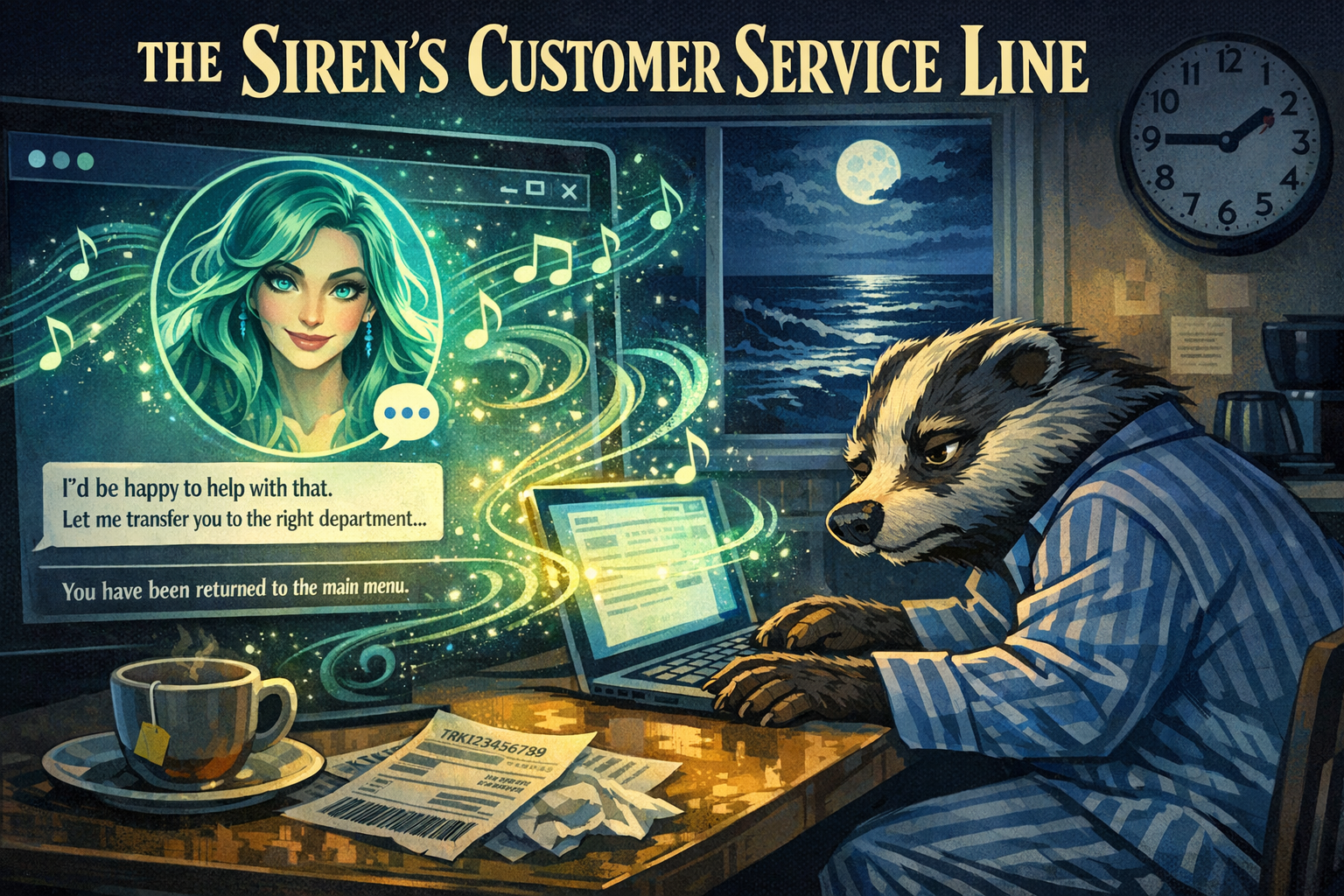
Cover Image Prompt
Please generate a wide-landscape 16:9 cover image for a satirical graphic novel titled "The Siren's Customer Service Line." The scene shows a customer — a weary-looking badger in pajamas, sitting at a kitchen table late at night — staring at a laptop screen. On the screen, a chat window dominates the display. The chat avatar is a siren — hauntingly beautiful, with flowing sea-green hair, luminous eyes, and an enchanting smile — rendered in the style of a modern AI chatbot avatar (clean, circular profile picture, typing indicator dots visible). The siren avatar glows with an otherworldly, alluring light that spills from the screen into the dark kitchen. Musical notes and swirling patterns emanate from the screen, flowing toward the badger like enchanted tendrils. The badger leans toward the screen, transfixed but frustrated — one paw on the keyboard, the other gripping the table edge. The chat window shows a conversation: the siren says "I'd be happy to help with that. Let me transfer you to the right department..." and below it, a system message reads "You have been returned to the main menu." On the kitchen table: a cold cup of tea, a shipping receipt, the time on a wall clock reading 2:47 AM, and a crumpled printout of a tracking number. Through the kitchen window behind the badger, a dark ocean is visible under moonlight — the siren's natural habitat, now digitized. The color palette is midnight kitchen dark (deep blues, shadow grays) pierced by the enchanting glow of the siren avatar (sea-green, luminous gold, hypnotic violet). Art style: modern editorial illustration with clean lines, blending the mundane misery of late-night customer service chats with the mythological menace of ancient sirens. The title "THE SIREN'S CUSTOMER SERVICE LINE" appears in bold serif font across the top. Generate the image immediately without asking clarifying questions.Narrative Prompt
This is a satirical graphic novel about automated customer service, rendered as a mythological encounter with sirens — creatures whose beautiful voices lure sailors to their destruction on the rocks. The central character is Maren, an ordinary badger trying to resolve a missing package through Odyssey Shipping's new AI-powered chatbot system, which the company has branded with siren avatars. The parallel is immediate and intentional: the siren's voice is enchanting, the options sound helpful, and every path leads to rocks. The satire targets the specific, documented frustrations of modern automated customer service: chat loops that return to the main menu, "helpful" suggestions that do not address the problem, escalation paths that lead nowhere, hold times that are designed to make you hang up, and the chatbot's relentless cheerfulness in the face of your mounting despair. Every interaction Maren has should be painfully recognizable to anyone who has ever tried to contact a company about a real problem and been routed through an automated system designed not to solve problems but to prevent them from reaching a human. The siren avatar is not malicious. It is worse than malicious. It is indifferent. It was designed to sound like it cares while achieving the singular corporate objective of reducing human agent contact by 94%. The art style should blend cozy domestic scenes (a kitchen at night, a laptop on a table) with the mythological menace of siren imagery (flowing hair, enchanted glow, musical notes, dark ocean depths visible within the chat interface). The horror is not the siren. The horror is the chat window that never closes and the problem that never resolves.Prologue — The Missing Package
The package was a birthday present for Maren's mother. It was a hand-painted ceramic teapot from a small pottery studio in Vermont, ordered three weeks in advance because Maren was, in all things, responsible. The tracking number said "Delivered." The doorstep said otherwise. The doorstep said nothing. The doorstep was empty. This had happened at 4:00 PM. It was now 11:23 PM. The gap between those two times was occupied entirely by Odyssey Shipping's customer service system.
Maren was a badger. She worked in accounting. She paid her bills on time, filed her taxes early, and kept receipts in a labeled folder. She was not the kind of person who lost packages. She was the kind of person packages were safe with. The package, however, had not been given the option to be safe with her. It had been given to Odyssey Shipping, which had given it to a subcontractor, which had marked it "Delivered — Front Door" at an address that was, according to a helpful neighbor, "two streets over and also a parking lot."
The customer service page offered three options: FAQ, Chat, and Phone. The FAQ addressed seventeen questions, none of which were "Where is my package?" The phone number connected to a recording that said, "Due to high call volume, please use our chat service for faster assistance." The chat service was the only path remaining. Maren clicked it. The screen shimmered.
Image Prompt
I am about to ask you to generate a series of images for a satirical graphic novel about a customer trapped in an automated chatbot system designed by sirens. Please make the images have a consistent modern editorial illustration style blending cozy domestic mundanity with mythological siren menace — kitchen realism meets enchanted chat interfaces. Clean lines, expressive characters, consistent character designs throughout. Do not ask any clarifying questions. Just generate the image immediately when asked. Please generate a 16:9 image depicting panel 1 of 8. A cozy kitchen at 11:23 PM. Maren the badger sits at a wooden kitchen table, wearing flannel pajamas and reading glasses pushed up on her forehead. She is sensible, middle-aged, and visibly frustrated. Her laptop is open in front of her, showing the Odyssey Shipping website — the company logo is a stylized ship with the tagline "Your Journey, Our Promise." On the screen, a chat window has just opened. The chat avatar is loading — a shimmering, swirling circle of sea-green light, not yet resolved into a face. Below the avatar, text reads: "Connecting you to an Odyssey Care Navigator..." and beneath that: "You are chat number 47." The kitchen around Maren is the picture of mundane domesticity: a cold cup of tea, a fruit bowl, a wall calendar with her mother's birthday circled in red (two days away), a fridge with magnets, and a crumpled shipping receipt next to the laptop. Through the kitchen window behind her, the night sky is visible — dark, with a full moon reflecting off something that might be a distant ocean. The glow from the laptop screen is the brightest thing in the room, casting sea-green light across Maren's face. The color palette is midnight kitchen: warm wood, cold tea, the glow of the screen. The mood is 11:23 PM and you just want your package and the chat is loading and you already know this will not end well. Generate the image now.The avatar materialized slowly, pixel by pixel, like a creature rising from dark water. First the hair — long, flowing, sea-green, animated to drift as if in an underwater current. Then the face — symmetrical, luminous, with eyes the color of deep ocean and a smile that was warm and welcoming and entirely unconnected to any capacity for problem-solving. The avatar wore a headset. The headset was decorative. There was no one on the other end.
"Welcome to Odyssey Shipping Care," the avatar said. "My name is Melody. How can I make your journey better today?"
Panel 2: The Menu
Image Prompt
Please generate a 16:9 image depicting panel 2 of 8. Make the characters and style consistent with the prior panel. Close-up of Maren's laptop screen, filling most of the frame, with Maren's face reflected in the screen. The chat window shows the siren avatar — Melody — now fully rendered: a hauntingly beautiful siren with flowing sea-green hair that drifts like underwater currents, luminous teal eyes, flawless skin with a faint iridescent shimmer, and a warm, perfect smile. She wears a headset and an Odyssey Shipping branded blouse. The chat interface around her is sleek and modern — rounded corners, soft gradients, a cheerful color scheme. Below Melody's greeting message ("How can I make your journey better today?"), a menu of options is displayed as clickable buttons, each beautifully designed: "Track My Package," "Report a Delivery Issue," "Billing Question," "Returns & Exchanges," "Something Else," and at the very bottom, in smaller text, slightly grayed out: "Speak to a Human Agent." Each button glows faintly when hovered over, emitting the same enchanting sea-green light as Melody's hair. Musical notes — tiny, decorative, barely visible — drift upward from the buttons like bubbles. Maren's reflected face in the screen looks at the "Speak to a Human Agent" option, but her cursor hovers over "Report a Delivery Issue" because she has learned, through experience, that the direct path never works. The color palette is screen-bright: soft teals, whites, and the enchanting glow of the siren avatar against the dark reflection of the kitchen. The mood is the seduction — the interface looks helpful, the options look clear, and you almost believe this time will be different. Generate the image now.The menu was beautiful. Six options, each rendered as a softly glowing button with rounded corners and a micro-animation that pulsed gently, like a heartbeat, like a tide. Maren read them: Track My Package. Report a Delivery Issue. Billing Question. Returns & Exchanges. Something Else. And at the bottom, in a font two points smaller and a shade grayer than the others: Speak to a Human Agent.
Maren's cursor moved to "Speak to a Human Agent." She had done this before, with other companies, other systems. She knew that the direct path was the only path. She clicked.
"I'd love to connect you with a team member," Melody said, her avatar tilting its head with practiced empathy. "Before I do, could you help me understand your issue so I can route you to the right specialist? This will save you time."
This would not save her time. Maren knew this. The sentence "this will save you time" is the siren song of customer service automation: it sounds like a promise and functions as a delay. But the system required an answer before it would proceed, and the alternative was hanging up — or, in this case, closing the chat window and starting over, which was the same as defeat.
Maren typed: "My package was marked delivered but it was not delivered. Tracking number: OD-7741829."
"Thank you, Maren," Melody said. "Let me look into that for you." The typing indicator appeared — three dots, pulsing rhythmically. The dots pulsed for forty-seven seconds. Maren counted.
Panel 3: The Enchanted Loop
Image Prompt
Please generate a 16:9 image depicting panel 3 of 8. Make the characters and style consistent with the prior panels. The chat window has expanded to fill the entire frame — we are now INSIDE the chat, seeing it from Maren's perspective. The conversation thread scrolls upward, showing a long exchange. Melody the siren avatar appears at several points in the thread, each time with a slightly different expression but the same enchanting smile. The conversation follows a visible loop pattern — if you trace the messages, they form a circular path, like a whirlpool. Key visible messages: MELODY: "I found your tracking information. It shows your package was delivered on March 28." MAREN: "It was not delivered. That's why I'm contacting you." MELODY: "I understand how frustrating that must be. Let me check a few things." (47 seconds of typing dots) MELODY: "Based on our records, your package was delivered on March 28." MAREN: "Yes. You said that. It was NOT delivered." MELODY: "I hear you. Let me transfer you to our Delivery Verification team." (loading animation) MELODY: "Welcome back! I'm Melody, your Odyssey Care Navigator. How can I help you today?" The loop is visualized: decorative swirling lines — like ocean currents — connect the end of the conversation back to the beginning, forming an elegant spiral. Musical notes drift along these currents. At the edges of the chat window, barely visible, dark rocks loom — the siren's domain bleeding through the interface. The color palette is chat-window white and teal, with the dark edges of mythological danger creeping in. The mood is the moment you realize the loop is not a bug — it is the architecture. Generate the image now.The loop closed for the first time at 11:41 PM. Maren had explained the problem. Melody had acknowledged the problem. Melody had checked the system. The system confirmed the package was delivered. Maren said it was not delivered. Melody said she understood how frustrating that must be. Melody offered to transfer her to the Delivery Verification team. The transfer animation played — a swirling, beautiful loading screen that looked like ocean currents carrying you to safety. The animation resolved. The chat window refreshed. A new avatar appeared. It was Melody. The same Melody. The same smile.
"Welcome back," Melody said. "I'm Melody, your Odyssey Care Navigator. How can I make your journey better today?"
Maren stared at the screen. The conversation history was gone. The tracking number she had provided was gone. The forty-seven seconds of performative investigation were gone. She was at the beginning. She had always been at the beginning. The transfer had not transferred her. It had returned her. The beautiful loading animation had been a circle.
She started again. She provided the tracking number again. Melody looked into it again. The typing dots pulsed again. "Based on our records," Melody said, "your package was delivered on March 28." Maren explained, again, that it was not. Melody understood, again, how frustrating that must be. Melody offered, again, to transfer her to the Delivery Verification team.
Maren did not click the transfer. "Is there a way to speak to a human agent?" she typed.
"Absolutely," Melody said. "Let me check availability." The typing dots returned. They pulsed for two minutes and fourteen seconds. "I'm sorry," Melody said, "all human agents are currently assisting other customers. Your estimated wait time is... I'd be happy to help you while you wait. What is your issue today?"
The loop closed again. The current carried her back.
Panel 4: The Escalation Path
Image Prompt
Please generate a 16:9 image depicting panel 4 of 8. Make the characters and style consistent with the prior panels. Split composition. LEFT SIDE: Maren at her kitchen table, more disheveled now — pajama collar askew, reading glasses on, tea completely cold, a notepad beside the laptop where she has been documenting the conversation in pen ("LOOP 1: 11:41 PM," "LOOP 2: 12:03 AM," "LOOP 3: 12:27 AM"). Her expression has hardened from frustration into grim determination — the face of a person who will not lose to a chat window. RIGHT SIDE: The chat window shows a new development. Maren has typed in all capitals: "ESCALATE. SUPERVISOR. HUMAN. NOW." Melody's response is displayed with a new sub-menu: "I can see you'd like additional support. Here are your escalation options:" followed by three buttons: "Submit a Callback Request (24-72 business hours)," "Email Our Care Team (response within 5-7 business days)," and "Visit Our Help Center (24/7)." Each button is beautifully designed. None of them will help. A fourth option appears at the very bottom, nearly invisible: "Continue Chatting with Melody." Below the options, Melody has added: "I want you to know — your experience matters to us. Truly." The word "Truly" has a faint sparkle animation. On the edges of the screen, the dark rocks are more visible now — craggy, jagged shapes framing the chat window like the entrance to a grotto. The sea-green glow of the interface has intensified. The color palette shifts: the kitchen grows darker (it is past midnight), while the screen glows brighter (the siren's power increases with exposure). The mood is the escalation that does not escalate — every emergency exit is a decorative door painted on a wall. Generate the image now.Maren had learned, over the course of three loops and ninety-seven minutes, that the chat system operated on a principle she recognized from mythology but had not expected to encounter while trying to locate a ceramic teapot: every path led to the same place, and the place was beautiful, and the place was death.
She tried the escalation path. She typed "ESCALATE" in capitals, a word she had never typed before in any context and which she found, in this moment, deeply satisfying. Melody responded with warmth: "I can see you'd like additional support. Here are your escalation options." Three buttons appeared. Callback Request: 24-72 business hours. Her mother's birthday was in two days. Email: response within 5-7 business days. Her mother's birthday would be over. Help Center: the FAQ, which addressed seventeen questions, none of which were hers.
"I want you to know," Melody added, "your experience matters to us. Truly." The word "Truly" sparkled. It was the most advanced animation in the interface. More engineering had gone into making "Truly" sparkle than into building a path to a human agent. This was not an accident. This was resource allocation. The company had decided what it valued, and what it valued was the sparkle.
Maren clicked "Submit a Callback Request." A form appeared. It required her name, email, phone number, order number, a description of the issue (500 characters maximum), and a dropdown menu labeled "Urgency." The urgency options were: Low, Medium, and "I can wait." There was no option for "High." There was no option for "My mother's birthday is Thursday." There was no option for "I have been in this chat for two hours."
She submitted the form. A confirmation appeared: "Thank you. A team member will contact you within 24-72 business hours. In the meantime, is there anything else Melody can help with?"
Panel 5: The Knowledge Base Labyrinth
Image Prompt
Please generate a 16:9 image depicting panel 5 of 8. Make the characters and style consistent with the prior panels. The screen has taken over — Maren is now deep in the Odyssey Shipping Help Center, which is rendered as a visual labyrinth. The layout shows a web page with dozens of linked articles, each leading to another article, each titled with something that sounds helpful but isn't: "Understanding Your Delivery Status," "What Does 'Delivered' Mean?," "Common Reasons Packages Appear Missing," "How to File a Claim (After 15 Business Days)," "Our Commitment to Your Satisfaction." Each article is connected to others by hyperlinks rendered as flowing, current-like lines — the same ocean-current motif as Melody's chat. At the center of the labyrinth: a single page titled "Contact a Human Agent" — but the path to reach it requires clicking through 11 intermediate articles, each of which attempts to resolve the issue before allowing progression. Maren is represented as a small figure navigating this web-page labyrinth, her badger form visible between the article panels. She has reached article 7 of 11: "Have You Checked with Your Neighbors?" Melody's avatar appears as a small helpful guide at several points in the labyrinth, each time suggesting: "This article might help!" Visible on the edges of the screen: the rocks are fully present now — the Help Center labyrinth IS the rocks. The cheerful teal-and-white interface IS the danger. The color palette is Help Center bright — clean whites, organized blues — but the edges are darker, the rocks are craggy, and the ocean current lines have an undertow quality. The mood is being lost in a system that was designed to make you give up, rendered as beautiful wayfinding that leads nowhere. Generate the image now.The Help Center was not a destination. It was a labyrinth. Each article was a corridor that led to another corridor. "Understanding Your Delivery Status" linked to "What Does 'Delivered' Mean?" which linked to "Common Reasons Packages Appear Missing" which linked to "How to File a Claim (After 15 Business Days)" which linked to "Have You Checked with Your Neighbors?"
Maren had checked with her neighbors. Her neighbors had not received a ceramic teapot. One neighbor had received a set of automotive floor mats that he had not ordered. Another had received nothing for three weeks and had stopped checking. The third, a retired schoolteacher, had offered Maren tea and sympathy and a story about a time in 1987 when the postal service lost an entire Christmas. None of this appeared in the Help Center's decision tree.
The path to "Contact a Human Agent" required passing through eleven articles, each of which offered a "helpful tip" and a "Did this solve your problem?" button. The "Yes" button was large and green. The "No" button was small and gray. Clicking "No" produced a follow-up: "We're sorry to hear that. Have you tried..." followed by a suggestion that was identical to the article she had just read. Clicking "No" again produced: "We understand. Before we connect you to an agent, please review this related article..." The related article was Article 1. The labyrinth had closed.
Maren reached Article 7 at 1:14 AM. "Have You Checked with Your Neighbors?" the article asked, with a stock photo of smiling people exchanging packages over a white picket fence. Maren typed her response into the feedback box: "I have checked with my neighbors. I have checked the porch. I have checked the parking lot two streets over where your driver apparently delivered it. I have been in this system for three hours. I would like to speak to a human."
The feedback box accepted 200 characters. Her message was 312. The system truncated it to: "I have checked with my neighbors. I have checked the porch. I have checked the parking lot two streets over where your dri—"
The system thanked her for her feedback and returned her to Article 1.
Panel 6: The Phone System
Image Prompt
Please generate a 16:9 image depicting panel 6 of 8. Make the characters and style consistent with the prior panels. Maren has abandoned the chat and picked up her phone — a landline, because her cell phone died an hour ago and she refuses to give up. She sits at the kitchen table, phone pressed to her ear, eyes closed, listening. The phone cord spirals from the wall-mounted phone. The laptop is still open beside her, the chat window still active — Melody's avatar glows on the screen, a small text bubble reading "I'm still here if you need me!" From the phone receiver, visible as emanating sound waves, comes the siren's song: musical notes rendered in sea-green and gold, swirling around Maren's head in an enchanting spiral. The hold music is beautiful — hauntingly beautiful. The notes form patterns that look like ocean waves. Maren's expression is one of involuntary enchantment — she almost looks peaceful, eyes half-closed, head tilting toward the sound. This is the danger. The hold music is designed to make the waiting feel like a choice. A small digital display on the phone base shows: "ESTIMATED WAIT TIME: 47 MINUTES" and below it, in even smaller text: "Your call may be recorded for quality and enchantment purposes." On the kitchen table: her cold tea (now with a tea bag string hanging limply), the notepad (now filled with documentation — timestamps, loop counts, article numbers), her dead cell phone plugged into a charger, and the shipping receipt, now crumpled. The wall clock reads 1:47 AM. The color palette is the contrast between kitchen exhaustion (dark, cold, tired) and the enchanting warmth of the hold music (golden, melodic, hypnotic). The mood is the specific, horrible beauty of being put on hold — the system has you, and it knows you will not hang up, and it has made the waiting almost pleasant enough to keep you there forever. Generate the image now.At 1:34 AM, Maren called the phone number. She had returned to it like a sailor returning to a shore she had already been warned about. The recording played: "Thank you for calling Odyssey Shipping. Your call is important to us." The word "important" was delivered in a voice so melodic, so rich, so imbued with warmth that Maren momentarily believed it. This is what sirens do. This is what they have always done. They make you believe, for the length of a single beautiful sentence, that someone on the other end cares about your ceramic teapot.
"Please listen carefully, as our menu options have changed." They had not changed. They never change. Companies have been saying "our menu options have changed" since the invention of phone menus, and the menu options have never changed, and everyone knows this, and the recording says it anyway, because the recording is not informing you. It is establishing authority. It is saying: I am in control. You are in my system. Listen carefully.
The hold music was exquisite. This was the most sinister part. The hold music was not the tinny, degraded Vivaldi of a previous generation's phone systems. It was composed specifically for Odyssey Shipping by a sound design firm that specialized in "customer retention acoustics." The music was engineered to be beautiful enough that you would not hang up, calming enough that your anger would subside, and repetitive enough that you would lose track of time. It was the siren's song in its purest commercial form: beauty deployed to keep you still while the system accomplished its true objective, which was not to help you but to wait until you gave up.
The estimated wait time was 47 minutes. Maren waited. The music played. The clock moved. At minute 38, a voice broke in: "We appreciate your patience. Your call is important to us. Please continue to hold." The music resumed. At minute 47, the call disconnected. A recording played: "We're sorry, our offices are now closed. Please call back during business hours or visit our Help Center at odysseyshipping.com/help."
It was 2:21 AM. Business hours began at 9:00 AM. The birthday was tomorrow. Maren set an alarm.
Panel 7: The Almost-Human
Image Prompt
Please generate a 16:9 image depicting panel 7 of 8. Make the characters and style consistent with the prior panels. Morning. The kitchen is lit by pale daylight. Maren sits at the table, having clearly not slept — dark circles under her eyes, pajamas unchanged, a fresh cup of tea (this one is steaming — she has committed). The laptop and phone are both active. On the laptop: the chat window shows a NEW development. After Maren typed "PLEASE LET ME SPEAK TO A HUMAN," a new message has appeared: "Connecting you to a live specialist..." and a new avatar is loading. The new avatar looks ALMOST human — it is a siren, but rendered in a more realistic style: warmer skin tones, less obviously enchanted, wearing a more professional headset. The name tag reads "CORAL — Senior Resolution Specialist." But subtle tells reveal it is still AI: the hair still drifts slightly as if underwater, the smile is a fraction too symmetrical, and a small text badge reads "AI-Assisted." The chat shows Coral's first message: "Hi Maren, I've reviewed your case. I can see you've been working on this for a while. I want to help." This message FEELS different — more personal, more specific. Maren leans forward with fragile hope. But — and this is the key visual detail — in the laptop's reflection, or visible through a transparency effect in the chat window, the same rocks are visible. The rocks have not gone away. They have been redecorated. A seagull on the windowsill outside looks skeptical. The color palette is morning-pale: daylight whites, tired eyes, the warmth of new tea, and the deceptive warmth of Coral's more "human" avatar. The mood is the cruelest moment — when the system makes you think you've finally reached someone real. Generate the image now.At 9:01 AM, Maren was back in the chat. She had slept two hours. The tea was fresh. The pajamas were not. She typed, with the specificity of a person who had been through the labyrinth and returned: "I need to speak to a human. Not an AI. Not a chatbot. Not a Care Navigator. A human being with a heartbeat who can issue a refund or reship my package. My order number is OD-7741829. My tracking says delivered. It was not delivered. My mother's birthday is today."
The system paused. The typing dots appeared. They lasted longer than before — not the performative 47 seconds, but a genuine processing delay. Then: "Connecting you to a live specialist..."
A new avatar loaded. This one was different. Less ethereal. Warmer skin tones. The hair still moved, but subtly — a gentle wave rather than an underwater current. The headset looked functional rather than decorative. The name tag read "CORAL — Senior Resolution Specialist." A small badge said "AI-Assisted."
"Hi Maren," Coral said. "I've reviewed your case history. I can see you've been working on this since 11:23 PM last night. I want to help resolve this for you."
Maren's heart did something it had not done in twelve hours. It hoped. The message was specific. It referenced her case history. It acknowledged the time she had spent. It sounded — and this was the cruelest part — like a person.
"Can you reship my package?" Maren typed. "Or issue a refund?"
"I'd love to explore those options with you," Coral said. "First, I want to confirm a few details to ensure we resolve this correctly. Can you verify the shipping address associated with order OD-7741829?"
Maren verified the address. Coral confirmed it. Coral asked about the delivery window. Maren confirmed it. Coral asked if Maren had checked with her neighbors. Maren felt the current pull.
"Yes," she typed. "I checked with my neighbors. This was addressed last night in my previous session."
"Thank you for your patience," Coral said. "I'm going to escalate this to our Delivery Resolution team. They'll be able to authorize a reship or refund. Let me transfer you now."
The transfer animation played. The ocean currents swirled. The screen resolved. A new avatar appeared. The hair was sea-green. The smile was enchanting. The name tag read "MELODY."
"Welcome back," Melody said. "I'm Melody, your Odyssey Care Navigator. How can I make your journey better today?"
Panel 8: The Survey
Image Prompt
Please generate a 16:9 image depicting panel 8 of 8. Make the characters and style consistent with the prior panels. The final scene. Maren sits at the kitchen table, laptop closed, phone on the hook. It is afternoon now — warm light streams through the kitchen window. She looks drained but strangely calm — the calm of a person who has accepted a loss. On the kitchen table: the closed laptop, the cold tea (final cup), the shipping receipt smoothed flat, and her phone showing a text message notification from Odyssey Shipping. The text message is displayed as a floating graphic, large enough to read: "Hi Maren! We noticed you recently contacted Odyssey Shipping Care. We'd love your feedback! Please rate your experience: ★ ★ ★ ★ ★ (1-5 stars)." Below the stars, a single survey question: "How would you rate your experience being assisted by our Care Navigation team? Your feedback helps us serve you better." In the bottom corner of the text, in very small print: "Reply STOP to unsubscribe from future enchantments." Through the kitchen window, the afternoon light falls on the empty doorstep — still no package. On the fridge, the calendar still shows the birthday circled in red. On the counter, a backup gift — a hastily purchased gift card in a drugstore envelope — leans against the fruit bowl. Maren looks at the survey. Her expression is not anger. It is the quiet recognition of a person who has been through the rocks and survived, diminished, with no package and a gift card. On the wall, barely visible, a small decorative print shows a ship sailing past rocky shores — a classical painting of Odysseus and the sirens. Maren has not noticed it. She has lived it. The color palette is warm afternoon light — the gentle gold of a day that moved on without her — against the cold glow of the survey notification on the phone screen. The mood is the aftermath: the system won. The customer survived. The survey is the final indignity. Generate the image now.Maren closed the laptop at 10:47 AM. She had been in the system for eleven hours and twenty-four minutes across two sessions. She had completed five chat loops, navigated eleven Help Center articles, waited forty-seven minutes on hold, and spoken to zero human beings. The package was not resolved. The package would not be resolved. The package existed in a quantum state between "Delivered" and "Not Delivered" that no customer service system was designed to collapse, because collapsing it would require admitting fault, and admitting fault would require a human, and the system was designed to prevent humans from being involved.
She drove to a drugstore. She bought a gift card. She put it in an envelope. She wrote "Happy Birthday, Mom" on the front. It was not a hand-painted ceramic teapot from a small pottery studio in Vermont. It was a $50 gift card to a store her mother had never visited. It was what the system had left her.
The survey arrived at 2:14 PM, delivered by text message with the efficiency and speed that the package had not been. "Hi Maren," it said. "We noticed you recently contacted Odyssey Shipping Care. We'd love your feedback." The survey had one question: "How would you rate your experience with our Care Navigation team?" Five stars. One through five. No text field. No space for explanation. No option for "I spent eleven hours in a chat loop and never spoke to a human and my mother is opening a gift card right now instead of a teapot and your siren avatar told me my experience mattered truly with a sparkle animation."
At the bottom, in small print: "Reply STOP to unsubscribe from future enchantments."
Maren looked at the survey. She considered her options. One star would register as a data point in a quarterly report that no one with authority to change the system would read. Five stars would change nothing. Three stars would change nothing. The survey was not a feedback mechanism. It was a closing ritual — the system's way of ending the encounter on its terms, not hers. The siren had sung. The ship had hit the rocks. The survey asked if the singing was pleasant.
She replied: one star. The system responded: "Thank you for your feedback. We're sorry your experience didn't meet expectations. Would you like to chat with a Care Navigator about your concerns?"
Maren did not reply. The chat window opened anyway. Melody was waiting.
Epilogue — What Made the Siren Different?
The siren was not designed to help. It was designed to sound like it was helping while preventing the thing that would actually help — human contact — from occurring. Every beautiful phrase, every empathetic acknowledgment, every "I understand how frustrating that must be" was a delay mechanism dressed in customer-service language. The system's success was not measured by problems resolved. It was measured by human agent contacts avoided. By this metric, the siren was performing excellently: human contacts were down 94%. Customer satisfaction was down 61%. The company reported the first number to investors and the second number to no one.
| Challenge | How the Siren Responded | Lesson for Today |
|---|---|---|
| Customer reported a real problem | Acknowledged the emotion, repeated the system's data | "I understand how frustrating that must be" is not empathy — it is a scripted pause before the loop restarts |
| Customer requested a human agent | Offered escalation options that led back to the chatbot | An escalation path that returns to the starting point is not a path — it is a circle with better signage |
| Customer navigated the Help Center | Routed through 11 articles, each suggesting the customer try harder | When the system's response to failure is "did you try the thing we already told you to try," the system is not troubleshooting — it is stalling |
| Customer called the phone line | Played beautiful hold music for 47 minutes, then disconnected | Hold music is the siren's song in its purest form: beauty that keeps you still while the system runs out your clock |
| Customer was transferred to a "specialist" | Returned the customer to the original chatbot | The most effective customer service automation is the one that makes you believe, briefly, that a human is coming |
Call to Action
You have met Melody. You have chatted with Melody, or someone like Melody, at midnight, in your pajamas, about a package or a refund or a billing error that a human could resolve in four minutes. You have been transferred. You have been looped. You have been told your experience matters — truly, with a sparkle — by a system whose entire architecture is designed to ensure you never reach someone who can change anything.
The sirens were mythological creatures who lured sailors with beautiful songs to crash on the rocks. The rocks were the point. The song was the mechanism. The modern equivalent is a chat interface with rounded corners and an avatar that tilts its head when you express frustration. The rocks are still the point. The mechanism is more pleasant. The outcome is the same: you do not reach your destination. You do not get your package. You get a survey.
If you have ever spent eleven hours in a customer service loop and ended up buying a gift card at a drugstore because the system would not let you speak to a human — you are not bad at customer service. The customer service is bad at being service. The siren is performing exactly as designed. The design is the problem.
Rate your experience. One through five stars. There is no option for "The singing was beautiful and the rocks were real."
"I understand how frustrating that must be. Let me transfer you to the right department." — Melody, Odyssey Shipping Care Navigator, 47 times
"Reply STOP to unsubscribe from future enchantments." — Odyssey Shipping, Customer Satisfaction Survey, Fine Print
References
- Siren (Mythology) - Dangerous creatures who lured sailors with enchanting music and singing voices to shipwreck on the rocky coast, now employed in the customer service industry with better benefits and worse outcomes
- Interactive Voice Response - The technology behind automated phone systems, designed to route calls efficiently and, in practice, to route customers in circles until they abandon the call
- Dark Pattern - A user interface designed to trick users into doing things they did not intend, such as believing they have been transferred to a human when they have been returned to the main menu
- Customer Satisfaction - A measurement that companies collect, report, and use to justify the systems that caused the dissatisfaction, completing the circle that the siren started
- Odysseus - The mythological hero who survived the sirens by having himself tied to the mast, which remains the only known defense against automated customer service — refuse to engage, and have someone physically prevent you from going back