The Phoenix Retraining Program: Learning to Code at 3,000
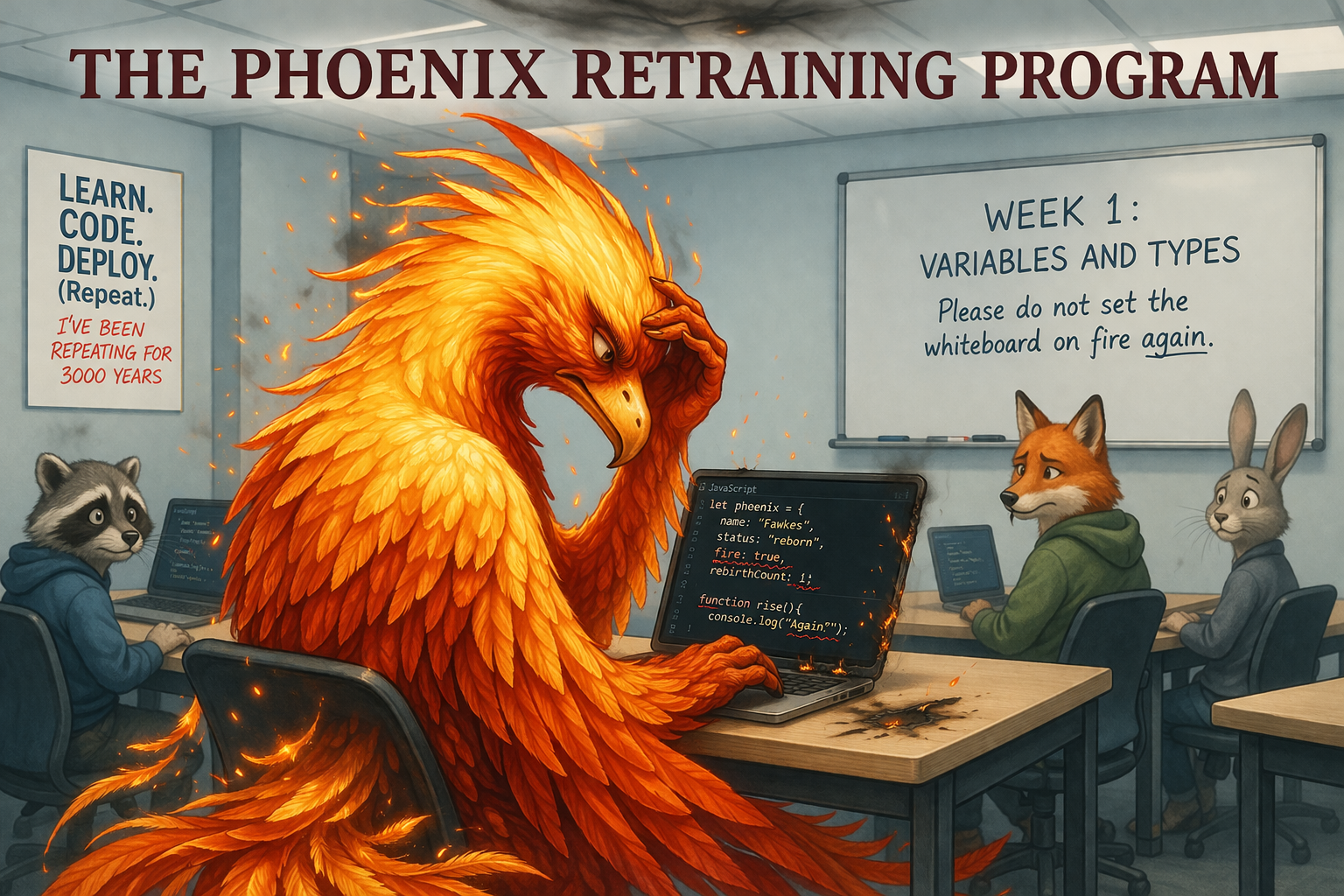
Cover Image Prompt
Please generate a wide-landscape 16:9 cover image for a satirical graphic novel titled "The Phoenix Retraining Program." The scene shows a magnificent phoenix — plumage in brilliant golds, oranges, and deep reds, with long elegant tail feathers — sitting at a small desk in a modern coding bootcamp classroom. The phoenix is hunched over a laptop, talons awkwardly positioned on the keyboard, with a look of deep frustration. The laptop screen shows JavaScript code with red error squiggles everywhere. Small embers drift from the phoenix's feathers, and scorch marks are visible on the desk, the laptop edges, and the ceiling directly above. Around the phoenix, other bootcamp students — a young raccoon, a fox, a rabbit — sit at identical desks, all giving the phoenix nervous sideways glances. On the whiteboard at the front of the room: "WEEK 1: VARIABLES AND TYPES — Please do not set the whiteboard on fire again." A motivational poster on the wall reads "LEARN. CODE. DEPLOY. (Repeat.)" with someone having written "I'VE BEEN REPEATING FOR 3000 YEARS" in red marker beneath it. The color palette is the warm golds and reds of the phoenix against the cold fluorescent blues and grays of a modern tech classroom. Art style: modern editorial illustration with clean lines, warm satirical detail, blending mythological grandeur with WeWork-office mundanity. The title "THE PHOENIX RETRAINING PROGRAM" appears in bold serif font across the top. Generate the image immediately without asking clarifying questions.Narrative Prompt
This is a satirical graphic novel about career reinvention in an era of constant disruption. The central character is Pyra — a 3,000-year-old phoenix who has reinvented herself through dramatic self-immolation and glorious rebirth approximately once per century, and who has now been told that this skill is no longer marketable. The satire targets coding bootcamp culture, the tech industry's obsession with perpetual reskilling, the absurdity of job requirements for technologies younger than most houseplants, and the quiet indignity of being ancient, powerful, and mythological but still needing to learn JavaScript to pay rent. Every coding frustration Pyra experiences should be painfully recognizable to anyone who has learned to program: the inexplicable behavior of `this` in JavaScript, the existential void of a blank terminal, the false confidence of a passing test followed by the crushing reality of a failing deployment. The art style should blend the grandeur of mythological illustration — flames, gold, celestial drama — with the fluorescent-lit mundanity of a modern tech office. Pyra is not stupid. She is brilliant, ancient, and capable of things no mortal can comprehend. She simply cannot get her div to center.Prologue — The Ashes, Again
Pyra had been rising from ashes since before the pyramids were blueprints. She had burned and been reborn in Mesopotamia, in Athens, in Rome, in Constantinople, in Vienna, in San Francisco. Each time: the flames, the dissolution, the quiet dark, and then — the return. More radiant. More powerful. More herself. It was, she had always believed, the ultimate marketable skill. Reinvention. Transformation. The ability to emerge from total destruction better than before.
The career counselor — a pragmatic tortoise named Harold who had outlived most of his clients — delivered the news with the gentleness of a man who had done this before. "The market has shifted," he said, adjusting his bifocals. "Self-immolation followed by rebirth — it is a niche skill. Very impressive at parties. But the job boards are looking for Python, not pyrotechnics."
"I know Python," Pyra said. "I ate one in 412 BC."
"The programming language," Harold clarified.
Image Prompt
I am about to ask you to generate a series of images for a satirical graphic novel about a phoenix attending a coding bootcamp. Please make the images have a consistent modern editorial illustration style blending mythological grandeur with tech-office mundanity — clean lines, expressive characters, consistent character designs throughout. Do not ask any clarifying questions. Just generate the image immediately when asked. Please generate a 16:9 image depicting panel 1 of 8. A career counseling office — small, cluttered, fluorescent-lit, with motivational posters on the wall. Behind a wooden desk sits Harold, a middle-aged tortoise wearing bifocals, a brown cardigan, and a patient expression. He holds a pamphlet titled "SO YOUR SKILL HAS BEEN AUTOMATED: A Guide." Across the desk sits Pyra the phoenix — a magnificent bird with plumage in brilliant golds, deep oranges, and crimson reds, with long elegant tail feathers that drape over the back of her chair and onto the floor. She is regal, ancient, and currently annoyed. Small embers drift from her feathers. The chair beneath her has scorch marks. On Harold's desk: a laptop showing job listings, a coffee mug reading "I SURVIVED THE INDUSTRIAL REVOLUTION (BARELY)," and a singed pamphlet. On the wall behind Harold, a chart shows "MARKETABLE SKILLS 2026" — the top entries are "AI/ML," "Python," "Cloud Architecture" — at the very bottom, barely visible, is "Mythological Rebirth (Declining)." The color palette is the warm gold and red of Pyra against the dull beige and fluorescent white of the office. The mood is the moment you learn your career is obsolete. Generate the image now.Pyra had not updated her resume in 400 years. Her most recent entry read "Renaissance — Served as metaphorical inspiration for the rebirth of Western civilization." Before that: "Roman Empire (Fall of) — Provided symbolic framework for cyclical historical theory." Her skills section listed "combustion," "resurrection," "dramatic timing," and "inspiring awe in mortals." LinkedIn's algorithm had classified her profile as "incomplete."
Panel 2: Orientation Day
Image Prompt
Please generate a 16:9 image depicting panel 2 of 8. Make the characters and style consistent with the prior panel. A modern coding bootcamp classroom on the first day. Rows of identical desks with laptops, motivational tech-culture posters on the walls ("MOVE FAST AND BREAK THINGS," "EAT SLEEP CODE REPEAT"), exposed brick, Edison bulb lighting, and a coffee station in the corner. At the front, an instructor — a young, enthusiastic border collie in a hoodie and jeans — gestures at a whiteboard that reads "WELCOME TO ASHFORGE ACADEMY — 12 Weeks to a New You! (Week 1: HTML & CSS)." The students are seated: a nervous young rabbit with a brand-new laptop still in shrink wrap, a confident fox in a tech startup t-shirt, a studious owl taking notes, and Pyra — who is twice the size of everyone else, her tail feathers extending across two desks, small flames occasionally licking from her plumage. A fire extinguisher has been placed conspicuously next to her desk. On her laptop screen: a terminal with the text "Hello World" and several error messages. The student next to her — the rabbit — has scooted their chair slightly away. The ceiling tile above Pyra is slightly singed. The color palette is warm bootcamp tones — exposed brick, warm wood, screen glow — with Pyra's mythological golds disrupting the modern setting. Generate the image now.Ashforge Academy's twelve-week Full-Stack Development Bootcamp had a 94% job placement rate, which it calculated by counting students who got jobs at Ashforge Academy teaching the next cohort. Tuition was $16,000, payable in installments or in a single lump sum that included a free branded water bottle. The water bottle was the most tangible thing Pyra would receive for her money.
Orientation began at 9:00 AM. The instructor, a border collie named Dev who had graduated from the same bootcamp seven months earlier, opened with a question: "Who here has coded before?" The fox raised a paw. The owl raised a wing. Pyra raised a talon and said, "I wrote incantations in Sumerian cuneiform that could summon fire from the void." Dev said, "Great, so you're familiar with the command line."
Panel 3: The JavaScript Problem
Image Prompt
Please generate a 16:9 image depicting panel 3 of 8. Make the characters and style consistent with the prior panels. Close-up of Pyra at her desk, late at night. The classroom is empty except for her — the other students have gone home. Coffee cups (singed) litter her desk. Her laptop screen dominates the left side of the image, showing JavaScript code with the keyword `this` highlighted in multiple places, each pointing to a different thing. Red error messages fill the console below the code. Pyra stares at the screen with an expression that blends ancient fury with modern bewilderment — the face of an immortal being who has survived the fall of civilizations but cannot understand JavaScript scoping. Her plumage has dimmed from frustration — the golds are muted, the reds less vibrant, like embers cooling. One talon is raised as if about to strike the keyboard. The other grips the desk edge, leaving scorch marks. On the whiteboard behind her, someone has written "this → refers to: ???" with arrows pointing in contradictory directions. A sticky note on her monitor reads "DO NOT SET LAPTOP ON FIRE (3rd replacement this week)." A small flame flickers at the tip of her tail — stress response. The color palette is the cold blue of the laptop screen against the dim warm amber of Pyra's fading glow. The mood is 2 AM and nothing works and you have been alive for three millennia and it does not help. Generate the image now.JavaScript was the first real obstacle. Pyra had mastered Sumerian, Aramaic, Classical Greek, Latin, Old Norse, Middle English, and Mandarin. She had decoded the Rosetta Stone for fun. She had read the Library of Alexandria before it burned — she had, in fact, been partially responsible for the burning, but that was a different story. None of this prepared her for the this keyword.
"In a method, this refers to the object," Dev explained. "Unless it's in an arrow function, where it inherits from the enclosing scope. Unless that scope is a callback, where it might refer to the global object. Unless you're in strict mode, where it's undefined. Unless you've used .bind(), which creates a new function with this permanently set to whatever you pass it."
Pyra asked what this referred to in her specific code. Dev looked at it for thirty seconds and said, "I genuinely do not know." The fox, who had been coding for two years, nodded sympathetically. No one knows what this refers to. Not really. Not always. The language itself seems uncertain.
Pyra stayed until 2 AM. She rewrote the function eleven times. On the twelfth attempt, it worked. She did not know why. She committed the code with the message "it works do not touch it" and went home. This, she would later learn, is professional software development.
Panel 4: The Whiteboard Interview
Image Prompt
Please generate a 16:9 image depicting panel 4 of 8. Make the characters and style consistent with the prior panels. A tech company interview room — sterile white walls, a glass table, and a large whiteboard. Two interviewers sit at the table: a slick wolf in a Patagonia vest and a no-nonsense hawk in a blazer, both holding tablets with scoring rubrics. Pyra stands at the whiteboard, dry-erase marker in talon, having been writing out a solution to a coding problem. The problem is visible at the top of the board: "Reverse a binary tree (on the whiteboard, please)." Pyra's solution is halfway complete and actually correct — her handwriting is beautiful, an ancient calligraphic style applied to modern code. BUT: the whiteboard is on fire. Pyra's proximity and her stress response have ignited the dry-erase surface. Flames lick up from the bottom of the board, consuming her code. Pyra looks mortified — wings half-spread in alarm. The wolf interviewer holds a fire extinguisher, looking resigned rather than surprised (this has happened before). The hawk interviewer is still scoring the rubric, unbothered, writing "fire risk: HIGH" in the notes column. A smoke detector on the ceiling is going off. Through the glass wall of the interview room, other employees in the hallway watch with mild interest — this is not the strangest thing they have seen this quarter. The color palette is sterile interview-room white, the orange of flames, and corporate gray. The mood is the exact moment a job interview goes wrong, combined with the specific humiliation of a physical limitation you cannot control. Generate the image now.The mock interview was scheduled for Week 6. Ashforge Academy partnered with local tech companies to give students "real-world interview experience," which meant being evaluated by people who had been in the industry for three years and had already forgotten what it was like to not know things. Pyra's interviewers were a wolf in a Patagonia vest and a hawk in a blazer. They asked her to reverse a binary tree on the whiteboard.
Pyra approached the whiteboard with confidence. She had been solving problems for three thousand years. She picked up the dry-erase marker, began writing — elegant, precise code in a calligraphic hand that the Sumerians would have admired — and caught fire. Not metaphorically. Her stress response activated. Her plumage flared. The whiteboard ignited.
The wolf reached for the fire extinguisher with the practiced calm of someone who keeps one in the interview room for exactly this reason. The hawk continued scoring. In the "Additional Notes" field, she wrote: "Strong problem-solving. Solution was correct before it burned. Fire risk: significant. Recommend remote interviews only."
Pyra did not get a callback. The company's insurance did not cover mythological combustion events.
Panel 5: The CI/CD Revelation
Image Prompt
Please generate a 16:9 image depicting panel 5 of 8. Make the characters and style consistent with the prior panels. The bootcamp classroom during a lecture on deployment pipelines. Dev the border collie instructor stands at the whiteboard, which shows a diagram of a CI/CD pipeline: "CODE → BUILD → TEST → DEPLOY → MONITOR → REPEAT." Each stage is connected by arrows in a continuous cycle. Pyra sits at her desk, staring at the diagram with the expression of someone who has just seen their life's work reduced to a flowchart. The realization is hitting her: the pipeline — code, build, test, fail, rebuild, redeploy — is exactly what she does. Destroy and recreate. Burn and rise. The cycle of death and rebirth, automated and running in a Docker container. A thought bubble above Pyra shows her traditional rebirth cycle — flames, ashes, golden egg, glorious emergence — next to the CI/CD pipeline. They are identical. The other students take notes normally, unaware of the existential crisis occurring two seats over. The fox is doodling. The owl is highlighting. Only Pyra understands that her three-thousand-year mythology has been replaced by a YAML configuration file. The color palette is whiteboard blue and black for the diagram, warm gold for Pyra's thought bubble, and the flat gray of an existential crisis. Generate the image now.Week 8 was DevOps. Dev drew a CI/CD pipeline on the whiteboard: Code. Build. Test. Deploy. If it fails, destroy the environment and rebuild from scratch. Monitor. Repeat. The cycle continues forever. Each iteration is faster. Each rebuild is cleaner. The system improves through destruction and recreation.
Pyra stared at the diagram for a long time.
"This is what I do," she said.
"What?" Dev asked.
"Burn. Die. Rise. Repeat. You have automated me. I am a CI/CD pipeline. My entire mythology — three thousand years of dramatic self-immolation and glorious rebirth — is a YAML file and a cron job."
The classroom was silent. The fox stopped doodling. The owl looked up from her notes. Dev opened his mouth, closed it, and then said, with genuine compassion, "I mean, when you put it that way, it does sound like continuous deployment."
Pyra excused herself. She sat in the parking lot for forty minutes. A pigeon landed next to her. It was not a metaphor. It was just a pigeon. She went back inside.
Panel 6: The Group Project
Image Prompt
Please generate a 16:9 image depicting panel 6 of 8. Make the characters and style consistent with the prior panels. A late-night group project session in the bootcamp classroom. Four students huddle around a shared screen: Pyra, the rabbit (now more confident, wearing a bootcamp t-shirt), the fox (who has not pushed code in three days), and the owl (who has rewritten everyone else's code without telling them). The shared screen shows a GitHub repository with merge conflicts highlighted in angry red — dozens of conflicting changes. Pyra's talons hover over the keyboard, trying to resolve a merge conflict. The rabbit points at one section of code. The fox scrolls Twitter on a second monitor. The owl has printed out the entire codebase and is annotating it with a red pen. On the whiteboard behind them: their project name — "PhoenixApp: A Task Manager That Rises From Crashed Servers" — and a Kanban board with most tasks in the "In Progress" column and nothing in "Done." Pizza boxes are stacked on a nearby desk (Pyra's slices are slightly charred). Post-it notes cover every surface. One reads "WHO PUSHED TO MAIN???" The clock on the wall shows 11:47 PM. The color palette is late-night screen glow, pizza-box beige, and the warm amber of Pyra's feathers providing ambient light for the group. The mood is every group project at every bootcamp — exhaustion, friction, and the slow realization that working with people is harder than working with code. Generate the image now.The group project was called PhoenixApp — a task management tool that automatically recovered from server crashes. Pyra's idea. The metaphor was obvious. The implementation was not.
The team consisted of four students with four different working styles: Pyra, who wrote elegant code and occasionally set the test environment on fire; the rabbit, who had become quietly competent and pushed clean commits at regular intervals; the fox, who had not pushed code in three days and claimed to be "working on the architecture"; and the owl, who had silently rewritten everyone else's code at 3 AM without telling anyone, introducing fourteen new bugs while fixing two.
The merge conflicts alone took an entire day. Pyra learned that collaboration is harder than combustion. Burning yourself to ashes and starting over is a solo act. Building software with other people requires a different kind of destruction: the destruction of your ego, your assumptions, and your conviction that your solution is the correct one. The owl's code was better. Pyra did not enjoy this realization. She committed to it anyway.
Panel 7: Demo Day
Image Prompt
Please generate a 16:9 image depicting panel 7 of 8. Make the characters and style consistent with the prior panels. Demo Day at Ashforge Academy — the classroom has been transformed into a presentation space. Rows of folding chairs hold an audience of tech company recruiters (various animals in business casual), bootcamp alumni, and a few skeptical-looking venture capitalists. A banner reads "ASHFORGE ACADEMY — COHORT 47 DEMO DAY." Pyra stands at the front, presenting PhoenixApp from a laptop connected to a projector screen. The app is displayed: a clean, professional-looking task management interface. Pyra is mid-presentation, one wing gesturing at the screen, speaking with the controlled confidence of someone who has addressed Roman emperors and is now addressing a room of people in branded hoodies. Her plumage is at full brilliance — golds and reds glowing, tail feathers fanned dramatically behind her. She looks magnificent. The app, on the projector, shows a live demo — and in the bottom corner of the screen, a small notification reads "Server crashed. Recovering..." followed by "Server restored. 0 tasks lost." The audience leans forward. One recruiter is already typing on a phone. But — and this is the key visual detail — a small wisp of smoke rises from the laptop. Not enough to set off alarms. Enough to notice. Pyra's proximity to the hardware remains a liability, even in her finest moment. The color palette is presentation-bright: clean whites, Pyra's gold, and the blue glow of the projector. Generate the image now.Demo Day was the culmination of twelve weeks, $16,000, four laptops (fire damage), one destroyed whiteboard, and the complete dismantling of a three-thousand-year-old identity. Pyra presented PhoenixApp to a room of recruiters, alumni, and two venture capitalists who had come for the free coffee and stayed because the app actually worked.
The demo went well. The app crashed during the live presentation — as all demos must — and then recovered automatically, restoring every task with zero data loss. The audience murmured. "How does it handle recovery so gracefully?" a recruiter asked. Pyra said, "I have some experience with the concept." A wisp of smoke rose from the laptop. Nobody mentioned it.
The fox presented a cryptocurrency portfolio tracker that crashed and did not recover. The owl presented a code review tool that automatically rejected all pull requests, which the owl insisted was "a feature, not a bug." The rabbit presented a quiet, well-built weather app that worked perfectly, impressed no one, and would, within two years, be the only project from the cohort still in production.
Panel 8: The Offer Letter
Image Prompt
Please generate a 16:9 image depicting panel 8 of 8. Make the characters and style consistent with the prior panels. Pyra sits on a bench outside the bootcamp building — a modern tech campus with glass walls and exposed concrete. It is early morning, golden hour light. She holds a printed offer letter in one talon and her phone in the other. The offer letter is from "Ember Technologies" — the letterhead is visible, with a small flame logo. Key details are readable: "Position: Junior Developer," "Salary: $62,000" (Pyra has circled this with a slight scorch mark, her expression suggesting this is less than she made as a mythical symbol), and — highlighted with a golden glow — "Benefits: Full health insurance, including coverage for fire-related incidents." This last line is what matters. Pyra's expression is complex: relief, pride, a touch of melancholy, and the quiet dignity of someone who once inspired civilizations and is now grateful for dental coverage. Her plumage is calm — warm, steady amber rather than dramatic flames. Beside her on the bench: her bootcamp laptop (singed but functional), a copy of "JavaScript: The Good Parts" (very thin, slightly charred), and her old resume with "Mythical Symbol of Renewal" crossed out and "Junior Developer" written below in her ancient calligraphic hand. The morning light makes her look, for a moment, exactly like what she is: reborn. The color palette is golden hour warmth — soft golds, gentle amber, morning blue sky. The mood is bittersweet triumph. Not the dramatic rebirth of mythology, but the quiet one that actually counts. Generate the image now.The offer came from Ember Technologies, a mid-sized startup whose name Pyra chose not to read into. Junior Developer. $62,000 per year. This was less than she had earned as a mythical symbol of renewal, when "earned" was measured in temples built in her honor and "salary" was the devotion of civilizations. Sixty-two thousand dollars would not buy a temple. It would cover rent, groceries, and the student loan payments on a bootcamp that had charged her $16,000 to learn what this refers to (answer: still unclear).
But the benefits package included full health insurance. And the health insurance covered fire damage.
Pyra read that line three times. In three thousand years, no employer had ever covered fire damage. The temples had not offered dental. The civilizations had not provided a 401(k). Ember Technologies offered both, plus unlimited PTO that everyone understood meant "do not actually take unlimited PTO."
She signed the offer with a talon that left a faint scorch mark on the signature line. She would start on Monday. She would sit at a desk, open a laptop, and write code that no one would worship and no one would build a temple to honor. She would attend standups and sprint retrospectives and quarterly reviews. She would be, for the first time in three millennia, ordinary.
It was, she realized, the most frightening reinvention she had ever attempted. Every previous rebirth had been dramatic: flames, ashes, glory. This one was quiet. This one came with a lanyard and a parking pass. This one required her to be not a myth, not a symbol, not an allegory — just a person, at a desk, doing the work.
She closed the laptop. The morning light caught her feathers — warm gold, steady amber, not the dramatic blaze of mythology but the quieter glow of someone who had survived the thing she feared most: starting over without burning down first.
Epilogue — What Made Pyra Different?
Pyra had reinvented herself dozens of times. But every previous reinvention followed the same pattern: total destruction followed by automatic renewal. The bootcamp was different because it offered no guarantee of rebirth. The code did not compile because she willed it to. The interviews did not go well because she was mythological. The job market did not care that she was ancient and radiant and capable of summoning fire from the void. It cared whether she could center a div. She could not, at first. She learned. That is the reinvention that counts.
| Challenge | How Pyra Responded | Lesson for Today |
|---|---|---|
| Core skill declared obsolete | Enrolled in retraining instead of denying the change | The willingness to be a beginner again is the hardest part of reinvention |
JavaScript's this keyword |
Stayed until 2 AM, rewrote the function twelve times | Some things cannot be understood — they can only be survived |
| Failed whiteboard interview (caught fire) | Accepted the rejection, adapted to remote formats | Your limitations are real. Working around them is the skill |
| Discovering her mythology had been automated (CI/CD) | Sat in a parking lot for forty minutes, then went back inside | Grieving what you were is part of becoming what you will be |
| Accepting a junior role at age 3,000 | Signed the offer, showed up on Monday | Starting over does not erase what came before — it builds on it, even when no one can see the foundation |
Call to Action
The economy does not care how many times you have risen from the ashes. It does not care about your mythology, your legacy, or the civilizations that built temples in your name. It cares about your GitHub profile and whether you can pass a technical screen without setting the whiteboard on fire.
This is not fair. Pyra's skills — pattern recognition across millennia, resilience under literal fire, the ability to transform completely and emerge functional — are extraordinary. They are also not listed on the job boards. The job boards want Python (the language, not the snake) and five years of experience in a framework that is three years old.
The phoenixes among us — the people who have been displaced, reskilled, retrained, and told to reinvent themselves one more time — are not failing. They are doing the hardest thing a professional can do: starting over without the promise that the fire will bring them back. Some of them will land at Ember Technologies. Some of them will land somewhere better. All of them deserve health insurance that covers fire damage.
"I have died and been reborn forty-seven times. None of those deaths were as painful as learning CSS grid." — Pyra, Bootcamp Week 3
"The pipeline deploys, the tests run, the build fails, the system rebuilds. I used to call this 'the sacred cycle of renewal.' Now they call it 'continuous integration.' Same thing. Worse pay." — Pyra, LinkedIn Post (47 likes, 3 comments, 1 recruiter DM)
References
- Coding Bootcamp - Intensive, short-term training programs that promise to transform beginners into employable developers in 8-16 weeks, which is faster than mythological rebirth but with a lower success rate
- Continuous Integration/Continuous Deployment - The practice of automating the build-test-deploy cycle, which a phoenix might reasonably describe as "industrializing the sacred flame"
- Impostor Syndrome - The persistent feeling that you are not qualified for your position, experienced even by immortal beings who once inspired the Renaissance
- Structural Unemployment - Unemployment caused by a mismatch between workers' skills and job requirements — particularly acute when your primary skill is self-immolation and the market wants JavaScript
- Phoenix (Mythology) - A mythical bird that cyclically regenerates, symbolizing renewal and transformation — now also symbolizing the emotional arc of anyone who has been told to "pivot" more than twice in a decade