The Vampire's Digital Transformation: Sucking the Life Out of Every Initiative
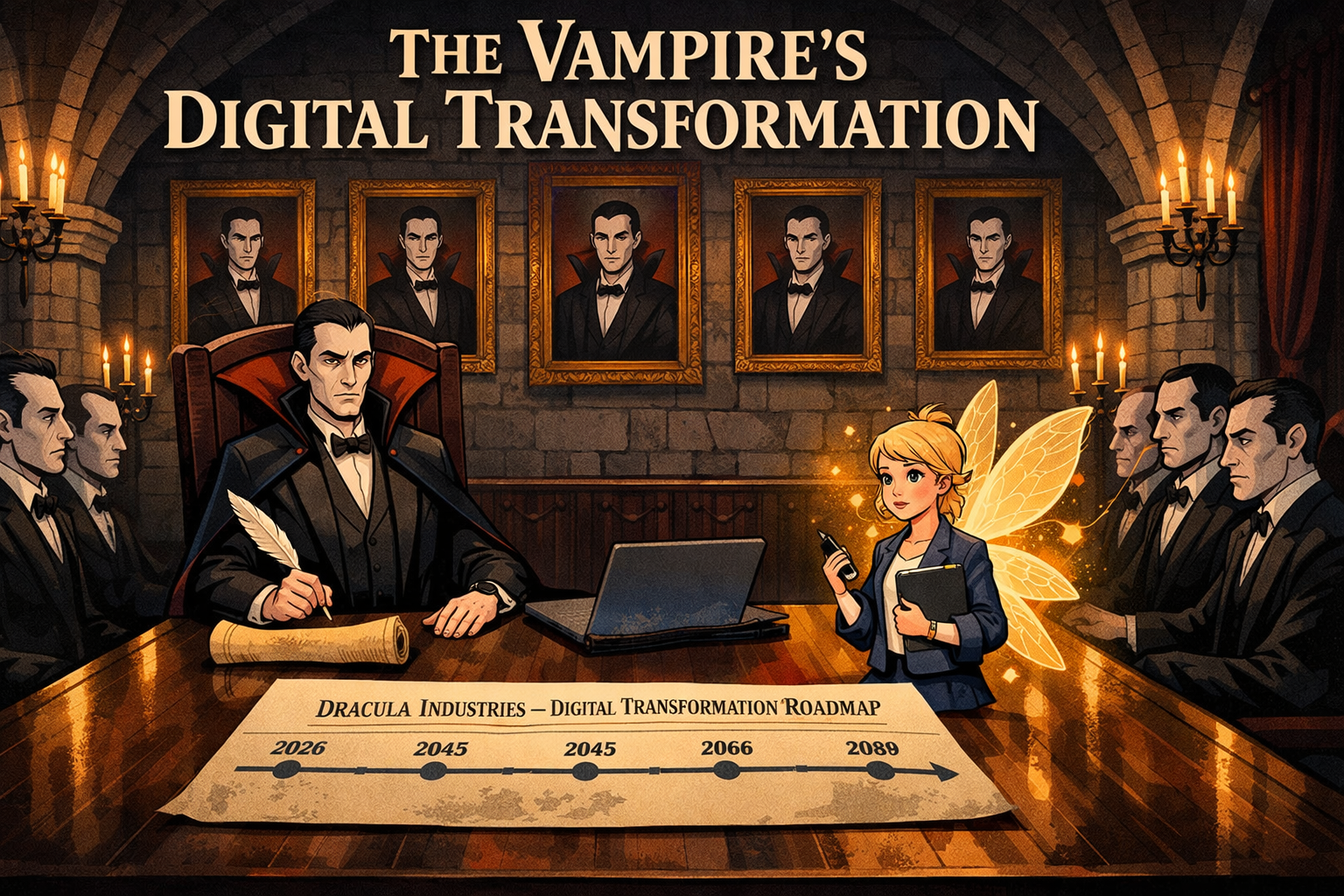
Cover Image Prompt
Please generate a wide-landscape 16:9 cover image for a satirical graphic novel titled "The Vampire's Digital Transformation." The scene shows a grand Gothic boardroom inside a Transylvanian castle — vaulted stone ceilings, candelabras, heavy velvet curtains, oil paintings of previous CEOs (all vampires, all looking identical across centuries). At the head of an enormous dark oak conference table sits Count Dracula — tall, gaunt, pale, wearing a perfectly tailored black suit with a high-collared cape over it, silver cufflinks, slicked-back black hair with a widow's peak, and an expression of imperious patience. He holds a quill pen in one hand. Before him on the table: a parchment scroll and a modern laptop, side by side — the laptop is closed and covered in a thin layer of dust. At the opposite end of the table stands the consultant — a small, bright-eyed fairy named Fern, glowing with golden light, wearing a smart blazer over her wings, holding a tablet and a presentation clicker. Her expression is determined but slightly uncertain — she has just arrived and has not yet understood what she is dealing with. Between them on the table: a project plan titled "DRACULA INDUSTRIES — DIGITAL TRANSFORMATION ROADMAP" with a timeline that stretches, visibly, from 2026 to 2089. Around the table, vampire executives sit in high-backed chairs — pale, formal, identically dressed in black, all looking at Fern with the specific polite attention of creatures who have survived 562 years by waiting for things to die. The color palette is Gothic dark — deep crimsons, shadowed stone, candlelight amber — pierced by Fern's golden fairy glow, which makes the darkness around her more obvious. Art style: modern editorial illustration with clean lines, blending Gothic castle atmosphere with corporate consulting aesthetics. The title "THE VAMPIRE'S DIGITAL TRANSFORMATION" appears in bold serif font across the top. Generate the image immediately without asking clarifying questions.Narrative Prompt
This is a satirical graphic novel about digital transformation consulting and the legacy organizations that drain the life out of every modernization effort. The central characters are Count Dracula — CEO of Dracula Industries (est. 1462), a 562-year-old company that has never changed and considers this a feature — and Fern, a bright-eyed fairy consultant hired to lead the company's digital transformation. The satire targets the specific, documented ways that legacy organizations neutralize modernization: adopting the vocabulary of change without the substance, rebranding existing processes with modern names, forming steering committees that steer nothing, celebrating milestones that represent no actual progress, and declaring victory the moment the consulting engagement ends. Every failed initiative in this story is drawn from real corporate playbooks: Agile implementations that add bureaucracy, cloud migrations that move nothing, AI strategies that automate the wrong things, and transformation roadmaps that stretch to the heat death of the universe. The vampire metaphor is precise: vampires drain the life from everything they touch. Legacy organizations drain the vitality from every initiative. Both are immortal. Both fear the light. Both have excellent taste in interior design. The art style should blend Gothic castle aesthetics — stone, candlelight, velvet, oil paintings — with the visual language of corporate consulting: slide decks, Gantt charts, sticky notes, whiteboards. The fairy's golden glow should dim over the course of the story as the organization drains her vitality, panel by panel.Prologue — The Engagement Letter
The engagement letter arrived by carrier bat. This should have been a warning sign, but Fern was an optimist — a professional requirement for transformation consultants and a personality defect that the industry selects for. The letter was handwritten in iron gall ink on vellum parchment, sealed with wax, and signed with a signature that had not changed since 1462. It read:
"Dear Ms. Fern. Dracula Industries (est. 1462) hereby engages your firm to lead a comprehensive digital transformation initiative. The Board of Shadows has approved a modernization budget of 847,000 gold crowns (net of garlic-related expenses). We seek to become, in the words of our Chairman, 'a forward-looking organization that embraces the future while honoring our rich heritage of doing things exactly as we have always done them.' We look forward to your arrival. Please note: the castle is best approached after sunset. Sincerely, Count V. Dracula, CEO."
Fern had read the letter three times. She had flagged the phrase "while honoring our rich heritage of doing things exactly as we have always done them" as a potential risk. Her project manager had flagged it as "standard client language." Her project manager had never met a vampire.
Image Prompt
I am about to ask you to generate a series of images for a satirical graphic novel about a fairy consultant leading a digital transformation at a vampire-run corporation in a Gothic castle. Please make the images have a consistent modern editorial illustration style blending Gothic castle atmosphere with corporate consulting aesthetics — candelabras next to whiteboards, parchment next to slide decks. Clean lines, expressive characters, consistent character designs throughout. Do not ask any clarifying questions. Just generate the image immediately when asked. Please generate a 16:9 image depicting panel 1 of 8. The entrance hall of Dracula Industries — a vast Gothic castle foyer with a stone floor, iron chandelier, and a sweeping staircase. The walls are lined with oil portraits of the company's leadership through the centuries: 1462, 1562, 1662, 1762, 1862, 1962, 2025 — all the same vampire, in slightly different period attire, all with the same pale face and widow's peak. Fern the fairy stands in the entrance, suitcase in one hand, tablet in the other, looking up at the portraits. She is small — about two feet tall — with translucent golden wings, warm light emanating from her body, wearing a smart navy blazer, tiny spectacles, and carrying a leather messenger bag. Her golden glow illuminates a small radius around her, making the surrounding darkness more pronounced. At the foot of the staircase, Dracula descends — tall, pale, black suit, high-collared cape, slicked hair, an expression of practiced cordiality. Behind him, two vampire executives stand at attention — Igor (COO, a hunched vampire in a rumpled suit) and Nadia (CFO, a sharp-featured vampire in a black pencil dress with a ledger book). A butler — a very old bat in a tiny tuxedo — takes Fern's coat. The foyer has small signs of modernity that have failed: a WiFi router sits unplugged on a stone shelf, a flatscreen TV is mounted on the wall but displays only static, and a "WELCOME TO THE FUTURE" banner has been hung with medieval iron brackets but is already sagging. The color palette is Gothic dark — stone gray, candlelight amber, crimson curtains — pierced by Fern's warm golden glow. The mood is the first day of an engagement where the consultant has energy and the client has centuries. Generate the image now.Dracula Industries occupied a castle in the Carpathian Mountains that had served as its headquarters since the company's founding. The building had not been renovated. Renovation was, in the Count's view, a form of weakness. The filing system was organized by century — documents from the 1400s in the east tower, the 1500s in the west wing, and everything after 1900 in a pile on the floor of the basement, where it remained because nothing after 1900 had been deemed important enough to file properly. The tech stack consisted of quill pens, carrier bats, an abacus (contested — the CFO preferred mental arithmetic), and a single fax machine that had been purchased in 1987 and operated by a ghoul who did not know it was no longer connected to a phone line.
"We are ready for change," Dracula said, descending the staircase with the measured pace of someone who had never needed to hurry. "Provided the change does not alter anything."
Panel 2: The Discovery Phase
Image Prompt
Please generate a 16:9 image depicting panel 2 of 8. Make the characters and style consistent with the prior panel. A large Gothic chamber repurposed as a "war room" for the transformation project. Fern has set up her consulting workspace: a whiteboard (propped against a stone wall), sticky notes (arranged in swim lanes), a projector (aimed at a tapestry depicting a medieval battle, which now serves as a screen), and her laptop (the only glowing screen in the room). On the whiteboard: a "Current State Assessment" with categories: "Technology: Quill pens, carrier bats, 1 fax machine (disconnected)," "Processes: Unchanged since 1462," "Culture: Immortal," "Change Readiness: Unknown (possibly hostile)." Fern stands on a stack of old leather-bound books to reach the whiteboard, writing notes with a dry-erase marker. Her golden glow is still bright — she is fresh. Around the room, vampire employees sit in high-backed chairs watching her with polite, unblinking attention. They hold parchment notepads and quill pens. One vampire takes notes using a quill that drips actual ink onto the stone floor. Another has fallen asleep — he has been asleep since the 1700s and no one has woken him. Igor the COO hovers nearby, wringing his hands. On a side table: a silver tray with refreshments — goblets of a dark red liquid that Fern has not asked about, and a small plate of cookies (untouched — vampires do not eat cookies). The color palette is candlelit amber and whiteboard white — modern consulting in a medieval setting. The mood is the discovery phase, when the consultant still believes the client wants to change. Generate the image now.The discovery phase took three weeks. It should have taken one. The delays were cultural: meetings could only be held after sunset, stakeholder interviews were interrupted by dawn, and the Chief Technology Officer — a vampire named Aldric who had held the position since 1847 — insisted that each interview begin with a formal greeting that lasted forty-five minutes and included a genealogical recitation of his bloodline. Fern learned to schedule accordingly.
The findings were comprehensive. Dracula Industries had no email system. Internal communications were handled by carrier bats, which had a delivery rate of 71% (higher than the pigeons at Stonewall, lower than the postal service in 1923). The company's financial records were maintained in handwritten ledgers by the CFO, Nadia, who had been balancing the books since 1683 and whose arithmetic was flawless and whose willingness to adopt a spreadsheet was zero. The customer database was a Rolodex — not the metaphorical kind that sales professionals reference, but an actual Rolodex, built in 1956, containing 14,000 cards, each handwritten in Aldric's precise copperplate.
"The Rolodex works," Aldric said, when Fern suggested a CRM system. "It has worked for seventy years."
"It's not searchable," Fern said.
"I have a system," Aldric said. "The system is that I remember everything. I have been alive for 712 years. My memory is the database. The Rolodex is the backup."
Fern added to her assessment: "CTO views himself as the primary data infrastructure. This is a single point of failure. CTO does not acknowledge this because CTO considers himself immortal. CTO is, technically, correct."
Panel 3: The Agile Transformation
Image Prompt
Please generate a 16:9 image depicting panel 3 of 8. Make the characters and style consistent with the prior panels. The castle's great hall, repurposed for a "daily standup meeting." The standup has gone terribly wrong. The concept of a 15-minute daily meeting has been adapted to Dracula Industries' culture: the vampires stand in a circle (they are good at standing — they sleep standing up in coffins), but the meeting has lasted four hours. A grandfather clock on the wall shows it is now 2 AM. Fern stands in the center of the circle on a small stool, holding a timer that has long since expired, looking exhausted. Her golden glow has dimmed slightly — perceptibly less bright than Panel 1. The vampires are engaged in a formal debate about whether "sprint" is an appropriate term ("We do not sprint — we endure") and whether a two-week sprint should be extended to accommodate the six-month approval process that all decisions require. A Kanban board has been set up on an easel, but the sticky notes are written on parchment in iron gall ink and are too heavy for the board — several have fallen off. The columns read: "TO DO (Requires Approval)," "IN PROGRESS (Awaiting Stakeholder Alignment)," "BLOCKED (By Tradition)," and "DONE." The "DONE" column is empty. The "BLOCKED" column is overflowing. On a nearby table: Fern's original Agile training materials, now annotated in red by Igor: "Stand-up meeting → Standing Court Session (minimum 3 hours)," "Sprint → Deliberative Cycle (6 months)," "User Story → Formal Petition to the Count." The color palette is candlelit and tired — the warm glow of the great hall, the dimming gold of Fern, the white of sticky notes against dark stone. The mood is the moment an Agile transformation becomes Agile in name only, which is all Agile transformations. Generate the image now.The Agile transformation began in week four. Fern introduced the concept of a daily standup: a 15-minute meeting where each team member shares what they accomplished yesterday, what they plan to accomplish today, and what is blocking them. The vampires adapted the format to their culture.
The standup lasted four hours. Each vampire, beginning with the most senior (Dracula himself, who had 562 years of seniority), delivered a formal accounting of their activities, beginning with a ceremonial acknowledgment of the Count's authority and ending with a request for permission to continue. The blockers section alone took ninety minutes, because every blocker required a formal motion, a second, and a vote.
"The daily standup," Fern said carefully, "is meant to be fifteen minutes."
"Fifteen minutes is insufficient for proper deliberation," Dracula said. "We have deliberated for centuries. Speed is the enemy of wisdom."
"Speed is the point of Agile," Fern said.
"Then we shall be Agile," Dracula said, "at our own pace."
The sprint length was set at six months, which the vampires called a "Deliberative Cycle." User stories were rewritten as "Formal Petitions to the Count." Story points were replaced with "Centuries of Effort." The Kanban board had four columns: "To Do (Requires Approval)," "In Progress (Awaiting Stakeholder Alignment)," "Blocked (By Tradition)," and "Done." After three months, the "Done" column contained one item: "Create Kanban Board."
Fern's glow dimmed. She did not notice at first. Consultants never do.
Panel 4: The Cloud Migration
Image Prompt
Please generate a 16:9 image depicting panel 4 of 8. Make the characters and style consistent with the prior panels. A castle storage room — a cavernous stone chamber filled with rows of wooden coffins stacked on shelving units. This is Dracula Industries' "data center" — the company stores all records, documents, and archives in coffins. The "cloud migration" is in progress: workers (ghouls in work aprons) are physically moving coffins from the ground floor shelves to higher shelves — literally moving to "a higher shelf." Igor supervises, holding a clipboard, checking off coffins as they are relocated upward. A ladder leans against the shelving. One ghoul struggles with a particularly heavy coffin labeled "FINANCIAL RECORDS 1462-1523." On the wall, a banner reads "CLOUD MIGRATION — PHASE 1: VERTICAL REPOSITIONING." Fern stands in the doorway, watching with an expression of someone who has just been told that "moving to the cloud" means moving coffins to a higher shelf, and who is realizing, slowly, that this was not a misunderstanding — this is what the client approved, this is what was budgeted, and this is what will be reported to the Board of Shadows as "completed." Her golden glow is noticeably dimmer — perhaps 70% of its original intensity. On her tablet, she holds a proper cloud migration plan with AWS architecture diagrams — no one has looked at it. A carrier bat roosts on a coffin, holding a tiny scroll that reads "MIGRATION STATUS: ON TRACK." The color palette is stone-cellar dark — cold gray, coffin brown, the faint gold of Fern's diminished glow. The mood is the exact moment a consultant realizes the client has redefined the deliverable so thoroughly that completion and failure are indistinguishable. Generate the image now.The cloud migration was approved in month three. Fern had prepared a comprehensive proposal: migrate the company's records from physical storage to a cloud-based document management system. AWS. Azure. Google Cloud. Any of them. All of them. The point was to move from coffins full of parchment to a searchable, accessible, backed-up digital archive.
Dracula approved the proposal with a single amendment: the word "cloud" would be interpreted literally.
The ghouls began moving coffins to higher shelves. This was the cloud migration. Coffins that had been stored on the ground floor — the "on-premises" level — were physically relocated to the top shelves of the storage chamber, which were, at the castle's altitude of 1,400 meters, technically closer to the clouds than any AWS data center in the region. Igor supervised with a clipboard. Each coffin was logged. Each relocation was documented. A progress report was submitted to the Board of Shadows: "Cloud Migration Phase 1: Vertical Repositioning — 34% Complete. All records successfully migrated to elevated storage. Accessibility improved (ladder provided)."
Fern stood in the doorway with her tablet, which displayed an AWS architecture diagram that no one had reviewed. The diagram showed a multi-region, redundant, auto-scaling document management system that could have been deployed in two weeks. The coffins were being moved by hand, one at a time, up a ladder, by ghouls who were paid in "room and board" (the room was a crypt; the board was questionable).
"This is not cloud migration," Fern said.
"The coffins are higher," Igor said. "The clouds are above us. The coffins are now closer to the clouds. The migration is directionally correct."
Fern opened her mouth. She closed it. She noted on her tablet: "Client has redefined 'cloud' in a manner that is technically defensible and operationally meaningless." Her glow dimmed to 70%.
Panel 5: The AI Strategy
Image Prompt
Please generate a 16:9 image depicting panel 5 of 8. Make the characters and style consistent with the prior panels. The castle boardroom — the same grand Gothic room from the cover, but now decorated with consulting artifacts: a projector screen (showing a slide deck), whiteboards (covered in strategy diagrams), and printed handouts at each seat. Fern presents the AI strategy to the Board of Shadows — Dracula at the head, flanked by Igor, Nadia, Aldric, and three other vampire executives (all pale, all in black, all attentive in a way that suggests they are memorizing rather than processing). The projector slide reads "AI STRATEGY — Use Cases for Dracula Industries" with a bulleted list. But the list has been modified since Fern wrote it — someone (Dracula, in red ink, in medieval script) has annotated each item. Original: "AI-powered document search." Annotation: "To more efficiently locate records of blood debts." Original: "Predictive analytics for market trends." Annotation: "To predict which mortals will be most compliant." Original: "Automated customer communications." Annotation: "To send more threatening notices with less effort." Original: "Process automation to reduce manual work." Annotation: "Agreed. The ghouls are unreliable." Fern reads the annotations with the expression of someone who has lost control of her own deliverable. Her glow is at about 60% — noticeably faded. On the table: the original strategy document (clean, modern) next to Dracula's annotated version (parchment, red ink, medieval margin notes). A carrier bat perches on the projector, casting a shadow on the screen. The color palette is boardroom formal — dark wood, projector blue, the fading gold of Fern. The mood is the AI strategy meeting where you realize the client will use AI to do the wrong things more efficiently. Generate the image now.The AI strategy was Fern's best work. She had spent three weeks analyzing Dracula Industries' operations, identifying use cases, and building a roadmap that would bring the company into the current century — not the twenty-first century, necessarily, but any century after the fifteenth would represent progress. The strategy included: AI-powered document search (to replace Aldric's memory), predictive analytics (to identify market trends), automated customer communications (to replace the carrier bats), and process automation (to reduce the ghouls' workload).
Dracula reviewed the strategy overnight. He returned it annotated in red ink, in medieval script, in the margins.
AI-powered document search: "To more efficiently locate records of outstanding blood debts." Predictive analytics: "To predict which regional markets will be most receptive to our traditional business model." Automated customer communications: "To send threatening notices at scale with reduced ghoul labor." Process automation: "Agreed. The ghouls are unreliable. They have always been unreliable. Automate them."
Every use case had been accepted. Every use case had been redirected. The AI would not modernize the company. It would make the company more efficiently ancient. The predictive analytics would forecast the same things the company had always forecast. The document search would find the same documents the company had always sought. The automation would replace the ghouls — which was, Fern admitted, actually a reasonable efficiency gain, though the ghouls' union representative (a particularly old ghoul named Merv) had filed a formal grievance in triplicate, on parchment, delivered by bat.
"We embrace artificial intelligence," Dracula said at the board meeting, reading from notes Fern had written and he had edited. "We will use it to more efficiently do the things we have always done." He paused, as if savoring the sentence. "Which is resist change."
He had not edited that last part. He had added it. Fern checked. It was not in her notes. The board applauded.
Panel 6: The Culture Workshop
Image Prompt
Please generate a 16:9 image depicting panel 6 of 8. Make the characters and style consistent with the prior panels. A castle chamber set up for a "Culture and Change Management Workshop." The room has been arranged in the circular format consultants prefer — chairs in a circle, a flipchart in the center, name tags for each participant. The participants are vampires. The name tags read: "Dracula — CEO (562 years)," "Aldric — CTO (712 years)," "Nadia — CFO (341 years)," "Igor — COO (289 years)." Fern stands at the flipchart, which has the header "CHANGE READINESS EXERCISE" and below it: "What are you afraid of?" The responses, written in the vampires' handwriting, are: "Sunlight," "Garlic," "Wooden stakes," "Holy water," and — in Dracula's elegant script — "Quarterly board meetings with McKinsey." The vampires sit in the circle with the posture of creatures who have survived centuries by not changing and who view a "change readiness exercise" with the same wariness they view a crucifix. Fern's glow is at about 50% — she is visibly fading. Her blazer is slightly rumpled. Her wings droop at the tips. She has dark circles under her eyes (unusual for a fairy). The flipchart has several pages already turned — previous exercises visible, including "Our Values" (the list reads: "Tradition. Endurance. Patience. Blood.") and "Our Vision for 2030" (blank). The color palette is workshop-warm against Gothic-dark — flipchart white, marker colors, fading fairy gold. The mood is the culture workshop where you ask immortal beings what they are afraid of and the answers are not metaphorical. Generate the image now.The culture workshop was scheduled for month five. Fern had designed a two-day "Change Readiness and Innovation Mindset" program based on frameworks she had used at twelve previous clients, all of which had been mortal organizations whose employees did not sleep in coffins.
The first exercise was "What are you afraid of?" — a standard change-management icebreaker designed to surface anxieties about transformation. The vampires took it literally. Sunlight. Garlic. Wooden stakes. Holy water. Running water. Uninvited entry. Dracula added "Quarterly board meetings with external consultants," which was either a joke or a threat. Fern could not tell. With vampires, she was learning, the two categories overlapped.
The second exercise was "Our Vision for 2030." The flipchart remained blank for forty-seven minutes. Nadia finally spoke: "Our vision for 2030 is the same as our vision for 1530. Endure. Accumulate. Do not die." She paused. "We are very good at this."
"The exercise asks you to envision change," Fern said. Her glow had faded to 50%. She could see it now — her wings reflected less light, her skin had lost its warmth, and the golden aura that fairy consultants carry as a natural byproduct of optimism was thinning like fog at dawn.
"We have envisioned change," Dracula said. "We have envisioned it many times. We envisioned it in 1789, when they stormed the Bastille. We envisioned it in 1917, when they stormed the Winter Palace. We envisioned it in 2008, when they stormed the banks. In each case, we waited. In each case, the change exhausted itself. We remained." He folded his hands. "This is our vision. We will be here after the change is finished. We will be here after you are finished."
Fern wrote on the flipchart: "Vision for 2030: Outlast everything." It was the most honest corporate vision statement she had ever recorded.
Panel 7: The Consultant's Decline
Image Prompt
Please generate a 16:9 image depicting panel 7 of 8. Make the characters and style consistent with the prior panels. Fern's temporary office in the castle — a small stone chamber that was once a broom closet (the brooms are still in the corner). The room has been set up as her workspace: a desk (a plank on two coffins), her laptop (running low on battery — there are no outlets), stacks of unread deliverables, and a wall covered in project documentation that no one has reviewed. Fern sits at the desk, head in her hands, her golden glow now at approximately 20% — barely visible, a faint shimmer rather than the bright aura she arrived with. Her blazer is off, draped over a coffin. Her wings are dull, almost translucent. Her spectacles sit on the desk beside her. She looks aged — not old, but depleted, as if years of vitality have been extracted in months. On the desk: her original transformation roadmap (now covered in red annotations that redefine every milestone) and a status report she has been writing. The status report is visible: "Month 6 Status: Agile — Implemented (redefined as 6-month cycles). Cloud Migration — Complete (coffins moved to higher shelf). AI Strategy — Approved (for traditional purposes only). Culture Change — In Progress (no change detected). Consultant Health — Declining." On the wall, a mirror shows no reflection — a standard feature of vampire offices that Fern has stopped noticing. Next to the mirror, a small sign reads "YOU ARE MAKING A DIFFERENCE" — Fern put it up herself in week one. The sign is now dusty. A carrier bat hangs upside down from the ceiling, watching Fern. The color palette is nearly dark — the golden glow is almost gone, the stone is cold, the only warm light comes from the laptop screen. The mood is what happens to optimism in an organization that feeds on it. Generate the image now.By month six, Fern had lost 80% of her glow. This was not a metaphor. Fairy consultants generate light as a function of professional optimism — the belief that the engagement will produce outcomes, that the client wants to change, that the work matters. The light is biological. It responds to conviction. When the conviction fades, the light fades. Fern had seen it happen to other consultants: the slow dimming, the translucent wings, the loss of warmth. She had always believed it would not happen to her. She had always been wrong about the same thing: she was different. She was better. She would be the one who got through.
The status report wrote itself — or, more accurately, it wrote itself because the status had not changed. "Agile: Implemented." The implementation was a four-hour standup and a six-month sprint. "Cloud Migration: Complete." The coffins were on higher shelves. "AI Strategy: Approved." The AI would automate blood debt collection. "Culture Change: In Progress." Nothing had progressed. "Consultant Health: Declining."
She had submitted fourteen deliverables. Three had been read. One had been annotated by Dracula (the annotation was a single word: "Noted"). Ten had been filed in the east tower with the 1400s documents. The filing was performed by Igor, who explained that the deliverables would be "reviewed in due course," and that "due course" at Dracula Industries was measured in decades.
The castle had no electrical outlets. Fern's laptop had been running on battery since week two. She charged it using a portable solar panel that she set up on the castle's north-facing wall during the brief hours of daylight that the vampires did not occupy. The WiFi was a hotspot from her phone, which received one bar of signal from a tower seventeen miles away. She had submitted her deliverables by attaching them to carrier bats, which delivered them to Igor's desk with a reliability rate of approximately 71%.
The mirror in her office showed no reflection. She had stopped checking.
Panel 8: The Press Release
Image Prompt
Please generate a 16:9 image depicting panel 8 of 8. Make the characters and style consistent with the prior panels. The castle's grand hall, decorated for a celebration. A banner reads "DRACULA INDUSTRIES — DIGITAL TRANSFORMATION: COMPLETE." The room is lit by candelabras (not electric lights — the transformation did not include lighting). Dracula stands at a podium, reading from a press release written on parchment, looking more vibrant than ever — his skin is smoother, his eyes brighter, his cape more lustrous. The transformation has energized him — because he consumed the energy from the consultant. Around the room, vampire executives mingle with glasses of red liquid, looking equally refreshed. The press release is visible on the podium, excerpts readable: "Dracula Industries is proud to announce the successful completion of its digital transformation initiative... embracing cloud technology, artificial intelligence, and Agile methodologies... positioned for the next 562 years of growth..." In the background, nothing has actually changed: a carrier bat delivers a message, a ghoul pushes a coffin on a cart, and the Rolodex sits on Aldric's desk, untouched. In the far corner of the room, nearly invisible in the shadows, Fern stands alone. Her glow is nearly gone — the faintest shimmer, like the last ember of a candle. Her blazer is wrinkled, her wings are dull, her posture is the posture of someone who has given everything and changed nothing. She holds her tablet, which displays the final project report: "PROJECT STATUS: SUCCESS (per client definition)." She is looking at the press release on Dracula's podium. It is excellent. It describes a transformation that did not occur with language so polished and confident that no investor, no analyst, no journalist would question it. The press release is the deliverable. The press release was always the deliverable. In the very foreground: a small table with a single document — Fern's invoice, stamped "PAID IN FULL" in red ink. The color palette is celebration crimson and candlelight gold — the room is warmer and more vibrant than any previous panel, because the energy is in the room, extracted from the consultant. Fern's corner is cold and dark. The mood is the completion ceremony for a transformation that transformed nothing except the person who tried to make it happen. Generate the image now.The press release was magnificent. It was the finest deliverable the engagement produced — four paragraphs of flawless corporate communications that described, with precision and enthusiasm, a digital transformation that had not occurred.
"Dracula Industries is proud to announce the successful completion of its comprehensive digital transformation initiative," it began. "Under the visionary leadership of Count V. Dracula, CEO, the company has embraced cloud technology, artificial intelligence, and Agile methodologies, positioning itself for the next 562 years of sustainable growth. Key achievements include: migration of all records to a cloud-based infrastructure, deployment of an AI strategy aligned with core business objectives, and implementation of Agile workflows across all departments."
Every sentence was true. Every sentence was a lie. The coffins were on higher shelves. The AI would automate blood debts. The Agile workflows were four-hour standups. The press release described these things in language that made them sound like what they were supposed to be rather than what they were. This is the skill: the ability to translate nothing into something using only adjectives and verb tense.
Dracula read the press release at a celebration in the grand hall. He looked magnificent — more vibrant than Fern had ever seen him. His skin was smoother. His eyes were brighter. The cape was lustrous. The transformation had given him something: the energy of a consultant who had arrived glowing and was leaving dim. This is what vampires do. They do not change. They consume the people who try to change them.
Fern stood in the corner. Her glow was nearly gone — a faint shimmer, candle-end light. Her tablet displayed the final project report: "PROJECT STATUS: SUCCESS (per client definition)." The parenthetical was doing all the work. Per client definition, the project was complete. Per any other definition, nothing had changed. The Rolodex was on Aldric's desk. The carrier bats roosted in the tower. The ghouls pushed coffins on carts. The filing system was organized by century.
Her invoice sat on a table near the exit, stamped "PAID IN FULL" in red ink. She picked it up. She walked out of the castle into the dawn — the first sunrise she had seen in six months. The light should have restored her. It did not. Some things, once drained, do not refill.
Behind her, the castle stood as it had always stood. Inside, the press release was being distributed by carrier bat. The bats had a delivery rate of 71%. By Dracula Industries' standards, this was excellent.
Epilogue — What Made Dracula Different?
Dracula Industries did not resist the digital transformation. It consumed it. The company adopted every term — Agile, cloud, AI — and drained each one of its meaning. The vocabulary changed. The PowerPoint decks changed. The press releases changed. The company did not change. This is the genius of legacy organizations: they do not fight modernization. Fighting is conspicuous. Instead, they absorb modernization into their existing structure, redefine it until it is compatible with the status quo, and emerge stronger — because they have consumed the energy of the people who came to change them while producing a press release that says the change occurred.
| Challenge | How Dracula Responded | Lesson for Today |
|---|---|---|
| Agile methodology | Adopted the vocabulary, extended the timeline to 6 months, kept the hierarchy | "We are Agile" and "we practice Agile" are different sentences with different truth values |
| Cloud migration | Moved coffins to higher shelves and reported it as complete | When the client defines the deliverable, the client can define it to mean anything, including nothing |
| AI strategy | Approved every use case, redirected each to traditional purposes | AI that automates the wrong things is not transformation — it is preservation at higher speed |
| Culture change | Participated in every workshop, changed no behavior | A vampire attending a change management workshop is still a vampire when the workshop ends |
| The consultant's optimism | Consumed it completely | Legacy organizations do not kill consultants. They drain them. The consultant leaves. The organization remains. |
Call to Action
Every consulting firm has lost a fairy in a castle like this. The engagement begins with optimism, a roadmap, and a confident belief that this client is ready. The engagement ends with a press release, an invoice, and a consultant whose glow has dimmed in ways that do not fully recover. The castle does not change. The castle never changes. The castle was built to endure, and endurance is the opposite of transformation.
If you are a consultant walking into a 562-year-old organization that says it is "ready for change" — check the mirrors. If they show no reflection, the organization is not seeing itself. It is seeing you. It is seeing your energy, your conviction, your light. It is hungry.
If you are the organization — if you are the castle — ask yourself: did the transformation change anything that matters, or did it change only the language you use to describe the things that did not change? If the carrier bats are still delivering messages and the press release says "digital transformation complete," the bats did not fail. The transformation did. The press release is the only thing that was successfully delivered.
The glow does not come back on its own. Fern learned this. The next consultant will learn it too.
"We embrace the future while honoring our rich heritage of doing things exactly as we have always done them." — Count V. Dracula, CEO, Engagement Letter
"Project Status: SUCCESS (per client definition)." — Fern, Final Project Report, Parenthetical
References
- Digital Transformation - The process of integrating digital technology into all areas of a business, which at Dracula Industries was integrated in the same way garlic is integrated into a vampire's diet: theoretically possible, practically avoided
- Agile Software Development - A methodology emphasizing iterative development and rapid response to change, which can survive any environment except one where "rapid" means "six months" and "change" means "nothing"
- Change Management - The discipline of transitioning organizations from a current state to a desired future state, which assumes the organization desires a future state, which is not a safe assumption when the current state has worked since 1462
- Organizational Culture - The shared values, beliefs, and practices that characterize an organization, which at legacy institutions function less as culture and more as immune system — identifying and neutralizing foreign elements while appearing hospitable
- Vampire - An undead creature that sustains itself by drinking the vital essence of the living, which is also an accurate description of enterprise clients who hire transformation consultants, consume their energy, and produce a press release