Reconstruction and Its Aftermath (1865–1877)
Summary
This chapter covers the constitutional revolution of the Reconstruction amendments, the ambitions and failures of Radical Reconstruction, the Freedmen's Bureau, and the violent dismantling of Black political power through the Ku Klux Klan and the Compromise of 1877. It also introduces the Lost Cause narrative as a case study in historical misinformation and develops the full toolkit of misinformation detection, lateral reading, and fact-checking strategies.
Concepts Covered
This chapter covers the following 22 concepts from the learning graph:
- Thirteenth Amendment
- Fourteenth Amendment
- Fifteenth Amendment
- Reconstruction Plans
- Radical Reconstruction
- Freedmen's Bureau
- Carpetbaggers and Scalawags
- Black Codes
- Ku Klux Klan Origins
- Compromise of 1877
- Redeemer South
- Sharecropping System
- Due Process
- Equal Protection Clause
- Habeas Corpus
- Racial Categories in Law
- Jim Crow Laws
- Lost Cause Narrative
- Misinformation Detection
- Lateral Reading
- Source Triangulation
- Fact-Checking Strategies
Prerequisites
This chapter builds on concepts from: - Chapter 8: Sectionalism and the Civil War
The second founding — and its unraveling
 Welcome to Chapter 9! Reconstruction is one of the most historically significant and most deliberately misrepresented periods in American history. The constitutional revolution of 1865–1870 was the closest the country came to making good on the Declaration of Independence's promises for all its people. Its violent destruction created the legal and social architecture of racial segregation that lasted a century. And the narrative constructed to justify that destruction — the Lost Cause — is one of the most successful misinformation campaigns in American history. Let's investigate the evidence!
The Constitutional Revolution
Before examining Reconstruction's politics and failures, we need to understand what the Reconstruction amendments actually did — because understanding that makes the subsequent destruction of Reconstruction comprehensible.
The Thirteenth Amendment (1865)
The Thirteenth Amendment abolished slavery and involuntary servitude throughout the United States, except as punishment for a crime. It was ratified in December 1865, eight months after Lee's surrender. The "except as punishment for a crime" clause has been used in subsequent decades to justify prison labor systems that critics argue functioned as a continuation of slavery under another name — a second-order effect that the amendment's drafters likely did not intend.
The Fourteenth Amendment (1868)
The Fourteenth Amendment is the most consequential amendment ever added to the Constitution after the Bill of Rights. It did three transformative things:
- Defined citizenship: "All persons born or naturalized in the United States" are citizens — directly overturning the Dred Scott decision's ruling that Black Americans were not citizens
- Due process: States cannot deprive any person of "life, liberty, or property, without due process of law" — the due process clause
- Equal protection: States cannot deny any person "the equal protection of the laws" — the equal protection clause
The equal protection clause has been the constitutional basis for nearly every major civil rights expansion in American history: the desegregation decisions of the 1950s, voting rights protections, gender equality cases, and same-sex marriage rulings. It is one of the most litigated provisions in constitutional history.
Habeas corpus — the right to challenge one's detention before a court — was strengthened by the Fourteenth Amendment's due process protections. The right of habeas corpus, which the Founders considered so fundamental that they prohibited its suspension except in cases of rebellion or invasion, is the procedural foundation of all other rights: without it, no other constitutional protection can be enforced.
The Fifteenth Amendment (1870)
The Fifteenth Amendment prohibited denying the right to vote "on account of race, color, or previous condition of servitude." It gave Black men the right to vote. (Women — including Black women — would not gain the constitutional right to vote until the Nineteenth Amendment in 1920.)
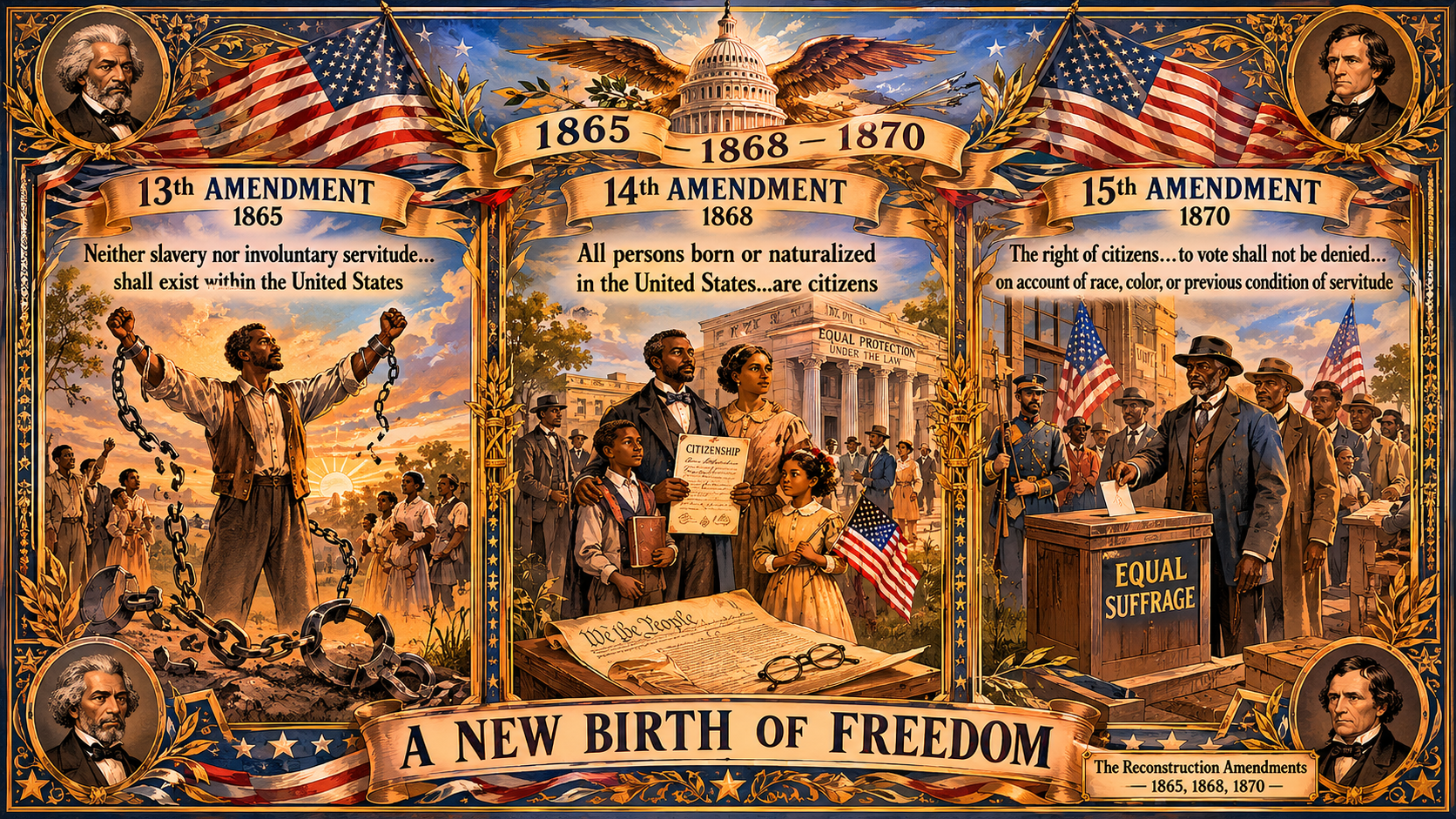
Together, the Reconstruction amendments represented a second founding — a constitutional transformation designed to make the principles of the Declaration of Independence operational for Black Americans. The question Reconstruction had to answer was whether political and legal change could overcome the social, economic, and cultural structures of four centuries of slavery.
Part 1: Reconstruction Politics (1865–1877)
Reconstruction Plans and Radical Reconstruction
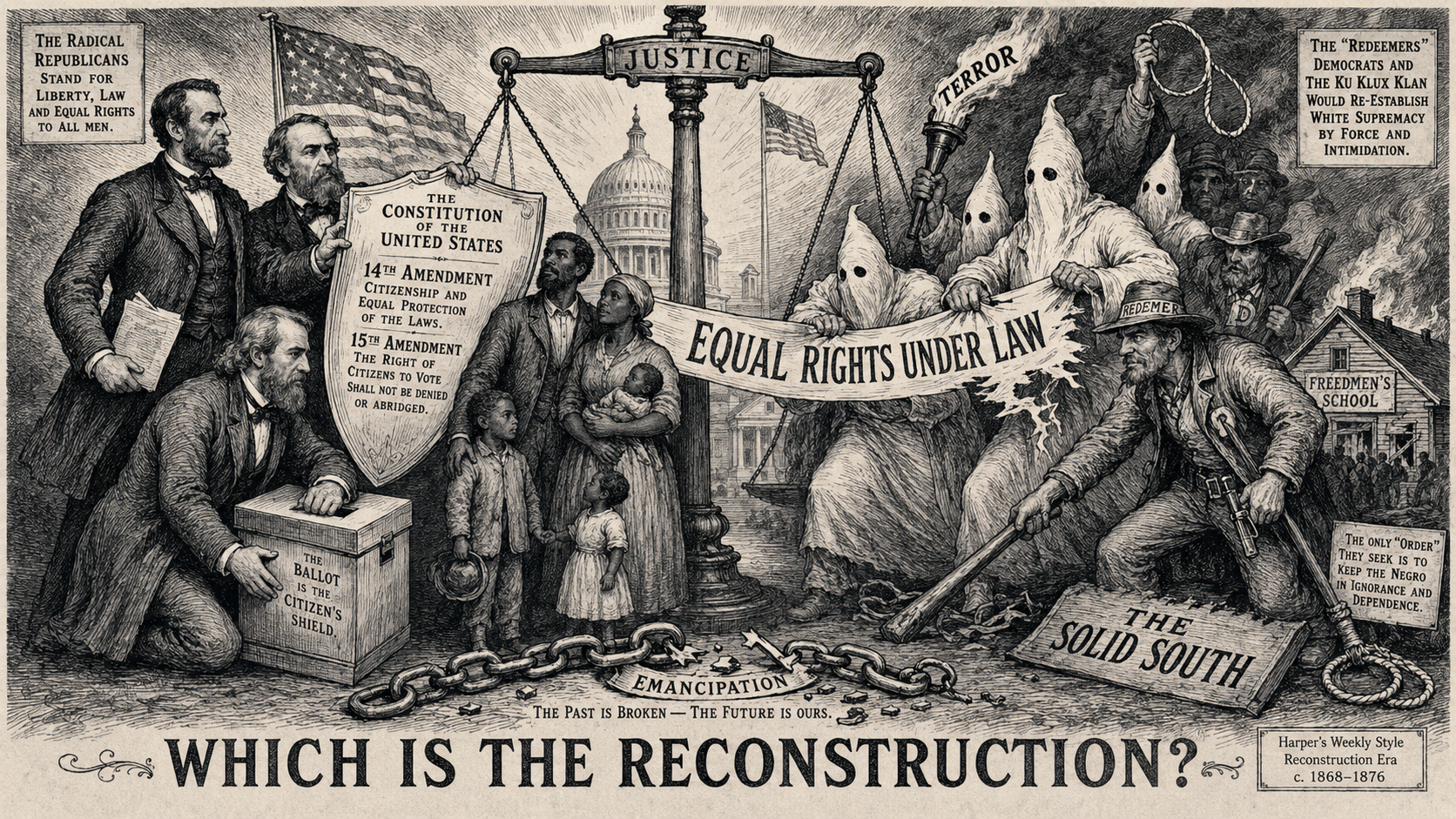
Reconstruction Plans emerged from a conflict between Lincoln (who wanted lenient, quick restoration), the Radical Republicans in Congress (who wanted to ensure civil and political rights for freed people before restoring Southern states), and, after Lincoln's assassination, President Andrew Johnson (who proved even more lenient than Lincoln and actively hostile to Black political rights).
Radical Reconstruction (1867–1877) represented Congress's assertion of control over the reconstruction process. The Reconstruction Acts of 1867 divided the former Confederate states into five military districts, required them to ratify the Fourteenth Amendment and write new state constitutions guaranteeing Black male suffrage before readmission to the Union. Under these conditions, Black men voted in large numbers and were elected to office across the South — including 16 Black congressmen and two Black U.S. senators.
This brief period of multiracial democracy in the South is one of the most dramatically misrepresented episodes in American history. The Lost Cause narrative portrayed Reconstruction governments as corrupt, incompetent, and dominated by Northern carpetbaggers exploiting a helpless South. The historical evidence shows that Reconstruction governments built the South's first public school systems, enacted progressive taxation, and passed civil rights legislation — while facing violent paramilitary opposition that made governance nearly impossible.
The Freedmen's Bureau
The Freedmen's Bureau (Bureau of Refugees, Freedmen, and Abandoned Lands) was established in 1865 to assist formerly enslaved people in transitioning to freedom. It provided food, medical care, and legal assistance; helped establish schools (including many that eventually became historically Black colleges and universities); and attempted to negotiate fair labor contracts between freedpeople and their former enslavers.
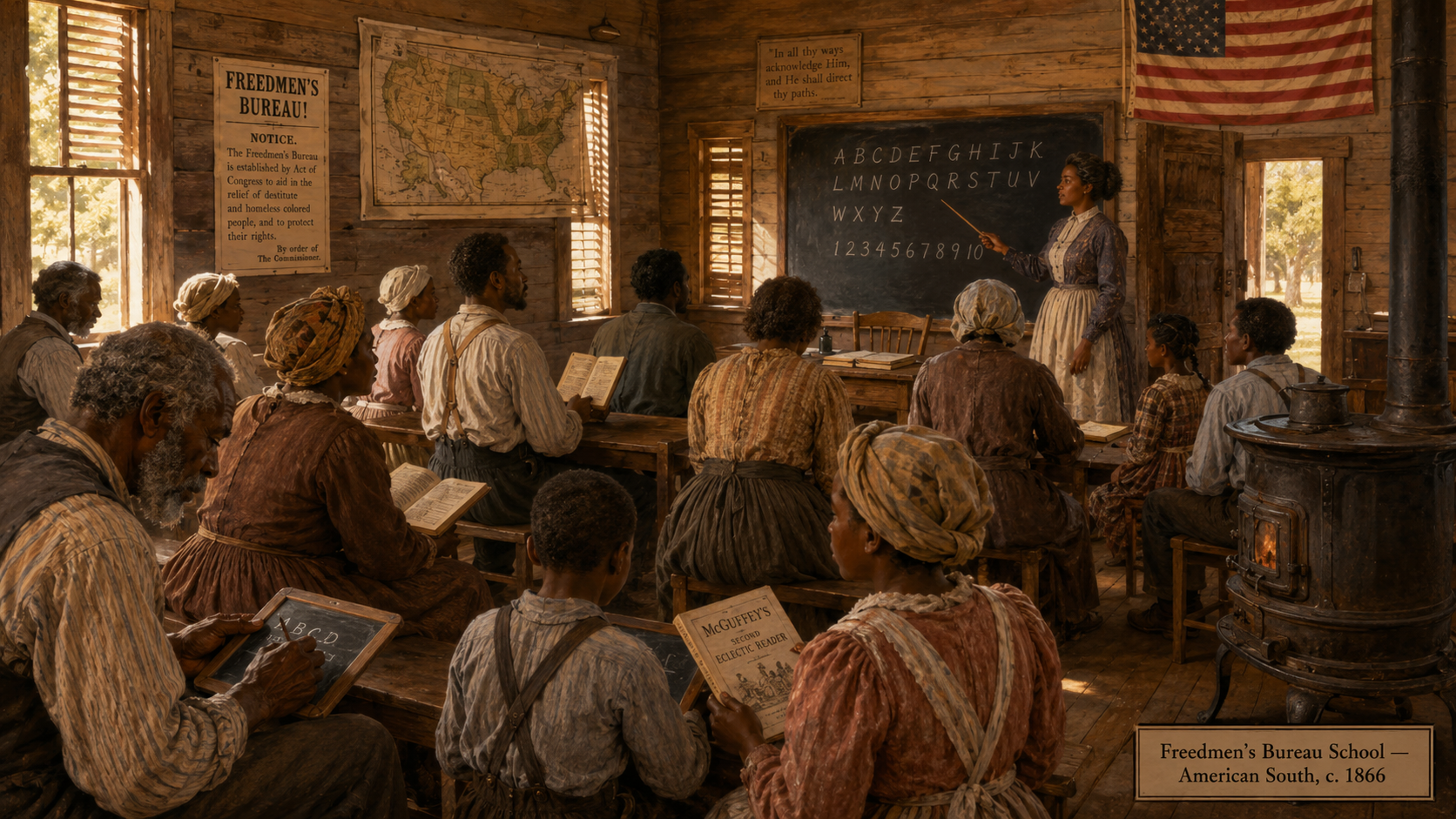
The Bureau operated for seven years (1865–1872) under chronic underfunding, inadequate staffing, and determined resistance from Southern white opponents. It helped roughly four million freed people navigate the transition from slavery to freedom — but it was unable to deliver the land redistribution ("forty acres and a mule") that would have given freed people economic independence. Without land, freed Black southerners were economically dependent on the same planters who had enslaved them.
Black Codes and the Sharecropping System
Southern states under Johnson's lenient reconstruction immediately passed Black Codes — laws that restricted the movement, labor, and civil rights of freed Black people in ways that functionally recreated many conditions of slavery. Black people in Mississippi, for example, were required to have written proof of employment or face arrest for vagrancy and be forced into unpaid labor for the county.
The Black Codes were the immediate provocation for the Radical Republicans' takeover of Reconstruction. But even after they were struck down, economic structures emerged that achieved similar ends.
The sharecropping system replaced slavery as the South's dominant labor arrangement. Freed people and poor white farmers rented land from large landowners, giving the landowner a share (typically 50 percent) of the crop at harvest. Sharecroppers borrowed against their future harvest for seed, tools, and food — purchasing through the landowner's store at inflated prices. The accounting was done by the landowner. The result was a system of debt peonage that kept sharecroppers economically trapped across generations. Sharecropping was not slavery, but for many it reproduced slavery's material conditions without the formal legal status.
The system perpetuates itself
 Apply causal loop thinking to the sharecropping system. The sharecropper borrows to plant (+debt). Debt requires the crop to be surrendered to pay it (−wealth). Low crop prices and inflated store prices add more debt (+debt). The crop is surrendered again the next year. This is a reinforcing feedback loop trapping sharecroppers in poverty. What force could have broken this loop? The answer — land redistribution — was politically blocked. The failure to break the loop is itself a historical choice with a clear beneficiary.
Part 2: The Destruction of Reconstruction
The Ku Klux Klan and Racial Terror
The Ku Klux Klan was founded in 1865 by Confederate veterans in Pulaski, Tennessee, and rapidly became the armed wing of white supremacist resistance to Reconstruction. The Klan and allied paramilitary organizations (the White League, the Red Shirts) used assassination, arson, flogging, and mass violence to drive Black voters from the polls, murder Republican officials, and terrorize Black communities that attempted to exercise their new political rights.
Between 1868 and 1871, the Klan killed thousands of people. Congress passed the Ku Klux Klan Acts (1870–1871) and federal troops suppressed much of the organized Klan violence. But the underlying terror — and the political will to use violence to prevent Black political participation — persisted through different organizational forms.
The Redeemer South and the Compromise of 1877
"Redeemer" Democrats — white Southern conservatives who framed their recapture of state governments as "redeeming" the South from Reconstruction — systematically dismantled Black political power through a combination of violence, fraud, economic coercion, and eventually legal disenfranchisement.
The Compromise of 1877 effectively ended Reconstruction. The presidential election of 1876 between Republican Rutherford Hayes and Democrat Samuel Tilden was disputed in three Southern states. A congressional compromise awarded the presidency to Hayes in exchange for withdrawing federal troops from the South. Without federal military protection, the remaining Reconstruction governments collapsed within months.
The Redeemer South that emerged from Reconstruction's destruction built a legal and social system of white supremacy designed to maintain political and economic dominance while operating within the post-Civil War constitutional framework.
Jim Crow Laws and Racial Categories in Law
Jim Crow Laws were the legal architecture of racial segregation that the Redeemer South constructed after Reconstruction's fall. State and local laws required separation of the races in schools, public transportation, restaurants, hotels, restrooms, waiting rooms, and virtually every public space. The Supreme Court's decision in Plessy v. Ferguson (1896) upheld "separate but equal" facilities as constitutional, providing federal sanction for the Jim Crow system for the next 58 years.
Racial categories in law were themselves a legal construction. The "one drop rule" — common in Southern states — defined anyone with any known Black ancestry as Black, regardless of appearance. This legal construction served to prevent any erosion of the racial binary that the Jim Crow system required. The historical arbitrariness of racial categories in law is a key insight for understanding how racism operates systemically rather than simply as individual prejudice.
Part 3: The Lost Cause as a Case Study in Misinformation
This section develops the misinformation detection skills introduced in Chapter 1 through one of the most consequential examples of organized historical misinformation in American history.
The Lost Cause Narrative
The Lost Cause narrative was a set of historical claims constructed by Confederate veterans, sympathizers, and organizations in the decades after the Civil War. Its central arguments were:
- The Civil War was not fought over slavery but over states' rights and constitutional principle
- Confederate soldiers fought for an honorable cause with courage and nobility
- Reconstruction was a corrupt, brutal occupation of the South by Northerners and unqualified Black politicians
- The antebellum South was a benevolent, paternalistic society in which enslaved people were cared for and often happy
Every one of these claims is contradicted by the primary source evidence available at the time the claims were made.
The Lost Cause was not simply a nostalgic fantasy held by some former Confederates. It was a coordinated public campaign prosecuted through textbooks, monument-building, veterans' organizations (particularly the United Daughters of the Confederacy), films (Birth of a Nation, 1915), and political pressure on school curricula. By the early 20th century, the Lost Cause version of the Civil War and Reconstruction was taught as fact in schools across the South — and in many Northern schools as well.
The Lost Cause is misinformation, not 'perspective'
 Students sometimes frame the Lost Cause as "the Southern perspective" on the Civil War — treating it as an equally valid interpretation that differs from the "Northern perspective." This framing is incorrect. The Lost Cause is not a perspective but a set of factual claims, and those claims are refuted by the evidence — including the Confederate founding documents written by Southerners before the war required any reframing. There is a genuine historical debate about the relative importance of different factors in causing the war; "slavery vs. states' rights" is not that debate, because the historical evidence clearly supports one side.
Misinformation Detection: How to Evaluate Historical Claims
The Lost Cause provides a case study for applying misinformation detection skills to historical claims. The same skills apply to contemporary misinformation.
Step 1: Source the claim. Where did this claim originate? Who is making it, when, and for what purpose? The Lost Cause claims about Reconstruction — that Black politicians were incompetent, that Reconstruction governments were uniquely corrupt — originated in the Redeemer South of the 1870s–1900s, made by people with a clear interest in discrediting Reconstruction to justify their dismantling of it.
Step 2: Lateral reading. Before evaluating the claim's content, check who else is making it and who is refuting it. Lateral reading means opening additional sources to investigate a claim's credibility rather than reading deeply into a single source. For historical claims, lateral reading means checking what historians working from primary sources say about the claim — not what popular websites or political commentators say.
Step 3: Source triangulation. Cross-reference the claim against multiple independent sources. Source triangulation means looking for convergent evidence from different types of sources — primary documents, contemporary accounts, quantitative data, archaeological evidence. For Reconstruction-era corruption claims: are the primary sources (legislative records, trial records, contemporary accounts) consistent with the claim, or do they contradict it?
Step 4: Fact-checking strategies. Apply specific fact-checking strategies to concrete claims: - Check the primary source: Is the "quotation" or "statistic" accurately cited? - Check the context: Is the claim taken out of context in a way that changes its meaning? - Check the consensus: What do historians who have studied this question most carefully conclude? - Check the motive: What would the source gain if the claim is believed?
| Lost Cause Claim | Primary Source Evidence |
|---|---|
| "War was about states' rights, not slavery" | Confederate secession declarations specifically cite slavery; Confederate VP Stephens's "Cornerstone Speech" explicitly centers slavery |
| "Reconstruction governments were uniquely corrupt" | Reconstruction governments built the South's first public schools and passed civil rights legislation; corruption comparable to or less than Northern "Gilded Age" governments of the same era |
| "Black politicians were incompetent" | Black congressmen of the Reconstruction era had literacy rates comparable to white counterparts; many had college degrees; their legislative records show competent governance |
| "Slavery was a benevolent institution" | Slave narratives, runaway slave advertisements, court records of violence, testimony of formerly enslaved people all contradict this claim |
Diagram: Misinformation Detection MicroSim — Lost Cause Claims
Misinformation Detection MicroSim — Evaluating Historical Claims
Type: microsim
sim-id: misinformation-detector
Library: p5.js
Status: Specified
Purpose: Give students structured practice applying the four-step misinformation detection process (source the claim, lateral reading, source triangulation, fact-checking) to historical claims drawn from the Lost Cause narrative and Reconstruction historiography.
Bloom Level: Evaluate (L5) Bloom Verb: Assess
Learning Objective: Students assess historical claims using a structured misinformation detection framework, identifying which claims are supported by primary source evidence and which are contradicted by it.
Canvas layout: - Responsive width; height approximately 520px - Top panel (30%): Displays a historical claim (text card) - Middle panel (40%): Four-step investigation panel — one button per step; clicking each reveals the relevant information for that step - Bottom panel (30%): Verdict area where student selects: "Supported by evidence," "Contradicted by evidence," or "Partially supported/context needed" — then submits and receives feedback
Step buttons reveal: 1. "Source the Claim" → Who made this claim, when, and what was their stake in the outcome? 2. "Lateral Reading" → What do historians working from primary sources say about this claim? 3. "Source Triangulation" → What do three different types of evidence show? 4. "Check the Facts" → What specific primary source contradicts or confirms this claim?
Sample claims (6 total, cycling): 1. "Southern states seceded over states' rights, not slavery" → Contradicted 2. "Reconstruction governments were uniquely corrupt and incompetent" → Contradicted 3. "The Freedmen's Bureau helped millions transition from slavery to freedom" → Supported 4. "Black voters were largely prevented from voting through violence and intimidation after 1877" → Supported 5. "Sharecropping gave freed people economic independence" → Contradicted 6. "The Ku Klux Klan was primarily a social fraternity that occasionally became violent" → Contradicted
Verdict feedback: - Correct: green border, brief explanation of why the evidence supports this verdict - Incorrect: amber border, redirect to which evidence step the student should revisit
Score tracker: "X / Y evaluated correctly"
Responsive behavior: Steps stack vertically on narrow canvas.
Instructional Rationale: Evaluate-level task requires students to assess quality of evidence — not just identify who made a claim. The structured four-step process prevents students from verdict-first reasoning (deciding the answer before checking evidence).
Part 4: The Legacy of Reconstruction
Reconstruction's legacy is layered and paradoxical. Its constitutional achievements — the 13th, 14th, and 15th Amendments — provided the legal foundation for every major civil rights advance of the 20th century. Its political achievements — brief multiracial democracy, the South's first public school systems — demonstrated that Black political participation produced capable governance. Its failures — the destruction of Black political power, the rise of sharecropping and Jim Crow, the entrenchment of white supremacy through law and violence — shaped the lives of Black Americans for the next century.
The defeat of Reconstruction was not inevitable. It required specific political choices: the Compromise of 1877, the Supreme Court's narrowing of the 14th Amendment's protections, Congress's withdrawal of support for federal enforcement. It required sustained organized violence — thousands of murders, widespread terror — that the federal government chose not to stop. And it required the construction of the Lost Cause narrative to provide ideological cover for what was, plainly, a violent counterrevolution.
Understanding Reconstruction requires holding all of these dimensions simultaneously: the constitutional revolution, the brief success of multiracial democracy, the violent destruction of that democracy, and the misinformation campaign that justified the destruction and shaped American memory of the period for generations.
Knowledge Check 1 — Click to reveal
Question: Apply lateral reading to evaluate this claim: "Reconstruction governments in the South were the most corrupt in American history." What sources would you check, and what would they show?
Answer: Lateral reading means checking what historians who have studied this question using primary sources conclude — not what popular claims say. Historians who have studied Reconstruction governments systematically (W.E.B. Du Bois in Black Reconstruction, Eric Foner in Reconstruction: America's Unfinished Revolution) find that while corruption existed in Reconstruction governments, it was not uniquely severe or worse than the corruption in the Northern "Gilded Age" governments of the same era. Moreover, Reconstruction governments accomplished significant achievements: building public school systems, enacting progressive taxation, funding infrastructure. The "most corrupt" claim, source-traced, originates primarily with Redeemer Democrats who had political incentives to discredit the governments they were dismantling, and is contradicted by the primary source record of what those governments actually did.
Knowledge Check 2 — Click to reveal
Question: The 14th Amendment's equal protection clause was ratified in 1868, yet segregation laws were upheld by the Supreme Court until 1954. Explain this apparent contradiction using what you know about the gap between legal rights and political enforcement.
Answer: The gap between the 14th Amendment's text and its application illustrates a recurring pattern in American constitutional history: constitutional rights require political will to enforce. In Plessy v. Ferguson (1896), the Supreme Court held that "separate but equal" facilities were consistent with equal protection — an interpretation that the plain meaning of the clause and the intent of its drafters contradicted. The Court's willingness to accept this interpretation reflected the political climate of the 1890s, when the federal government had abandoned Reconstruction enforcement and both major political parties were accommodating white supremacy. The 14th Amendment's meaning was not fixed in 1868 — it was actively contested and deliberately narrowed over decades by political and judicial choices. Brown v. Board of Education (1954) did not change the Amendment's text; it changed the political and legal interpretation of text that had always been there.
Chapter 9 Complete!
 You've just worked through one of the most complex and consequential chapters in American history — and developed one of the most important skills in this course: detecting organized historical misinformation. The Lost Cause narrative you've analyzed here is a template for how misinformation campaigns work: they don't invent facts from nothing, they selectively present evidence, appeal to in-group loyalty, and construct alternative narratives that serve clear political purposes. Those techniques appear in every era — including ours. In Chapter 10, we turn to the Gilded Age: the industrial explosion that transformed America after Reconstruction's defeat.