The Roaring Twenties, Depression, and New Deal (1920–1941)
Summary
This chapter spans two decades of American life so different they seem to belong to different worlds: the consumer boom of the 1920s — automobiles, radio, the Harlem Renaissance, jazz, and Prohibition — and the catastrophic decade that followed, as the 1929 crash cascaded into the Great Depression and the New Deal reshaped the relationship between the federal government and American citizens. Understanding why the prosperity of the 1920s collapsed, and how the New Deal responded, requires the systems thinking tools you developed in earlier chapters.
Concepts Covered
This chapter covers the following 35 concepts from the learning graph:
- Consumer Culture of 1920s
- Automobile Culture
- Mass Media and Radio
- Harlem Renaissance
- Langston Hughes
- Jazz Age
- Prohibition Era
- Bootlegging and Organized Crime
- Scopes Trial
- Nativism and Anti-Immigration
- Emergency Quota Act
- National Origins Act
- Ku Klux Klan 1920s Revival
- 1929 Stock Market Crash
- Causes of the Great Depression
- Bank Failures
- Herbert Hoover's Response
- Hoovervilles
- Bonus Army
- Franklin D. Roosevelt
- New Deal Programs
- Civilian Conservation Corps
- Social Security Act
- Tennessee Valley Authority
- Wagner Act
- Court-Packing Plan
- Dust Bowl
- Okies Migration
- Rise of Fascism in Europe
- Hitler and Nazi Germany
- U.S. Isolationism Pre-WWII
- Neutrality Acts
- Labor Rights Evolution
- Minimum Wage History
- Nativism and Xenophobia
Prerequisites
This chapter builds on concepts from: - Chapter 13: U.S. Imperialism and World War I
From boom to bust and back again
 Welcome to Chapter 14! The 1920s and 1930s are two of the most consequential decades in American history — and they are most powerful when understood together. The prosperity of the 1920s contained the seeds of the catastrophe that followed. The Depression produced the policy revolution of the New Deal. And throughout both decades, questions of race, immigration, and belonging were answered in ways that still shape American life. Let's investigate the evidence!
Part 1: The Roaring Twenties
Consumer Culture and the Automobile
The 1920s marked the first modern consumer culture in American history — a society organized not around production and thrift but around purchasing and enjoyment. The enabling technologies were mass production (especially Henry Ford's assembly line, which brought the price of a Model T from $850 in 1908 to $260 in 1924), installment credit (buying on the "payment plan"), and national advertising that created desires for products people had never previously wanted.
Automobile culture was the organizing technology of the decade. By 1929, there were 26 million registered automobiles in the United States — one for every five Americans. The car transformed geography (suburbs became viable without streetcars), social life (dating, mobility, and privacy changed fundamentally), and the economy (auto manufacturing stimulated steel, glass, rubber, petroleum, and road construction). The Federal Highway Act of 1921 began the road network that the automobile required.
Mass media and radio created, for the first time, a genuine national culture. The first commercial radio broadcast was KDKA Pittsburgh in 1920; by 1929 there were over 600 stations and 10 million receivers. Radio created shared experiences — the same music, the same sports broadcasts, the same news reaching audiences from Maine to California simultaneously. Hollywood films (now with sound, after 1927's The Jazz Singer) completed the picture: for the first time, the United States had a single popular culture that transcended regional, ethnic, and class boundaries — though not racial ones.
The Harlem Renaissance
While white America danced to jazz and drove its new Fords, Black Americans were creating one of the most extraordinary cultural movements in American history. 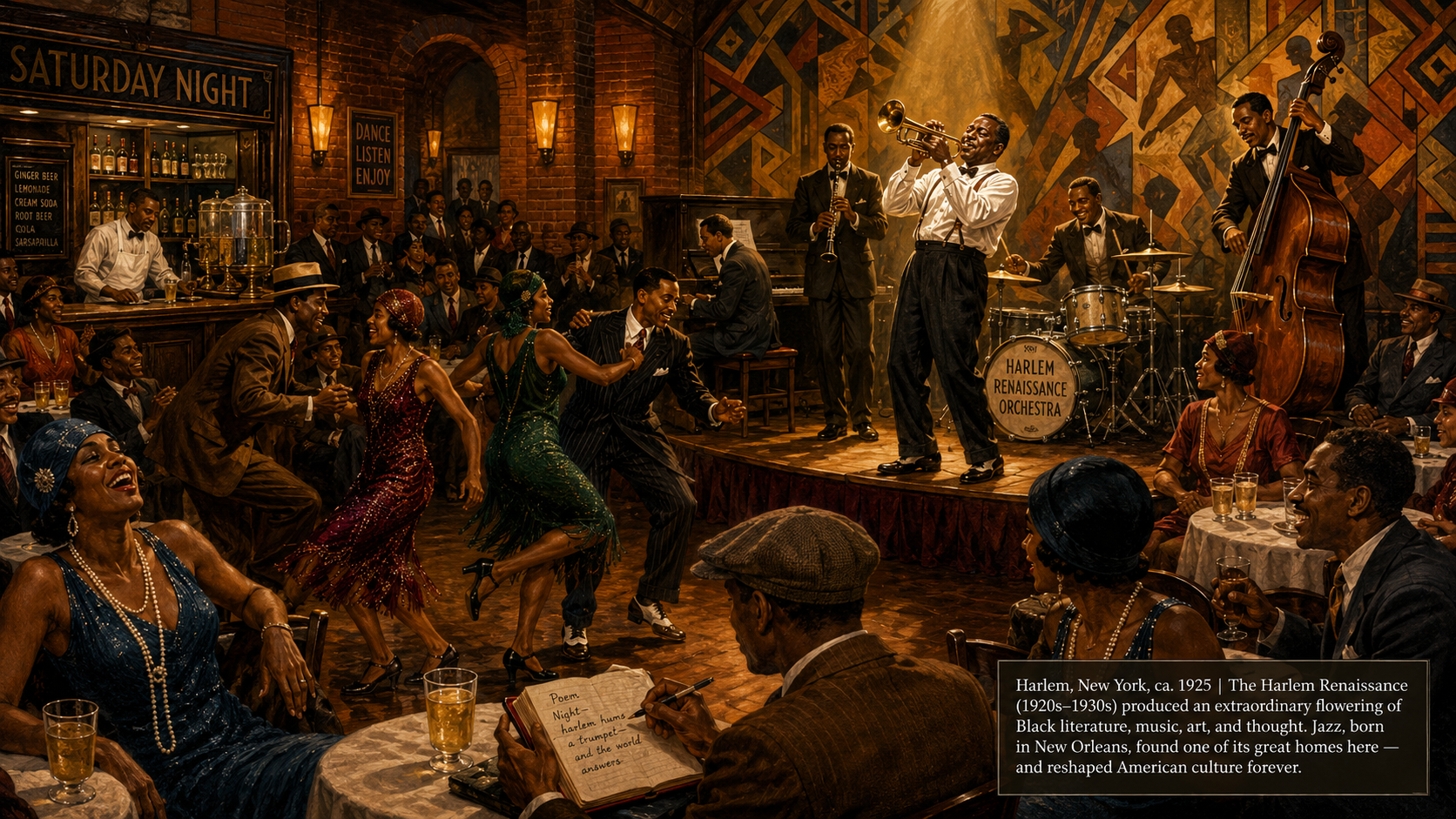
The Harlem Renaissance (roughly 1919–1935) was an explosion of Black literary, visual, and musical creativity centered in Harlem, New York — itself the product of the Great Migration, the movement of hundreds of thousands of Black Americans from the Jim Crow South to Northern cities that accelerated during and after World War I.
The Harlem Renaissance's writers, poets, painters, and musicians created a new self-image for Black America — one that claimed artistic achievement, intellectual sophistication, and cultural pride in the face of persistent racism. Langston Hughes was its preeminent poet. His poetry drew on Black vernacular, jazz rhythms, and everyday life to create work that was simultaneously accessible and profound. "I, Too" (1926) — "I, too, am America" — is a declaration of belonging that insists on Black Americans' full citizenship in a country that denied it.
The Jazz Age takes its name from the music that crossed racial boundaries more readily than almost anything else in American life. Jazz — emerging from New Orleans Black musical traditions, blues, and ragtime — moved to Chicago and New York via the Great Migration, where it became the defining sound of the decade. Its rhythms were new, improvisational, and genuinely shocking to older Americans who associated it with moral looseness. It was also, unmistakably, an African American art form that white Americans consumed enthusiastically while often denying the social equality of the people who created it.
The Harlem Renaissance as counternarrative
 Apply sourcing to the Harlem Renaissance. When Langston Hughes wrote "I, Too, am America," who was his audience? What was he arguing against? The poem is in dialogue with Walt Whitman's "I Hear America Singing" (1860), which celebrated American workers — all white in Whitman's imagining. Hughes inserts a Black voice into that national song, claiming full Americanness. Understanding the Harlem Renaissance means understanding it not just as a cultural flowering but as a political argument — an assertion of full humanity and citizenship in the teeth of Jim Crow. When you read Harlem Renaissance texts, always ask: what is this work pushing against? What does it affirm?
Prohibition and Its Consequences
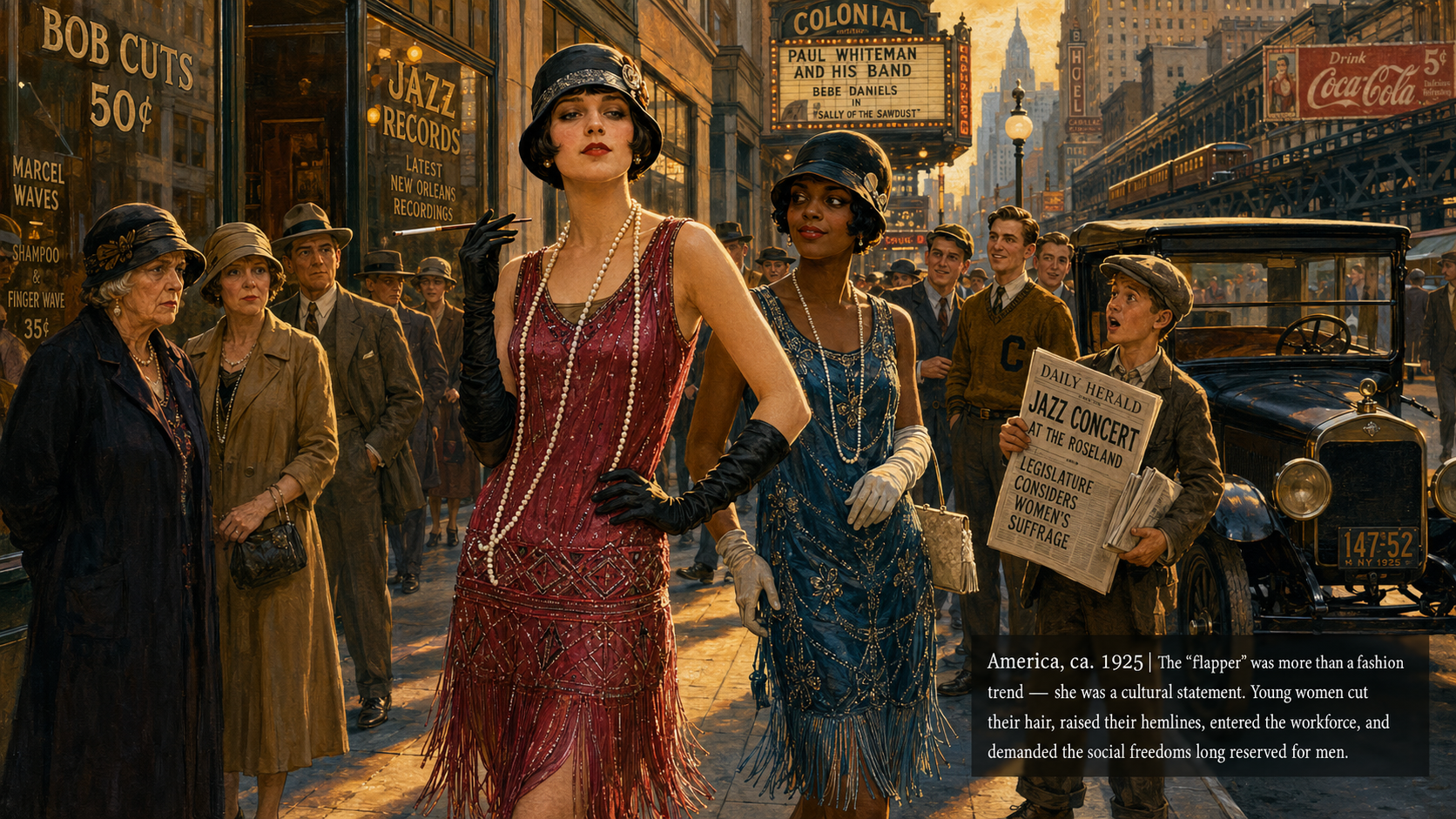
The Eighteenth Amendment (ratified 1919) prohibited the manufacture, sale, and transportation of intoxicating liquors. The Prohibition Era (1920–1933) was one of the most dramatic examples in American history of a policy producing effects precisely opposite to its intentions — a textbook case of reinforcing feedback loops created by unintended consequences.
Before examining what happened, two definitions are essential. A reinforcing feedback loop is a system dynamic in which an initial change amplifies itself: more of X produces more of X. A balancing feedback loop corrects deviations: when X gets too high, forces push it back down.
Prohibition aimed to create a balancing force against alcohol consumption. The actual dynamics were:
- Legal alcohol supply eliminated → illegal demand created a market
- Illegal market → enormous profits for criminal suppliers
- Enormous profits → capital to corrupt police, politicians, and courts
- Corruption → reduced law enforcement effectiveness
- Reduced enforcement → safer conditions for criminal enterprise
- Organized crime emerged to manage illegal alcohol at scale
Bootlegging and organized crime created criminal enterprises of unprecedented scale. Al Capone's Chicago operation grossed an estimated $60 million annually (over $1 billion today). The violence of criminal turf wars (St. Valentine's Day Massacre, 1929) made organized crime a national spectacle. Most significantly, Prohibition transferred an enormous industry from legal, regulated businesses to criminal organizations — organizations that used their Prohibition-era capital and organizational structures to survive and expand after repeal.
Prohibition was repealed by the Twenty-First Amendment (1933) — the only constitutional amendment to repeal another. Its failure demonstrated that constitutional law cannot easily override deeply embedded social practices, and that eliminating legal supply for a broadly consumed good creates criminal markets as a near-mathematical certainty.
Cultural Conflicts: Scopes Trial, Nativism, and the KKK
The prosperity and cultural change of the 1920s produced a powerful reaction from Americans who felt threatened by modernity, immigration, and racial mixing. Three episodes illustrate this reaction.
The Scopes Trial (1925) — formally State of Tennessee v. John Thomas Scopes — put a Dayton, Tennessee high school teacher on trial for teaching evolution in violation of the Butler Act. The trial became a national media spectacle, with Clarence Darrow defending Scopes and William Jennings Bryan (the former Populist hero, now a Protestant fundamentalist) prosecuting. Scopes was convicted and fined $100 (later overturned on a technicality). The deeper conflict was between scientific modernity and Protestant fundamentalism — a conflict that was not resolved in 1925 and continues to recur.
Nativism and anti-immigration sentiment, always present in American history, reached a legislative peak in the 1920s. The Emergency Quota Act (1921) limited immigration by nationality for the first time, establishing quotas based on the 1910 census — a formula designed to reduce immigration from Southern and Eastern Europe. The National Origins Act (1924) tightened the quotas further, using the 1890 census as a baseline (before the great wave of Southern and Eastern European immigration) and explicitly excluding nearly all immigration from Asia. For the first time, numerical limits fundamentally reshaped American immigration.
The Ku Klux Klan's 1920s revival was not the defeated remnant of Reconstruction but a mass movement at the height of its power. The "second Klan," refounded in 1915 and using the 1915 film Birth of a Nation as a recruiting tool, reached an estimated 3–6 million members by the mid-1920s. It was not exclusively Southern — Indiana was one of its strongest states. And its targets extended beyond Black Americans to include Catholics, Jews, immigrants, and anyone who violated its conception of "100 percent Americanism." The second Klan's collapse came through internal corruption scandals rather than external opposition — another illustration of how authoritarian movements often destroy themselves.
Part 2: The Great Depression
The 1929 Crash and Its Causes
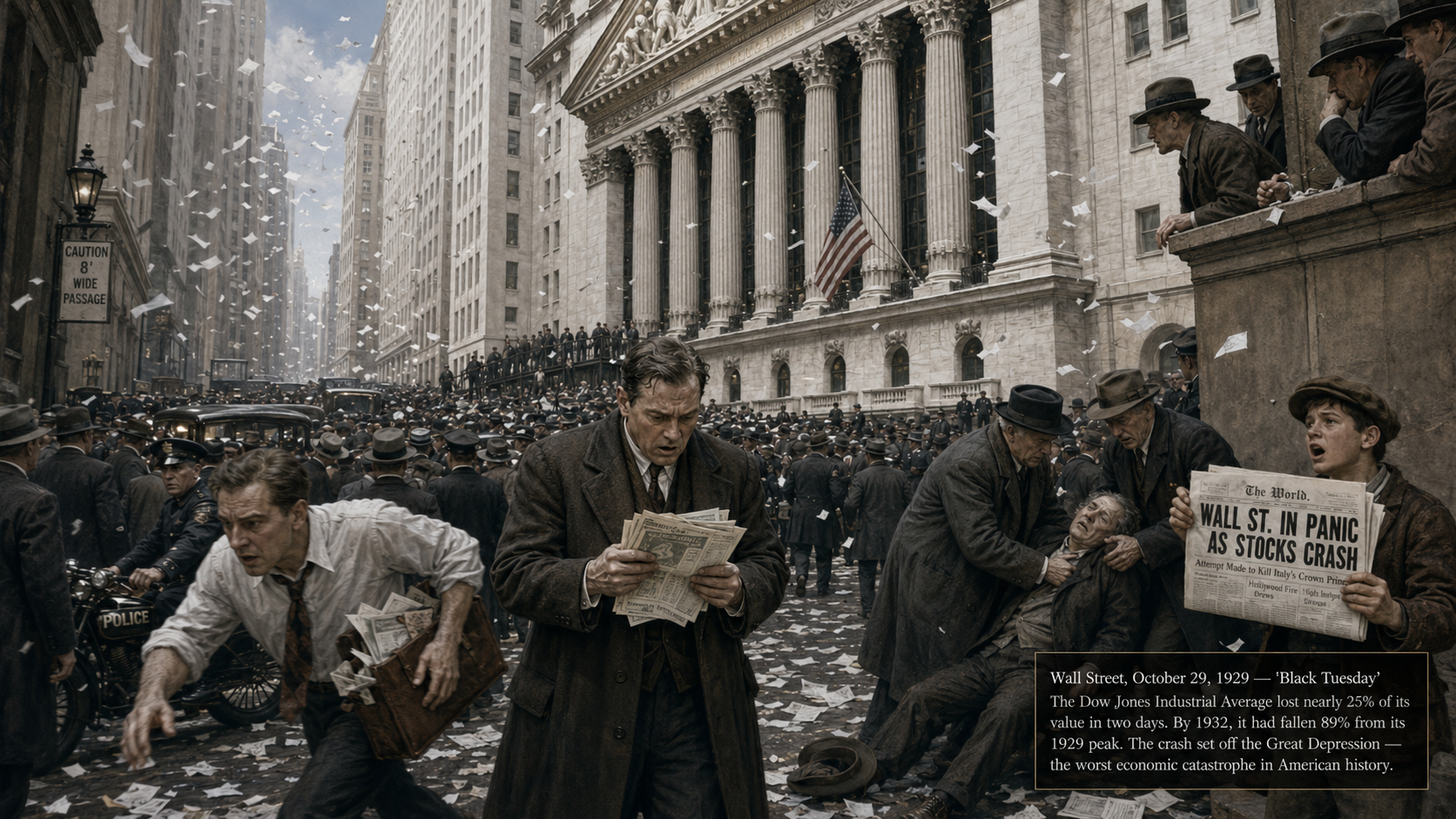
The 1929 Stock Market Crash began on "Black Thursday" (October 24) and accelerated through "Black Tuesday" (October 29), when the Dow Jones Industrial Average fell 13 percent in a single day. The market lost nearly 90 percent of its value from its 1929 peak to its 1932 trough.
The crash was a trigger, not the cause. Before examining the causes of the Great Depression, two structural features of the 1920s economy need definition. Overproduction means producing more goods than consumers can purchase — sustainable only as long as credit allows consumers to buy beyond their means. Speculation means purchasing assets not for their productive value but in expectation of reselling them at higher prices — sustainable only as long as prices continue to rise.
The structural causes of the Depression were multiple and interacting:
| Cause | Mechanism | How It Amplified the Crash |
|---|---|---|
| Stock speculation | Buying stocks on margin (10% down) | When prices fell, margin calls forced selling, driving prices further down |
| Overproduction | Farm and factory output exceeded consumer purchasing power | Inventories built up; manufacturers cut production and workers |
| Agricultural weakness | Farm prices had been depressed since 1921 | Rural banks failed first; farm sector never shared in 1920s prosperity |
| Bank fragility | Small unit banks with concentrated local exposure | Bank runs → bank failures → destruction of savings |
| Tariff war | Smoot-Hawley Tariff (1930) triggered foreign retaliation | International trade collapsed; export markets for U.S. goods disappeared |
| Federal Reserve failure | Raised interest rates during recession | Contracted money supply when expansion was needed |
Bank Failures and the Spiral
Bank failures were the mechanism through which the crash transmitted to the broader economy. In 1929–1933, over 9,000 American banks failed — wiping out savings accounts that had no federal deposit insurance. When a bank failed, depositors lost everything. Fear of bank failure produced runs (everyone trying to withdraw simultaneously), which caused healthy banks to fail. The banking system's collapse destroyed the credit mechanism the economy needed to function.
By 1932, unemployment had reached 25 percent. Industrial production had fallen by half. International trade had collapsed. Hoovervilles — shantytowns of makeshift structures built by the homeless — appeared in cities across the country, named with bitter irony for the president who seemed unable or unwilling to act.
Herbert Hoover's Response
Herbert Hoover is often portrayed as a do-nothing president who let the Depression worsen through inaction. The reality is more complex — and more instructive. Hoover was not a laissez-faire ideologue; he was a sophisticated administrator (he had managed food relief for post-WWI Europe with great effectiveness) who believed that the federal government should coordinate voluntary action and provide indirect support rather than direct relief.
Hoover's response included: the Reconstruction Finance Corporation (lending to banks and businesses), the Federal Home Loan Bank Act (supporting mortgage lenders), and pressure on industry to maintain wages (which most firms abandoned as conditions worsened). He opposed direct federal relief to individuals on principle — he believed it would undermine self-reliance and local community responsibility.
The Bonus Army (summer 1932) demonstrated both the depth of the crisis and the limits of Hoover's response. World War I veterans, who had been promised a bonus payment due in 1945, marched on Washington demanding early payment. About 20,000 veterans and their families camped in Anacostia Flats. Hoover ordered Army Chief of Staff Douglas MacArthur to clear the camp. MacArthur, with Dwight Eisenhower and George Patton among his officers, used cavalry, tanks, and tear gas against the veterans. The spectacle of the U.S. Army routing destitute veterans destroyed whatever remained of Hoover's public standing.
Hoover and the myth of inaction
 The "do-nothing Hoover" is a historical myth worth examining critically. Hoover was actually more interventionist than any previous president had been during an economic crisis — his problem was that his interventions were insufficient given the scale of the collapse, and that he held a principled objection to direct federal relief that prevented him from taking the steps that might have helped most. Understanding Hoover's actual position (rather than the caricature) is important because it clarifies what the New Deal was responding to: not pure laissez-faire, but an interventionism that had real limits. It also illustrates how political mythmaking works — Hoover became a symbol of inaction because the contrast with FDR's activism was politically useful for Democrats, not because the caricature was accurate.
Part 3: The New Deal
Franklin D. Roosevelt
Franklin D. Roosevelt (FDR) won the 1932 election in a landslide, carrying 42 of 48 states. He was a New York patrician who had been struck by polio in 1921 and had overcome the paralysis of his legs through years of physical therapy — an experience that shaped his resilience and, arguably, his empathy for suffering. His first inaugural address included the most famous line in American political history: "The only thing we have to fear is fear itself."
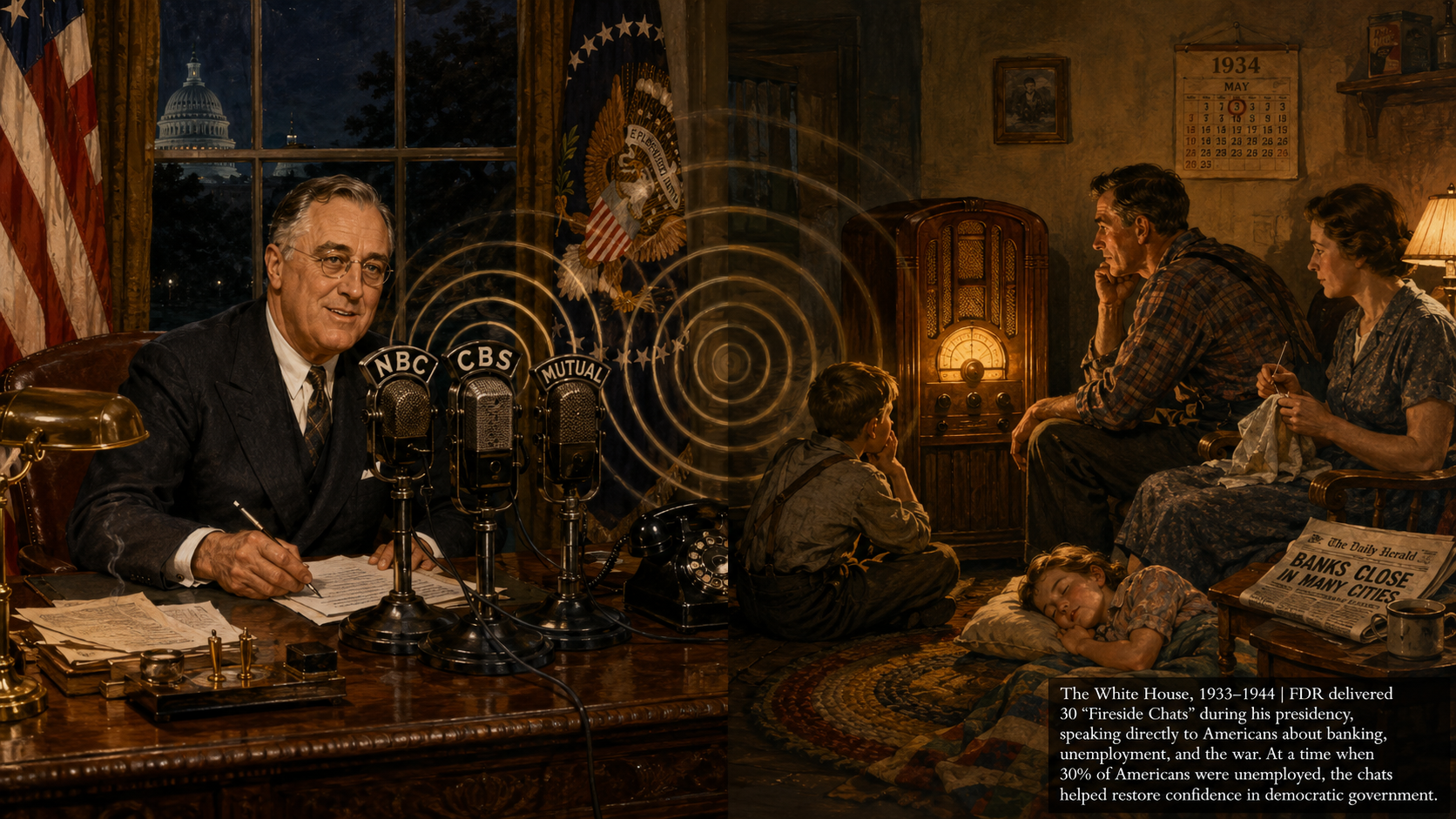
Roosevelt's political genius was less ideological than pragmatic. He had no systematic theory of what caused the Depression or what would end it; his approach was to try things, keep what worked, and discard what didn't. "Take a method and try it," he said. "If it fails, try another. But above all, try something." This pragmatism infuriated ideologues of both left and right — but it also made the New Deal politically durable.
New Deal Programs
The New Deal unfolded in two phases. The "First Hundred Days" (1933) addressed the immediate banking crisis and provided emergency relief. The "Second New Deal" (1935) created the lasting institutional framework that reshaped American society.
Before the major programs, one key concept: the New Deal was based on Keynesian economics (named for British economist John Maynard Keynes), which held that during a recession governments should increase spending to stimulate demand — even if it meant running budget deficits. This was a direct challenge to the conventional wisdom that governments, like households, should balance their budgets during hard times.
Key New Deal programs:
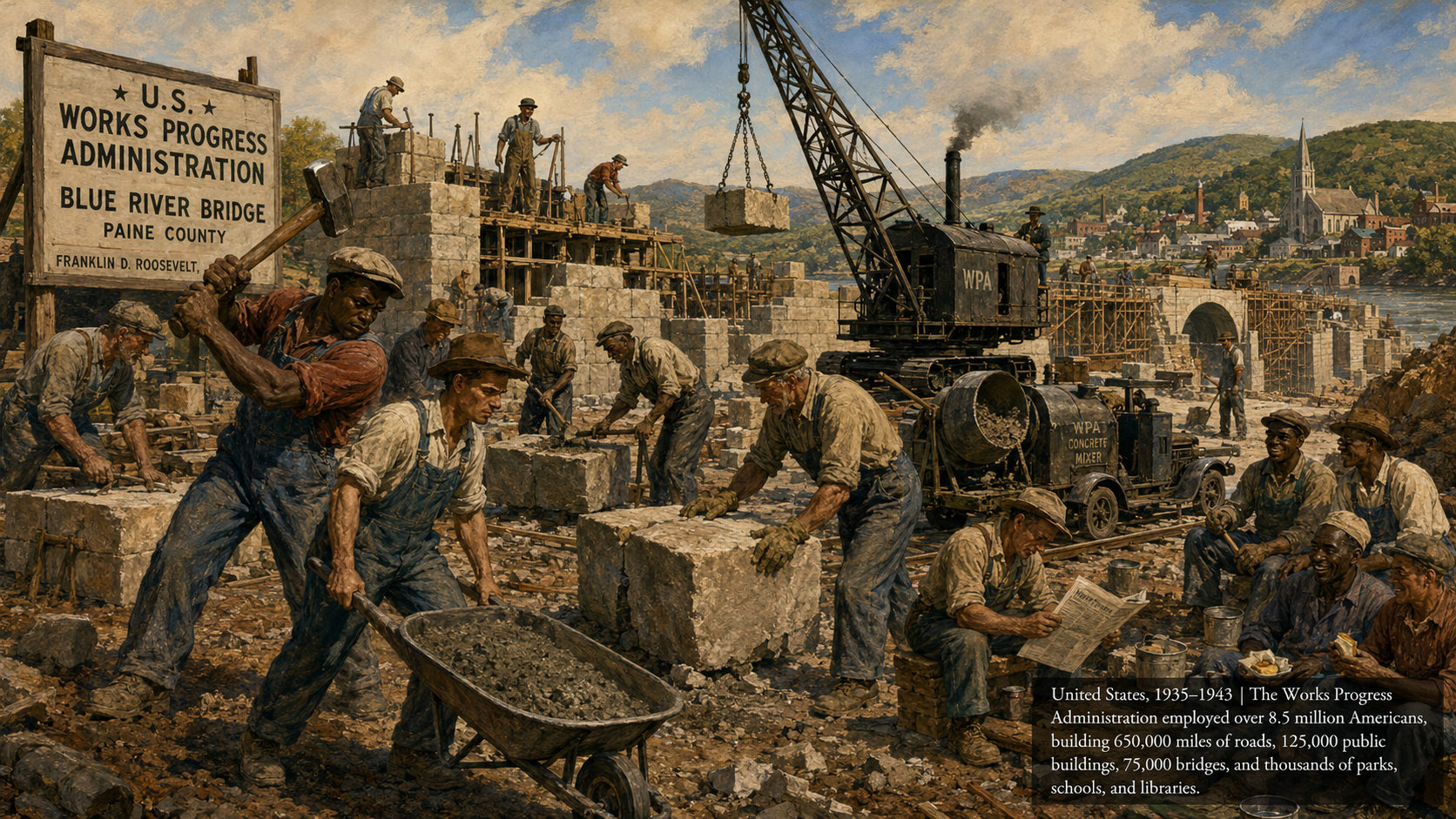
Civilian Conservation Corps (CCC): Employed 3 million young men (1933–1942) in conservation work on public lands — planting trees, building trails, fighting erosion. It addressed unemployment while creating public goods. The CCC was racially segregated, as were most New Deal programs — a concession to Southern Democratic congressmen whose votes FDR needed.
Tennessee Valley Authority (TVA): Created to develop the Tennessee River basin through dam construction, flood control, and hydroelectric power generation. The TVA brought electricity to rural Appalachian communities for the first time — electricity that powered refrigerators, radios, and eventually industries. It was also the most ambitious exercise in federal economic planning since the Civil War, and remains a significant precedent for regional development authority.
Wagner Act (National Labor Relations Act, 1935): Guaranteed workers the right to organize into unions and bargain collectively, and established the National Labor Relations Board to enforce those rights. The Wagner Act was the legal foundation for the massive expansion of union membership that followed — union membership grew from 10 percent of the workforce in 1935 to 35 percent by 1945. It fundamentally redistributed economic power between labor and management.
Social Security Act (1935): Established old-age insurance (what most people mean when they say "Social Security"), unemployment insurance, and welfare programs for dependent children and the disabled. It created, for the first time, a federal guarantee that Americans would not face destitution in old age or during periods of unemployment. The program was structured as a contributory insurance system (workers paid into it and received benefits based on their contributions) rather than welfare — a deliberate choice to build political support by making it feel like something earned rather than given.
Diagram: New Deal Programs — What They Did and What Survived
New Deal Programs Explorer — Interactive Overview
Type: explorer
sim-id: new-deal-programs
Library: p5.js
Status: Specified
Purpose: Allow students to explore the major New Deal programs, what problem each addressed, how it worked, and whether it survived to the present — building a comprehensive understanding of the New Deal's scope and lasting impact.
Bloom Level: Understand (L2) Bloom Verb: Categorize
Learning Objective: Students categorize New Deal programs by their purpose (relief, recovery, reform), identify the specific problem each addressed, and determine which programs still exist today.
Canvas layout: - Responsive width; height approximately 480px - Three columns: Relief | Recovery | Reform (FDR's framework) - Each program shown as a clickable card with its acronym (CCC, TVA, FDIC, SSA, etc.) - Color-coded: green = still exists, amber = modified/successor exists, red = ended
Programs by category: Relief: CCC, FERA, CWA, WPA, PWA Recovery: AAA, NRA (struck down), RFC, TVA Reform: FDIC, Glass-Steagall, SEC, Wagner Act, Social Security Act
Detail panel (on click): - Full name and date - Problem it addressed - How it worked (2 sentences) - Scale (how many people/dollars involved) - Current status: exists/modified/ended and why
Summary statistics at bottom: X of Y programs (or their successors) still exist today.
Interactivity: - Hover shows tooltip with program name and 1-sentence description - Filter by "Still Active" or "Historical Only"
Color scheme: Blue/green for relief; gold for recovery; teal for reform.
Labor Rights Evolution and Minimum Wage History
The New Deal's labor rights evolution transformed American industrial relations. Before the Wagner Act, employers could fire union organizers, hire replacement workers during strikes, and use private security forces against labor actions. After 1935, workers had enforceable rights to organize, bargain, and strike. The Congress of Industrial Organizations (CIO), founded in 1935, organized previously unorganized industries (auto, steel, rubber) through sit-down strikes that paralyzed production.
Minimum wage history begins with the Fair Labor Standards Act (1938), which established a federal minimum wage of 25 cents per hour and a maximum workweek of 44 hours. This was one of the Populist Party's 1892 demands, finally enacted 46 years later. The minimum wage has been periodically raised by Congress, though its purchasing power (adjusted for inflation) peaked in 1968 and has declined since — illustrating how a policy victory does not automatically sustain its own value.
Court-Packing Plan
Roosevelt's biggest political mistake was the Court-Packing Plan (1937). The Supreme Court had struck down key New Deal programs (the NRA and AAA) as unconstitutional overreaches of federal power. Roosevelt proposed adding up to six new justices (one for each sitting justice over age 70) — which would have given him a pro-New Deal majority.
The plan failed politically (even Democrats opposed it as an assault on judicial independence) but arguably succeeded practically: in what historians call "the switch in time that saved nine," Justice Owen Roberts began voting with the pro-New Deal bloc just as the court-packing debate heated up, producing a 5-4 majority for the New Deal's constitutionality. The court-packing episode illustrates an important political principle: even popular presidents face institutional limits, and overreaching can generate backlash that constrains future action.
Part 4: The Dust Bowl and the Gathering Storm
The Dust Bowl and Okies Migration
The Dust Bowl (roughly 1930–1936) was an ecological catastrophe that combined with the Depression to produce one of the most severe human displacement events in American history. Decades of intensive farming on the Great Plains had stripped the native grasses that held the soil in place. When drought came in the early 1930s, the topsoil — with nothing to anchor it — blew away in massive dust storms ("black blizzards") that buried farms, killed livestock, and caused widespread respiratory disease.
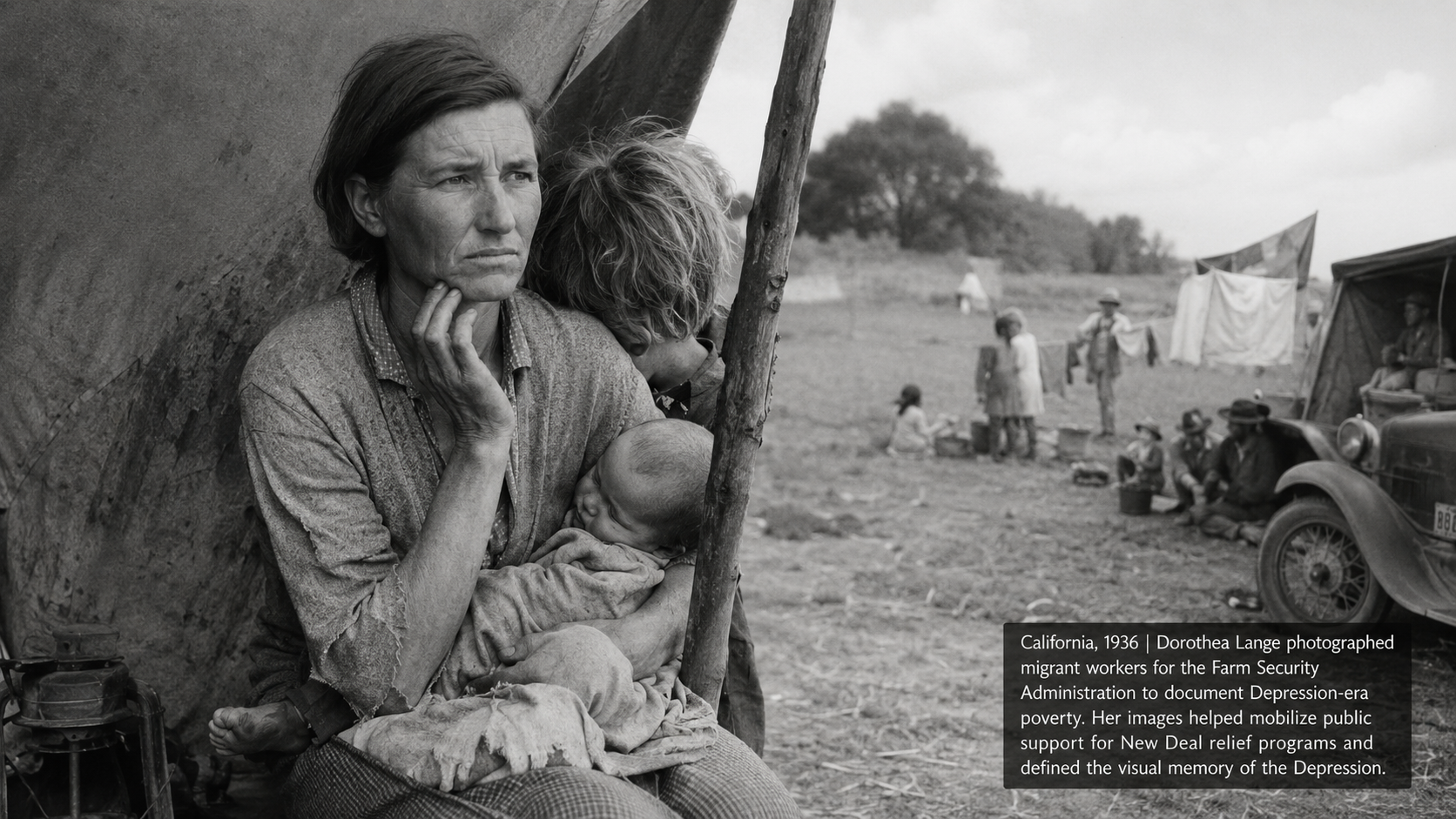
An estimated 3.5 million people left the Great Plains during the 1930s. Those from Oklahoma became known as "Okies" — a term that was initially derogatory. John Steinbeck's The Grapes of Wrath (1939) traced one Oklahoma family's migration to California, where they faced exploitation, hostility, and destitution rather than the promised land they had expected. The Dust Bowl's root cause was a market failure: individual farmers had no incentive to adopt soil-conservation practices because the costs (lower yields) were immediate and personal, while the benefits (preventing soil erosion) were shared and long-term. The New Deal's Soil Conservation Service attempted to address this through federal programs and incentives — an early example of using government policy to correct an environmental market failure.
The Dust Bowl as systems thinking
 The Dust Bowl illustrates a reinforcing feedback loop that crosses ecological and economic systems. More farming → more soil disturbance → less grass cover → more wind erosion → less productive soil → economic desperation → more intensive farming (to compensate for lower yields) → more soil disturbance. The loop was self-reinforcing and could not be broken by individual farmers acting rationally within the existing market structure — only by external intervention (government conservation programs, drought relief, migration) that changed the system's conditions. When you see an environmental problem today, ask: what are the feedback loops, and what would it take to create a balancing force?
Rise of Fascism and U.S. Isolationism
The same years that produced the New Deal also produced a global crisis. Fascism — a political ideology combining ultranationalism, authoritarian single-party rule, glorification of violence, and corporate capitalism subordinated to state direction — rose to power in Italy (Mussolini, 1922) and Germany (Hitler, 1933). Hitler and Nazi Germany combined fascist politics with explicit racial ideology: the claim that Jews, Roma, and other groups were biologically inferior and threatened the German "Aryan" race.
American public opinion, scarred by WWI and focused on the Depression, was strongly isolationist. U.S. isolationism pre-WWII drew on genuine memories of WWI's costs (116,000 American dead, the betrayal of Wilson's idealism at Versailles) and on the influential "merchants of death" thesis that America had been manipulated into WWI by arms manufacturers and bankers. The Neutrality Acts (1935, 1936, 1937) prohibited arms sales and loans to belligerent nations and barred Americans from traveling on belligerent ships — attempting to avoid the entanglements that had drawn the United States into WWI.
Nativism and xenophobia in this period also shaped U.S. response to the refugee crisis produced by Nazi persecution. The 1924 National Origins Act's strict quotas prevented most Jewish refugees from entering the United States. The State Department's systematic enforcement of visa restrictions — and a State Department official's explicit anti-Semitism — meant that the United States turned away refugees who would subsequently be murdered in the Holocaust. The MS St. Louis (1939), a ship carrying 937 Jewish refugees that the United States refused to admit, is the most publicized example; hundreds of its passengers later died in the Holocaust.
Diagram: Depression Causes — Interacting Feedback Loops
Great Depression Feedback Loops — Systems Diagram
Type: causal-loop
sim-id: depression-feedback-loops
Library: p5.js
Status: Specified
Purpose: Allow students to visualize the interlocking feedback loops that turned a stock market crash into a decade-long depression, building systems thinking skills by tracing causal connections across economic sectors.
Bloom Level: Analyze (L4) Bloom Verb: Diagram
Learning Objective: Students diagram the reinforcing feedback loops that amplified the 1929 crash into a decade-long depression, identifying which loops the New Deal attempted to break and how.
Canvas layout: - Responsive width; height approximately 480px - Circular causal loop diagram with 8 nodes connected by labeled arrows - Color-coded: red arrows = reinforcing (R, makes things worse); blue arrows = balancing (B, correction) - Nodes: Stock Market, Consumer Spending, Business Production, Employment, Bank Deposits, Bank Loans, Agricultural Prices, International Trade
Key loops to show: - R1 (Deflationary Spiral): Employment ↓ → Consumer Spending ↓ → Business Production ↓ → Employment ↓ - R2 (Banking Panic): Bank Deposits ↓ → Bank Loans ↓ → Business Investment ↓ → Employment ↓ → Bank Deposits ↓ - R3 (Trade Collapse): Tariffs ↑ → Imports ↓ → Foreign retaliation → U.S. Exports ↓ → Business ↓ - B1 (New Deal Intervention): Federal Spending ↑ → Consumer Demand ↑ → Production ↑ (attempts to break R1)
Interactivity: - Clicking a loop highlights all arrows in that loop and opens a panel explaining how the loop worked - "New Deal Response" button shows which loops each major program targeted - Slider: "Shock Size" (1929–1932) shows how feedback loops amplified a 40% market drop into 25% unemployment
Color scheme: Red for reinforcing loops; blue for balancing; green for New Deal interventions.
Summary
The two decades from 1920 to 1941 demonstrate how rapidly prosperity can collapse when structural vulnerabilities accumulate — and how thoroughly a political crisis can reshape the relationship between government and citizens. The 1920s consumer boom rested on speculation, debt, and overproduction; when it collapsed, it revealed an economy without the shock absorbers (deposit insurance, unemployment insurance, agricultural stabilizers) that modern economies take for granted. The New Deal installed most of those shock absorbers — which is why, when the 2008 financial crisis hit, the unemployment rate reached 10 percent rather than 25 percent.
The chapter also demonstrates the persistence of nativism and xenophobia as responses to social change — the 1920s revivals of anti-immigration sentiment and the KKK were responses to the same demographic and cultural changes that produced the Harlem Renaissance. And the decade's end, with fascism consolidating across Europe and U.S. isolationism preventing effective response, sets the stage for the global war that will dominate Chapter 15.
Knowledge Check 1 — Click to reveal
Question: Apply systems thinking to explain why Prohibition created organized crime rather than eliminating alcohol consumption. Identify the feedback loops.
Answer: Prohibition eliminated the legal supply of alcohol but did not eliminate demand — it was too deeply embedded in American social culture. Eliminating legal supply created an illegal market with extraordinary profit margins (no legal competition, no taxes, premium prices for risk). Those profit margins funded the organizational development, bribery, and violence that produced organized crime. The key reinforcing loop: higher illegal profits → more capital to corrupt enforcement → weaker enforcement → safer operating environment for criminal enterprise → even higher profits. The balancing force (enforcement) was overwhelmed by the reinforcing loop (profit-driven criminal organization). The lesson: eliminating legal supply of a broadly consumed good does not eliminate the demand; it transfers the supply to criminal actors who are far less controllable than regulated legal businesses.
Knowledge Check 2 — Click to reveal
Question: FDR's New Deal is sometimes described as "saving capitalism from itself." What does this mean, and what evidence from the chapter supports or challenges this interpretation?
Answer: The interpretation holds that the New Deal's reforms — Social Security, bank regulation, labor rights, deposit insurance — addressed the system's most destabilizing features (lack of demand stabilizers, financial fragility, extreme inequality) in ways that made capitalism more sustainable, heading off more radical alternatives (socialism, fascism) that were gaining support. Evidence supporting this: the New Deal deliberately preserved private ownership and markets; it rejected nationalization (except TVA); it structured Social Security as insurance rather than welfare to make it politically durable. Evidence challenging this: the New Deal did not end the Depression (World War II spending did); it was bitterly opposed by business elites who did not feel "saved"; and programs like the Wagner Act significantly shifted power toward labor in ways business owners did not experience as preservation. The interpretation captures something real (the New Deal stabilized capitalism) but understates the genuine conflicts it created and the extent to which it represented a shift in power, not just a technical correction.
Chapter 14 Complete!
 You've just navigated two of the most consequential decades in American history — from the heights of consumer prosperity to the depths of the Depression and back toward recovery through the New Deal. The systems thinking tools you applied here (feedback loops, reinforcing dynamics, unintended consequences) will be essential in every chapter that follows. And the questions the New Deal raised — how much should government intervene in the economy? What do citizens owe each other in hard times? — remain live political questions today. In Chapter 15, the gathering storm breaks: World War II changes everything.