World War II and the Home Front (1939–1945)
Summary
World War II was the defining event of the 20th century — a conflict that killed an estimated 70–85 million people, including six million Jews and millions of others murdered in the Holocaust, reshaped every major nation, and established the global order that still persists today. This chapter examines both the strategic military story (how the Allies defeated Nazi Germany and Imperial Japan) and the home front transformation (how the war reshaped American society, women's roles, and civil liberties). The atomic bombings of Hiroshima and Nagasaki raise ethical questions that remain genuinely contested — making this chapter a case study in how historians evaluate evidence, weigh values, and reach different conclusions.
Concepts Covered
This chapter covers the following 16 concepts from the learning graph:
- German Blitzkrieg
- Lend-Lease Act
- Attack on Pearl Harbor
- U.S. Entry into WWII
- Home Front War Production
- Women in the Workforce (WWII)
- Rosie the Riveter
- Japanese American Internment
- Korematsu v. United States
- D-Day (Normandy Invasion)
- Island Hopping Strategy
- Manhattan Project
- Atomic Bombs on Japan
- Holocaust and U.S. Response
- Yalta Conference
- United Nations Formation
Prerequisites
This chapter builds on concepts from: - Chapter 14: The Roaring Twenties, Depression, and New Deal
The world at war
 Welcome to Chapter 15! World War II was not one war but several — a war against Nazi Germany in Europe and North Africa, a war against Imperial Japan across the Pacific, a war of industrial production on the home front, and, underneath all of it, the Holocaust: the systematic murder of six million Jews and millions of others that the war both revealed and, ultimately, ended. The United States' role in all of these stories is complex and sometimes contradictory. Applying critical thinking means resisting both simple heroism (the "Good War" narrative) and simple condemnation — and instead examining the evidence with the careful sourcing skills you've been building. Let's investigate.
Part 1: From Isolation to War
German Blitzkrieg and the Fall of Europe
When Germany invaded Poland on September 1, 1939, triggering British and French declarations of war, the United States was officially neutral — but the German Blitzkrieg that followed made neutrality increasingly difficult to sustain morally or strategically.
Blitzkrieg ("lightning war") was a combined-arms military doctrine that used fast-moving tanks and motorized infantry, supported by close air support, to punch through defensive lines before the defender could respond. It was not a new technology but a new operational concept — speed and coordination rather than mass. In May–June 1940, Germany conquered France in six weeks, a country that had held out for four years in WWI. By late 1940, Britain stood alone against a Germany that controlled most of Western Europe, with a German air campaign (the Blitz) targeting British cities and industry.
Lend-Lease Act
President Roosevelt, unable to enter the war directly (American public opinion remained strongly isolationist), found a way to support Britain within the existing neutrality framework. The Lend-Lease Act (March 1941) authorized the president to "lend or lease" military equipment to any nation whose defense was deemed vital to U.S. security — which in practice meant Britain, and later the Soviet Union (after Germany invaded it in June 1941) and China.
Lend-Lease was, as Churchill said, "the most unsordid act in the history of any nation" — but it was also squarely in American strategic interest. The idea was that if Germany and Japan conquered Europe and Asia, the United States would face a world of hostile empires with no allies. Lend-Lease eventually provided $50 billion (roughly $800 billion today) in military equipment, food, and supplies to Allied nations. The Soviet Union received about $11 billion — a fact that complicated Cold War memory of the war in both the United States and the USSR.
Attack on Pearl Harbor and U.S. Entry into WWII
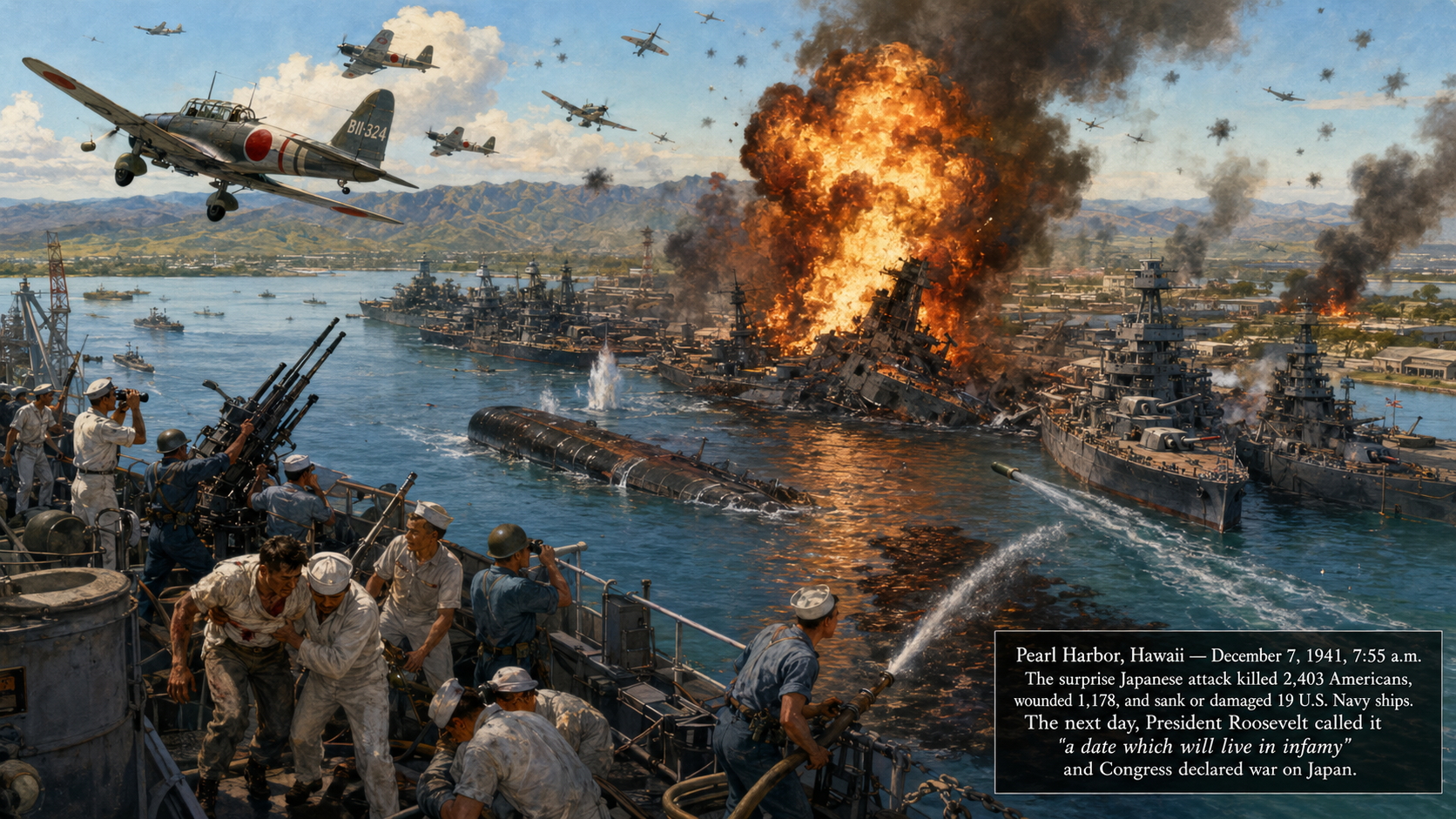
The attack on Pearl Harbor (December 7, 1941) ended American neutrality in a morning. Japanese carrier-based aircraft launched a surprise attack on the U.S. Pacific Fleet at Pearl Harbor, Hawaii, killing 2,403 Americans, wounding 1,178, and sinking or damaging 19 ships including 8 battleships. Roosevelt's address to Congress the next day called it "a date which will live in infamy." Congress declared war on Japan the same day; Germany and Italy declared war on the United States four days later, resolving the European question as well.
U.S. entry into WWII transformed the conflict's scale and probable outcome. American industrial capacity — already partially mobilized for Lend-Lease — could now be fully directed toward military production. The United States could draw on its entire population, its vast natural resources, and geographic security (no enemy could reach the continental United States in meaningful force) in ways that no other combatant could match.
Part 2: The Home Front
Home Front War Production
Home front war production was one of the most remarkable industrial mobilizations in history. American factories converted from consumer to military production with extraordinary speed: Ford's Willow Run plant, which had built cars before the war, was retooled to produce a B-24 Liberator bomber every hour at peak production. By 1944, the United States was producing more military equipment than all the Axis powers combined.
The War Production Board allocated raw materials; the Office of Price Administration controlled prices and rationed consumer goods (meat, gasoline, nylon, rubber); citizens bought war bonds to finance military spending. GDP more than doubled between 1940 and 1945. Unemployment, which had been 15 percent in 1940, fell to under 2 percent by 1943 — not because the New Deal had succeeded (it hadn't fully) but because 16 million Americans were in uniform and 10 million more were building the weapons they used.
Women in the Workforce and Rosie the Riveter
With millions of men in the military, women entered the industrial workforce on an unprecedented scale. Women in the workforce (WWII) saw the female labor force participation rate rise from 27 percent in 1940 to 37 percent in 1945 — 6 million women took jobs that had previously been closed to them, including welding, riveting, and heavy manufacturing.
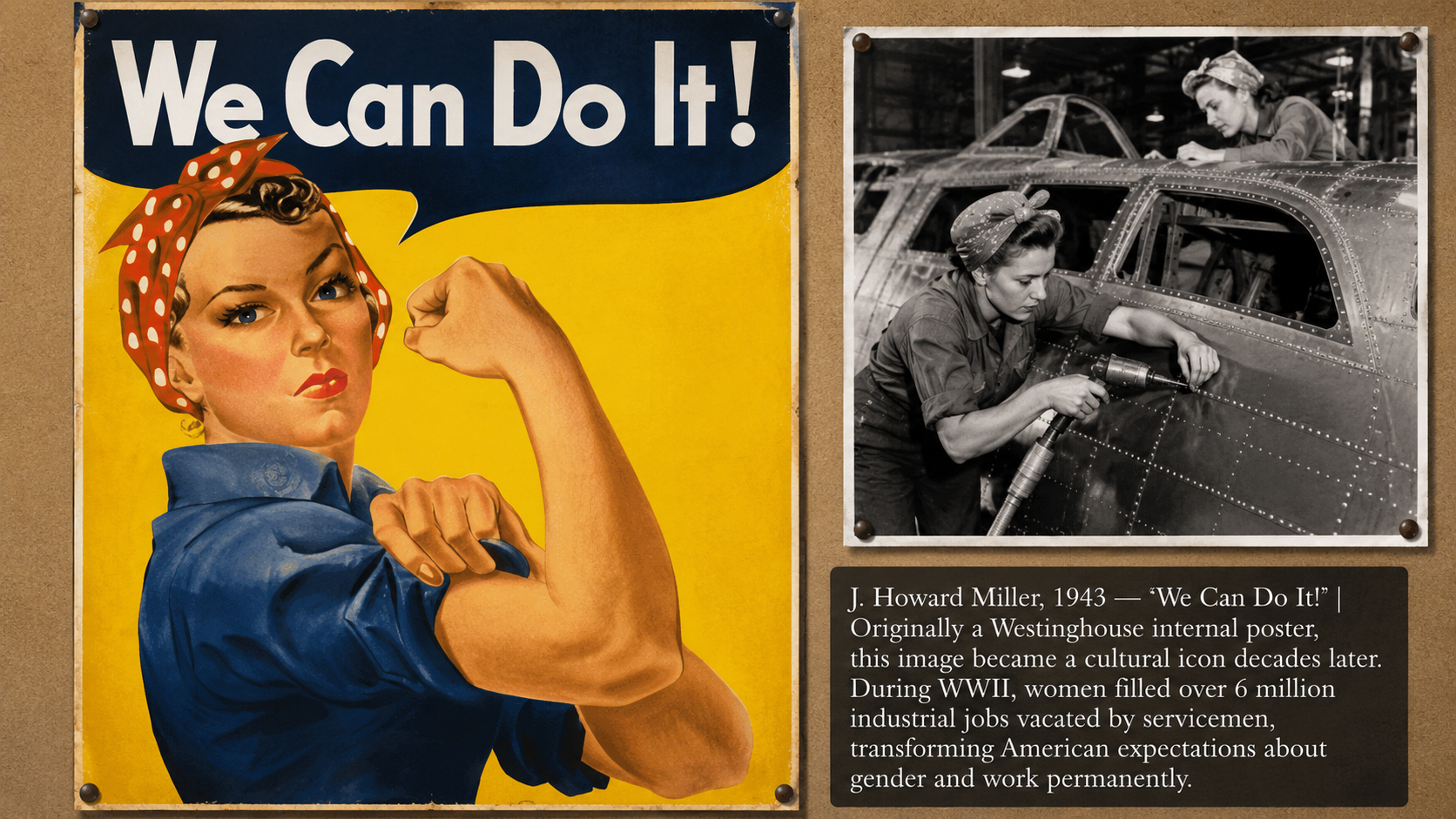
"Rosie the Riveter" — depicted in Norman Rockwell's Saturday Evening Post cover and the iconic "We Can Do It!" poster — became the cultural symbol of women's wartime contribution. Rosie represented a genuine social shift: women demonstrating competence in industrial work that had been defined as male. When the war ended, most of these women were expected to return home, and many were forced out of their jobs as veterans returned. But the experience of wartime employment — and the demonstrated capacity for women to perform industrial work — permanently changed what women (and employers) believed was possible. It is one of the roots of the postwar women's movement.
The Rosie myth and the historical reality
 Apply sourcing to the "Rosie the Riveter" image. The "We Can Do It!" poster was created for the Westinghouse Corporation's internal employee communications — not as a government poster. The Rockwell "Rosie" ran on the Saturday Evening Post cover in 1943. Neither depicts a real woman, and the "Rosie" imagery excluded Black women, who also did war work in significant numbers but were often segregated into less-glamorous positions. The iconic images captured something real about wartime women's participation — but they also constructed a particular (white, industrial, heroic) version of that participation that excluded other stories. When you see an iconic historical image, ask: who made it, for what audience, and whose story does it leave out?
Japanese American Internment and Korematsu
Japanese American internment is the starkest civil liberties failure of the wartime period. Following Pearl Harbor, President Roosevelt signed Executive Order 9066 (February 1942), authorizing the military to designate "exclusion zones" from which persons could be removed. In practice, this meant the forced relocation of approximately 120,000 people of Japanese ancestry — two-thirds of them American citizens — from the West Coast to inland "relocation centers" (effectively prison camps).
The stated justification was military necessity — fear that Japanese Americans might engage in espionage or sabotage. The actual evidence for this was negligible: not a single Japanese American was ever convicted of espionage or sabotage during the war. German Americans and Italian Americans (whose home countries were also at war with the United States) were not subject to mass internment — a difference that cannot be explained by anything other than race.
Internees lost their homes, businesses, and property. They were confined in barracks behind barbed wire, often in desert or mountain terrain. Despite this treatment, 33,000 Japanese Americans served in the U.S. military during the war; the 442nd Regimental Combat Team became the most decorated unit in U.S. Army history.
Korematsu v. United States (1944): Fred Korematsu, an American citizen, refused the order to report for internment and was convicted. The Supreme Court upheld the conviction 6-3, ruling that "pressing public necessity" could justify the exclusion (without using the word "internment"). The majority opinion, written by Justice Hugo Black, is one of the most criticized in Supreme Court history. Justice Frank Murphy's dissent called it a "legalization of racism." The decision was formally repudiated by the Supreme Court in Trump v. Hawaii (2018), which described Korematsu as "gravely wrong the day it was decided."
Part 3: Military Campaigns
D-Day — The Normandy Invasion
By 1944, the Allies had liberated North Africa (1943), invaded Sicily and the Italian mainland (1943–1944), and the Soviet Union had turned the tide on the Eastern Front. The question was when and where to open a second front in Western Europe. The answer was Operation Overlord.
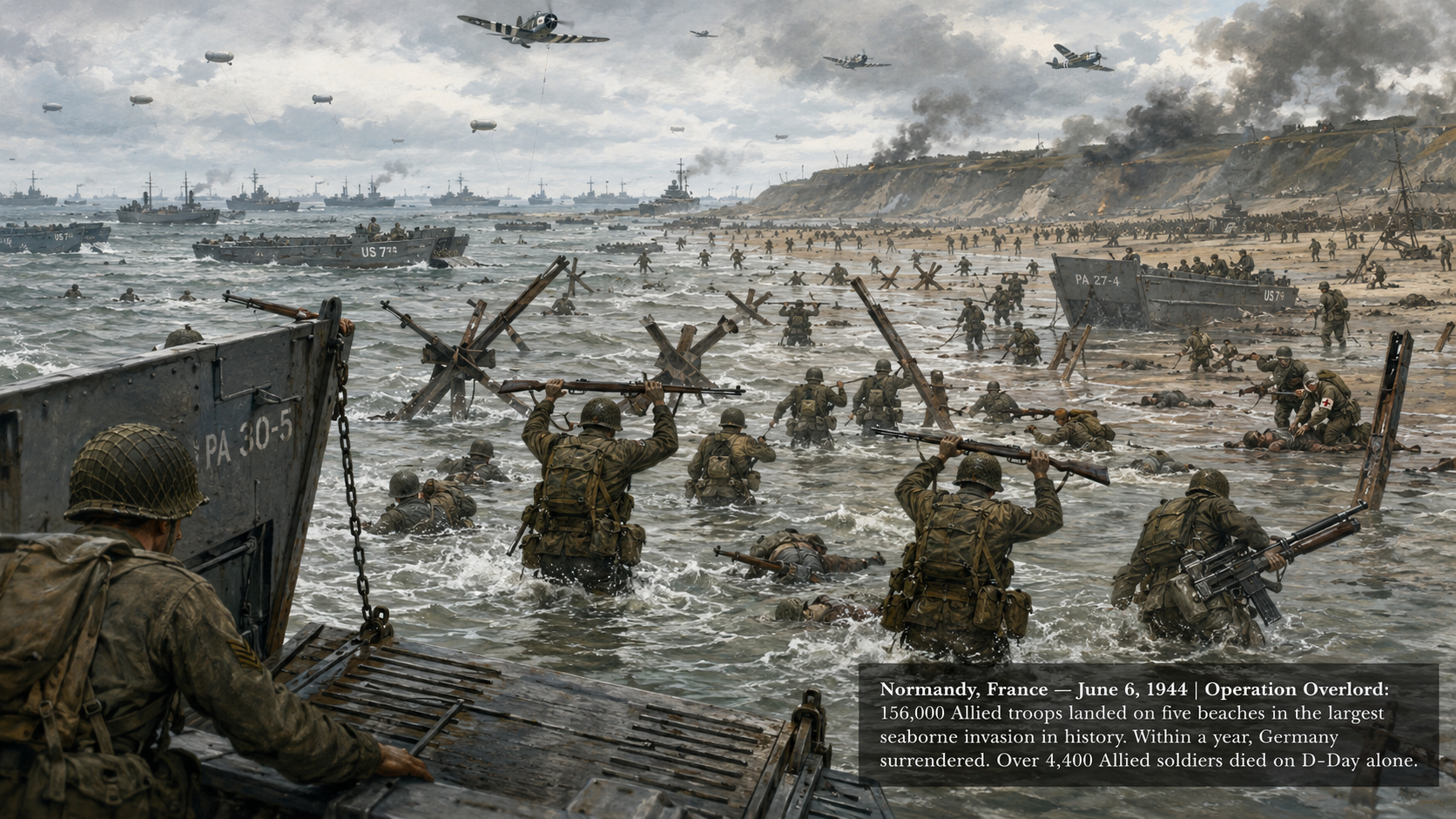
D-Day (June 6, 1944) was the largest amphibious assault in history. Allied forces — American, British, Canadian, and troops from occupied European nations — landed on five beaches in Normandy, France, under combined naval and air support. The scale was staggering: 156,000 troops crossed the English Channel in 5,000 ships, supported by 13,000 aircraft. American forces at Omaha Beach faced the heaviest German defenses and suffered approximately 2,000 casualties in a single morning.
The Normandy campaign opened the Western Front that Germany had feared — forcing it to fight simultaneously in the East (against the Soviet Union), the South (Italy), and the West (France). Germany's military position was now hopeless, though German resistance continued for another eleven months.
Island Hopping Strategy in the Pacific
In the Pacific, the U.S. strategy was island hopping (also called "leapfrogging"): rather than attacking every Japanese-held island in sequence, American forces captured only those islands that provided airfields and naval bases for the next advance, bypassing and isolating heavily defended Japanese positions. This approach, developed by Admiral Chester Nimitz and General Douglas MacArthur, allowed the United States to advance toward Japan more quickly than a sequential island-by-island campaign would have permitted.
The island battles — Guadalcanal (1942–1943), Tarawa (1943), Saipan (1944), Iwo Jima (1945), Okinawa (1945) — were among the most brutal of the war.
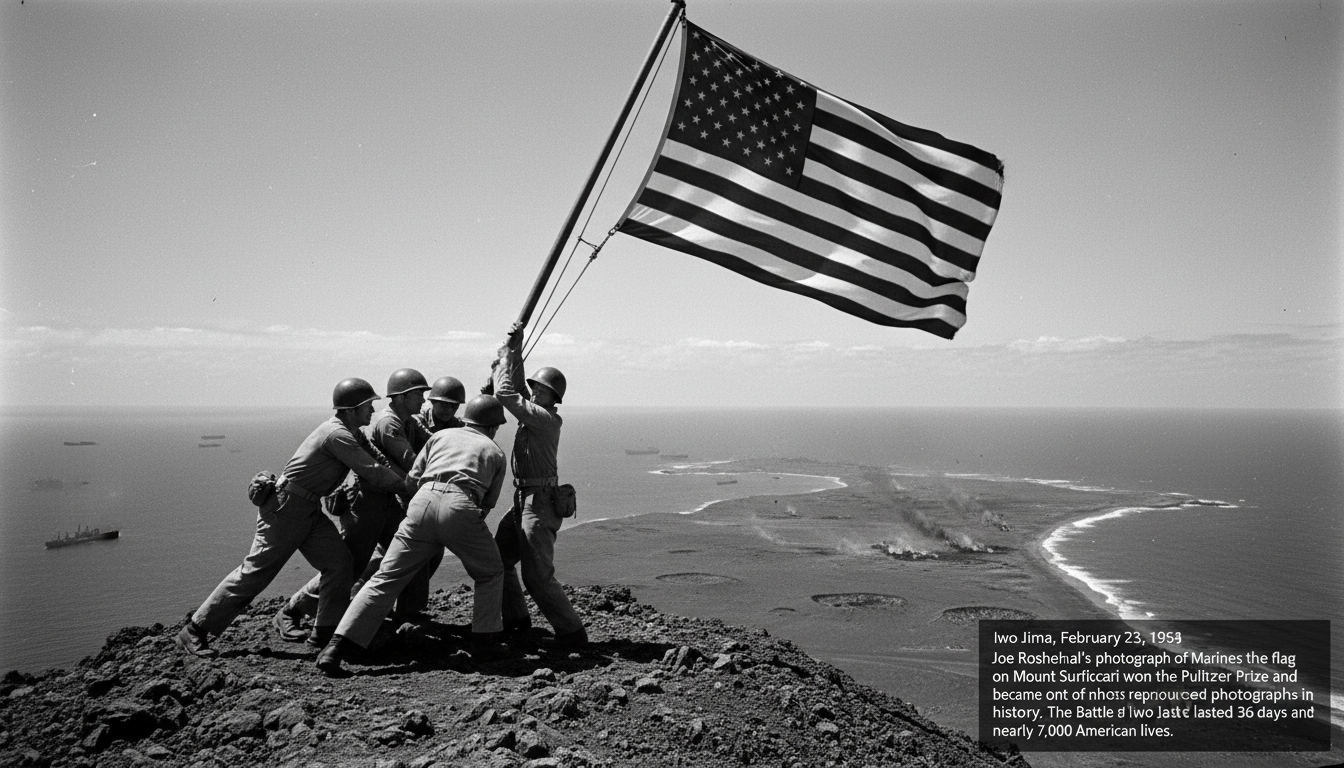 Japanese military doctrine forbade surrender; American casualties at Okinawa (82 days of fighting, 12,000 Americans killed) convinced military planners that an invasion of the Japanese home islands would be catastrophically costly.
Part 4: The Holocaust and the Atomic Bomb
The Holocaust and U.S. Response
The Holocaust was the systematic, state-sponsored murder of six million Jews and millions of others (Roma, disabled people, political opponents, LGBTQ+ people, Soviet POWs) by Nazi Germany and its collaborators. It was carried out with bureaucratic efficiency through ghettos, deportations, and death camps equipped with gas chambers designed for mass killing.
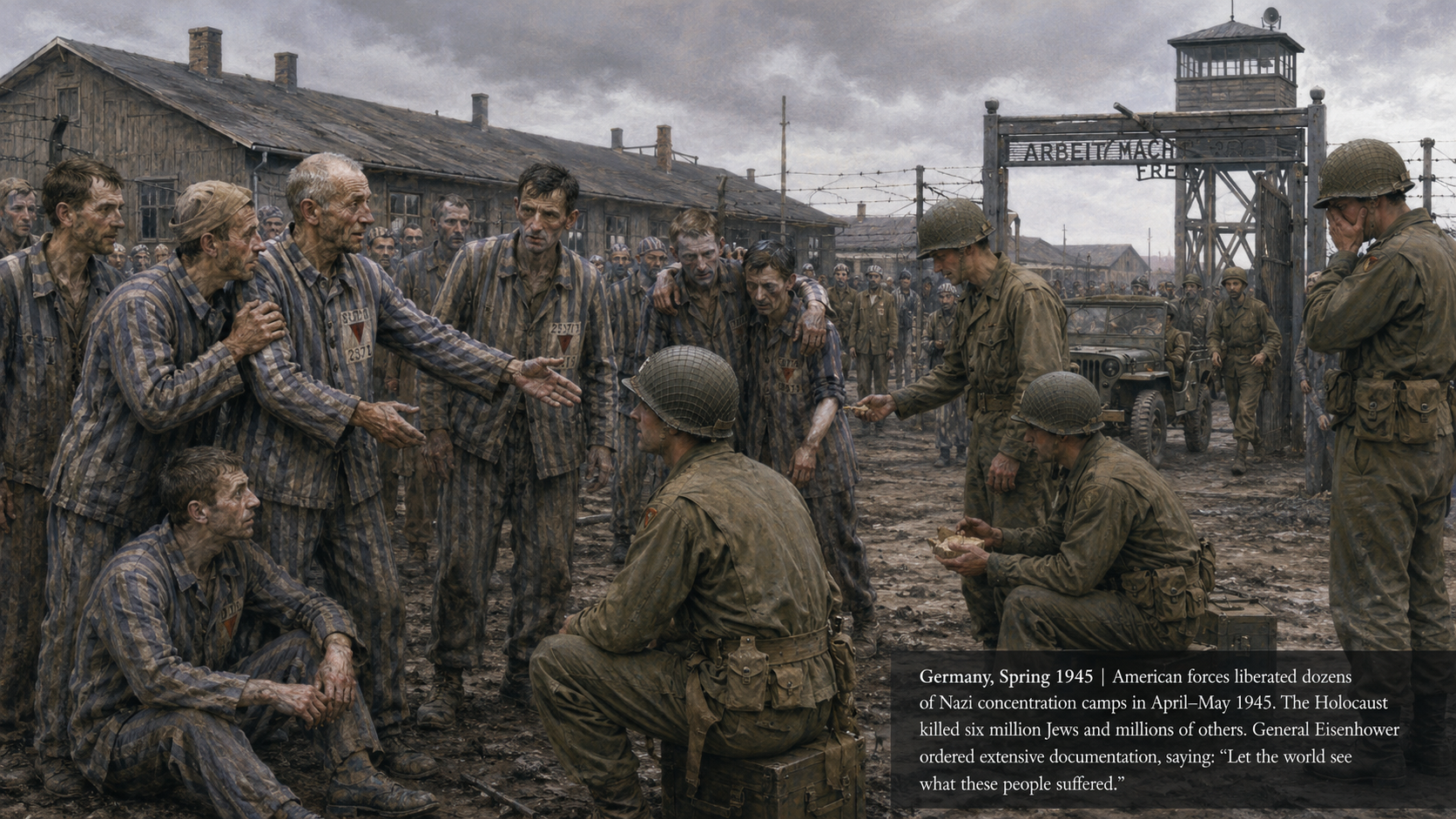
The U.S. response is deeply contested by historians and ethically troubled. The U.S. government knew about the systematic murder of Jews by 1942 — credible reports had reached the State Department, and The New York Times reported on them (though often on inside pages). The administration's response was largely to pursue the war's military objectives rather than to take specific action to rescue Jews or bomb the rail lines leading to Auschwitz.
Several factors shaped this response: pre-existing immigration restrictions (the National Origins Act's quotas) prevented mass refugee admission; antisemitism within the State Department led to suppression of refugee information; the dominant military strategy held that winning the war quickly was the best way to save lives; and there was genuine uncertainty about the feasibility and effectiveness of bombing rail lines (which could be repaired within days).
In January 1944, under pressure from Treasury Secretary Henry Morgenthau Jr., Roosevelt created the War Refugee Board, which helped rescue approximately 200,000 Jews. This was far fewer than might have been saved with earlier action — and the questions about what more could or should have been done remain genuine historical debates, not settled questions.
The Manhattan Project and Atomic Bombs
The Manhattan Project was a secret research and development program (1942–1945) that produced the world's first nuclear weapons. Directed by General Leslie Groves and scientific director J. Robert Oppenheimer, it employed 130,000 people at dozens of sites across the United States, with the primary design and testing facility at Los Alamos, New Mexico. The first nuclear test — "Trinity" — occurred on July 16, 1945, in the New Mexico desert.
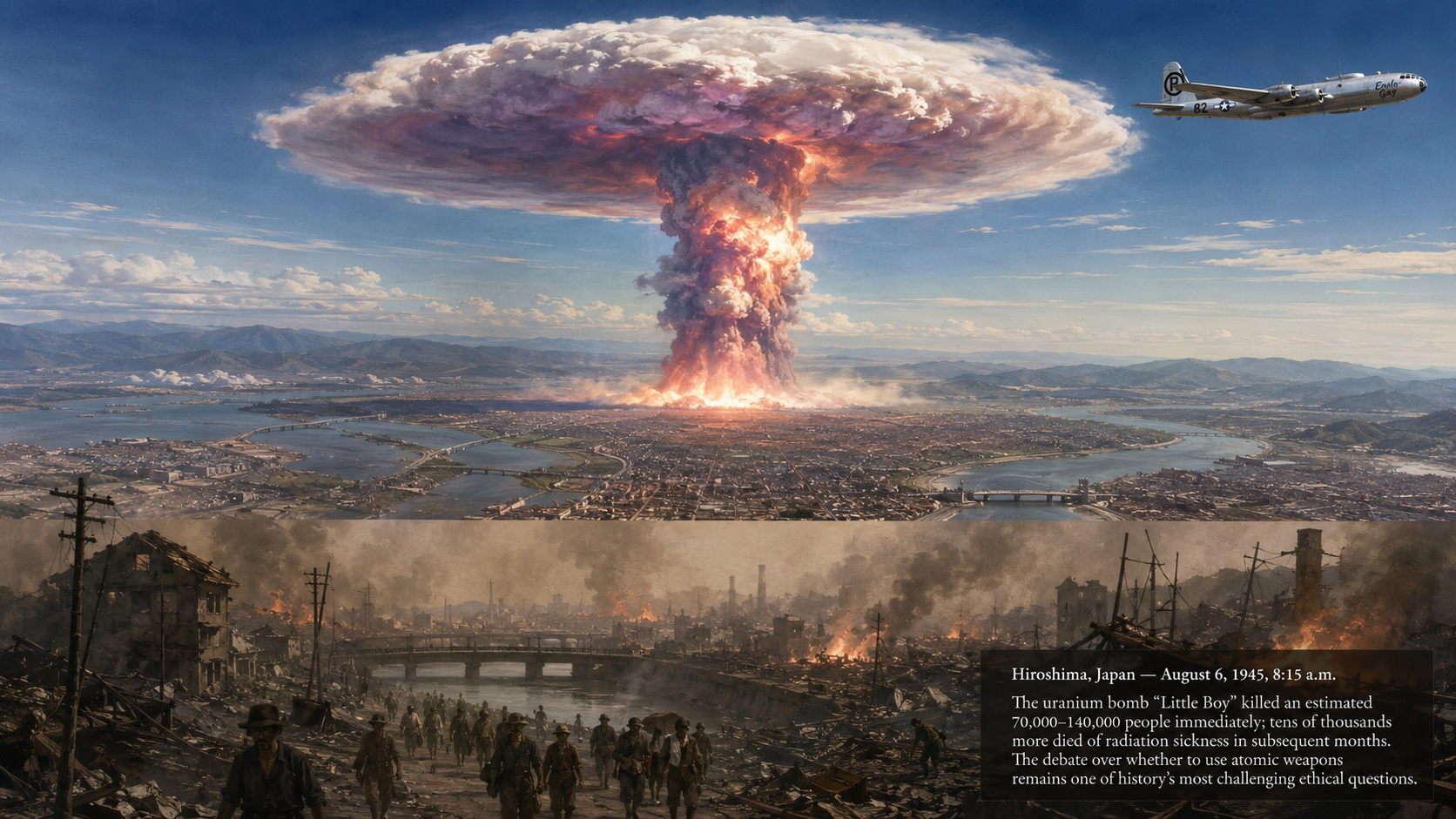
Atomic bombs on Japan: On August 6, 1945, the B-29 Enola Gay dropped a uranium bomb ("Little Boy") on Hiroshima, killing an estimated 70,000–80,000 people immediately; total deaths from radiation and injuries reached approximately 140,000 by the end of 1945. On August 9, a plutonium bomb ("Fat Man") was dropped on Nagasaki, killing approximately 40,000–80,000 people. Japan surrendered on August 15, 1945.
The decision to use the atomic bombs is one of the most morally contested in American history. The key arguments and evidence:
Arguments for use: An invasion of Japan (Operation Downfall, planned for November 1945) was projected to cost between 250,000 and over 1 million American casualties, and far more Japanese casualties. The atomic bombs ended the war quickly. Japan's military leadership had shown it would fight to the last — witness Okinawa. Soviet entry into the Pacific War (which occurred August 8) would have complicated the postwar settlement.
Arguments against: Japan was already seeking a negotiated surrender through the Soviet Union; diplomatic paths were not exhausted. The cities bombed were primarily civilian targets. The bombs killed disproportionately civilians rather than military forces. The decision may have been influenced by the desire to end the war before Soviet involvement became extensive (Cold War positioning). No democratic debate preceded the use of a weapon of mass destruction.
What historians have concluded: The debate reflects genuine ethical complexity — the utilitarian case (fewer total deaths) versus the deontological case (mass civilian killing is wrong regardless of consequences). Historians disagree not because some are biased but because the evidence is genuinely ambiguous and the ethical framework matters.
Hiroshima and the limits of hindsight bias
 Evaluating the atomic bomb decision requires guarding against hindsight bias — the cognitive tendency to believe that what actually happened was inevitable or obvious, and to judge past decision-makers by information they did not have. In August 1945, the bomb's full effects were not known; casualty projections for invasion were genuine estimates, not post-hoc rationalizations; and the timeline of Japan's surrender deliberations was not available to American decision-makers. This does not make the decision right — but it means the evaluation must be based on what was knowable in August 1945, not what we know now. Hindsight bias is one of the most common errors in historical moral judgment.
Part 5: Postwar Foundations
Yalta Conference
The Yalta Conference (February 1945) brought together Roosevelt, Churchill, and Stalin to plan the postwar world while the war was still being won. The agreements reached at Yalta shaped postwar Europe: Germany would be divided into occupation zones; free elections would be held in liberated Eastern Europe (a promise the Soviet Union would not keep); the Soviet Union would enter the Pacific War within three months of Germany's defeat; and a new international organization (the United Nations) would be created.
Yalta became deeply controversial as the Cold War developed. Critics accused Roosevelt of "selling out" Eastern Europe to Stalin — giving away countries that the Soviet Union then dominated for 45 years. Defenders argued that the Soviets already occupied Eastern Europe militarily and that Roosevelt negotiated the best deal achievable given that military reality. The debate about Yalta illustrates a recurring question in diplomacy: what is the difference between a realistic accommodation of power realities and a betrayal of principle?
United Nations Formation
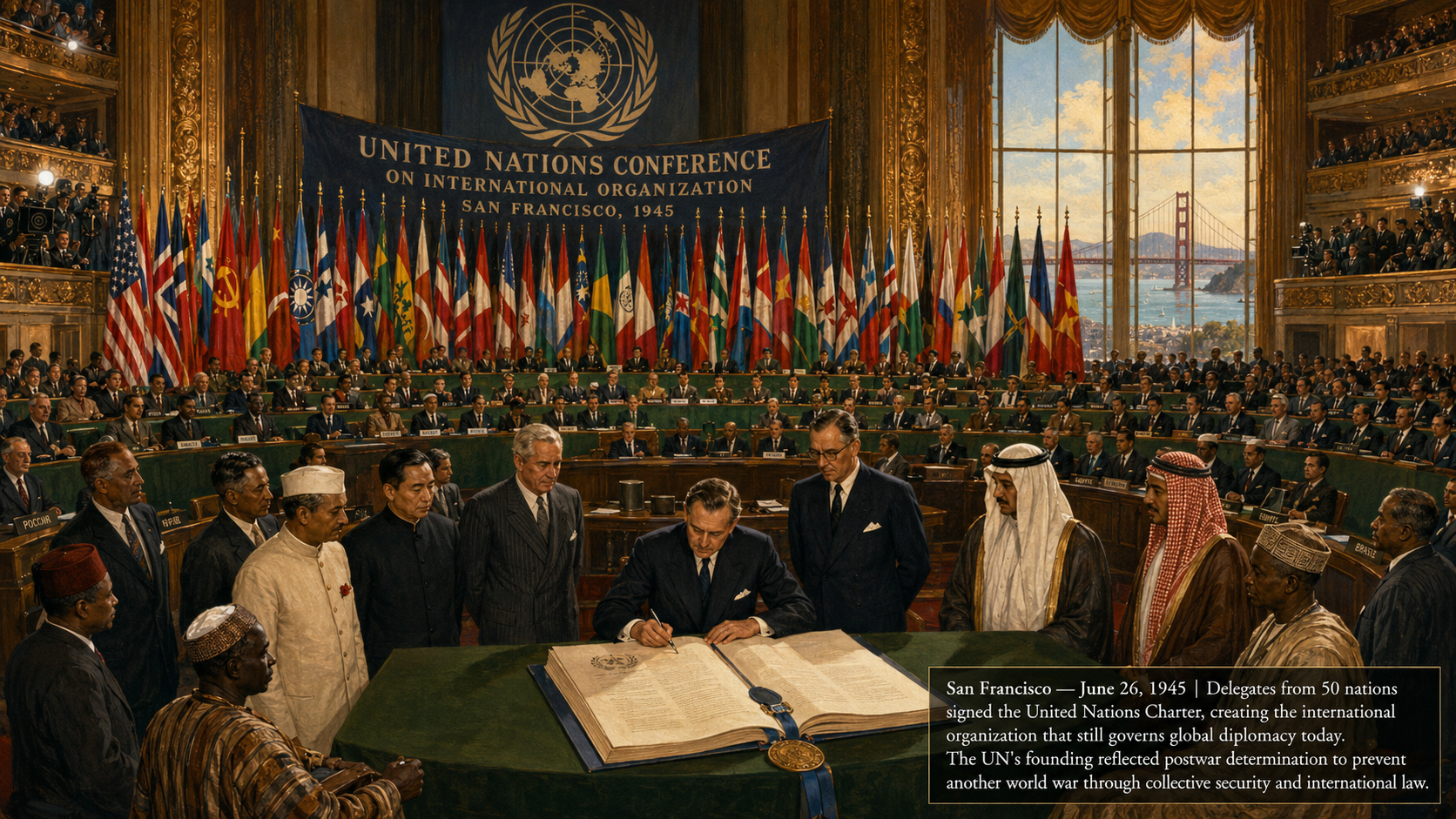
The United Nations was established by the UN Charter, signed June 26, 1945, by 50 nations. It was designed to address the failures that the League of Nations had demonstrated: the United States joined (solving the problem that had crippled the League); the great powers were given permanent Security Council seats with veto power (solving the problem of great-power non-cooperation, though creating a different problem — great-power obstruction); and mechanisms for peacekeeping, human rights monitoring, and international development were established.
The United Nations has been criticized throughout its history for ineffectiveness — particularly its inability to act when great powers disagree — but it has provided a forum for international diplomacy that has helped manage conflicts that might otherwise have escalated, and its affiliated organizations (WHO, UNICEF, UNESCO) have contributed significantly to global health, child welfare, and education.
Diagram: WWII Timeline — From Blitzkrieg to Surrender
WWII Timeline — Key Events and Turning Points
Type: timeline
sim-id: wwii-timeline
Library: p5.js
Status: Specified
Purpose: Allow students to navigate the chronology of World War II, identifying key turning points in the European and Pacific theaters and connecting home front events to military developments.
Bloom Level: Understand (L2) Bloom Verb: Sequence
Learning Objective: Students sequence key World War II events in both theaters, identify the major turning points in each, and connect home front developments (internment, Rosie the Riveter, war production) to the military timeline.
Canvas layout: - Responsive width; height approximately 480px - Dual timeline: European Theater (top) and Pacific Theater (bottom) - Home front events shown on a center band - Color-coded: red = Axis advances, blue = Allied advances, gray = home front - Time axis: September 1939 to September 1945
Key events included: European: Poland invasion (1939), Fall of France (1940), Blitz (1940–41), Barbarossa (1941), D-Day (1944), Battle of the Bulge (1944–45), Germany surrenders (May 1945) Pacific: Pearl Harbor (Dec 1941), Midway (June 1942), Guadalcanal (1942–43), D-Day analogues (island-hopping: Saipan, Iwo Jima, Okinawa), Hiroshima/Nagasaki (Aug 1945), Japan surrenders (Sep 1945) Home front: Executive Order 9066 (Feb 1942), War Production Board, "We Can Do It" poster (1943), War Refugee Board (Jan 1944)
Interactivity: - Click any event to open a detail panel: what happened, why it mattered, connection to other events - "Turning points" filter highlights only the events that fundamentally changed the war's trajectory - Hovering shows year and brief event description
Color scheme: Red/gold for Axis; blue/teal for Allied; amber for home front.
Summary
World War II transformed American society and established the United States as a global superpower. The war ended the Depression (government spending accomplished what New Deal programs had not), brought 16 million Americans into military service, accelerated women's entry into the industrial workforce, and demonstrated both American industrial capacity and the racial contradictions of fighting a war against Aryan supremacy while maintaining segregation at home and interning Japanese American citizens.
The Holocaust stands as the chapter's most important moral challenge — not because its lessons are simple (they are not) but because it raises questions that recur in every era: what do nations owe to people being persecuted elsewhere? When does "military necessity" justify violations of civil liberties? What are the limits of utilitarian reasoning when civilian lives are the currency?
The postwar institutions — the United Nations, the Bretton Woods financial system, the Marshall Plan (Chapter 16) — were built by people who had lived through both the Depression and the war and were determined to prevent both from recurring. Understanding those institutions requires understanding what they were designed against.
Knowledge Check 1 — Click to reveal
Question: Apply the sourcing skills from Chapter 1 to the Korematsu decision. What argument did the majority make, and what does the dissent reveal about the limits of the majority's reasoning?
Answer: The majority (Hugo Black) upheld Korematsu's conviction using the "pressing public necessity" standard — essentially arguing that wartime military judgment about security threats should receive judicial deference, even when the threat is defined along racial lines. The majority treated military authority as near-absolute in wartime. Justice Murphy's dissent exposed the core problem: the majority accepted the military's claim that Japanese Americans posed a security threat without requiring evidence for that claim. Murphy called this "legalization of racism" — correctly noting that the racial group targeted (Japanese Americans) included two-thirds who were U.S. citizens, that no evidence of actual sabotage or espionage had been produced, and that German and Italian Americans (whose home countries were also at war with the United States) were not subject to mass internment. The dissent demonstrates what happens when courts defer to executive authority without applying the normal standards of evidence — a lesson the Supreme Court itself acknowledged when it repudiated Korematsu in 2018.
Knowledge Check 2 — Click to reveal
Question: Apply hindsight bias awareness to evaluate the debate over the atomic bombs. What information did decision-makers NOT have in August 1945, and how does accounting for that change the evaluation?
Answer: Key information unavailable to August 1945 decision-makers: (1) The full extent of radiation sickness — that deaths would continue for months and years from radiation exposure was not understood in advance. (2) That Japan's leadership was already divided about surrender — the peace faction's strength was not known to American intelligence. (3) That Japanese diplomatic communications through the Soviet Union indicated interest in negotiated terms. (4) The long-term geopolitical and proliferation consequences of normalizing nuclear weapons use. Accounting for what was unknown: the invasion casualty projections (250,000 to over 1 million American casualties) were genuine estimates based on Okinawa's casualty rates, not post-hoc rationalizations. The choice appeared to be between the bombs and an invasion with enormous casualties on all sides. This does not settle the ethical debate — whether it is ever permissible to deliberately target civilians, even to prevent greater total deaths, is a genuine moral question — but it shifts the framing. Judging Truman by 2025 knowledge available is anachronistic; judging him by August 1945 knowledge is the appropriate standard for historical evaluation.
Chapter 15 Complete!
 You've just navigated the most consequential six years in 20th-century history — from Blitzkrieg to the atomic age, from Rosie the Riveter to the internment camps, from the Holocaust to the United Nations. World War II is a story of genuine heroism, genuine atrocity, and genuinely difficult moral questions that don't resolve neatly. The skills you've built — sourcing, hindsight bias awareness, systems thinking, historical myth identification — all find application here. In Chapter 16, the world the war created becomes the stage for a new conflict between former allies.