The Progressive Era (1890–1914)
Summary
This chapter traces the Progressive movement's effort to address the abuses of industrialization through investigative journalism, regulatory legislation, and constitutional reform — the 16th through 19th Amendments. Theodore Roosevelt's Square Deal, trust-busting, the Pure Food and Drug Act, and the early conservation movement (National Parks, public lands policy) demonstrate how reformers reshaped the relationship between government and the economy.
Concepts Covered
This chapter covers the following 21 concepts from the learning graph:
- Progressive Era
- Muckrakers
- Upton Sinclair and The Jungle
- Ida Tarbell
- Jacob Riis
- Theodore Roosevelt
- Square Deal
- Trust-Busting
- Pure Food and Drug Act
- Susan B. Anthony
- Women's Suffrage Movement
- NAACP Formation
- Booker T. Washington
- W.E.B. Du Bois
- Sixteenth Amendment (Income Tax)
- Seventeenth Amendment (Direct Election)
- Eighteenth Amendment (Prohibition)
- Nineteenth Amendment (Women's Suffrage)
- Public Lands Policy
- Environmental Conservation History
- National Parks System
Prerequisites
This chapter builds on concepts from: - Chapter 11: Populism and the Closing of the Frontier
The age of reform
 Welcome to Chapter 12! The Progressive Era is the story of Americans deciding that the unregulated industrial capitalism of the Gilded Age had gone too far — and that government had both the right and the duty to intervene. It produced four constitutional amendments in eight years, reshaped the relationship between government and the economy, and established the investigative journalism tradition that remains a cornerstone of democratic accountability. Let's investigate the evidence!
The Muckrakers: Journalism as Reform Tool
The Progressive Era (roughly 1890–1920) was driven by information: investigative journalists, social scientists, and reformers who documented the human costs of industrialization in ways that moved public opinion from acceptance to demand for change.
Muckrakers
Muckrakers — journalists who exposed corruption, dangerous conditions, and corporate abuse in popular magazines and books — were the catalysts of Progressive reform. Theodore Roosevelt coined the term (from John Bunyan's character who could only look down at the muck), intending it as mild criticism, but reformers adopted it proudly.
Ida Tarbell spent four years researching Standard Oil's business practices for McClure's Magazine (1902–1904), producing a 19-part series that documented in meticulous detail the secret railroad rebates, industrial espionage, and predatory pricing that Rockefeller's empire had used to destroy competitors. Her work was journalism at its most rigorous — based on primary documents, corporate records, and interviews — and was directly responsible for the public pressure that led to the Supreme Court's 1911 dissolution of Standard Oil.
Jacob Riis, a Danish-American journalist and photographer, had documented tenement life in How the Other Half Lives (1890). His use of photographs made the reality of tenement poverty unavoidable for middle-class readers who had never entered one.
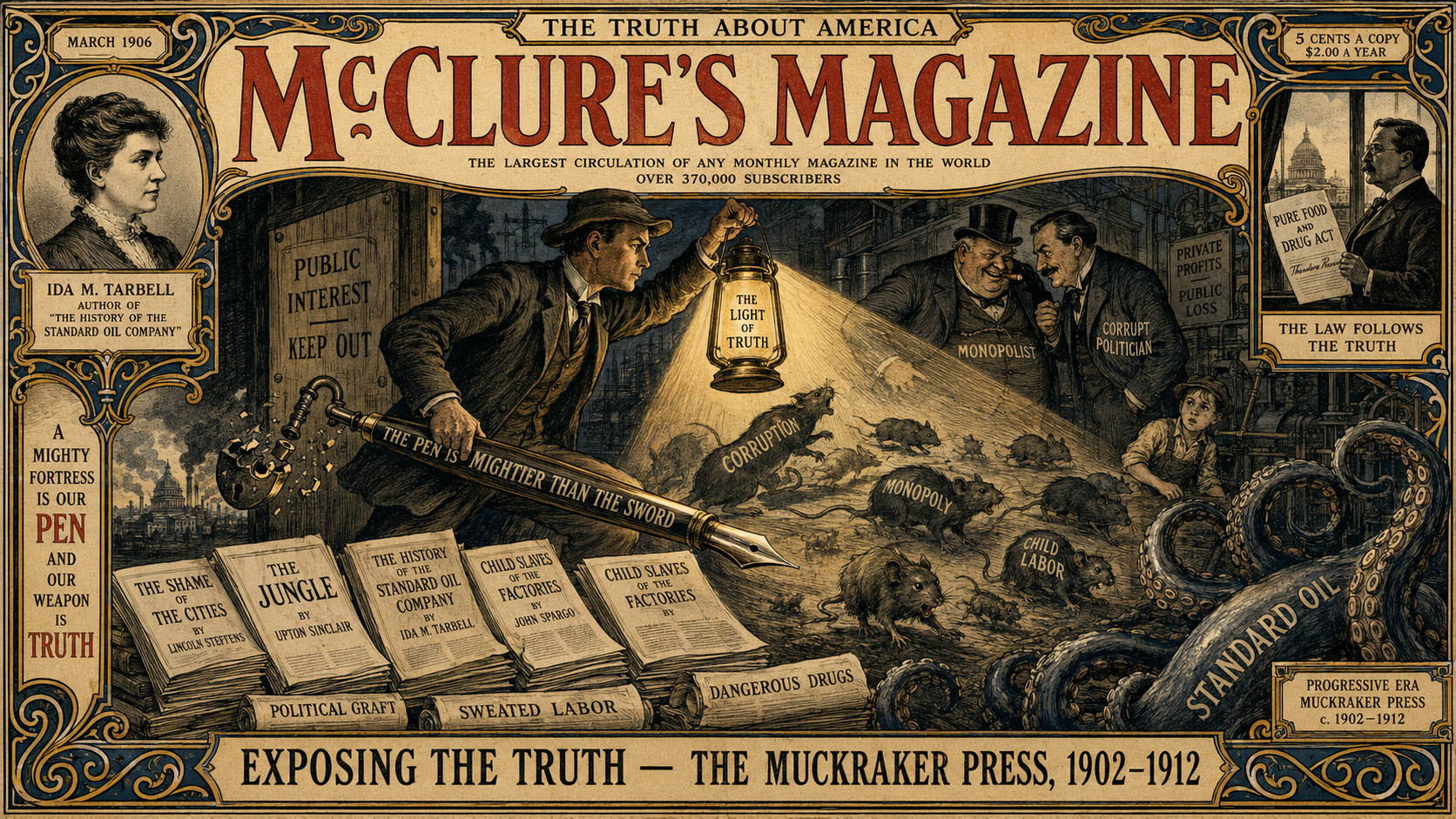
Upton Sinclair wrote The Jungle (1906), a novel following a Lithuanian immigrant family working in the Chicago meatpacking industry. Sinclair intended it as an indictment of capitalism's exploitation of immigrant workers. Readers focused instead on his graphic descriptions of unsanitary meatpacking conditions — rat droppings, contaminated meat, occasional human body parts entering the meat supply. "I aimed at the public's heart," Sinclair wrote ruefully, "and by accident I hit it in the stomach."
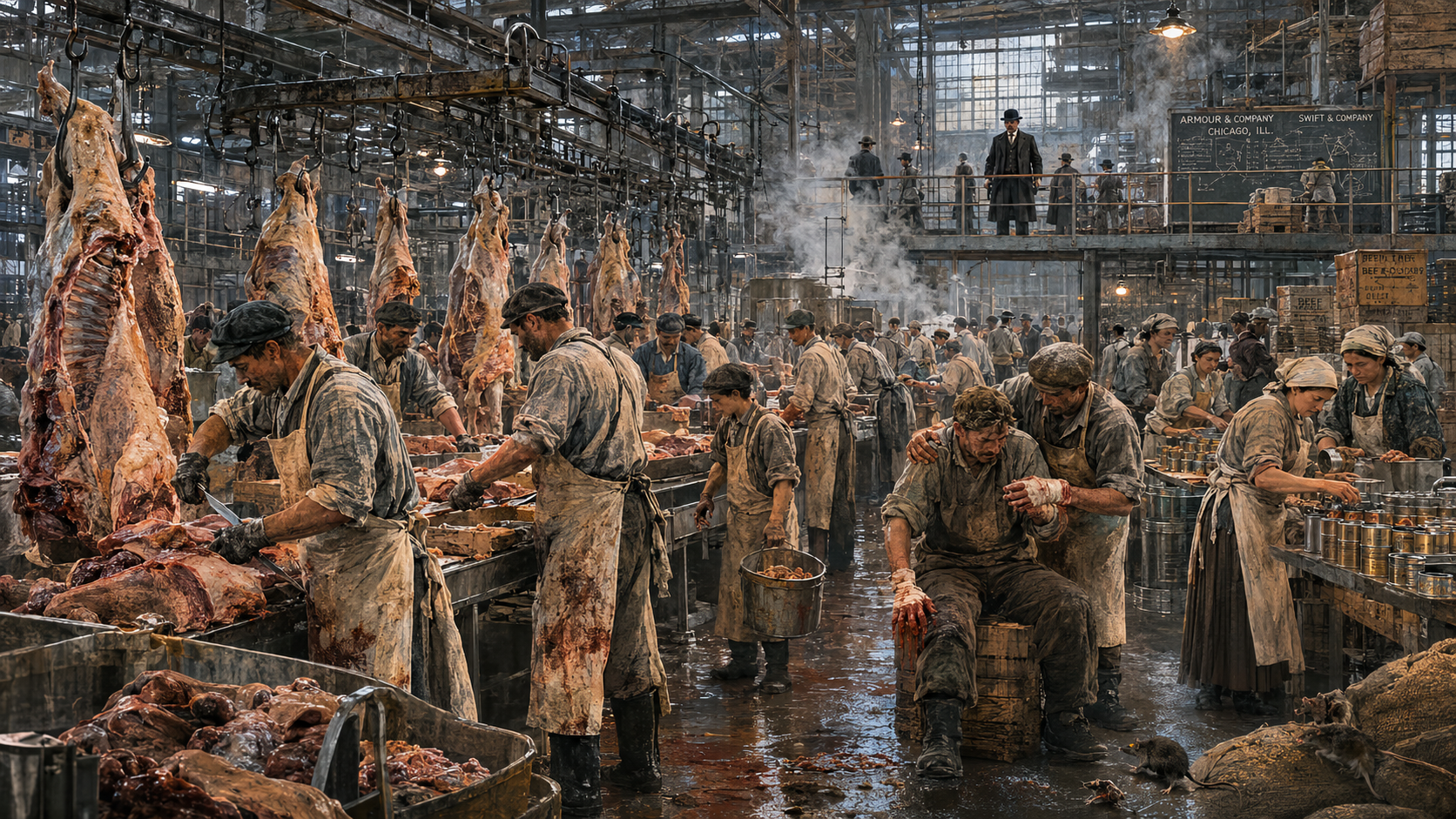
The Jungle's immediate impact was the Pure Food and Drug Act and the Meat Inspection Act (1906). This is a case study in how public outrage over a visceral issue (food safety) can produce policy change faster than any abstract argument about labor exploitation.
Muckraking and the limits of journalism as reform
 Muckraking journalism is powerful but limited. It works best when it produces visceral public reaction (the Jungle's food safety impact) or provides concrete documentation of criminal behavior (Tarbell's Standard Oil series). It works less well when the abuse requires structural change that threatens broad economic interests, or when the audience isn't already predisposed to outrage. Apply sourcing to the muckrakers themselves: what audiences were they writing for, and how did that shape their choices of subject and frame?
Part 1: Theodore Roosevelt and the Square Deal
Theodore Roosevelt
Theodore Roosevelt became President in 1901 when William McKinley was assassinated — at 42, the youngest president in U.S. history. Roosevelt brought to the presidency an expansive conception of executive power, a genuine belief in the public interest as distinct from the interests of corporations, and a talent for political theater that made him the dominant figure in American public life for the next decade.
Roosevelt's Square Deal was his domestic program — a commitment to fairness between business, labor, and the public. It had three main components: conservation of natural resources, control of corporations (trust-busting), and consumer protection.
Trust-Busting
Trust-busting under Roosevelt meant using the Sherman Antitrust Act aggressively — something his predecessors had largely failed to do. Roosevelt's Justice Department brought 44 antitrust suits, most famously against Northern Securities (a railroad monopoly controlled by J.P. Morgan) and Standard Oil. The Supreme Court upheld the Northern Securities dissolution in 1904, establishing that the Sherman Act could be used against holding companies as well as trusts.
Roosevelt's approach was more nuanced than the term "trust-busting" suggests. He distinguished between "good trusts" (large corporations that competed fairly and served the public) and "bad trusts" (those that used anti-competitive practices). He preferred regulation over dissolution in most cases, arguing that large corporations were natural features of the modern economy that needed to be supervised rather than broken up.
Pure Food and Drug Act and Consumer Protection
The Pure Food and Drug Act (1906) prohibited the manufacture, sale, or transportation of adulterated or mislabeled food and drug products. The Meat Inspection Act (same year) required federal inspection of meatpacking facilities. These were the first major federal consumer protection laws — establishing the principle that the federal government had authority to regulate the production of goods for interstate commerce to protect public health.
The Acts established regulatory agencies with ongoing oversight authority — a model that would be expanded dramatically in the New Deal. They also demonstrated that regulatory legislation, once enacted, tends to expand: each new food safety scandal produced calls for stronger regulation, creating a reinforcing loop of exposure → outrage → legislation → stronger oversight.
Part 2: The Constitutional Revolution of the Progressive Era
Between 1913 and 1920, four constitutional amendments were ratified — the largest single burst of constitutional change since the Bill of Rights and the Reconstruction amendments.
The Sixteenth Amendment (1913): Income Tax
The Sixteenth Amendment gave Congress the power to levy a graduated income tax — one of the core demands of the 1892 Populist platform. The first income tax applied only to incomes above $3,000 (roughly $90,000 today) at a rate of 1 percent, rising to 7 percent on incomes above $500,000. The amendment established the mechanism; subsequent legislation determined the rates, which would rise dramatically during the World Wars.
The Seventeenth Amendment (1913): Direct Election of Senators
The Seventeenth Amendment required U.S. senators to be elected directly by voters rather than by state legislatures — another Populist demand. The original design (state legislature selection) had been intended to make the Senate a deliberative body insulated from popular passion. In practice, it made senators dependent on state machine politicians and susceptible to corporate capture of state legislatures. Direct election made senators accountable to broader electorates.
The Eighteenth Amendment (1919): Prohibition
The Eighteenth Amendment prohibited the manufacture, sale, and transportation of intoxicating liquors. The temperance movement, long organized and increasingly militant, had built a coalition that included evangelical Protestants, women's suffrage advocates (who saw alcohol as a cause of domestic violence), and nativists (who associated saloon culture with immigrant communities). Wartime nationalism during World War I provided the final push — conserving grain for the war effort.
Prohibition's consequences will be examined in Chapter 14. For now, it is worth noting that it is one of the most dramatic examples in American history of a balancing feedback loop being overwhelmed by a reinforcing political coalition — and then producing massive unintended consequences when enacted.
The Nineteenth Amendment (1920): Women's Suffrage
The Nineteenth Amendment prohibited denying the right to vote on account of sex, granting women full voting rights nationwide. It was the culmination of more than 70 years of organizing, beginning with the 1848 Seneca Falls Declaration. The path from Seneca Falls to the 19th Amendment illustrates both the possibilities and the frustrations of democratic reform: seven decades, multiple generations of organizers, partial victories (Wyoming territory granted women's suffrage in 1869), setbacks, and eventual success.
Susan B. Anthony was the dominant figure of women's suffrage for the second half of the 19th century. She was arrested for voting in the 1872 presidential election and used her trial to expose the absurdity of a democracy that denied the vote to half its citizens. She died in 1906, 14 years before the amendment's ratification.
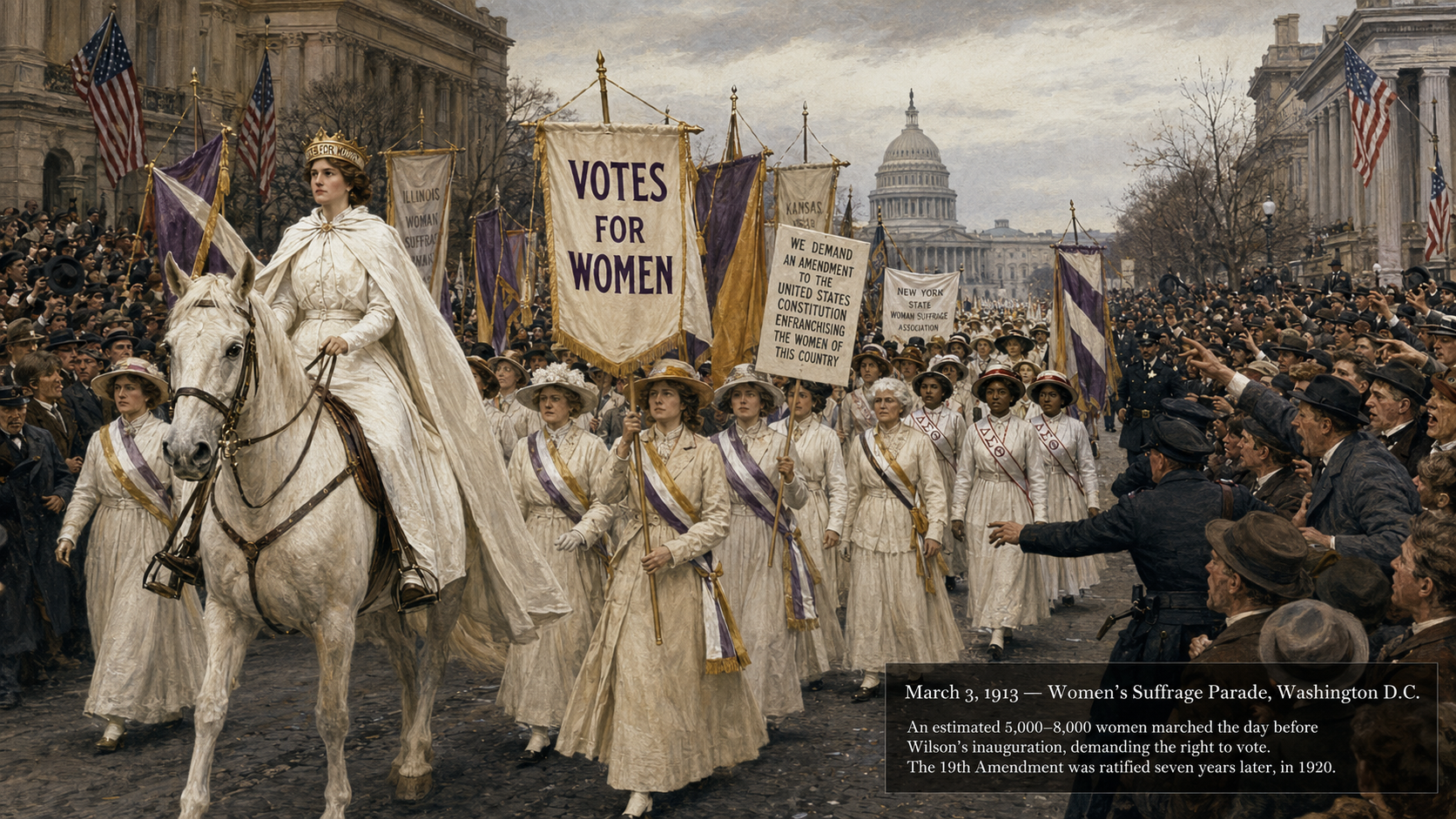
The Women's Suffrage Movement deployed multiple strategies over its history — moral suasion, legal challenges, electoral pressure, and, in the movement's final decade, mass marches, lobbying campaigns, and civil disobedience. Its success in 1920 was the product of strategic adaptation across seven decades.
Diagram: Four Progressive Era Amendments — Timeline and Context
Four Progressive Era Amendments — Interactive Timeline
Type: timeline
sim-id: progressive-amendments-timeline
Library: p5.js
Status: Specified
Purpose: Allow students to explore the four Progressive Era constitutional amendments (16th–19th), the social movements that produced them, and the political context in which each was ratified.
Bloom Level: Understand (L2) Bloom Verb: Explain
Learning Objective: Students explain the purpose of each Progressive Era amendment and the social movement or political pressure that produced it.
Canvas layout: - Responsive width; height approximately 480px - Horizontal timeline from 1890 to 1925 - Four clickable markers, one per amendment: 16th (1913), 17th (1913), 18th (1919), 19th (1920) - Background shows key political events: McKinley assassination (1901), TR presidency, WWI shading (1917–1918)
Each marker, when clicked, opens a detail panel: - Amendment number and ratification year - What it changed (one sentence) - The movement that drove it (Populists, direct democracy reformers, temperance, women's suffrage) - One historical context note explaining the timing - A "What happened next?" line showing the amendment's legacy or unintended consequences
Additional clickable elements: - Hovering the WWI band shows: "Wartime nationalism accelerated both Prohibition (grain conservation) and women's suffrage (women's war contributions)" - A "Populating over time" mode shows state ratification maps for the 18th and 19th amendments
Color scheme: Each amendment has a distinct color (gold = 16th, indigo = 17th, red = 18th, teal = 19th); WWI period shaded in gray.
Responsive behavior: Timeline scrolls horizontally on narrow canvas.
Implementation: p5.js
Part 3: Race and Reform — Washington, Du Bois, and the NAACP
The Progressive Era is sometimes celebrated as an age of democratic reform — and it was, for white Americans, particularly white women. For Black Americans, the Progressive Era coincided with the height of Jim Crow, a surge in lynching, and the active exclusion of Black workers from many Progressive reform coalitions. Understanding the Progressive Era requires holding this contradiction squarely.
Booker T. Washington and W.E.B. Du Bois
The most important debate within Black America about how to respond to Jim Crow was between Booker T. Washington and W.E.B. Du Bois — two men who agreed on the diagnosis (Black Americans faced systematic oppression) and disagreed profoundly on the prescription.
Booker T. Washington, founder of Tuskegee Institute and the most prominent Black public figure of the era, advocated what he called "accommodationism": Black Americans should accept, for now, political disenfranchisement and social subordination, focusing instead on economic self-improvement through vocational education and entrepreneurship. His 1895 Atlanta Compromise speech proposed a bargain: Black labor and political quietism in exchange for economic opportunity and Southern white tolerance. Washington expressed this privately and publicly: "In all things that are purely social we can be as separate as the fingers, yet one as the hand in all things essential to mutual progress."
W.E.B. Du Bois, the first Black American to earn a Harvard doctorate and a founder of the NAACP, rejected accommodationism as surrendering the rights the Reconstruction amendments had guaranteed. In The Souls of Black Folk (1903), he argued that Washington's program "practically accepts the alleged inferiority of the Negro" and that what Black Americans needed was full civil and political rights, access to higher education, and vigorous legal challenges to Jim Crow. Du Bois coined the concept of "double consciousness" — the sense of always looking at oneself through the eyes of a white society that defined Blackness as inferior.
The Washington-Du Bois debate is not simply a historical controversy. It raises questions that recur in every civil rights struggle: Is it better to work within an unjust system to gain incremental improvements, or to reject the system's terms and demand full rights? The answer depends partly on empirical predictions (which strategy will actually produce better outcomes?) and partly on values (what are the moral costs of accepting one's own subordination as a strategic concession?).
NAACP Formation (1909)
The NAACP (National Association for the Advancement of Colored People) was founded in 1909 by Du Bois, Ida Wells-Barnett (an anti-lynching journalist), and white progressives including Oswald Garrison Villard. It pursued Du Bois's strategy of legal challenges and political advocacy rather than Washington's accommodationism.
The NAACP's legal strategy — filing constitutional challenges to Jim Crow laws in federal court — was a long game. Its first major victory came with Buchanan v. Warley (1917, striking down residential segregation ordinances). Its greatest victory — Brown v. Board of Education — would come 45 years after its founding, in 1954. The NAACP's history illustrates how institutional strategies for social change operate on generational time scales.
Part 4: Conservation and the Environment
Theodore Roosevelt and the Conservation Movement
Environmental conservation history in America begins seriously with Theodore Roosevelt's presidency. Roosevelt was a genuine naturalist who had explored the West and was alarmed by the rapid destruction of American forests, wildlife, and landscapes by logging companies, mining operations, and agricultural clearing.
The National Parks System was expanded dramatically under Roosevelt, who created five new national parks, 18 national monuments, and the U.S. Forest Service. His public lands policy used executive authority under the Antiquities Act (1906) to reserve 230 million acres of public land from commercial development — more than any previous president.
Roosevelt's conservation philosophy distinguished between preservation (keeping wilderness unchanged) and conservation (managing natural resources sustainably for future use). He largely favored the latter — professional management of resources by technical experts in the public interest — over both unchecked commercial exploitation and absolute preservation. This distinction, contested ever since, shapes American environmental policy to this day.
Conservation as systems thinking
 Roosevelt's conservation philosophy was fundamentally systems thinking. He recognized that the unregulated extraction of natural resources was a reinforcing feedback loop: more extraction → more profit → more capital for more extraction → faster depletion. The balancing force — sustainable management for future generations — had to be imposed by government because the market's time horizon (quarterly profits) was too short to account for long-term resource depletion. This is one of the earliest examples of using government policy to correct a market's systematic failure to account for second-order temporal effects.
Summary
The Progressive Era reshaped the relationship between the federal government and the economy — establishing consumer protection, antitrust regulation, income taxation, and the institutional framework for ongoing regulatory oversight. Muckraking journalism demonstrated that investigative reporting could move public opinion and produce legislative change. Four constitutional amendments transformed the constitutional structure.
But the Progressive Era's reform impulse was selective. It addressed the abuses of industrial capitalism while largely ignoring or actively perpetuating racial oppression. The NAACP's founding in 1909 began the long campaign to extend Progressive ideals to Black Americans — a campaign that would not achieve major legislative victories until the 1960s. And the Eighteenth Amendment's prohibition of alcohol would produce, within a decade, some of the most dramatic unintended consequences in American legislative history.
Knowledge Check 1 — Click to reveal
Question: Upton Sinclair said he "aimed at the public's heart" with The Jungle but "hit it in the stomach." Apply the concept of availability heuristic to explain why the food safety impact was greater than the labor exploitation impact.
Answer: The availability heuristic predicts that people will respond more strongly to threats that are easy to imagine affecting themselves — and food contamination is immediately available to any reader's imagination. "This could be in my food" triggers visceral self-interest. "This worker is being exploited" requires empathy with a distant other — a psychologically more demanding response. Sinclair's labor exploitation argument required middle-class readers to identify with immigrant meatpacking workers in a way that the food safety argument did not. The latter made exploitation their problem; the former required them to see it as someone else's problem that they had an obligation to address. The availability heuristic helps explain this asymmetry.
Knowledge Check 2 — Click to reveal
Question: Du Bois argued that Washington's accommodationism "practically accepts the alleged inferiority of the Negro." Apply historical comparison to evaluate both men's strategies using evidence from the decades after 1895.
Answer: Comparison requires assessing what each strategy actually produced. Washington's accommodationist approach produced Tuskegee Institute, a network of Black businesses, and a degree of Southern white tolerance for Black economic activity within a rigidly segregated society. It did not produce a reduction in lynching, political rights, or legal equality — the very things Washington's critics argued required direct confrontation. Du Bois's NAACP strategy produced legal victories over decades (the NAACP's litigation campaign eventually produced Brown v. Board in 1954), built an organizational infrastructure for civil rights advocacy, and maintained the moral claim to full citizenship. The evidence suggests that Du Bois's assessment of Washington's strategy was largely correct empirically: economic self-improvement within a Jim Crow framework produced neither the economic security nor the political rights its advocates promised.
Chapter 12 Complete!
 You've just navigated an era of genuine reform — and its genuine limits. The Progressive Era reshaped American government, extended democratic rights to women, and established the conservation movement. It also demonstrated that reform movements can be selective, that muckraking journalism works best on visceral issues, and that the NAACP's patient legal strategy would have to wait another half-century for its greatest victories. In Chapter 13, America's Progressive energy collides with global war.