The Early Cold War (1945–1960)
Summary
The Cold War was the defining geopolitical framework of the second half of the 20th century — a global competition between the United States and the Soviet Union that shaped alliances, wars, domestic politics, culture, and technology for 45 years. This chapter traces its origins in the contradictions of the WWII alliance, through the formulation of containment strategy, the Marshall Plan's economic reconstruction of Europe, the Korean War, and the domestic paranoia of McCarthyism. It introduces the AP thematic lens of "America in the World" — how American identity and values are shaped by engagement with the global community — and uses arms race dynamics as a case study in how systems thinking explains apparently irrational behavior.
Concepts Covered
This chapter covers the following 16 concepts from the learning graph:
- Origins of the Cold War
- Containment Policy
- Truman Doctrine
- Marshall Plan
- Berlin Blockade
- NATO Formation
- Korean War
- McCarthyism
- House Un-American Activities Committee
- Arms Race
- Space Race
- Eisenhower and Military-Industrial Complex
- Interstate Highway System
- Baby Boom
- Arms Race Dynamics
- America in the World
Prerequisites
This chapter builds on concepts from: - Chapter 15: World War II and the Home Front
A new kind of conflict
 Welcome to Chapter 16! The Cold War was unlike any previous conflict in American history. There was no declaration of war, no clear battlefield, no single moment of victory or defeat. It was a competition — ideological, economic, military, and cultural — conducted simultaneously across the globe and within American domestic life. Understanding it requires the "America in the World" thematic lens: how does America's relationship with the rest of the world shape what America is at home? Let's investigate the evidence!
The AP Thematic Lens: America in the World
America in the World is an AP U.S. History thematic lens that examines how the United States has engaged with other nations and how that engagement has shaped American society, politics, and identity. The Cold War is the lens's most sustained application: for 45 years, the competition with the Soviet Union influenced everything from military spending to civil rights (the embarrassment of racial segregation in a country claiming to lead the "free world") to the interstate highway system (built partly for military evacuation) to suburban culture (defined partly against the Soviet image of collective, industrial society).
Using this lens means asking: when domestic developments occur, how are they shaped by America's international position? And when America acts internationally, what domestic forces and values drive those actions?
Part 1: Origins of the Cold War
Why Former Allies Became Adversaries
The United States and Soviet Union were the two nations that emerged from WWII with their industrial capacity intact and their military power expanded. Every other major power — Britain, France, Germany, Japan, China — was devastated. This structural reality made U.S.-Soviet competition over the postwar order nearly inevitable, even before ideological differences are factored in.
The origins of the Cold War lie in several converging factors:
Ideological incompatibility: The United States stood for liberal democracy and market capitalism; the Soviet Union for one-party Communist rule and a state-managed economy. Each side believed its system was historically correct and the other's was fundamentally illegitimate.
WWII's unresolved agreements: As Chapter 15 noted, Yalta's agreements on Eastern European free elections were never honored. As Soviet forces occupied Eastern Europe, they installed Communist governments — a direct violation of what the United States understood the Yalta agreements to require.
Nuclear monopoly and its end: The United States held a nuclear monopoly from 1945 to 1949. Soviet nuclear testing in August 1949 ended that monopoly and fundamentally changed the strategic calculus: the United States could no longer deter Soviet aggression with the implicit threat of nuclear attack without facing the same threat in return.
Containment Policy and the Truman Doctrine
American strategy toward the Soviet Union was shaped by the containment policy, formulated by diplomat George Kennan in his famous "Long Telegram" (1946) and "X Article" (1947). Kennan argued that Soviet expansionism was driven by a combination of Marxist ideology and Russian historical insecurity — and that it could be "contained" by firm counterpressure at every point where Soviet expansion threatened to occur. The Soviets, he predicted, would eventually moderate their behavior or collapse under the weight of their own contradictions.
The Truman Doctrine (March 1947) was the political expression of containment. When Britain announced it could no longer support Greece (fighting a Communist insurgency) and Turkey (under Soviet pressure), Truman asked Congress for $400 million in aid and articulated a sweeping principle: "It must be the policy of the United States to support free peoples who are resisting attempted subjugation by armed minorities or outside pressures." This open-ended commitment — any nation threatened by Communism could request American support — shaped U.S. foreign policy for the next 40 years.
Marshall Plan
The Marshall Plan (officially the European Recovery Program, 1948–1952) was Secretary of State George Marshall's proposal to provide $13 billion in economic aid to reconstruct Western Europe. The reasoning was strategic as well as humanitarian: poverty and economic dislocation created conditions in which Communist parties could win democratic elections (as seemed possible in France and Italy in 1947). Prosperous, stable democracies were better able to resist Communist political appeal.
The Marshall Plan was one of the most successful foreign policy initiatives in American history. Western European economies recovered rapidly; Communist parties in France and Italy lost electoral ground; the rebuilt European economies became important trading partners for American goods. It also established a precedent — that American economic power could be used as an instrument of foreign policy — that shaped subsequent foreign aid programs throughout the Cold War.
The Marshall Plan as systems thinking
 Apply systems thinking to the Marshall Plan. The problem was not simply that Europe was poor — it was that poverty created conditions (unemployment, instability, resentment) that Communist parties could exploit to win democratic power. The Marshall Plan targeted the second-order cause (economic conditions that created political vulnerability) rather than just the first-order symptom (Communist parties' electoral strength). Contrast this with the post-WWI approach at Versailles: punishing Germany created economic conditions (inflation, unemployment, desperation) that enabled the Nazi movement. The Marshall Plan's architects had lived through Versailles and consciously designed a different approach. This is what learning from history looks like in practice.
Berlin Blockade and NATO Formation
The Berlin Blockade (June 1948–May 1949) was the Cold War's first major crisis. Berlin, located 100 miles inside Soviet-occupied East Germany, was divided into Western (American, British, French) and Soviet zones. In June 1948, the Soviets blockaded all land routes to West Berlin — attempting to force the Western powers to either abandon the city or accept Soviet terms.
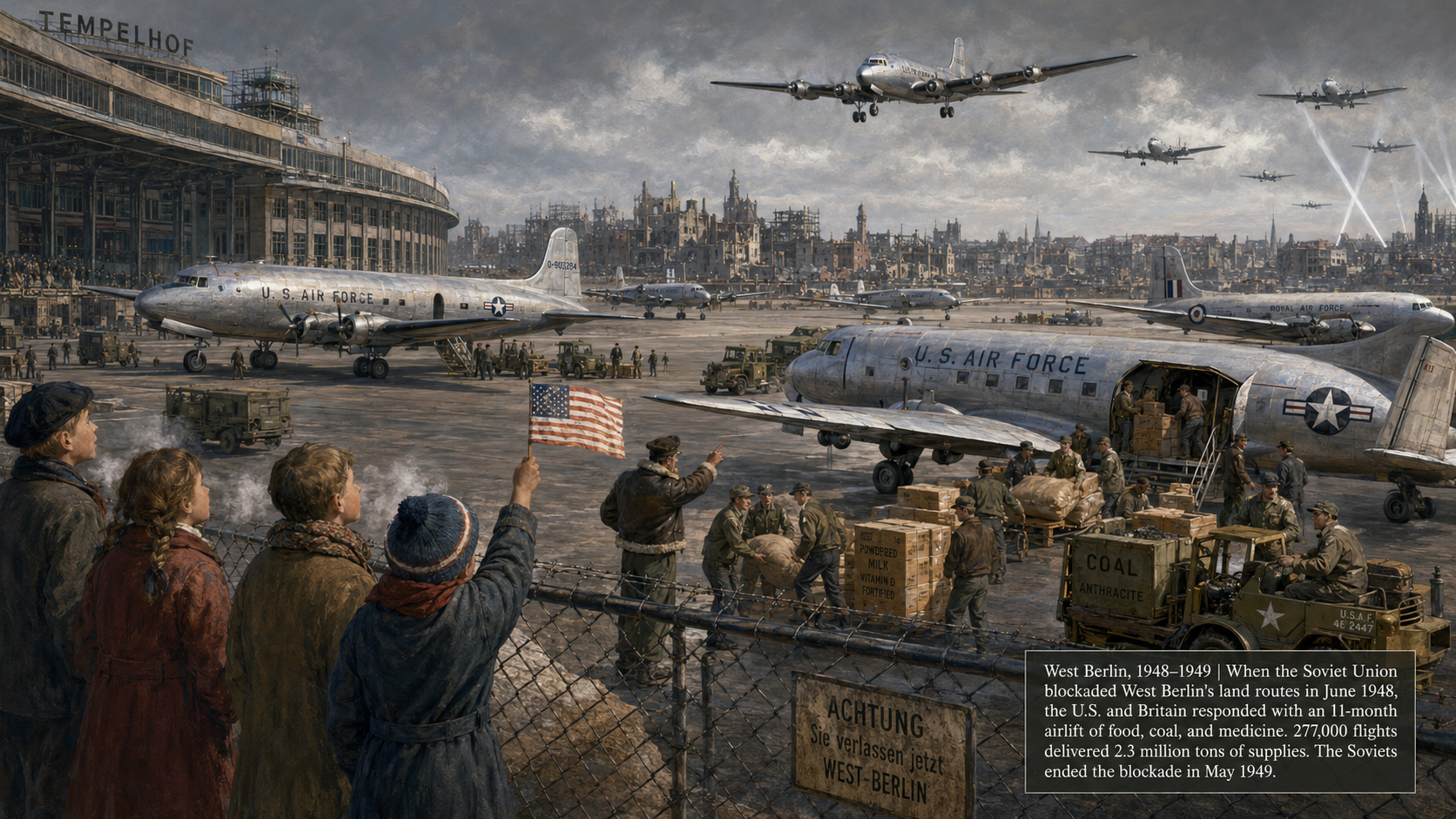
The Western response — the Berlin Airlift — supplied the entire city (2.5 million people) by air for 324 days: 200,000 flights delivering 2.3 million tons of supplies, including coal for heating. The Soviets lifted the blockade in May 1949, having failed to force a Western retreat. The episode established two principles: the Western powers would not abandon West Berlin, and they would respond to Soviet pressure without direct military confrontation.
NATO Formation (April 1949) was the institutional response to the Soviet threat. The North Atlantic Treaty committed the United States, Canada, and Western European nations to collective defense: "an armed attack against one... shall be considered an attack against them all." NATO represented the most significant peacetime military alliance in American history — a permanent departure from the "no entangling alliances" tradition that Washington had articulated in his Farewell Address.
Part 2: Korea and McCarthyism
The Korean War
Korea had been divided at the 38th parallel after WWII — Soviet troops in the north, American in the south. On June 25, 1950, North Korean forces crossed the 38th parallel in a massive invasion of South Korea. Truman immediately committed American forces under a United Nations umbrella.
The Korean War (1950–1953) went through several phases. American and South Korean forces were pushed back to a small perimeter around Pusan; General Douglas MacArthur's daring amphibious landing at Inchon (September 1950) reversed the situation, and UN forces pushed north toward the Chinese border; China entered the war in November 1950, pushing UN forces back south; the war stabilized roughly at the 38th parallel, where it began, and an armistice was signed in July 1953.
The Korean War's outcome — approximately where the pre-war boundary was — gave rise to the dismissive characterization "the Forgotten War." But the war's strategic significance was enormous: it demonstrated that the United States would use military force to resist Communist expansion; it militarized the Cold War (defense spending tripled); and MacArthur's insubordination (he publicly advocated expanding the war to China and was fired by Truman) established the principle of civilian control of the military.
McCarthyism and HUAC
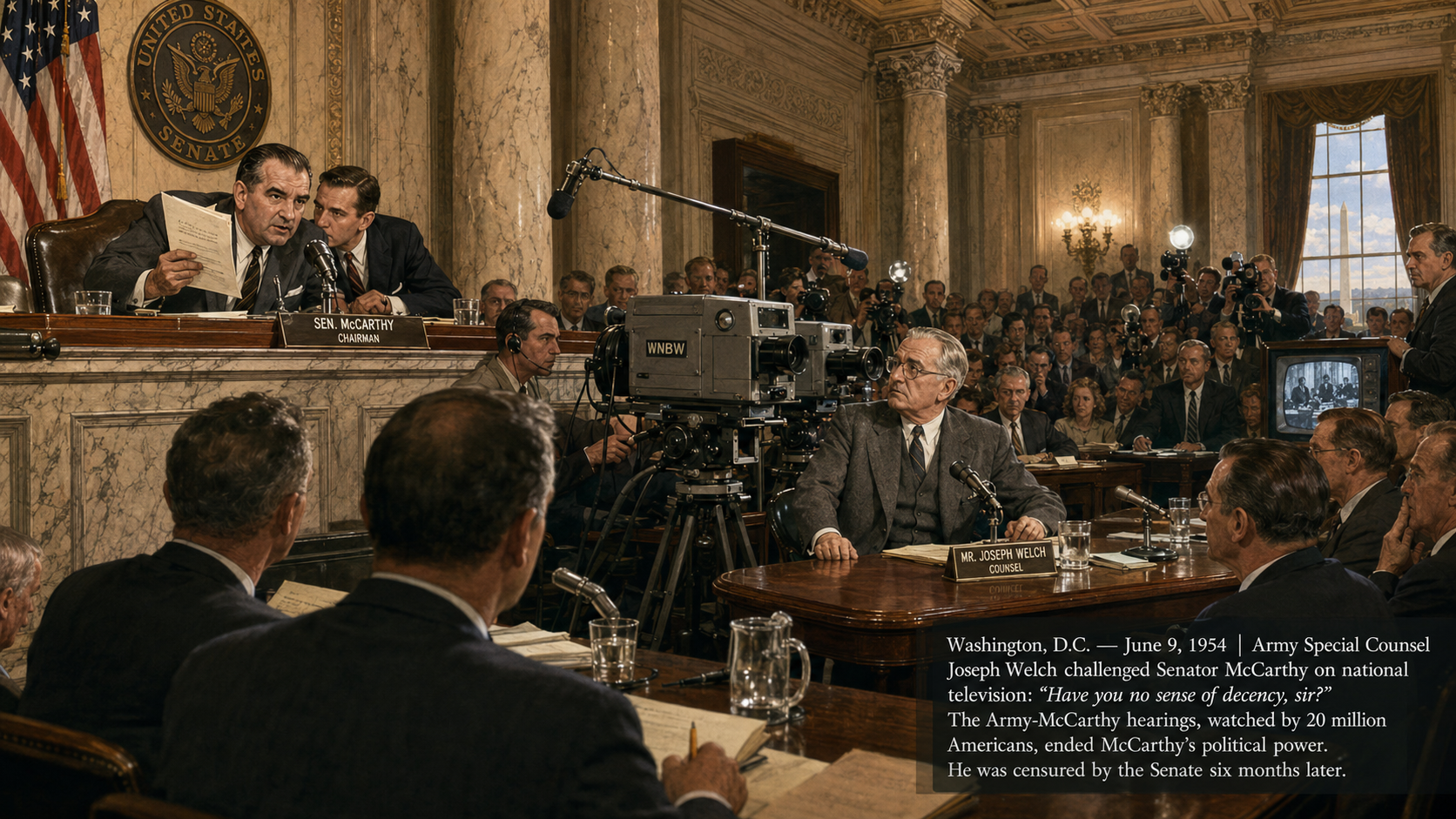
McCarthyism — the practice of making sweeping, often unsubstantiated accusations of Communist infiltration — was named for Senator Joseph McCarthy of Wisconsin, who claimed in February 1950 to have a list of Communists working in the State Department. Over the next four years, McCarthy conducted a campaign of accusation that ended careers, destroyed reputations, and created a political climate in which association with anything labeled "Communist" was politically lethal.
Before examining McCarthyism's techniques, one historical context is essential: there was real Soviet espionage in the United States. Julius and Ethel Rosenberg were convicted of passing nuclear secrets to the Soviet Union; Alger Hiss, a senior State Department official, was convicted of perjury related to Soviet espionage. McCarthy's supporters argued that the threat was real and his methods were necessary.
The House Un-American Activities Committee (HUAC) conducted investigations of Communist influence in Hollywood, government, and unions. The "Hollywood Ten" — directors and screenwriters who refused to testify — were imprisoned. Hundreds more were blacklisted (unable to work) after being named as Communist sympathizers. The blacklist operated without due process: accusation was sufficient, and those named had no effective means of clearing their names.
McCarthy's downfall came in 1954 during televised Army-McCarthy hearings, when Army counsel Joseph Welch confronted him: "Have you no sense of decency, sir, at long last? Have you left no sense of decency?" The hearings showed millions of Americans, for the first time, the character of McCarthy's methods — the bullying, the innuendo, the recklessness. The Senate voted to censure him in December 1954.
McCarthyism and confirmation bias
 McCarthyism illustrates confirmation bias — the tendency to seek out and weight evidence that confirms a prior belief while discounting or ignoring contradictory evidence. McCarthy interpreted every denial of Communist affiliation as evidence of guilt (a true Communist would deny it). Every refusal to name others was evidence of conspiracy. This is the logical structure of an unfalsifiable belief: no evidence could possibly disprove it, because all evidence is interpreted as confirmation. Apply lateral reading to HUAC testimony: who was testifying, what were they risking by testifying, who were they being asked to name, and what happened to those they named? The structure of the proceedings made truth-telling extraordinarily costly and accusation cost-free — a setup that systematically rewards false testimony.
Part 3: The Nuclear Arms Race and Eisenhower Era
Arms Race Dynamics
The arms race between the United States and the Soviet Union is one of the most important cases of arms race dynamics in history — and one of the best illustrations of why rational individual actors can produce collectively irrational outcomes.
Before analyzing the dynamics, two key concepts need definition. Mutual Assured Destruction (MAD) is the strategic condition in which both sides have enough nuclear weapons to destroy the other, even after absorbing a first strike — making nuclear war suicidal for both sides. Security dilemma is the structural condition in which one nation's defensive military buildup looks offensive to its rivals, leading them to build up in response, which leads to further buildup by the original nation — a reinforcing loop that produces an arms race even when neither side wants one.
The arms race dynamic worked as follows:
- United States develops nuclear bomb (1945) → Soviet Union feels threatened
- Soviet Union develops nuclear bomb (1949) → United States feels threatened
- United States develops hydrogen bomb (1952) → Soviet Union feels threatened
- Soviet Union tests hydrogen bomb (1953) → United States feels threatened
- Both sides develop long-range missiles (ICBMs) → both feel threatened
- Both sides develop submarine-launched missiles (SLBMs) → nuclear deterrence becomes robust
- Each new weapon capability triggers matching development by the other side
The reinforcing loop: new weapon → rival develops matching weapon → original country develops next-generation weapon → rival matches... At peak (early 1980s), the United States and Soviet Union together held approximately 60,000 nuclear warheads — enough to destroy human civilization many times over. This is a reinforcing loop that produced vastly more destructive capacity than either side actually needed for deterrence.
Eisenhower and the Military-Industrial Complex
Dwight Eisenhower (president 1953–1961) was uniquely positioned to understand the arms race's dynamics — as Supreme Allied Commander in WWII, he had managed the military-industrial relationship from the inside. His farewell address (January 1961) contained a warning that has become one of the most quoted in American political history:
"In the councils of government, we must guard against the acquisition of unwarranted influence, whether sought or unsought, by the military-industrial complex. The potential for the disastrous rise of misplaced power exists and will persist."
Eisenhower's warning was about the structural relationship between defense contractors (who profited from military spending), the military services (which wanted more weapons), and Congress (whose members wanted defense contracts in their districts). This "iron triangle" had its own institutional interest in maintaining and increasing defense spending — independent of any strategic necessity. The Cold War arms race made this interest nearly irresistible.
Space Race
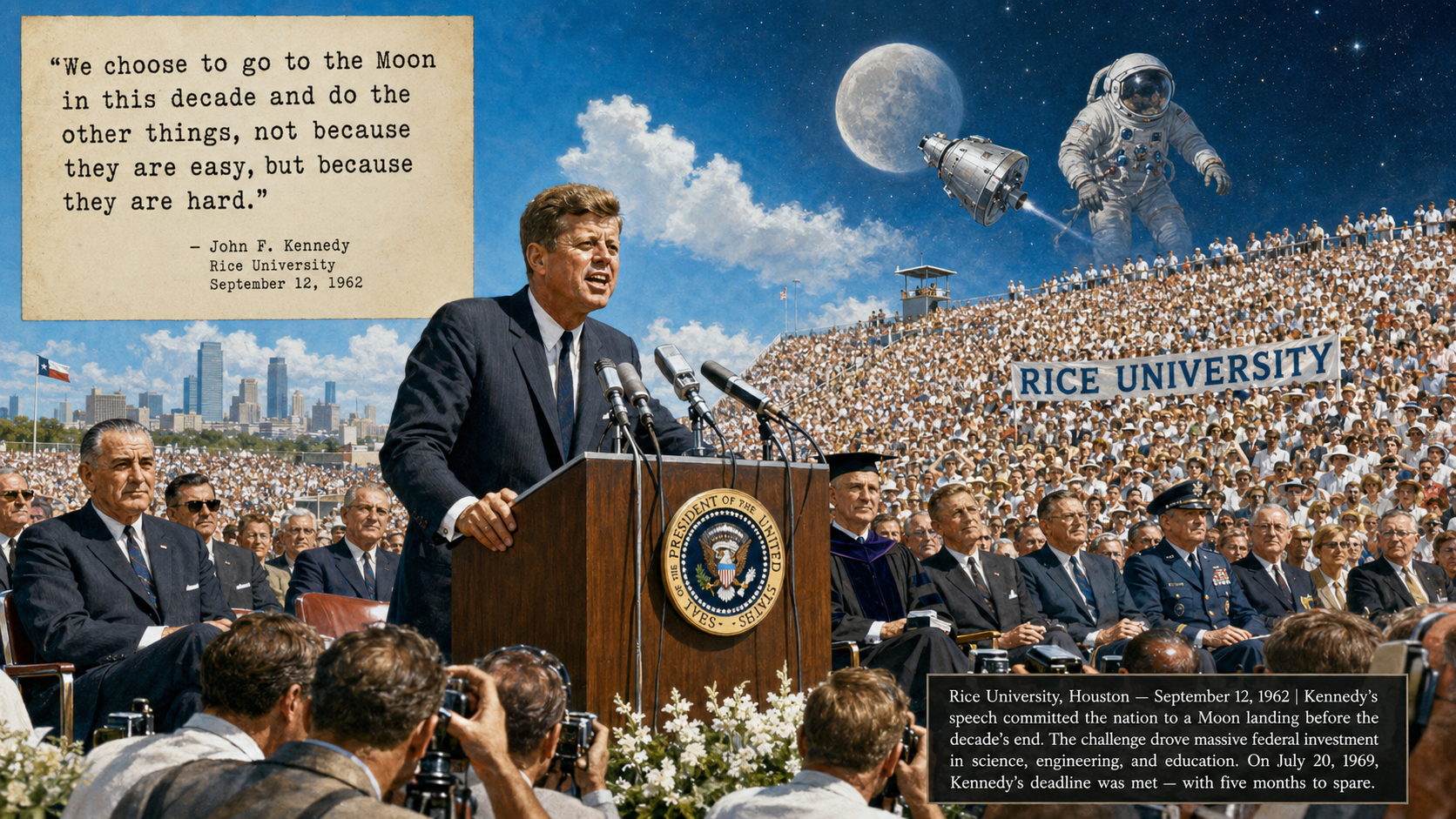
The Space Race began in October 1957 when the Soviet Union launched Sputnik — the first artificial satellite to orbit Earth. Sputnik produced a national crisis in the United States: if the Soviets could put a satellite in orbit, they could put a nuclear warhead on an intercontinental ballistic missile. Congress responded with the National Defense Education Act (1958), funding math and science education, and NASA was created to coordinate space exploration.
The United States' response to Sputnik illustrates how foreign policy competition shapes domestic policy. The interstate highway system (1956) was justified partly by military logistics; the education funding surge of the late 1950s was justified partly by Cold War competition. The Cold War shaped the domestic landscape in ways that outlasted the competition that produced them.
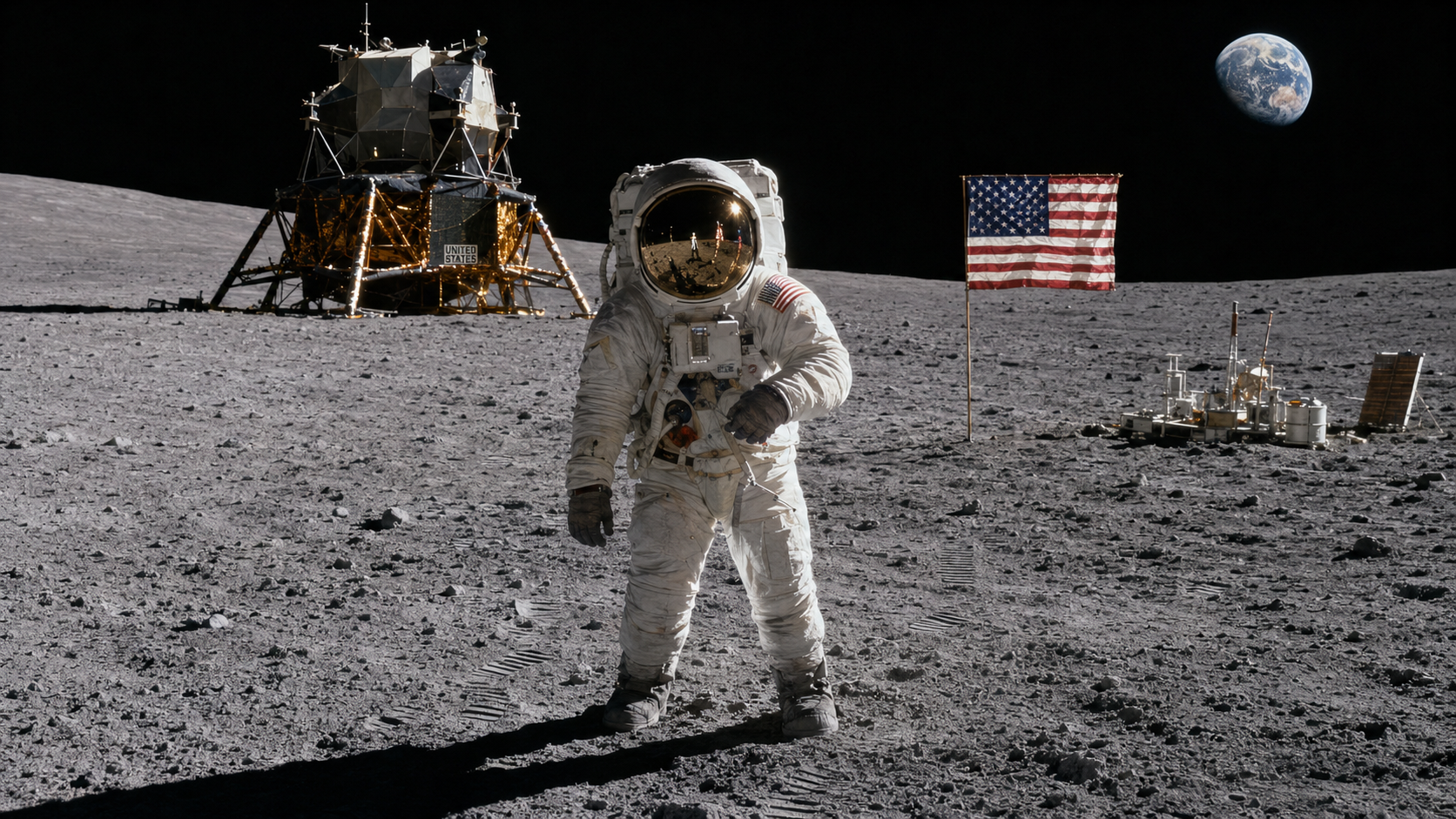
Diagram: Arms Race Dynamics — The Security Dilemma Loop
Arms Race Dynamics — Security Dilemma Causal Loop Diagram
Type: causal-loop
sim-id: arms-race-dynamics
Library: p5.js
Status: Specified
Purpose: Allow students to visualize the security dilemma feedback loop that drives arms races, and to trace how the U.S.-Soviet nuclear arms race exemplified this dynamic from 1945 to 1991.
Bloom Level: Analyze (L4) Bloom Verb: Model
Learning Objective: Students model the security dilemma feedback loop that drives arms races, identify the reinforcing loops at work, and evaluate what conditions could break the loop (arms control agreements, mutual vulnerability, transparency).
Canvas layout: - Responsive width; height approximately 480px - Two-nation causal loop diagram (U.S. left, USSR right) - Each nation node shows: current nuclear arsenal size (slider-adjustable) - Arrows between nations: "Perceived Threat" (red, bidirectional), "Weapons Development" (gold, from each nation to its arsenal)
Core loops: - R1 (US-Soviet): US Arsenal ↑ → Soviet Perceived Threat ↑ → Soviet Arsenal ↑ → US Perceived Threat ↑ → US Arsenal ↑ (reinforcing) - B1 (MAD): When both arsenals reach "destruction threshold," a "MAD" indicator appears — loop becomes self-limiting (neither side can use weapons) - B2 (Arms Control): "Treaty" button introduces a balancing force — shows effect of SALT I (1972), SALT II (1979), START (1991)
Historical mode: - Slider from 1945 to 1991 shows actual warhead counts for each side - Key events annotated: first Soviet test (1949), H-bomb (1952/53), Sputnik (1957), Cuban Missile Crisis (1962), SALT I (1972), Reagan buildup (1981–88), START (1991)
Interactivity: - "What-if" sliders: adjust US arsenal by ±20% and see projected Soviet response - Toggle between "Rational Actor" and "Security Dilemma" models
Color scheme: Blue for U.S., red for USSR; gold for nuclear arsenals; green for arms control.
Part 4: Postwar American Society
Baby Boom and Suburban America
The end of WWII triggered a massive demographic shift. The Baby Boom — the surge in births between 1946 and 1964 — produced 76 million children, creating the largest generational cohort in American history. Baby Boomers would shape every institution they moved through: schools in the 1950s, universities in the 1960s, the workforce in the 1970s–1980s, and retirement in the 2010s–2020s.
The postwar prosperity enabled — and the Baby Boom encouraged — massive suburbanization. Levittown (Long Island, 1947) demonstrated that mass-produced suburban housing could be built cheaply enough for working-class families. VA loans (for veterans) and FHA mortgages subsidized homeownership; the Interstate Highway System (funded by the Federal-Aid Highway Act of 1956) connected suburbs to cities. By 1960, more Americans lived in suburbs than in cities or rural areas.
Suburban growth was not racially neutral. FHA loan underwriting guidelines explicitly "redlined" Black neighborhoods (rating them as poor mortgage risks), steering Black families away from suburban mortgages. VA loans were administered through local authorities who often discriminated against Black veterans. The white middle class moved to suburbs; Black Americans were largely confined to urban neighborhoods by a combination of formal redlining, restrictive covenants, and real estate discrimination — a geographic pattern with lasting consequences for school quality, wealth accumulation, and opportunity.
The 'good old days' and selective memory
 The 1950s are frequently invoked in American political discourse as a golden era of prosperity, family stability, and social cohesion — a time "when America was great." Apply historical thinking: great for whom? The postwar prosperity was real, but it was built on government subsidies (GI Bill, FHA loans, highway construction) that disproportionately benefited white Americans; it coexisted with Jim Crow segregation, McCarthyite suppression of dissent, and legal discrimination against women in employment and credit. The "golden age" narrative is a form of selective memory — choosing which past to idealize based on present political needs. Identifying which people's experience is centered in any historical narrative is a basic critical thinking skill.
Summary
The Cold War's first fifteen years established the institutional and ideological framework that would shape American foreign policy for the next three decades. Containment, NATO, and the Korean War militarized the competition; McCarthyism demonstrated that external threats could be used to suppress domestic dissent; the arms race created a permanent military-industrial complex that Eisenhower warned against in his farewell address.
The "America in the World" thematic lens illuminates how thoroughly the Cold War shaped domestic life: the interstate highway system, the education funding surge, suburban development, and McCarthyism's suppression of civil liberties were all, in part, consequences of America's international position. Understanding American domestic history in this period requires understanding it in its global Cold War context.
The arms race dynamics case study demonstrates a fundamental insight of systems thinking: individual actors responding rationally to their perceived environment can produce collective outcomes that no one wanted — a catastrophic arms buildup that made both sides less, not more, secure. Breaking such loops requires recognizing the dynamic and introducing a balancing force (arms control agreements) from outside the individual-actor logic.
Knowledge Check 1 — Click to reveal
Question: Apply the "America in the World" thematic lens to McCarthyism. How did America's international position shape the domestic political dynamics that made McCarthyism possible?
Answer: The Cold War created the conditions that made McCarthyism politically viable. America's international position — locked in ideological competition with the Soviet Union, with real Soviet espionage confirmed (Rosenbergs, Hiss), with China "lost" to Communism in 1949 and the Korean War stalemating — created genuine public anxiety about Communist subversion. This anxiety made accusations of Communist sympathies politically potent: any politician who defended accused individuals risked appearing "soft" on Communism in a period when that could be career-ending. The "America in the World" lens reveals that McCarthyism was not simply a domestic phenomenon — it was powered by international developments (Soviet bomb, Korea, China) that created a political environment in which civil liberties could be suspended with broad public support. Without the Cold War context, McCarthyism would have been a fringe phenomenon rather than a dominant political force.
Knowledge Check 2 — Click to reveal
Question: Apply systems thinking to explain why both the United States and Soviet Union built far more nuclear weapons than were needed for deterrence. What feedback loop explains this, and what would break it?
Answer: The security dilemma feedback loop explains the overkill: each side's weapons increase → the other side perceives increased threat → the other side builds more weapons → the first side perceives increased threat → it builds more weapons. The loop is reinforcing and self-perpetuating, with no natural stopping point. Individual rational actors (military planners) responded rationally to perceived threats, but the collective result (60,000 warheads at peak) was irrational — far exceeding any conceivable deterrence requirement. Breaking the loop requires a balancing force external to the individual-actor logic: arms control agreements (SALT I, SALT II, START) that imposed mutual constraints, transparency mechanisms (satellite verification) that reduced threat perception, and diplomatic communication (hotline, summits) that allowed signaling intentions. The loop was eventually slowed by arms control and ended by the Soviet Union's collapse — which removed the threat entirely by removing one of the loop's two nodes.
Chapter 16 Complete!
 You've navigated the Cold War's foundations — from the wartime alliance's collapse through containment, Korea, McCarthyism, and the arms race's chilling logic. The "America in the World" lens and arms race dynamics are tools you'll use in every subsequent chapter. In Chapter 17, the Cold War's contradictions come home: How can America claim to lead the "free world" while denying civil rights to millions of its own citizens? The answer to that question will shape the most consequential domestic political movement of the 20th century.