A Folder of Files, a Graph of Knowledge
Open the interactive poster full screen
Use Explore mode to hover over or click a panel and read what it shows. The left half is the folder of files. The right half is the same material as a graph. Use Quiz mode to read a clue and click the panel it describes.
The seven regions are:
- The Folder — Papers, notes, results, and drafts with no recorded relationships.
- Keyword Search Only — A search that finds the words you typed and misses the rest.
- Links That Mean Nothing — Untyped links that let you navigate but not compute.
- Typed Nodes and Edges — Entities with types, joined by named, directed relationships.
- A Three-Hop Question — A path of three links that answers what no single note states.
- A Grounded Answer — Facts from followed links placed in the prompt, so the answer can be checked.
- The Privacy Ring — The part of the graph an agent may not read.
Static Poster
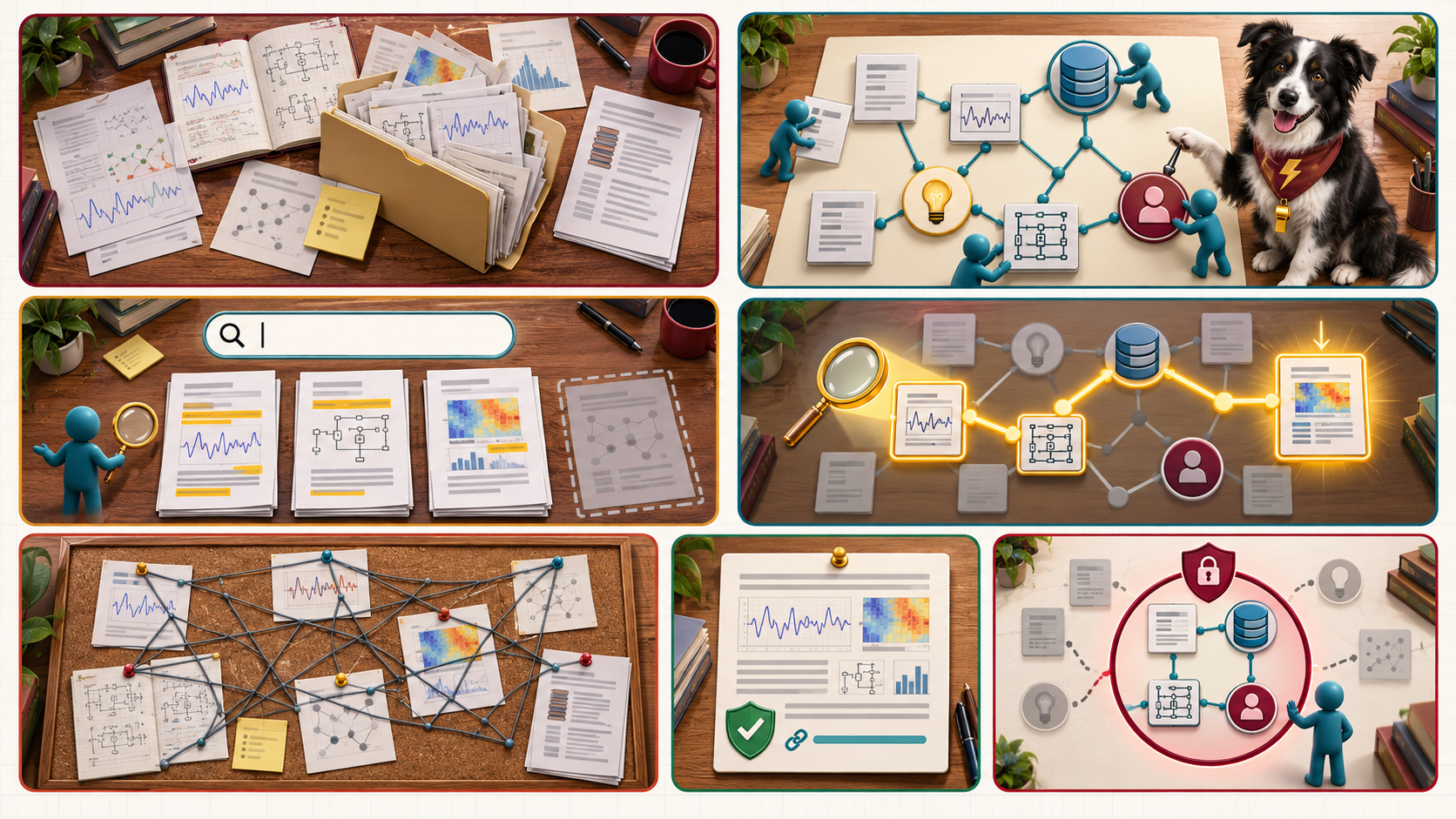
The full-size poster above is a static copy of the interactive version, handy for printing, sharing, or viewing without JavaScript.
Why This Matters
A model forgets everything between sessions, so the only memory a research project has is what you write down. A folder of linked files is a good memory for reading. It is a poor one for asking, because a question such as which papers depend on a corrupted dataset needs several links followed in order. Typed links turn the notes into a graph a program can traverse. The same graph can ground an agent's answer in facts you can check.
The same property has a cost. Whoever can query the graph can see it. Chapter 19 treats this as personal knowledge privacy: partition the graph by data class, give each agent a view of only what its job needs, and review what an agent writes back. The poster does not claim that a graph is always better than a folder. It claims that a graph is better for questions that follow relationships, and that the graph is only as good as its entities and links, which a human must review. The example graph is invented for illustration.
Connects to
- Chapter 6: Knowledge Bases, Personal Knowledge Graphs, and the Anatomy of an Agent Skill
- Chapter 19: Always-On Personal Agents for Research
Source
The linked chapters of this book, including the Personal Knowledge Graphs appendix that Chapter 6 cites for the idea that a little semantics goes a long way. The entities, relationships, and paper names in the poster come from the illustrative graph in Chapter 6.
Teachers and editors can open calibration mode to adjust zone positions after the artwork is generated. Copy only the x1, y1, x2, and y2 numbers back into data.json, because the calibration export omits showLabels and palette.