Twenty Planners, Ten Doers, One Researcher
Open the interactive poster full screen
Use Explore mode to hover over a numbered marker or its label and read what that part of the team does. Use Quiz mode to read a clue and click the marker that matches. The marker numbers are hidden in Quiz mode, so you must find the matching part of the stage. Planners are on the top tier, the task belt is in the middle, and the doers are at the bottom.
The twelve callouts are:
- Task Queue — The ordered list of waiting tasks, kept as a plain file everyone reads.
- Handoff Card — The goal, inputs, constraints, criteria, and status that pass from one agent to the next.
- Planning Agent Bank — About twenty agents that explore, decompose, and specify.
- Review Checkpoint — A point where output is examined before the next step uses it, often automated.
- Human Approval Gate — A checkpoint where a person must say yes.
- Attention Meter — The review budget that sets how big a team can usefully be.
- Execution Agent Bank — About ten agents that carry out specified tasks.
- Shared Workspace — The common area for files, with separate outputs and reviewed merges.
- Critical Path — The longest chain of dependent tasks, which extra agents cannot shorten.
- Status Board — The morning report: finished, blocked, needs a decision, and spent.
- The Orchestrator — The researcher, who coordinates the work and stays accountable.
- Conflict Flag — Two agents with incompatible results, traced to the first point of divergence.
Static Poster
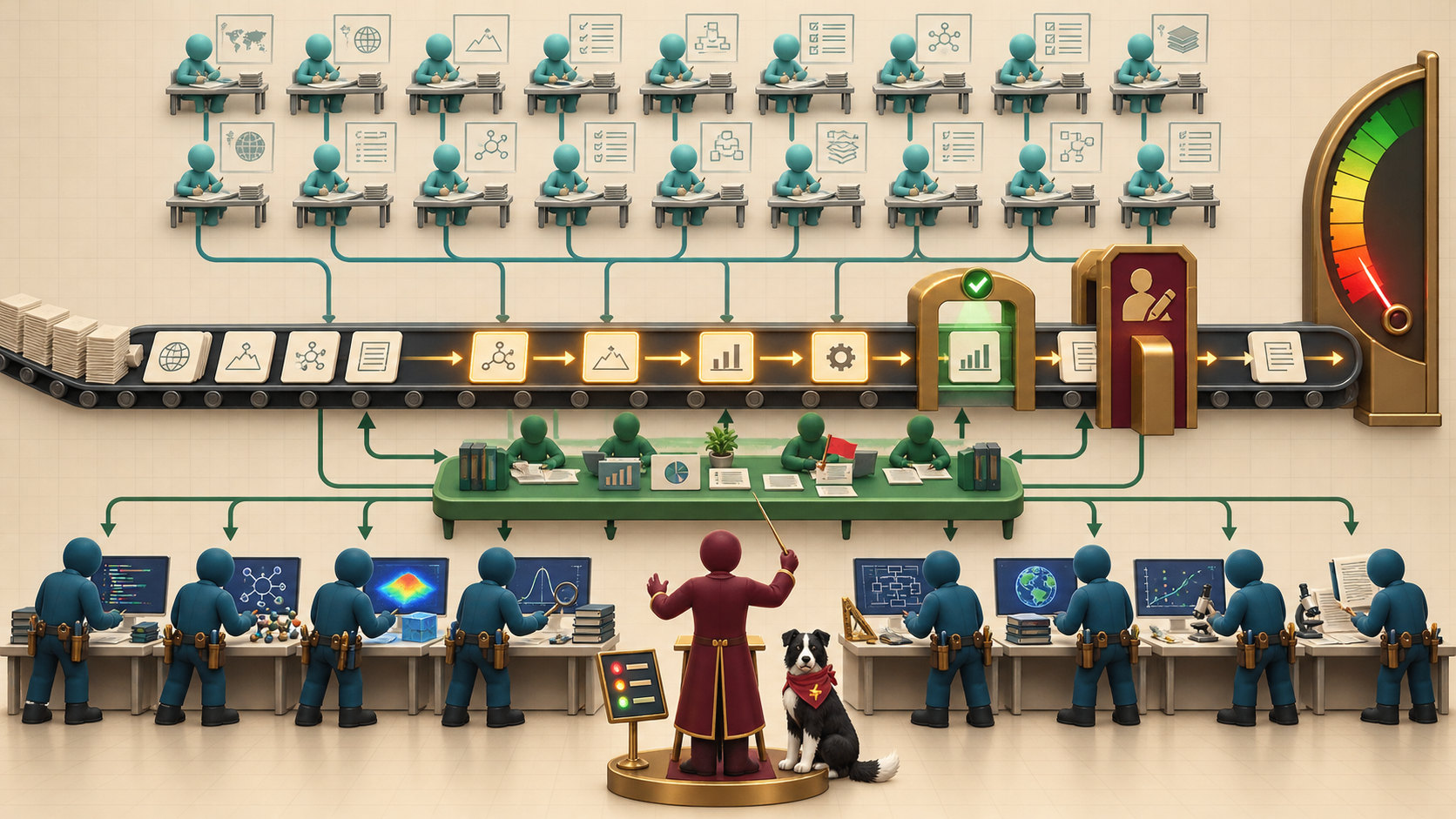
The full-size poster above is a static copy of the interactive version, handy for printing, sharing, or viewing without JavaScript.
Why This Matters
Chapter 10 describes an agent team as planning agents plus execution agents with explicit handoffs. Planning output is cheap and reversible, so many plans can run in parallel. Execution output changes files and costs more attention to check, so that side stays smaller. The chapter's arithmetic makes the point: 20 planners, 10 executors, and 30 minutes of conflict resolution need 300 minutes of review, which is more than a 4-hour budget unless you sample, automate checks, or shrink the team.
The numbers on the poster are the chapter's illustrative figures. The 20-to-10 ratio is a design target, not a law, and the right team size depends on how checkable your tasks are and how much attention you have. The poster does not claim that more agents get more done. Dependencies, review cost, and coordination all cap the benefit.
Connects to
- Chapter 10: Orchestrating Teams of Planning and Execution Agents
- Chapter 9: Supervising Agents and Defining Agent Roles
- Chapter 1: Research Workflows and the Researcher as Orchestrator
Source
Chapter 10, sections "The Team and the Orchestrator", "Breaking Work Down", "Handoffs, Shared Workspaces, and Conflicts", "Review, Approval, and Researcher Attention", and "Specifying, Prioritizing, and Reporting". Chapter 9 for planning and execution roles and handoff contents. Chapter 1 for the 20-and-10 model. All durations and minute counts are the chapters' illustrative figures.
Teachers and editors can open calibration mode to drag the markers and copy updated coordinates after the artwork is generated.