Using a Motor Controller Board
Welcome to the Controller Board Lab
 Individual transistors and H-bridge chips work great for learning. But when you want to build a real robot quickly, a motor controller board bundles everything into one neat package. Let's build something amazing!
What Is a Motor Controller Board?
A motor controller board is a small printed circuit that already has all the wiring built in. It connects your microcontroller to one or more motors with just a few wires. You do not need loose transistors, diodes, or a messy breadboard circuit.
Most motor controller boards contain:
- An H-bridge chip (so each motor can go forward or backward)
- Screw terminals for the motor wires (so the connections stay tight)
- A power input for the motor battery
- Logic pins that connect to your Pico's GPIO pins
Key Idea
 The motor battery and the Pico's USB power are separate. Motors need their own power supply — usually 4 AA batteries — so they do not steal current from your Pico.
The Maker Pi RP2040 Controller Board
One popular choice for MicroPython robots is the Maker Pi RP2040 from Cytron. It has a Raspberry Pi RP2040 chip built right into the board, along with:
- Two DC motor ports (M1 and M2) with screw terminals
- Four servo ports labelled SERVO1–SERVO4
- Two Grove connectors for plug-and-play sensors
- A piezo buzzer and two programmable RGB LEDs
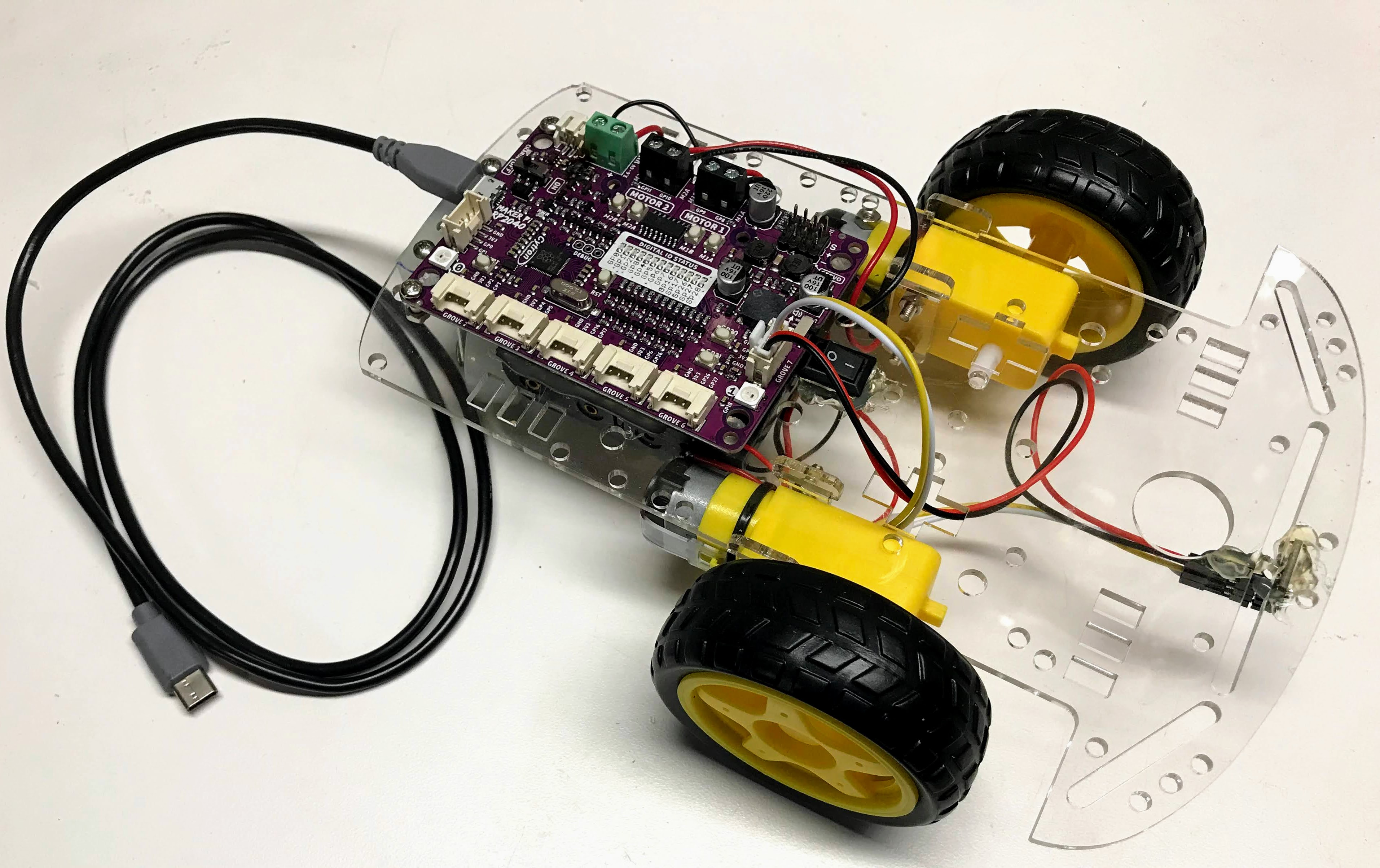
Because the RP2040 chip is already on the board, you do not need a separate Pico. You just plug in batteries, connect motors, and start coding.
Wiring a Two-Motor Robot
Follow these steps to connect two hobby DC motors to the M1 and M2 ports:
- Loosen the two screws on the M1 terminal.
- Insert the two wires from your left motor into M1 — one wire per hole.
- Tighten the screws firmly so the wires cannot pull out.
- Repeat steps 1–3 for the right motor on the M2 terminal.
- Connect your 4 × AA battery pack positive (red) wire to the VIN screw terminal.
- Connect the battery pack negative (black) wire to the GND screw terminal.
- Plug the USB cable into the board to power the RP2040 logic.
Watch Out!
 Make sure the battery pack positive (red) wire goes to VIN and the negative (black) wire goes to GND. Reversing them can damage the board.
Controlling the Motors in MicroPython
The Maker Pi RP2040 motor driver uses four GPIO pins — two per motor — to set direction and speed.
| Pin | Motor | Function |
|---|---|---|
| GP8 | M1 | Direction |
| GP9 | M1 | Speed (PWM) |
| GP10 | M2 | Direction |
| GP11 | M2 | Speed (PWM) |
Here is a simple program that drives both motors forward for two seconds, then stops:
1 2 3 4 5 6 7 8 9 10 11 12 13 14 15 16 17 18 19 20 21 22 23 24 25 26 27 28 29 | |
What Each Line Does
| Line | Purpose |
|---|---|
PWM(Pin(9)) |
Creates a PWM signal on the speed pin |
m1_speed.freq(1000) |
Sets the PWM frequency to 1000 Hz |
m1_direction.value(1) |
Sets the direction pin HIGH — motor goes forward |
m1_speed.duty_u16(49152) |
Sets speed to about 75% (49152 out of 65535 max) |
m1_speed.duty_u16(0) |
Sets speed to 0% — motor stops |
Monty's Tip
 Try changing
 49152 to smaller numbers like 32768 (50%) or 16384 (25%) to see how speed changes. PWM speed values range from 0 (stopped) to 65535 (full speed).
Reversing a Motor
To reverse a motor, change the direction pin from 1 to 0:
1 2 3 4 5 6 | |
What Each Line Does
| Line | Purpose |
|---|---|
m1_direction.value(0) |
Sets direction pin LOW — motor runs in reverse |
m1_speed.duty_u16(motor_power) |
Sets motor speed to the given value |
References
Great Work!
 You can now control two motors with a real controller board — forward, backward, and stopped. Next you will combine this with sensors so your robot can detect obstacles and steer itself!