Lab 08: Set the Clock from the Internet
The Pico forgets the time whenever it loses power. Real clocks that hang in stations don't have this problem, because a master clock keeps them all right. Your clock will do the next best thing: ask the internet.
Welcome to Lab 08
 This is the lab where your clock goes online. After this, it can set
its own time anywhere there's WiFi, the same way a phone does. Let's
make time tick!
What You Will Learn
- how the Pico joins a WiFi network
- what a time server is
- what time zones and daylight saving time are
- how to keep a password out of your code
Before You Run It
The Pico needs the name and password of your WiFi network. They go in a
special file called secrets.py:
- Find the file
secrets-template.pyin the kit folder. - Copy it, and name the copy
secrets.py. - Type in your network's name and password:
1 2 | |
- Save
secrets.pyto the Pico.
Keep Secrets Secret
 Never put a password right inside a program, because programs get
shared. Keeping it in its own file means you can share every program
without sharing your password. This repository's
.gitignore keeps
secrets.py from ever being uploaded to the internet.
Run It
Open 08-wifi-sync-time.py in Thonny and click Run. The screen tells
you what's happening, one step at a time:
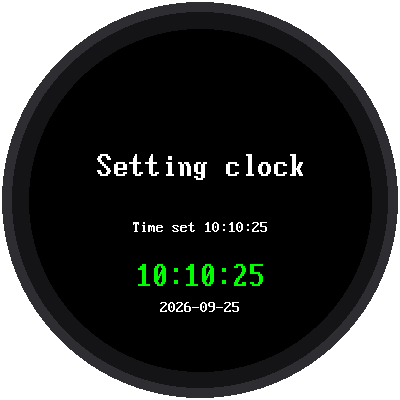
Joining your-network-nameIP 10.0.0.22, which means your Pico is on the networkAsking pool.ntp.org, which means it's asking a time serverTime set 10:10:25, and the time appears in big green numbers
How It Works
Special computers on the internet called time servers do nothing but tell other computers the exact time. They follow a set of rules called NTP, the Network Time Protocol. The Pico asks one, and in a fraction of a second it gets the answer.
All of that happens in one line of the program:
1 | |
sync_time() lives in the kit's file wifi_time.py. It joins your WiFi,
asks a time server, fixes the time zone, sets the Pico's clock, and then
turns the WiFi off again to save power.
Time zones
A time server answers in UTC, the time in London, England (in
winter). So the program adds the number of hours in TIMEZONE_HOURS from
config.py:
| Time zone | TIMEZONE_HOURS | When it's noon UTC, it's... |
|---|---|---|
| Eastern | -5 | 7 AM |
| Central | -6 | 6 AM |
| Mountain | -7 | 5 AM |
| Pacific | -8 | 4 AM |
Daylight saving time
In most of the United States, clocks "spring forward" one hour in March
and "fall back" one hour in November. The program works out whether today
is in daylight saving time and adds the extra hour when it is. If you
live in Arizona or Hawaii, where clocks don't change, set
USE_US_DST = False in config.py.
Try This
- Change
TIMEZONE_HOURSto -8 and run the program again. What time does it say now? - After this lab finishes, run Lab 07. The face shows the right time, because the Pico's clock keeps going until the power is unplugged.
If It Doesn't Work
No secrets.py on the Pico. You forgot step 4: savesecrets.pyto the Pico.WiFi failed. Check the spelling of the network name and password. Capital letters matter! Also, the Pico only connects to 2.4 GHz networks.- The time is off by exactly one hour. Check
TIMEZONE_HOURSandUSE_US_DSTinconfig.py.
Your Clock Is Online!
 You joined a WiFi network, asked a time server for the exact time, and
kept your password out of your code. Next, you'll set the red hand in
motion.
Next: Lab 09: Tick Tock