Lab 08: A Digital Watch Face
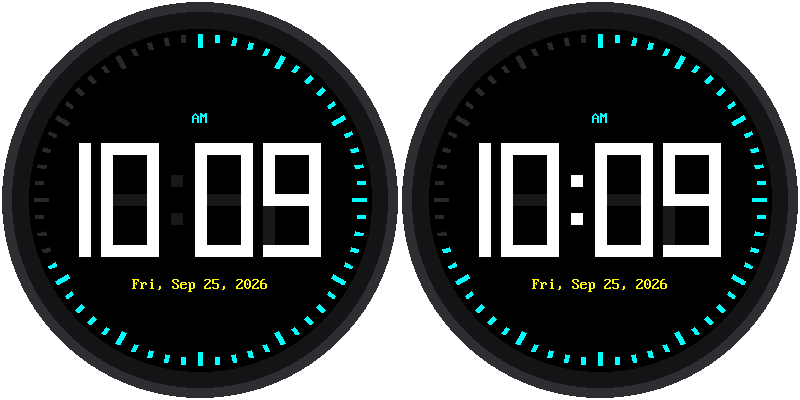
This watch face has giant numbers, 114 pixels tall, big enough to read from across the room. The date sits underneath, and a ring of 60 tick marks around the edge fills up as the seconds go by.
Welcome to Lab 08
 This is the watch face people notice from across the room. Build it,
and you'll know the secret behind the numbers on scoreboards, gas
pumps, and alarm clocks. Let's make time tick!
This is the watch face people notice from across the room. Build it,
and you'll know the secret behind the numbers on scoreboards, gas
pumps, and alarm clocks. Let's make time tick!
What You Will Learn
- how every digit from 0 to 9 is made of just seven bars
- how a number can store seven on/off switches
- how to change only the pixels that need to change
Run It
Open 08-digital-watch-face.py in Thonny and click Run. Like the
analog face, it sets its own time from the internet first.
Seven Bars Make Every Digit
Look closely at a microwave, an alarm clock, or a calculator. Their numbers are built from seven bars, called segments. The segments have letters, a through g:
1 2 3 4 5 6 7 | |
Light up different segments to make different digits:
| Digit | Lit segments |
|---|---|
| 1 | b, c |
| 7 | a, b, c |
| 4 | b, c, f, g |
| 8 | all seven |
Look at the dim gray shapes behind the white digits in the picture. Those are the unlit segments, painted in a faint "ghost" color, like the segments you can just barely see on a real LCD watch.
Filling in the corners
If you only draw the seven bars, each digit has black gaps at its corners and joints, and the numbers are hard to read. So this face also draws the six little squares where the bars meet. A square lights up whenever any bar touching it is lit, so each digit looks like one solid shape.
A Number Full of Switches
Computers store numbers as bits, 1s and 0s. A 7-bit number has seven places, one for each segment: 1 means lit and 0 means dark. Here's the digit 7, which lights segments a, b, and c:
1 | |
The 0b means "this number is written in binary." Reading from the
right, the first three bits are for a, b, and c, and they're 1.
Binary Takes Practice
 If
If 0b0000111 looks like a secret code, you're not alone, because
binary trips up almost everyone at first. You already know which
segments light up for each digit from the table above, and each bit is
just one of those segments. Try writing the bits for the digit 1 on
paper before you read on.
Change Only What Changes
When the time goes from 12:59 to 1:00, which segments need redrawing?
Compare the old digit and the new digit, bit by bit. Where they're
different, that segment changed. Python has an operator that does exactly
this comparison, called XOR and written ^:
1 | |
The program repaints only the segments in changed. A segment that's lit
in both digits isn't touched at all, so there's no flicker. In a normal
second, this watch sends only 333 pixels to the display, out of 129,600.
Try This
- Near the top, change
BLINK_COLON = TruetoFalse. What's different? - Change
TWELVE_HOUR = TruetoFalsefor a 24-hour clock, like the ones used in hospitals and the military. - Change
GHOSTtoconfig.BLACK. The unlit segments disappear. Which way do you like better? - What digit is
0b1100110? (Hint: bits are read from the right: a, b, c, d, e, f, g.)
Giant Digits Done!
 You stored a whole digit in seven bits and used XOR to repaint only the
segments that changed. Next, your watch learns to read the weather
forecast.
You stored a whole digit in seven bits and used XOR to repaint only the
segments that changed. Next, your watch learns to read the weather
forecast.