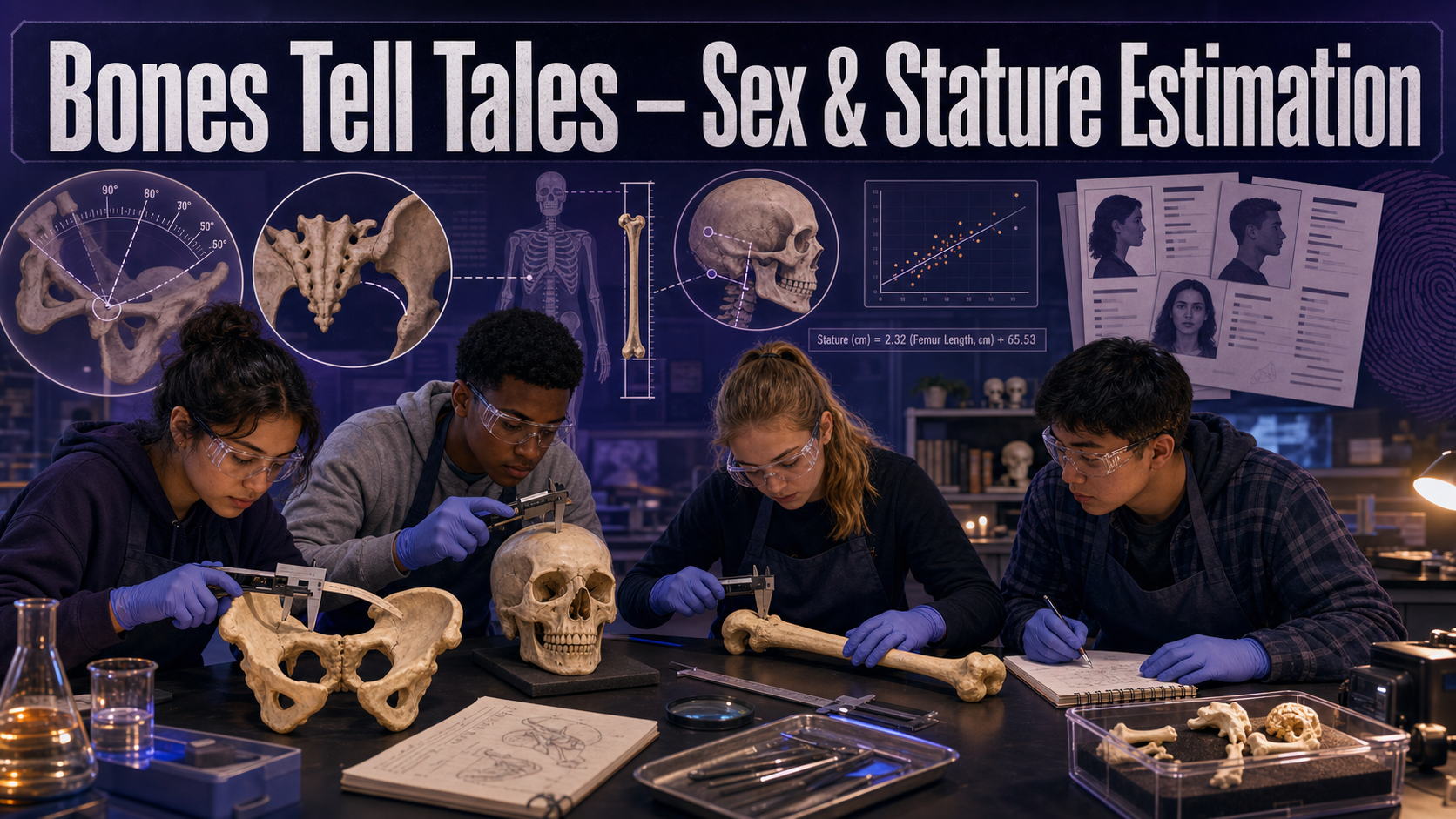
Bones Tell Tales — Sex & Stature Estimation
Welcome, Investigators!

No name, no ID, no face — just bones on the examination table. And yet those bones are about to tell you who this person probably was: their biological sex, roughly how tall they stood, enough to give a missing family an answer. Grab your calipers. Follow the evidence!
The Case
Skeletal remains are recovered from a wooded ravine. There is no wallet, no clothing, no dental records — only bone. Your lab's job is to build a biological profile: the set of physical estimates that narrows down who this person could be. Three families have filed missing-person reports that came in from the same county, and the medical examiner needs to know which one (if any) these remains are consistent with.
You'll work two questions. First, biological sex — read the pelvis and skull, whose shapes differ between the sexes. Second, stature — measure a long bone and run it through a regression equation that predicts height. Put the two together, compare against the three reports, and tell the examiner which lead is worth pursuing.
Learning Objectives
By the end of this investigation you will be able to:
- Measure pelvic and cranial features associated with biological sex.
- Estimate biological sex from skeletal morphology, acknowledging overlap.
- Apply a long-bone regression equation to estimate stature with an error range.
- Compare a completed biological profile against missing-person reports to include or exclude candidates.
Quick Facts
| Lab type | 🔀 Combination (bone measurement + interactive comparison) |
| Group size | 2–3 investigators |
| Time | 50–60 minutes |
| Cost | ≈ $25 per group (shared bone set amortizes) |
| Ties to | Ch 11 — Pelvic Morphology, Subpubic Angle, Biological Sex Estimation, Long Bone Measurements, Stature Regression Equations |
Materials
Per group (≈ $25; a shared class bone set spreads the cost):
- A pelvis and skull to examine: plastic-cast or 3D-printed models, or high-resolution printed photos with scale bars
- A long bone to measure: a femur cast/photo with a scale bar, or a cleaned chicken/turkey leg bone as a cheap stand-in for the regression math
- Calipers or a metric ruler (measure to the nearest mm)
- A protractor (for the subpubic angle)
- The Anthropometry Card with the stature regression equations
- The three Missing-Person Report cards
- Calculator; disposable gloves if handling real animal bone
Handle With Care — and Humility

If you use real animal bones, they must be cleaned and sanitized; wear gloves and wash your hands afterward. Handle every model and specimen gently — a cracked cast ruins the next group's measurement. And remember the scientific rule: you are producing an estimate, not an identity.
Background: Reading a Skeleton
When there's nothing but bone, forensic anthropologists build a biological profile — biological sex, age, ancestry, and stature. Two of those are within your reach today. The most reliable sex indicators live in the pelvis, because it is shaped by the demands of childbirth. A wider subpubic angle (greater than about 90°), a broad greater sciatic notch, and a rounder pelvic inlet lean female; narrower versions lean male. The skull adds supporting clues: a heavier brow ridge, a larger mastoid process behind the ear, and a squarer mental eminence (chin) tend to be more pronounced in males.
Stature works differently — it's arithmetic. A person's long bones scale with their height, so measuring a bone lets you predict stature with a regression equation built from thousands of known skeletons. For the femur, forensic scientists use equations such as:
- Male: stature (cm) = 2.32 × (femur length in cm) + 65.5, error ≈ ± 3.9 cm
- Female: stature (cm) = 2.47 × (femur length in cm) + 54.1, error ≈ ± 3.7 cm
Notice two things. The equation you pick depends on the sex you estimated — so your two tasks are linked. And every estimate carries an error range; real anthropologists report stature as an interval, never a single exact number. Before you measure, calibrate your eye on what the sex features actually look like.
Explore: Skeletal Sex Indicators
Skeletal Sex Indicators Interactive Diagram MicroSim
Type: microsim
sim-id: skeletal-sex-indicators
Library: p5.js
Status: Specified
Learning Objective: Compare male and female pelvis and skull features to identify the morphological traits used to estimate biological sex and judge each trait's reliability (Bloom Level 2 — Understand).
Click each labeled feature — subpubic angle, greater sciatic notch, pelvic inlet, brow ridge, mastoid process, mental eminence — to see how it differs between the sexes and how reliable it is. Then flip the labels off and use Quiz Me mode to test yourself before you touch a real specimen.
Procedure
Part 1 — Estimate biological sex.
- Examine the pelvis. Measure the subpubic angle with your protractor and inspect the greater sciatic notch (wide or narrow) and the pelvic inlet shape. Record each observation and which sex it suggests.
- Examine the skull. Rate the brow ridge, mastoid process, and mental eminence as more or less pronounced. Record what each suggests.
- Weigh the evidence. The pelvis outvotes the skull when they disagree. Write your sex estimate and a confidence word (likely / probable / uncertain).
Part 2 — Estimate stature.
- Measure the maximum length of your long bone in millimeters, then convert to centimeters. Measure it three times and average — precision matters here.
- From the Anthropometry Card, choose the regression equation that matches your estimated sex from Part 1.
- Plug your average bone length into the equation to get an estimated stature. Then add and subtract the error to report a stature range (e.g., "168 ± 4 cm").
Part 3 — Build the profile and match.
- Combine your results into a biological profile: estimated sex + stature range.
- Read the three Missing-Person Report cards. Mark each as consistent or not consistent with your profile, and identify the single best-supported lead — or state that none fits.
Data Collection
Sex indicators
| Feature | Observation | Suggests M or F? |
|---|---|---|
| Subpubic angle | ||
| Greater sciatic notch | ||
| Pelvic inlet shape | ||
| Brow ridge | ||
| Mastoid process | ||
| Mental eminence |
Stature
| Long bone | Avg length (cm) | Equation used (M/F) | Estimated stature (cm) | Range (± cm) |
|---|---|---|---|---|
Profile vs. reports
| Missing person | Reported sex | Reported height | Consistent? |
|---|---|---|---|
| Report A | |||
| Report B | |||
| Report C |
Analysis Questions
- Which pelvic feature gave you the most confidence about biological sex, and why is the pelvis considered more reliable than the skull for this estimate?
- Your skull and pelvis pointed to different sexes (or could have). Explain how you would resolve that conflict and why anthropologists weight the pelvis more heavily.
- Why do stature results have to be reported as a range instead of a single number? What real-world factors add to the uncertainty?
- You chose the male or female regression equation based on your sex estimate. How would using the wrong equation change your stature result, and what does that reveal about how the two tasks depend on each other?
- Two of the three missing-person reports are consistent with your profile. What additional skeletal evidence (age, ancestry, DNA, dental records) would you request to tell them apart, and why isn't sex-plus-stature enough for a positive identification?
Deliverable
Turn in a completed Biological Profile Report stating your estimated biological sex (with confidence), your stature estimate as a range, the measurements and equation behind each, and a ranked comparison to the three missing-person reports naming your best-supported lead and the reports you can exclude.
What Does the Data Tell Us?

A biological profile narrows the search — it doesn't name the person. Skeletal sex features overlap between individuals, and a stature range is still a range. The bones tell you who this could be; a positive ID waits on DNA or dental records. Say "consistent with," and let the next test finish the story.
Extension Challenge: When the Femur Is Broken
Your best long bone arrives in two pieces and you can't measure its full length. Research how anthropologists estimate stature from a fragmentary bone (for example, using a measurable segment or a different bone like the tibia or humerus). Find a second regression equation, apply it, and compare the stature range it gives to your original.
Teacher Notes
Setup, timing, and grading (click to expand)
- Prep: One shared class set of cast/3D-printed pelvis + skull + femur keeps per-group cost low; scaled photos with scale bars are a near-free fallback. Print the Anthropometry Card (both regression equations) and three Missing-Person Report cards per group.
- Design the answer key: Set the specimen's true sex and stature so that two reports are consistent and one is clearly excluded — this forces students to reason about overlap rather than snap to a single "match."
- Chicken-bone option: A cleaned chicken/turkey femur plus a provided proxy equation lets every group practice caliper technique and the regression math cheaply, even without human casts.
- Accuracy matters: Insist on "biological sex" (not gender), on "estimate," and on a stature range. Dock reports that state an exact height or claim a positive identification from bone shape alone.
- Differentiation: Shorten by supplying the sex estimate and having students do only the stature math. Extend with the fragmentary-bone challenge or a second long bone for cross-checking.
- Assessment focus: Reward careful measurement (averaged, to the mm), the correct sex-matched equation, an honest error range, and "consistent-with" language in the final comparison.
Case Closed — For Now

From a nameless set of bones you built a profile precise enough to point the medical examiner at the right family — and humble enough to leave the final ID to DNA. That balance of skill and scientific honesty is the heart of forensic anthropology. Remarkable work, investigators. Follow the evidence!