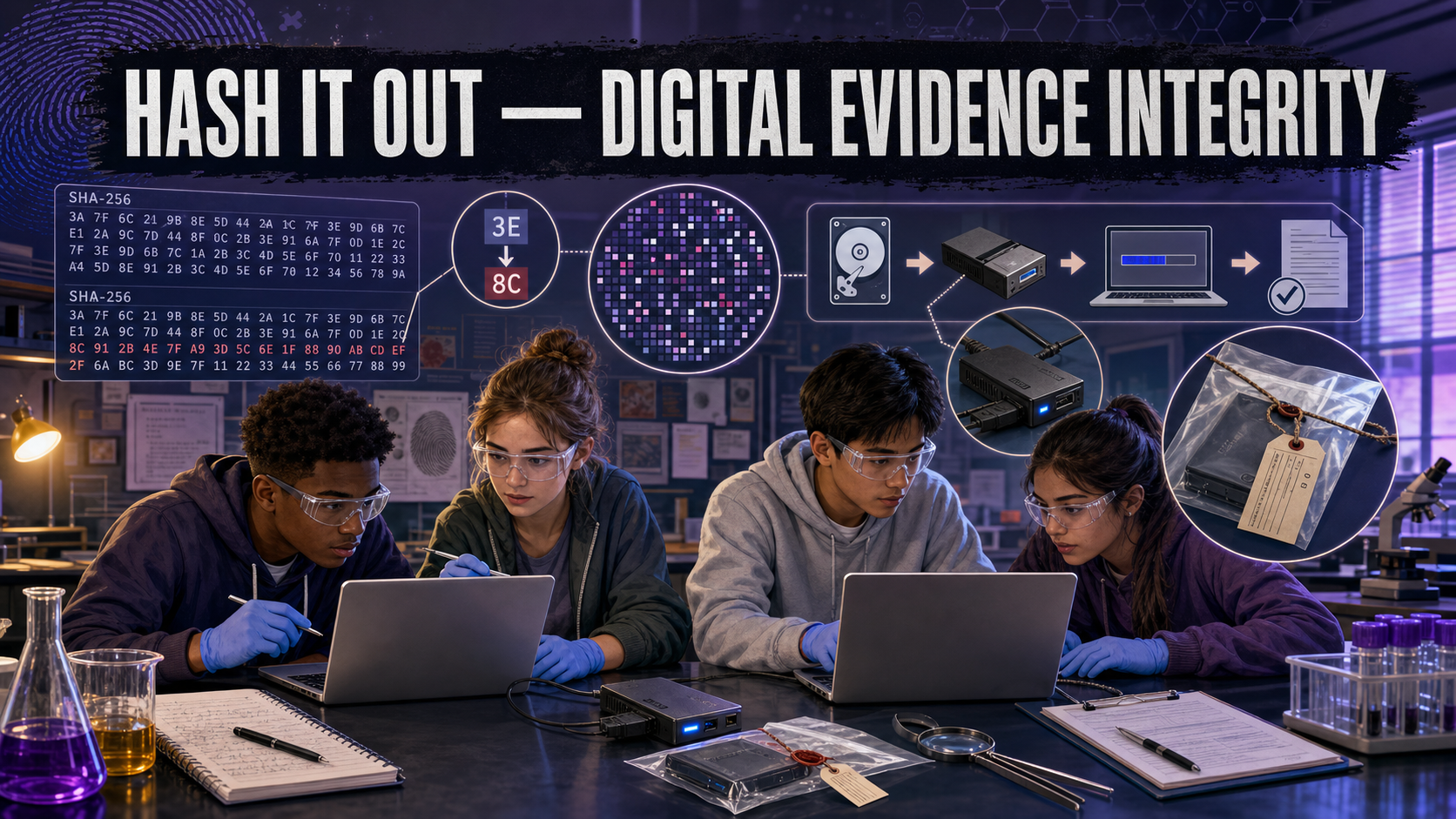
Hash It Out — Digital Evidence Integrity
Welcome, Investigators!

A hard drive can hold a case's entire story — but how do you prove that not one single bit changed between the crime scene and the courtroom? Today you'll learn the trick digital investigators trust: a cryptographic hash, a tiny fingerprint that betrays even the smallest tampering. Follow the evidence!
The Case
A laptop was seized from a suspect and handed to the digital-forensics unit. Before anyone opened a single file, an analyst made a bit-stream copy — an exact, bit-for-bit duplicate of the drive — so the original could stay untouched in the evidence locker. Weeks later, the defense claims the copy was altered after seizure.
You have three files that all claim to be the original evidence file, plus the hash value the analyst recorded the day it was seized. Only one of the three is the genuine, unaltered original. Your job: use hashing to prove — mathematically — which file is authentic and which two have been changed, even if the change is a single character.
Learning Objectives
By the end of this investigation you will be able to:
- Explain why investigators hash a drive before and after imaging.
- Compute the MD5 and SHA-256 hash of an evidence file.
- Analyze the avalanche effect by altering one character and re-hashing.
- Evaluate three files against a known hash to authenticate the original.
Quick Facts
| Lab type | 🔀 Combination (hands-on tool + reasoning) |
| Group size | 2 investigators |
| Time | 40–50 minutes |
| Cost | $0 — computer-based |
| Ties to | Ch 15 — MD5 & SHA-256 Hash Functions, Hash Verification, Forensic Imaging, Bit-Stream Copy, Write-Blocker Hardware |
Materials
Per group:
- None — a laptop and a browser.
- The instructor's provided sample evidence files and the recorded "day-of-seizure" hash card.
- Assumes access to one computer per group.
Data-Integrity Ground Rules

- Hash only the sample files the instructor provides. Never hash a real person's private files "to test it" — that is someone else's evidence.
- In a real case, altering a seized file is a crime and breaks the chain of custody. In this lab you simulate tampering to learn how it's caught.
- A hash proves a file changed; it does not prove who changed it or what the file contains. Keep your claims to what the math supports.
Background: A Fingerprint for Data
A cryptographic hash function takes any input — a word, a file, a whole drive — and produces a fixed-length string of characters called a hash or digest. MD5 always returns 128 bits (32 hex characters); SHA-256 always returns 256 bits (64 hex characters). The same input always produces the same hash, but the function only runs one way — you cannot reverse a hash back into the file.
The property that makes hashing powerful for evidence is the avalanche effect: change a single bit of the input and roughly half of the output bits flip. Add one space, swap one letter, and the new hash looks completely unrelated to the old one. There is no "close" — a hash either matches exactly or it doesn't.
This is how investigators prove a copy is perfect. Before imaging, the analyst runs the drive (behind a write-blocker, so the act of reading can't alter it) and records its hash. After making the bit-stream copy, they hash the copy. If the two hashes match, the copy is a verifiable, court-ready twin of the original. If a single byte were disturbed, the hashes would diverge and everyone would know.
Explore: The Forensic Imaging Workflow
Forensic Imaging Workflow Interactive MicroSim
Type: microsim
sim-id: forensic-imaging-workflow
Library: p5.js
Status: Specified
Learning Objective: Sequence the forensic-imaging workflow and identify where hashing verifies integrity at each step (Bloom Level 2 — Understand).
Step through the workflow and notice where the hash is taken — once on the original, once on the copy. That before-and-after pair is the whole point. Now you'll compute those hashes yourself.
Explore: Live Hash & Tamper Detector
Type evidence text, flip a single character to watch the avalanche effect rewrite the whole fingerprint, then compare two files to authenticate the untouched original.
Live Hash & Tamper Detector Interactive MicroSim
Type: microsim
sim-id: live-hash-tamper-detector
Library: JavaScript (Web Crypto)
Status: Implemented
Learning Objective: Compute and compare MD5 and SHA-256 digests and demonstrate the avalanche effect from a single-character change (Bloom Level 3 — Apply).
Procedure
Part 1 — Hash the original.
- Open the hashing tool in your browser. Load the instructor's original
evidence file (
evidence.txt). - Compute its MD5 and SHA-256 hashes. Record the first 8 and last 8 characters of each in your data table (writing all 64 is optional — the ends are enough to compare).
- Compare your hashes to the "day-of-seizure" hash card. They should match exactly. You have now verified the original.
Part 2 — Watch the avalanche.
- Change one character in the file — flip a single letter, or add one space.
- Re-compute both hashes. Record them. Compare, character by character, to your Part 1 hashes.
- Count roughly how many characters changed. This is the avalanche effect: a one-character edit rewrites nearly the whole fingerprint.
Part 3 — Find the untouched original.
- The instructor gives you three files:
seized_A,seized_B,seized_C. Each claims to be the original. - Hash all three and compare each hash to the recorded day-of-seizure hash.
- Exactly one will match. That file is the authentic, unaltered original — the other two have been tampered with. Record your verdict and the evidence.
Data Collection
Record the first-8 and last-8 hex characters of each hash.
| File / step | MD5 (first…last) | SHA-256 (first…last) | Matches seizure hash? |
|---|---|---|---|
| Original (Part 1) | — | ||
| After 1-char edit (Part 2) | |||
| seized_A | |||
| seized_B | |||
| seized_C |
Analysis Questions
- Which seized file is the authentic original? State the exact hash evidence that lets you exclude the other two.
- In Part 2, about how many hash characters changed when you edited a single character? What does this tell you about detecting "small" tampering?
- Why does an investigator hash the drive both before and after imaging, rather than just once?
- A hash proves a file changed but not what it now contains or who changed it. Write one sentence a careful investigator could testify to, and one an over-reaching one might wrongly claim.
- MD5 is older and has known weaknesses; modern practice prefers SHA-256. Why might a lab still record both hashes for the same evidence file?
Deliverable
Turn in a one-page Evidence Integrity Report that names the authentic original, lists the recorded seizure hash and the matching computed hash, and explains — in plain language a jury could follow — how the avalanche effect let you rule out the two tampered files.
What Does the Data Tell Us?

A hash match doesn't tell you the file is innocent — it tells you the file is unchanged since it was hashed. That's a narrower, stronger claim, and it's exactly the kind of precision a courtroom rewards. Say what the math proves, and nothing more.
Extension Challenge: The Collision Question
A hash collision is when two different inputs produce the same hash. Researchers have engineered MD5 collisions on purpose; nobody has done it for SHA-256. Research one real MD5 collision example and write a short paragraph: why does the mere possibility of a collision matter for evidence, and why is SHA-256 the safer choice today?
Teacher Notes
Setup, timing, and grading (click to expand)
- Prep: Create
evidence.txtwith a short paragraph. Makeseized_A/B/Cby copying it three times, then quietly editing two of the three (change one character in each). Record the true hash of the untouched copy on the "hash card" you hand out. Any browser-based hasher works; the proposed MicroSim keeps everything offline and private. - The reveal: Have groups commit to which file is authentic before you confirm — this rewards trusting the math over guessing.
- Differentiation: For a quicker run, use SHA-256 only. For a challenge, add a fourth file that is byte-identical to the original (same hash) to show that identical content = identical hash, regardless of filename.
- Assessment focus: Reward students who cite the exact matching/mismatching hash as evidence and who state the narrow claim a hash supports (unchanged since hashing), not an over-broad one.
Case Closed — For Now

You just caught a single altered character hiding inside a file — using nothing but a fingerprint made of math. That's the quiet superpower behind every piece of digital evidence that ever held up in court. Follow the evidence!