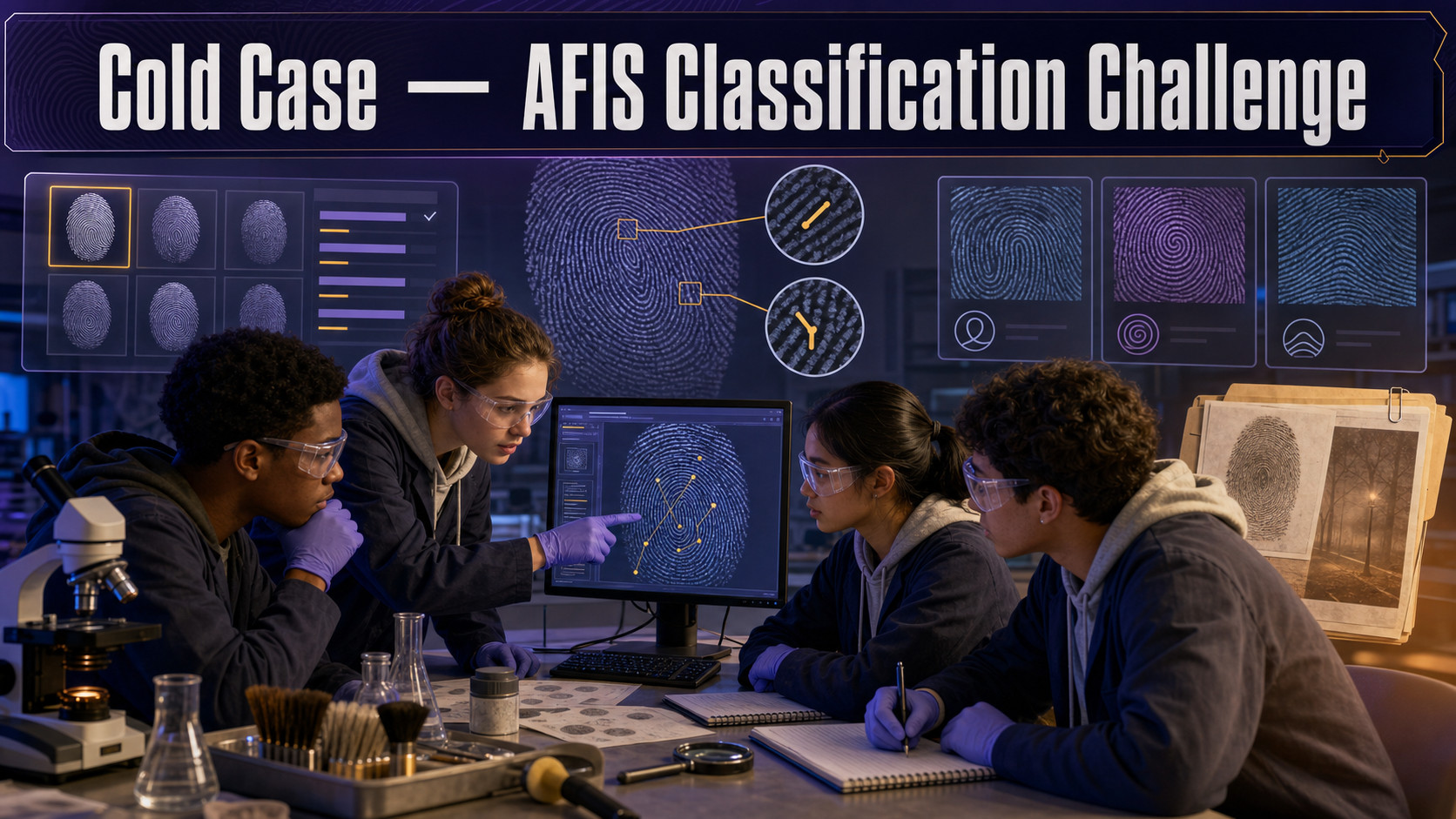
Cold Case — AFIS Classification Challenge
Welcome, Investigators!

A print sat in an evidence file for eleven years waiting for someone patient enough to work it. Today that someone is you. You'll classify it, count its tiny landmarks, and let the database hand you a ranked list of suspects — then decide who's really guilty. The computer narrows the field; you make the call. Follow the evidence!
The Case
Eleven years ago, a jade figurine vanished from the Meridian Museum during a private after-hours event. The only physical evidence was a single latent print lifted from the empty display mount — smudged, partial, and never matched. The case went cold. Now a grant has funded a re-examination, and six people from the original guest-and-staff list are still on record in the database:
| Suspect | Role that night |
|---|---|
| S-1 | Night security guard |
| S-2 | Visiting curator |
| S-3 | Catering staff |
| S-4 | Donor / VIP guest |
| S-5 | Cleaning contractor |
| S-6 | Museum board member |
Your job: classify the cold-case print, count its minutiae, run it against all six database records the way an Automated Fingerprint Identification System (AFIS) would, and produce a ranked candidate list — then explain why the top rank is a lead, not a verdict.
Learning Objectives
By the end of this investigation you will be able to:
- Classify a latent print by pattern type (loop, whorl, or arch) and locate its core and delta.
- Identify and count minutiae — ridge endings and bifurcations — on a partial print.
- Explain how an AFIS search produces a ranked candidate list from minutiae coordinates rather than a single yes/no match.
- Evaluate why a human examiner, not the computer, makes the final identification.
Quick Facts
| Lab type | 💻 Virtual |
| Group size | 1–2 investigators (one workstation) |
| Time | 35–45 minutes |
| Cost | $0 — no consumables |
| Ties to | Ch 3 — AFIS Database, Fingerprint Individualization, Minutiae Points, Pattern Classification |
Materials
Per workstation:
- 1 computer, tablet, or laptop with a browser
- The AFIS Search Workflow MicroSim (linked below)
- A printout of the six suspect exemplar cards (provided by your teacher) or the on-screen database
- Scratch paper for tallying minutiae counts
No physical consumables — this is a fully digital lab.
Fair-Search Rules

- Count before you compare. Tally the cold-case print's minutiae before you look at the suspects, so you don't unconsciously bend the evidence to fit a favorite.
- AFIS returns a ranked list, never a "guilty" stamp. Treat the top candidate as the start of your work, not the end.
- Record your reasoning as you go. In a real cold case, an examiner has to defend every decision years later.
Background: How a Machine Reads a Fingerprint
An AFIS does not compare pictures of fingerprints the way you compare two photos. Instead, it reduces each print to a map of minutiae — the exact coordinates and directions of every ridge ending and bifurcation (a point where one ridge splits into two). A print might yield 40–100 of these points; a smudged partial from a crime scene might give only 8 or 10. The system then looks for database records whose minutiae maps overlap the crime-scene map and scores each one.
The output is a ranked candidate list: the records most similar to the unknown, ordered by match score, highest first. Crucially, AFIS is a search tool, not a decision tool. It might return ten close candidates; it never declares a winner. A trained latent print examiner then compares the top candidates side by side and makes the actual identification — or rules them all out. This human-in-the-loop design exists precisely because automated scores can be fooled by smudges, partials, and coincidental similarity.
That distinction matters for justice. In the 2004 Madrid train bombing, the FBI's AFIS returned Oregon lawyer Brandon Mayfield as a candidate for a latent found on a bag of detonators. Human examiners then wrongly confirmed the match, and he was jailed for two weeks before Spanish police identified the real source. The lesson forensic science took from it: a candidate list is a starting point, and even expert human verification carries an error rate. Now try the search yourself.
Explore: AFIS Search Workflow
AFIS Search Workflow Interactive MicroSim
Type: microsim
sim-id: afis-search-workflow
Library: p5.js
Status: Specified
Learning Objective: Explain how an AFIS search converts minutiae into a ranked candidate list that a human examiner then verifies (Bloom Level 2 — Understand).
Walk through each stage of the workflow: capture, feature extraction, search, and the ranked candidate list. Watch how the match score drops off after the top few candidates — that gap between rank 1 and rank 2 is a signal an examiner weighs, but never treats as proof on its own.
Explore: Minutiae-Tagging Canvas
Tag each ridge ending and bifurcation on the cold-case print, then search the six-suspect database and watch AFIS rank the candidates by how many of your minutiae overlap each one.
Minutiae-Tagging Canvas Interactive MicroSim
Type: microsim
sim-id: minutiae-tagging-canvas
Library: p5.js
Status: Implemented
Learning Objective: Locate and classify minutiae on a latent print and interpret the resulting ranked AFIS candidate list, recognizing that the system ranks while a human examiner decides (Bloom Level 4 — Analyze).
Procedure
Part 1 — Classify the cold-case print.
- Open the cold-case latent print (on screen or on your printout).
- Locate the core (center) and any delta (triangular ridge meeting). Use the delta count to classify: arch = no delta, loop = one delta, whorl = two deltas.
- Record the pattern type on your data sheet.
Part 2 — Tag and count the minutiae.
- Working across the print, mark every ridge ending (a ridge that just stops) and every bifurcation (a ridge that forks). On paper, circle each one; in the proposed canvas widget, click each one.
- Tally your totals: number of ridge endings, number of bifurcations, and the combined minutiae count. This is your unknown's "feature map."
Part 3 — Search the database and rank.
- Run the AFIS Search Workflow MicroSim, or compare your feature map against each of the six suspect exemplars by hand.
- For each suspect, note how many minutiae fall in the same relative position as the unknown. Assign a rough match score.
- Order the six suspects into a ranked candidate list, highest score first.
- Take the top candidate and verify it as an examiner would: confirm the pattern type agrees and that specific minutiae line up. Decide whether the evidence supports an identification or whether the print is too limited to individualize.
Data Collection
| Suspect | Pattern type | Ridge endings in agreement | Bifurcations in agreement | Match score (rank) |
|---|---|---|---|---|
| S-1 | ||||
| S-2 | ||||
| S-3 | ||||
| S-4 | ||||
| S-5 | ||||
| S-6 |
Cold-case print — pattern type: _ Total minutiae counted: _
Analysis Questions
- What pattern type is the cold-case print, and which suspects can you exclude immediately on pattern type alone?
- Which suspect ranked first on your candidate list? Cite the specific minutiae that put them at the top.
- AFIS returned a ranked list, not a single name. Explain in your own words why the system is designed to rank rather than to decide.
- The print is a partial with fewer minutiae than a full rolled print. How does a low minutiae count affect how confident your identification can be?
- Using the Brandon Mayfield case, explain why a human examiner's confirmation is still not a guarantee. What safeguard would you add before making an arrest?
Deliverable
Turn in your completed ranked candidate list for all six suspects plus a short examiner's statement: name your top candidate, state the pattern type and the minutiae that support the ranking, and state honestly whether the partial print is sufficient to individualize or only to include. Precision of language is graded.
What Does the Data Tell Us?

Here's the twist most people miss: AFIS never says "match." It says "here are the closest records — now a human decides." The computer is fast and tireless but blind to context; the examiner is slow and fallible but can reason. The strongest cold-case work pairs both and stays honest about the limits of a smudged partial print.
Extension Challenge: The Twelve-Point Debate
Some countries once required a fixed minimum number of matching minutiae (often cited as 12 or 16) before declaring an identification; the United States uses a holistic examiner judgment instead. Research one argument for a numeric standard and one against it, then write which approach you'd defend if you were testifying — and why.
Teacher Notes
Setup, timing, and grading (click to expand)
- Prep: Load the AFIS Search Workflow MicroSim on each workstation and print the six suspect exemplar cards plus the cold-case latent at high resolution. Decide in advance which suspect is the "true" source so you can confirm rankings, but keep it sealed until groups commit.
- Sequencing matters: Insist students count minutiae in Part 2 before seeing the suspects. This models blind analysis and blocks confirmation bias — the exact failure mode behind the Mayfield error.
- Differentiation: For a shorter run, provide the pattern-type classification and have students focus only on ranking. For a challenge, include two suspects with the same pattern type so minutiae are the only way to separate them.
- Assessment focus: Reward correct pattern classification, honest minutiae counting, a defensible ranked list, and — above all — an examiner's statement that distinguishes include from individualize and acknowledges the partial-print limitation.
Case Closed — For Now

Eleven years cold, and you just handed the ranked list that reopens the file. You did what AFIS can't: you reasoned. The machine narrowed six suspects to a front-runner, but the judgment was yours — exactly as it should be. Follow the evidence!