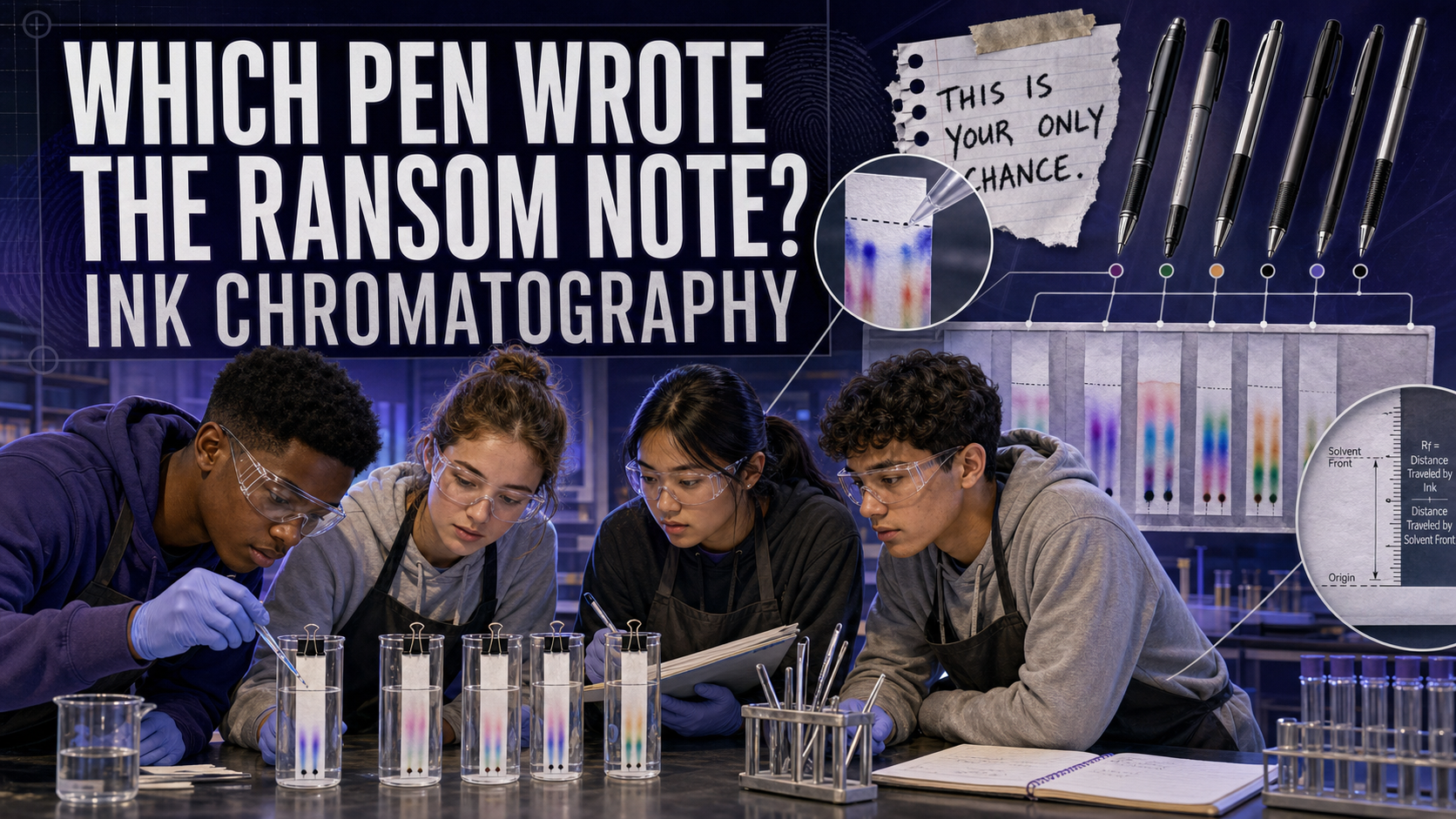
Which Pen Wrote the Ransom Note? Ink Chromatography
Welcome, Investigators!

Black ink is a liar — it looks like one color, but it's almost always a mixture of hidden dyes blended to look black. Give that mixture a little solvent and it splits apart into a rainbow of stripes, and no two brands split the same way. Today you'll unmask six inks and catch the one pen that wrote a ransom note. Follow the evidence!
The Case
A ransom note turns up, handwritten in ordinary black ink. Six pens were seized from six suspects — all of them black, all of them ordinary-looking. To the naked eye, every stroke looks identical. But each ink is a different recipe of dyes, and chromatography can pull that recipe apart.
Your job: separate each pen's ink into its component dyes, do the same to a sample lifted from the note, and find the one pen whose pigment fingerprint matches the note.
Learning Objectives
By the end of this investigation you will be able to:
- Explain how paper chromatography separates a mixture into its components.
- Separate six black inks into their component dyes on chromatography paper.
- Calculate an R_f value for a dye spot from its travel distance.
- Compare the questioned note's dye pattern to six knowns and identify the pen used.
Quick Facts
| Lab type | 🧪 Physical bench lab |
| Group size | 2–3 investigators |
| Time | 40–50 minutes |
| Cost | ≈ $10 per group (consumables) |
| Ties to | Ch 14 — Ink Chemistry Analysis, Paper Chromatography, Thin-Layer Chromatography, Document Examination |
Materials
Per group (≈ $10):
- Chromatography paper strips (or cut coffee-filter strips)
- 6 different black water-based markers or pens, labeled 1–6 (deliberately different brands)
- A "ransom note" sample written by the teacher with one of the six pens
- Rubbing alcohol (isopropyl) or plain water as the solvent
- 2–3 clear cups or jars
- Pencils (to suspend the strips) and tape
- Ruler with millimeter markings
- Shared: a hair dryer to speed drying (optional)
Safety & Fair-Test Rules

- Use water-based markers — permanent/solvent inks need harsher chemicals. If you use rubbing alcohol, keep the room ventilated, goggles on, and away from any flame.
- Mark your origin spot with a pencil, never a pen — ink on the start line would run and ruin the lane.
- Keep the origin spot above the solvent surface. If the solvent touches the ink directly, the dyes wash off instead of climbing.
Background: One Black, Many Dyes
Chromatography is a family of techniques that separate a mixture by letting its components travel at different speeds through a medium. In paper chromatography, a solvent soaks up a strip of paper and carries the ink's dyes along with it. Some dyes cling tightly to the paper and barely move; others dissolve easily and race ahead with the solvent. Because each dye moves at its own rate, a single black dot fans out into a stack of colored bands — the ink's chemical fingerprint.
To compare fingerprints fairly, examiners measure the R_f value (retention factor) of each band: the distance the dye traveled divided by the distance the solvent front traveled. R_f is always between 0 and 1, and — under the same paper and solvent — it's a repeatable property of that dye. Two inks match only if their bands share the same colors and the same R_f values. The professional version of this is thin-layer chromatography (TLC), which uses a coated plate instead of paper for sharper, more reproducible separation.
Before you run your strips, watch a TLC separation and practice reading R_f.
Explore: TLC Ink Separation
TLC Ink Separation Interactive MicroSim
Type: microsim
sim-id: tlc-ink-separation
Library: p5.js
Status: Implemented
Learning Objective: Explain how thin-layer chromatography separates ink into its dye components and interpret the result as matching or non-matching (Bloom Level 2 — Understand).
Run the chromatography and watch the solvent front rise while each dye migrates to its own height. Toggle UV to reveal fluorescent components that are invisible in white light, then use Calculate R_f to compare the questioned lane to the reference lanes component by component — exactly the comparison you're about to do with paper.
Procedure
Part 1 — Spot the samples.
- Cut seven paper strips. On each, draw a light pencil line about 2 cm from the bottom — this is the origin.
- On six strips, place a small, concentrated dot of ink from pens 1–6 on the origin line. Label each strip in pencil at the top.
- On the seventh strip, dab a sample from the ransom note onto the origin. Label it NOTE. Let all dots dry.
Part 2 — Run the chromatography.
- Pour solvent into the cup to a depth of about 1 cm — below the origin line.
- Tape each strip to a pencil and hang it so the bottom edge just touches the solvent but the ink dot stays above the liquid.
- Watch the solvent climb. Before it reaches the top, remove each strip and immediately mark the solvent front in pencil. Let the strips dry.
Part 3 — Measure and compare.
- For each colored band, measure how far it traveled from the origin and how far the solvent front traveled. Compute R_f = (dye distance) ÷ (solvent- front distance).
- Line the NOTE strip up against pens 1–6. The matching pen has the same colors at the same R_f values.
Data Collection
Record each band you see. Add rows as needed.
| Strip | Band color | Dye distance (mm) | Solvent-front distance (mm) | R_f | Matches NOTE? |
|---|---|---|---|---|---|
| NOTE | — | ||||
| Pen 1 | |||||
| Pen 2 | |||||
| Pen 3 | |||||
| Pen 4 | |||||
| Pen 5 | |||||
| Pen 6 |
Analysis Questions
- Which pen wrote the ransom note? Cite two matching bands (color and R_f) that support your conclusion.
- Two pens produced a band of the same color but at different R_f values. Are those the same dye? Explain what R_f tells you that color alone can't.
- Why must the origin dot stay above the solvent surface at the start? What would go wrong otherwise?
- Your lab partner ran their strip in water while you used rubbing alcohol. Would it be fair to compare your two R_f values directly? Why or why not?
- Ink chromatography identifies the type of ink, not the individual pen off a factory line. Explain the difference between saying "this ink is consistent with Pen 3" and "Pen 3 definitely wrote this note."
Deliverable
Turn in a one-page Questioned Document Report that names the matching pen, includes your dried NOTE strip taped beside the matching pen's strip, and lists the R_f values you used to make the call. State your conclusion as "the note's ink is consistent with Pen ___."
What Does the Data Tell Us?

A matching separation tells you the note's ink is the same formulation as one pen's ink — a powerful lead. But many pens of the same brand share the exact same ink recipe, so chromatography says "consistent with," not "this one pen and no other." Knowing the difference is what keeps an examiner honest.
Extension Challenge: The Aged Note
Real questioned-document examiners sometimes estimate a note's age from how far its dyes have already spread or faded. Write a note, wait a day (or warm it under a lamp), then run it beside a fresh sample of the same pen. Do the R_f values or band intensities shift? What might that tell an investigator about when a document was written?
Teacher Notes
Setup, timing, and grading (click to expand)
- Prep: Test your six pens in advance and pick brands that separate into visibly different patterns — many cheap markers use blue, purple, and pink dyes that fan out beautifully. Write the ransom note with one of them and keep the answer sealed.
- Solvent choice: Water works for most washable markers and is the safest option; rubbing alcohol gives crisper separation for slightly more stubborn inks. Keep the two solvents consistent within a comparison.
- Timing: Strips run in 10–15 minutes. Start them early and use the wait to run the MicroSim and pre-compute practice R_f values.
- Differentiation: For a shorter version, compare by pattern alone and skip the R_f math. For a challenge, add a decoy pen whose ink is almost identical to the real one so students must rely on precise R_f.
- Assessment focus: Reward correct R_f calculation, a pencil origin line, and cautious "consistent with" phrasing over an overstated "match."
Case Closed — For Now

Six identical-looking black pens walked in, and you split them into six different fingerprints — then caught the one that wrote the note. That's the whole magic of chromatography: making a mixture confess what it's really made of. Beautifully separated, investigators. Follow the evidence!