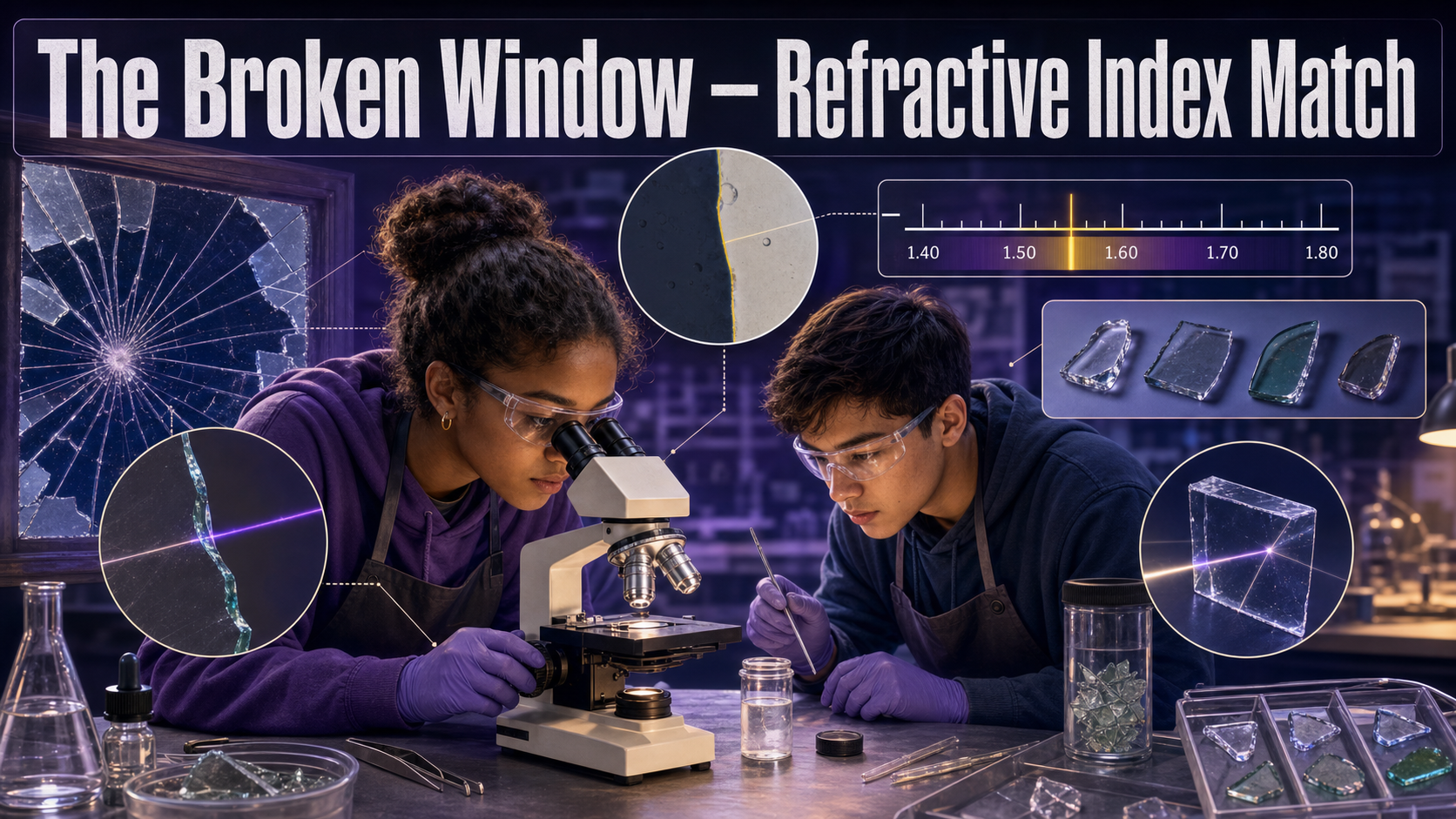
The Broken Window — Refractive Index Match
Welcome, Investigators!

A window is smashed, and a tiny fleck of glass is riding on a suspect's jacket. To the naked eye, one clear chip looks exactly like another — but glass has a hidden fingerprint you can measure. Today you'll bend light through a fragment to read that fingerprint. Grab your goggles and your pipette. Follow the evidence!
The Case
A jewelry store's front window was shattered during a break-in on Grove Street. When police stopped Marcus Vale three blocks away, the crime-scene tech noticed glinting chips embedded in the sleeve of his jacket. Marcus insists the glass came from a drinking glass he dropped at home — not from the store.
The lab has two glass samples:
- The KNOWN — a reference chip taken directly from the broken store window.
- The QUESTIONED — the chip recovered from Marcus's jacket sleeve.
Your job: measure the refractive index of each chip and decide whether the questioned glass could have come from that window — using evidence, not the alibi.
Learning Objectives
By the end of this investigation you will be able to:
- Explain what refractive index is and why it varies between types of glass.
- Apply the Becke line immersion method to bracket a fragment's refractive index between two liquids.
- Compare a questioned glass fragment to a known source using its measured refractive index.
- Evaluate whether refractive-index agreement is enough to say two glass samples share a common origin.
Quick Facts
| Lab type | 🔀 Combination (bench immersion + simulator) |
| Group size | 2–3 investigators |
| Time | 45–55 minutes |
| Cost | ≈ $16 per group (consumables) |
| Ties to | Ch 5 — Glass Composition, Refractive Index, Becke Line Test, Immersion Oil Technique |
Materials
Per group (≈ $16):
- Pre-sorted glass chips: a labeled KNOWN set and a labeled QUESTIONED set (teacher pre-crushes and pre-sorts — see safety note)
- 3 watch glasses or small clear dishes
- Immersion liquids: water (n ≈ 1.33), mineral oil (n ≈ 1.47), glycerin or corn syrup (n ≈ 1.47–1.49)
- Disposable pipettes
- Fine-tip tweezers
- Hand magnifier or loupe
- Shared: one classroom compound microscope (to view the Becke line clearly)
- Shared: a computer or tablet for the
becke-line-testsimulator
Safety & Handling Rules

- The teacher pre-crushes all glass. You handle only pre-sorted chips with tweezers, and goggles stay on the whole time.
- Never rub or brush a chip with a bare finger — glass edges are sharp and small chips are easy to lose.
- Report any spilled chip immediately. A lost fragment on the floor is a safety hazard and a contaminated scene.
Background: Reading Glass With Light
Refractive index (RI) is a number that tells you how much a material bends light as light passes into it. Water bends light a little (RI ≈ 1.33); most window glass bends it more (RI ≈ 1.51–1.52). Because RI depends on the exact chemical recipe of the glass, two panes from different manufacturers often have slightly different values. That makes RI a useful way to compare an unknown fragment to a known source.
Here's the clever part. When a clear glass chip sits in a clear liquid, you can only see the chip if its RI differs from the liquid's. If the glass and the liquid bend light by the same amount, the chip nearly vanishes. As you focus up and down through the microscope, a bright halo called the Becke line appears at the chip's edge and moves toward whichever material has the higher refractive index. Track that line and you can tell whether the glass is "denser to light" than the liquid around it — and bracket its RI between two liquids.
Real crime labs do this with a precise oil-gradient instrument. You'll start with household liquids to bracket the value, then use the simulator to fine-tune a virtual immersion oil to an exact match.
Explore: The Becke Line Test
Becke Line Test Interactive MicroSim
Type: microsim
sim-id: becke-line-test
Library: p5.js
Status: Specified
Learning Objective: Use the movement of the Becke line under focus to determine whether a glass fragment's refractive index is higher or lower than the surrounding immersion liquid, and tune the liquid to a match (Bloom Level 3 — Apply).
Change the immersion liquid's refractive index and watch the Becke line jump to the higher-RI side as you rack focus up. When the line disappears and the chip melts into the background, you've found the match point — the liquid's RI equals the glass's RI.
Procedure
Part 1 — Bracket the refractive index (bench).
- Place one KNOWN chip in a watch glass and cover it with water. View it under the microscope and rack the focus up. Note which way the Becke line moves — toward the glass means the glass has the higher RI.
- Repeat with a fresh KNOWN chip in mineral oil, then another in glycerin/corn syrup. Record the Becke-line direction each time.
- From your three trials, decide the bracket: the two liquids whose RI values the glass falls between.
Part 2 — Repeat for the questioned glass.
- Run the exact same three immersions on the QUESTIONED chips.
- Record the bracket for the questioned glass the same way.
Part 3 — Fine-tune the match in the simulator.
- Open the
becke-line-testsimulator. Set the virtual chip to your KNOWN bracket, then adjust the immersion-oil RI until the Becke line vanishes. Record that RI as your KNOWN match value. - Repeat for the QUESTIONED chip and record its match value.
- Compare the two match values.
Data Collection
Record the Becke-line direction (toward glass = glass is higher RI) and your final match values.
| Sample | Water (n≈1.33) | Mineral oil (n≈1.47) | Glycerin (n≈1.48) | Bracketed range | Sim match value |
|---|---|---|---|---|---|
| KNOWN (window) | |||||
| QUESTIONED (jacket) |
Analysis Questions
- For the KNOWN chip in water, which way did the Becke line move as you focused up, and what does that tell you about the glass's RI compared to water?
- What range did you bracket the questioned glass into before using the simulator? How did the simulator narrow it down?
- Do the KNOWN and QUESTIONED match values agree within measurement error? State your conclusion about whether the jacket glass could have come from the window.
- Refractive index is class evidence. Explain why a matching RI shows the two samples are consistent with a common source but does not prove they came from the same window.
- Name one source of measurement error in your bench immersions and describe how the simulator step reduced its effect.
Deliverable
Turn in a one-page Glass Comparison Report that states each sample's bracket and final match value, your conclusion about whether the questioned glass is consistent with the window, and one sentence on what your evidence cannot prove. Attach your completed data table.
What Does the Data Tell Us?

Matching refractive index makes the jacket glass consistent with the window — it doesn't stamp Marcus guilty. Millions of panes share the same RI. The strongest reports say exactly that: the evidence includes a source but can't individualize it. Precise language is what holds up in court.
Extension Challenge: The Density Cross-Check
Refractive index isn't the only measurable glass property — density is another. Design a simple density comparison (for example, watching whether a chip sinks or floats in liquids of known density) that could support or contradict your RI conclusion. Would two glass samples that match on both RI and density be a stronger association than a match on RI alone? Explain why.
Teacher Notes
Setup, timing, and grading (click to expand)
- Prep: You crush the glass in advance inside a folded cloth or a zip bag, then sort chips into labeled KNOWN and QUESTIONED vials. Students never crush glass. For an even safer version, substitute clear acrylic chips or glass beads with distinct known RIs — the Becke-line logic is identical.
- The reveal: Keep the ground-truth answer (whether the questioned chip really matches the window) sealed. Groups commit to a conclusion from their match values before it's revealed — this rewards evidence over guessing.
- Differentiation: For a quicker version, skip the microscope and use only the simulator to demonstrate Becke-line movement. For a challenge, add a third "decoy" glass with an RI very close to the window's so groups must measure carefully to tell them apart.
- Assessment focus: Reward students who correctly read Becke-line direction, who bracket before fine-tuning, and who distinguish inclusion from individualization in their conclusion.
Case Closed — For Now

You just measured something invisible — the way a fleck of glass bends light — and used it to test an alibi. A halo of light at the edge of a chip was your silent witness, and you knew how to read it. Follow the evidence!