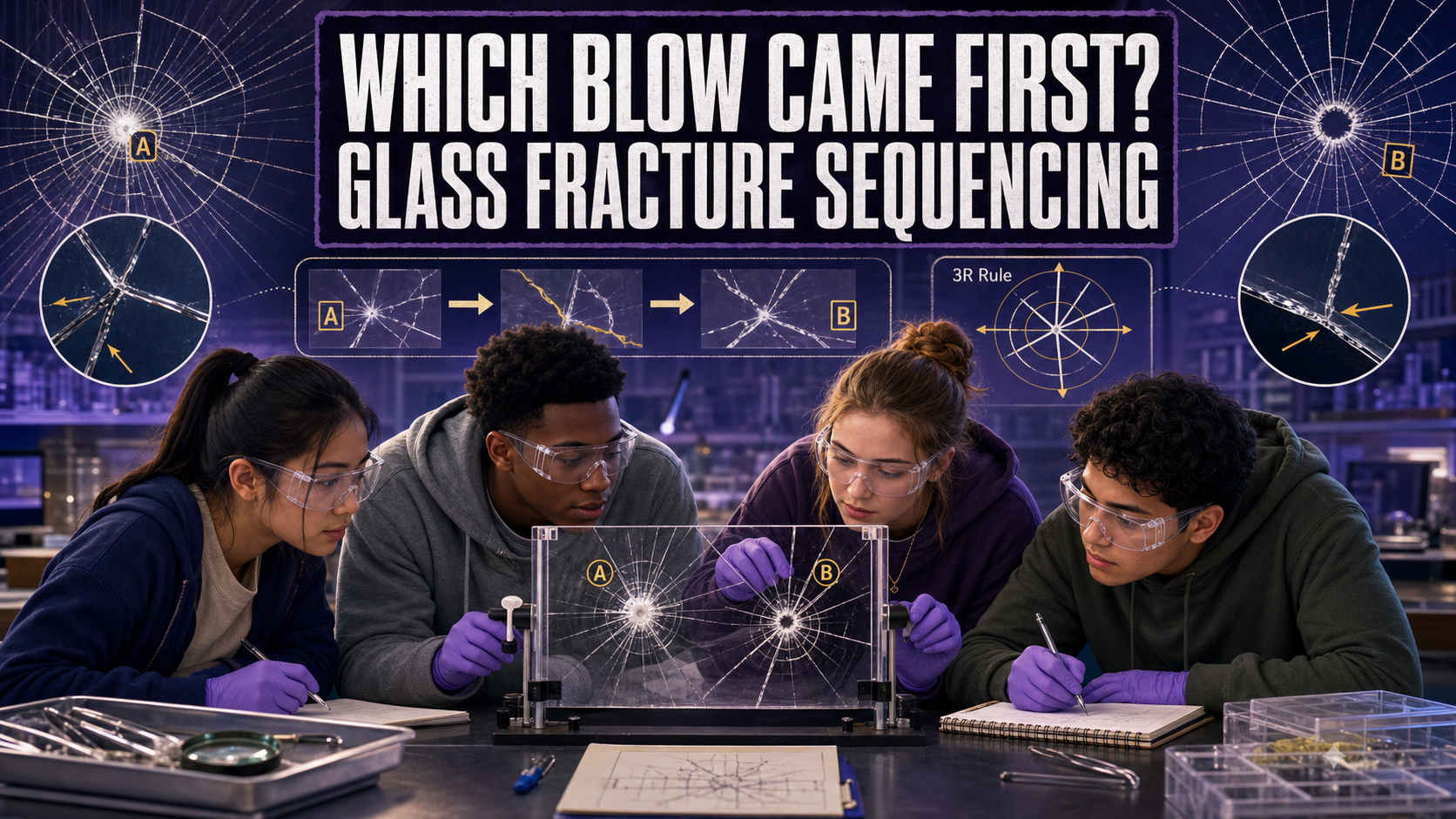
Which Blow Came First? Glass Fracture Sequencing
Welcome, Investigators!

Two bullets went through the same window — but which one first? The order of the shots can make or break an alibi, and the glass already recorded the answer. You just have to know how to read the cracks. No fingerprints, no DNA — pure pattern reasoning today. Sharpen your eyes. Follow the evidence!
The Case
A storefront window on Rutledge Avenue took two gunshots during a late-night dispute. The two people involved tell opposite stories:
- Deja Harper says she fired first, from outside, in self-defense — then the other shot came.
- Cole Ramsey says he fired first, from inside, and that Deja shot back afterward.
Only one order can be true. The pane has two bullet holes, each surrounded by cracks, and in one spot the cracks from the two holes run into each other. That intersection is the whole case.
Your job: use the physics of how glass breaks to determine which hole was made first — and decide whose story the glass supports.
Learning Objectives
By the end of this investigation you will be able to:
- Describe radial and concentric fracture lines and how each forms when glass is struck.
- Apply the 3R rule (Radial cracks form Right angles on the Reverse side) to determine which side of the glass an impact came from.
- Analyze intersecting fracture patterns using the rule that a fracture terminates at a pre-existing fracture.
- Justify a conclusion about the sequence of two impacts using the crack evidence.
Quick Facts
| Lab type | 🔀 Combination (photo/panel analysis + simulator) |
| Group size | 2–3 investigators |
| Time | 40–50 minutes |
| Cost | ≈ $8 per group (mostly analysis) |
| Ties to | Ch 5 — Radial & Concentric Fractures, 3R Rule, Glass Fracture Sequence & Mechanics |
Materials
Per group (≈ $8):
- A high-resolution printed fracture photo of a two-hole pane, or a teacher-prepared cracked acrylic panel (scored to produce intersecting cracks)
- A clear dry-erase overlay sheet (or transparency film) taped over the photo
- Dry-erase or fine-tip markers in two colors
- Ruler
- Hand magnifier or loupe
- Shared: a computer or tablet for the
glass-fracture-sequencesimulator
Safety & Handling Rules

- If your station uses a real cracked acrylic panel, keep it inside its sealed sleeve and trace on the overlay — never pick loose pieces.
- Goggles on if any physical panel is present.
- This lab is mostly looking and reasoning. Slow down: the answer is in the pattern, not in touching the glass.
Background: How Glass Remembers the Order
When something strikes glass, two families of cracks appear. Radial cracks shoot outward from the impact point like spokes on a wheel. Concentric cracks form rings around the impact, connecting the radials. Together they make the classic "spider web."
Two rules let you read these webs. First, the 3R rule: a Radial crack forms a Right angle on the Reverse side of the force. If you examine the edge of a radial crack and see the tiny stress lines (called hackle or rib marks) meeting the surface at a right angle, that surface is the opposite side from where the blow landed — telling you which side the shot came from.
Second, and the key to sequencing: a fracture always stops when it reaches a fracture that is already there. A crack cannot cross a gap that is already open. So when a radial crack from Hole B runs toward Hole A and suddenly stops dead at one of Hole A's cracks, Hole A's crack must have existed first. The crack that terminates is the later impact; the crack that keeps going is the earlier one.
Practice spotting terminations in the simulator before you commit to an answer.
Explore: Glass Fracture Sequencing
Glass Fracture Sequence Interactive MicroSim
Type: microsim
sim-id: glass-fracture-sequence
Library: p5.js
Status: Specified
Learning Objective: Determine the order of two impacts on a fractured pane by identifying which radial cracks terminate at pre-existing fractures (Bloom Level 4 — Analyze).
Toggle the impact order and watch how the second hole's cracks stop at the first hole's web. Find the intersection, note which crack ends and which continues, and you've read the sequence.
Procedure
Part 1 — Map the two webs.
- Tape the dry-erase overlay over your fracture photo (or over the panel's sleeve). Label the two impact points Hole 1 and Hole 2.
- In one marker color, trace the radial cracks from each hole. In the second color, trace the concentric (ring) cracks.
Part 2 — Apply the 3R rule (direction of force).
- Pick two clear radial cracks and examine their edges with the magnifier for rib/hackle marks. Use the 3R rule to decide which side each shot was fired from (inside vs. outside).
Part 3 — Read the sequence.
- Find the spot where cracks from the two holes meet. Look closely: does a crack from one hole stop at a crack from the other?
- The crack that terminates belongs to the later shot. The one that continues uninterrupted belongs to the earlier shot. Circle the termination on your overlay.
- Verify your reading in the
glass-fracture-sequencesimulator, then write down which hole came first.
Data Collection
| Observation | Hole 1 | Hole 2 |
|---|---|---|
| # of radial cracks traced | ||
| # of concentric cracks traced | ||
| 3R rule → force came from (inside/outside) | ||
| At the intersection, this hole's crack terminates (yes/no) | ||
| Impact order (1st or 2nd) |
Analysis Questions
- At the intersection, which hole's crack terminated against the other's? State which shot was fired first and cite that termination as your evidence.
- What did the 3R rule tell you about the direction each shot came from? Does that match either Deja's or Cole's story?
- Explain in your own words why a crack cannot cross a pre-existing fracture. What is physically happening at that stopped edge?
- Whose account does the glass support — Deja's or Cole's? Point to the specific evidence (sequence and direction) behind your answer.
- Suppose the two holes were far apart and their cracks never intersected. Could you still determine the order from this pane alone? Explain.
Deliverable
Turn in your annotated fracture overlay (radials and concentrics traced, termination circled) plus a short Sequence Statement: which shot came first, which direction each came from, whose story the glass supports, and the specific crack evidence for each claim.
What Does the Data Tell Us?

One stopped crack settled the whole dispute — because glass can't lie about the order it broke in. But notice the limit: the pane tells you the sequence and direction, not who pulled the trigger. State exactly what the fractures prove and stop there. Overreach is how good evidence gets thrown out.
Extension Challenge: Three Impacts
Add a third bullet hole to the scenario. With three overlapping webs, you can build a full order (1st, 2nd, 3rd) by chaining termination rules: the crack that stops at everything is the last shot. Sketch a three-hole pane, decide where cracks would terminate for a given order, and write the reasoning chain a jury could follow.
Teacher Notes
Setup, timing, and grading (click to expand)
- Prep: The cheapest, safest version is a high-res printed photo of a real two-hole fracture with a clear termination. To make a physical panel, score an acrylic sheet at two points so cracks propagate and intersect, then seal it in a rigid sleeve before students handle it. Never hand out loose glass.
- The intersection is the whole lab. Choose or stage a photo where one crack unambiguously terminates at another — a muddy intersection frustrates students and defeats the objective.
- Differentiation: For support, pre-trace the two webs so students focus only on the termination. For a challenge, give a three-hole pane (see the Extension) or ask them to also justify the 3R direction call.
- Assessment focus: Reward the correct termination reasoning and a clear sequence + direction statement. A right answer with no cited termination earns partial credit — the evidence chain is the point.
Case Closed — For Now

Two shots, two stories, one honest witness: the glass. You read the order of events out of a spider web of cracks without anyone telling you — that's reconstruction, and you just did it. Follow the evidence!