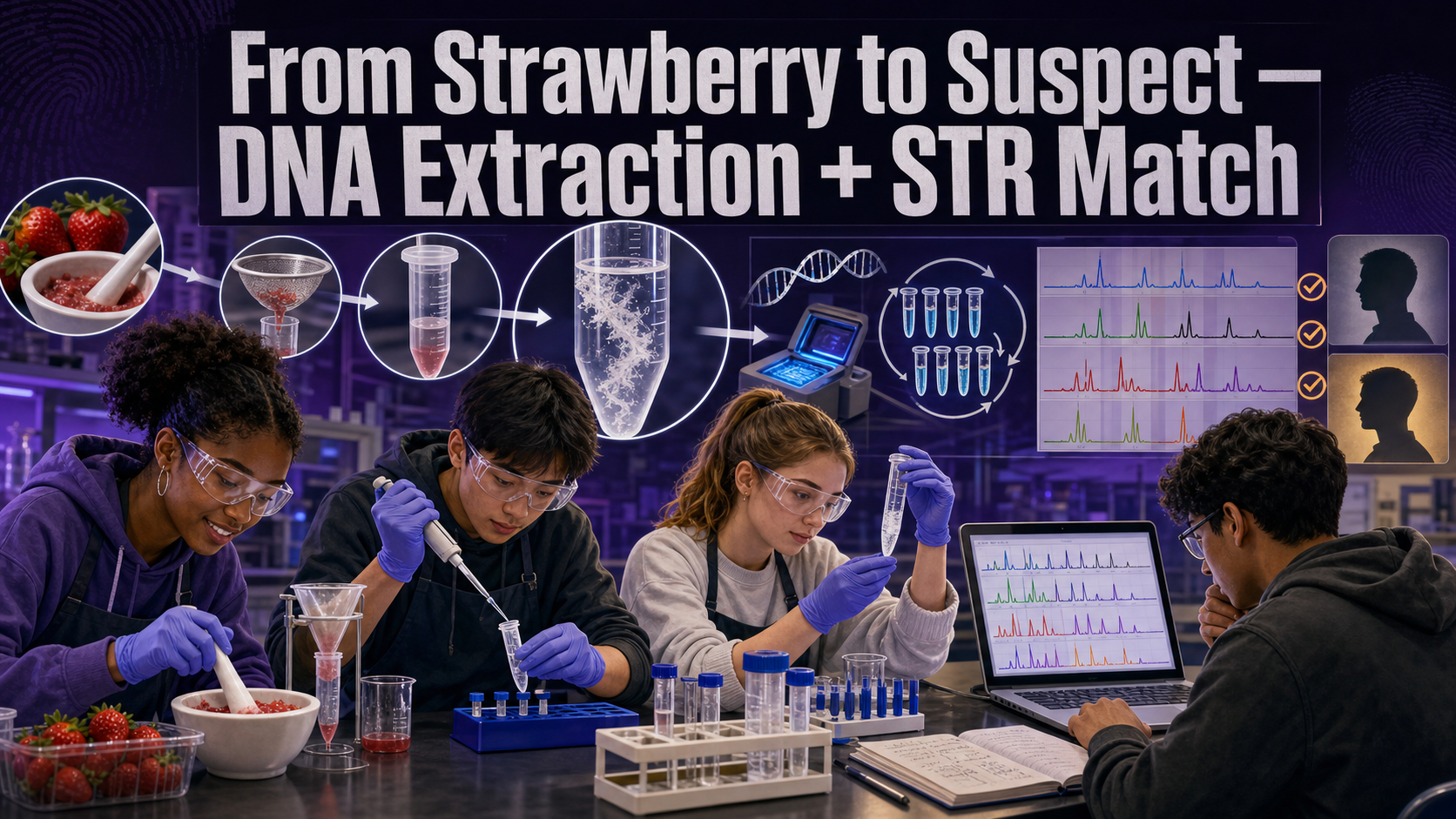
From Strawberry to Suspect — DNA Extraction + STR Match
Welcome, Investigators!

First you'll pull a stringy white glob of real DNA out of a strawberry with nothing but dish soap, salt, and cold alcohol — proof that DNA is actual, physical stuff. Then you'll do what a $30,000 sequencer does, in a simulator: copy it, read it, and match it. Two labs, one molecule. Follow the evidence!
The Case
A cracked-open safe at a downtown office left a smear of blood on the metal lip. The lab pulls a DNA profile from that crime-scene sample and from three suspects who had after-hours access:
- Suspect 1 — Alvarez, the night custodian.
- Suspect 2 — Boyd, a contractor with a grudge.
- Suspect 3 — Chen, a co-worker who reported the break-in.
Your job comes in two acts. First, prove you can extract DNA from cells with your own hands. Then, using simulated instruments, amplify the sample by PCR and compare its STR profile to all three suspects across several CODIS loci to answer the question — whose profile matches the safe, and how sure can you be?
Learning Objectives
By the end of this investigation you will be able to:
- Extract visible DNA from plant cells using detergent, salt, and cold alcohol.
- Explain how PCR copies short tandem repeat regions to make a readable profile.
- Compare crime-scene and suspect STR profiles across CODIS loci to include or exclude.
- Estimate the strength of a match using the random match probability product rule.
Quick Facts
| Lab type | 🔀 Combination (physical extraction + virtual PCR/STR match) |
| Group size | 2–3 investigators |
| Time | 55–70 minutes (or split across two class periods) |
| Cost | ≈ $10 per group (food-safe) |
| Ties to | Ch 8 — DNA Structure, Short Tandem Repeats, PCR, Capillary Electrophoresis, Electropherogram Interpretation, CODIS Loci, Random Match Probability |
Materials
Per group (≈ $10, food-safe):
- 2–3 fresh or frozen strawberries in a sturdy zip bag
- Dish soap (1 tsp) and table salt (a pinch)
- Cold isopropyl (rubbing) alcohol or ethanol — kept in the freezer
- A coffee filter or cheesecloth + a funnel
- A clear cup or test tube, plus a wooden skewer to spool the DNA
- Water, a spoon for mashing, and measuring spoons
- A computer or tablet to run the PCR and STR simulators
Safety & Fair-Test Rules

- The alcohol is flammable and not for tasting — no open flames, keep it capped when not pouring, goggles on.
- Pour the cold alcohol slowly down the side of the cup so it layers on top. Dump it in and you'll mix the layers and lose your DNA.
- This is a food-safe extraction, but a lab is still a lab: no eating the strawberries afterward, and wash hands at the end.
Background: From a Cell to a Courtroom Profile
Every cell keeps its DNA coiled inside a nucleus, wrapped around proteins and sealed behind two layers of fat (the cell and nuclear membranes). To see it, you break in: dish soap dissolves those fatty membranes, salt makes the released DNA clump together, and cold alcohol — which DNA can't dissolve in — forces the strands out of solution as a stringy white mass you can spool on a skewer. That glob is millions of DNA molecules tangled together.
Real casework can't see individual differences by eye, so it targets short tandem repeats (STRs) — short DNA sequences repeated a variable number of times. At one location (a locus), you might repeat "GATA" 11 times; someone else repeats it 14 times. PCR (the polymerase chain reaction) copies these regions millions of times so they can be measured. Capillary electrophoresis then sorts the copies by size and draws an electropherogram — a row of peaks whose positions equal the repeat counts.
The FBI's CODIS system compares 20 core loci. A person's repeat counts at each locus form their profile. Match every locus and the odds that a random stranger shares that whole profile become astronomically small — the random match probability, found by multiplying each locus's frequency together with the product rule. Miss even one locus and the suspect is excluded outright. Run the two simulators below to see both halves — copying, then the statistics.
Explore: PCR Amplification Simulator
PCR Amplification Simulator Interactive MicroSim
Type: microsim
sim-id: pcr-amplification-simulator
Library: p5.js
Status: Specified
Learning Objective: Explain how repeated denature–anneal–extend cycles of PCR double the number of target DNA copies (Bloom Level 2 — Understand).
Step through the denature → anneal → extend cycle and watch the copy count double each round. Notice how just 30 cycles turns a few molecules into millions — enough for the instrument to read a tiny crime-scene smear.
Explore: Random Match Probability (Product Rule)
Random Match Probability Product Rule Interactive MicroSim
Type: microsim
sim-id: rmp-product-rule
Library: p5.js
Status: Specified
Learning Objective: Apply the product rule to combine per-locus allele frequencies into an overall random match probability (Bloom Level 3 — Apply).
Add loci one at a time and watch the random match probability plummet — from "1 in a few hundred" at one locus to "1 in billions" once several agree. That collapse is why a full CODIS match is so powerful, and why a single locus is never enough.
Explore: STR Electropherogram Comparison
Compare the crime-scene STR profile against each suspect across five CODIS loci and tally the matching loci to include or exclude them.
STR Electropherogram Comparison Interactive MicroSim
Type: microsim
sim-id: str-electropherogram-comparison
Library: p5.js
Status: Implemented
Learning Objective: Compare crime-scene and suspect STR peak sets across CODIS loci to determine matching loci and include or exclude a suspect (Bloom Level 4 — Analyze).
Pick each suspect in turn, check whether their orange peaks sit at the same repeat numbers as the scene's blue peaks, then press Compare Loci. Exactly one suspect matches all five loci; the others differ at a locus — and a single mismatch is enough to exclude. Record the repeat counts and matches in the data table below.
Procedure
Part 1 — Extract the DNA (physical).
- Seal 2–3 strawberries in a zip bag and mash them for about a minute until smooth — this breaks open the cells' outer walls.
- In a cup, mix 1 tsp dish soap, a pinch of salt, and a few tablespoons of water. Add it to the bag and gently mash 1 more minute (avoid making foam).
- Filter the slurry through a coffee filter into a clear cup.
- Slowly pour cold alcohol down the side of the cup to form a layer on top — about equal to the strawberry liquid. Do not stir.
- Watch the white, stringy DNA appear at the boundary. Spool it onto a wooden skewer.
Part 2 — Amplify and read (virtual).
- Open the PCR Amplification Simulator and run enough cycles to "amplify" the crime-scene sample. Note how many copies a readable profile needs.
- From your evidence card (or the STR Electropherogram Comparison sim above), record the repeat counts at each CODIS locus for the scene and each suspect.
Part 3 — Compare and weigh the match.
- For each suspect, compare their repeat counts to the scene locus by locus. Any single mismatch = excluded.
- For the suspect who matches every locus, open the Random Match Probability sim and multiply the per-locus frequencies to estimate how rare that full profile is.
Data Collection
Record repeat counts (alleles) at each locus. Mark ✔ if the suspect matches the scene at that locus, ✘ if not.
| CODIS locus | Scene | Suspect 1 (Alvarez) | Suspect 2 (Boyd) | Suspect 3 (Chen) |
|---|---|---|---|---|
| TH01 | ||||
| TPOX | ||||
| CSF1PO | ||||
| D5S818 | ||||
| D7S820 | ||||
| Loci matched | — |
Estimated random match probability for the matching suspect: 1 in ______
Analysis Questions
- In the extraction, what was the job of the dish soap, the salt, and the cold alcohol? Name the part of the cell each one acted on.
- Why must the crime-scene sample be amplified by PCR before it can be read? What would happen if you tried to profile a smear too small to amplify?
- Which suspects can you exclude, and at which locus did each one first fail to match? Why is a single mismatched locus enough to exclude someone?
- Which suspect matches the scene at every locus? Using the product rule, explain why adding more matching loci makes that conclusion far stronger.
- A defense attorney argues, "Plenty of people share this profile." Using your estimated random match probability, write one sentence a juror could understand about how likely a random match really is.
Deliverable
Turn in a DNA Case Report: a photo of your spooled strawberry DNA, your completed CODIS locus table, the suspects you exclude (with the failing locus for each), the matching suspect, and your estimated random match probability with one plain-English sentence interpreting it for a jury.
What Does the Data Tell Us?

A DNA profile doesn't shout a name — it whispers a probability. "Consistent with, at a random match probability of 1 in 3 billion" is honest and powerful; "this proves it was Boyd" is neither. The careful phrasing is what holds up when the defense pushes back. Every clue matters.
Extension Challenge: The Mixed Sample
Real crime-scene DNA is often a mixture from two or more people. Sketch what an electropherogram at one locus would look like with three or four peaks instead of one or two. How would a mixture complicate matching a single suspect, and what extra information would an analyst need to interpret it?
Teacher Notes
Setup, timing, and grading (click to expand)
- Prep: Freeze the alcohol the night before — warm alcohol barely precipitates DNA and the "wow" moment fails. Frozen strawberries work fine and mash easily. Print an STR evidence card with repeat counts for the scene and three suspects; set exactly one suspect to match all loci and make each other suspect fail at a different locus so exclusions are clean.
- Split option: Extraction fits one period; PCR/STR/RMP simulators fit a second. The two halves are independent enough to run on different days.
- Differentiation: For a shorter lab, supply the completed extraction photo and focus on the STR comparison. For a challenge, add a mixed scene sample (extra peaks) and discuss why it can't cleanly match one person.
- Assessment focus: Reward a correct extraction explanation (soap/salt/ alcohol roles), correct locus-by-locus exclusions, and — above all — careful probabilistic language instead of "this proves guilt."
Case Closed — For Now

You held real DNA on a skewer and reasoned like a forensic analyst about a profile — copying it, matching it, and weighing exactly how strong that match is. From a strawberry to a suspect, one honest probability at a time. Follow the evidence!