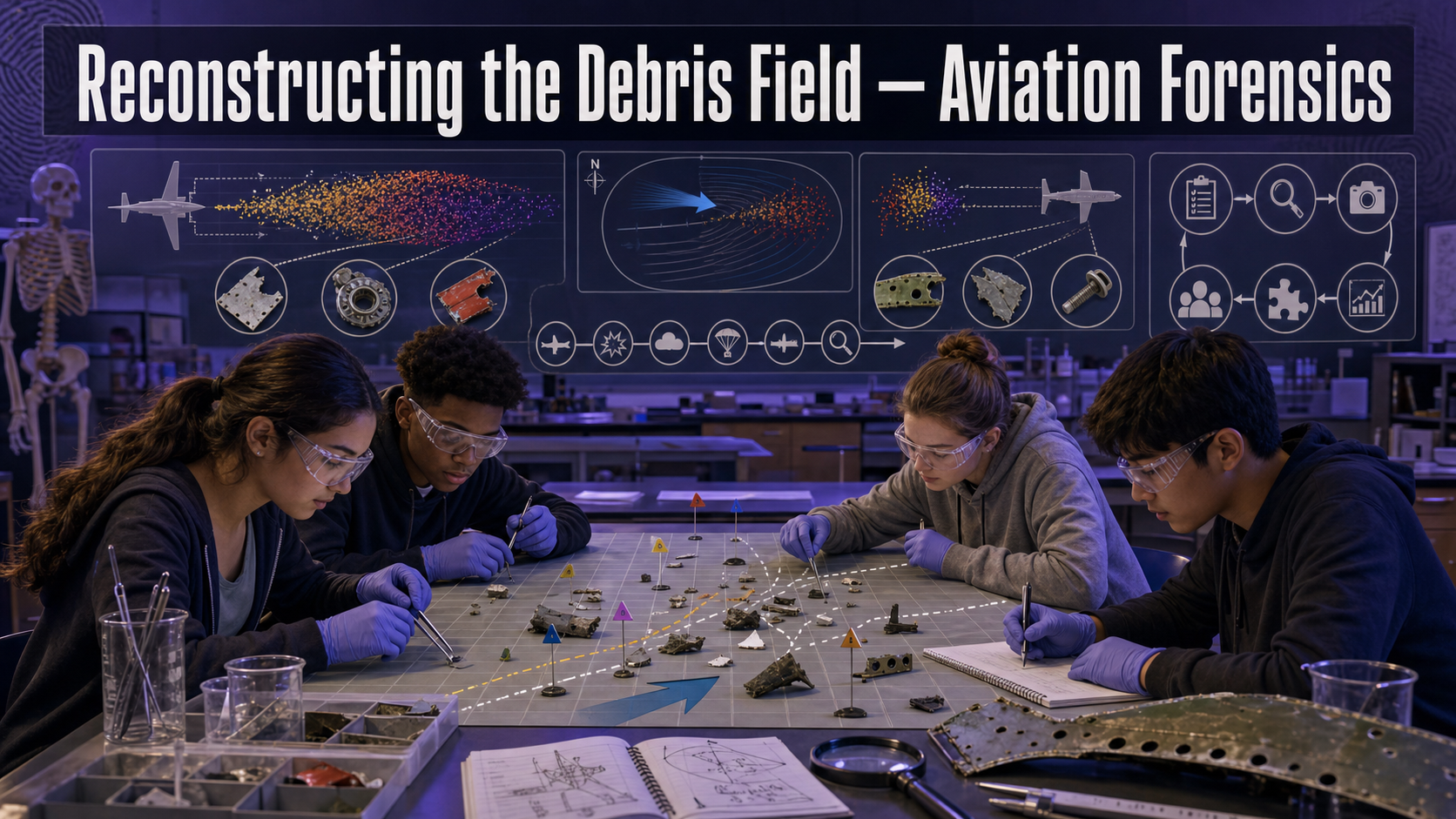
Reconstructing the Debris Field — Aviation Forensics
Welcome, Investigators!

An aircraft accident scatters its own story across the ground — and reading that scatter is one of the most demanding jobs in all of forensics. This is a capstone investigation: you'll classify a debris field, sequence the wreckage, follow the flight path, and run the same workflow a real crash team uses. Take your time. Follow the evidence!
The Case
An aircraft has gone down. Investigators arrive to a field of wreckage spread across the landscape, radar and ADS-B track logs from the final minutes, and a set of witness reports. The central question every crash investigation must answer: what was the probable cause?
Your team will work it the way the professionals do. First, read the debris field — a tightly clustered scatter and a long, strung-out one tell very different stories. Then sequence the wreckage to infer what came apart first. Fold in the flight-path data. Finally, run the NTSB party-system workflow end to end and commit to a probable-cause hypothesis you can defend. There is no "case closed" until every stage agrees.
Learning Objectives
By the end of this investigation you will be able to:
- Distinguish an in-flight breakup from an intact impact using debris scatter.
- Sequence wreckage to infer the order in which the aircraft came apart.
- Integrate radar / ADS-B flight-path data into a probable-cause hypothesis.
- Evaluate a crash using the NTSB party-system workflow end to end.
Quick Facts
| Lab type | 💻 Virtual (capstone-scale) |
| Group size | 3–4 investigators (assign NTSB roles) |
| Time | 70–90 minutes (or two class periods) |
| Cost | $0 — computer-based |
| Ties to | Ch 19 — Debris Field Analysis, In-Flight Breakup vs. Intact Impact, Wreckage Reconstruction, Radar/ADS-B Path Reconstruction, Probable Cause, NTSB Party System |
Materials
Per group:
- None — a laptop and a browser.
- The instructor's provided crash dossier: debris-field scatter data, the ADS-B track log, and witness statements.
- Assumes access to one computer per group.
Hold the Hypothesis Loosely

- Real crash investigations take months to years. Never rush to a single cause — early theories that ignore contradicting evidence are how mistakes get made.
- Aviation forensics reports a probable cause, not a certainty. State your hypothesis as the best explanation of all the evidence, and name what could still change it.
- Treat this as a serious professional exercise. Real accidents involve real loss; the discipline here is respect for the evidence and the people affected.
Background: The Ground Remembers the Sky
When an aircraft crashes intact — flying into terrain in one piece — it tends to leave a concentrated debris field: a tight, high-energy scatter near a single impact point. When an aircraft breaks up in flight, pieces separate at altitude and fall along the flight path, producing a long, strung-out debris field that can stretch for kilometres. The shape of the scatter is the first big clue to what happened.
Within the field, the distribution of specific parts refines the story. Components that separated first fall earliest and land farthest back along the track; the heaviest, most-intact structure often travels farthest forward. By mapping which pieces landed where, investigators sequence the break-up — reconstructing the order in which the aircraft failed. This physical scatter is then cross-checked against radar and ADS-B data, which records the aircraft's position, altitude, and speed second by second in its final minutes.
No single investigator owns the answer. The NTSB party system brings together parties with technical knowledge — the operator, the manufacturer, and others — under NTSB coordination, each contributing expertise while the NTSB alone determines the probable cause. Your team will move through three stages that mirror this process: field analysis → workflow roles → timeline synthesis.
Stage 1 — Explore: The Debris-Field Pattern Explorer
Debris-Field Pattern Explorer Interactive MicroSim
Type: microsim
sim-id: debris-field-pattern-explorer
Library: p5.js
Status: Specified
Learning Objective: Classify a debris scatter as in-flight breakup versus intact impact and infer break-up order from part distribution (Bloom Level 4 — Analyze).
Study the scatter. Is it concentrated (intact impact) or strung out (in-flight breakup)? Note which parts landed farthest back along the path — those likely separated first. This classification anchors everything that follows.
Stage 2 — Explore: The NTSB Investigation Workflow
NTSB Investigation Workflow Interactive MicroSim
Type: microsim
sim-id: ntsb-investigation-workflow
Library: p5.js
Status: Specified
Learning Objective: Trace the NTSB party-system workflow and identify each party's role in reaching a probable cause (Bloom Level 3 — Apply).
Walk the workflow and assign your team to the roles — operator, manufacturer, systems, structures, and the NTSB coordinator who owns the final finding. Notice how each party contributes evidence but only the NTSB determines probable cause.
Stage 3 — Explore: The Aviation Crash Investigation Timeline
Aviation Crash Investigation Timeline Interactive MicroSim
Type: microsim
sim-id: aviation-crash-investigation-timeline
Library: p5.js
Status: Specified
Learning Objective: Synthesize debris, flight-path, and witness data into a single sequenced timeline supporting a probable-cause hypothesis (Bloom Level 5 — Synthesize/Evaluate).
Lay the ADS-B track, the debris sequence, and the witness reports on one timeline. Where they all point the same way, you have the spine of your probable cause. Where they conflict, you have the questions your report must resolve.
Procedure
Part 1 — Classify the field.
- Open the debris-field explorer. Measure how spread out the scatter is and record it: concentrated or strung-out?
- State your first classification: in-flight breakup or intact impact, and the specific scatter feature that supports it.
- Note which components landed farthest back — candidates for what failed first.
Part 2 — Sequence and correlate.
- Using part distribution, propose the order in which the aircraft came apart.
- Overlay the ADS-B / radar track. Find the point on the path where altitude or speed changed abruptly and check whether it lines up with your break-up point.
- Add the witness reports to the timeline. Do they corroborate the where and when of the break-up, or conflict?
Part 3 — Run the NTSB workflow and conclude.
- Assign NTSB party roles across your team and step through the workflow.
- Each role reviews the evidence from their angle and contributes one finding.
- As a team, synthesize a single probable-cause hypothesis — and explicitly list the evidence for it and the one piece that could still overturn it.
Data Collection
| Evidence stream | Key observation | What it suggests |
|---|---|---|
| Debris scatter shape | ||
| Part distribution / sequence | ||
| ADS-B / radar track | ||
| Witness statements | ||
| Combined timeline |
Analysis Questions
- Was this an in-flight breakup or an intact impact? Cite the debris-field feature that most strongly supports your classification.
- What was the likely order of the break-up, and how did part distribution let you infer it?
- Where does the ADS-B track agree with your debris sequence, and where (if anywhere) does it disagree? How do you resolve the disagreement?
- In the NTSB party system, why does having the operator and manufacturer at the table strengthen the investigation — and why does only the NTSB get to declare probable cause?
- State your team's probable-cause hypothesis in one sentence, then name the single piece of new evidence that would most change your conclusion.
Deliverable
Turn in a Probable-Cause Report structured like an NTSB finding: (1) the debris- field classification with its evidence, (2) the reconstructed break-up sequence, (3) the correlation with flight-path data, (4) the party findings, and (5) a clearly stated probable-cause hypothesis with its supporting evidence and its biggest remaining uncertainty. Include your combined timeline.
What Does the Data Tell Us?

The strongest crash reports aren't the ones that sound the most certain — they're the ones where the debris, the flight path, and the witnesses all point the same direction, and the investigator says plainly what would change their mind. Convergence is confidence. A lone clue is just a lead.
Extension Challenge: The Black Box Speaks
Real investigations add two more streams you didn't have: the Flight Data Recorder (thousands of parameters) and the Cockpit Voice Recorder. Research what each records, then write a short plan: if the recorders arrived tomorrow, which parts of your probable-cause hypothesis would you test first, and what result would confirm — or break — it?
Teacher Notes
Setup, timing, and grading (click to expand)
- Prep: Assemble a crash dossier: a debris scatter (choose intact-impact or in-flight-breakup on purpose), an ADS-B track with one abrupt change, and 2–3 witness statements (include one that partly conflicts, to force resolution). Budget two class periods for the full capstone; one period covers Stages 1–2.
- Assign the roles. The NTSB party system only lands if each student owns a role and reports from that viewpoint. Rotate a coordinator who reconciles the findings.
- Differentiation: For a shorter run, provide the debris classification and have teams do only sequencing + timeline. For a challenge, hand two groups the same dossier with different witness sets and compare their hypotheses.
- Assessment focus: Reward convergence reasoning (multiple streams agreeing), an explicit probable-cause statement, and honest acknowledgment of the remaining uncertainty — not a fast, overconfident single cause.
Case Closed — For Now

You read a story written across an entire landscape, checked it against the sky, and built a conclusion careful enough to defend. That's capstone-level work — the real thing, done with real discipline. Take a breath, investigators. Follow the evidence!