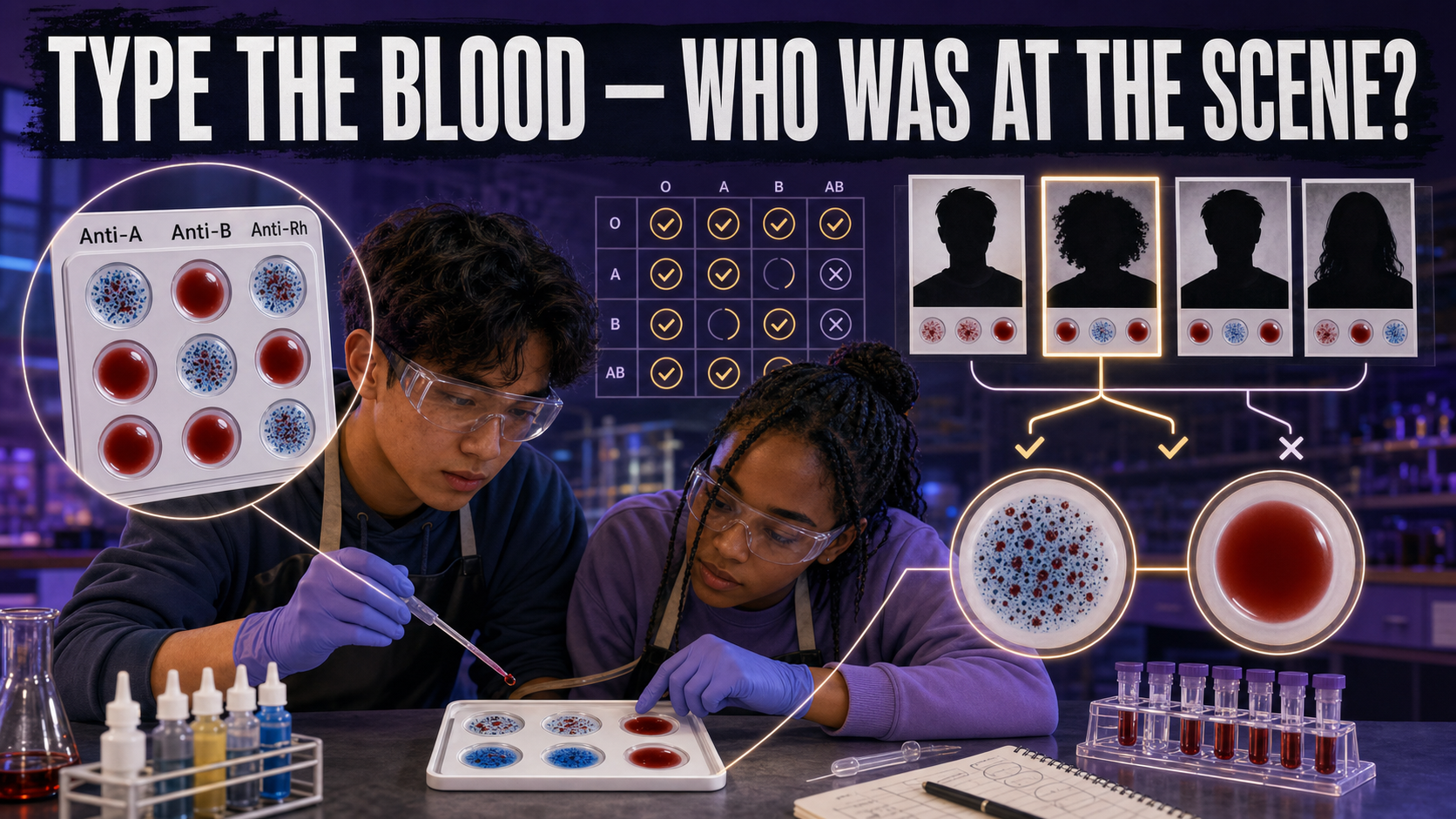
Type the Blood — Who Was at the Scene?
Welcome, Investigators!

A single drop of dried blood on a windowsill is about to narrow four suspects down to one. You won't do it by matching a name — blood can't do that. You'll do it by crossing suspects off the list until only the consistent one remains. Grab your typing tray. Follow the evidence!
The Case
A jewelry case was smashed during last night's gala and the thief cut their hand on the broken glass. Investigators recovered one blood stain from the scene. Four guests had the opportunity and no alibi:
- Ms. Ortega, who left early complaining of a "paper cut."
- Mr. Whitfield, whose sleeve had a fresh red smear.
- Dr. Kane, who wore a bandage on one thumb.
- Mr. Sato, who insists he never went near the case.
Your job: type the crime-scene stain and all four suspects with a simulated blood-typing kit, then answer the question the detective needs settled — whose blood type is consistent with the stain, and whom can you exclude outright?
Learning Objectives
By the end of this investigation you will be able to:
- Explain how anti-A, anti-B, and anti-Rh sera reveal an unknown ABO/Rh type.
- Determine the blood type of an unknown sample by reading agglutination.
- Compare suspect types against a crime-scene stain to include or exclude.
- Justify why blood type excludes suspects far more powerfully than it identifies one.
Quick Facts
| Lab type | 🧪 Physical bench lab |
| Group size | 2–3 investigators |
| Time | 40–50 minutes |
| Cost | ≈ $35 per group (simulated kit — no biohazard) |
| Ties to | Ch 6 — ABO Blood Typing, Rh Factor, Agglutination Chemistry, Blood Composition |
Materials
Per group (≈ $35):
- 1 simulated-blood ABO/Rh typing kit (synthetic "bloods" for four suspects + one scene stain)
- Simulated anti-A, anti-B, and anti-Rh (anti-D) sera (in dropper bottles)
- White typing trays or spot plates with labeled wells
- Wooden toothpick stirrers (one per well — never reuse)
- Fine-tip marker and masking tape for labeling
- Paper towels and a waste cup
- Shared: a white light source or light box to read faint reactions
Safety & Fair-Test Rules

- Everything here is synthetic — no real blood — but wear goggles and treat the sera like any lab chemical. Wipe spills, wash hands after.
- Use a fresh toothpick for every well. One reused stirrer can carry anti-A into a "B" well and hand you a false AB result.
- Add sera in the same order for every sample. Sloppy technique, not the blood, is the number-one cause of a wrong type.
Background: Reading Blood Without a Name Tag
Your red blood cells wear tiny molecular flags called antigens. In the ABO system, type A cells carry the A antigen, type B carry B, type AB carry both, and type O carry neither. A separate flag, the Rh (D) antigen, makes you "positive" if present and "negative" if absent. Nobody can see these flags directly — so we make them show themselves.
The trick is agglutination: clumping. When you add anti-A serum to blood that carries the A antigen, the antibodies latch onto the A flags and drag the cells into visible clumps. No matching antigen, no clumping — the drop stays smooth. So a sample that clumps with anti-A but not anti-B is type A; one that clumps with both is AB; one that clumps with neither is O. Add anti-Rh the same way to settle positive or negative.
Here's the catch that makes this forensic science and not magic: type O-positive is the most common type on Earth — over a third of people. If the stain is O-positive, you have not found the person; you have found a huge group the person belongs to. Blood type is class evidence. It excludes suspects with certainty (a type-A person did not leave a type-B stain) but it never identifies one by itself. Meet the reaction before you run the kit.
Explore: ABO Blood Typing
ABO Blood Typing Interactive MicroSim
Type: microsim
sim-id: abo-blood-typing
Library: p5.js
Status: Specified
Learning Objective: Determine an unknown ABO/Rh blood type by interpreting agglutination reactions with anti-A, anti-B, and anti-Rh sera (Bloom Level 3 — Apply).
Test each blood type against the three sera and watch which wells clump. Build yourself a mental key — which pattern of clumping means A, B, AB, or O — before you touch a real toothpick.
Procedure
Part 1 — Set up the trays.
- Label five typing trays: SCENE, Ortega, Whitfield, Kane, Sato.
- On each tray, label three wells: Anti-A, Anti-B, Anti-Rh.
- Place one drop of that sample's simulated blood in each of its three wells.
Part 2 — Add the sera and read the clumps.
- To the Anti-A well add one drop of anti-A serum; to Anti-B add anti-B; to Anti-Rh add anti-Rh. Keep the order identical for every tray.
- Stir each well with its own fresh toothpick for a few seconds.
- Wait 30–60 seconds, then read against the light. Clumping / grainy = positive reaction; smooth = negative. Record each well.
Part 3 — Type and compare.
- From the three reactions, write the full type for each sample (e.g. clumps in Anti-A and Anti-Rh only = A positive).
- Compare each suspect's type to the SCENE type. Mark each suspect consistent (same type) or excluded (different type).
Data Collection
Record + for clumping, − for smooth. Then write the type.
| Sample | Anti-A | Anti-B | Anti-Rh | Blood type | Consistent with SCENE? |
|---|---|---|---|---|---|
| SCENE | — | ||||
| Ortega | |||||
| Whitfield | |||||
| Kane | |||||
| Sato |
Analysis Questions
- What is the crime-scene stain's blood type, and which three reactions did you use to determine it?
- Which suspects can you exclude? For one of them, name the specific reaction that rules them out.
- Which suspect(s) are consistent with the stain? Can blood typing alone prove that person is the thief? Explain.
- Suppose the scene stain typed O positive. Roughly a third of people are O positive. What does that do to the strength of your conclusion, and what evidence would you request next?
- A team reused one toothpick between the Anti-A and Anti-B wells and got an "AB" result. Explain how contamination produced a false type.
Deliverable
Turn in a one-page Serology Report listing all five blood types, the suspects you exclude (with the reaction that excludes each), the suspect(s) consistent with the stain, and one sentence stating clearly what blood-type evidence can and cannot prove in this case. Attach your completed data table.
What Does the Data Tell Us?

Notice what just happened: your strongest, most certain results were the exclusions. "Consistent with" only shrinks the crowd — it never points to one face. The best investigators lead with what the evidence rules out, then ask for more. Every clue matters.
Extension Challenge: The Missing Suspect
A fifth suspect appears, but their sample is contaminated and won't type. Given the four types you already have and the scene type, could a new suspect of any type change your conclusion? Design a two-line rule your team could hand police for deciding when blood type is worth collecting at all.
Teacher Notes
Setup, timing, and grading (click to expand)
- Prep: One class-size simulated ABO/Rh kit (Carolina / Home Science Tools) covers several groups. Pre-fill and label the five "blood" bottles so groups spend time reading reactions, not decanting. Set the SCENE stain equal to exactly one suspect and make the other three genuinely different types so exclusions are clean.
- The teaching moment is the O-positive trap. If you want a harder run, make two suspects share the scene type — now blood typing cannot pick between them and students must say so. That honesty is the assessment.
- Differentiation: For a shorter lab, type only ABO (skip Rh). For a challenge, add a suspect whose type matches the scene to force the "consistent ≠ guilty" conclusion.
- Assessment focus: Reward correct reading of agglutination, correct exclusions with the specific reaction cited, and — most of all — students who refuse to call a consistent type a match.
Case Closed — For Now

You turned an invisible molecular flag into a courtroom-ready statement about who was — and wasn't — at that jewelry case. And you did it the honest way: by ruling people out, not by overselling a match. That's real serology. Follow the evidence!