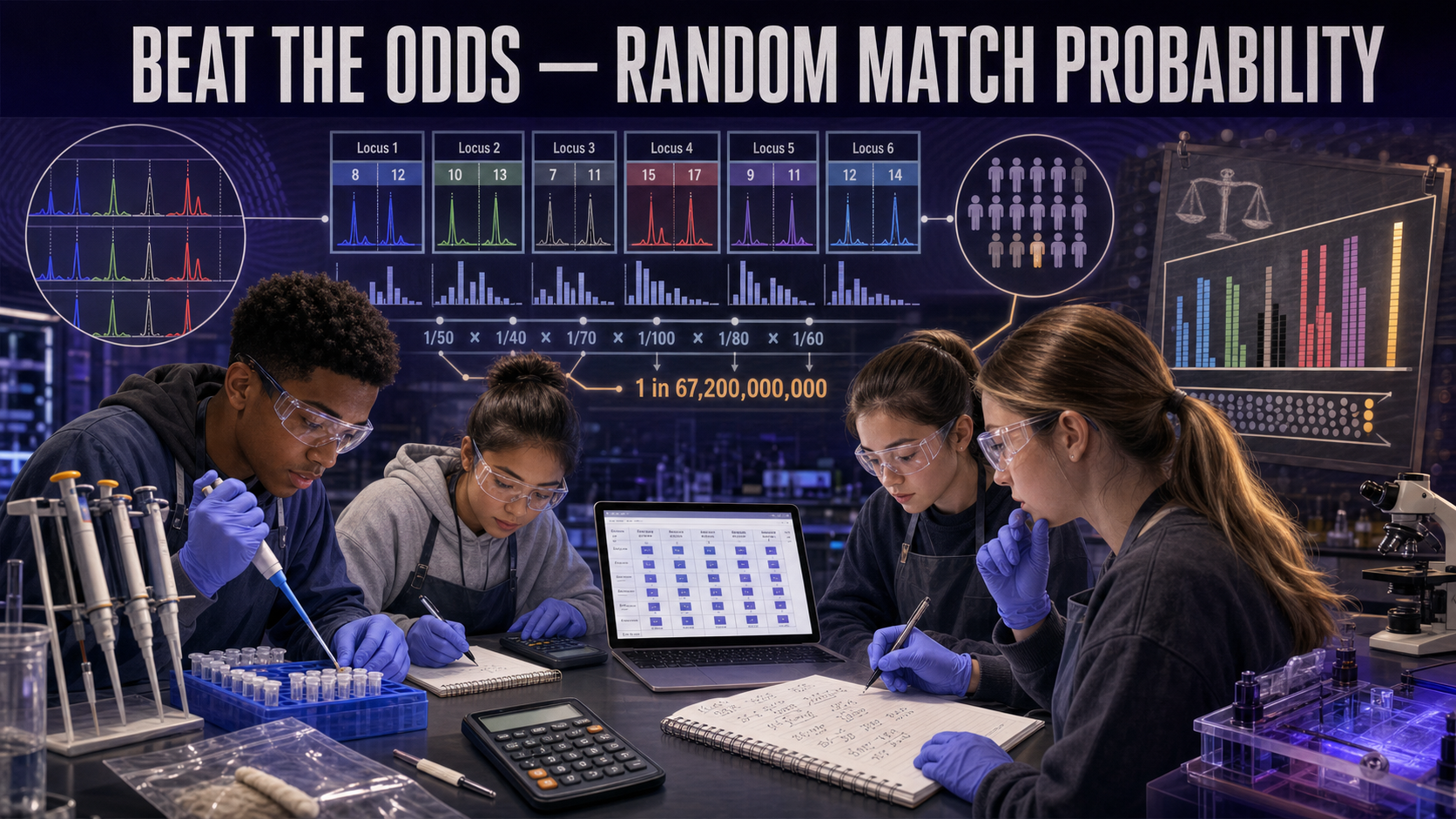
Beat the Odds — Random Match Probability
Welcome, Investigators!

The lab found a DNA match. Now the defense attorney stands up and says, "Lots of people share that profile." Are they right? Today you'll do the math that answers that question — and learn how a single number can turn a match into the most powerful evidence in the room. Follow the evidence!
The Case
A burglary left a bloodstain on a broken window. The crime lab developed a DNA profile from the stain and found that it matches the profile of the defendant, J. Rivera, at every locus tested. The prosecution says the match is overwhelming. The defense fires back:
"A match isn't proof. Thousands — maybe millions — of people could have this same profile. My client just happens to be one of them."
You are the prosecution's expert witness. Your job is not to declare Rivera guilty — that's the jury's call. Your job is to calculate the random match probability (RMP): the chance that a random, unrelated person would share this exact profile by coincidence. Then you must explain that number to a jury in plain English, honestly and without overstating it.
Learning Objectives
By the end of this investigation you will be able to:
- Explain why alleles at independent loci let us multiply frequencies.
- Apply the product rule to calculate a random match probability across multiple loci.
- Analyze how each added locus changes the RMP on a logarithmic scale.
- Evaluate what "1 in 7 billion" does and does not tell a jury, avoiding the prosecutor's fallacy.
Quick Facts
| Lab type | 💻 Virtual |
| Group size | 1–2 investigators (one computer each) |
| Time | 40–50 minutes |
| Cost | $0 (needs a computer or tablet) |
| Ties to | Ch 8 — Random Match Probability, Product Rule, DNA Alleles, Homozygous vs Heterozygous, DNA Database Searching |
Materials
Per investigator (no consumables):
- A computer or tablet with a web browser
- The Random Match Probability MicroSim (embedded below)
- The Evidence Card of allele frequencies (provided by your teacher)
- A calculator that shows scientific notation (or a phone calculator)
- Your lab notebook for the courtroom statement
Beware the Prosecutor's Fallacy

The RMP is the chance that a random person matches — it is not the chance the defendant is innocent. Swapping those two ideas is a famous courtroom mistake called the prosecutor's fallacy. Say exactly what the number means, and never a word more.
Background: Why We Multiply
A DNA profile isn't one measurement — it's a set of results from many different loci (locations on the DNA). At each locus a person inherits two alleles, one from each parent. Some allele combinations are common in the population; some are rare. Population geneticists have measured how often each allele shows up, and those numbers are printed on your Evidence Card.
Here's the key idea. Because the loci used in forensic testing sit on different chromosomes (or far apart on the same one), the genotype you inherit at one locus is independent of the genotype at another — knowing one tells you nothing about the next. When two events are independent, the probability of both happening is the product of their separate probabilities. That is the product rule: multiply the per-locus frequencies together to get the frequency of the whole profile.
For a heterozygous locus (two different alleles, frequencies p and q), the genotype frequency is 2pq. For a homozygous locus (two copies of the same allele, frequency p), it is p². One locus might match roughly 1 in 10 people — not impressive on its own. But multiply a dozen such loci together and the profile frequency collapses toward one in billions. Watch it happen.
Explore: The Random Match Probability Calculator
Random Match Probability Product-Rule Interactive MicroSim
Type: microsim
sim-id: rmp-product-rule
Library: p5.js
Status: Specified
Learning Objective: Apply the product rule across independent loci to calculate a DNA profile's random match probability and interpret it against population size (Bloom Level 3 — Apply).
Toggle loci in and out with the checkboxes and watch the running product shrink on a log scale. Notice how the RMP reads three ways — as a fraction, as "1 in X," and compared to the U.S. and world populations. That last comparison is the one a jury actually feels.
Procedure
Part 1 — Read the profile.
- Open your Evidence Card. It lists each locus, the defendant's genotype at that locus, and the population frequency of each allele.
- For every locus, decide whether it is heterozygous (two different alleles) or homozygous (two identical alleles). Write "het" or "hom" next to each row.
Part 2 — Calculate locus by locus.
- For each heterozygous locus, compute the genotype frequency as 2 × p × q. For each homozygous locus, compute p². Record each result.
- In the MicroSim, turn on just the first locus and confirm your hand calculation matches the sim's value.
- Add the loci one at a time. After each one, record the running RMP from the sim. Watch the number plummet.
Part 3 — Multiply and interpret.
- With all loci switched on, read the final RMP as a fraction and as "1 in X." This is your profile frequency.
- Compare that "1 in X" to the world population (~8 billion). How many random, unrelated people on Earth would you expect to share this profile?
- Draft a one-paragraph courtroom statement of the result in plain English.
Data Collection
Fill in one row per locus, then complete the summary line.
| Locus | Genotype | Het or Hom? | Allele freq(s) | Genotype frequency |
|---|---|---|---|---|
| 1 | ||||
| 2 | ||||
| 3 | ||||
| 4 | ||||
| 5 | ||||
| 6 |
| Final RMP (fraction) | Final RMP ("1 in X") | Expected matches on Earth |
|---|---|---|
Analysis Questions
- Why can you multiply the per-locus frequencies together? What assumption about the loci makes the product rule valid?
- Pick the single locus with the highest genotype frequency (the least rare). On its own, roughly how many people would match it? Why isn't one locus enough for court?
- The RMP dropped fastest when you added certain loci. What made those loci more powerful than others — common alleles or rare ones? Explain.
- Write the sentence you would say to the jury to describe your final RMP. Then write the wrong version that commits the prosecutor's fallacy, and explain the difference.
- Identical twins share the same STR profile. What does that tell you about the limits of an RMP, and how might a database search of many people change how you interpret a "1 in a billion" match?
Deliverable
Turn in your completed RMP worksheet (all loci, the running values, and the final number) plus a one-paragraph expert-witness statement written for a jury. The statement must (a) give the RMP three ways, (b) compare it to a population, and (c) state clearly what the number does not prove.
What Does the Data Tell Us?

A random match probability of 1 in 7 billion doesn't say Rivera is guilty — it says that if you grabbed a random stranger, the odds they'd match by pure chance are about the same as picking one specific person off the entire planet. Powerful, yes. Proof of guilt, no. That honesty is what makes an expert witness trustworthy.
Extension Challenge: The Relatives Problem
The product rule assumes the "random person" is unrelated to the defendant. Full siblings share far more DNA than strangers do. Research how forensic scientists calculate a separate, larger match probability for a close relative, and rewrite your courtroom statement to address a defense claim that "it could have been my brother."
Teacher Notes
Setup, timing, and grading (click to expand)
- Prep: Print one Evidence Card per investigator with 6–13 loci, each showing a genotype and realistic allele frequencies (0.05–0.30 works well). Vary the cards slightly so neighbors can't copy final answers.
- Math scaffold: Some students freeze at scientific notation. A quick warm-up multiplying three small fractions (1/10 × 1/8 × 1/12) before they touch the sim pays off. The MicroSim's log-scale bar does the heavy lifting once they trust it.
- The point is the interpretation. The calculation is arithmetic; the grade should reward the courtroom paragraph — correct RMP, honest framing, and a clean avoidance of the prosecutor's fallacy.
- Differentiation: For a shorter version, hand out pre-computed per-locus frequencies so students only multiply. For a challenge, require the relatives extension and a rebuttal to a defense expert.
- Assessment focus: Full credit goes to students who state precisely what the RMP means (chance a random person matches) and never claim it proves guilt or innocence.
Case Closed — For Now

You just turned a pile of allele frequencies into a number a jury can understand — and you were honest about its limits. That combination of rigor and restraint is exactly what a real DNA analyst brings to the witness stand. Beautifully argued, investigators. Follow the evidence!