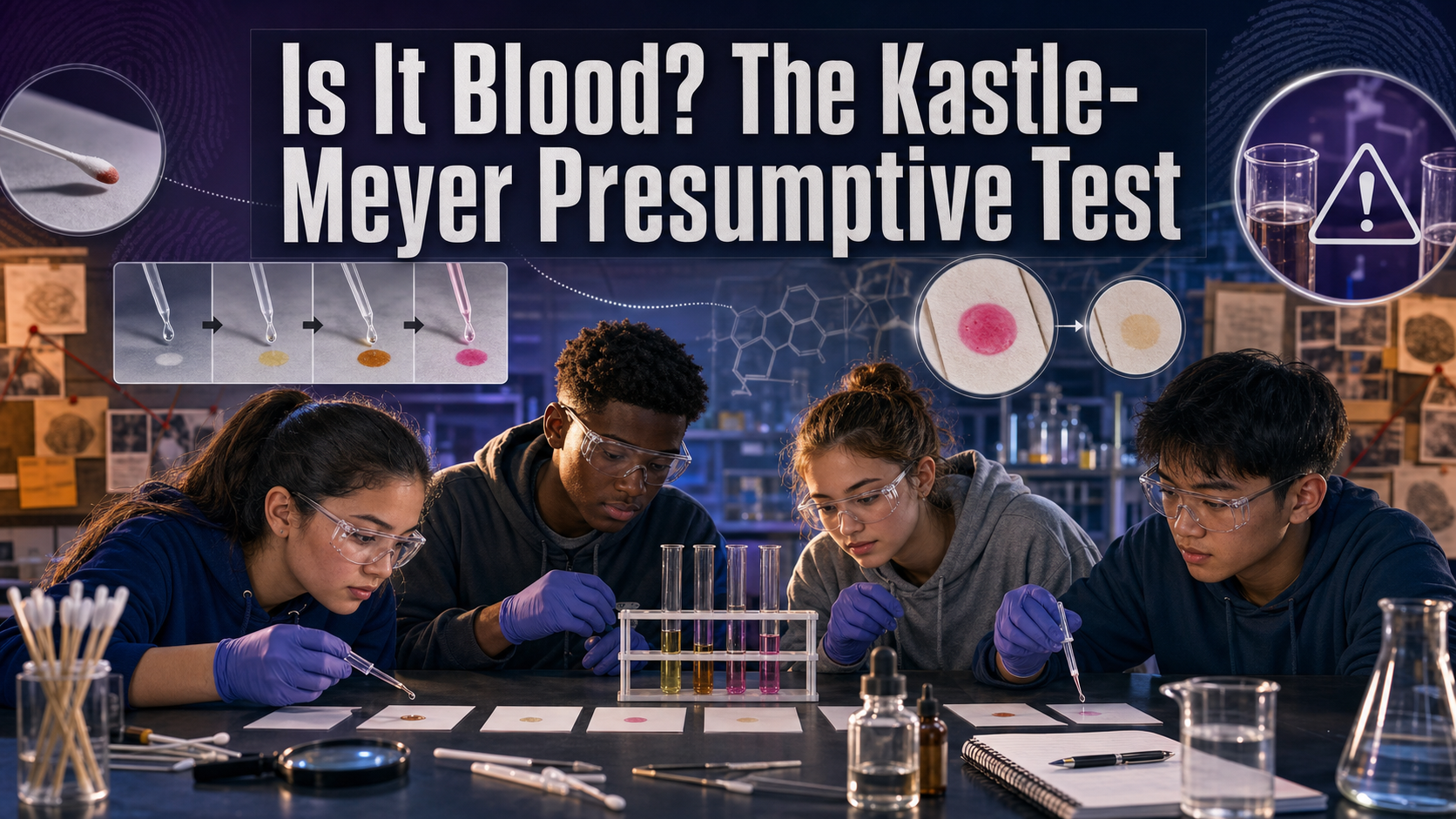
Is It Blood? The Kastle-Meyer Presumptive Test
Welcome, Investigators!

Four reddish-brown stains, and every one of them could be blood — or ketchup, or rust, or just an old juice spill. Before a lab spends money confirming anything, someone has to screen the stains fast and cheap. That's your job today, and the tool is a color that flashes pink in seconds. Goggles on. Follow the evidence!
The Case
A struggle was reported in the break room at Halden Logistics. When investigators arrived, they photographed four reddish-brown stains on items near the scene and need to know which ones are worth sending to the lab:
- Item A — a stain on a sleeve cuff.
- Item B — a smear on a metal shelf bracket.
- Item C — a drip on the break-room counter.
- Item D — a spot on a lunch bag.
A confirmatory DNA test is slow and expensive, so you can't send all four. Your job: run a presumptive test on each stain, decide which are possibly blood and which you can set aside, and — just as important — explain what a positive result does and does not prove.
Learning Objectives
By the end of this investigation you will be able to:
- Perform a Kastle-Meyer-style presumptive test on unknown stains.
- Interpret a rapid pink color change as a positive presumptive result.
- Explain the difference between a presumptive test (screens) and a confirmatory test (identifies), including the role of false positives.
- Evaluate which stains warrant confirmatory testing and justify why a presumptive positive is not proof of blood.
Quick Facts
| Lab type | 🧪 Physical bench lab |
| Group size | 2–3 investigators |
| Time | 40–50 minutes |
| Cost | ≈ $14 per group (consumables) |
| Ties to | Ch 6 — Presumptive Blood Tests, Kastle-Meyer Color Test, Confirmatory Tests; Ch 1 — Scientific Method: screening vs. confirmation |
Materials
Per group (≈ $14):
- Phenolphthalein indicator solution (reduced/Kastle-Meyer reagent), or a teacher-mixed KM kit
- 3% hydrogen peroxide
- Grated horseradish (peroxidase source) as the "blood" simulant
- Decoy stain makers: rust water, ketchup, and a fruit juice (e.g. cranberry or apple)
- Cotton swabs
- A white spot plate (or a white paper towel over a tray)
- Distilled water, plastic pipettes, labels
- Shared: gloves and goggles for every investigator
Safety & Substitution Rules

- No real blood is ever used. Your "blood" is a peroxidase simulant (grated horseradish), which triggers the same color chemistry safely.
- Wear goggles and gloves. Hydrogen peroxide and phenolphthalein reagent can irritate skin and eyes.
- Dispose of peroxide and used swabs per your district's policy — don't pour reagents down the drain unless your teacher says to.
Background: Screen First, Confirm Later
Forensic testing works in two stages, and today is all about stage one. A presumptive test is fast, cheap, and sensitive: it tells an investigator a stain might be blood so they don't waste a slow, expensive confirmatory test on a ketchup smear. A confirmatory test comes later and actually identifies the substance. Presumptive tests screen; they never prove.
The Kastle-Meyer test uses a chemical called phenolphthalein. Blood contains hemoglobin, and hemoglobin acts like an enzyme called a peroxidase: when hydrogen peroxide is added, hemoglobin speeds up a reaction that turns colorless phenolphthalein reagent a bright pink within seconds. A fast pink flash is a positive presumptive result. (In this lab, horseradish stands in for blood because it is loaded with the same peroxidase activity — no biohazard required.)
Here's the catch that makes this a screening test, not proof: other things also contain peroxidase or act like it. Horseradish, some other plants, certain fruits, and even chemical oxidizers like rust can trigger a pink result — a false positive. So a Kastle-Meyer positive means "consistent with blood; confirm it," never "this is blood." That distinction is the entire lesson.
Explore: Presumptive-Test Decision Tool
Pick a reddish-brown sample, run the presumptive test to watch peroxidase-active stains flash pink, then run the confirmatory test to see which "positives" were really blood — and which were false alarms.
Presumptive-Test Decision Tool Interactive MicroSim
Type: microsim
sim-id: presumptive-test-decision-tool
Library: p5.js
Status: Implemented
Learning Objective: Judge which stains warrant confirmatory testing and reason about false positives, distinguishing a presumptive screen from a confirmatory identification (Bloom Level 5 — Evaluate).
Procedure
Part 1 — Prepare and verify the test.
- Put on gloves and goggles. Set out the spot plate and label four wells A, B, C, D for the four unknown stains, plus a + control well and a – control well.
- In the + control well, swab a bit of the horseradish simulant. In the – control well, use plain distilled water. These prove your reagent works.
Part 2 — Run the Kastle-Meyer test.
- For each well, rub a damp swab on the stain, then touch the swab to the well.
- Add one drop of phenolphthalein reagent, wait a moment, then add one drop of hydrogen peroxide.
- Watch the timing. Record whether a pink color appears, and how fast (immediate = strong positive; slow/faint = weak; none = negative). The
- control should flash pink; the – control should stay colorless.
Part 3 — Decide and reason.
- Sort each unknown into "presumptive positive — confirm" or "negative — set aside."
- For every positive, write down what it could be besides blood (a possible false positive) based on the decoys on your bench.
Data Collection
| Well | Stain | Pink? (Y/N) | Speed (fast/slow/none) | Presumptive call | Possible false positive? |
|---|---|---|---|---|---|
| + control | horseradish | (should be +) | — | ||
| – control | water | (should be –) | — | ||
| A | sleeve cuff | ||||
| B | shelf bracket | ||||
| C | counter drip | ||||
| D | lunch bag |
Analysis Questions
- Which items gave a presumptive positive? Which would you send for confirmatory testing, and why not send all four?
- Why do the + and – controls matter? What would a pink – control tell you about your results?
- One of your decoys (rust, ketchup, or juice) may have turned pink. Explain how a false positive happens and why it does not mean the stain is blood.
- In your own words, state the difference between a presumptive and a confirmatory test. Where does each fit in the scientific method of screen-then-confirm?
- A TV detective declares "It's blood!" the instant a swab turns pink. Using today's results, explain what's scientifically wrong with that statement.
Deliverable
Turn in a one-page Screening Report: your presumptive call for each item, the control results that validate your test, which items you'd send for confirmation, and one clear sentence explaining why a pink result is consistent with blood but does not identify it. Attach your data table.
What Does the Data Tell Us?

A pink flash is a green light, not a verdict. It says "this stain earned a confirmatory test," nothing more. The best investigators are the ones who can say "presumptive positive — could be blood, could be a false positive, let's confirm." Getting that language exactly right is how wrongful conclusions get avoided.
Extension Challenge: Design a Confirmatory Follow-Up
A presumptive positive is only step one. Research a real confirmatory approach for blood — for example, a Takayama or Teichmann crystal test, or modern DNA/serology — and write a short plan for how you'd confirm your positives from today. What can the confirmatory test establish that Kastle-Meyer cannot, and why is it worth the extra time and cost?
Teacher Notes
Setup, timing, and grading (click to expand)
- Prep: Make the four "unknown" stains ahead of time and dry them: one true simulant (horseradish paste), and decoys of rust water, ketchup, and fruit juice — deliberately include at least one false-positive decoy (rust or horseradish decoy) so students meet a real screening pitfall. Pre-mix the KM/phenolphthalein reagent per your kit instructions.
- Absolutely no real blood. Horseradish reproduces the peroxidase color chemistry with zero biohazard. Emphasize this to students so the "blood" framing stays a model.
- Differentiation: For support, run the + and – controls as a whole-class demo first so students know what a true positive looks like. For a challenge, add an unlabeled "mystery" stain and require students to defend their call and name the confirmatory test they'd order.
- Assessment focus: Reward correct control interpretation, correct presumptive calls, and — most of all — students who articulate presumptive vs. confirmatory and acknowledge false positives. A student who calls a positive "proof of blood" has missed the core objective.
Case Closed — For Now

You screened four stains, caught a false positive, and knew better than to call any of them "blood" without confirmation. That careful, two-stage thinking — screen first, confirm second — is exactly how real serology keeps the innocent out of the courtroom. Follow the evidence!