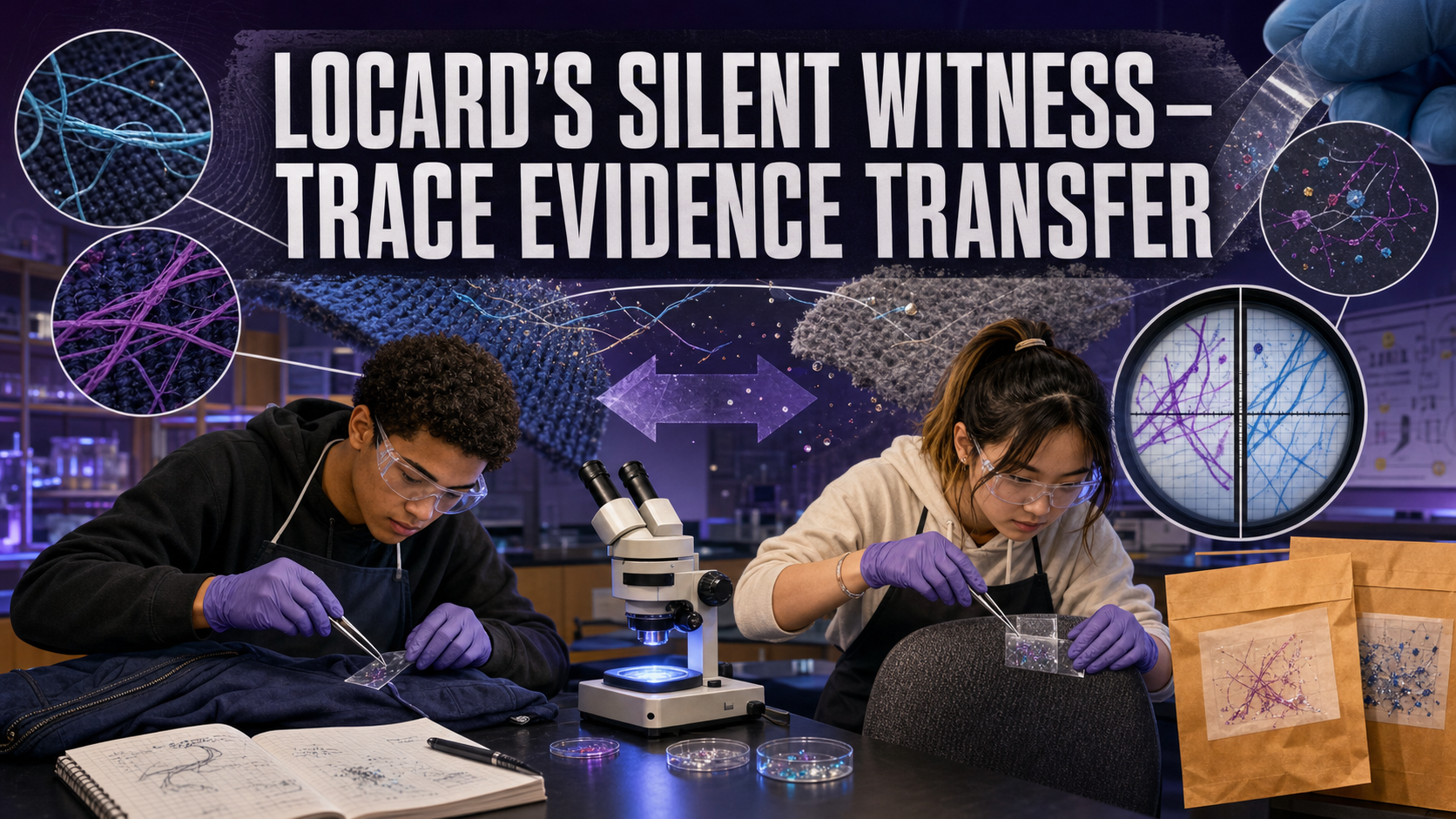
Locard's Silent Witness — Trace Evidence Transfer
Welcome, Investigators!

Somebody leaned against the wrong thing at the wrong time — and they have no idea what they left behind. In this investigation you'll prove the most important rule in all of forensic science: every contact leaves a trace. Grab your tape and your magnifier. Follow the evidence!
The Case
Last night someone leaned against the freshly cleaned display case in the school museum and pocketed a rare coin. The case was wiped spotless beforehand, so anything on it now was left by the thief. Three suspects were in the building:
- Suspect A wore a red fleece jacket.
- Suspect B wore a wool scarf.
- Suspect C carried a folder dusted with craft glitter from art class.
Your job: examine the "display case" surface, recover the trace evidence, and decide which suspect made contact — using evidence, not the story.
Learning Objectives
By the end of this investigation you will be able to:
- Explain Locard's Exchange Principle in your own words.
- Recover trace evidence from a surface using a tape lift.
- Document the two-way (bidirectional) transfer between two objects.
- Use recovered trace evidence to include or exclude a suspect.
Quick Facts
| Lab type | 🧪 Physical bench lab |
| Group size | 2–3 investigators |
| Time | 40–50 minutes |
| Cost | ≈ $18 per group (consumables) |
| Ties to | Ch 1 — Locard Exchange Principle, Ch 2 — Trace Evidence & Collection, Ch 4 — Class Evidence |
Materials
Per group (≈ $18):
- Clear packing tape + white index cards (for tape lifts)
- 1 red fleece glove or fabric square
- 1 wool scarf or wool yarn
- Craft glitter
- A small handful of pet fur or craft fur
- 5× hand magnifiers or loupes
- Tweezers
- A black construction-paper "display case" mat
- Shared: one classroom compound microscope for the reveal
Safety & Fair-Test Rules

- Wipe the mat clean before every trial — a contaminated scene is a ruined scene.
- Handle tape lifts by the edges only. Your own sleeve is now a source of contamination.
- No eating the glitter. Yes, Trace has to say it every year.
Background: The Principle That Started It All
In the early 1900s, French scientist Edmond Locard argued that a criminal always brings something to a scene and always takes something away. We now call this Locard's Exchange Principle, and it is the reason trace evidence exists at all.
The transfer goes both ways. If a suspect's wool scarf brushes the display case, wool fibers move onto the case — and microscopic traces from the case move onto the scarf. A good investigator looks for both halves of the exchange. Fibers, hairs, and glitter are class evidence: they can tell you a suspect is consistent with the scene, and they can exclude a suspect outright, but they rarely identify one single person by themselves.
Before you touch anything, meet the principle in action.
Explore: The Locard Exchange Visualizer
Locard Exchange Visualizer Interactive MicroSim
Type: microsim
sim-id: locard-exchange-visualizer
Library: p5.js
Status: Specified
Learning Objective: Demonstrate that contact between two surfaces produces a two-way transfer of trace material (Bloom Level 2 — Understand).
Drag one object against another and watch material move in both directions. Notice how a longer, firmer contact transfers more material — a clue you'll use in the analysis.
Procedure
Part 1 — Stage the exchange (the "crime").
- One team member is the Scene Keeper. Wipe the black mat completely clean.
- A second member is the Suspect. Without the analysts watching, press one suspect object (fleece, wool, or glitter folder) firmly against the mat for five seconds. Set it aside in a labeled bag.
- The Scene Keeper seals the mat — this is now your protected crime scene.
Part 2 — Recover the trace evidence.
- Press a strip of clear tape onto the mat, lift it, and stick it to a white index card. Label it "SCENE."
- Take a tape lift from each of the three suspect objects and label them A, B, and C. These are your knowns.
Part 3 — Compare.
- Examine every tape lift with a magnifier, then under the microscope.
- Record what you see: fiber color, thickness, curl, and any glitter or fur.
- Look for the two-way match — the material on the SCENE lift should also appear on exactly one suspect's lift, and trace from the mat should appear on that suspect's object.
Data Collection
Fill in one row per tape lift.
| Lift | Fibers seen (color / type) | Glitter? | Hair/fur? | Matches SCENE? |
|---|---|---|---|---|
| SCENE | — | |||
| Suspect A (fleece) | ||||
| Suspect B (wool) | ||||
| Suspect C (glitter) |
Analysis Questions
- Which suspect's known lift best matches the SCENE lift? Cite two observations that support your conclusion.
- Give one piece of evidence that lets you exclude a different suspect.
- Describe the second half of the exchange — what would you expect to find on the suspect's object that came from the mat?
- Fibers are class evidence. Explain why matching fibers alone would not be enough to convict in a real courtroom.
- Where in your procedure was contamination most likely to sneak in, and how did you guard against it?
Deliverable
Turn in a one-page Trace Evidence Report that states which suspect you include, which you exclude, and the two-way evidence that supports each decision. Attach your labeled tape-lift cards.
What Does the Data Tell Us?

A match makes a suspect consistent with the scene — not automatically guilty. The strongest reports say exactly what the evidence can prove and are honest about what it can't. That precision is what separates a real investigator from a TV detective.
Extension Challenge: The Double Transfer
Design a trial where two suspects touch the mat. Can your team still tell them apart from a single SCENE lift? What extra documentation would you need to keep their contributions straight? Write a short plan and test it.
Teacher Notes
Setup, timing, and grading (click to expand)
- Prep: Pre-cut tape strips and index cards. Pre-load each suspect object with a distinct, easy-to-see trace (bright fleece, dark wool, chunky glitter) so microscope time stays short.
- The reveal: Keep the "which object touched the mat" answer in a sealed envelope. Groups commit to a conclusion before opening it — this rewards evidence over guessing.
- Differentiation: For a quicker version, skip the microscope and judge with magnifiers only. For a challenge, add a decoy object with fibers similar to a real suspect's.
- Assessment focus: Reward students who describe both directions of transfer and who correctly distinguish inclusion from identification.
Case Closed — For Now

You just used a 100-year-old principle to catch a thief. Every fiber, every hair, every fleck of glitter was a silent witness waiting for someone patient enough to look. That someone is you. Follow the evidence!